Knowledge Management Systems in
      Electronic Business
         Management & e-business


             DR. NEZAR SAMI, ESLSCA 34C

                   October 23, 2011
            Authored by: Ahmed Adel Kamel
Table of contents:
Table of contents: ............................................................................................................................ 1
List of figures: .................................................................................................................................. 2
List of tables: ................................................................................................................................... 2
               Executive Summary ......................................................................................................... 3
               Abstract ........................................................................................................................... 4
               INTRODUCTION ............................................................................................................... 4
What is knowledge? ........................................................................................................................ 4
Knowledge management ................................................................................................................ 5
Why do organizations need Knowledge management ................................................................... 7
Knowledge management process: .................................................................................................. 8
Biggest difficulties to successfully managing knowledge in organizations: .................................. 10
e-Business Development and Knowledge Management .............................................................. 10
KM and real business application from your working environment. ............................................ 12
Conclusion ..................................................................................................................................... 12
REFERENCES .................................................................................................................................. 12
List of figures:
Figure Description                                                         Page
Figure 1 (NASA KM roadmap)                                                 8
Figure 2 KM Success Factors                                                9
Figure 3 Biggest difficulties to successfully manage knowledge             11
Figure 4 (Position KM Process Perspective within E-Business Development)   12

Figure 5Developing e-BusinessSystems based onKnowledgeManagementProcess    13
Perspective


List of tables:
Table Description                                                          Page
Table 1 Sharing and Using Knowledge                                        9
Executive Summary
Knowledge management is a strategic initiative essential for any corporation mission success. As
a rising retirement rate diminishes the size of the workforce, the organization’s ability to protect
– and effectively utilize – its intellectual capital is similarly diminished. A lack of critical
knowledge negatively impacts an organization’s ability to make effective decisions in a timely
manner. This limitation also inhibits organizations from being able to successfully execute their
program on time, as well as being able to stay within the program’s budgetary limits. One
assessment of this dilemma comes from the Aberdeen Group, who says, “Knowledge workers
today are losing productivity in an endless search for information they know resides in the
organization but is not easily accessible.” By implementing an enterprise knowledge
management strategy coupled with an effective knowledge framework, the organization can
distribute this critical program knowledge to widely dispersed stakeholders. This flexibility
enables teams to continuously understand the interdependencies and consequences of
changing requirements and changing environments across the life of the entire program/
project. However, data by itself is only representative of a single point in time with no
understanding of that data’s relationships or how it can be used for decision making. By being
able to fully comprehend all aspects of organization knowledge (i.e., its lifecycle), knowledge
workers can employ this information more effectively during the decision making process. This
approach allows end users to understand organization knowledge as a whole so that they can
ascertain its patterns and develop additional knowledge about how to use this information on a
best practice basis. In turn, these knowledge management techniques enable organizations to
make informed decisions that improve the likelihood of success

What is “knowledge management”? Knowledge management is getting the right information to
the right people at the right time, and helping people create knowledge and share and act upon
information in ways that will measurably improve the performance of the corporation and its
partners. This means providing access to information at the time people need it to make the
best decisions possible for mission safety and success. It means
        Providing an engineer the history of design decisions on previous projects
        Giving a project manager access to the best risk management practices and tools when
        he or she needs them
        Providing the time for a senior scientist to mentor a promising young star

Some of this can be accomplished through clever information technology solutions. The larger
part of this relates to capturing the tacit knowledge of our workforce and effecting cultural
changes that will encourage people to share what they know.
There are three goals where KM activities can help corporation’s ability to deliver its missions
1. To sustain the corporation’s knowledge across missions and generations, KM activities will
identify and capture the information that exists across the organization.
2. To help people find, organize, and share the knowledge we already have, KM implementations
will help to efficiently manage the Agency’s knowledge resource.
3. To increase collaboration and to facilitate knowledge creation and sharing, KM teams will
develop techniques, tools, venues, and facilities to enable teams and communities to collaborate
across the barriers of time and space In realizing these goals, some of the specific near-term
objectives should include capturing key employee knowledge, managing the information
resources organization already have, and creating ways for remote teams to work
collaboratively. The knowledge management efforts are envisioned as a coordinating function
that encompasses implementation responsibilities that might be necessary to “fill the gaps” that
exist between organizations.


Abstract
The focus of this paper is proposing a framework for developing e-Business systems based on
knowledge management (KM) process perspective. In past, developing e-Business systems were
often given priority according to technical criteria rather than business imperatives. “Technology
for technology’s sake” problem tends to be a business phenomenon. The study tries to give
some ideals for building e-Business systems based on KM process perspective and expects that
the viewpoint will facilitate the company using IT to achieve the effectiveness of ebusiness
systems development.


INTRODUCTION
In today’s 21st century, e-Business has become an important means by which enterprises
respond to competition. *Hesterbrink (1999) pointed out that e-Business uses an innovation
approach to utilize organizationalresources and partner relationships in order to create strategic
advantage. Moreover, *Kalakota and Robinson (1995)consider e-Business to be the complex
fusion of business processes, enterprise applications, and organizationalstructure necessary to
create a high-performance model. According to the above discussion, e-Business is without
adoubt the means to survival of enterprises in the future, and a necessary path for the
enterprise to follow. As a result,e-Business has already become a major policy and program used
by the world’s industrialized countries andenterprises in responding to this new economy.
Following a five-year study, *Luftman and Brief (1999) pointed outthat the vast majority of
enterprises that engaged in computerization did not obtain ideal results, which meant that it
was not necessary for them to engage in computerization to increase the value of their
enterprise and createbusiness competitiveness(*Davenport,1998;Ryan, Harrison and
Schkade,2002). As soon as managers regarded e-Business as that computers had been
popularized, that time spent on line had increased, and that thecomputerization of the original
functional procedures, it had in fact been of little real assistance in creating andincreasing
enterprise competitiveness.


What is knowledge?
Denham Grey offers the following view on Knowledge stating that it is the full utilization of
information and data, coupled with the potential of people's skills, competencies, ideas,
intuitions, commitments and motivations.
In today's economy, knowledge is people, money, leverage, learning, flexibility, power, and
competitive advantage. Knowledge is more relevant to sustained business than capital, labor or
land. Nevertheless, it remains the most neglected asset. It is more than justified true belief and
is essential for action, performance and adaption. Knowledge provides the ability to respond to
novel situations.

A holistic view considers knowledge to be present in ideas, judgments, talents, root causes,
relationships, perspectives and concepts. Knowledge is stored in the individual brain or encoded
in organizational processes, documents, products, services, facilities and systems.

Knowledge is the basis for, and the driver of, our post-industrial economy. Knowledge is the
result of learning which provides the only sustainable competitive advantage. Knowledge is the
next paradigm shift in computing following data processing 1945-1965 and information
management 1966-1995. Knowledge is action, focused innovation, pooled expertise, special
relationships and alliances. Knowledge is value-added behavior and activities. For knowledge to
be of value it must be focused, current, tested and shared.


Knowledge management
An Open Discussion of Knowledge Management", Brian (Bo)Newman, 1991, Knowledge
Management is the collection of processes that govern the creation, dissemination, and
utilization of knowledge. In one form or another, knowledge management has been around for
a very long time. Practitioners have included philosophers, priests, teachers, politicians, scribes,
Liberians, etc.

So if Knowledge Management is such an ageless and broad topic what role does it serve in
today's Information Age? These processes exist whether we acknowledge them or not and they
have a profound effect on the decisions we make and the actions we take, both of which are
enabled by knowledge of some type. If this is the case, and we agree that many of our decisions
and actions have profound and long lasting effects, it makes sense to recognize and understand
the processes that effect or actions and decision and, where possible, take steps to improve the
quality these processes and in turn improve the quality of those actions and decisions for which
we are responsible?

Knowledge management is not a, "a technology thing" or a, "computer thing" If we accept the
premise that knowledge management is concerned with the entire process of discovery and
creation of knowledge, dissemination of knowledge , and the utilization of knowledge then we
are strongly driven to accept that knowledge management is much more than a "technology
thing" and that elements of it exist in each of our jobs.


“Knowledge Management” Pankaj Sharma 2008,Maarten Sierhuis provided the following
definition of Knowledge Management and supporting concepts. Knowledge Management
(KM):This is, as the word implies, the ability to manage "knowledge". We are all familiar with
the term Information Management. This term came about when people realized that
information is a resource that can and needs to be managed to be useful in an organization.
From this, the ideas of Information Analysis and Information Planning came about.
Organizations are now starting to look at "knowledge" as a resource as well. This means that we
need ways for managing the knowledge in an organization. We can use techniques and methods
that were developed as part of Knowledge Technology to analyze the knowledge sources in an
organization. Using these techniques we can perform Knowledge Analysis and Knowledge
Planning. Knowledge Analysis (KA): In Knowledge Analysis we model a knowledge source in
such a way that we can analyze its usefulness, its weaknesses and its appropriateness within the
organization. Knowledge Analysis is a necessary step for the ability to manage knowledge.
Within Knowledge Analysis we can use knowledge modeling and knowledge acquisition
techniques. Knowledge Planning (KP): When an organization has a grip on its knowledge (i.e.
has performed Knowledge Analysis), it will be able to plan for the future. An organization will
now be able to develop a multi-year knowledge plan that defines how the organization will
develop its knowledge resources, either by training its human agents, or by developing
knowledge-based systems to support the human agents, or by other means that allow the
organization to stay competitive. Knowledge Technology (KT): This is, as the word already
implies, the (application of) techniques and methods from the field of AI, or to be more specific,
the field of knowledge-based systems. KT has been around for quite some time, and most
people know about the application of KT in the form of expert systems, and decision support
systems. Techniques and methods to design these kind of systems are well known; The best
known methodology for building knowledge-based systems is CommonKADS (formerly known as
KADS). Computer Supported Work Systems (CSWS): This is a formal and informal (human)
activity system, within an organization where the (human) agents are supported by computer
systems. The application of Knowledge Technology is very helpful in such work systems,
although definitely *not* the only important factor in the analysis and design, nor in the
effectiveness of the activity system.


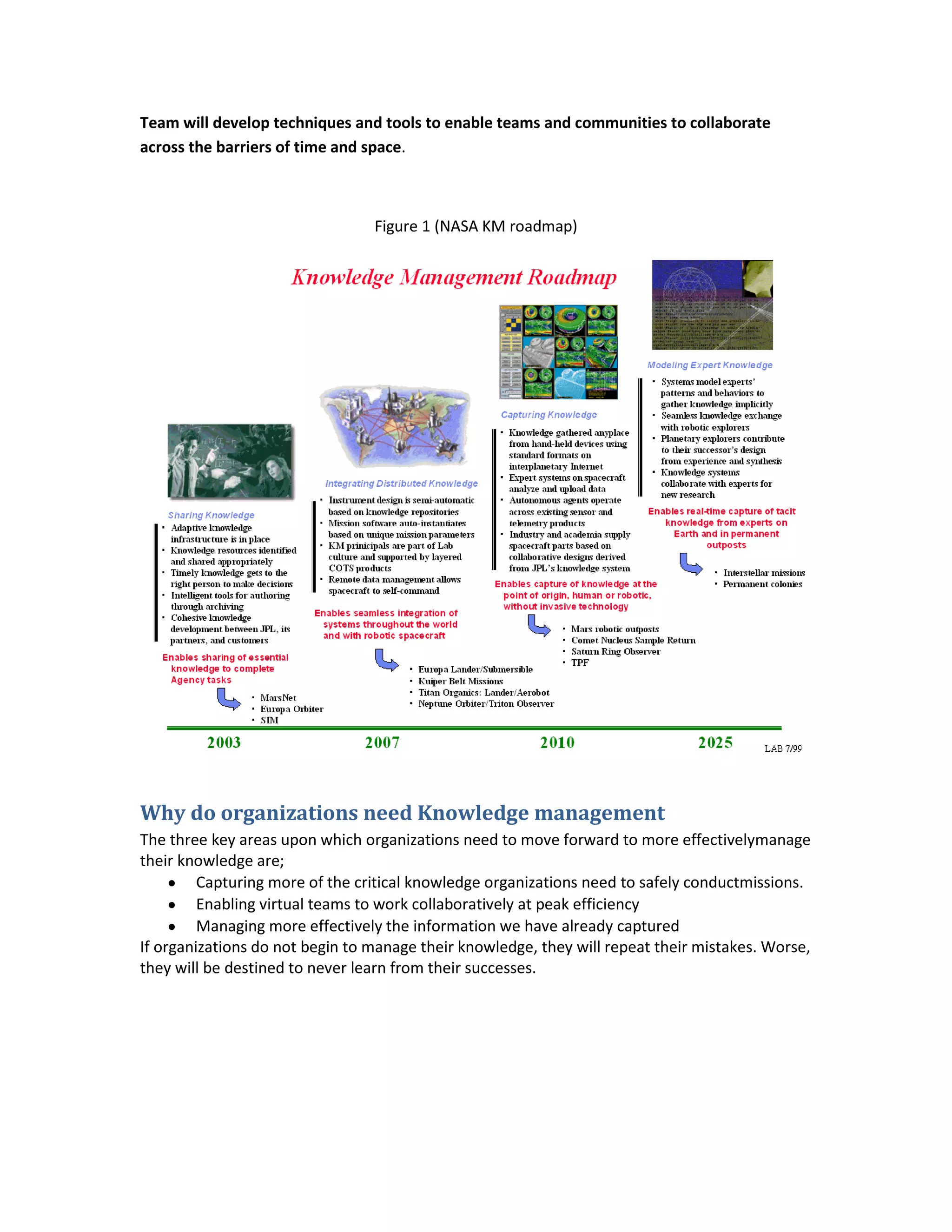
In April 2002 NASA has releases its Knowledge management strategic plan identifying
Knowledge management is getting the right information to the right people at the right time,
and helping people create knowledge and share and act upon information in ways that will
measurably improve the performance of NASA and its partners. For NASA this means delivering
the systems and services that will help our employees and partners get the information they
need to make better decisions. There are three priority areas where KM systems and processes
can help NASA's ability to deliver its missions: 1)To sustain NASA's knowledge across missions
and generationsKM activities will identify and capture the information that exists across the
Agency. 2)To help people find, organize, and share the knowledge we already have
KM processes will help to efficiently manage the Agency's knowledge resources. 3)To increase
collaboration and to facilitate knowledge creation and sharingThe Knowledge Management
Team will develop techniques and tools to enable teams and communities to collaborate
across the barriers of time and space.


                                 Figure 1 (NASA KM roadmap)


Why do organizations need Knowledge management
The three key areas upon which organizations need to move forward to more effectivelymanage
their knowledge are;
         Capturing more of the critical knowledge organizations need to safely conductmissions.
         Enabling virtual teams to work collaboratively at peak efficiency
         Managing more effectively the information we have already captured
If organizations do not begin to manage their knowledge, they will repeat their mistakes. Worse,
they will be destined to never learn from their successes.
Knowledge management process:

Knowledge management—facilitating the sharing of knowledge—occurs when people have easy
access to and use tools, processes, venues, and facilities provided to help them solve problems
and achieve understanding. Given the highly distributed, “virtual” teams at the organization
today, the challenge before is to bring together people and their expertise across barriers of
time, space, and culture. KM activities can provide an environment in which knowledge sharing
and learning lead to actions in support of the corporation’s goals (Figure 1). KM activities is to
capture design decisions as they occur and share those with current and future projects could
help lead to a culture where sharing knowledge is part of the daily work.

Sharing and Using Knowledge
People                     Process                               Technology
        Enable
        remotecollaboration
                                          Enhance knowledge
                                          capture
                                                                 • Enhance system
                                                                 integration and data
        Support communities               Manage                 mining
        ofpractice                        information
        Reward and recognize                                     • Utilize intelligent
        knowledge sharing                                        agents
        Encourage
        storytelling
                                                                 • Exploit expert
                                                                 systems
Supporting Activities
Education and         IT Infrastructure           HR                       Security
training

Some organizations have achieved success in knowledge management through a centralized KM
organization, others through an architecture that unites distributed activities. Successful
implementation of KM is truly measured by its contribution to mission success. However,
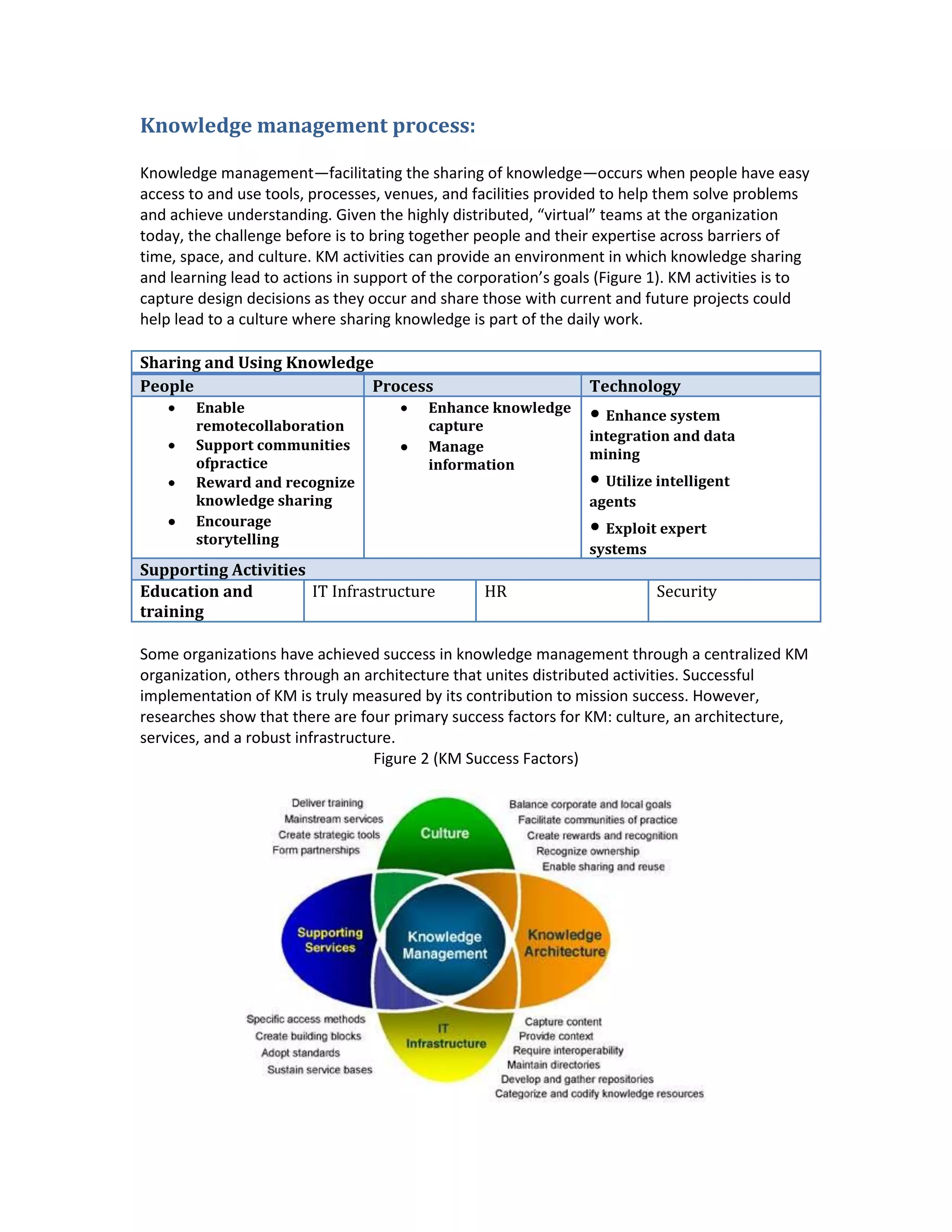
researches show that there are four primary success factors for KM: culture, an architecture,
services, and a robust infrastructure.
                                   Figure 2 (KM Success Factors)
Effron (2004), asserts that given the definition of knowledge as “the fact or condition of knowing
something with familiarity gained through experience or association”, it is “impossible to
acquire “knowledge” without either experiencing something yourself or interacting with
someone else who has” (p. 40). Knowledge Management is not synonymous with IT systems and
processes. Rather knowledge resides in the experiences of people in different contexts. With
regard to Knowledge Management, the aim of an organization is to work within business
processes that create, and transfer knowledge throughout the organization. If knowledge is
created and transferred via human experiences then these business processes must encompass
an understanding of how people learn and transfer their knowledge; that is the business
processes must emphasize person-to-person contact (Effron, 2004).

Examples of business processes that will lead to effective knowledge management are:

        The setting of goals and objective – be realistic and recognize the limitations of data
        mining and information gathering. Make the increase of organizational knowledge a
        stated and specific goal for the all.
        Employee retention – HR processes should focus on what it takes to retain employees
        who hold key knowledge. Provide opportunities that are developmental, have purpose,
        and have a high impact on business performance. Compensate such employees above
        typical market rates.
        Employee development processes – pairing experts (what some companies call “Oak
        Trees”) and apprentices provide opportunities for employees with differing levels of
        knowledge to work together and increase the organizational knowledge. These
        relationships allow for a true exchange of knowledge through a human relationship and
        experience.
        Organized networking and annual conferences – these provide forums for face-to-face
        interaction and knowledge sharing and can lead to effective organizational knowledge
        management.

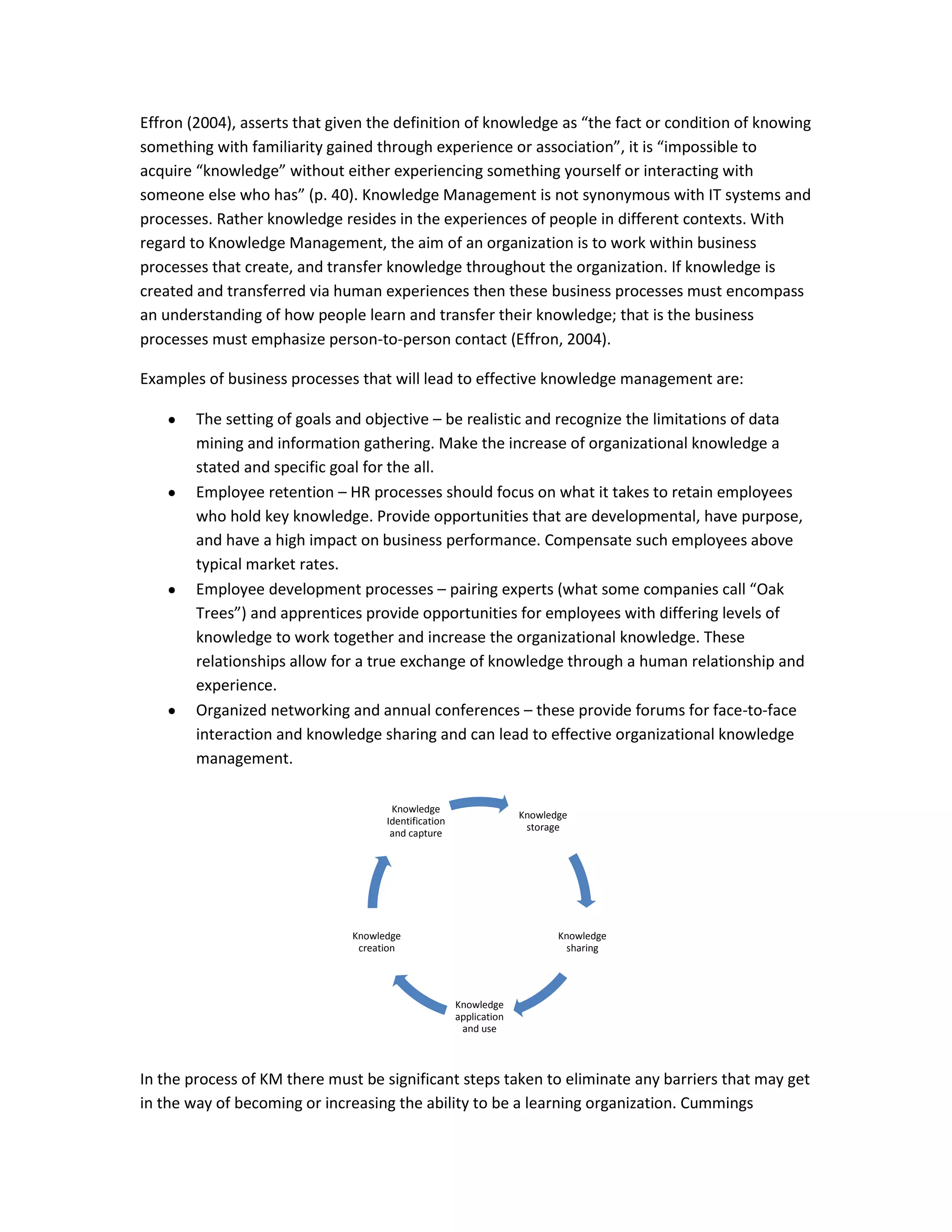
                                      Knowledge
                                                                    Knowledge
                                     Identification
                                                                     storage
                                      and capture


                               Knowledge                                   Knowledge
                                creation                                    sharing


                                                      Knowledge
                                                      application
                                                       and use


In the process of KM there must be significant steps taken to eliminate any barriers that may get
in the way of becoming or increasing the ability to be a learning organization. Cummings
challenged our intentionality for to effectively help the processes of KM within an organization
there must be intentional efforts to remove barriers that would inhibit ideas, talent, and money
from getting to the point of best use (Trompenaars& Hampden-Turner, 2004).


Biggest difficulties to successfully managing knowledge in
organizations:
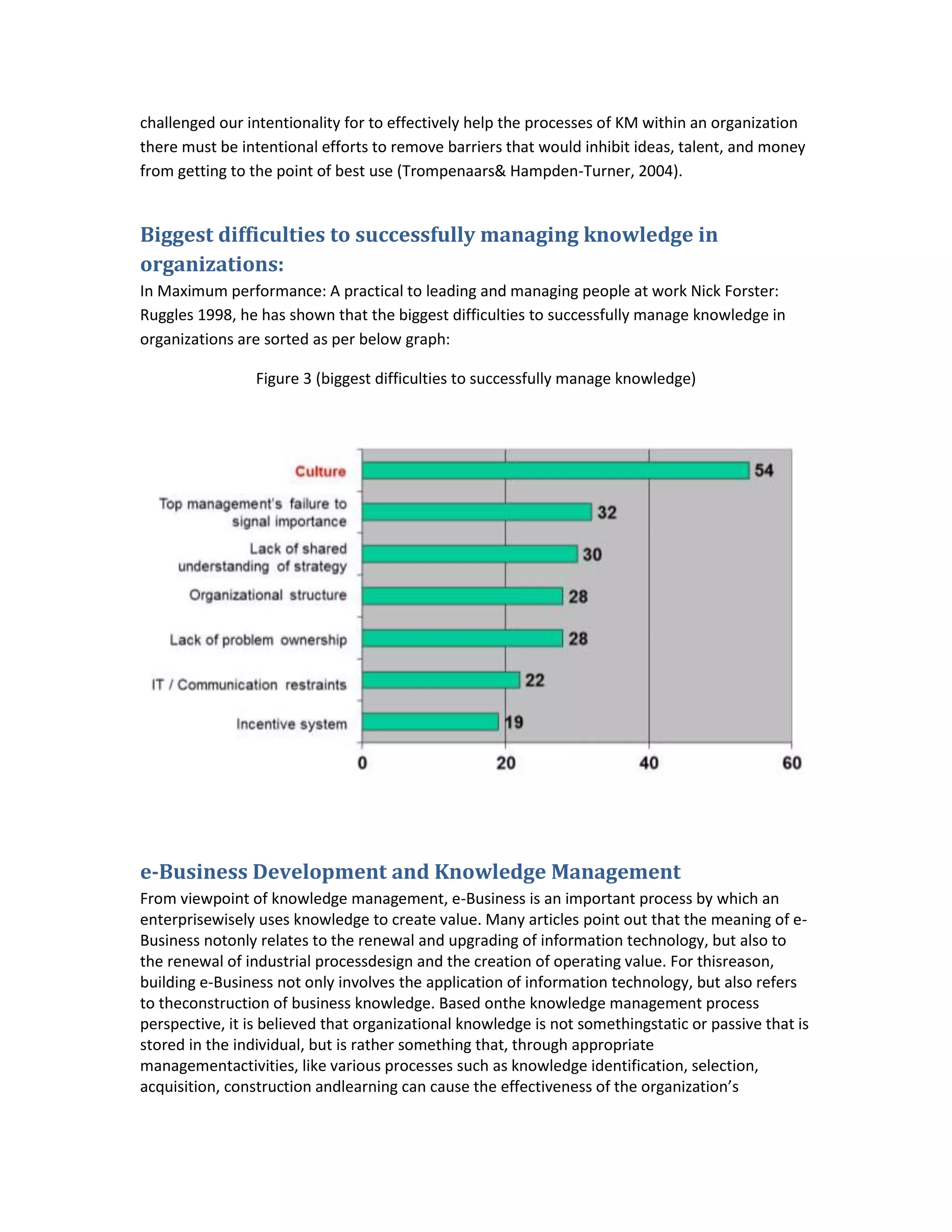
In Maximum performance: A practical to leading and managing people at work Nick Forster:
Ruggles 1998, he has shown that the biggest difficulties to successfully manage knowledge in
organizations are sorted as per below graph:

                 Figure 3 (biggest difficulties to successfully manage knowledge)


e-Business Development and Knowledge Management
From viewpoint of knowledge management, e-Business is an important process by which an
enterprisewisely uses knowledge to create value. Many articles point out that the meaning of e-
Business notonly relates to the renewal and upgrading of information technology, but also to
the renewal of industrial processdesign and the creation of operating value. For thisreason,
building e-Business not only involves the application of information technology, but also refers
to theconstruction of business knowledge. Based onthe knowledge management process
perspective, it is believed that organizational knowledge is not somethingstatic or passive that is
stored in the individual, but is rather something that, through appropriate
managementactivities, like various processes such as knowledge identification, selection,
acquisition, construction andlearning can cause the effectiveness of the organization’s
knowledge to shine forth (Wiig’s, 1997; Beckman,1997;Demarest 1997; Cohen,1998; Ruggles
1998).
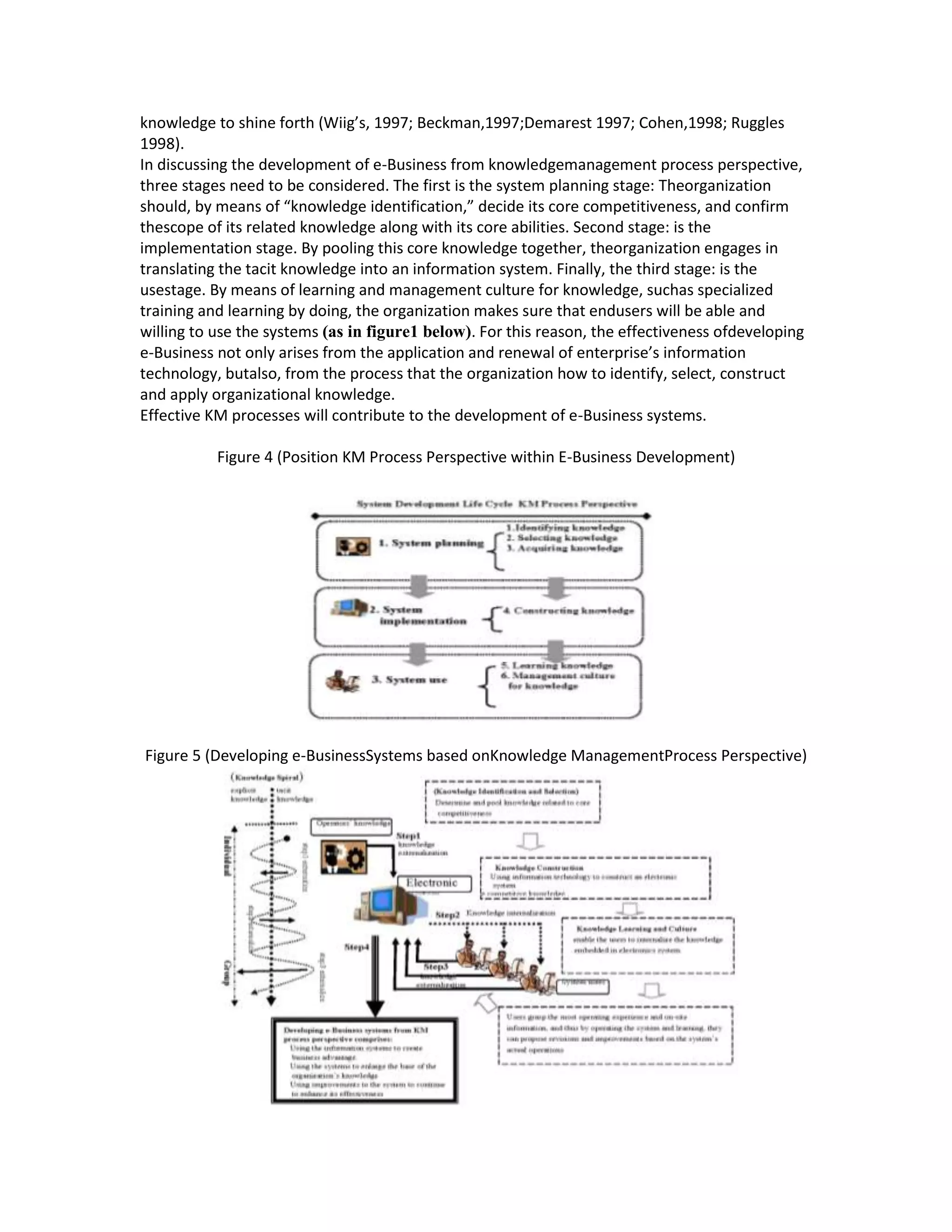
In discussing the development of e-Business from knowledgemanagement process perspective,
three stages need to be considered. The first is the system planning stage: Theorganization
should, by means of “knowledge identification,” decide its core competitiveness, and confirm
thescope of its related knowledge along with its core abilities. Second stage: is the
implementation stage. By pooling this core knowledge together, theorganization engages in
translating the tacit knowledge into an information system. Finally, the third stage: is the
usestage. By means of learning and management culture for knowledge, suchas specialized
training and learning by doing, the organization makes sure that endusers will be able and
willing to use the systems (as in figure1 below). For this reason, the effectiveness ofdeveloping
e-Business not only arises from the application and renewal of enterprise’s information
technology, butalso, from the process that the organization how to identify, select, construct
and apply organizational knowledge.
Effective KM processes will contribute to the development of e-Business systems.

           Figure 4 (Position KM Process Perspective within E-Business Development)


Figure 5 (Developing e-BusinessSystems based onKnowledge ManagementProcess Perspective)
KM and real business application from your working environment.
          From my point of view and my interaction within the organization, I have found that the
          e-business applications (ERP, Exchange servers, intranet, etc.. ) used within my
          organization doesn’t serve the knowledge management intended end results in a good
          manner, how much it increased the productivity and create the lessons learned that
          benefits the organization can’t be significantly seen. Nevertheless it has created the
          media that overcome some challenges that face the knowledge management, such as
          space and time, but it didn’t deal with one of the major obstacles which is the culture of
          the users, and the goals of the implementation wasn’t that clear. The identification of
          knowledge wasn’t that clear, what has to be shared and when wasn’t put in a specific
          plan to be followed.


Conclusion
The whole point of knowledge management process is to make sure that the knowledge in an
organization is applied productively for the benefit of that organization. Based on KM processes
perspective, the processes developing e-Business systems are the one that a business how to
identify, select, acquire the tacit knowledge in an organization, how to translate the tacit
knowledge into e-Business systems (constructing knowledge), and how to educate the users to
use the systems well and learning the knowledge embodied in the systems out of habit (learning
knowledge and management culture for knowledge). To discuss the development of e-Business
from KM process perspective, its main meaning is to assist the enterprise’s management in
answering the question to help systems implementation personnel in understanding “how to
engage in building e-Business,” and to assist system users regarding “how toby means of the
system operate and learn from it”, as a means of enabling the system to show forth its
effectiveness. The traditional approach to systemsdevelopment, such as the traditional life cycle
approach, has provided e-Business building with clear-cut planning and guidance, but today
there are still many enterprises that have failed. From knowledge management perspective, the
building of an e-Business system is truly the construction of the organization’s knowledge.
“Knowledge” is the basic component of an information system, and e-Business systems
development is also theprocess that a company how to identify, construct and apply
organization’s knowledge.


REFERENCES
Davenport, T.H. 1998 : Living with ERP, CIO Magazine, 12 (5): 30-32.
Davenport, T. H., and Klahr. 1998: Managing Customer Support Knowledge”, California Management Review, 3(40): 193-208.
Hesterbrink, C. 1999: Ringing two Paradigms Together, Price water house Coopers.
Kalakota, R., and Whinston, A.B. 1997:Electronics Commerce: A Manager’s Guide, Addition-Wesley.
Kalakota, R., and Robinson, M. 1995: E-Business Roadmap for Success, Reading, Mass.: Addition-Wesley.
Luftman, J. and Brief, T. 1999 : Achieving and Sustaining Business-IT Alignment, California Management Review, 1 (42): 109-122.
Ryan, S.D. , Harrison, D.A. and Schkade, L.L. 2002: Information-Technology Investment Decisions Social Subsystem Matter?
The Journal of American Academy of Business, Cambridge * March 2005
NASA strategic plan for knowledge management 2002

Knowledge management systems in electronic business ahmed adel

  • 1.
    Knowledge Management Systemsin Electronic Business Management & e-business DR. NEZAR SAMI, ESLSCA 34C October 23, 2011 Authored by: Ahmed Adel Kamel
  • 2.
    Table of contents: Tableof contents: ............................................................................................................................ 1 List of figures: .................................................................................................................................. 2 List of tables: ................................................................................................................................... 2 Executive Summary ......................................................................................................... 3 Abstract ........................................................................................................................... 4 INTRODUCTION ............................................................................................................... 4 What is knowledge? ........................................................................................................................ 4 Knowledge management ................................................................................................................ 5 Why do organizations need Knowledge management ................................................................... 7 Knowledge management process: .................................................................................................. 8 Biggest difficulties to successfully managing knowledge in organizations: .................................. 10 e-Business Development and Knowledge Management .............................................................. 10 KM and real business application from your working environment. ............................................ 12 Conclusion ..................................................................................................................................... 12 REFERENCES .................................................................................................................................. 12
  • 3.
    List of figures: FigureDescription Page Figure 1 (NASA KM roadmap) 8 Figure 2 KM Success Factors 9 Figure 3 Biggest difficulties to successfully manage knowledge 11 Figure 4 (Position KM Process Perspective within E-Business Development) 12 Figure 5Developing e-BusinessSystems based onKnowledgeManagementProcess 13 Perspective List of tables: Table Description Page Table 1 Sharing and Using Knowledge 9
  • 4.
    Executive Summary Knowledge managementis a strategic initiative essential for any corporation mission success. As a rising retirement rate diminishes the size of the workforce, the organization’s ability to protect – and effectively utilize – its intellectual capital is similarly diminished. A lack of critical knowledge negatively impacts an organization’s ability to make effective decisions in a timely manner. This limitation also inhibits organizations from being able to successfully execute their program on time, as well as being able to stay within the program’s budgetary limits. One assessment of this dilemma comes from the Aberdeen Group, who says, “Knowledge workers today are losing productivity in an endless search for information they know resides in the organization but is not easily accessible.” By implementing an enterprise knowledge management strategy coupled with an effective knowledge framework, the organization can distribute this critical program knowledge to widely dispersed stakeholders. This flexibility enables teams to continuously understand the interdependencies and consequences of changing requirements and changing environments across the life of the entire program/ project. However, data by itself is only representative of a single point in time with no understanding of that data’s relationships or how it can be used for decision making. By being able to fully comprehend all aspects of organization knowledge (i.e., its lifecycle), knowledge workers can employ this information more effectively during the decision making process. This approach allows end users to understand organization knowledge as a whole so that they can ascertain its patterns and develop additional knowledge about how to use this information on a best practice basis. In turn, these knowledge management techniques enable organizations to make informed decisions that improve the likelihood of success What is “knowledge management”? Knowledge management is getting the right information to the right people at the right time, and helping people create knowledge and share and act upon information in ways that will measurably improve the performance of the corporation and its partners. This means providing access to information at the time people need it to make the best decisions possible for mission safety and success. It means Providing an engineer the history of design decisions on previous projects Giving a project manager access to the best risk management practices and tools when he or she needs them Providing the time for a senior scientist to mentor a promising young star Some of this can be accomplished through clever information technology solutions. The larger part of this relates to capturing the tacit knowledge of our workforce and effecting cultural changes that will encourage people to share what they know. There are three goals where KM activities can help corporation’s ability to deliver its missions 1. To sustain the corporation’s knowledge across missions and generations, KM activities will identify and capture the information that exists across the organization. 2. To help people find, organize, and share the knowledge we already have, KM implementations will help to efficiently manage the Agency’s knowledge resource. 3. To increase collaboration and to facilitate knowledge creation and sharing, KM teams will develop techniques, tools, venues, and facilities to enable teams and communities to collaborate across the barriers of time and space In realizing these goals, some of the specific near-term objectives should include capturing key employee knowledge, managing the information
  • 5.
    resources organization alreadyhave, and creating ways for remote teams to work collaboratively. The knowledge management efforts are envisioned as a coordinating function that encompasses implementation responsibilities that might be necessary to “fill the gaps” that exist between organizations. Abstract The focus of this paper is proposing a framework for developing e-Business systems based on knowledge management (KM) process perspective. In past, developing e-Business systems were often given priority according to technical criteria rather than business imperatives. “Technology for technology’s sake” problem tends to be a business phenomenon. The study tries to give some ideals for building e-Business systems based on KM process perspective and expects that the viewpoint will facilitate the company using IT to achieve the effectiveness of ebusiness systems development. INTRODUCTION In today’s 21st century, e-Business has become an important means by which enterprises respond to competition. *Hesterbrink (1999) pointed out that e-Business uses an innovation approach to utilize organizationalresources and partner relationships in order to create strategic advantage. Moreover, *Kalakota and Robinson (1995)consider e-Business to be the complex fusion of business processes, enterprise applications, and organizationalstructure necessary to create a high-performance model. According to the above discussion, e-Business is without adoubt the means to survival of enterprises in the future, and a necessary path for the enterprise to follow. As a result,e-Business has already become a major policy and program used by the world’s industrialized countries andenterprises in responding to this new economy. Following a five-year study, *Luftman and Brief (1999) pointed outthat the vast majority of enterprises that engaged in computerization did not obtain ideal results, which meant that it was not necessary for them to engage in computerization to increase the value of their enterprise and createbusiness competitiveness(*Davenport,1998;Ryan, Harrison and Schkade,2002). As soon as managers regarded e-Business as that computers had been popularized, that time spent on line had increased, and that thecomputerization of the original functional procedures, it had in fact been of little real assistance in creating andincreasing enterprise competitiveness. What is knowledge? Denham Grey offers the following view on Knowledge stating that it is the full utilization of information and data, coupled with the potential of people's skills, competencies, ideas, intuitions, commitments and motivations.
  • 6.
    In today's economy,knowledge is people, money, leverage, learning, flexibility, power, and competitive advantage. Knowledge is more relevant to sustained business than capital, labor or land. Nevertheless, it remains the most neglected asset. It is more than justified true belief and is essential for action, performance and adaption. Knowledge provides the ability to respond to novel situations. A holistic view considers knowledge to be present in ideas, judgments, talents, root causes, relationships, perspectives and concepts. Knowledge is stored in the individual brain or encoded in organizational processes, documents, products, services, facilities and systems. Knowledge is the basis for, and the driver of, our post-industrial economy. Knowledge is the result of learning which provides the only sustainable competitive advantage. Knowledge is the next paradigm shift in computing following data processing 1945-1965 and information management 1966-1995. Knowledge is action, focused innovation, pooled expertise, special relationships and alliances. Knowledge is value-added behavior and activities. For knowledge to be of value it must be focused, current, tested and shared. Knowledge management An Open Discussion of Knowledge Management", Brian (Bo)Newman, 1991, Knowledge Management is the collection of processes that govern the creation, dissemination, and utilization of knowledge. In one form or another, knowledge management has been around for a very long time. Practitioners have included philosophers, priests, teachers, politicians, scribes, Liberians, etc. So if Knowledge Management is such an ageless and broad topic what role does it serve in today's Information Age? These processes exist whether we acknowledge them or not and they have a profound effect on the decisions we make and the actions we take, both of which are enabled by knowledge of some type. If this is the case, and we agree that many of our decisions and actions have profound and long lasting effects, it makes sense to recognize and understand the processes that effect or actions and decision and, where possible, take steps to improve the quality these processes and in turn improve the quality of those actions and decisions for which we are responsible? Knowledge management is not a, "a technology thing" or a, "computer thing" If we accept the premise that knowledge management is concerned with the entire process of discovery and creation of knowledge, dissemination of knowledge , and the utilization of knowledge then we are strongly driven to accept that knowledge management is much more than a "technology thing" and that elements of it exist in each of our jobs. “Knowledge Management” Pankaj Sharma 2008,Maarten Sierhuis provided the following definition of Knowledge Management and supporting concepts. Knowledge Management
  • 7.
    (KM):This is, asthe word implies, the ability to manage "knowledge". We are all familiar with the term Information Management. This term came about when people realized that information is a resource that can and needs to be managed to be useful in an organization. From this, the ideas of Information Analysis and Information Planning came about. Organizations are now starting to look at "knowledge" as a resource as well. This means that we need ways for managing the knowledge in an organization. We can use techniques and methods that were developed as part of Knowledge Technology to analyze the knowledge sources in an organization. Using these techniques we can perform Knowledge Analysis and Knowledge Planning. Knowledge Analysis (KA): In Knowledge Analysis we model a knowledge source in such a way that we can analyze its usefulness, its weaknesses and its appropriateness within the organization. Knowledge Analysis is a necessary step for the ability to manage knowledge. Within Knowledge Analysis we can use knowledge modeling and knowledge acquisition techniques. Knowledge Planning (KP): When an organization has a grip on its knowledge (i.e. has performed Knowledge Analysis), it will be able to plan for the future. An organization will now be able to develop a multi-year knowledge plan that defines how the organization will develop its knowledge resources, either by training its human agents, or by developing knowledge-based systems to support the human agents, or by other means that allow the organization to stay competitive. Knowledge Technology (KT): This is, as the word already implies, the (application of) techniques and methods from the field of AI, or to be more specific, the field of knowledge-based systems. KT has been around for quite some time, and most people know about the application of KT in the form of expert systems, and decision support systems. Techniques and methods to design these kind of systems are well known; The best known methodology for building knowledge-based systems is CommonKADS (formerly known as KADS). Computer Supported Work Systems (CSWS): This is a formal and informal (human) activity system, within an organization where the (human) agents are supported by computer systems. The application of Knowledge Technology is very helpful in such work systems, although definitely *not* the only important factor in the analysis and design, nor in the effectiveness of the activity system. In April 2002 NASA has releases its Knowledge management strategic plan identifying Knowledge management is getting the right information to the right people at the right time, and helping people create knowledge and share and act upon information in ways that will measurably improve the performance of NASA and its partners. For NASA this means delivering the systems and services that will help our employees and partners get the information they need to make better decisions. There are three priority areas where KM systems and processes can help NASA's ability to deliver its missions: 1)To sustain NASA's knowledge across missions and generationsKM activities will identify and capture the information that exists across the Agency. 2)To help people find, organize, and share the knowledge we already have KM processes will help to efficiently manage the Agency's knowledge resources. 3)To increase collaboration and to facilitate knowledge creation and sharingThe Knowledge Management
  • 8.
    Team will developtechniques and tools to enable teams and communities to collaborate across the barriers of time and space. Figure 1 (NASA KM roadmap) Why do organizations need Knowledge management The three key areas upon which organizations need to move forward to more effectivelymanage their knowledge are; Capturing more of the critical knowledge organizations need to safely conductmissions. Enabling virtual teams to work collaboratively at peak efficiency Managing more effectively the information we have already captured If organizations do not begin to manage their knowledge, they will repeat their mistakes. Worse, they will be destined to never learn from their successes.
  • 9.
    Knowledge management process: Knowledgemanagement—facilitating the sharing of knowledge—occurs when people have easy access to and use tools, processes, venues, and facilities provided to help them solve problems and achieve understanding. Given the highly distributed, “virtual” teams at the organization today, the challenge before is to bring together people and their expertise across barriers of time, space, and culture. KM activities can provide an environment in which knowledge sharing and learning lead to actions in support of the corporation’s goals (Figure 1). KM activities is to capture design decisions as they occur and share those with current and future projects could help lead to a culture where sharing knowledge is part of the daily work. Sharing and Using Knowledge People Process Technology Enable remotecollaboration Enhance knowledge capture • Enhance system integration and data Support communities Manage mining ofpractice information Reward and recognize • Utilize intelligent knowledge sharing agents Encourage storytelling • Exploit expert systems Supporting Activities Education and IT Infrastructure HR Security training Some organizations have achieved success in knowledge management through a centralized KM organization, others through an architecture that unites distributed activities. Successful implementation of KM is truly measured by its contribution to mission success. However, researches show that there are four primary success factors for KM: culture, an architecture, services, and a robust infrastructure. Figure 2 (KM Success Factors)
  • 10.
    Effron (2004), assertsthat given the definition of knowledge as “the fact or condition of knowing something with familiarity gained through experience or association”, it is “impossible to acquire “knowledge” without either experiencing something yourself or interacting with someone else who has” (p. 40). Knowledge Management is not synonymous with IT systems and processes. Rather knowledge resides in the experiences of people in different contexts. With regard to Knowledge Management, the aim of an organization is to work within business processes that create, and transfer knowledge throughout the organization. If knowledge is created and transferred via human experiences then these business processes must encompass an understanding of how people learn and transfer their knowledge; that is the business processes must emphasize person-to-person contact (Effron, 2004). Examples of business processes that will lead to effective knowledge management are: The setting of goals and objective – be realistic and recognize the limitations of data mining and information gathering. Make the increase of organizational knowledge a stated and specific goal for the all. Employee retention – HR processes should focus on what it takes to retain employees who hold key knowledge. Provide opportunities that are developmental, have purpose, and have a high impact on business performance. Compensate such employees above typical market rates. Employee development processes – pairing experts (what some companies call “Oak Trees”) and apprentices provide opportunities for employees with differing levels of knowledge to work together and increase the organizational knowledge. These relationships allow for a true exchange of knowledge through a human relationship and experience. Organized networking and annual conferences – these provide forums for face-to-face interaction and knowledge sharing and can lead to effective organizational knowledge management. Knowledge Knowledge Identification storage and capture Knowledge Knowledge creation sharing Knowledge application and use In the process of KM there must be significant steps taken to eliminate any barriers that may get in the way of becoming or increasing the ability to be a learning organization. Cummings
  • 11.
    challenged our intentionalityfor to effectively help the processes of KM within an organization there must be intentional efforts to remove barriers that would inhibit ideas, talent, and money from getting to the point of best use (Trompenaars& Hampden-Turner, 2004). Biggest difficulties to successfully managing knowledge in organizations: In Maximum performance: A practical to leading and managing people at work Nick Forster: Ruggles 1998, he has shown that the biggest difficulties to successfully manage knowledge in organizations are sorted as per below graph: Figure 3 (biggest difficulties to successfully manage knowledge) e-Business Development and Knowledge Management From viewpoint of knowledge management, e-Business is an important process by which an enterprisewisely uses knowledge to create value. Many articles point out that the meaning of e- Business notonly relates to the renewal and upgrading of information technology, but also to the renewal of industrial processdesign and the creation of operating value. For thisreason, building e-Business not only involves the application of information technology, but also refers to theconstruction of business knowledge. Based onthe knowledge management process perspective, it is believed that organizational knowledge is not somethingstatic or passive that is stored in the individual, but is rather something that, through appropriate managementactivities, like various processes such as knowledge identification, selection, acquisition, construction andlearning can cause the effectiveness of the organization’s
  • 12.
    knowledge to shineforth (Wiig’s, 1997; Beckman,1997;Demarest 1997; Cohen,1998; Ruggles 1998). In discussing the development of e-Business from knowledgemanagement process perspective, three stages need to be considered. The first is the system planning stage: Theorganization should, by means of “knowledge identification,” decide its core competitiveness, and confirm thescope of its related knowledge along with its core abilities. Second stage: is the implementation stage. By pooling this core knowledge together, theorganization engages in translating the tacit knowledge into an information system. Finally, the third stage: is the usestage. By means of learning and management culture for knowledge, suchas specialized training and learning by doing, the organization makes sure that endusers will be able and willing to use the systems (as in figure1 below). For this reason, the effectiveness ofdeveloping e-Business not only arises from the application and renewal of enterprise’s information technology, butalso, from the process that the organization how to identify, select, construct and apply organizational knowledge. Effective KM processes will contribute to the development of e-Business systems. Figure 4 (Position KM Process Perspective within E-Business Development) Figure 5 (Developing e-BusinessSystems based onKnowledge ManagementProcess Perspective)
  • 13.
    KM and realbusiness application from your working environment. From my point of view and my interaction within the organization, I have found that the e-business applications (ERP, Exchange servers, intranet, etc.. ) used within my organization doesn’t serve the knowledge management intended end results in a good manner, how much it increased the productivity and create the lessons learned that benefits the organization can’t be significantly seen. Nevertheless it has created the media that overcome some challenges that face the knowledge management, such as space and time, but it didn’t deal with one of the major obstacles which is the culture of the users, and the goals of the implementation wasn’t that clear. The identification of knowledge wasn’t that clear, what has to be shared and when wasn’t put in a specific plan to be followed. Conclusion The whole point of knowledge management process is to make sure that the knowledge in an organization is applied productively for the benefit of that organization. Based on KM processes perspective, the processes developing e-Business systems are the one that a business how to identify, select, acquire the tacit knowledge in an organization, how to translate the tacit knowledge into e-Business systems (constructing knowledge), and how to educate the users to use the systems well and learning the knowledge embodied in the systems out of habit (learning knowledge and management culture for knowledge). To discuss the development of e-Business from KM process perspective, its main meaning is to assist the enterprise’s management in answering the question to help systems implementation personnel in understanding “how to engage in building e-Business,” and to assist system users regarding “how toby means of the system operate and learn from it”, as a means of enabling the system to show forth its effectiveness. The traditional approach to systemsdevelopment, such as the traditional life cycle approach, has provided e-Business building with clear-cut planning and guidance, but today there are still many enterprises that have failed. From knowledge management perspective, the building of an e-Business system is truly the construction of the organization’s knowledge. “Knowledge” is the basic component of an information system, and e-Business systems development is also theprocess that a company how to identify, construct and apply organization’s knowledge. REFERENCES Davenport, T.H. 1998 : Living with ERP, CIO Magazine, 12 (5): 30-32. Davenport, T. H., and Klahr. 1998: Managing Customer Support Knowledge”, California Management Review, 3(40): 193-208. Hesterbrink, C. 1999: Ringing two Paradigms Together, Price water house Coopers. Kalakota, R., and Whinston, A.B. 1997:Electronics Commerce: A Manager’s Guide, Addition-Wesley. Kalakota, R., and Robinson, M. 1995: E-Business Roadmap for Success, Reading, Mass.: Addition-Wesley. Luftman, J. and Brief, T. 1999 : Achieving and Sustaining Business-IT Alignment, California Management Review, 1 (42): 109-122. Ryan, S.D. , Harrison, D.A. and Schkade, L.L. 2002: Information-Technology Investment Decisions Social Subsystem Matter? The Journal of American Academy of Business, Cambridge * March 2005 NASA strategic plan for knowledge management 2002