Strategic AnalysisRushda JalalRoll# 508194531
Strategic AnalysisThe process of conducting research on the business environment within which an organization operates and on the organization itself, in order to formulate strategy. Why use it? To take advantage of the path of least resistance to achieve 	your goal. When to use it?		When you are planning to make a change in your 	organization, and you need to determine the best path to take.
TOOLS of Strategic AnalysisA number of tools are used in the process of strategic analysis, including PEST, SWOT analysis, and Michael Porter's five forces model.
PEST AnalysisPEST analysis stands for "Political, Economic, Social, and Technological analysis" and describes a framework of macro-environmental factors used in the environmental scanning component of strategic management.
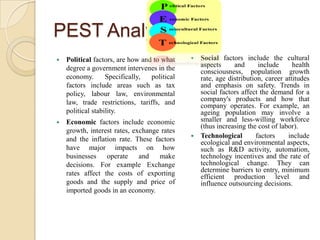
PEST AnalysisPolitical factors, are how and to what degree a government intervenes in the economy. Specifically, political factors include areas such as tax policy, labour law, environmental law, trade restrictions, tariffs, and political stability. Economic factors include economic growth, interest rates, exchange rates and the inflation rate. These factors have major impacts on how businesses operate and make decisions. For example Exchange rates affect the costs of exporting goods and the supply and price of imported goods in an economy.Social factors include the cultural aspects and include health consciousness, population growth rate, age distribution, career attitudes and emphasis on safety. Trends in social factors affect the demand for a company's products and how that company operates. For example, an ageing population may involve a smaller and less-willing workforce (thus increasing the cost of labor). Technological factors include ecological and environmental aspects, such as R&D activity, automation, technology incentives and the rate of technological change. They can determine barriers to entry, minimum efficient production level and influence outsourcing decisions.
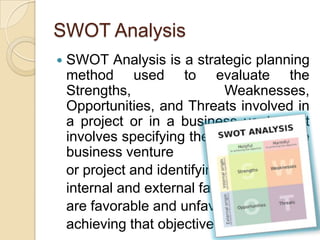
SWOT AnalysisSWOT Analysis is a strategic planning method used to evaluate the Strengths, Weaknesses, Opportunities, and Threats involved in a project or in a business venture. It involves specifying the objective of the business venture or project and identifying the internal and external factors that are favorable and unfavorable to achieving that objective.
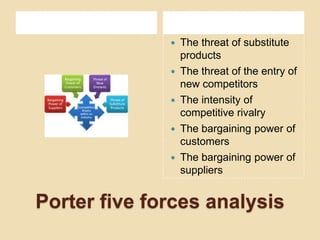
Porter five forces analysisThe threat of substitute productsThe threat of the entry of new competitorsThe intensity of competitive rivalryThe bargaining power of customersThe bargaining power of suppliers
Value chain analysisValue chain analysis is based on the principle that organizations exist to create value for their customers. In the analysis, the organization's activities are divided into separate sets of activities that add value.The three steps for conducting a value chain analysis are:Separate the organization's operations into primary and support activitiesAllocate cost to each activity.Identify the activities that are important to customer’s satisfaction and market success.
Strategic PlanningIdentify mission and purposeIdentify goalsIdentify objectives—specific, measurableImplement objectives to meet goalsEvaluate process.
Scenario PlanningAddresses the weakness of strategic planning to see multiple futuresScenario planning identifies multiple possibilitiesThink the unthinkableDiscuss each scenario and plan accordingly
Strategy formulationStrategic formulation is a combination of three main processes which are as follows:Performing a situation analysis, self-evaluation and competitor analysis: both internal and external; both micro-environmental and macro-environmental. Concurrent with this assessment, objectives are set. These objectives should be parallel to a timeline; some are in the short-term and others on the long-term. This involves crafting vision statements, mission statements, overall corporate objectives, strategic business unit objectives, and tactical objectives. These objectives should, suggest a strategic plan. The plan provides the details of how to achieve these objectives.
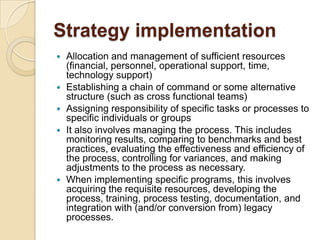
Strategy implementationAllocation and management of sufficient resources (financial, personnel, operational support, time, technology support)Establishing a chain of command or some alternative structure (such as cross functional teams) Assigning responsibility of specific tasks or processes to specific individuals or groups It also involves managing the process. This includes monitoring results, comparing to benchmarks and best practices, evaluating the effectiveness and efficiency of the process, controlling for variances, and making adjustments to the process as necessary. When implementing specific programs, this involves acquiring the requisite resources, developing the process, training, process testing, documentation, and integration with (and/or conversion from) legacy processes.
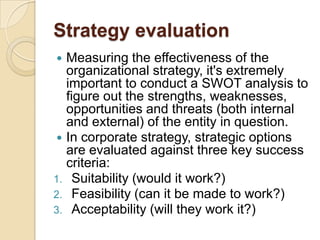
Strategy evaluationMeasuring the effectiveness of the organizational strategy, it's extremely important to conduct a SWOT analysis to figure out the strengths, weaknesses, opportunities and threats (both internal and external) of the entity in question.In corporate strategy, strategic options are evaluated against three key success criteria:Suitability (would it work?) Feasibility (can it be made to work?) Acceptability (will they work it?)
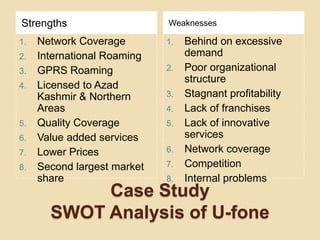
Case Study SWOT Analysis of U-foneStrengthsWeaknessesNetwork CoverageInternational RoamingGPRS RoamingLicensed to Azad Kashmir & Northern AreasQuality CoverageValue added servicesLower PricesSecond largest market shareBehind on excessive demandPoor organizational structureStagnant profitabilityLack of franchisesLack of innovative servicesNetwork coverageCompetitionInternal problems
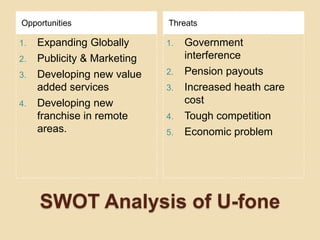
SWOT Analysis of U-foneOpportunitiesThreatsExpanding GloballyPublicity & MarketingDeveloping new value added servicesDeveloping new franchise in remote areas.Government interferencePension payoutsIncreased heath care costTough competitionEconomic problem
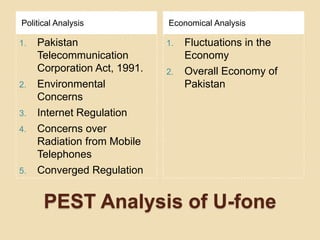
PEST Analysis of U-fonePolitical AnalysisEconomical AnalysisPakistan Telecommunication Corporation Act, 1991.Environmental Concerns Internet Regulation Concerns over Radiation from Mobile Telephones Converged Regulation Fluctuations in the Economy Overall Economy of Pakistan
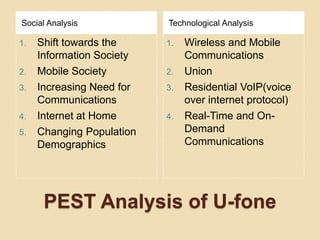
PEST Analysis of U-foneSocial AnalysisTechnological AnalysisShift towards the Information Society Mobile SocietyIncreasing Need for Communications Internet at Home Changing Population DemographicsWireless and Mobile CommunicationsUnion Residential VoIP(voice over internet protocol)Real-Time and On-Demand Communications
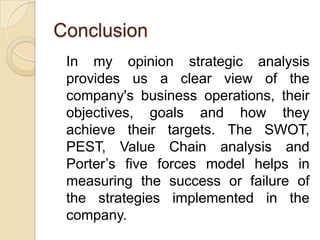
Conclusion	In my opinion strategic analysis provides us a clear view of the company's business operations, their objectives, goals and how they achieve their targets. The SWOT, PEST, Value Chain analysis and Porter’s five forces model helps in measuring the success or failure of the strategies implemented in the company.
Strategic Analysis

Strategic Analysis

  • 1.
  • 2.
    Strategic AnalysisThe processof conducting research on the business environment within which an organization operates and on the organization itself, in order to formulate strategy. Why use it? To take advantage of the path of least resistance to achieve your goal. When to use it? When you are planning to make a change in your organization, and you need to determine the best path to take.
  • 3.
    TOOLS of StrategicAnalysisA number of tools are used in the process of strategic analysis, including PEST, SWOT analysis, and Michael Porter's five forces model.
  • 4.
    PEST AnalysisPEST analysisstands for "Political, Economic, Social, and Technological analysis" and describes a framework of macro-environmental factors used in the environmental scanning component of strategic management.
  • 5.
    PEST AnalysisPolitical factors,are how and to what degree a government intervenes in the economy. Specifically, political factors include areas such as tax policy, labour law, environmental law, trade restrictions, tariffs, and political stability. Economic factors include economic growth, interest rates, exchange rates and the inflation rate. These factors have major impacts on how businesses operate and make decisions. For example Exchange rates affect the costs of exporting goods and the supply and price of imported goods in an economy.Social factors include the cultural aspects and include health consciousness, population growth rate, age distribution, career attitudes and emphasis on safety. Trends in social factors affect the demand for a company's products and how that company operates. For example, an ageing population may involve a smaller and less-willing workforce (thus increasing the cost of labor). Technological factors include ecological and environmental aspects, such as R&D activity, automation, technology incentives and the rate of technological change. They can determine barriers to entry, minimum efficient production level and influence outsourcing decisions.
  • 6.
    SWOT AnalysisSWOT Analysisis a strategic planning method used to evaluate the Strengths, Weaknesses, Opportunities, and Threats involved in a project or in a business venture. It involves specifying the objective of the business venture or project and identifying the internal and external factors that are favorable and unfavorable to achieving that objective.
  • 7.
    Porter five forcesanalysisThe threat of substitute productsThe threat of the entry of new competitorsThe intensity of competitive rivalryThe bargaining power of customersThe bargaining power of suppliers
  • 8.
    Value chain analysisValuechain analysis is based on the principle that organizations exist to create value for their customers. In the analysis, the organization's activities are divided into separate sets of activities that add value.The three steps for conducting a value chain analysis are:Separate the organization's operations into primary and support activitiesAllocate cost to each activity.Identify the activities that are important to customer’s satisfaction and market success.
  • 9.
    Strategic PlanningIdentify missionand purposeIdentify goalsIdentify objectives—specific, measurableImplement objectives to meet goalsEvaluate process.
  • 10.
    Scenario PlanningAddresses theweakness of strategic planning to see multiple futuresScenario planning identifies multiple possibilitiesThink the unthinkableDiscuss each scenario and plan accordingly
  • 11.
    Strategy formulationStrategic formulationis a combination of three main processes which are as follows:Performing a situation analysis, self-evaluation and competitor analysis: both internal and external; both micro-environmental and macro-environmental. Concurrent with this assessment, objectives are set. These objectives should be parallel to a timeline; some are in the short-term and others on the long-term. This involves crafting vision statements, mission statements, overall corporate objectives, strategic business unit objectives, and tactical objectives. These objectives should, suggest a strategic plan. The plan provides the details of how to achieve these objectives.
  • 12.
    Strategy implementationAllocation andmanagement of sufficient resources (financial, personnel, operational support, time, technology support)Establishing a chain of command or some alternative structure (such as cross functional teams) Assigning responsibility of specific tasks or processes to specific individuals or groups It also involves managing the process. This includes monitoring results, comparing to benchmarks and best practices, evaluating the effectiveness and efficiency of the process, controlling for variances, and making adjustments to the process as necessary. When implementing specific programs, this involves acquiring the requisite resources, developing the process, training, process testing, documentation, and integration with (and/or conversion from) legacy processes.
  • 13.
    Strategy evaluationMeasuring theeffectiveness of the organizational strategy, it's extremely important to conduct a SWOT analysis to figure out the strengths, weaknesses, opportunities and threats (both internal and external) of the entity in question.In corporate strategy, strategic options are evaluated against three key success criteria:Suitability (would it work?) Feasibility (can it be made to work?) Acceptability (will they work it?)
  • 14.
    Case Study SWOTAnalysis of U-foneStrengthsWeaknessesNetwork CoverageInternational RoamingGPRS RoamingLicensed to Azad Kashmir & Northern AreasQuality CoverageValue added servicesLower PricesSecond largest market shareBehind on excessive demandPoor organizational structureStagnant profitabilityLack of franchisesLack of innovative servicesNetwork coverageCompetitionInternal problems
  • 15.
    SWOT Analysis ofU-foneOpportunitiesThreatsExpanding GloballyPublicity & MarketingDeveloping new value added servicesDeveloping new franchise in remote areas.Government interferencePension payoutsIncreased heath care costTough competitionEconomic problem
  • 16.
    PEST Analysis ofU-fonePolitical AnalysisEconomical AnalysisPakistan Telecommunication Corporation Act, 1991.Environmental Concerns Internet Regulation Concerns over Radiation from Mobile Telephones Converged Regulation Fluctuations in the Economy Overall Economy of Pakistan
  • 17.
    PEST Analysis ofU-foneSocial AnalysisTechnological AnalysisShift towards the Information Society Mobile SocietyIncreasing Need for Communications Internet at Home Changing Population DemographicsWireless and Mobile CommunicationsUnion Residential VoIP(voice over internet protocol)Real-Time and On-Demand Communications
  • 18.
    Conclusion In my opinionstrategic analysis provides us a clear view of the company's business operations, their objectives, goals and how they achieve their targets. The SWOT, PEST, Value Chain analysis and Porter’s five forces model helps in measuring the success or failure of the strategies implemented in the company.