GKR: GALILEO Knowledge
      Repository
         Marlee Givens
          Andy Carter
         Debra Skinner

       GaCOMO Conference
           Macon, GA
         October 4, 2012
About us
• Marlee Givens
   GKR project manager
• Andy Carter
   Digital Projects Archivist, Digital Library of Georgia
   GKR Content & Metadata Committee chair
• Debra Skinner
   Coordinator of Cataloging & Metadata, Assistant Dept.
    Head, Georgia Southern University
   GKR Content & Metadata Committee member
The Problem
• Much of USG’s intellectual product never appears in a permanent
  printed form
• Exists as disorganized pockets of digitally born objects & media
  scattered among individual hard drives, departmental servers,
  and removable storage media across an institution
• While USG’s digital scholarly output reflects substantial
  investment of resources, assets and effort, it
      Lacks curatorial stewardship;
      May be inaccessible;
      Exists on unsustainable hardware, software, or individual support;
      Needs future-proofing migration strategies.
GALILEO Knowledge Repository (GKR)
• Building a system-wide approach to Institutional
  Repositories
• Concept developed by Regents Advisory
  Committee on Libraries (RACL) in August 2004
• Federal grant (IMLS National Leadership) awarded
  2009 to seed the project
• Leads: Georgia Institute of Technology &
  University of Georgia
GKR partners
                  Georgia Gwinnett
                  College
       KSU                     UGA

             GT
                      GSU
                             Georgia Health
                             Sciences University


                                     Georgia Southern


              Albany State                    College of
              University                      Coastal Georgia


                                 VSU
GKR Project Components
• 4 new institutional repositories (IRs)
• Central metadata repository
• IR-related services: digitization, content
  submission, rights assistance, preservation
• USG statewide faculty survey
• Symposium and workshop
• Documentation of technical model
GKR metadata repository
• http://gaknowledge.org/
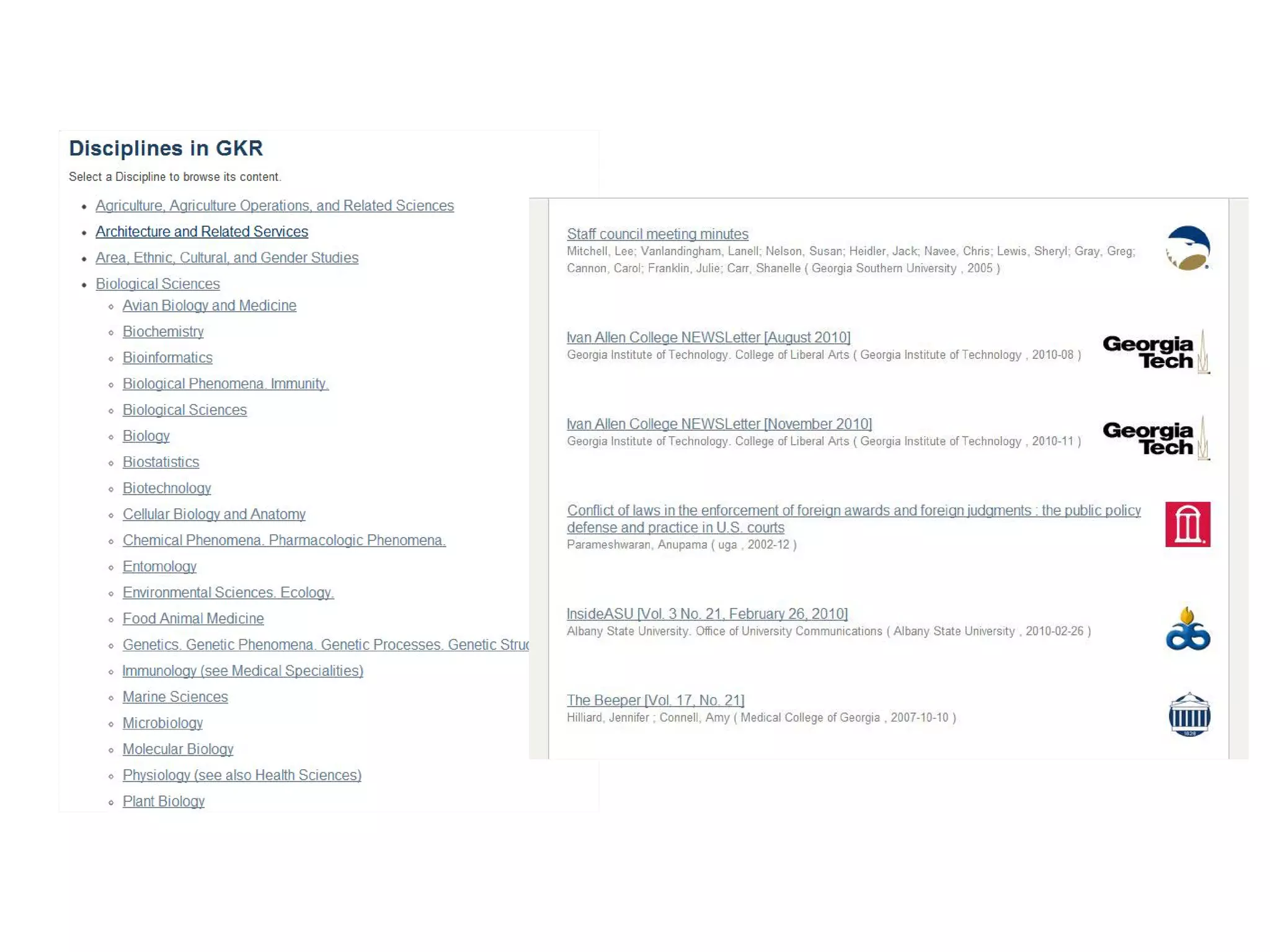
• Content from USG repositories available from a
  central site, organized by academic discipline
• DSpace repository with content harvested via OAI-
  PMH and the GKR Mapping Tool
• Keyword/full-text search
• Browse by title, author, date
• Browse by discipline
New repositories
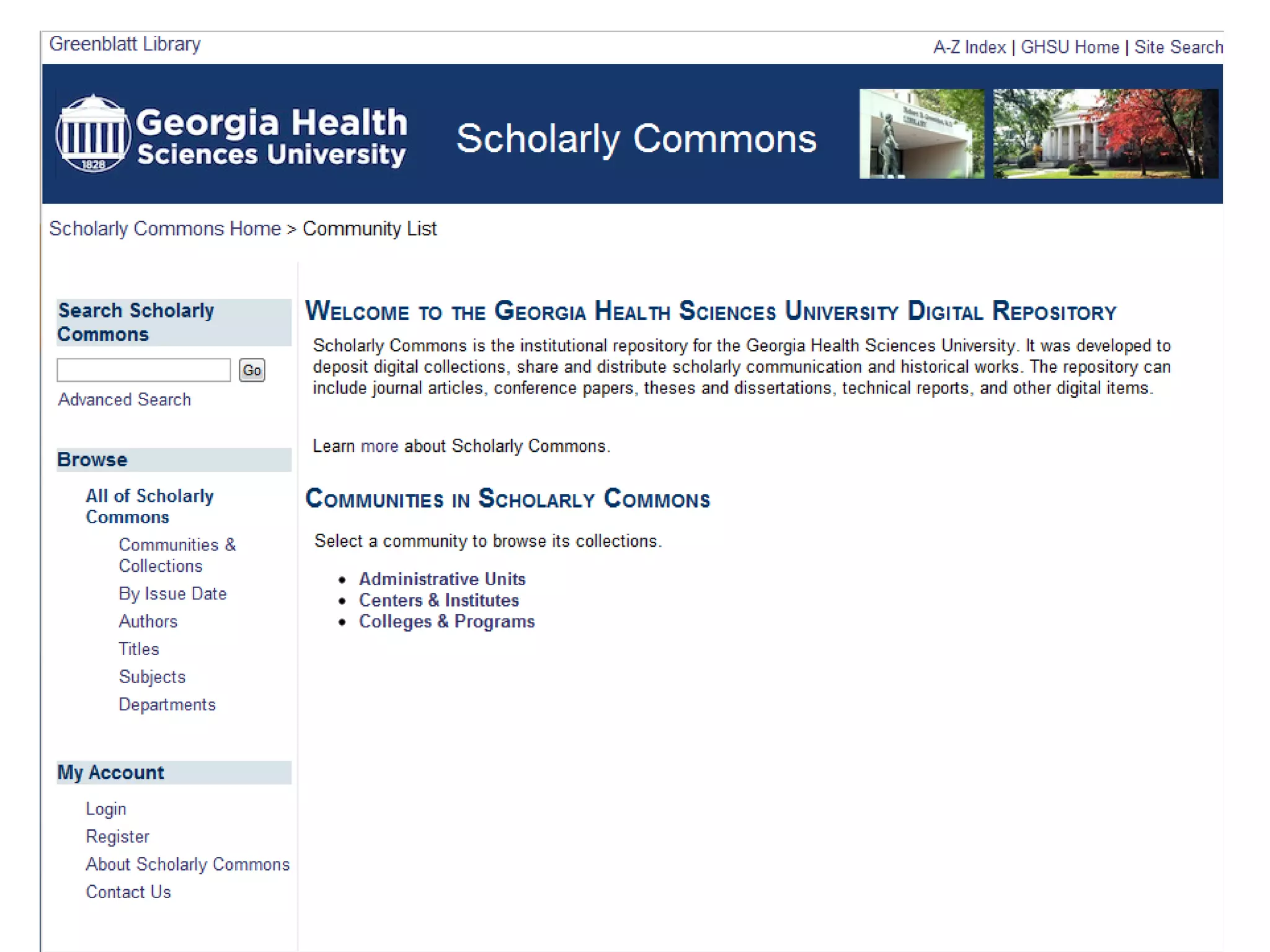
•   Georgia Health Sciences University
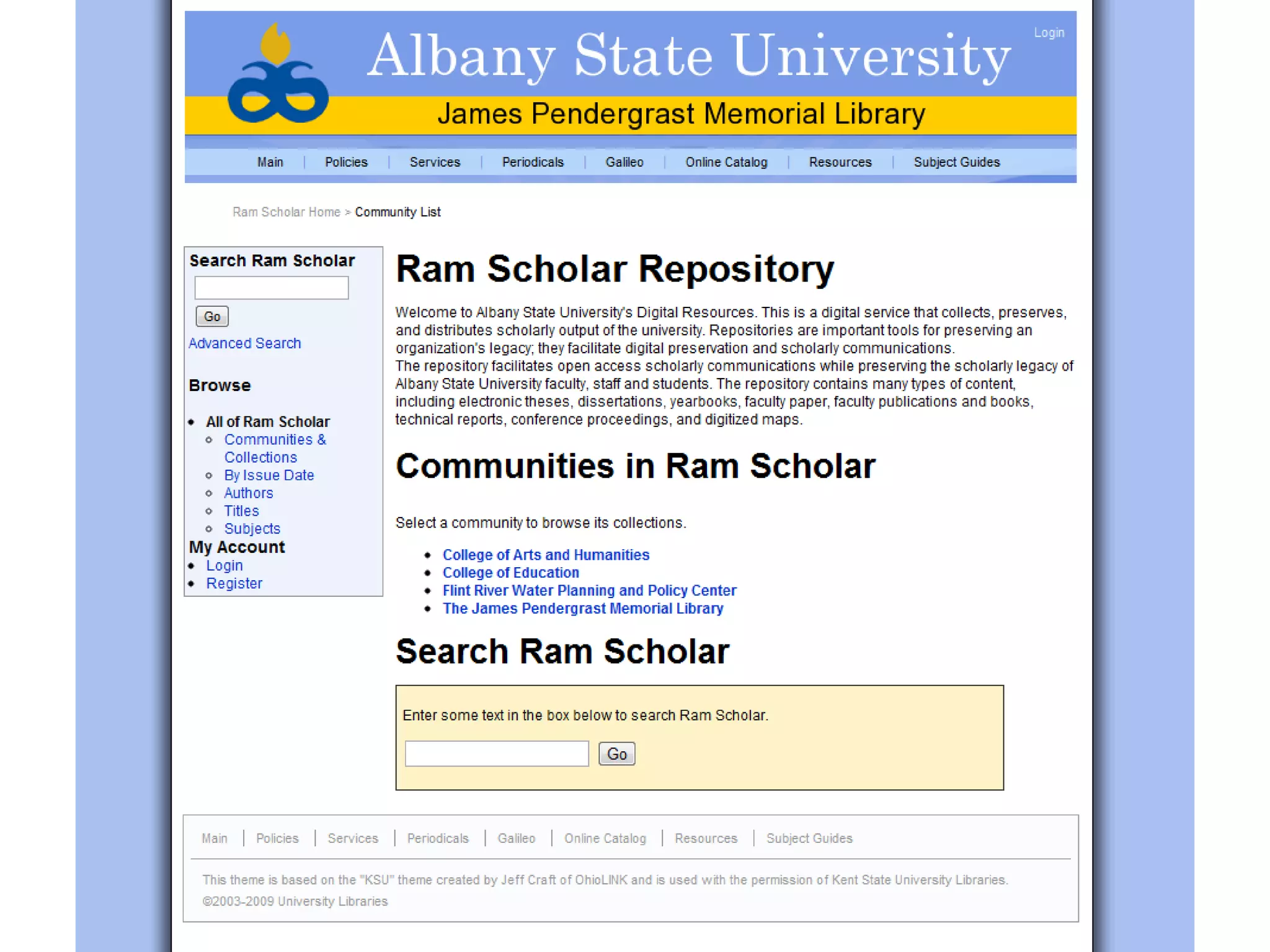
•   Albany State University
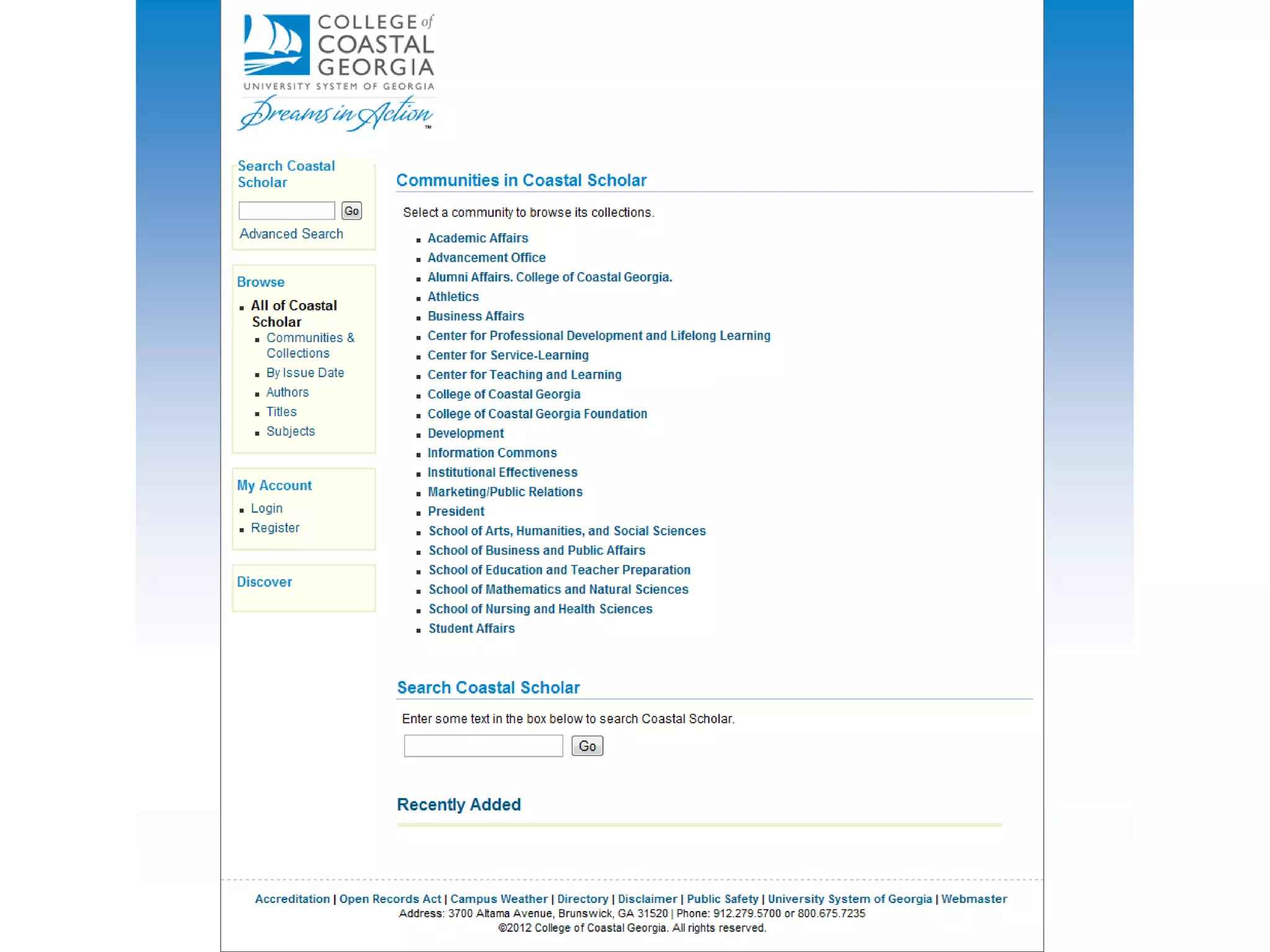
•   College of Coastal Georgia
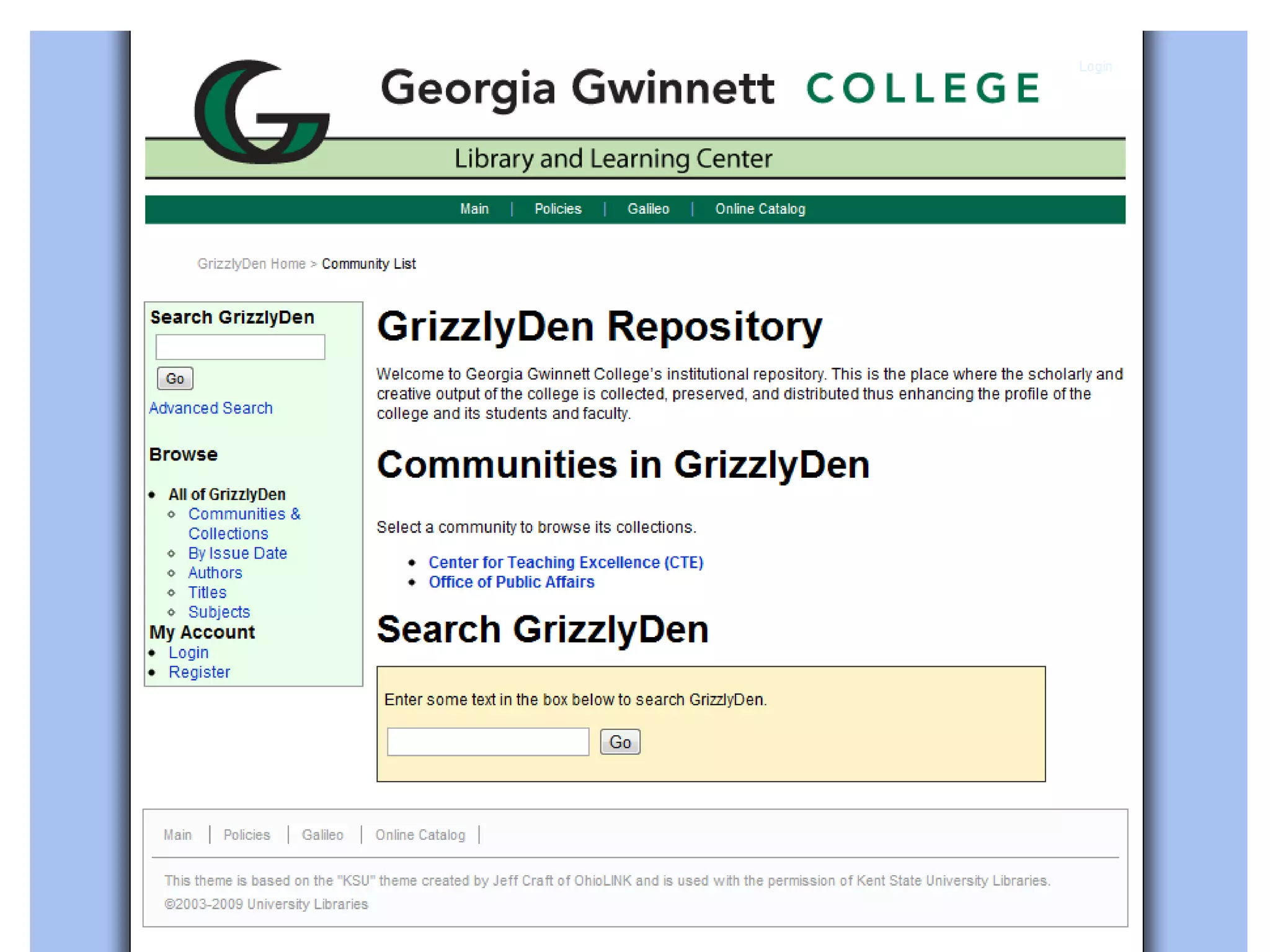
•   Georgia Gwinnett College
•   DSpace instance and content hosted on GT server
•   Content managed by hosted site
IR-related Services
• To reduce barriers to recruiting scholarly content
   Digitization
   Content submission
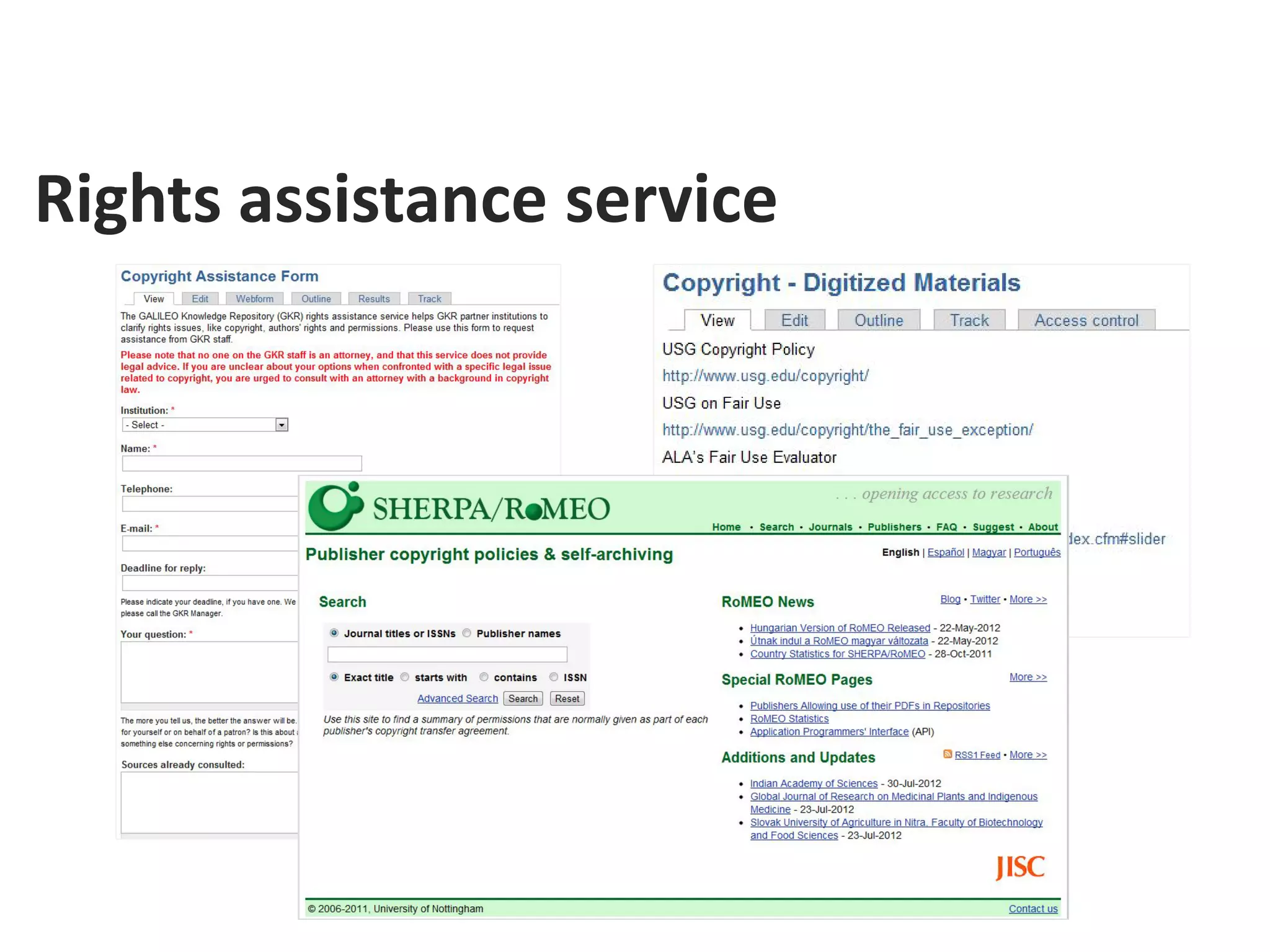
   Rights assistance
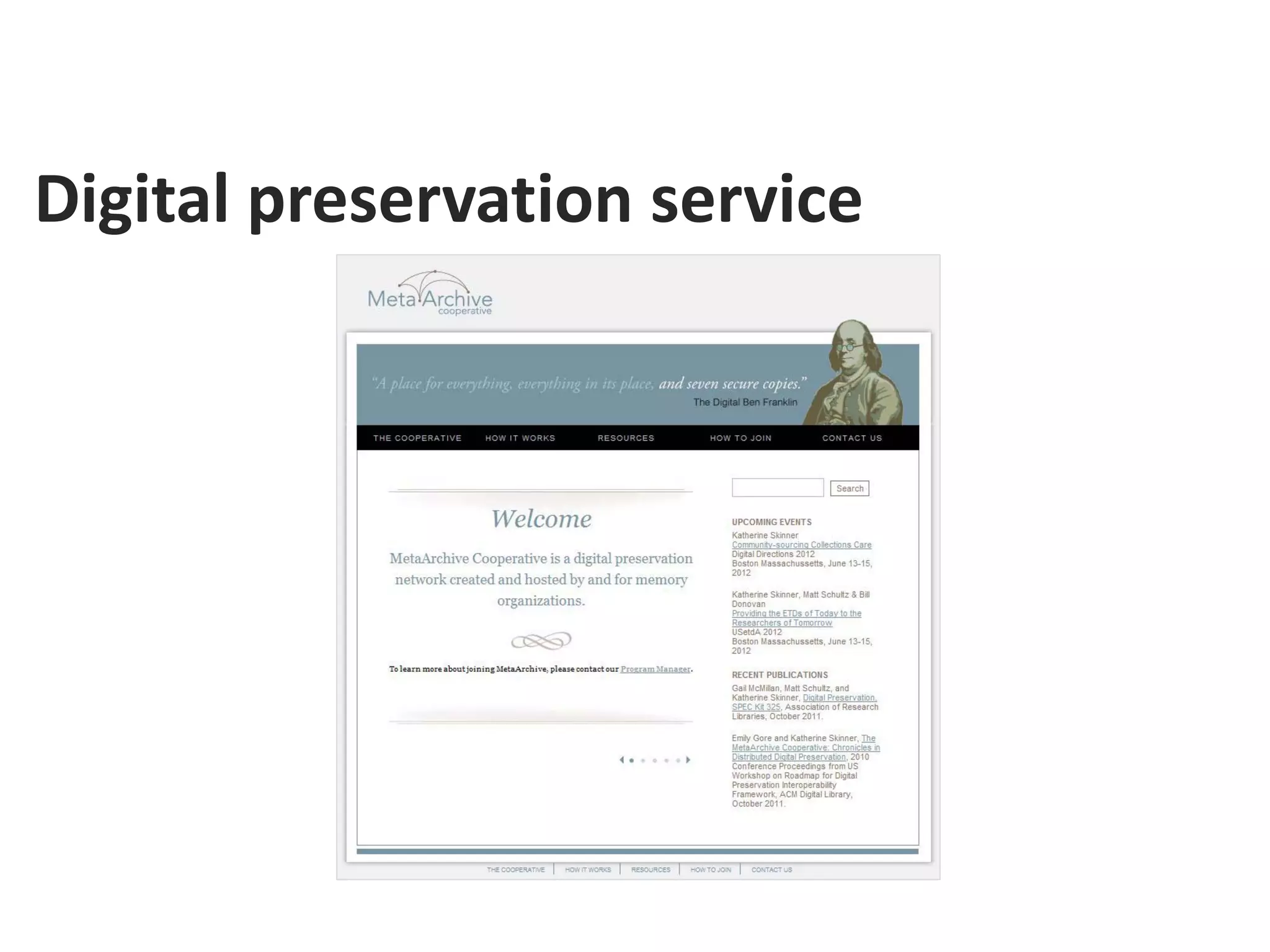
   Preservation
• Services resulted from the USG-wide GKR
  stakeholder meeting of November 30, 2007
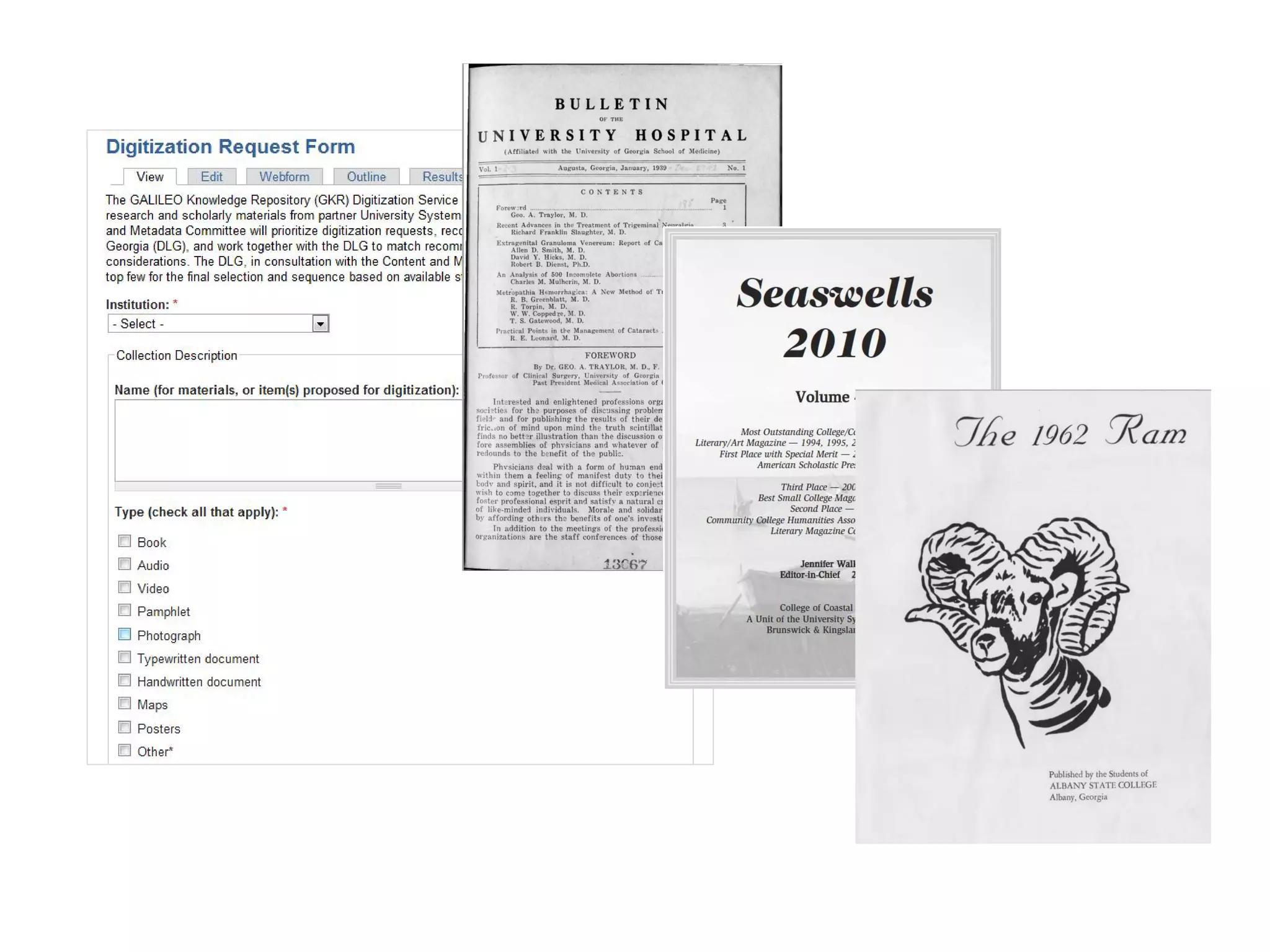
Digitization service
•   Digital Library of Georgia
•   GKR Content & Metadata Committee
•   Request form
•   Weighted prioritization
•   Approx. 50 requests since Spring 2010
•   10 projects completed
     Over 300 documents
     Over 50,000 images
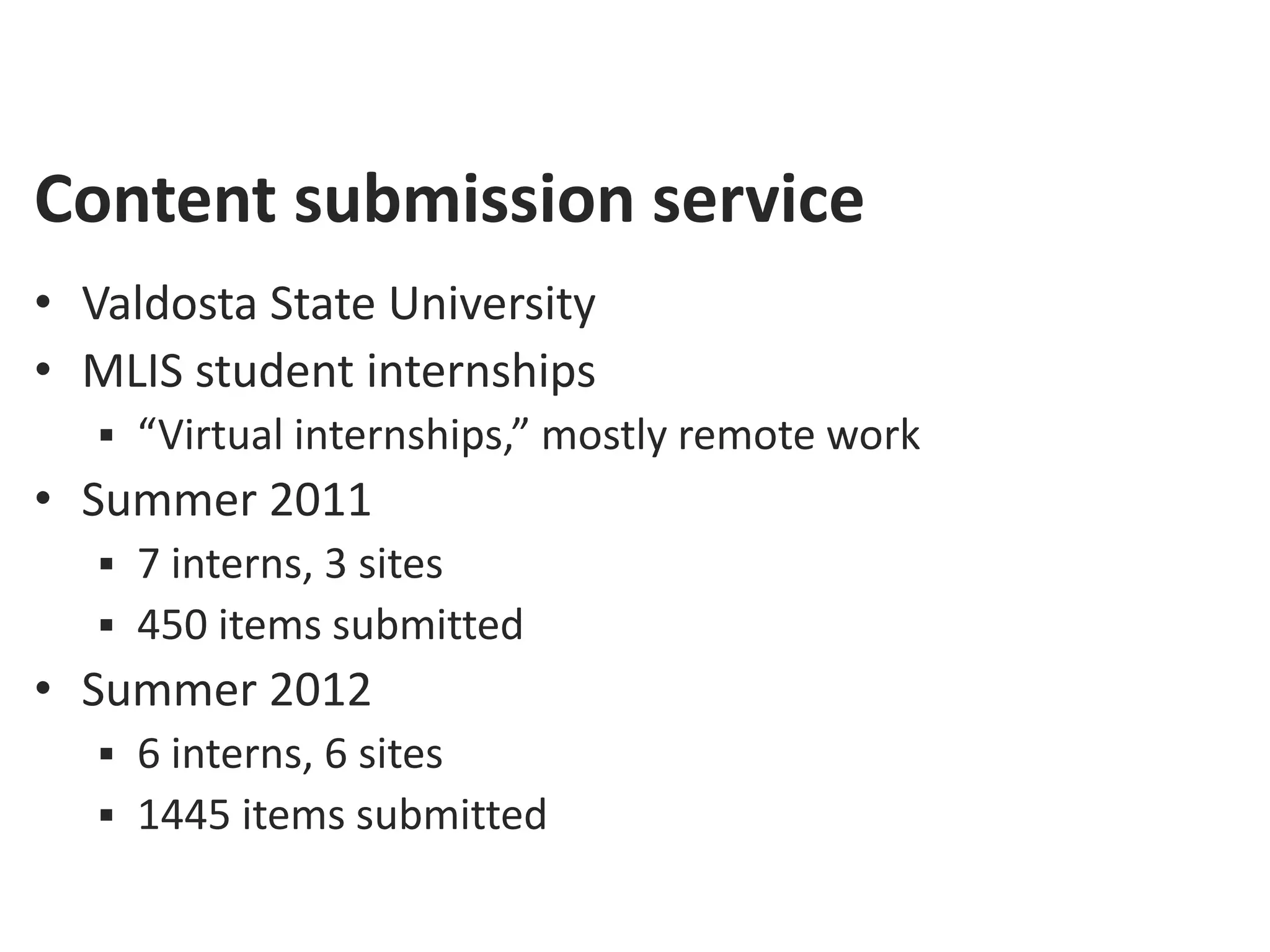
Content submission service
• Valdosta State University
• MLIS student internships
    “Virtual internships,” mostly remote work
• Summer 2011
    7 interns, 3 sites
    450 items submitted
• Summer 2012
    6 interns, 6 sites
    1445 items submitted
Rights assistance service
Digital preservation service
Statewide faculty survey
•   Spring 2012, led by Dr. Jennifer Campbell-Meier, UA SLIS
•   Population: all faculty at 35 USG institutions
•   539 respondents, from 26 USG institutions, completed the survey
•   Research questions
     To what extent do faculty in the USG publish in open access journals
        or repositories?
       To what extent are faculty aware of the individual rights of authors?
       Who is publishing in open access journals and repositories?
       To what extent are faculty interested in developing pilot collections?
       To what extent are the administrators familiar with the open access
        movement?
       What campus needs can the repository meet?
Symposium and workshop
• Cooperative Curation, August 8-9
   Free registration
     o 104 registered, 89 attended
   Travel scholarships
   Guide to Statewide and Consortial Repositories
   August 8: Symposium
     o Consortial repository case studies
     o Future trends panel
   August 9: Workshop
     o Management and Technology tracks
     o Lessons learned panel
Georgia Southern

PARTNER PERSPECTIVES
Perspectives from Georgia Southern
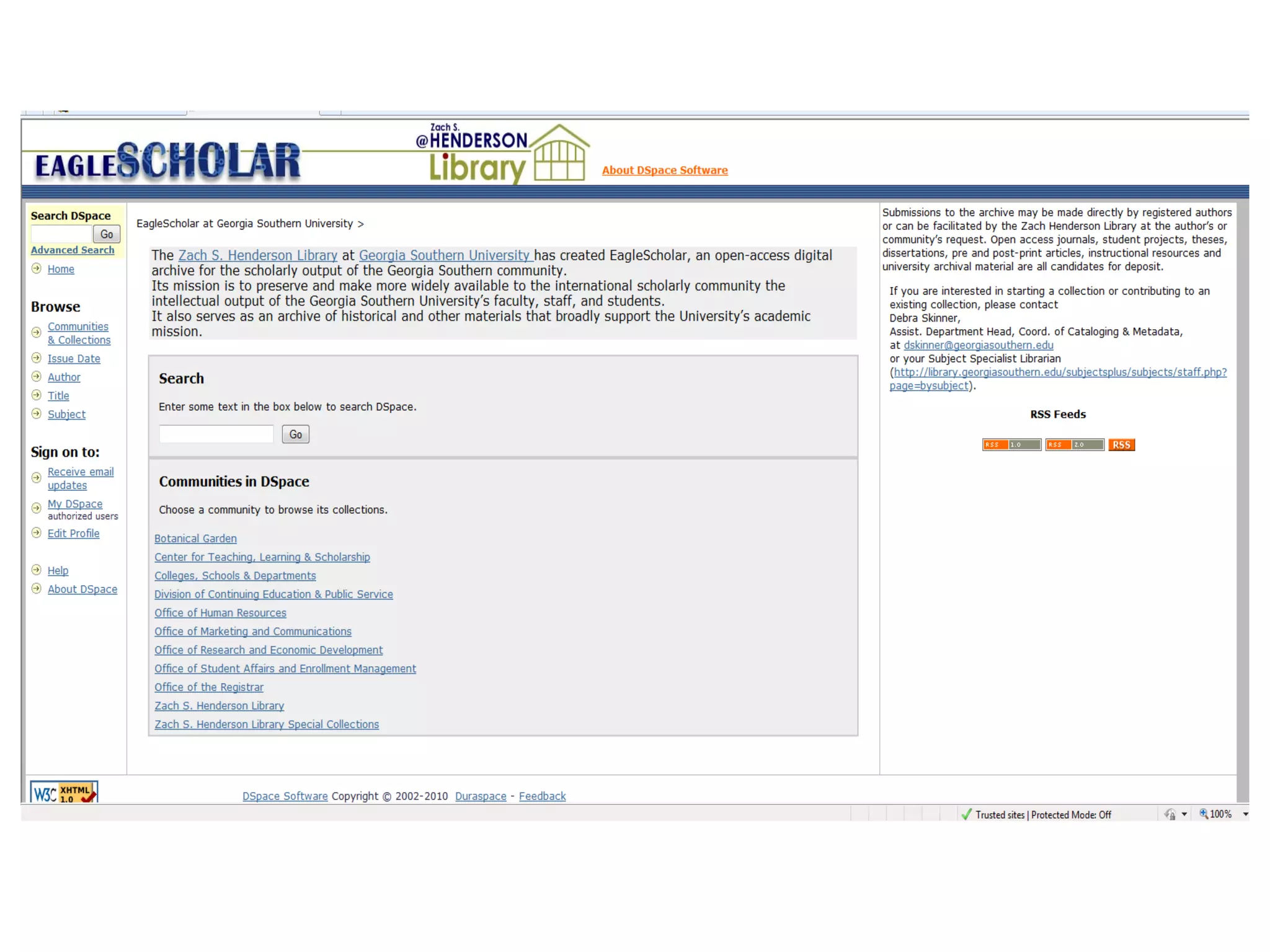
• Early partner site
• Maintained local instance of DSpace
   Harvested rather than hosted
   Relied on local IT services to set-up & maintain DSpace
• Opportunity to be part of state-wide consortium
Partner Site Contributions
• Library representatives on several GKR committees
    Content & Metadata Committee
    Steering Committee
• Asked for input every step of the way
    Dublin Core
    Item types
• Content & Metadata Committee - Online meetings
    Evaluated digitization submissions
    Tested our sites & provided feedback
Partner Sites Workload
• No additional staffing
• Developed workflow involving multiple library staff
    Liaisons – Encouraged use of IR with faculty
    Content Management - Reviewed submissions &
     checked/advised regarding copyright
    Cataloging/Metadata Staff – Entered metadata
• Promotion
    PowerPoint presentation, FAQs, presentation to Library
     Committee & others, liaison promotion
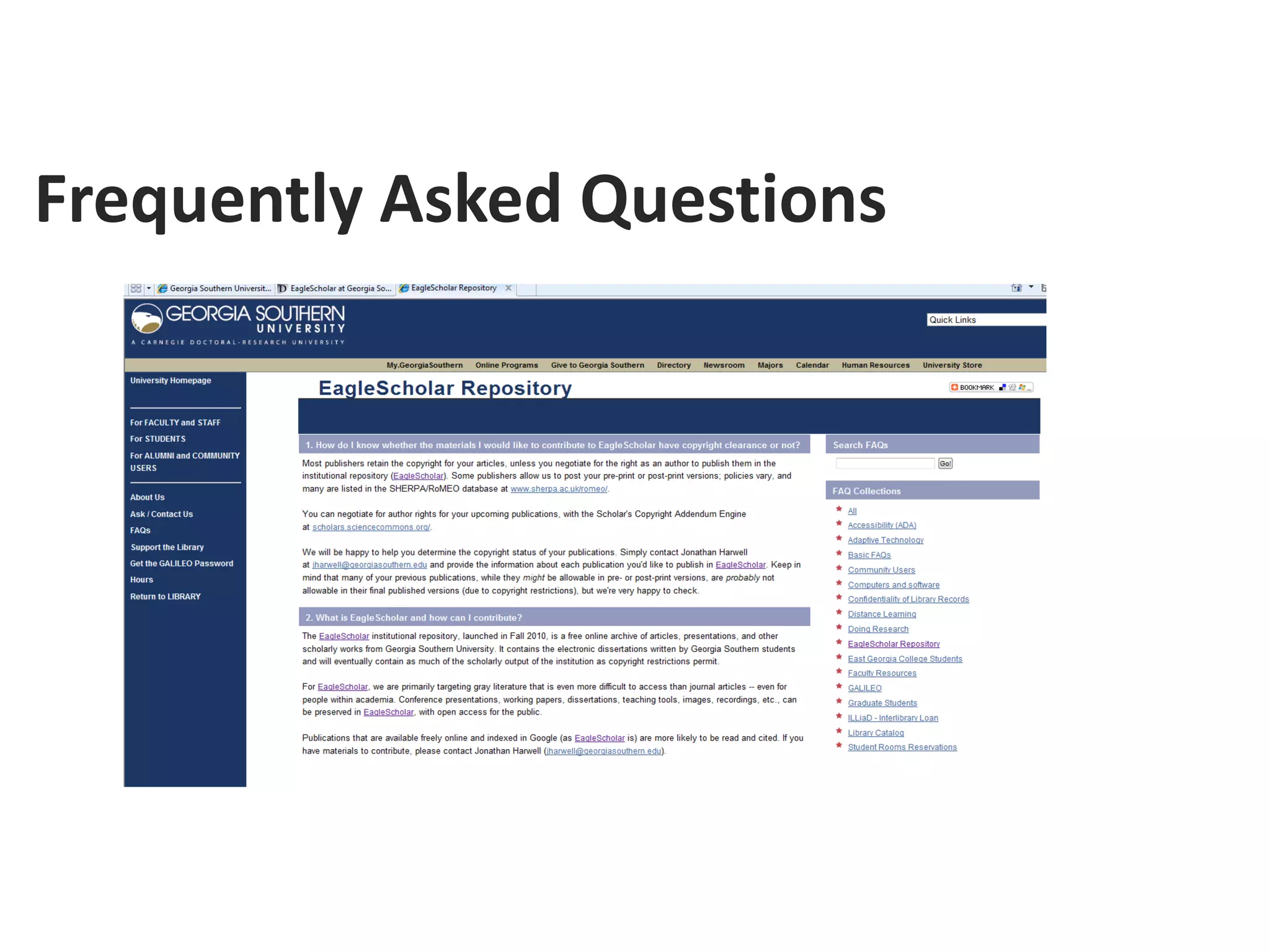
Frequently Asked Questions
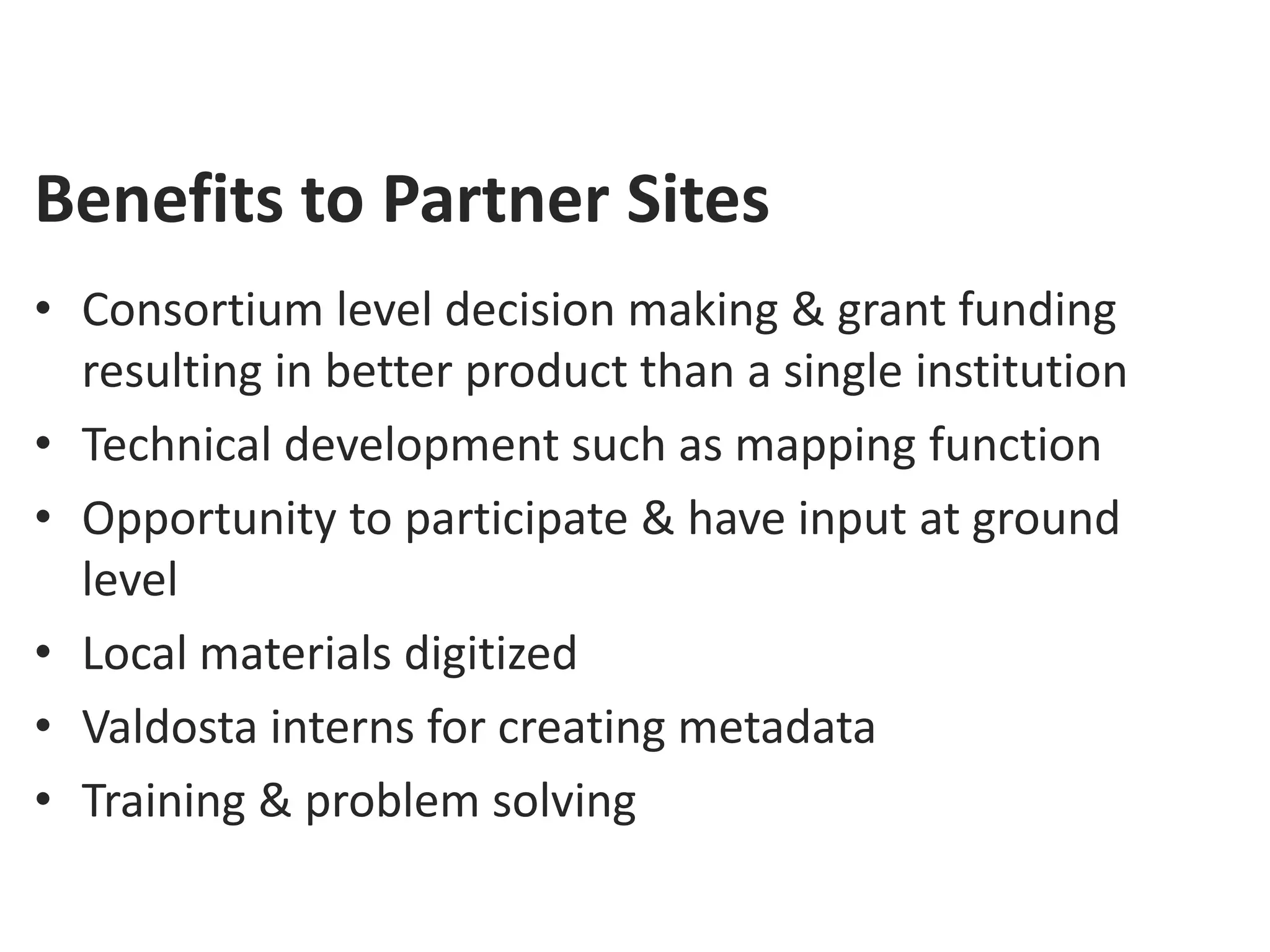
Benefits to Partner Sites
• Consortium level decision making & grant funding
  resulting in better product than a single institution
• Technical development such as mapping function
• Opportunity to participate & have input at ground
  level
• Local materials digitized
• Valdosta interns for creating metadata
• Training & problem solving
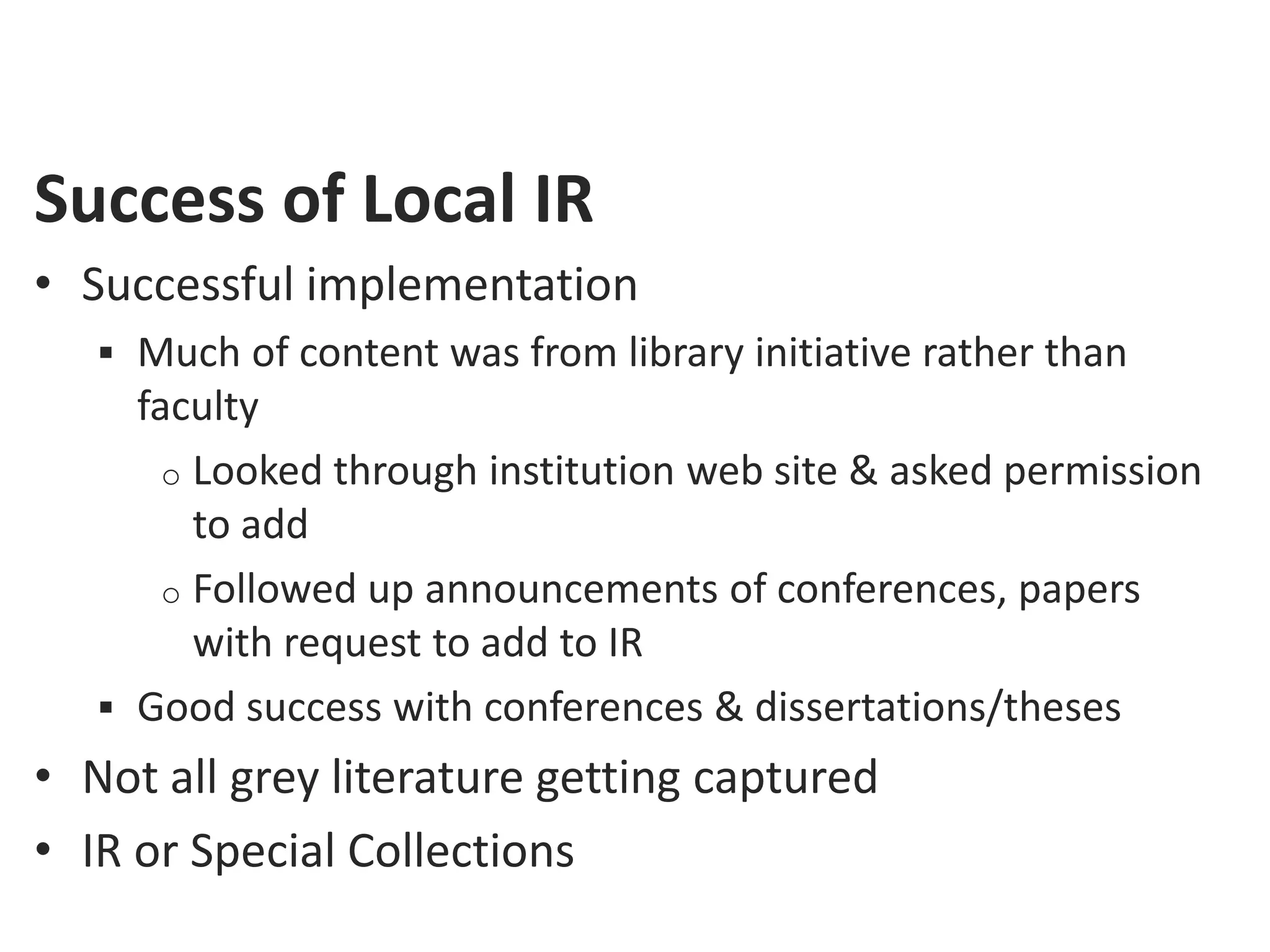
Success of Local IR
• Successful implementation
    Much of content was from library initiative rather than
     faculty
       o Looked through institution web site & asked permission
         to add
       o Followed up announcements of conferences, papers
         with request to add to IR
    Good success with conferences & dissertations/theses
• Not all grey literature getting captured
• IR or Special Collections
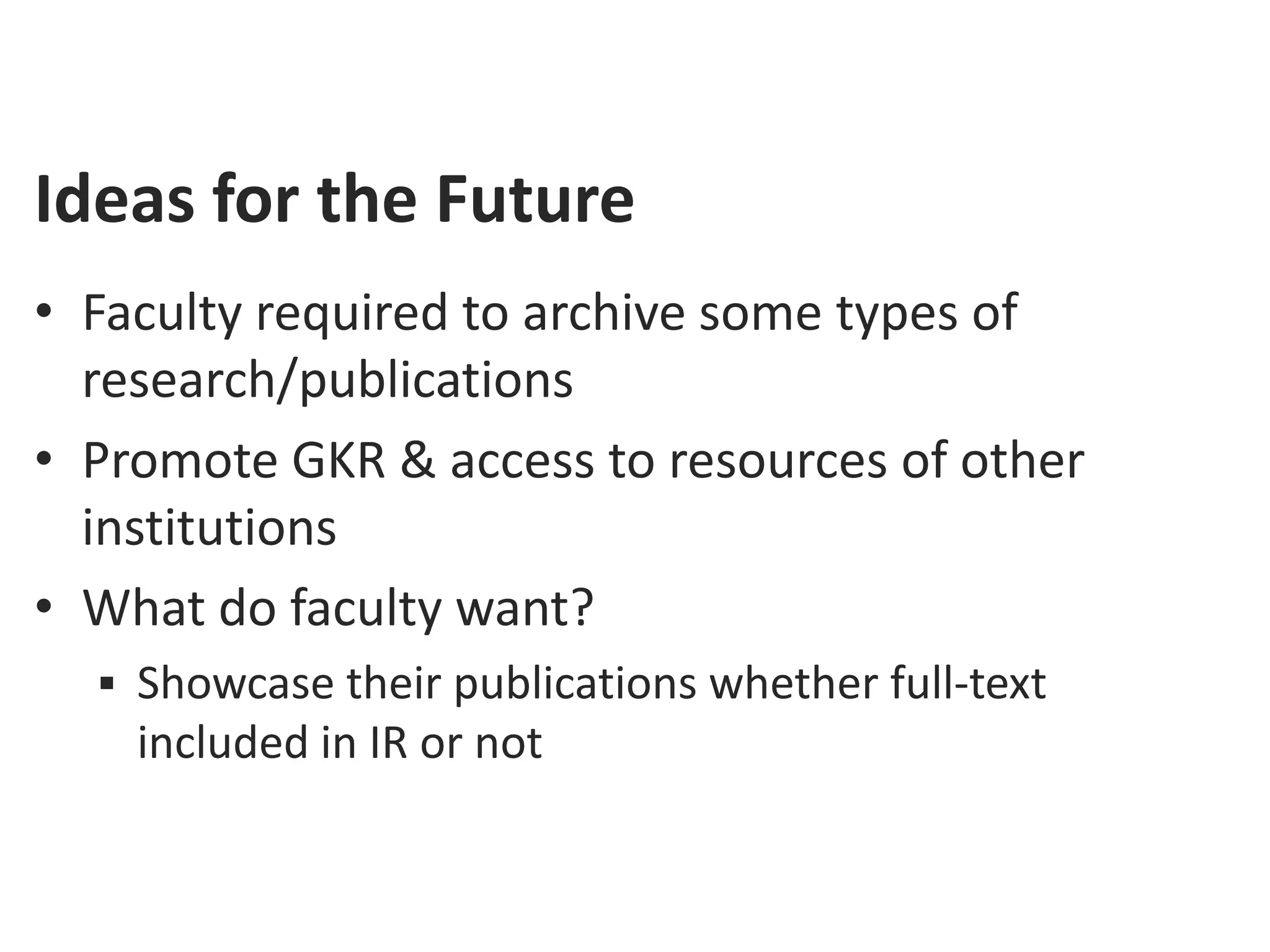
Ideas for the Future
• Faculty required to archive some types of
  research/publications
• Promote GKR & access to resources of other
  institutions
• What do faculty want?
   Showcase their publications whether full-text
    included in IR or not
UGA

PARTNER PERSPECTIVES
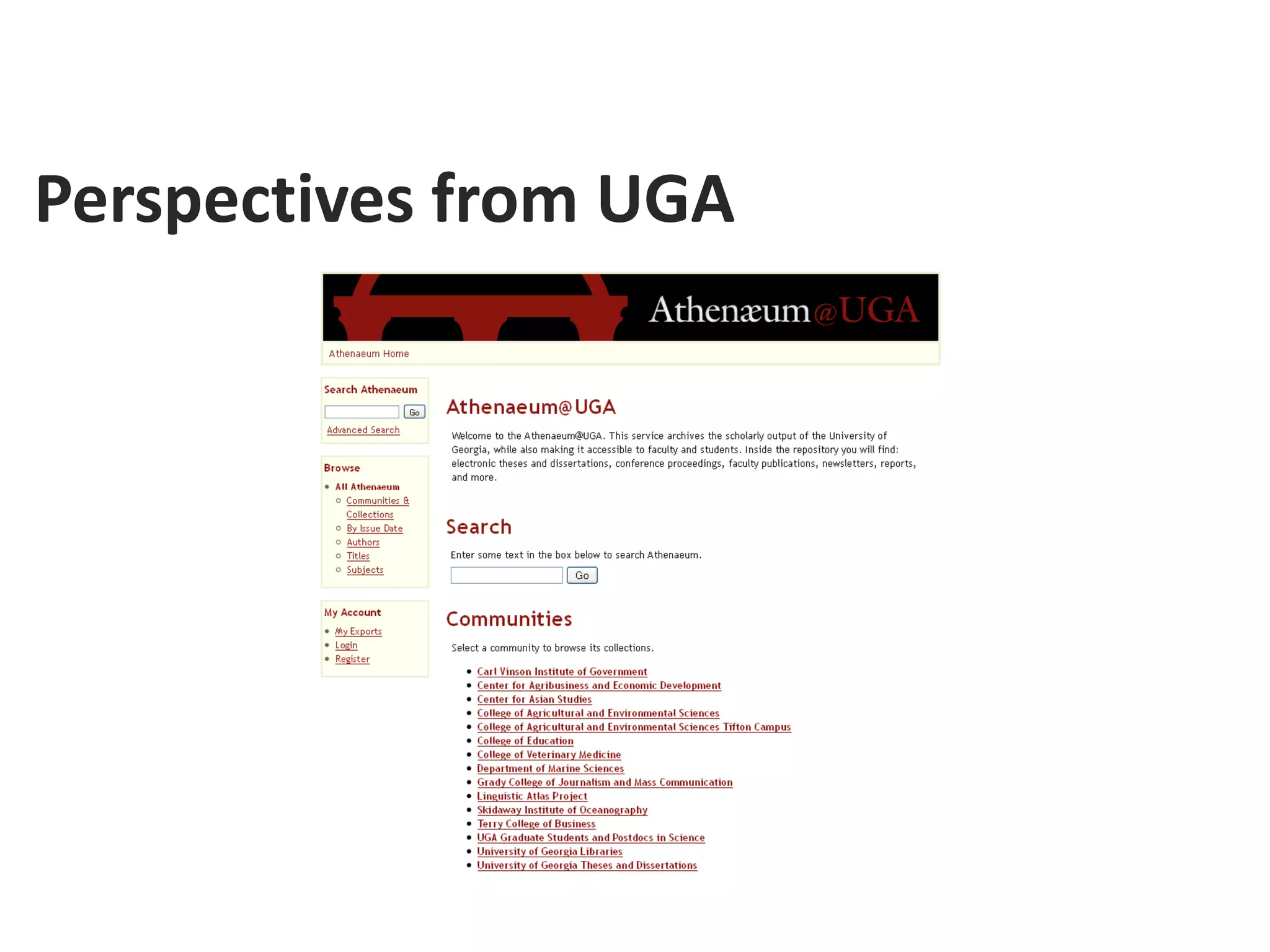
Perspectives from UGA
History of IR development at UGA
 -Planning started in 2005

 -Content Harvesting

 -Original DSpace instance

 -Renewed effort as a result of GKR grant

 -Hiring of Scholarly Communications Librarian
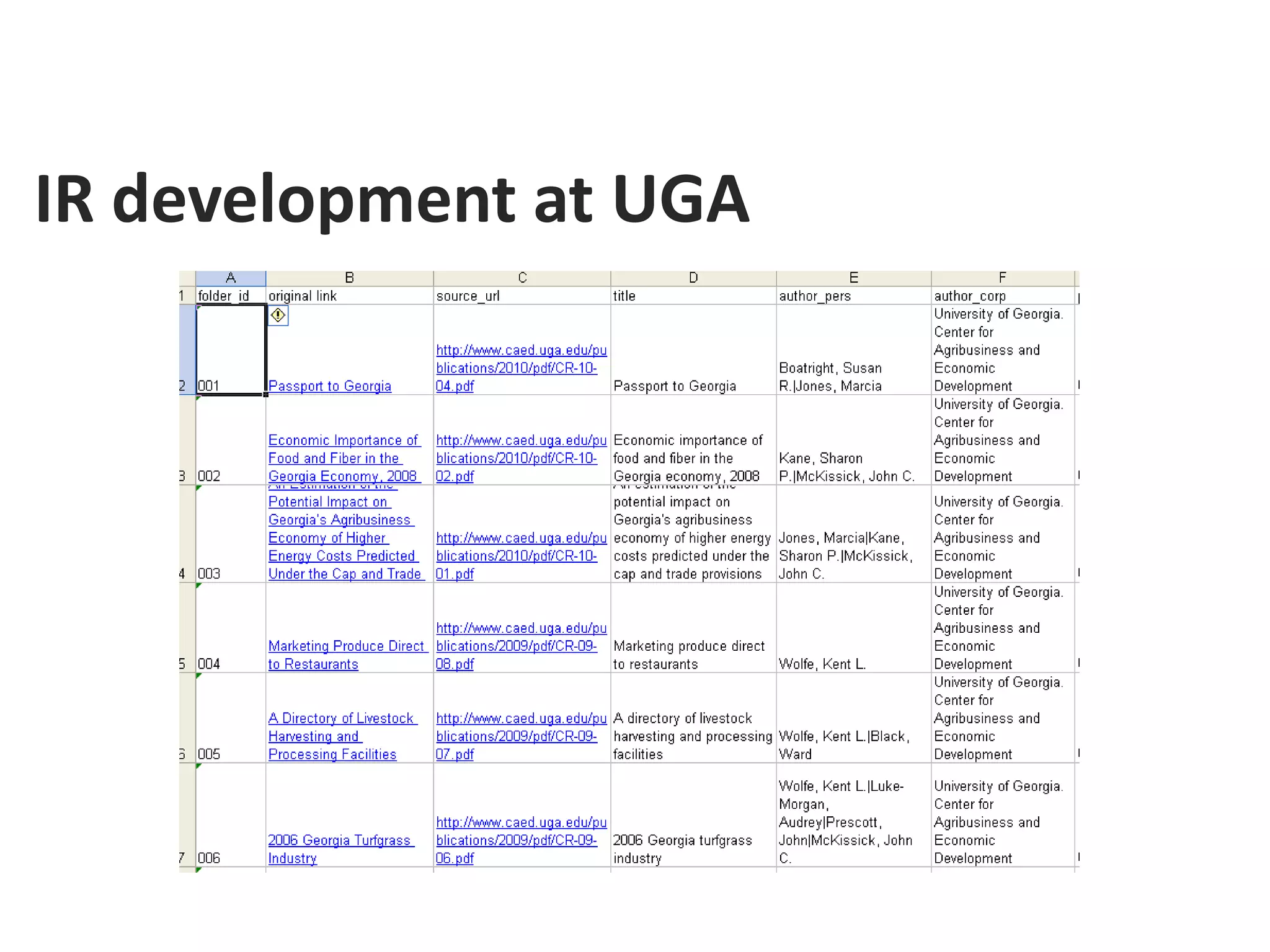
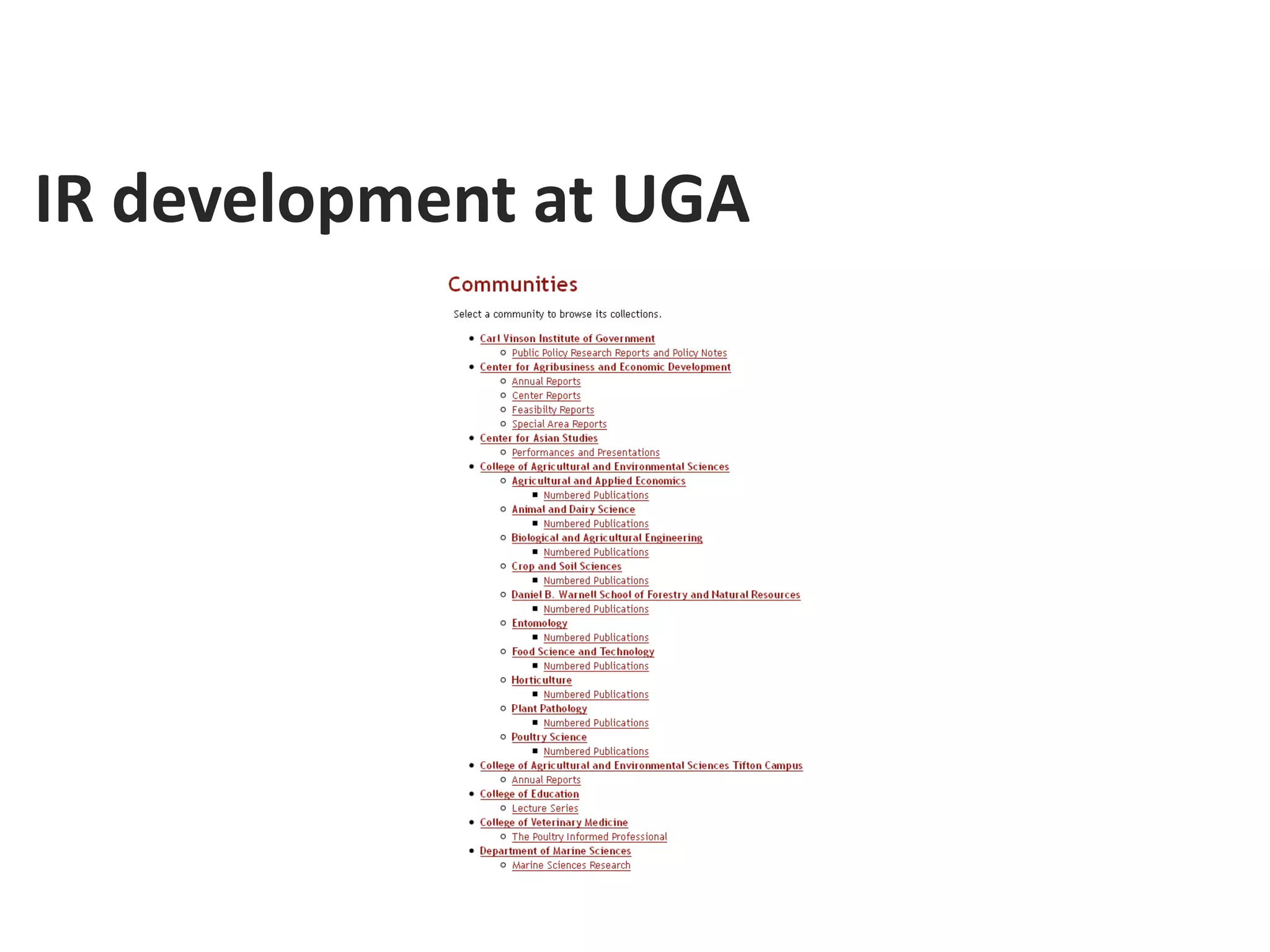
IR development at UGA
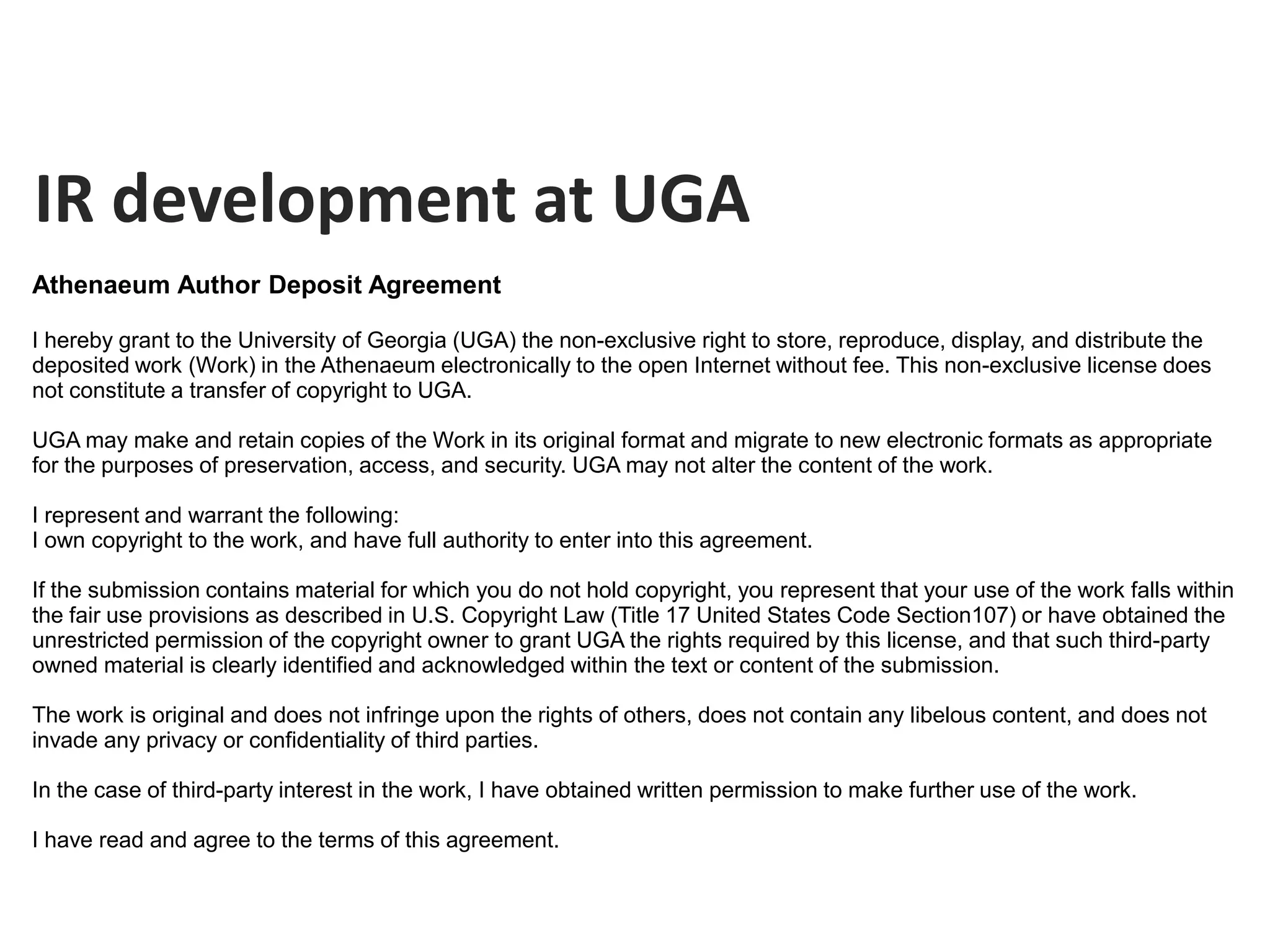
Athenaeum Author Deposit Agreement

I hereby grant to the University of Georgia (UGA) the non-exclusive right to store, reproduce, display, and distribute the
deposited work (Work) in the Athenaeum electronically to the open Internet without fee. This non-exclusive license does
not constitute a transfer of copyright to UGA.

UGA may make and retain copies of the Work in its original format and migrate to new electronic formats as appropriate
for the purposes of preservation, access, and security. UGA may not alter the content of the work.

I represent and warrant the following:
I own copyright to the work, and have full authority to enter into this agreement.

If the submission contains material for which you do not hold copyright, you represent that your use of the work falls within
the fair use provisions as described in U.S. Copyright Law (Title 17 United States Code Section107) or have obtained the
unrestricted permission of the copyright owner to grant UGA the rights required by this license, and that such third-party
owned material is clearly identified and acknowledged within the text or content of the submission.

The work is original and does not infringe upon the rights of others, does not contain any libelous content, and does not
invade any privacy or confidentiality of third parties.

In the case of third-party interest in the work, I have obtained written permission to make further use of the work.

I have read and agree to the terms of this agreement.
IR development at UGA
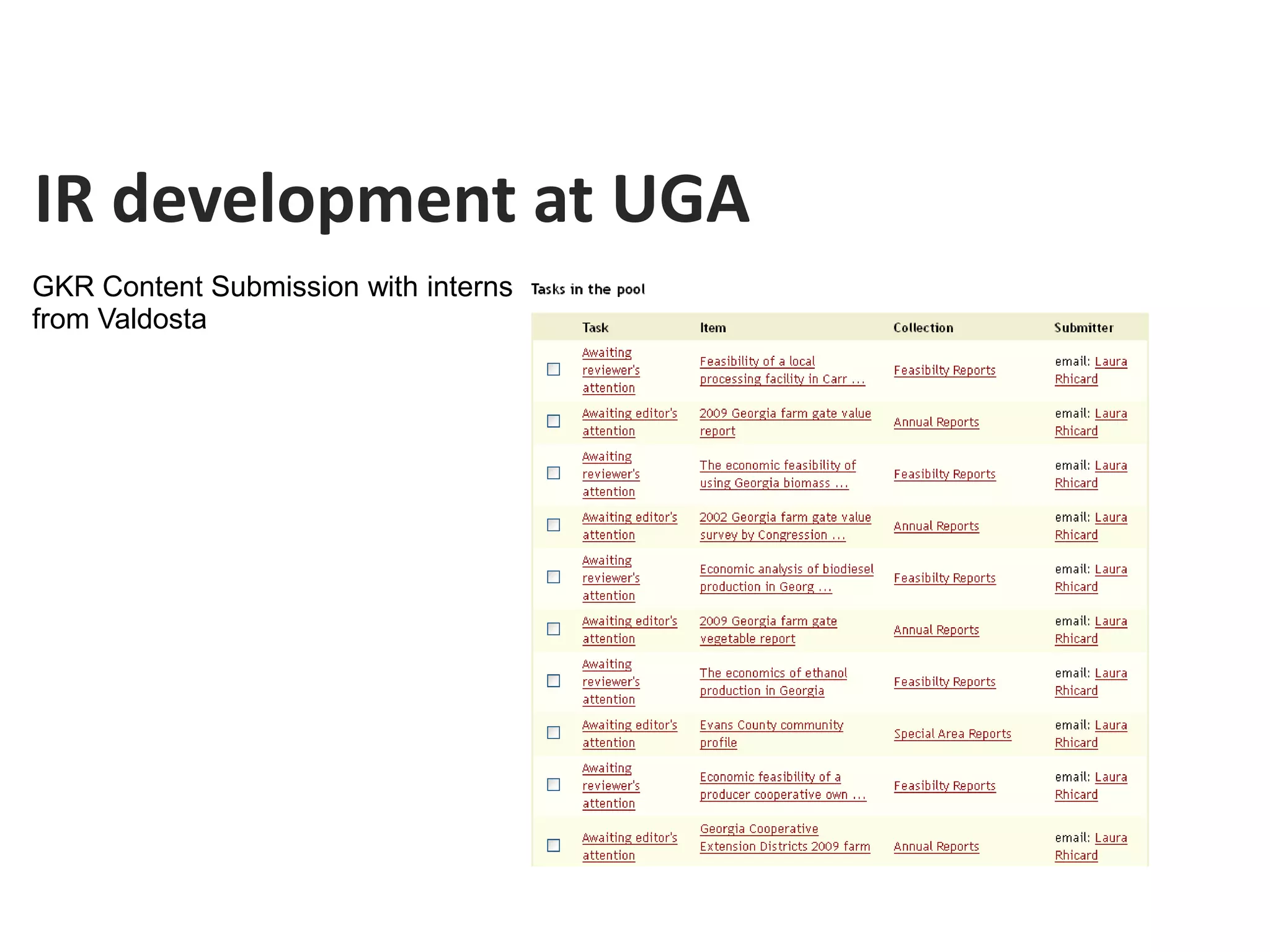
GKR Content Submission with interns
from Valdosta
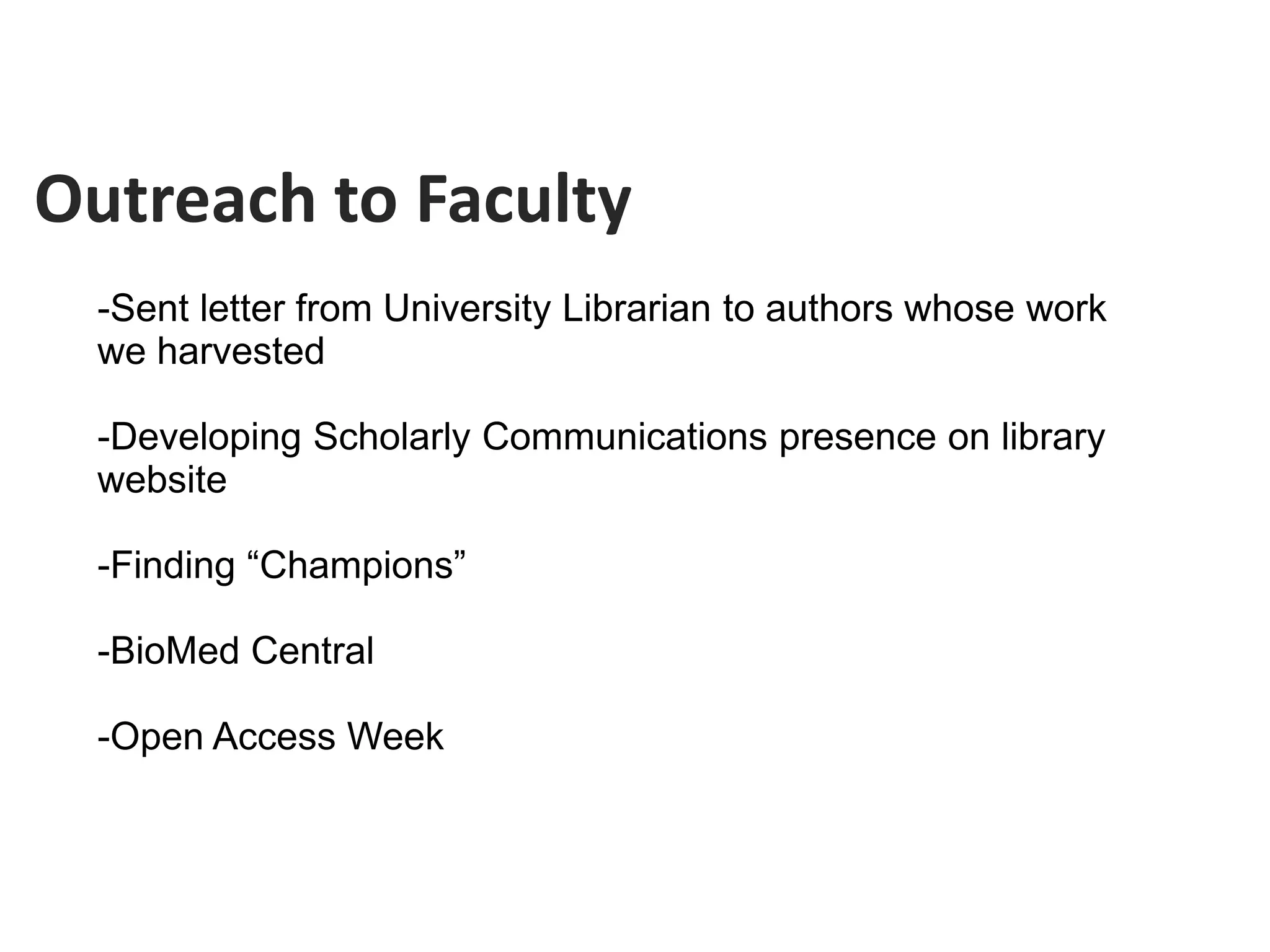
Outreach to Faculty
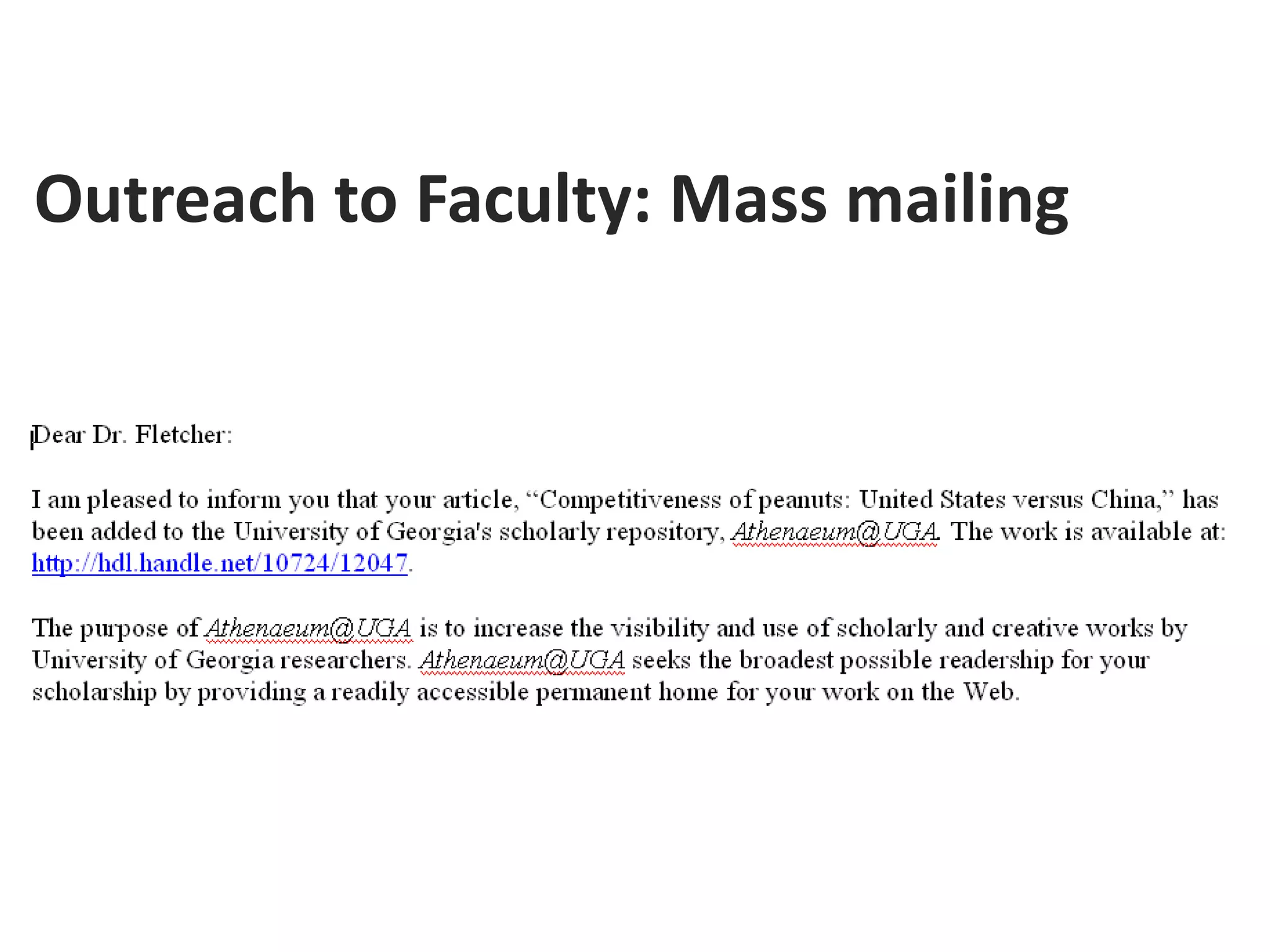
  -Sent letter from University Librarian to authors whose work
  we harvested

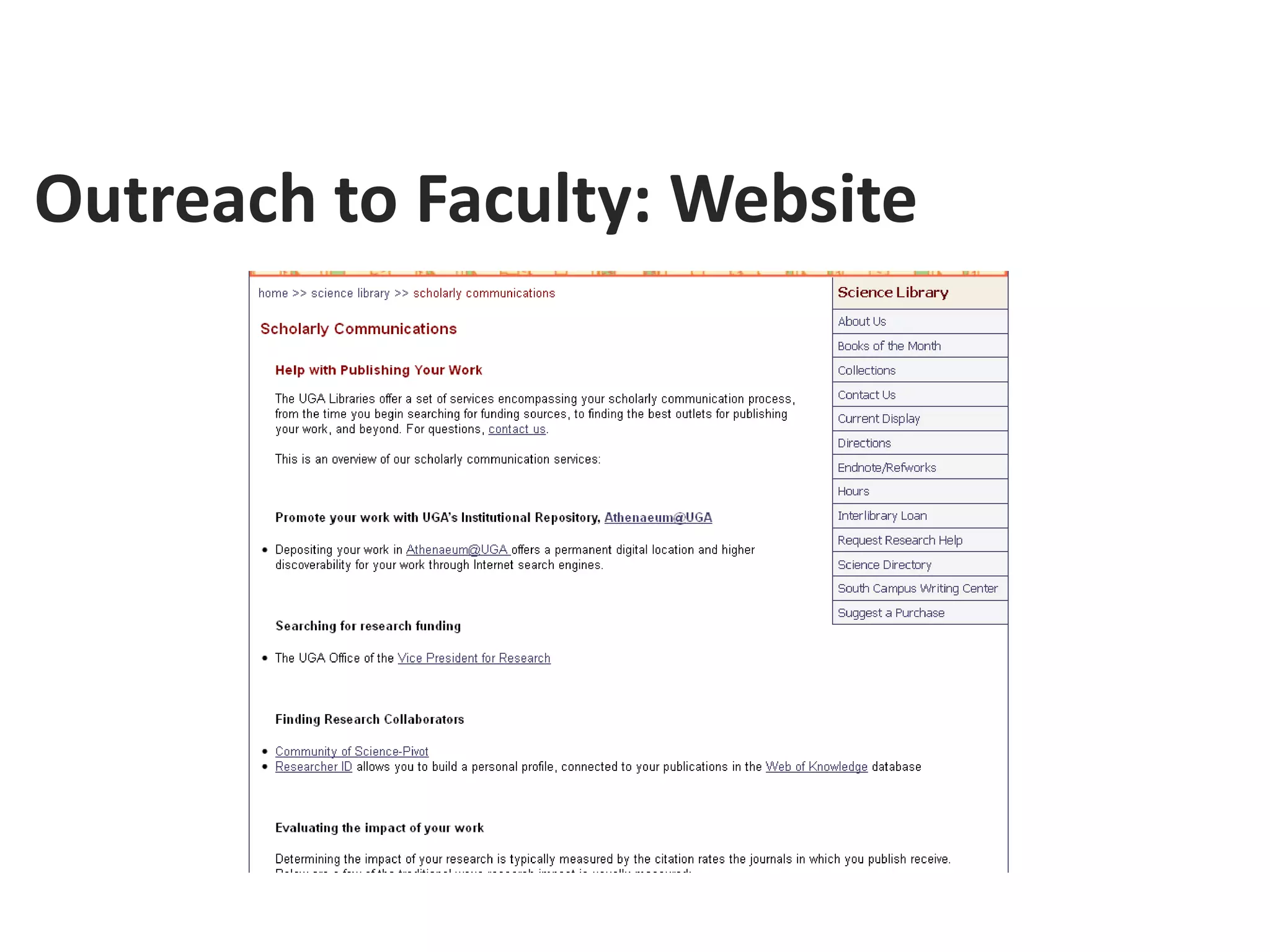
  -Developing Scholarly Communications presence on library
  website

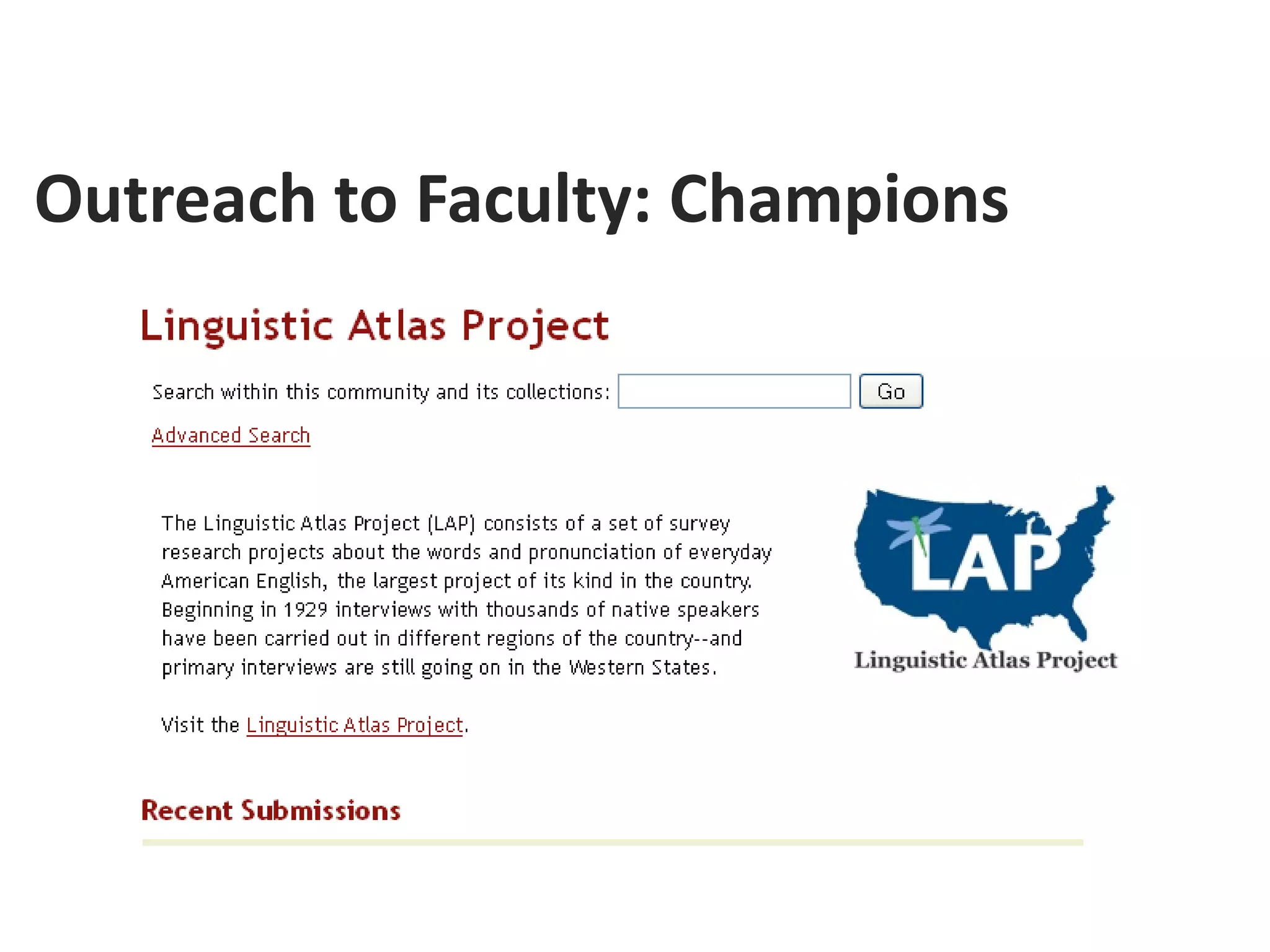
  -Finding “Champions”

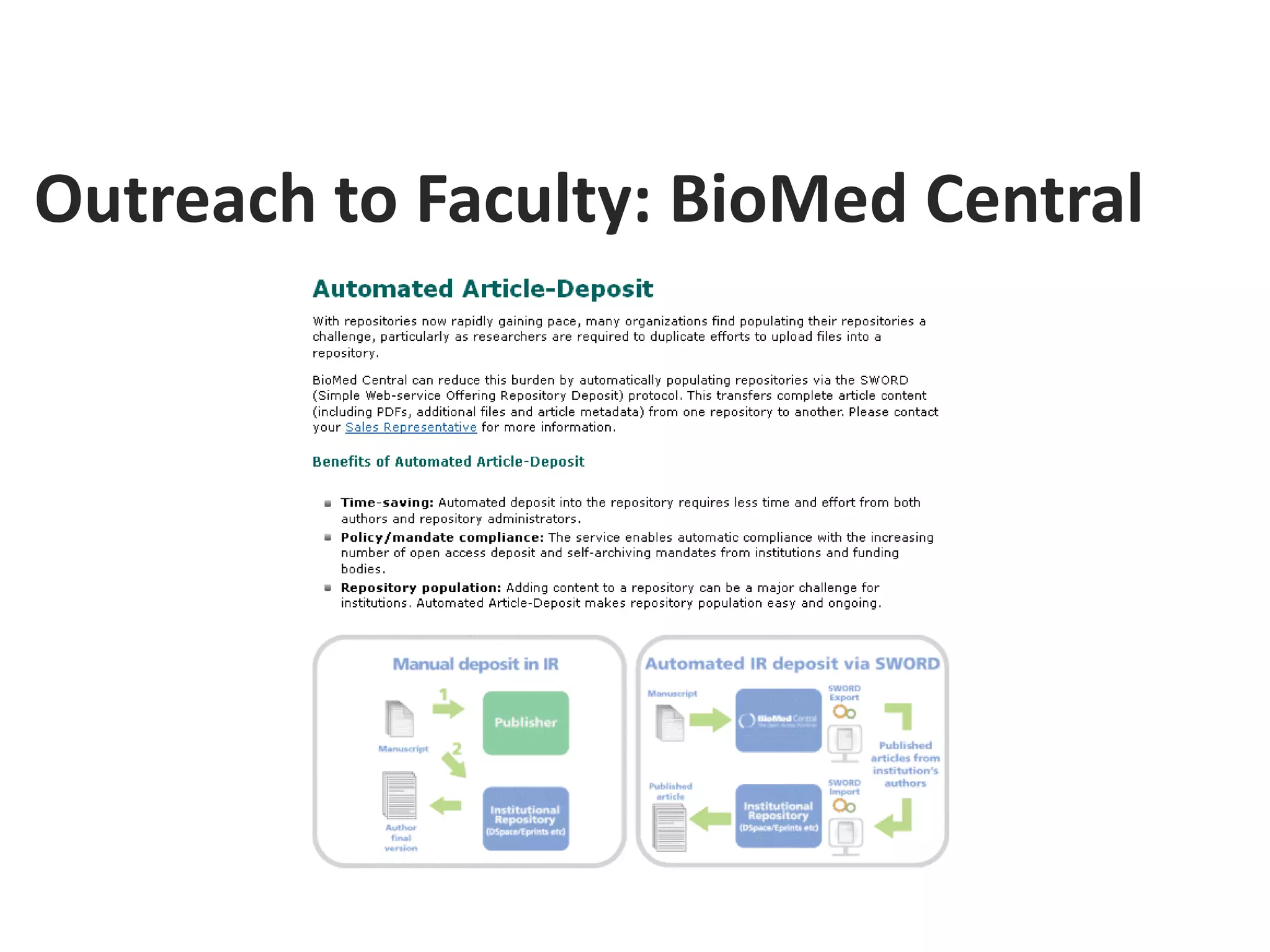
  -BioMed Central

  -Open Access Week
Outreach to Faculty: Mass mailing
Outreach to Faculty: Website
Outreach to Faculty: Champions
Outreach to Faculty: BioMed Central
Outreach to Faculty: Open Access
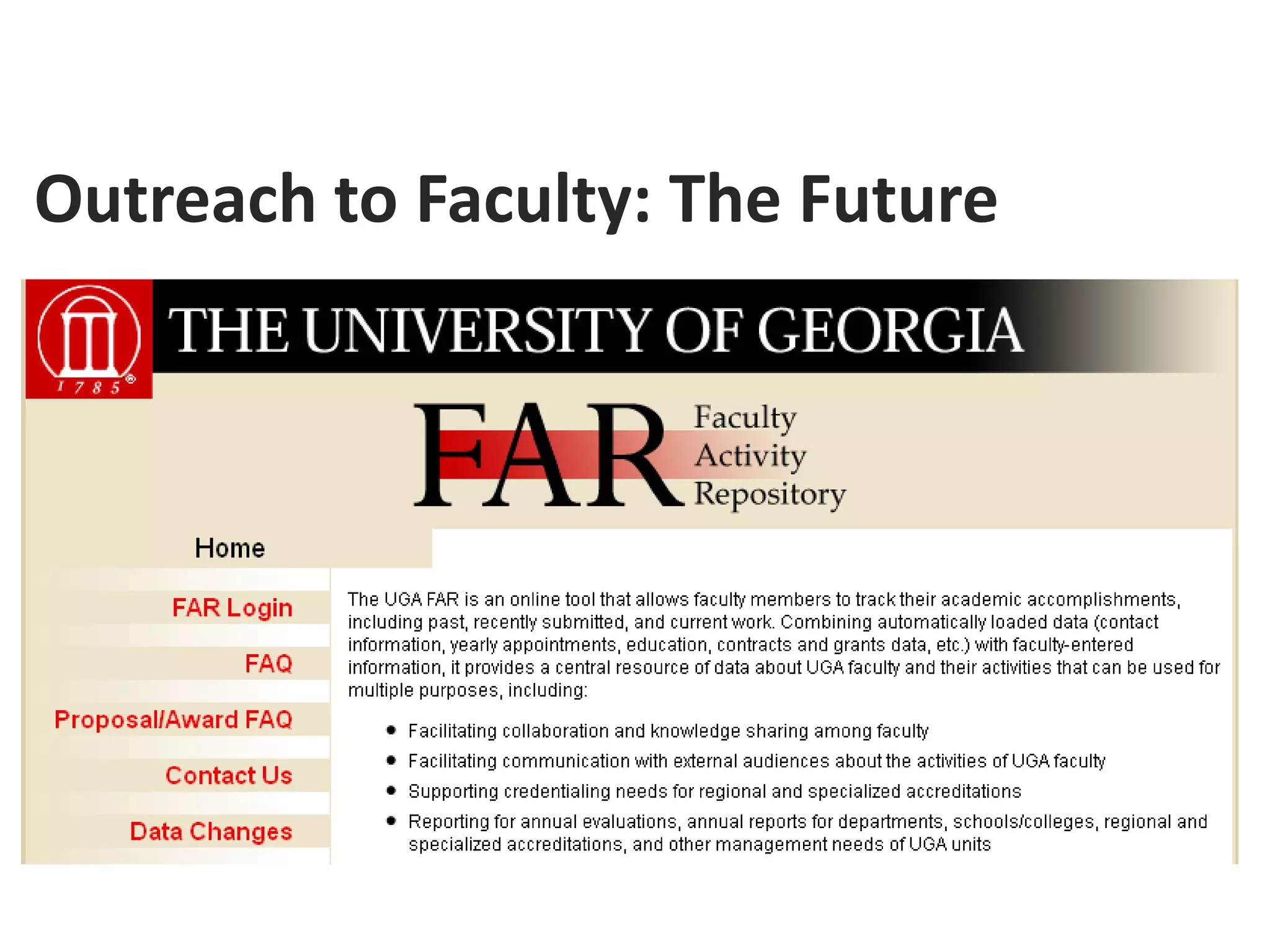
Outreach to Faculty: The Future
WHAT’S NEXT FOR THE GKR?
Plans for grant extension
• Continue grant services
     Digitization
     Content submission
     Preservation
     Rights assistance
• Faculty outreach
   On-site workshops
   Develop focus group materials
• Transfer DSpace hosting service to vendor
• Expand metadata repository to new partners
What questions do you have?
Thank you!
http://gaknowledge.org/

GALILEO Knowledge Repository (GKR) Panel

  • 1.
    GKR: GALILEO Knowledge Repository Marlee Givens Andy Carter Debra Skinner GaCOMO Conference Macon, GA October 4, 2012
  • 2.
    About us • MarleeGivens  GKR project manager • Andy Carter  Digital Projects Archivist, Digital Library of Georgia  GKR Content & Metadata Committee chair • Debra Skinner  Coordinator of Cataloging & Metadata, Assistant Dept. Head, Georgia Southern University  GKR Content & Metadata Committee member
  • 3.
    The Problem • Muchof USG’s intellectual product never appears in a permanent printed form • Exists as disorganized pockets of digitally born objects & media scattered among individual hard drives, departmental servers, and removable storage media across an institution • While USG’s digital scholarly output reflects substantial investment of resources, assets and effort, it  Lacks curatorial stewardship;  May be inaccessible;  Exists on unsustainable hardware, software, or individual support;  Needs future-proofing migration strategies.
  • 4.
    GALILEO Knowledge Repository(GKR) • Building a system-wide approach to Institutional Repositories • Concept developed by Regents Advisory Committee on Libraries (RACL) in August 2004 • Federal grant (IMLS National Leadership) awarded 2009 to seed the project • Leads: Georgia Institute of Technology & University of Georgia
  • 5.
    GKR partners Georgia Gwinnett College KSU UGA GT GSU Georgia Health Sciences University Georgia Southern Albany State College of University Coastal Georgia VSU
  • 6.
    GKR Project Components •4 new institutional repositories (IRs) • Central metadata repository • IR-related services: digitization, content submission, rights assistance, preservation • USG statewide faculty survey • Symposium and workshop • Documentation of technical model
  • 7.
    GKR metadata repository •http://gaknowledge.org/ • Content from USG repositories available from a central site, organized by academic discipline • DSpace repository with content harvested via OAI- PMH and the GKR Mapping Tool • Keyword/full-text search • Browse by title, author, date • Browse by discipline
  • 10.
    New repositories • Georgia Health Sciences University • Albany State University • College of Coastal Georgia • Georgia Gwinnett College • DSpace instance and content hosted on GT server • Content managed by hosted site
  • 15.
    IR-related Services • Toreduce barriers to recruiting scholarly content  Digitization  Content submission  Rights assistance  Preservation • Services resulted from the USG-wide GKR stakeholder meeting of November 30, 2007
  • 16.
    Digitization service • Digital Library of Georgia • GKR Content & Metadata Committee • Request form • Weighted prioritization • Approx. 50 requests since Spring 2010 • 10 projects completed  Over 300 documents  Over 50,000 images
  • 18.
    Content submission service •Valdosta State University • MLIS student internships  “Virtual internships,” mostly remote work • Summer 2011  7 interns, 3 sites  450 items submitted • Summer 2012  6 interns, 6 sites  1445 items submitted
  • 19.
  • 20.
  • 21.
    Statewide faculty survey • Spring 2012, led by Dr. Jennifer Campbell-Meier, UA SLIS • Population: all faculty at 35 USG institutions • 539 respondents, from 26 USG institutions, completed the survey • Research questions  To what extent do faculty in the USG publish in open access journals or repositories?  To what extent are faculty aware of the individual rights of authors?  Who is publishing in open access journals and repositories?  To what extent are faculty interested in developing pilot collections?  To what extent are the administrators familiar with the open access movement?  What campus needs can the repository meet?
  • 22.
    Symposium and workshop •Cooperative Curation, August 8-9  Free registration o 104 registered, 89 attended  Travel scholarships  Guide to Statewide and Consortial Repositories  August 8: Symposium o Consortial repository case studies o Future trends panel  August 9: Workshop o Management and Technology tracks o Lessons learned panel
  • 23.
  • 24.
    Perspectives from GeorgiaSouthern • Early partner site • Maintained local instance of DSpace  Harvested rather than hosted  Relied on local IT services to set-up & maintain DSpace • Opportunity to be part of state-wide consortium
  • 26.
    Partner Site Contributions •Library representatives on several GKR committees  Content & Metadata Committee  Steering Committee • Asked for input every step of the way  Dublin Core  Item types • Content & Metadata Committee - Online meetings  Evaluated digitization submissions  Tested our sites & provided feedback
  • 27.
    Partner Sites Workload •No additional staffing • Developed workflow involving multiple library staff  Liaisons – Encouraged use of IR with faculty  Content Management - Reviewed submissions & checked/advised regarding copyright  Cataloging/Metadata Staff – Entered metadata • Promotion  PowerPoint presentation, FAQs, presentation to Library Committee & others, liaison promotion
  • 28.
  • 29.
    Benefits to PartnerSites • Consortium level decision making & grant funding resulting in better product than a single institution • Technical development such as mapping function • Opportunity to participate & have input at ground level • Local materials digitized • Valdosta interns for creating metadata • Training & problem solving
  • 30.
    Success of LocalIR • Successful implementation  Much of content was from library initiative rather than faculty o Looked through institution web site & asked permission to add o Followed up announcements of conferences, papers with request to add to IR  Good success with conferences & dissertations/theses • Not all grey literature getting captured • IR or Special Collections
  • 31.
    Ideas for theFuture • Faculty required to archive some types of research/publications • Promote GKR & access to resources of other institutions • What do faculty want?  Showcase their publications whether full-text included in IR or not
  • 32.
  • 33.
  • 34.
    History of IRdevelopment at UGA -Planning started in 2005 -Content Harvesting -Original DSpace instance -Renewed effort as a result of GKR grant -Hiring of Scholarly Communications Librarian
  • 35.
  • 36.
  • 37.
    IR development atUGA Athenaeum Author Deposit Agreement I hereby grant to the University of Georgia (UGA) the non-exclusive right to store, reproduce, display, and distribute the deposited work (Work) in the Athenaeum electronically to the open Internet without fee. This non-exclusive license does not constitute a transfer of copyright to UGA. UGA may make and retain copies of the Work in its original format and migrate to new electronic formats as appropriate for the purposes of preservation, access, and security. UGA may not alter the content of the work. I represent and warrant the following: I own copyright to the work, and have full authority to enter into this agreement. If the submission contains material for which you do not hold copyright, you represent that your use of the work falls within the fair use provisions as described in U.S. Copyright Law (Title 17 United States Code Section107) or have obtained the unrestricted permission of the copyright owner to grant UGA the rights required by this license, and that such third-party owned material is clearly identified and acknowledged within the text or content of the submission. The work is original and does not infringe upon the rights of others, does not contain any libelous content, and does not invade any privacy or confidentiality of third parties. In the case of third-party interest in the work, I have obtained written permission to make further use of the work. I have read and agree to the terms of this agreement.
  • 38.
    IR development atUGA GKR Content Submission with interns from Valdosta
  • 39.
    Outreach to Faculty -Sent letter from University Librarian to authors whose work we harvested -Developing Scholarly Communications presence on library website -Finding “Champions” -BioMed Central -Open Access Week
  • 40.
  • 41.
  • 42.
  • 43.
    Outreach to Faculty:BioMed Central
  • 44.
  • 45.
  • 46.
  • 47.
    Plans for grantextension • Continue grant services  Digitization  Content submission  Preservation  Rights assistance • Faculty outreach  On-site workshops  Develop focus group materials • Transfer DSpace hosting service to vendor • Expand metadata repository to new partners
  • 48.
  • 49.