How to develop a KnowledgeHow to develop a Knowledge
Management Strategy forManagement Strategy for
your Libraryyour Library
Practical PresentationPractical Presentation
ByBy
Rodney MalesiRodney Malesi
USIUUSIU
What is a KMWhat is a KM
Strategy?Strategy?
In simple terms a KM strategy is theIn simple terms a KM strategy is the
process of generating, codifying, andprocess of generating, codifying, and
transferring explicit and tacittransferring explicit and tacit
knowledge within an organization,knowledge within an organization,
getting the right information, to thegetting the right information, to the
right people, in the right place and atright people, in the right place and at
the right time.the right time.
Effects of Lack ofEffects of Lack of
StrategyStrategy
1. an incoherent knowledge vision or lack of1. an incoherent knowledge vision or lack of
ownership of the knowledge vision;ownership of the knowledge vision;
2.lack of appreciation of knowledge as an2.lack of appreciation of knowledge as an
important asset;important asset;
3.a lack of an information sharing culture and3.a lack of an information sharing culture and
climate;climate;
4. inappropriate methods or tools for measuring4. inappropriate methods or tools for measuring
and valuing knowledge;and valuing knowledge;
5.inadequate standardized processes;5.inadequate standardized processes;
STRATEGYSTRATEGY
IMPLEMENTATIONIMPLEMENTATION
STEP ONESTEP ONE
Identify the problems youIdentify the problems you
want to solve.want to solve.
due to rapid knowledge decay anddue to rapid knowledge decay and
consequently need to create new knowledge;consequently need to create new knowledge;
high staff turnover and loss of knowledge;high staff turnover and loss of knowledge;
dwindling library budgets;dwindling library budgets;
needs of operational efficiency to addressneeds of operational efficiency to address
increased demands from faculty and students;increased demands from faculty and students;
need to establish best practices;need to establish best practices;
need to manage e-evolution;need to manage e-evolution;
need to leverage the available knowledge;need to leverage the available knowledge;
necessity to survive and sustain competitive edgenecessity to survive and sustain competitive edge
in the global community of profession;in the global community of profession;
and finally, seeing KM as a great opportunity toand finally, seeing KM as a great opportunity to
spread out the role of librarians to the academicspread out the role of librarians to the academic
community.community.
STEP TWOSTEP TWO
Prepare for changePrepare for change
• Get sponsorship identify howGet sponsorship identify how
the strategy will be fundedthe strategy will be funded
• Study the Knowledge SharingStudy the Knowledge Sharing
Culture-what hindersCulture-what hinders
information sharing? Whatinformation sharing? What
incentives can you introduce?incentives can you introduce?
“ I’ll share” “I ain’t sharin’
nuffin!”
The Biggest Challenge: Changing Your Culture to a
NEW WAY OF WORKING!!
 Create the implementationCreate the implementation
team Identifyteam Identify KM Leader, IS,KM Leader, IS,
Content experts, HR, Training, etc.Content experts, HR, Training, etc.
STEP 3
…… Creating the TeamCreating the Team
Building and launching a knowledgeBuilding and launching a knowledge
management system requires a broad range ofmanagement system requires a broad range of
expertise in a focused core teamexpertise in a focused core team
 Librarians good in financial mattersLibrarians good in financial matters
 Subject-Matter ExpertsSubject-Matter Experts
 Library Science SkillsLibrary Science Skills
 Communications, Training & MotivationCommunications, Training & Motivation
 Information TechnologyInformation Technology
Perform the Knowledge AuditPerform the Knowledge Audit
•to identify the information and knowledge needs of the library, theto identify the information and knowledge needs of the library, the
various departments and individuals.various departments and individuals.
•to identify information created internally and assess itsto identify information created internally and assess its
value/relevance to the organization.value/relevance to the organization.
•to identify information gaps and understand information processes.to identify information gaps and understand information processes.
•to review and evaluate current use of external and internalto review and evaluate current use of external and internal
information sources.information sources.
•to identify barriers and prioritize changes that need to be made toto identify barriers and prioritize changes that need to be made to
ensure the steady flow of information and knowledge across theensure the steady flow of information and knowledge across the
department.department.
•to develop a knowledge map of the organization indicatingto develop a knowledge map of the organization indicating
appropriate connections and collectionsappropriate connections and collections
STEP 4
 Identify the human capitalIdentify the human capital
 Information ResourcesInformation Resources
STEP 5
Understand & identify your knowledge assets, their source & structure
Create Knowledge ManagementCreate Knowledge Management
SolutionsSolutions
• Focused Information AccessFocused Information Access
ApplicationsApplications
• Query Across Existing SystemsQuery Across Existing Systems
• A Knowledge Warehouse to unify &A Knowledge Warehouse to unify &
add value to information silosadd value to information silos
• Document/content managementDocument/content management
systemssystems
• Establish communitiesEstablish communities
• Introduce KM processIntroduce KM process
STEP 6
• Finding subject matter expertsFinding subject matter experts
• Content management & KnowledgeContent management & Knowledge
EditorsEditors
STEP 7
Link Knowledge to People
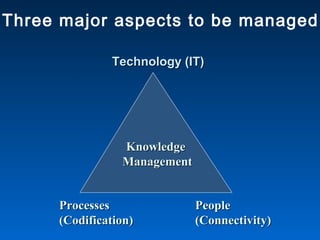
Technology (IT)Technology (IT)
ProcessesProcesses
(Codification)(Codification)
PeoplePeople
(Connectivity)(Connectivity)
KnowledgeKnowledge
ManagementManagement
Three major aspects to be managed
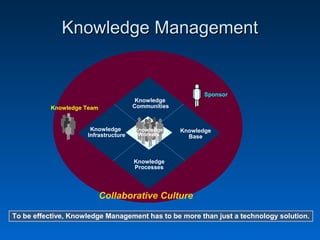
To be effective, Knowledge Management has to be more than just a technology solution.
Knowledge
Communities
Knowledge
Infrastructure
Knowledge
Processes
Knowledge
Base
Knowledge
Workers
Collaborative Culture
Knowledge Team
Sponsor
Knowledge ManagementKnowledge Management
““Don’ts” for Knowledge ManagementDon’ts” for Knowledge Management
 Don’t treat KM as a project, a one-off, an ITDon’t treat KM as a project, a one-off, an IT
“solution”“solution”
• it’s part of the management discipline!it’s part of the management discipline!
 Don’t focus on KM; focus on the business needsDon’t focus on KM; focus on the business needs
and use KM as a means to help you manage yourand use KM as a means to help you manage your
way there (only if needed)way there (only if needed)
 Don’t underestimate the scope, timeframes andDon’t underestimate the scope, timeframes and
effort, depending upon your needseffort, depending upon your needs
• this is organisational change towards maturitythis is organisational change towards maturity
as a knowledge-intensive organisationas a knowledge-intensive organisation
Thank YouThank You
 Any Questions?Any Questions?

Knowledge management strategy

  • 1.
    How to developa KnowledgeHow to develop a Knowledge Management Strategy forManagement Strategy for your Libraryyour Library Practical PresentationPractical Presentation ByBy Rodney MalesiRodney Malesi USIUUSIU
  • 2.
    What is aKMWhat is a KM Strategy?Strategy? In simple terms a KM strategy is theIn simple terms a KM strategy is the process of generating, codifying, andprocess of generating, codifying, and transferring explicit and tacittransferring explicit and tacit knowledge within an organization,knowledge within an organization, getting the right information, to thegetting the right information, to the right people, in the right place and atright people, in the right place and at the right time.the right time.
  • 3.
    Effects of LackofEffects of Lack of StrategyStrategy 1. an incoherent knowledge vision or lack of1. an incoherent knowledge vision or lack of ownership of the knowledge vision;ownership of the knowledge vision; 2.lack of appreciation of knowledge as an2.lack of appreciation of knowledge as an important asset;important asset; 3.a lack of an information sharing culture and3.a lack of an information sharing culture and climate;climate; 4. inappropriate methods or tools for measuring4. inappropriate methods or tools for measuring and valuing knowledge;and valuing knowledge; 5.inadequate standardized processes;5.inadequate standardized processes;
  • 4.
  • 5.
    STEP ONESTEP ONE Identifythe problems youIdentify the problems you want to solve.want to solve.
  • 6.
    due to rapidknowledge decay anddue to rapid knowledge decay and consequently need to create new knowledge;consequently need to create new knowledge; high staff turnover and loss of knowledge;high staff turnover and loss of knowledge; dwindling library budgets;dwindling library budgets; needs of operational efficiency to addressneeds of operational efficiency to address increased demands from faculty and students;increased demands from faculty and students;
  • 7.
    need to establishbest practices;need to establish best practices; need to manage e-evolution;need to manage e-evolution; need to leverage the available knowledge;need to leverage the available knowledge; necessity to survive and sustain competitive edgenecessity to survive and sustain competitive edge in the global community of profession;in the global community of profession; and finally, seeing KM as a great opportunity toand finally, seeing KM as a great opportunity to spread out the role of librarians to the academicspread out the role of librarians to the academic community.community.
  • 8.
    STEP TWOSTEP TWO Preparefor changePrepare for change • Get sponsorship identify howGet sponsorship identify how the strategy will be fundedthe strategy will be funded • Study the Knowledge SharingStudy the Knowledge Sharing Culture-what hindersCulture-what hinders information sharing? Whatinformation sharing? What incentives can you introduce?incentives can you introduce?
  • 9.
    “ I’ll share”“I ain’t sharin’ nuffin!” The Biggest Challenge: Changing Your Culture to a NEW WAY OF WORKING!!
  • 10.
     Create theimplementationCreate the implementation team Identifyteam Identify KM Leader, IS,KM Leader, IS, Content experts, HR, Training, etc.Content experts, HR, Training, etc. STEP 3
  • 11.
    …… Creating theTeamCreating the Team Building and launching a knowledgeBuilding and launching a knowledge management system requires a broad range ofmanagement system requires a broad range of expertise in a focused core teamexpertise in a focused core team  Librarians good in financial mattersLibrarians good in financial matters  Subject-Matter ExpertsSubject-Matter Experts  Library Science SkillsLibrary Science Skills  Communications, Training & MotivationCommunications, Training & Motivation  Information TechnologyInformation Technology
  • 12.
    Perform the KnowledgeAuditPerform the Knowledge Audit •to identify the information and knowledge needs of the library, theto identify the information and knowledge needs of the library, the various departments and individuals.various departments and individuals. •to identify information created internally and assess itsto identify information created internally and assess its value/relevance to the organization.value/relevance to the organization. •to identify information gaps and understand information processes.to identify information gaps and understand information processes. •to review and evaluate current use of external and internalto review and evaluate current use of external and internal information sources.information sources. •to identify barriers and prioritize changes that need to be made toto identify barriers and prioritize changes that need to be made to ensure the steady flow of information and knowledge across theensure the steady flow of information and knowledge across the department.department. •to develop a knowledge map of the organization indicatingto develop a knowledge map of the organization indicating appropriate connections and collectionsappropriate connections and collections STEP 4
  • 13.
     Identify thehuman capitalIdentify the human capital  Information ResourcesInformation Resources STEP 5 Understand & identify your knowledge assets, their source & structure
  • 15.
    Create Knowledge ManagementCreateKnowledge Management SolutionsSolutions • Focused Information AccessFocused Information Access ApplicationsApplications • Query Across Existing SystemsQuery Across Existing Systems • A Knowledge Warehouse to unify &A Knowledge Warehouse to unify & add value to information silosadd value to information silos • Document/content managementDocument/content management systemssystems • Establish communitiesEstablish communities • Introduce KM processIntroduce KM process STEP 6
  • 16.
    • Finding subjectmatter expertsFinding subject matter experts • Content management & KnowledgeContent management & Knowledge EditorsEditors STEP 7 Link Knowledge to People
  • 17.
  • 18.
    To be effective,Knowledge Management has to be more than just a technology solution. Knowledge Communities Knowledge Infrastructure Knowledge Processes Knowledge Base Knowledge Workers Collaborative Culture Knowledge Team Sponsor Knowledge ManagementKnowledge Management
  • 19.
    ““Don’ts” for KnowledgeManagementDon’ts” for Knowledge Management  Don’t treat KM as a project, a one-off, an ITDon’t treat KM as a project, a one-off, an IT “solution”“solution” • it’s part of the management discipline!it’s part of the management discipline!  Don’t focus on KM; focus on the business needsDon’t focus on KM; focus on the business needs and use KM as a means to help you manage yourand use KM as a means to help you manage your way there (only if needed)way there (only if needed)  Don’t underestimate the scope, timeframes andDon’t underestimate the scope, timeframes and effort, depending upon your needseffort, depending upon your needs • this is organisational change towards maturitythis is organisational change towards maturity as a knowledge-intensive organisationas a knowledge-intensive organisation
  • 20.
    Thank YouThank You Any Questions?Any Questions?

Editor's Notes

  • #2 Feasible = possible, practicable, viable, reasonable, realistic, practical.