
FOUNDATIONS OF
ORGANIZATIONAL STRUCTURE
Organizational Behavior
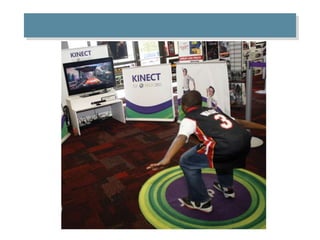
At Microsoft, customer departmentalization allows the
company to better understand customers and respond to their
needs. Microsoft is organized by four customer segments:
consumers, software developers, small businesses, and large
corporations. Products and services the company designs for
consumers include Bing, Windows, Windows Phone 7, Xbox
360, and Microsoft retail stores, which give the company direct
contact with consumers. This photo shows a boy playing the
Kinect for Xbox 360 at a gaming store. Kinect, which has a
full-body sensor, allows consumers to play Xbox games
without using a controller and to interact with games in a real
physical sense.
What Is Organizational Structure?
Key Elements:
1. Work specialization
2. Departmentalization
3. Chain of command
4. Span of control
5. Centralization and
decentralization
6. Formalization
Organizational Structure
Defines how job tasks are
formally divided, grouped,
and coordinated.
There are six key elements
that managers need to
address when they design
their org.’s structure.
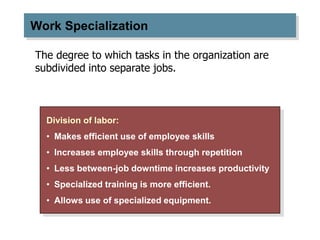
Work Specialization
Division of labor:
• Makes efficient use of employee skills
• Increases employee skills through repetition
• Less between-job downtime increases productivity
• Specialized training is more efficient.
• Allows use of specialized equipment.
The degree to which tasks in the organization are
subdivided into separate jobs.
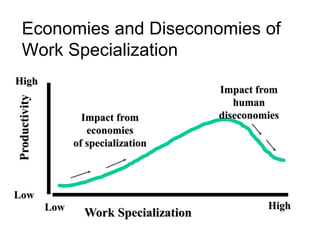
Economies and Diseconomies of
Work Specialization
Impact from
economies
of specialization
Impact from
human
diseconomies
High
Low
Low High
Productivity
Work Specialization
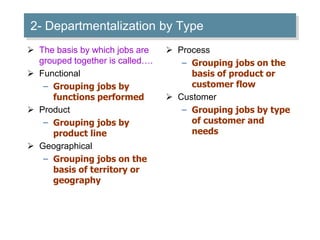
2- Departmentalization by Type
 The basis by which jobs are
grouped together is called….
 Functional
– Grouping jobs by
functions performed
 Product
– Grouping jobs by
product line
 Geographical
– Grouping jobs on the
basis of territory or
geography
 Process
– Grouping jobs on the
basis of product or
customer flow
 Customer
– Grouping jobs by type
of customer and
needs
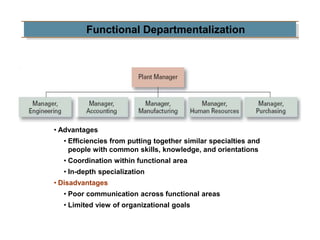
Functional Departmentalization
• Advantages
• Efficiencies from putting together similar specialties and
people with common skills, knowledge, and orientations
• Coordination within functional area
• In-depth specialization
• Disadvantages
• Poor communication across functional areas
• Limited view of organizational goals
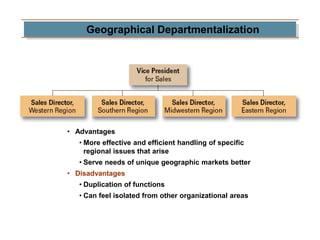
Geographical Departmentalization
• Advantages
• More effective and efficient handling of specific
regional issues that arise
• Serve needs of unique geographic markets better
• Disadvantages
• Duplication of functions
• Can feel isolated from other organizational areas
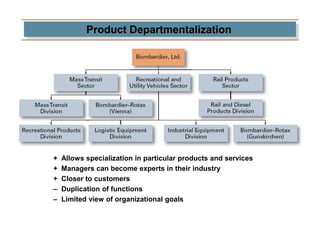
Product Departmentalization
+ Allows specialization in particular products and services
+ Managers can become experts in their industry
+ Closer to customers
– Duplication of functions
– Limited view of organizational goals
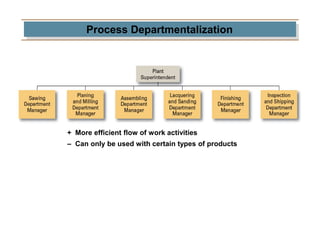
Process Departmentalization
+ More efficient flow of work activities
– Can only be used with certain types of products
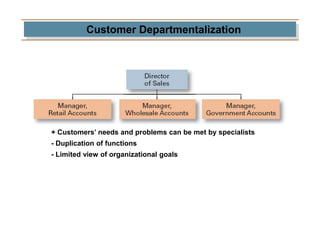
Customer Departmentalization
+ Customers’ needs and problems can be met by specialists
- Duplication of functions
- Limited view of organizational goals
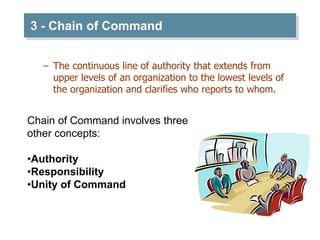
3 - Chain of Command
– The continuous line of authority that extends from
upper levels of an organization to the lowest levels of
the organization and clarifies who reports to whom.
Chain of Command involves three
other concepts:
•Authority
•Responsibility
•Unity of Command
3 - Chain of Command……continued
 Authority
– Refers to the rights inherent in a managerial position to tell
people what to do and to expect them to do it.
 Responsibility
– The obligation or expectation to perform any assigned
duties.
 Unity of Command
– The concept that a person should have one boss and should
report only to that person (Fayol, Weber, Taylor)
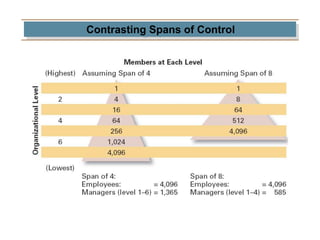
4 - Span of Control
Narrow Span Drawbacks:
• Expense of additional layers of management.
• Increased complexity of vertical communication.
• Encouragement of overly tight supervision and
discouragement of employee autonomy.
Concept:
Wider spans of management increase organizational
efficiency.
The number of subordinates a manager can efficiently
and effectively direct.
Contrasting Spans of Control
5 - Centralization & Decentralization
 Centralization
– The degree to which decision-making is concentrated
at a single point in the organizations.
• Organizations in which top managers make all the
decisions and lower-level employees simply carry out
those orders.
 Decentralization
– Organizations in which decision-making is pushed
down to the managers who are closest to the action.
 Employee Empowerment
– Increasing the decision-making authority (power) of
employees.
6 - Formalization
– The degree to which jobs within the organization are
standardized and the extent to which employee
behavior is guided by rules and procedures.
• Highly formalized jobs offer little discretion over what is
to be done.
• Low formalization means fewer constraints on how
employees do their work.
Common Organizational Designs
Three of the more common org. designs in use: the simple
structure, the bureaucracy, and the matrix
Simple Structure
A structure characterized by a low degree of departmentalization, wide
spans of control, authority centralized in a single person, and little
formalization.
This structure is most widely practiced in small businesses in which the
manager & the owner are one & the same.
Strength: simplicity. It is fast, flexible, & inexpensive to maintain, and
accountability is clear.
Weakness: it’s difficult to maintain in any other than small orgs. As org.
grows due to its low formalization & high centralization creates information
overload at the top.
Common Organization Designs (cont’d)
Max Weber’s Bureaucracy Model
Standardization is the key concept that underlies all
bureaucracies.
•highly operating routine tasks achieved through specialization,
•formalized rules and regulations,
• tasks are grouped into functional departments,
•centralized authority
•narrow spans of control
• decision making that follows the chain of command.
The Bureaucracy
 Strengths
– Functional
economies of scale
– Minimum duplication
of personnel and
equipment
– Enhanced
communication
– Centralized decision
making
 Weaknesses
– Subunit conflicts with
organizational goals
– Obsessive concern
with rules and
regulations
– Lack of employee
discretion to deal
with problems
Common Organization Designs (cont’d)
Key Elements:
+ Gains the advantages of functional and product
departmentalization while avoiding their weaknesses.
+ Facilitates coordination of complex and
interdependent activities.
– Breaks down unity-of-command concept.
Matrix Structure
A structure that creates dual lines of authority and
combines functional and product departmentalization.
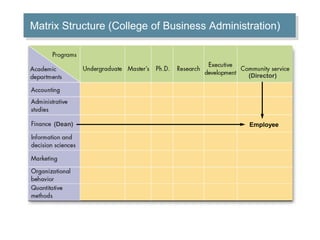
Matrix Structure (College of Business Administration)
(Dean)
(Director)
Employee
New Design Options
Characteristics:
• Breaks down departmental barriers.
• Decentralizes decision making to the team level.
• Requires employees to be generalists as well as
specialists.
• Creates a “flexible bureaucracy.”
Team Structure
The use of teams as the central device to coordinate
work activities.
New Design Options (cont’d)
Concepts:
Advantage: Provides maximum flexibility while
concentrating on what the organization does best.
Disadvantage: Reduced control over key parts of
the business.
Virtual Organization
A small, core organization that outsources its major
business functions.
Highly centralized with little or no departmentalization.
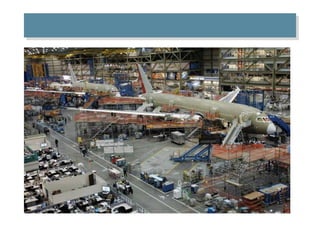
As a network organization, Boeing outsourced the production of
about 70 percent of the components for its new 787 Dreamliner
passenger jet aircraft. Boeing used some 100 suppliers at more
than 100 sites in different countries, including Alenia
Aeronautica of Italy to produce the plane’s rear fuselage and
Mitsubishi Motors of Japan to create the wings. Although global
outsourcing helped Boeing reduce the plane’s development and
production costs, the extreme complexities of such a structure
was also responsible for delays in bringing the cutting-edge
aircraft to market. Shown here is the plane’s assembly line
surrounded by rows of workers at their computers as the planes
are built at Boeing’s plant in Everett, Washington.
New Design Options (cont’d)
Boundaryless Organization
•The boundary-less organization seeks to eliminate the chain of
command, have limitless spans of control, and replace
departments with empowered teams.
• Org. rely so heavily on IT, it is also sometimes called the T-
form ( or technology based) org.
BMW Group operates as a boundaryless organization in
designing, developing, and producing its BMW, Rolls-Royce,
and Mini cars. The automaker uses virtual tools such as
computer-aided design and simulation models and a flexible
global production network to respond quickly to fluctuations in
the market and individual customer preferences. BMW’s
boundaryless structure drives innovative ideas by eliminating
vertical and horizontal barriers among workers and creating
an environment of learning and experimentation. From their
first day on the job, employees are encouraged to build a
network of relationships from all functional areas and across
all divisions to speed innovation and problem-solving.
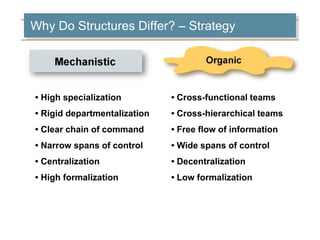
• High specialization
• Rigid departmentalization
• Clear chain of command
• Narrow spans of control
• Centralization
• High formalization
• Cross-functional teams
• Cross-hierarchical teams
• Free flow of information
• Wide spans of control
• Decentralization
• Low formalization
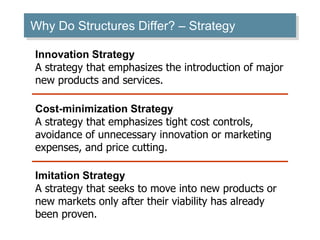
Why Do Structures Differ? – Strategy
Innovation Strategy
A strategy that emphasizes the introduction of major
new products and services.
Imitation Strategy
A strategy that seeks to move into new products or
new markets only after their viability has already
been proven.
Cost-minimization Strategy
A strategy that emphasizes tight cost controls,
avoidance of unnecessary innovation or marketing
expenses, and price cutting.
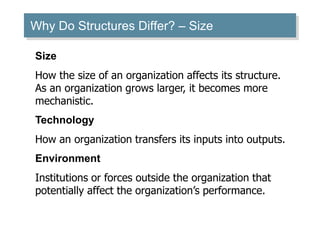
Why Do Structures Differ? – Size
Size
How the size of an organization affects its structure.
As an organization grows larger, it becomes more
mechanistic.
Technology
How an organization transfers its inputs into outputs.
Environment
Institutions or forces outside the organization that
potentially affect the organization’s performance.

3 Organization structure

  • 1.
  • 2.
    At Microsoft, customerdepartmentalization allows the company to better understand customers and respond to their needs. Microsoft is organized by four customer segments: consumers, software developers, small businesses, and large corporations. Products and services the company designs for consumers include Bing, Windows, Windows Phone 7, Xbox 360, and Microsoft retail stores, which give the company direct contact with consumers. This photo shows a boy playing the Kinect for Xbox 360 at a gaming store. Kinect, which has a full-body sensor, allows consumers to play Xbox games without using a controller and to interact with games in a real physical sense.
  • 4.
    What Is OrganizationalStructure? Key Elements: 1. Work specialization 2. Departmentalization 3. Chain of command 4. Span of control 5. Centralization and decentralization 6. Formalization Organizational Structure Defines how job tasks are formally divided, grouped, and coordinated. There are six key elements that managers need to address when they design their org.’s structure.
  • 5.
    Work Specialization Division oflabor: • Makes efficient use of employee skills • Increases employee skills through repetition • Less between-job downtime increases productivity • Specialized training is more efficient. • Allows use of specialized equipment. The degree to which tasks in the organization are subdivided into separate jobs.
  • 6.
    Economies and Diseconomiesof Work Specialization Impact from economies of specialization Impact from human diseconomies High Low Low High Productivity Work Specialization
  • 7.
    2- Departmentalization byType  The basis by which jobs are grouped together is called….  Functional – Grouping jobs by functions performed  Product – Grouping jobs by product line  Geographical – Grouping jobs on the basis of territory or geography  Process – Grouping jobs on the basis of product or customer flow  Customer – Grouping jobs by type of customer and needs
  • 8.
    Functional Departmentalization • Advantages •Efficiencies from putting together similar specialties and people with common skills, knowledge, and orientations • Coordination within functional area • In-depth specialization • Disadvantages • Poor communication across functional areas • Limited view of organizational goals
  • 9.
    Geographical Departmentalization • Advantages •More effective and efficient handling of specific regional issues that arise • Serve needs of unique geographic markets better • Disadvantages • Duplication of functions • Can feel isolated from other organizational areas
  • 10.
    Product Departmentalization + Allowsspecialization in particular products and services + Managers can become experts in their industry + Closer to customers – Duplication of functions – Limited view of organizational goals
  • 11.
    Process Departmentalization + Moreefficient flow of work activities – Can only be used with certain types of products
  • 12.
    Customer Departmentalization + Customers’needs and problems can be met by specialists - Duplication of functions - Limited view of organizational goals
  • 13.
    3 - Chainof Command – The continuous line of authority that extends from upper levels of an organization to the lowest levels of the organization and clarifies who reports to whom. Chain of Command involves three other concepts: •Authority •Responsibility •Unity of Command
  • 14.
    3 - Chainof Command……continued  Authority – Refers to the rights inherent in a managerial position to tell people what to do and to expect them to do it.  Responsibility – The obligation or expectation to perform any assigned duties.  Unity of Command – The concept that a person should have one boss and should report only to that person (Fayol, Weber, Taylor)
  • 15.
    4 - Spanof Control Narrow Span Drawbacks: • Expense of additional layers of management. • Increased complexity of vertical communication. • Encouragement of overly tight supervision and discouragement of employee autonomy. Concept: Wider spans of management increase organizational efficiency. The number of subordinates a manager can efficiently and effectively direct.
  • 16.
  • 17.
    5 - Centralization& Decentralization  Centralization – The degree to which decision-making is concentrated at a single point in the organizations. • Organizations in which top managers make all the decisions and lower-level employees simply carry out those orders.  Decentralization – Organizations in which decision-making is pushed down to the managers who are closest to the action.  Employee Empowerment – Increasing the decision-making authority (power) of employees.
  • 18.
    6 - Formalization –The degree to which jobs within the organization are standardized and the extent to which employee behavior is guided by rules and procedures. • Highly formalized jobs offer little discretion over what is to be done. • Low formalization means fewer constraints on how employees do their work.
  • 19.
    Common Organizational Designs Threeof the more common org. designs in use: the simple structure, the bureaucracy, and the matrix Simple Structure A structure characterized by a low degree of departmentalization, wide spans of control, authority centralized in a single person, and little formalization. This structure is most widely practiced in small businesses in which the manager & the owner are one & the same. Strength: simplicity. It is fast, flexible, & inexpensive to maintain, and accountability is clear. Weakness: it’s difficult to maintain in any other than small orgs. As org. grows due to its low formalization & high centralization creates information overload at the top.
  • 20.
    Common Organization Designs(cont’d) Max Weber’s Bureaucracy Model Standardization is the key concept that underlies all bureaucracies. •highly operating routine tasks achieved through specialization, •formalized rules and regulations, • tasks are grouped into functional departments, •centralized authority •narrow spans of control • decision making that follows the chain of command.
  • 21.
    The Bureaucracy  Strengths –Functional economies of scale – Minimum duplication of personnel and equipment – Enhanced communication – Centralized decision making  Weaknesses – Subunit conflicts with organizational goals – Obsessive concern with rules and regulations – Lack of employee discretion to deal with problems
  • 22.
    Common Organization Designs(cont’d) Key Elements: + Gains the advantages of functional and product departmentalization while avoiding their weaknesses. + Facilitates coordination of complex and interdependent activities. – Breaks down unity-of-command concept. Matrix Structure A structure that creates dual lines of authority and combines functional and product departmentalization.
  • 23.
    Matrix Structure (Collegeof Business Administration) (Dean) (Director) Employee
  • 24.
    New Design Options Characteristics: •Breaks down departmental barriers. • Decentralizes decision making to the team level. • Requires employees to be generalists as well as specialists. • Creates a “flexible bureaucracy.” Team Structure The use of teams as the central device to coordinate work activities.
  • 25.
    New Design Options(cont’d) Concepts: Advantage: Provides maximum flexibility while concentrating on what the organization does best. Disadvantage: Reduced control over key parts of the business. Virtual Organization A small, core organization that outsources its major business functions. Highly centralized with little or no departmentalization.
  • 26.
    As a networkorganization, Boeing outsourced the production of about 70 percent of the components for its new 787 Dreamliner passenger jet aircraft. Boeing used some 100 suppliers at more than 100 sites in different countries, including Alenia Aeronautica of Italy to produce the plane’s rear fuselage and Mitsubishi Motors of Japan to create the wings. Although global outsourcing helped Boeing reduce the plane’s development and production costs, the extreme complexities of such a structure was also responsible for delays in bringing the cutting-edge aircraft to market. Shown here is the plane’s assembly line surrounded by rows of workers at their computers as the planes are built at Boeing’s plant in Everett, Washington.
  • 28.
    New Design Options(cont’d) Boundaryless Organization •The boundary-less organization seeks to eliminate the chain of command, have limitless spans of control, and replace departments with empowered teams. • Org. rely so heavily on IT, it is also sometimes called the T- form ( or technology based) org.
  • 29.
    BMW Group operatesas a boundaryless organization in designing, developing, and producing its BMW, Rolls-Royce, and Mini cars. The automaker uses virtual tools such as computer-aided design and simulation models and a flexible global production network to respond quickly to fluctuations in the market and individual customer preferences. BMW’s boundaryless structure drives innovative ideas by eliminating vertical and horizontal barriers among workers and creating an environment of learning and experimentation. From their first day on the job, employees are encouraged to build a network of relationships from all functional areas and across all divisions to speed innovation and problem-solving.
  • 31.
    • High specialization •Rigid departmentalization • Clear chain of command • Narrow spans of control • Centralization • High formalization • Cross-functional teams • Cross-hierarchical teams • Free flow of information • Wide spans of control • Decentralization • Low formalization Why Do Structures Differ? – Strategy
  • 32.
    Why Do StructuresDiffer? – Strategy Innovation Strategy A strategy that emphasizes the introduction of major new products and services. Imitation Strategy A strategy that seeks to move into new products or new markets only after their viability has already been proven. Cost-minimization Strategy A strategy that emphasizes tight cost controls, avoidance of unnecessary innovation or marketing expenses, and price cutting.
  • 33.
    Why Do StructuresDiffer? – Size Size How the size of an organization affects its structure. As an organization grows larger, it becomes more mechanistic. Technology How an organization transfers its inputs into outputs. Environment Institutions or forces outside the organization that potentially affect the organization’s performance.