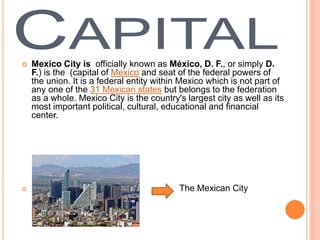
 Mexico City is officially known as México, D. F., or simply D.
F.) is the (capital of Mexico and seat of the federal powers of
the union. It is a federal entity within Mexico which is not part of
any one of the 31 Mexican states but belongs to the federation
as a whole. Mexico City is the country's largest city as well as its
most important political, cultural, educational and financial
center.
 The Mexican City
 As an "alpha" global city Mexico City is one of the most
important financial centers in America. It is located in
the Valley of Mexico (Valle de México), a large valley in the
high plateaus at the center of Mexico, at an altitude of 2,240
metres (7,350 ft). The city consists of sixteen boroughs
 The 2009 estimated population for the city proper was around
8.84 million people, with a land area of 1,485 square
kilometres (573 sq mi).According to the most recent definition
agreed upon by the federal and state governments,
the Greater Mexico City population is 21.2 million
people, making it the largest metropolitan area in the western
hemisphere, the tenth largest agglomeration, and the
largest Spanish-speaking city in the world.[16]
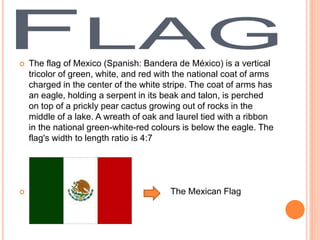
 The flag of Mexico (Spanish: Bandera de México) is a vertical
tricolor of green, white, and red with the national coat of arms
charged in the center of the white stripe. The coat of arms has
an eagle, holding a serpent in its beak and talon, is perched
on top of a prickly pear cactus growing out of rocks in the
middle of a lake. A wreath of oak and laurel tied with a ribbon
in the national green-white-red colours is below the eagle. The
flag's width to length ratio is 4:7
 The Mexican Flag
 Spanish troops led by Agustin de Iturbide and the Mexican
insurgent troops of Vicente Guerrero which fought separately
during the Mexican War of Independence (1810-1821) were
unified to form the 'Army of the Three Guarantees' (Ejercito
Trigarante) which consolidated Mexico's independence from
Spain. The French Tricolor served as the inspiration for the
design of the new flag for the new nation, but the colors were
chosen to represent the 'Three Guarantees' - Green
symbolized independence, white was for the Roman Catholic
religion, and red is for union of Americans and Europeans.
 Roman Catholic religion, and red is for union of Americans
and Europeans.
The Mexican Coat of Arms is based on a legend,
Huitzilopochtli, the Aztec's supreme deity, instructed the
leader of the Aztec people to settle in a place where an eagle
landed on a prickly-pear cactus, eating a snake. After years of
wandering they found the eagle eating a snake on a on a
prickly-pear cactus growing on a swampy island in the Lake
Texcoco. They settled there in 1345 and built the great city of
Tenochtitlan ("Place of the Prickly Pear Cactus"). It served as
the most important Aztec city until it was destroyed by the
invading Spanish in 1521. Mexico City is built on the ruins of
this ancient metropolis.
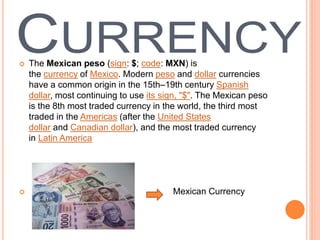
 The Mexican peso (sign: $; code: MXN) is
the currency of Mexico. Modern peso and dollar currencies
have a common origin in the 15th–19th century Spanish
dollar, most continuing to use its sign, "$". The Mexican peso
is the 8th most traded currency in the world, the third most
traded in the Americas (after the United States
dollar and Canadian dollar), and the most traded currency
in Latin America
 Mexican Currency
 The current ISO 4217 code for the peso is MXN; prior to the
1993 revaluation (see below), the code MXP was used. The
peso is subdivided into 100 centavos, represented by "¢". As
of November 12, 2014, the peso's exchange rate was
$18.2782 per euro and $14.6648 per U.S. dollar.
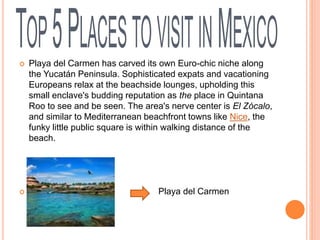
 Playa del Carmen has carved its own Euro-chic niche along
the Yucatán Peninsula. Sophisticated expats and vacationing
Europeans relax at the beachside lounges, upholding this
small enclave's budding reputation as the place in Quintana
Roo to see and be seen. The area's nerve center is El Zócalo,
and similar to Mediterranean beachfront towns like Nice, the
funky little public square is within walking distance of the
beach.
 Playa del Carmen
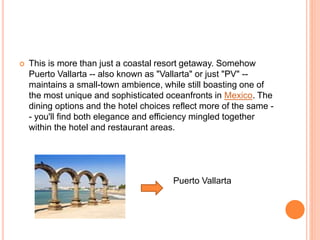
 This is more than just a coastal resort getaway. Somehow
Puerto Vallarta -- also known as "Vallarta" or just "PV" --
maintains a small-town ambience, while still boasting one of
the most unique and sophisticated oceanfronts in Mexico. The
dining options and the hotel choices reflect more of the same -
- you'll find both elegance and efficiency mingled together
within the hotel and restaurant areas.
Puerto Vallarta
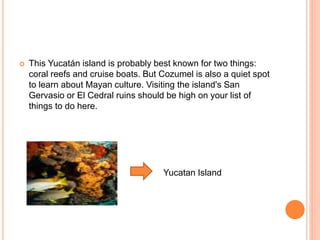
 This Yucatán island is probably best known for two things:
coral reefs and cruise boats. But Cozumel is also a quiet spot
to learn about Mayan culture. Visiting the island's San
Gervasio or El Cedral ruins should be high on your list of
things to do here.
Yucatan Island
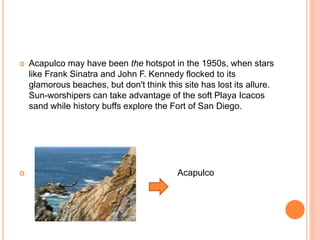
 Acapulco may have been the hotspot in the 1950s, when stars
like Frank Sinatra and John F. Kennedy flocked to its
glamorous beaches, but don't think this site has lost its allure.
Sun-worshipers can take advantage of the soft Playa Icacos
sand while history buffs explore the Fort of San Diego.
 Acapulco
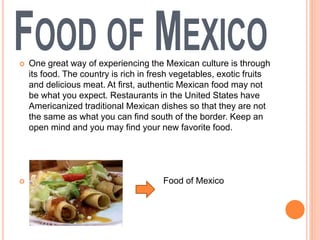
 One great way of experiencing the Mexican culture is through
its food. The country is rich in fresh vegetables, exotic fruits
and delicious meat. At first, authentic Mexican food may not
be what you expect. Restaurants in the United States have
Americanized traditional Mexican dishes so that they are not
the same as what you can find south of the border. Keep an
open mind and you may find your new favorite food.
 Food of Mexico
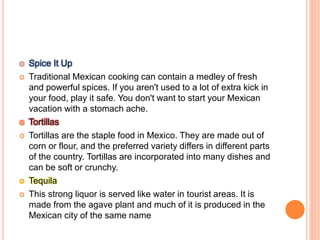
 Spice It Up
 Traditional Mexican cooking can contain a medley of fresh
and powerful spices. If you aren't used to a lot of extra kick in
your food, play it safe. You don't want to start your Mexican
vacation with a stomach ache.
 Tortillas
 Tortillas are the staple food in Mexico. They are made out of
corn or flour, and the preferred variety differs in different parts
of the country. Tortillas are incorporated into many dishes and
can be soft or crunchy.
 Tequila
 This strong liquor is served like water in tourist areas. It is
made from the agave plant and much of it is produced in the
Mexican city of the same name
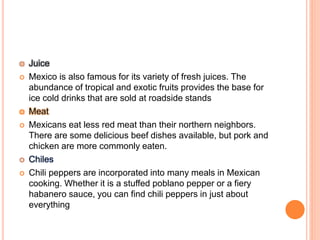
 Juice
 Mexico is also famous for its variety of fresh juices. The
abundance of tropical and exotic fruits provides the base for
ice cold drinks that are sold at roadside stands
 Meat
 Mexicans eat less red meat than their northern neighbors.
There are some delicious beef dishes available, but pork and
chicken are more commonly eaten.
 Chiles
 Chili peppers are incorporated into many meals in Mexican
cooking. Whether it is a stuffed poblano pepper or a fiery
habanero sauce, you can find chili peppers in just about
everything
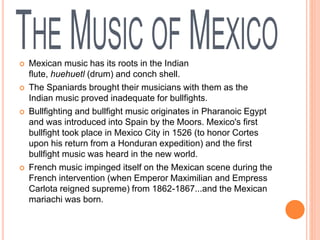
 Mexican music has its roots in the Indian
flute, huehuetl (drum) and conch shell.
 The Spaniards brought their musicians with them as the
Indian music proved inadequate for bullfights.
 Bullfighting and bullfight music originates in Pharanoic Egypt
and was introduced into Spain by the Moors. Mexico's first
bullfight took place in Mexico City in 1526 (to honor Cortes
upon his return from a Honduran expedition) and the first
bullfight music was heard in the new world.
 French music impinged itself on the Mexican scene during the
French intervention (when Emperor Maximilian and Empress
Carlota reigned supreme) from 1862-1867...and the Mexican
mariachi was born.
 Mexico’s modern folk dance tradition is a blending of elements
from its Indigenous, African and European heritage. Before
the arrival of the Spanish, indigenous dance developed with
strong ties to the religious practices. For the Aztecs, there
were two levels of dance, one for the common people, often
related to the agricultural cycle and those for the elite. After
the Conquest, the Spanish initially worked to eradicate
indigenous dances, considering them “too pagan” and
succeeded with a number of forms, especially those
associated with the priest and ruling classes. However, they
were unable to eradicate the more popular forms, especially in
the rural and more inaccessible regions of New Spain.
Instead, evangelizers worked to adapt dances to Christianity,
giving them new meanings. For this reason, most of these
dances have suffered at least some modification since the pre
Hispanic era.[1][3]
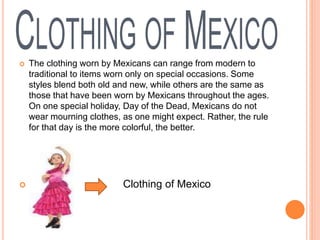
 The clothing worn by Mexicans can range from modern to
traditional to items worn only on special occasions. Some
styles blend both old and new, while others are the same as
those that have been worn by Mexicans throughout the ages.
On one special holiday, Day of the Dead, Mexicans do not
wear mourning clothes, as one might expect. Rather, the rule
for that day is the more colorful, the better.
 Clothing of Mexico
Thanks for seeing my
Presentation on Mexico
City

KNOW THY WORLD(MEXICO)

  • 2.
     Mexico Cityis officially known as México, D. F., or simply D. F.) is the (capital of Mexico and seat of the federal powers of the union. It is a federal entity within Mexico which is not part of any one of the 31 Mexican states but belongs to the federation as a whole. Mexico City is the country's largest city as well as its most important political, cultural, educational and financial center.  The Mexican City
  • 3.
     As an"alpha" global city Mexico City is one of the most important financial centers in America. It is located in the Valley of Mexico (Valle de México), a large valley in the high plateaus at the center of Mexico, at an altitude of 2,240 metres (7,350 ft). The city consists of sixteen boroughs  The 2009 estimated population for the city proper was around 8.84 million people, with a land area of 1,485 square kilometres (573 sq mi).According to the most recent definition agreed upon by the federal and state governments, the Greater Mexico City population is 21.2 million people, making it the largest metropolitan area in the western hemisphere, the tenth largest agglomeration, and the largest Spanish-speaking city in the world.[16]
  • 4.
     The flagof Mexico (Spanish: Bandera de México) is a vertical tricolor of green, white, and red with the national coat of arms charged in the center of the white stripe. The coat of arms has an eagle, holding a serpent in its beak and talon, is perched on top of a prickly pear cactus growing out of rocks in the middle of a lake. A wreath of oak and laurel tied with a ribbon in the national green-white-red colours is below the eagle. The flag's width to length ratio is 4:7  The Mexican Flag
  • 5.
     Spanish troopsled by Agustin de Iturbide and the Mexican insurgent troops of Vicente Guerrero which fought separately during the Mexican War of Independence (1810-1821) were unified to form the 'Army of the Three Guarantees' (Ejercito Trigarante) which consolidated Mexico's independence from Spain. The French Tricolor served as the inspiration for the design of the new flag for the new nation, but the colors were chosen to represent the 'Three Guarantees' - Green symbolized independence, white was for the Roman Catholic religion, and red is for union of Americans and Europeans.
  • 6.
     Roman Catholicreligion, and red is for union of Americans and Europeans. The Mexican Coat of Arms is based on a legend, Huitzilopochtli, the Aztec's supreme deity, instructed the leader of the Aztec people to settle in a place where an eagle landed on a prickly-pear cactus, eating a snake. After years of wandering they found the eagle eating a snake on a on a prickly-pear cactus growing on a swampy island in the Lake Texcoco. They settled there in 1345 and built the great city of Tenochtitlan ("Place of the Prickly Pear Cactus"). It served as the most important Aztec city until it was destroyed by the invading Spanish in 1521. Mexico City is built on the ruins of this ancient metropolis.
  • 7.
     The Mexicanpeso (sign: $; code: MXN) is the currency of Mexico. Modern peso and dollar currencies have a common origin in the 15th–19th century Spanish dollar, most continuing to use its sign, "$". The Mexican peso is the 8th most traded currency in the world, the third most traded in the Americas (after the United States dollar and Canadian dollar), and the most traded currency in Latin America  Mexican Currency
  • 8.
     The currentISO 4217 code for the peso is MXN; prior to the 1993 revaluation (see below), the code MXP was used. The peso is subdivided into 100 centavos, represented by "¢". As of November 12, 2014, the peso's exchange rate was $18.2782 per euro and $14.6648 per U.S. dollar.
  • 9.
     Playa delCarmen has carved its own Euro-chic niche along the Yucatán Peninsula. Sophisticated expats and vacationing Europeans relax at the beachside lounges, upholding this small enclave's budding reputation as the place in Quintana Roo to see and be seen. The area's nerve center is El Zócalo, and similar to Mediterranean beachfront towns like Nice, the funky little public square is within walking distance of the beach.  Playa del Carmen
  • 10.
     This ismore than just a coastal resort getaway. Somehow Puerto Vallarta -- also known as "Vallarta" or just "PV" -- maintains a small-town ambience, while still boasting one of the most unique and sophisticated oceanfronts in Mexico. The dining options and the hotel choices reflect more of the same - - you'll find both elegance and efficiency mingled together within the hotel and restaurant areas. Puerto Vallarta
  • 11.
     This Yucatánisland is probably best known for two things: coral reefs and cruise boats. But Cozumel is also a quiet spot to learn about Mayan culture. Visiting the island's San Gervasio or El Cedral ruins should be high on your list of things to do here. Yucatan Island
  • 12.
     Acapulco mayhave been the hotspot in the 1950s, when stars like Frank Sinatra and John F. Kennedy flocked to its glamorous beaches, but don't think this site has lost its allure. Sun-worshipers can take advantage of the soft Playa Icacos sand while history buffs explore the Fort of San Diego.  Acapulco
  • 13.
     One greatway of experiencing the Mexican culture is through its food. The country is rich in fresh vegetables, exotic fruits and delicious meat. At first, authentic Mexican food may not be what you expect. Restaurants in the United States have Americanized traditional Mexican dishes so that they are not the same as what you can find south of the border. Keep an open mind and you may find your new favorite food.  Food of Mexico
  • 14.
     Spice ItUp  Traditional Mexican cooking can contain a medley of fresh and powerful spices. If you aren't used to a lot of extra kick in your food, play it safe. You don't want to start your Mexican vacation with a stomach ache.  Tortillas  Tortillas are the staple food in Mexico. They are made out of corn or flour, and the preferred variety differs in different parts of the country. Tortillas are incorporated into many dishes and can be soft or crunchy.  Tequila  This strong liquor is served like water in tourist areas. It is made from the agave plant and much of it is produced in the Mexican city of the same name
  • 15.
     Juice  Mexicois also famous for its variety of fresh juices. The abundance of tropical and exotic fruits provides the base for ice cold drinks that are sold at roadside stands  Meat  Mexicans eat less red meat than their northern neighbors. There are some delicious beef dishes available, but pork and chicken are more commonly eaten.  Chiles  Chili peppers are incorporated into many meals in Mexican cooking. Whether it is a stuffed poblano pepper or a fiery habanero sauce, you can find chili peppers in just about everything
  • 16.
     Mexican musichas its roots in the Indian flute, huehuetl (drum) and conch shell.  The Spaniards brought their musicians with them as the Indian music proved inadequate for bullfights.  Bullfighting and bullfight music originates in Pharanoic Egypt and was introduced into Spain by the Moors. Mexico's first bullfight took place in Mexico City in 1526 (to honor Cortes upon his return from a Honduran expedition) and the first bullfight music was heard in the new world.  French music impinged itself on the Mexican scene during the French intervention (when Emperor Maximilian and Empress Carlota reigned supreme) from 1862-1867...and the Mexican mariachi was born.
  • 17.
     Mexico’s modernfolk dance tradition is a blending of elements from its Indigenous, African and European heritage. Before the arrival of the Spanish, indigenous dance developed with strong ties to the religious practices. For the Aztecs, there were two levels of dance, one for the common people, often related to the agricultural cycle and those for the elite. After the Conquest, the Spanish initially worked to eradicate indigenous dances, considering them “too pagan” and succeeded with a number of forms, especially those associated with the priest and ruling classes. However, they were unable to eradicate the more popular forms, especially in the rural and more inaccessible regions of New Spain. Instead, evangelizers worked to adapt dances to Christianity, giving them new meanings. For this reason, most of these dances have suffered at least some modification since the pre Hispanic era.[1][3]
  • 18.
     The clothingworn by Mexicans can range from modern to traditional to items worn only on special occasions. Some styles blend both old and new, while others are the same as those that have been worn by Mexicans throughout the ages. On one special holiday, Day of the Dead, Mexicans do not wear mourning clothes, as one might expect. Rather, the rule for that day is the more colorful, the better.  Clothing of Mexico
  • 19.
    Thanks for seeingmy Presentation on Mexico City