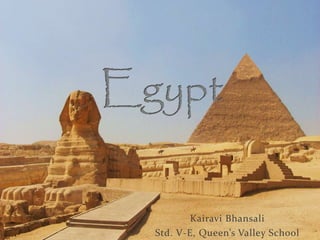
Kairavi Bhansali
Std. V-E, Queen’s Valley School
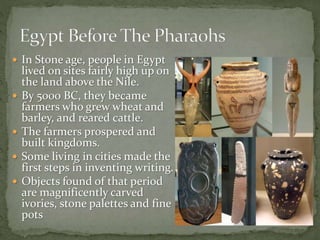
 In Stone age, people in Egypt
lived on sites fairly high up on
the land above the Nile.
 By 5000 BC, they became
farmers who grew wheat and
barley, and reared cattle.
 The farmers prospered and
built kingdoms.
 Some living in cities made the
first steps in inventing writing.
 Objects found of that period
are magnificently carved
ivories, stone palettes and fine
pots
 Desert (called Red Land) covers
more than 90% of Egypt. Very few
people live in the desert, these in
small settlements around oases.
 The river Nile is the lifeline of
Egypt.
 The fertile Black Land besides the
river Nile and its canals, where
crops grow, is where most of the
people settled.
 Without this fertile land, there
would have been no civilization in
Egypt.
 The King (called Pharaoh) was the most important
and powerful person in Egypt – thought to be a God by
the people.
Ramesses The Great
Queen Cleopatra
 Egyptians believed that preserving
the bodies of their Pharaohs after
their death would ensure they live
forever.
 They developed a process of
preserving bodies after death.
 Organs (except heart) of bodies
were removed and preserved in jars,
and the bodies were treated with
chemicals and wrapped in linen
bandages and placed in wooden
caskets
 Such preserved bodies are called
“Mummies”
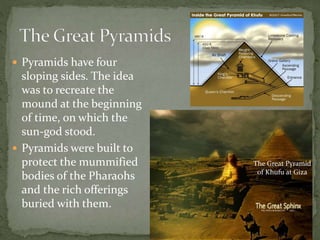
 Pyramids have four
sloping sides. The idea
was to recreate the
mound at the beginning
of time, on which the
sun-god stood.
 Pyramids were built to
protect the mummified
bodies of the Pharaohs
and the rich offerings
buried with them.
The Great Pyramid
of Khufu at Giza
 The Pyramid age ended in 2150 BC.
 Nearly all Pharaohs after that, from Tuthmosis I (1504
BC) to Ramesses XI (1070 BC) chose to be buried in
tombs in the Valley of Kings.
 The Valley were deep
in the cliffs to the west
of the Nile. There was
a ridge in front of the
entrance, where
guards were kept
 Egyptians worshipped several Gods and Goddesses.
 The Sun God, Ra, was the most important God.
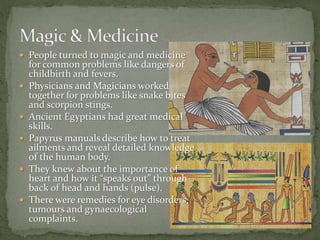
 People turned to magic and medicine
for common problems like dangers of
childbirth and fevers.
 Physicians and Magicians worked
together for problems like snake bites
and scorpion stings.
 Ancient Egyptians had great medical
skills.
 Papyrus manuals describe how to treat
ailments and reveal detailed knowledge
of the human body.
 They knew about the importance of
heart and how it “speaks out” through
back of head and hands (pulse).
 There were remedies for eye disorders,
tumours and gynaecological
complaints.
 Egyptians had great temples such
as the Karnak at Thebes, temple of
Isis at Philae and temple of
Dendera.
 The Pharaoh was supposed to
carry out the duties of high priest
in every temple. In his place, the
Chief Priest carried out the duties.
 The Chief Priest had great powers
and controlled vast wealth of
temple treasuries and great lands
of the temple.
 There were several other priests at
every temple. Some select priests
were involved in temple’s
ceremonies.
 Ancient Egyptians used to write on
papyrus sheets.
 The early picture-writing was called
“heiroglyphs”. A different form of
writing, called “hieratic” was also used.
Later, a rapid script, called “demotic”
evolved. Even later, the Egyptians used
to write Greek.
 The famous “Rosetta Stone”, discovered
in 1799, had a message in all these three
scripts – on the top was heiroglyphs,
the centre was demotic, and at the
bottom, Greek. This allowed us to
translate the heiroglyphs.
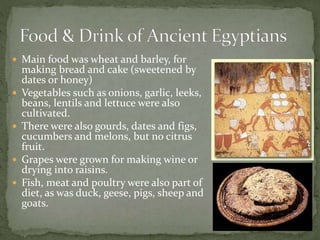
 Main food was wheat and barley, for
making bread and cake (sweetened by
dates or honey)
 Vegetables such as onions, garlic, leeks,
beans, lentils and lettuce were also
cultivated.
 There were also gourds, dates and figs,
cucumbers and melons, but no citrus
fruit.
 Grapes were grown for making wine or
drying into raisins.
 Fish, meat and poultry were also part of
diet, as was duck, geese, pigs, sheep and
goats.
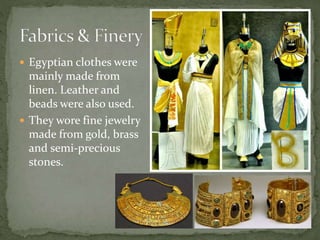
 Egyptian clothes were
mainly made from
linen. Leather and
beads were also used.
 They wore fine jewelry
made from gold, brass
and semi-precious
stones.
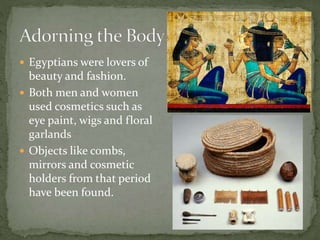
 Egyptians were lovers of
beauty and fashion.
 Both men and women
used cosmetics such as
eye paint, wigs and floral
garlands
 Objects like combs,
mirrors and cosmetic
holders from that period
have been found.
 Egypt was invaded by foreigners
several times in the last 1,000 years
B.C.
 The invaders included:
 Sudanese
 Persians
 Macedonians / Greek
(Alexander the Great)
 Romans
 Arabs
 The Arab invasion of 7th Century
A.D. turned Egypt into the mainly
Muslim country that it is today
Alexander the Great
Roman Emperor
Augustus
Persian invaders
 Egyptian meals typically start with a soup, served with flatbreads like pitta or aish
 A dish of chicken, lamb or veal that has been slow-roasted with herbs or a fish stew
accompanied by couscous or rice may follow.
 Meals in Egypt are almost always served with salad and dips, such as babaganoush
made from pureed aubergine or fuul, which is a combination of fava beans, lemon
and herbs.
 Desert is usually pastries filled with figs, dates and nuts, and drenched in honey, or a
mahallabiyaa (rice pudding) made with rosewater and sprinkled with spice. Yoghurt
and fruit, especially oranges, dates and figs, are often eaten as a dessert too.
 Two of Egypt’s most popular dishes are ful medames and koshari, made from
spaghetti or macaroni, or sometimes rice, which is cooked together with pulses,
garlic and tomatoes and topped with fried onions and herbs.
 Falafel, the spicy mashed bean or chickpea and herb patty delicacy can be found
everywhere and makes a tasty snack.
 The most popular drinks in Egypt are tea, which is usually flavoured with mint or a
delicate blend of herbs, and strong coffee. Fruit drinks are widely available, as are
local delicacies like karkaday.
Tribal Bedouins of Egypt
Modern Egyptians in Cairo
 Female attire:
Modesty is very important to Egyptian
women, most wear clothes that cover their full
body. Many women wear a hijab (a covering
for the neck and head) or a niquab (a covering
of the face and head). However, it is not
uncommon to see an Egyptian woman without
a head covering.
 Male Attire:
Some devout Muslims and usually men of
lower classes wear a galabiya (loose fitting
ankle length robe) along with a turban,
skullcap or fez. However, most men today
wear more Western type clothing. This
includes business suits while at work and
trousers and short sleeved shirts for every day
wear.
 Full name: Arab Republic of Egypt
 Flag: A tricolor of red, white and black, with a golden
eagle set in the middle.
 Capital: Cairo (also the largest city)
 Population: 80 million (2007 estimate)
 Area: 1 million sq. km.
 Currency: Egyptian Pound
 Major Religion: Islam
 Languages: Arabic (official), English, French.
 Major Cities: Cairo, Alexandria, Giza
 Climate : Hot summers and cool winters
more about egypt

more about egypt

  • 1.
    Kairavi Bhansali Std. V-E,Queen’s Valley School
  • 4.
     In Stoneage, people in Egypt lived on sites fairly high up on the land above the Nile.  By 5000 BC, they became farmers who grew wheat and barley, and reared cattle.  The farmers prospered and built kingdoms.  Some living in cities made the first steps in inventing writing.  Objects found of that period are magnificently carved ivories, stone palettes and fine pots
  • 5.
     Desert (calledRed Land) covers more than 90% of Egypt. Very few people live in the desert, these in small settlements around oases.  The river Nile is the lifeline of Egypt.  The fertile Black Land besides the river Nile and its canals, where crops grow, is where most of the people settled.  Without this fertile land, there would have been no civilization in Egypt.
  • 7.
     The King(called Pharaoh) was the most important and powerful person in Egypt – thought to be a God by the people. Ramesses The Great Queen Cleopatra
  • 8.
     Egyptians believedthat preserving the bodies of their Pharaohs after their death would ensure they live forever.  They developed a process of preserving bodies after death.  Organs (except heart) of bodies were removed and preserved in jars, and the bodies were treated with chemicals and wrapped in linen bandages and placed in wooden caskets  Such preserved bodies are called “Mummies”
  • 9.
     Pyramids havefour sloping sides. The idea was to recreate the mound at the beginning of time, on which the sun-god stood.  Pyramids were built to protect the mummified bodies of the Pharaohs and the rich offerings buried with them. The Great Pyramid of Khufu at Giza
  • 10.
     The Pyramidage ended in 2150 BC.  Nearly all Pharaohs after that, from Tuthmosis I (1504 BC) to Ramesses XI (1070 BC) chose to be buried in tombs in the Valley of Kings.  The Valley were deep in the cliffs to the west of the Nile. There was a ridge in front of the entrance, where guards were kept
  • 11.
     Egyptians worshippedseveral Gods and Goddesses.  The Sun God, Ra, was the most important God.
  • 12.
     People turnedto magic and medicine for common problems like dangers of childbirth and fevers.  Physicians and Magicians worked together for problems like snake bites and scorpion stings.  Ancient Egyptians had great medical skills.  Papyrus manuals describe how to treat ailments and reveal detailed knowledge of the human body.  They knew about the importance of heart and how it “speaks out” through back of head and hands (pulse).  There were remedies for eye disorders, tumours and gynaecological complaints.
  • 13.
     Egyptians hadgreat temples such as the Karnak at Thebes, temple of Isis at Philae and temple of Dendera.  The Pharaoh was supposed to carry out the duties of high priest in every temple. In his place, the Chief Priest carried out the duties.  The Chief Priest had great powers and controlled vast wealth of temple treasuries and great lands of the temple.  There were several other priests at every temple. Some select priests were involved in temple’s ceremonies.
  • 14.
     Ancient Egyptiansused to write on papyrus sheets.  The early picture-writing was called “heiroglyphs”. A different form of writing, called “hieratic” was also used. Later, a rapid script, called “demotic” evolved. Even later, the Egyptians used to write Greek.  The famous “Rosetta Stone”, discovered in 1799, had a message in all these three scripts – on the top was heiroglyphs, the centre was demotic, and at the bottom, Greek. This allowed us to translate the heiroglyphs.
  • 15.
     Main foodwas wheat and barley, for making bread and cake (sweetened by dates or honey)  Vegetables such as onions, garlic, leeks, beans, lentils and lettuce were also cultivated.  There were also gourds, dates and figs, cucumbers and melons, but no citrus fruit.  Grapes were grown for making wine or drying into raisins.  Fish, meat and poultry were also part of diet, as was duck, geese, pigs, sheep and goats.
  • 16.
     Egyptian clotheswere mainly made from linen. Leather and beads were also used.  They wore fine jewelry made from gold, brass and semi-precious stones.
  • 17.
     Egyptians werelovers of beauty and fashion.  Both men and women used cosmetics such as eye paint, wigs and floral garlands  Objects like combs, mirrors and cosmetic holders from that period have been found.
  • 18.
     Egypt wasinvaded by foreigners several times in the last 1,000 years B.C.  The invaders included:  Sudanese  Persians  Macedonians / Greek (Alexander the Great)  Romans  Arabs  The Arab invasion of 7th Century A.D. turned Egypt into the mainly Muslim country that it is today Alexander the Great Roman Emperor Augustus Persian invaders
  • 20.
     Egyptian mealstypically start with a soup, served with flatbreads like pitta or aish  A dish of chicken, lamb or veal that has been slow-roasted with herbs or a fish stew accompanied by couscous or rice may follow.  Meals in Egypt are almost always served with salad and dips, such as babaganoush made from pureed aubergine or fuul, which is a combination of fava beans, lemon and herbs.  Desert is usually pastries filled with figs, dates and nuts, and drenched in honey, or a mahallabiyaa (rice pudding) made with rosewater and sprinkled with spice. Yoghurt and fruit, especially oranges, dates and figs, are often eaten as a dessert too.  Two of Egypt’s most popular dishes are ful medames and koshari, made from spaghetti or macaroni, or sometimes rice, which is cooked together with pulses, garlic and tomatoes and topped with fried onions and herbs.  Falafel, the spicy mashed bean or chickpea and herb patty delicacy can be found everywhere and makes a tasty snack.  The most popular drinks in Egypt are tea, which is usually flavoured with mint or a delicate blend of herbs, and strong coffee. Fruit drinks are widely available, as are local delicacies like karkaday.
  • 21.
    Tribal Bedouins ofEgypt Modern Egyptians in Cairo  Female attire: Modesty is very important to Egyptian women, most wear clothes that cover their full body. Many women wear a hijab (a covering for the neck and head) or a niquab (a covering of the face and head). However, it is not uncommon to see an Egyptian woman without a head covering.  Male Attire: Some devout Muslims and usually men of lower classes wear a galabiya (loose fitting ankle length robe) along with a turban, skullcap or fez. However, most men today wear more Western type clothing. This includes business suits while at work and trousers and short sleeved shirts for every day wear.
  • 22.
     Full name:Arab Republic of Egypt  Flag: A tricolor of red, white and black, with a golden eagle set in the middle.  Capital: Cairo (also the largest city)  Population: 80 million (2007 estimate)  Area: 1 million sq. km.  Currency: Egyptian Pound  Major Religion: Islam  Languages: Arabic (official), English, French.  Major Cities: Cairo, Alexandria, Giza  Climate : Hot summers and cool winters