..::  initializing happy times  ::..
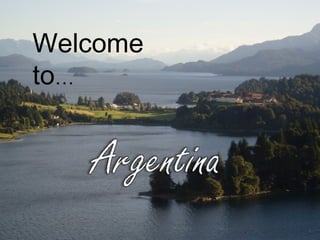
Welcome to …
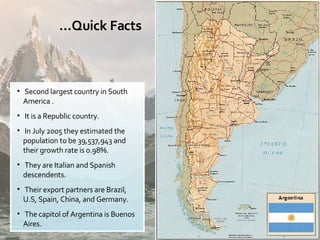
Second largest country in South America . It is a Republic country. In July 2005 they estimated the population to be 39,537,943 and their growth rate is 0.98%. They are Italian and Spanish descendents. Their export partners are Brazil, U.S, Spain, China, and Germany. The capitol of Argentina is Buenos Aires. … Quick Facts
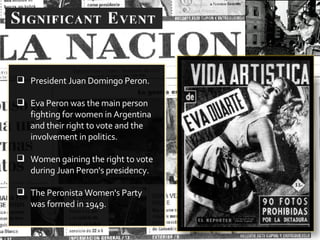
President Juan Domingo Peron. Eva Peron was the main person fighting for women in Argentina and their right to vote and the involvement in politics. Women gaining the right to vote during Juan Peron's presidency. The Peronista Women's Party was formed in 1949.
 
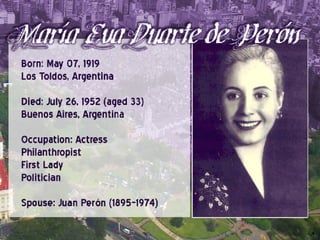
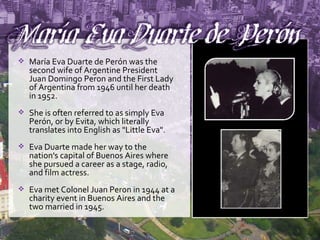
María Eva Duarte de Perón was the second wife of Argentine President Juan Domingo Peron and the First Lady of Argentina from 1946 until her death in 1952. She is often referred to as simply Eva Perón, or by Evita, which literally translates into English as "Little Eva".  Eva Duarte made her way to the nation's capital of Buenos Aires where she pursued a career as a stage, radio, and film actress.  Eva met Colonel Juan Peron in 1944 at a charity event in Buenos Aires and the two married in 1945.
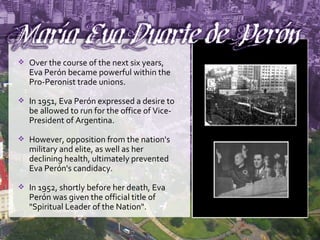
Over the course of the next six years, Eva Perón became powerful within the Pro-Peronist trade unions. In 1951, Eva Perón expressed a desire to be allowed to run for the office of Vice-President of Argentina. However, opposition from the nation's military and elite, as well as her declining health, ultimately prevented Eva Perón's candidacy. In 1952, shortly before her death, Eva Perón was given the official title of "Spiritual Leader of the Nation".
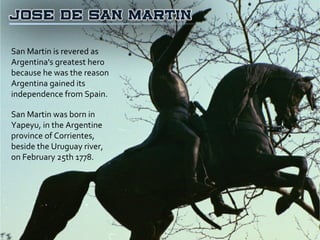
San Martin is revered as Argentina's greatest hero because he was the reason Argentina gained its independence from Spain. San Martin was born in Yapeyu, in the Argentine province of Corrientes,  beside the Uruguay river,  on February 25th 1778.
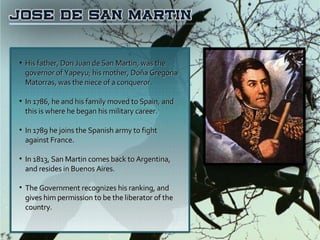
His father, Don Juan de San Martin, was the governor of Yapeyu; his mother, Doña Gregoria Matorras, was the niece of a conqueror.  In 1786, he and his family moved to Spain, and this is where he began his military career. In 1789 he joins the Spanish army to fight against France. In 1813, San Martin comes back to Argentina, and resides in Buenos Aires. The Government recognizes his ranking, and gives him permission to be the liberator of the country.
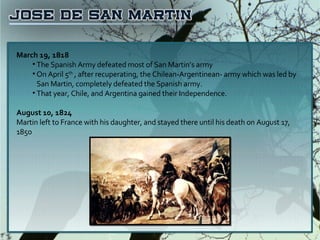
March 19, 1818 The Spanish Army defeated most of San Martin’s army On April 5 th  , after recuperating, the Chilean-Argentinean- army which was led by San Martin, completely defeated the Spanish army. That year, Chile, and Argentina gained their Independence. August 10, 1824 Martin left to France with his daughter, and stayed there until his death on August 17, 1850
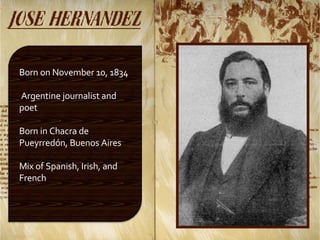
Born on November 10, 1834   Argentine journalist and poet Born in Chacra de Pueyrredón, Buenos Aires Mix of Spanish, Irish, and French
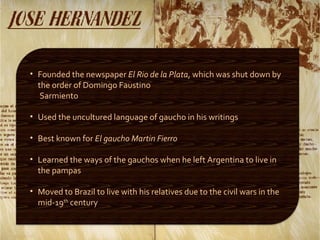
Founded the newspaper  El Rio de la Plata , which was shut down by the order of Domingo Faustino  Sarmiento Used the uncultured language of gaucho in his writings Best known for  El gaucho   Martin Fierro Learned the ways of the gauchos when he left Argentina to live in the pampas Moved to Brazil to live with his relatives due to the civil wars in the mid-19 th  century
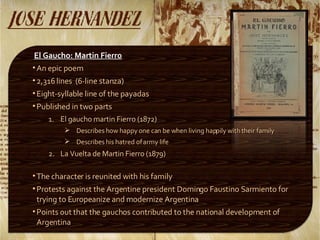
El Gaucho: Martin Fierro An epic poem 2,316 lines  (6-line stanza) Eight-syllable line of the payadas Published in two parts El gaucho martin Fierro (1872) Describes how happy one can be when living happily with their family Describes his hatred of army life La Vuelta de Martin Fierro (1879) The character is reunited with his family Protests against the Argentine president Domingo Faustino Sarmiento for trying to Europeanize and modernize Argentina Points out that the gauchos contributed to the national development of Argentina
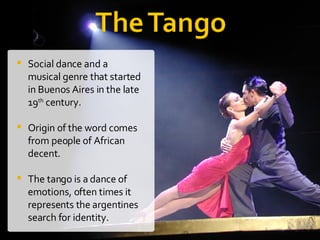
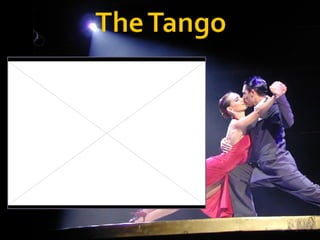
Social dance and a musical genre that started in Buenos Aires in the late 19 th  century.  Origin of the word comes from people of African decent.  The tango is a dance of emotions, often times it represents the argentines search for identity. 
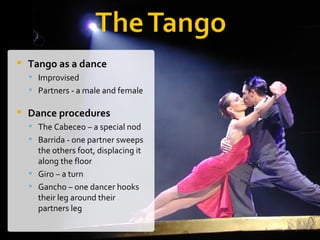
Tango as a dance   Improvised Partners - a male and female  Dance procedures   The Cabeceo – a special nod  Barrida - one partner sweeps the others foot, displacing it along the floor  Giro – a turn Gancho – one dancer hooks their leg around their partners leg 
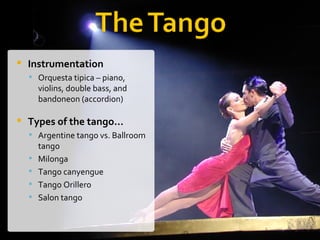
Instrumentation   Orquesta tipica – piano, violins, double bass, and bandoneon (accordion)  Types of the tango… Argentine tango vs. Ballroom tango  Milonga   Tango canyengue  Tango Orillero  Salon tango   
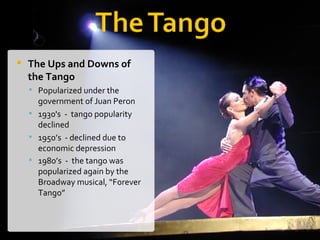
The Ups and Downs of the Tango Popularized under the government of Juan Peron 1930's  -  tango popularity declined 1950’s  - declined due to  economic depression 1980’s  -  the tango was popularized again by the Broadway musical, “Forever Tango”  
 
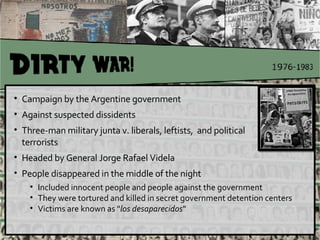
Campaign by the Argentine government  Against suspected dissidents Three-man military junta v. liberals, leftists,  and political terrorists Headed by General Jorge Rafael Videla People disappeared in the middle of the night  Included innocent people and people against the government  They were tortured and killed in secret government detention centers  Victims are known as " los desaparecidos "
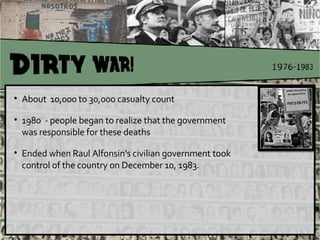
About  10,000 to 30,000 casualty count 1980  - people began to realize that the government  was responsible for these deaths Ended when Raul Alfonsin's civilian government took  control of the country on December 10, 1983.
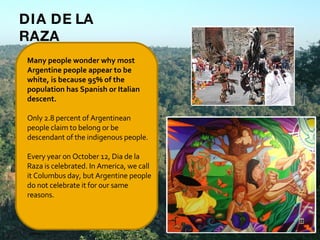
Many people wonder why most Argentine people appear to be white, is because 95% of the population has Spanish or Italian descent.   Only 2.8 percent of Argentinean people claim to belong or be descendant of the indigenous people.   Every year on October 12, Dia de la Raza is celebrated. In America, we call it Columbus day, but Argentine people do not celebrate it for our same reasons.   DIA DE LA RAZA
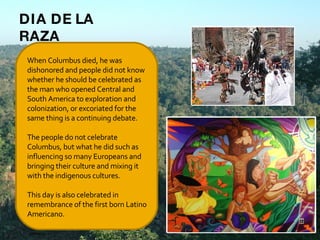
When Columbus died, he was dishonored and people did not know whether he should be celebrated as the man who opened Central and South America to exploration and colonization, or excoriated for the same thing is a continuing debate. The people do not celebrate Columbus, but what he did such as influencing so many Europeans and bringing their culture and mixing it with the indigenous cultures.   This day is also celebrated in remembrance of the first born Latino Americano.   DIA DE LA RAZA
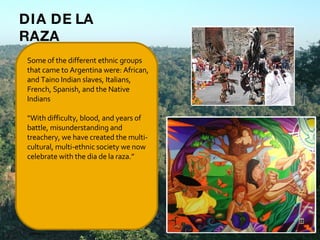
Some of the different ethnic groups that came to Argentina were: African, and Taino Indian slaves, Italians, French, Spanish, and the Native Indians   “ With difficulty, blood, and years of battle, misunderstanding and treachery, we have created the multi-cultural, multi-ethnic society we now celebrate with the dia de la raza.”     DIA DE LA RAZA
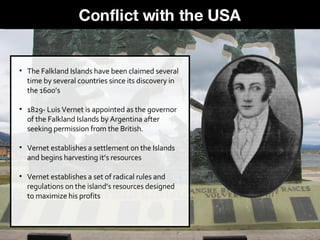
The Falkland Islands have been claimed several time by several countries since its discovery in the 1600’s 1829- Luis Vernet is appointed as the governor of the Falkland Islands by Argentina after seeking permission from the British.  Vernet establishes a settlement on the Islands and begins harvesting it’s resources Vernet establishes a set of radical rules and regulations on the island’s resources designed to maximize his profits Conflict with the USA
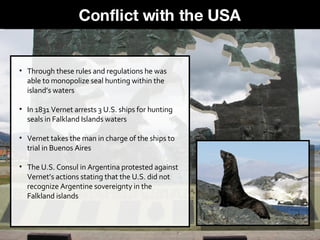
Through these rules and regulations he was able to monopolize seal hunting within the island’s waters  In 1831 Vernet arrests 3 U.S. ships for hunting seals in Falkland Islands waters Vernet takes the man in charge of the ships to trial in Buenos Aires  The U.S. Consul in Argentina protested against Vernet’s actions stating that the U.S. did not recognize Argentine sovereignty in the Falkland islands Conflict with the USA
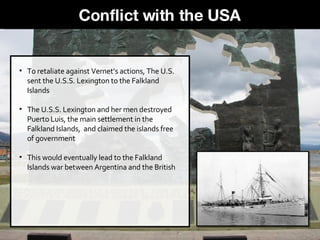
To retaliate against Vernet’s actions, The U.S. sent the U.S.S. Lexington to the Falkland Islands The U.S.S. Lexington and her men destroyed Puerto Luis, the main settlement in the Falkland Islands,  and claimed the islands free of government This would eventually lead to the Falkland Islands war between Argentina and the British Conflict with the USA
Chapter 8: Striving for Health and Coping with Illness   Anthropology of the body  is the field of cultural anthropology concerned with how the human body is culturally and socially construed.   Anthropology of the emotions  is a subdiscipline of cultural anthropology that focuses on how the body is a metaphor expressing personal and collective emotional stress.    Religion and Healing beliefs in indigenous, non-Western societies, shows the broader view of the relationship between mortals and the supernatural.     Shamanism  is a religions system marked by the belief that specific persons-shamans-have the ability to directly communicate with the supernatural through a trance or possession experience.       Shamans play a crucial role as guardians of the social order and mediators of inter-personal conflicts, and thereby an important political role.   
Chapter 8: Striving for Health and Coping with Illness   There are many kinds of shamanistic healing practices and beliefs.  They rely  on the transformation of plants into substances and use body altering substances such as tobacco or alcohol. Ritual power  is the ability of rituals or ritual behavior to harness authority or legitimacy.    Most people believe that serious illness originates in  witchcraft , which is the malignant use or deployment of supernatural powers.    Religious Pluralism  is the co-existence and overlap between different religious traditions.  
Chapter 8: Striving for Health and Coping with Illness   Religious Pluralism, biomedicine, and ethnomedicine compete and complement each other in the diagnosis and treatment of illnesses.    For decades, social and medical scientists and policy makers have debated the pros and cons of legalizing marijuana, especially for medical purposes.     Marijuana was introduced during the 19th century by east Indian indentured laborers brought to work on english colonial sugar plantations.    Mal de ojo  is the illness that attributes to direct eye contact with someone who is envious, jealous, or has a grudge.     Susto  is a popular illness sparked by a sudden and unexpected occurrence  that startles, frightens, or produces anxiety.
Chapter 8: Striving for Health and Coping with Illness   Striving for Health and Coping with illness   Medical anthropology Ethnomedicine vs. Biomedicine  Critical medical anthropology  Mortality, access to Biomedicine, and malnutrition Latin American and Caribbean countries mortality rates are very high compared to those in the US Not enough access or money being spent on health recourses Lack of sanitation Malnutrition
Chapter 8: Striving for Health and Coping with Illness   Poverty, Inequality and Disease people cannot afford to pay for food because of bad income distribution AIDS and tuberculosis are very rapidly spreading diseases in Latin America people don’t like to go to doctors because of trust issues and high costs. Aids is the most popular in Brazil and Haiti  Gender and Health   Women are more likely to get illnesses due to their roles in society 
Chapter 8: Striving for Health and Coping with Illness   Medical system  – beliefs, values, practices, and knowledge that enables members to understand, diagnose and treat health and illness.  Medical anthropology  – studies the social, cultural and biological dimensions of health and illness from a cross cultural perspective.  Ethnomedicine  – the culturally-specific medical systems in non-western societies.  Biomedicine  – the medical system dominant in western societies  Tuberculosis  - caused by the bacterium tubercle bacillus, which typically attacks the lungs.  Critical medical anthropology-  stresses how political and economic inequality affects the emergence and etiology of and responses to illness and disease.  Culturalist approach-  beliefs, values, and attitudes-and not inequality and differential power relations are seen as the chief culprit for the spread of tuberculosis and the lack of proper treatment.  Structural Violence  – draws attention to the effects of broad and pervasive patterns of poverty, inequality, and oppression that cut across cultural, ethnic, class, and gender boundaries.  Life’s Lesions  – the perceived adversity of existence, including inimical social relationships and unresolved contradictions which gnaw at a persons being and become inscribed on the body.
"History of Tango."  Wikipedia . 10 Oct. 2007. 8 Nov. 2007  http://en.wikipedia.org/wiki/History_of_Tango .  Taylor, Julie.  Paper Tangos . United States: Public Planet Books, 1998. 1-121.  Thompson, Robert F.  Tango: the Art History of Love . 1st ed. New York: Pantheon Books, 2005. 4-360.  http://www.evitaperon.org   http://www.nationsencyclopedia.com http://www.fsmitha.com http://geography.about.com/library/cia/blcargentina.htm   http://www.pachami.com/English/ressanmE.htm http://www.lasculturas.com/aa/aa100800a.php http://www.globalsecurity.org/military/world/war/argentina.htm  

Argentina Presentation

  • 1.
    ..:: initializinghappy times ::..
  • 2.
  • 3.
    Second largest countryin South America . It is a Republic country. In July 2005 they estimated the population to be 39,537,943 and their growth rate is 0.98%. They are Italian and Spanish descendents. Their export partners are Brazil, U.S, Spain, China, and Germany. The capitol of Argentina is Buenos Aires. … Quick Facts
  • 4.
    President Juan DomingoPeron. Eva Peron was the main person fighting for women in Argentina and their right to vote and the involvement in politics. Women gaining the right to vote during Juan Peron's presidency. The Peronista Women's Party was formed in 1949.
  • 5.
  • 6.
    María Eva Duartede Perón was the second wife of Argentine President Juan Domingo Peron and the First Lady of Argentina from 1946 until her death in 1952. She is often referred to as simply Eva Perón, or by Evita, which literally translates into English as "Little Eva". Eva Duarte made her way to the nation's capital of Buenos Aires where she pursued a career as a stage, radio, and film actress. Eva met Colonel Juan Peron in 1944 at a charity event in Buenos Aires and the two married in 1945.
  • 7.
    Over the courseof the next six years, Eva Perón became powerful within the Pro-Peronist trade unions. In 1951, Eva Perón expressed a desire to be allowed to run for the office of Vice-President of Argentina. However, opposition from the nation's military and elite, as well as her declining health, ultimately prevented Eva Perón's candidacy. In 1952, shortly before her death, Eva Perón was given the official title of "Spiritual Leader of the Nation".
  • 8.
    San Martin isrevered as Argentina's greatest hero because he was the reason Argentina gained its independence from Spain. San Martin was born in Yapeyu, in the Argentine province of Corrientes, beside the Uruguay river, on February 25th 1778.
  • 9.
    His father, DonJuan de San Martin, was the governor of Yapeyu; his mother, Doña Gregoria Matorras, was the niece of a conqueror. In 1786, he and his family moved to Spain, and this is where he began his military career. In 1789 he joins the Spanish army to fight against France. In 1813, San Martin comes back to Argentina, and resides in Buenos Aires. The Government recognizes his ranking, and gives him permission to be the liberator of the country.
  • 10.
    March 19, 1818The Spanish Army defeated most of San Martin’s army On April 5 th , after recuperating, the Chilean-Argentinean- army which was led by San Martin, completely defeated the Spanish army. That year, Chile, and Argentina gained their Independence. August 10, 1824 Martin left to France with his daughter, and stayed there until his death on August 17, 1850
  • 11.
    Born on November10, 1834 Argentine journalist and poet Born in Chacra de Pueyrredón, Buenos Aires Mix of Spanish, Irish, and French
  • 12.
    Founded the newspaper El Rio de la Plata , which was shut down by the order of Domingo Faustino Sarmiento Used the uncultured language of gaucho in his writings Best known for El gaucho Martin Fierro Learned the ways of the gauchos when he left Argentina to live in the pampas Moved to Brazil to live with his relatives due to the civil wars in the mid-19 th century
  • 13.
    El Gaucho: MartinFierro An epic poem 2,316 lines (6-line stanza) Eight-syllable line of the payadas Published in two parts El gaucho martin Fierro (1872) Describes how happy one can be when living happily with their family Describes his hatred of army life La Vuelta de Martin Fierro (1879) The character is reunited with his family Protests against the Argentine president Domingo Faustino Sarmiento for trying to Europeanize and modernize Argentina Points out that the gauchos contributed to the national development of Argentina
  • 14.
    Social dance anda musical genre that started in Buenos Aires in the late 19 th century.  Origin of the word comes from people of African decent.  The tango is a dance of emotions, often times it represents the argentines search for identity. 
  • 15.
    Tango as adance   Improvised Partners - a male and female  Dance procedures   The Cabeceo – a special nod  Barrida - one partner sweeps the others foot, displacing it along the floor  Giro – a turn Gancho – one dancer hooks their leg around their partners leg 
  • 16.
    Instrumentation   Orquestatipica – piano, violins, double bass, and bandoneon (accordion)  Types of the tango… Argentine tango vs. Ballroom tango  Milonga   Tango canyengue  Tango Orillero  Salon tango   
  • 17.
    The Ups andDowns of the Tango Popularized under the government of Juan Peron 1930's - tango popularity declined 1950’s - declined due to economic depression 1980’s - the tango was popularized again by the Broadway musical, “Forever Tango”  
  • 18.
  • 19.
    Campaign by theArgentine government Against suspected dissidents Three-man military junta v. liberals, leftists, and political terrorists Headed by General Jorge Rafael Videla People disappeared in the middle of the night  Included innocent people and people against the government  They were tortured and killed in secret government detention centers  Victims are known as " los desaparecidos "
  • 20.
    About 10,000to 30,000 casualty count 1980 - people began to realize that the government was responsible for these deaths Ended when Raul Alfonsin's civilian government took control of the country on December 10, 1983.
  • 21.
    Many people wonderwhy most Argentine people appear to be white, is because 95% of the population has Spanish or Italian descent.   Only 2.8 percent of Argentinean people claim to belong or be descendant of the indigenous people.   Every year on October 12, Dia de la Raza is celebrated. In America, we call it Columbus day, but Argentine people do not celebrate it for our same reasons.   DIA DE LA RAZA
  • 22.
    When Columbus died,he was dishonored and people did not know whether he should be celebrated as the man who opened Central and South America to exploration and colonization, or excoriated for the same thing is a continuing debate. The people do not celebrate Columbus, but what he did such as influencing so many Europeans and bringing their culture and mixing it with the indigenous cultures.   This day is also celebrated in remembrance of the first born Latino Americano.   DIA DE LA RAZA
  • 23.
    Some of thedifferent ethnic groups that came to Argentina were: African, and Taino Indian slaves, Italians, French, Spanish, and the Native Indians   “ With difficulty, blood, and years of battle, misunderstanding and treachery, we have created the multi-cultural, multi-ethnic society we now celebrate with the dia de la raza.”     DIA DE LA RAZA
  • 24.
    The Falkland Islandshave been claimed several time by several countries since its discovery in the 1600’s 1829- Luis Vernet is appointed as the governor of the Falkland Islands by Argentina after seeking permission from the British. Vernet establishes a settlement on the Islands and begins harvesting it’s resources Vernet establishes a set of radical rules and regulations on the island’s resources designed to maximize his profits Conflict with the USA
  • 25.
    Through these rulesand regulations he was able to monopolize seal hunting within the island’s waters In 1831 Vernet arrests 3 U.S. ships for hunting seals in Falkland Islands waters Vernet takes the man in charge of the ships to trial in Buenos Aires The U.S. Consul in Argentina protested against Vernet’s actions stating that the U.S. did not recognize Argentine sovereignty in the Falkland islands Conflict with the USA
  • 26.
    To retaliate againstVernet’s actions, The U.S. sent the U.S.S. Lexington to the Falkland Islands The U.S.S. Lexington and her men destroyed Puerto Luis, the main settlement in the Falkland Islands,  and claimed the islands free of government This would eventually lead to the Falkland Islands war between Argentina and the British Conflict with the USA
  • 27.
    Chapter 8: Strivingfor Health and Coping with Illness   Anthropology of the body is the field of cultural anthropology concerned with how the human body is culturally and socially construed.   Anthropology of the emotions is a subdiscipline of cultural anthropology that focuses on how the body is a metaphor expressing personal and collective emotional stress.   Religion and Healing beliefs in indigenous, non-Western societies, shows the broader view of the relationship between mortals and the supernatural.    Shamanism is a religions system marked by the belief that specific persons-shamans-have the ability to directly communicate with the supernatural through a trance or possession experience.     Shamans play a crucial role as guardians of the social order and mediators of inter-personal conflicts, and thereby an important political role.  
  • 28.
    Chapter 8: Strivingfor Health and Coping with Illness   There are many kinds of shamanistic healing practices and beliefs.  They rely on the transformation of plants into substances and use body altering substances such as tobacco or alcohol. Ritual power is the ability of rituals or ritual behavior to harness authority or legitimacy.   Most people believe that serious illness originates in witchcraft , which is the malignant use or deployment of supernatural powers.   Religious Pluralism is the co-existence and overlap between different religious traditions.  
  • 29.
    Chapter 8: Strivingfor Health and Coping with Illness   Religious Pluralism, biomedicine, and ethnomedicine compete and complement each other in the diagnosis and treatment of illnesses.   For decades, social and medical scientists and policy makers have debated the pros and cons of legalizing marijuana, especially for medical purposes.    Marijuana was introduced during the 19th century by east Indian indentured laborers brought to work on english colonial sugar plantations.   Mal de ojo is the illness that attributes to direct eye contact with someone who is envious, jealous, or has a grudge.   Susto is a popular illness sparked by a sudden and unexpected occurrence that startles, frightens, or produces anxiety.
  • 30.
    Chapter 8: Strivingfor Health and Coping with Illness   Striving for Health and Coping with illness   Medical anthropology Ethnomedicine vs. Biomedicine  Critical medical anthropology  Mortality, access to Biomedicine, and malnutrition Latin American and Caribbean countries mortality rates are very high compared to those in the US Not enough access or money being spent on health recourses Lack of sanitation Malnutrition
  • 31.
    Chapter 8: Strivingfor Health and Coping with Illness   Poverty, Inequality and Disease people cannot afford to pay for food because of bad income distribution AIDS and tuberculosis are very rapidly spreading diseases in Latin America people don’t like to go to doctors because of trust issues and high costs. Aids is the most popular in Brazil and Haiti  Gender and Health   Women are more likely to get illnesses due to their roles in society 
  • 32.
    Chapter 8: Strivingfor Health and Coping with Illness   Medical system – beliefs, values, practices, and knowledge that enables members to understand, diagnose and treat health and illness.  Medical anthropology – studies the social, cultural and biological dimensions of health and illness from a cross cultural perspective.  Ethnomedicine – the culturally-specific medical systems in non-western societies.  Biomedicine – the medical system dominant in western societies  Tuberculosis - caused by the bacterium tubercle bacillus, which typically attacks the lungs.  Critical medical anthropology- stresses how political and economic inequality affects the emergence and etiology of and responses to illness and disease.  Culturalist approach- beliefs, values, and attitudes-and not inequality and differential power relations are seen as the chief culprit for the spread of tuberculosis and the lack of proper treatment.  Structural Violence – draws attention to the effects of broad and pervasive patterns of poverty, inequality, and oppression that cut across cultural, ethnic, class, and gender boundaries.  Life’s Lesions – the perceived adversity of existence, including inimical social relationships and unresolved contradictions which gnaw at a persons being and become inscribed on the body.
  • 33.
    "History of Tango." Wikipedia . 10 Oct. 2007. 8 Nov. 2007 http://en.wikipedia.org/wiki/History_of_Tango .  Taylor, Julie. Paper Tangos . United States: Public Planet Books, 1998. 1-121.  Thompson, Robert F. Tango: the Art History of Love . 1st ed. New York: Pantheon Books, 2005. 4-360.  http://www.evitaperon.org http://www.nationsencyclopedia.com http://www.fsmitha.com http://geography.about.com/library/cia/blcargentina.htm http://www.pachami.com/English/ressanmE.htm http://www.lasculturas.com/aa/aa100800a.php http://www.globalsecurity.org/military/world/war/argentina.htm