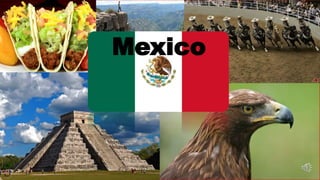
Mexico
Location
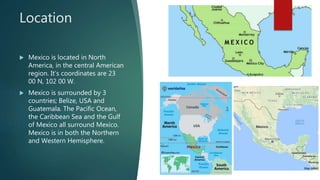
 Mexico is located in North
America, in the central American
region. It’s coordinates are 23
00 N, 102 00 W.
 Mexico is surrounded by 3
countries; Belize, USA and
Guatemala. The Pacific Ocean,
the Caribbean Sea and the Gulf
of Mexico all surround Mexico.
Mexico is in both the Northern
and Western Hemisphere.
Population and
Size
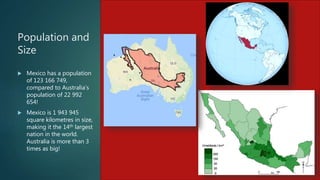
 Mexico has a population
of 123 166 749,
compared to Australia’s
population of 22 992
654!
 Mexico is 1 943 945
square kilometres in size,
making it the 14th largest
nation in the world.
Australia is more than 3
times as big!
National Symbols
Flora
The Xoloitzcuintli is the national
Mexican dog, and the Crested
Cara Cara is the national bird, but
the national animal of Mexico is
the native Golden Eagle.
Fauna
The Dahlia Pinnata is the national
flower of Mexico. It originated
from the mountainous regions of
Central America.
Colour
The national colours of Mexico are
green, red and white, like the flag.
Flag
 Mexico’s flag has 3 equal vertical bands of
green, white and red, with the Mexican
coat of arms in the middle. White
represents peace and honesty, green
symbolises hope, joy and love while red
represents hardiness, bravery, strength and
valour.
 The coat of arms is based on a legend that
the Aztec people were to settle at a
location where they would see an eagle on
a cactus eating a snake.
Government and Currency
 The government of Mexico is a
presidential federal republic. Their
current constitution was written in 1917.
Mexico’s current president is Enrique
Peña Nieto, who was elected president
on the 1st December, 2012.
 Mexico’s currency is the Mexican peso. 1
peso is equivalent to 70 Australian cents.
Cities
 Mexico’s capital is Mexico City, (top
left), and is the most populated city
as well. This is because of it’s superior
transport system and the many
factories and work opportunities.
 Mexico’s other major cities are:
• Ecatepec City - (Bottom Right)
• Guadalajara City
• Puebla City
• Monterrey City
Religion and
Language
 Mexico has a population of 123 166 749.
82.7% of the population are Roman
Catholic, 1.6% are Pentecostal, 1.4% are
Jehovah’s Witness, 5% are other
Evangelical Churches, 4.7% are not
religious and 2.7% are unspecified.
 Mexico’s official and common language
is Spanish, with 92.7% of Mexicans
speaking Spanish only. 5.7% speak
Spanish and indigenous languages, 0.8%
are indigenous only and 0.8% are
unspecified.
Demographics
Mexico Australia
Population Density 52 people/square mile 2 people/square mile
Literacy Rates 95% - Total Average
96.2% - Male Average
94.2% - Female Average
99% - Total Average
99% - Male Average
99% - Female Average
Infant Mortality 11.9 total/1000 live births
13.3 males/1000 live births
10.4 females/1000 live births
4.3 total/1000 live births
4.6 males/1000 live births
4 females/1000 live births
Life Expectancy 75.9yrs – Total Average
73.1yrs – Male Average
78.8yrs – Female Average
82.2yrs – Total Average
79.8yrs – Male Average
84.4yrs – Female Average
Physician Density 2.07 physicians/1000 people 3.37 physicians/1000 people
Unemployment Rate 9.6% - Total Average
9.2% - Male Average
10.3% - Female Average
13.3% - Total Average
14.1% - Male Average
12.5% - Female Average
Trade
 Mexico exports a lot of
manufactured goods, oil and oil
products, silver, fruits, vegetables,
coffee and cotton. They export
mainly to the US.
 Mexico imports a lot of machinery,
like metalworking machines,
automobile parts, agricultural
machinery, aircraft and aircraft
parts. They also import steel mill
products and electrical equipment.
Mexico mainly import from the US,
China, and Japan.
Natural Landforms
 The Copper Canyon is inside the Sierra Madre Range, and is
actually several large canyons. These canyons are 4 times larger
than the Grand Canyon in the US, covering 40 000 square
kilometres. The Copper Canyon gets it’s name from the
copper-green colouring of the canyon walls.
 Cancun’s beaches are famous world-wide. They are all amazing,
with their crystal blue waters, and soft sand. Cancun houses the
2nd biggest coral reef, the Great Mayan Barrier Reef. It is also
home to underwater caves.
 The Paricutin volcano is a cinder cone volcano. It is a famous
volcano, being one of the seven wonders of the world. It is
extinct, and is actually the first volcano that had a complete life
cycle, from birth to extinction.
Man-made Landforms
Chichen Itza
The Chichen Itza has 365
steps, one for each day of the
year. It is the second most
visited site for tourists.
Teotihuacan
Teotihuacan has 2 major
pyramids, the Pyramid of the
Sun and the Pyramid of the
Moon. Teotihuacan is 20
square kilometres and houses
many pyramids and ruins.
Palacio de Bellas Artes
The Palacio de Bellas Artes is a palace in
Mexico City. It’s name means Palace of
Fine Arts. The palace is Mexico’s
grandest and most spectacular
performance and art space.
Mexico was originally home to the Aztec people. As a result, there are many Aztec
pyramids in Mexico.
Climate and the Impact of Humans
 The climate in Mexico varies upon the
location in the country. Along the coast, it is
hot, humid and tropical, particularly in the
summer. Inland, especially on the higher
elevated areas, it is temperate and dryer.
 Mexico has many environmental issues
caused by humans. Deforestation, and water
and chemical pollution from waste dumping,
are 2 major negative impacts humans have in
Mexico. 65% of natural vegetation in Mexico
has already been cleared and destroyed.
Major Natural Disasters
 One significant natural disaster Mexico
City Earthquake, in 1985. It measured an
8.1 on the Richter Scale and lasted an
entire 2 minutes.
 Two more devastating natural disasters
that occurred in and around Mexico are
Hurricane Patricia and the Paricutin
Volcano eruption. Hurricane Patricia is the
strongest storm ever recorded and the
Paricutin volcano is the youngest volcano
to form in the northern hemisphere.
Fun Fact: The Paricutin Volcano
grew in a farmer’s cornfield. He
went out to tend to the crops and
noticed the volcano. The farmer
ran and was very lucky to survive!
Cultural Festivals
and Dances
 Mexican Independence Day – Independence day for
Mexico is on the 16th of September. Mexico became
independent from Spain when they declared a war, which is
now referred to as the Mexican War of Independence.
 Day of the Dead – Mexicans commemorate their dead
ancestors and family members on this day. The day of the
dead is on the nights of 31st October and 1st November. It is
believed that the dead spirits come to Earth on these nights.
 Las Posadas – This is a festival that re-enacts the journey of
Joseph and Mary. Neighbours open their doors and let
people come in and enjoy some food and drink.
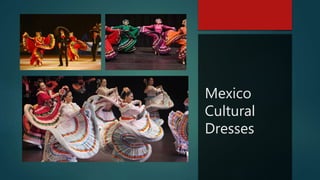
Mexico
Cultural
Dresses
Bibliography
 Wmforg. (2017). World Monuments Fund. Retrieved12 September, 2017, from
https://www.wmf.org/project/palace-fine-arts-palacio-de-bellas-artes
 Ciagov. (2017). Ciagov. Retrieved 12 September, 2017, from
https://www.cia.gov/library/publications/the-world-factbook/geos/mx.html
 Lonely planet. (2017). Mexico - Lonely Planet. Retrieved 12 September,
2017, from https://www.lonelyplanet.com/mexico
 My Nan
 Nationmastercom. (2017). Nationmastercom. Retrieved 12 September,
2017, from http://www.nationmaster.com/country-info/profiles/Mexico
 Copper canyon. (2017). Mexicoscoppercanyoncom. Retrieved 12 September,
2017, from http://mexicoscoppercanyon.com/tours/

Mexico presentation

  • 1.
  • 2.
    Location  Mexico islocated in North America, in the central American region. It’s coordinates are 23 00 N, 102 00 W.  Mexico is surrounded by 3 countries; Belize, USA and Guatemala. The Pacific Ocean, the Caribbean Sea and the Gulf of Mexico all surround Mexico. Mexico is in both the Northern and Western Hemisphere.
  • 3.
    Population and Size  Mexicohas a population of 123 166 749, compared to Australia’s population of 22 992 654!  Mexico is 1 943 945 square kilometres in size, making it the 14th largest nation in the world. Australia is more than 3 times as big!
  • 4.
    National Symbols Flora The Xoloitzcuintliis the national Mexican dog, and the Crested Cara Cara is the national bird, but the national animal of Mexico is the native Golden Eagle. Fauna The Dahlia Pinnata is the national flower of Mexico. It originated from the mountainous regions of Central America. Colour The national colours of Mexico are green, red and white, like the flag.
  • 5.
    Flag  Mexico’s flaghas 3 equal vertical bands of green, white and red, with the Mexican coat of arms in the middle. White represents peace and honesty, green symbolises hope, joy and love while red represents hardiness, bravery, strength and valour.  The coat of arms is based on a legend that the Aztec people were to settle at a location where they would see an eagle on a cactus eating a snake.
  • 6.
    Government and Currency The government of Mexico is a presidential federal republic. Their current constitution was written in 1917. Mexico’s current president is Enrique Peña Nieto, who was elected president on the 1st December, 2012.  Mexico’s currency is the Mexican peso. 1 peso is equivalent to 70 Australian cents.
  • 7.
    Cities  Mexico’s capitalis Mexico City, (top left), and is the most populated city as well. This is because of it’s superior transport system and the many factories and work opportunities.  Mexico’s other major cities are: • Ecatepec City - (Bottom Right) • Guadalajara City • Puebla City • Monterrey City
  • 8.
    Religion and Language  Mexicohas a population of 123 166 749. 82.7% of the population are Roman Catholic, 1.6% are Pentecostal, 1.4% are Jehovah’s Witness, 5% are other Evangelical Churches, 4.7% are not religious and 2.7% are unspecified.  Mexico’s official and common language is Spanish, with 92.7% of Mexicans speaking Spanish only. 5.7% speak Spanish and indigenous languages, 0.8% are indigenous only and 0.8% are unspecified.
  • 9.
    Demographics Mexico Australia Population Density52 people/square mile 2 people/square mile Literacy Rates 95% - Total Average 96.2% - Male Average 94.2% - Female Average 99% - Total Average 99% - Male Average 99% - Female Average Infant Mortality 11.9 total/1000 live births 13.3 males/1000 live births 10.4 females/1000 live births 4.3 total/1000 live births 4.6 males/1000 live births 4 females/1000 live births Life Expectancy 75.9yrs – Total Average 73.1yrs – Male Average 78.8yrs – Female Average 82.2yrs – Total Average 79.8yrs – Male Average 84.4yrs – Female Average Physician Density 2.07 physicians/1000 people 3.37 physicians/1000 people Unemployment Rate 9.6% - Total Average 9.2% - Male Average 10.3% - Female Average 13.3% - Total Average 14.1% - Male Average 12.5% - Female Average
  • 10.
    Trade  Mexico exportsa lot of manufactured goods, oil and oil products, silver, fruits, vegetables, coffee and cotton. They export mainly to the US.  Mexico imports a lot of machinery, like metalworking machines, automobile parts, agricultural machinery, aircraft and aircraft parts. They also import steel mill products and electrical equipment. Mexico mainly import from the US, China, and Japan.
  • 11.
    Natural Landforms  TheCopper Canyon is inside the Sierra Madre Range, and is actually several large canyons. These canyons are 4 times larger than the Grand Canyon in the US, covering 40 000 square kilometres. The Copper Canyon gets it’s name from the copper-green colouring of the canyon walls.  Cancun’s beaches are famous world-wide. They are all amazing, with their crystal blue waters, and soft sand. Cancun houses the 2nd biggest coral reef, the Great Mayan Barrier Reef. It is also home to underwater caves.  The Paricutin volcano is a cinder cone volcano. It is a famous volcano, being one of the seven wonders of the world. It is extinct, and is actually the first volcano that had a complete life cycle, from birth to extinction.
  • 12.
    Man-made Landforms Chichen Itza TheChichen Itza has 365 steps, one for each day of the year. It is the second most visited site for tourists. Teotihuacan Teotihuacan has 2 major pyramids, the Pyramid of the Sun and the Pyramid of the Moon. Teotihuacan is 20 square kilometres and houses many pyramids and ruins. Palacio de Bellas Artes The Palacio de Bellas Artes is a palace in Mexico City. It’s name means Palace of Fine Arts. The palace is Mexico’s grandest and most spectacular performance and art space. Mexico was originally home to the Aztec people. As a result, there are many Aztec pyramids in Mexico.
  • 13.
    Climate and theImpact of Humans  The climate in Mexico varies upon the location in the country. Along the coast, it is hot, humid and tropical, particularly in the summer. Inland, especially on the higher elevated areas, it is temperate and dryer.  Mexico has many environmental issues caused by humans. Deforestation, and water and chemical pollution from waste dumping, are 2 major negative impacts humans have in Mexico. 65% of natural vegetation in Mexico has already been cleared and destroyed.
  • 14.
    Major Natural Disasters One significant natural disaster Mexico City Earthquake, in 1985. It measured an 8.1 on the Richter Scale and lasted an entire 2 minutes.  Two more devastating natural disasters that occurred in and around Mexico are Hurricane Patricia and the Paricutin Volcano eruption. Hurricane Patricia is the strongest storm ever recorded and the Paricutin volcano is the youngest volcano to form in the northern hemisphere. Fun Fact: The Paricutin Volcano grew in a farmer’s cornfield. He went out to tend to the crops and noticed the volcano. The farmer ran and was very lucky to survive!
  • 15.
    Cultural Festivals and Dances Mexican Independence Day – Independence day for Mexico is on the 16th of September. Mexico became independent from Spain when they declared a war, which is now referred to as the Mexican War of Independence.  Day of the Dead – Mexicans commemorate their dead ancestors and family members on this day. The day of the dead is on the nights of 31st October and 1st November. It is believed that the dead spirits come to Earth on these nights.  Las Posadas – This is a festival that re-enacts the journey of Joseph and Mary. Neighbours open their doors and let people come in and enjoy some food and drink.
  • 16.
  • 17.
    Bibliography  Wmforg. (2017).World Monuments Fund. Retrieved12 September, 2017, from https://www.wmf.org/project/palace-fine-arts-palacio-de-bellas-artes  Ciagov. (2017). Ciagov. Retrieved 12 September, 2017, from https://www.cia.gov/library/publications/the-world-factbook/geos/mx.html  Lonely planet. (2017). Mexico - Lonely Planet. Retrieved 12 September, 2017, from https://www.lonelyplanet.com/mexico  My Nan  Nationmastercom. (2017). Nationmastercom. Retrieved 12 September, 2017, from http://www.nationmaster.com/country-info/profiles/Mexico  Copper canyon. (2017). Mexicoscoppercanyoncom. Retrieved 12 September, 2017, from http://mexicoscoppercanyon.com/tours/