BY:DONALD BURROUGHS

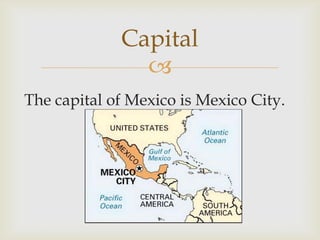
The capital of Mexico is Mexico City.
Capital

 113.7 million people
Population
The climate varies according to altitude and rainfall. The tropical
and subtropical zone (Tierra client), ranging from sea level to
about 900 m (3,000 ft.), consists of the coastal plains, the Yucatán
Peninsula, and the lower areas of southern Mexico. These areas
have a mean temperature of 25–27° C (77–81° F ), with a minimum
of 16° C (61° F ) and a maximum of almost 49° C (120° F ). The
temperate zone (Tierra template), at elevations of 900 to 1,800 m
(3,000–6,000 ft.), has a temperate-to-warm climate and a mean
temperature of 21° C (70° F ). Mexico City and most other
important population centers are in the cool zone (Tierra friar),
starting at about 1,800 m (6,000 ft.), with a mean annual
temperature of 17° C (63°F). The highest mountain peaks are
always covered with snow.
Climate

 The government of Mexico is a
 Constitutional
 Federal
 Republic
 Federation; A league or association formed by
federating, especially a government or political body
established through federal union.
Government

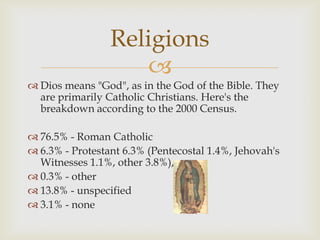
 Dios means "God", as in the God of the Bible. They
are primarily Catholic Christians. Here's the
breakdown according to the 2000 Census.
 76.5% - Roman Catholic
 6.3% - Protestant 6.3% (Pentecostal 1.4%, Jehovah's
Witnesses 1.1%, other 3.8%),
 0.3% - other
 13.8% - unspecified
 3.1% - none
Religions

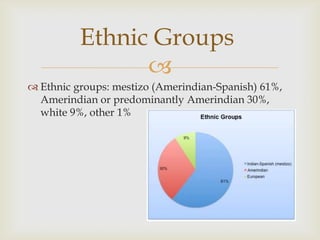
 Ethnic groups: mestizo (Amerindian-Spanish) 61%,
Amerindian or predominantly Amerindian 30%,
white 9%, other 1%
Ethnic Groups

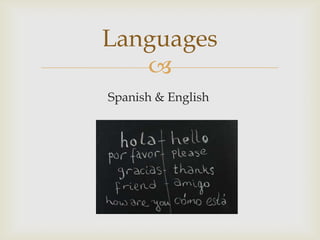
Spanish & English
Languages

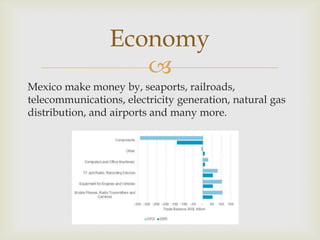
Mexico make money by, seaports, railroads,
telecommunications, electricity generation, natural gas
distribution, and airports and many more.
Economy

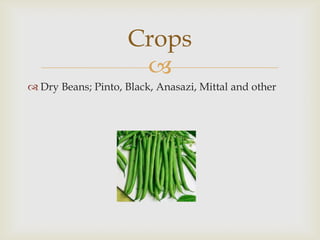
 Dry Beans; Pinto, Black, Anasazi, Mittal and other
Crops

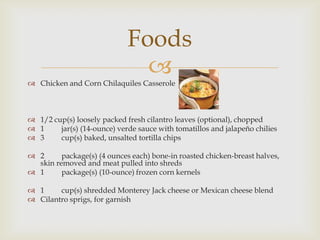
 Chicken and Corn Chilaquiles Casserole
 1/2 cup(s) loosely packed fresh cilantro leaves (optional), chopped
 1 jar(s) (14-ounce) verde sauce with tomatillos and jalapeño chilies
 3 cup(s) baked, unsalted tortilla chips
 2 package(s) (4 ounces each) bone-in roasted chicken-breast halves,
skin removed and meat pulled into shreds
 1 package(s) (10-ounce) frozen corn kernels
 1 cup(s) shredded Monterey Jack cheese or Mexican cheese blend
 Cilantro sprigs, for garnish
Foods

 Mexican peso
Currency[money]

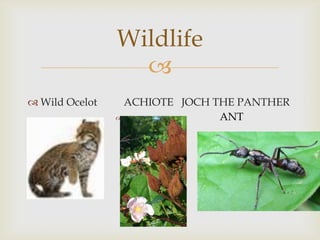
 Wild Ocelot ACHIOTE JOCH THE PANTHER
 ANT
Wildlife

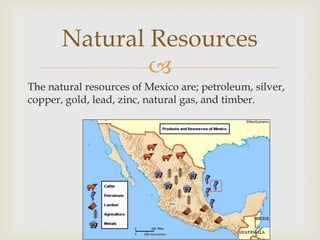
The natural resources of Mexico are; petroleum, silver,
copper, gold, lead, zinc, natural gas, and timber.
Natural Resources

Nov 20 the day of the Revolting Anniversary , and
September 27 End of Independence War.
1. Revolting Anniversary; The Mexican Revolution was one
of the great revolutionary upheavals of the twentieth
century: beginning in 1910, it still continues - at least
according to the official view of the Mexican
Government.
2. September 27 , End of Independence War; The
Revolutionary War beginning date was April 19, 1775 with
the Battle of Lexington and the end date was September 3,
1783.
Cultural traditions

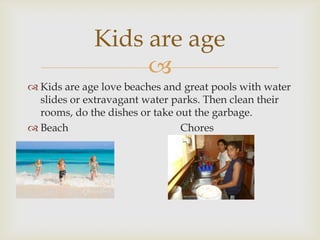
 Kids are age love beaches and great pools with water
slides or extravagant water parks. Then clean their
rooms, do the dishes or take out the garbage.
 Beach Chores

Kids are age

Facts
Mexico City has a population of more than 21 million. It is the third
largest city in the world behind Tokyo (Japan) and Seoul (South
Korea).
The city was founded by the Aztec civilization on March 13, 1325 and
was named as Mexico-Tenochtitlan, which means "Great place in the
center of the lake Moon".
The reference to "Lake Moon" is due to the fact that Tenochtitlan was
founded on a marshy island in the middle of Lake Texcoco (Lake
Moon for the Aztec people).
After Spanish conquistadors razed the city in August 13, 1521, they
started to drain the lake and used the remains of Aztec buildings to
build their own homes, religious and administrative buildings. One
example is the Metropolitan Cathedral, which was built with rocks
taken from the Aztec's Temple Mayor (Great Temple).
Because it sits upon a lake and its aquifers are being depleted, some
parts of Mexico City sink between 6 and 10 inches every year.
Mexico City

Mexico

  • 1.
  • 2.
     The capital ofMexico is Mexico City. Capital
  • 3.
      113.7 millionpeople Population
  • 4.
    The climate variesaccording to altitude and rainfall. The tropical and subtropical zone (Tierra client), ranging from sea level to about 900 m (3,000 ft.), consists of the coastal plains, the Yucatán Peninsula, and the lower areas of southern Mexico. These areas have a mean temperature of 25–27° C (77–81° F ), with a minimum of 16° C (61° F ) and a maximum of almost 49° C (120° F ). The temperate zone (Tierra template), at elevations of 900 to 1,800 m (3,000–6,000 ft.), has a temperate-to-warm climate and a mean temperature of 21° C (70° F ). Mexico City and most other important population centers are in the cool zone (Tierra friar), starting at about 1,800 m (6,000 ft.), with a mean annual temperature of 17° C (63°F). The highest mountain peaks are always covered with snow. Climate
  • 5.
      The governmentof Mexico is a  Constitutional  Federal  Republic  Federation; A league or association formed by federating, especially a government or political body established through federal union. Government
  • 6.
      Dios means"God", as in the God of the Bible. They are primarily Catholic Christians. Here's the breakdown according to the 2000 Census.  76.5% - Roman Catholic  6.3% - Protestant 6.3% (Pentecostal 1.4%, Jehovah's Witnesses 1.1%, other 3.8%),  0.3% - other  13.8% - unspecified  3.1% - none Religions
  • 7.
      Ethnic groups:mestizo (Amerindian-Spanish) 61%, Amerindian or predominantly Amerindian 30%, white 9%, other 1% Ethnic Groups
  • 8.
  • 9.
     Mexico make moneyby, seaports, railroads, telecommunications, electricity generation, natural gas distribution, and airports and many more. Economy
  • 10.
      Dry Beans;Pinto, Black, Anasazi, Mittal and other Crops
  • 11.
      Chicken andCorn Chilaquiles Casserole  1/2 cup(s) loosely packed fresh cilantro leaves (optional), chopped  1 jar(s) (14-ounce) verde sauce with tomatillos and jalapeño chilies  3 cup(s) baked, unsalted tortilla chips  2 package(s) (4 ounces each) bone-in roasted chicken-breast halves, skin removed and meat pulled into shreds  1 package(s) (10-ounce) frozen corn kernels  1 cup(s) shredded Monterey Jack cheese or Mexican cheese blend  Cilantro sprigs, for garnish Foods
  • 12.
  • 13.
      Wild OcelotACHIOTE JOCH THE PANTHER  ANT Wildlife
  • 14.
     The natural resourcesof Mexico are; petroleum, silver, copper, gold, lead, zinc, natural gas, and timber. Natural Resources
  • 15.
     Nov 20 theday of the Revolting Anniversary , and September 27 End of Independence War. 1. Revolting Anniversary; The Mexican Revolution was one of the great revolutionary upheavals of the twentieth century: beginning in 1910, it still continues - at least according to the official view of the Mexican Government. 2. September 27 , End of Independence War; The Revolutionary War beginning date was April 19, 1775 with the Battle of Lexington and the end date was September 3, 1783. Cultural traditions
  • 16.
      Kids areage love beaches and great pools with water slides or extravagant water parks. Then clean their rooms, do the dishes or take out the garbage.  Beach Chores  Kids are age
  • 17.
     Facts Mexico City hasa population of more than 21 million. It is the third largest city in the world behind Tokyo (Japan) and Seoul (South Korea). The city was founded by the Aztec civilization on March 13, 1325 and was named as Mexico-Tenochtitlan, which means "Great place in the center of the lake Moon". The reference to "Lake Moon" is due to the fact that Tenochtitlan was founded on a marshy island in the middle of Lake Texcoco (Lake Moon for the Aztec people). After Spanish conquistadors razed the city in August 13, 1521, they started to drain the lake and used the remains of Aztec buildings to build their own homes, religious and administrative buildings. One example is the Metropolitan Cathedral, which was built with rocks taken from the Aztec's Temple Mayor (Great Temple). Because it sits upon a lake and its aquifers are being depleted, some parts of Mexico City sink between 6 and 10 inches every year. Mexico City