Mexico
Introduction
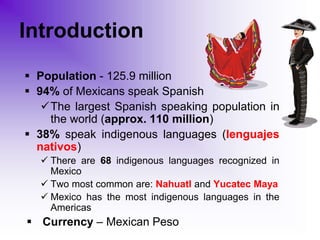
 Population - 125.9 million
 94% of Mexicans speak Spanish
The largest Spanish speaking population in
the world (approx. 110 million)
 38% speak indigenous languages (lenguajes
nativos)
 There are 68 indigenous languages recognized in
Mexico
 Two most common are: Nahuatl and Yucatec Maya
 Mexico has the most indigenous languages in the
Americas
 Currency – Mexican Peso
Geography
 The 14th largest country in the world with an area
of 758,449 square miles
 Capital - Mexico City (Ciudad de México)
 Borders (Fronteras) -
 Belize to the southeast
 Guatemala to the southwest
 United States to the north
 Climate varies with altitude (elevación); from desert
(desierto) to tropical rainforest (bosque tropical
húmedo) and coastal wetland (humedal costero)
 Type of government – Federal Republic
(Republica Federal)
Geography
 The largest mountain range is the Sierra Madre
that is rich in silver (plata) and copper (cobre)
 Located halfway between the Equator (Ecuador)
and Artic Circle (Circulo Polar Artico) which makes
it a refuge for migratory animals
 E.g. The gray whale (Ballena gris) from Alaska and the
monarch butterfly (Mariposas monarca) from the
US/Canada
Religion
 85% Catholic (Católico)
 During the Spanish conquest,
Roman Catholicism was
introduced
 Considered the second largest
catholic nation in the world
 The strongest symbol is that of
the Virgin of Guadalupe
(Virgen de Guadalupe)
 Some indigenous traditions
still exist
 Venerating the dead using
(Día de los Muertos)
Music
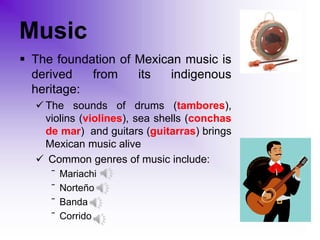
 The foundation of Mexican music is
derived from its indigenous
heritage:
 The sounds of drums (tambores),
violins (violines), sea shells (conchas
de mar) and guitars (guitarras) brings
Mexican music alive
 Common genres of music include:
˜ Mariachi
˜ Norteño
˜ Banda
˜ Corrido
Art (El Arte)
 Mexico’s folkloric art (arte
folclórica) is a
combination of indigenous
and Spanish symbolism
 Made by persons who
have no formal art
training; the art is meant
to be handmade
(artesanal) and
decorative (decorativo)
Holidays (Fiestas)
 Carnaval
 Semana Santa
 Cinco de mayo
 Día de los muertos
Sports (Deportes)
 Football (Futbol)
 Boxing (Boxeo)
 Baseball (Beisbol)
 Rodeo (Charrería)
Major Attractions
 Beaches
 Cenotes
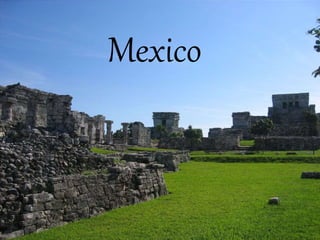
 Mayan Ruins
 Chichen Itza
 Tulum
 Palenque
 Frida Kahlo Museum
 Tequila Tours
Food
 Mexican cuisine is known for its intense and varied
flavors, colorful decoration and variety of spices
 Common dishes include:
Tacos al pastor
Tamales
Pozole
Chilaquiles
Mole
Cochinita pibil
Enchiladas
 Menudo
 Pipian
 Guacamole
Chile En Nogada

Mexico.ppt

  • 1.
  • 3.
    Introduction  Population -125.9 million  94% of Mexicans speak Spanish The largest Spanish speaking population in the world (approx. 110 million)  38% speak indigenous languages (lenguajes nativos)  There are 68 indigenous languages recognized in Mexico  Two most common are: Nahuatl and Yucatec Maya  Mexico has the most indigenous languages in the Americas  Currency – Mexican Peso
  • 4.
    Geography  The 14thlargest country in the world with an area of 758,449 square miles  Capital - Mexico City (Ciudad de México)  Borders (Fronteras) -  Belize to the southeast  Guatemala to the southwest  United States to the north  Climate varies with altitude (elevación); from desert (desierto) to tropical rainforest (bosque tropical húmedo) and coastal wetland (humedal costero)  Type of government – Federal Republic (Republica Federal)
  • 5.
    Geography  The largestmountain range is the Sierra Madre that is rich in silver (plata) and copper (cobre)  Located halfway between the Equator (Ecuador) and Artic Circle (Circulo Polar Artico) which makes it a refuge for migratory animals  E.g. The gray whale (Ballena gris) from Alaska and the monarch butterfly (Mariposas monarca) from the US/Canada
  • 6.
    Religion  85% Catholic(Católico)  During the Spanish conquest, Roman Catholicism was introduced  Considered the second largest catholic nation in the world  The strongest symbol is that of the Virgin of Guadalupe (Virgen de Guadalupe)  Some indigenous traditions still exist  Venerating the dead using (Día de los Muertos)
  • 8.
    Music  The foundationof Mexican music is derived from its indigenous heritage:  The sounds of drums (tambores), violins (violines), sea shells (conchas de mar) and guitars (guitarras) brings Mexican music alive  Common genres of music include: ˜ Mariachi ˜ Norteño ˜ Banda ˜ Corrido
  • 9.
    Art (El Arte) Mexico’s folkloric art (arte folclórica) is a combination of indigenous and Spanish symbolism  Made by persons who have no formal art training; the art is meant to be handmade (artesanal) and decorative (decorativo)
  • 10.
    Holidays (Fiestas)  Carnaval Semana Santa  Cinco de mayo  Día de los muertos
  • 11.
    Sports (Deportes)  Football(Futbol)  Boxing (Boxeo)  Baseball (Beisbol)  Rodeo (Charrería)
  • 12.
    Major Attractions  Beaches Cenotes  Mayan Ruins  Chichen Itza  Tulum  Palenque  Frida Kahlo Museum  Tequila Tours
  • 13.
    Food  Mexican cuisineis known for its intense and varied flavors, colorful decoration and variety of spices  Common dishes include: Tacos al pastor Tamales Pozole Chilaquiles Mole Cochinita pibil Enchiladas  Menudo  Pipian  Guacamole Chile En Nogada