David Sutton
Chapter 36
DAVID SUTTON PICTURES
DR. Muhammad Bin Zulfiqar
PGR-FCPS III SIMS/SHL
• Fig. 36.1 Irregular
periosteal new bone is
demonstrated in a patient
with varicose veins.
Fig. 36.2 Polyarteritis
nodosa. An exuberant
periostitis is seen along
both
tibia and fibula-much
more florid than that
seen in hypertrophic
osteoarthropathy.
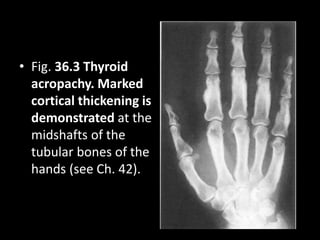
• Fig. 36.3 Thyroid
acropachy. Marked
cortical thickening is
demonstrated at the
midshafts of the
tubular bones of the
hands (see Ch. 42).
Fig. 36.4 Osteomyelitis. The three
ages of infection and how change
involves the joint.
• Fig. 36.5 (A) Early metaphyseal infection. There is very
minimal focal destruction at the distal radial metaphysis.
(B) With progressive bone destruction, metaphyseal
abnormality is now very evident.
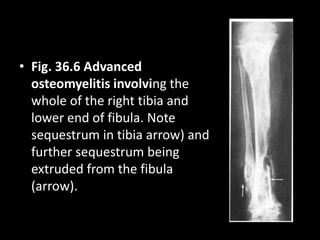
• Fig. 36.6 Advanced
osteomyelitis involving the
whole of the right tibia and
lower end of fibula. Note
sequestrum in tibia arrow) and
further sequestrum being
extruded from the fibula
(arrow).
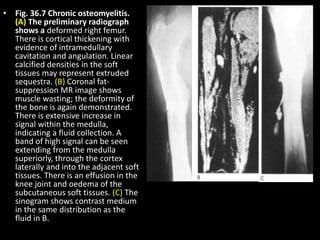
• Fig. 36.7 Chronic osteomyelitis.
(A) The preliminary radiograph
shows a deformed right femur.
There is cortical thickening with
evidence of intramedullary
cavitation and angulation. Linear
calcified densities in the soft
tissues may represent extruded
sequestra. (B) Coronal fat-
suppression MR image shows
muscle wasting; the deformity of
the bone is again demonstrated.
There is extensive increase in
signal within the medulla,
indicating a fluid collection. A
band of high signal can be seen
extending from the medulla
superiorly, through the cortex
laterally and into the adjacent soft
tissues. There is an effusion in the
knee joint and oedema of the
subcutaneous soft tissues. (C) The
sinogram shows contrast medium
in the same distribution as the
fluid in B.
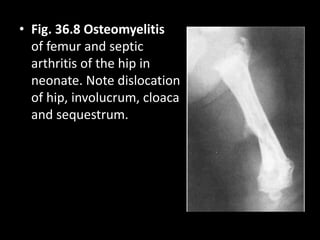
• Fig. 36.8 Osteomyelitis
of femur and septic
arthritis of the hip in
neonate. Note dislocation
of hip, involucrum, cloaca
and sequestrum.
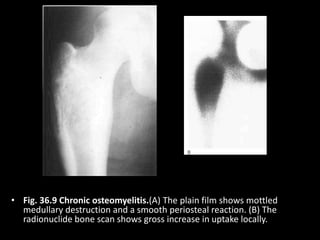
• Fig. 36.9 Chronic osteomyelitis.(A) The plain film shows mottled
medullary destruction and a smooth periosteal reaction. (B) The
radionuclide bone scan shows gross increase in uptake locally.
• Fig. 36.9 Chronic osteomyelitis: (C) On CT scanning, gross periosteal
reaction is demonstrated, causing considerable enlargement and sclerosis
of bone.(D) The MR scan shows the grossly altered signal in the affected
femoral neck and greater trochanter, with replacement of the normal
bright marrow signal on the T 1 – weighted image. Cortical changes are
demonstrated and a periostitis is seen.
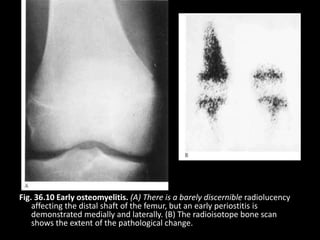
Fig. 36.10 Early osteomyelitis. (A) There is a barely discernible radiolucency
affecting the distal shaft of the femur, but an early periostitis is
demonstrated medially and laterally. (B) The radioisotope bone scan
shows the extent of the pathological change.
• Fig. 36.11 Chronic osteomyelitis. The CT scan
shows the left side to be normal, while on the
right there is extreme cortical thickening and
marrow oedema of the tibia.
• Fig: 13.6 osteomyelitis of the clavicle with an
involucrum and sequestrum, demonstrated at
CT.
• Fig. 36.13 Garre's type of
osteomyelitis.
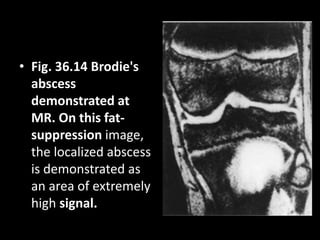
• Fig. 36.14 Brodie's
abscess
demonstrated at
MR. On this fat-
suppression image,
the localized abscess
is demonstrated as
an area of extremely
high signal.
• Fig. 36,15 ' Tunnelling' in osteomyelitis. (A) A finger-like
process of osteomyelitic bone destruction extends from the
main focus. This is tunnelling, which usually indicates the
presence of chronic infection. (B) In another patient, the
sagittal fat-suppression MR sequence shows a vertically
orientated and fluid-filled cavity in the proximal tibia. It is
well defined and has all the features of a chronic infective
lesion. (C) The chronically thickened cortex together with
the central fluid-filled cavity lying within the medulla are
demonstrated on this axial fat-suppression MR image.
• Fig. 36.16 Brodie's abscess. The plain film was not
helpful. (A) The radioisotope bone scan confirms the
presence of a focal lesion in the upper cervical spine.
• Fig. 36.16 Brodie's abscess. (B) The CT scan shows
an appearance which could represent either an
osteoid osteoma or a Brodie's abscess, that is, an
area of osteolysis with central sclerosis and
surrounding it a well-demarcated zone of reactive
sclerosis. (C) Changes at MR mirror those seen at
CT in the lateral mass of C2.
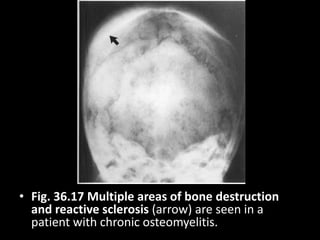
• Fig. 36.17 Multiple areas of bone destruction
and reactive sclerosis (arrow) are seen in a
patient with chronic osteomyelitis.
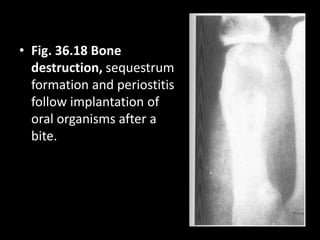
• Fig. 36.18 Bone
destruction, sequestrum
formation and periostitis
follow implantation of
oral organisms after a
bite.
• Fig. 36.19 Infective
discitis. (A) The initial
film shows early bone
destruction beneath
the end-plates around
a narrowed disc. (B)
The later film shows
progressive
destruction of disc
and bone with
surrounding reactive
sclerosis.
• Fig. 36.20 Infective
discitis. The sagittal T,-
weighted MR sequence
shows vertebrodiscal
destruction at [3/4 and
replacement of marrow-
fat signal by soft tissue.
There is also expansion of
the vertebrodiscal mass
posteriorly into the canal.
• Fig. 36.21 End-plate
destruction with distal
loss and a kyphosis is
associated with facet
subluxation and a large
anterior soft-tissue
mass (arrow).
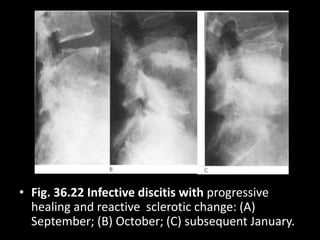
• Fig. 36.22 Infective discitis with progressive
healing and reactive sclerotic change: (A)
September; (B) October; (C) subsequent January.
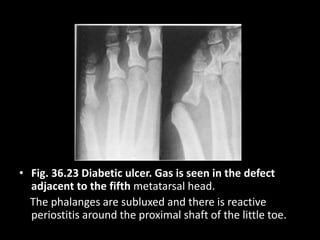
• Fig. 36.23 Diabetic ulcer. Gas is seen in the defect
adjacent to the fifth metatarsal head.
The phalanges are subluxed and there is reactive
periostitis around the proximal shaft of the little toe.
• Fig. 36.24 Chronic granulomatous disease. (A) There is a
localised metaphyseal defect surrounded by sclerosis.
These features are characteristic of chronic infection in a
child. (B) The MR scan confirms the presence of localized
metaphyseal abnormality with replacement of the local fat.
There is a mixture of destruction of bone, oedema and
reactive new bone formation at the margin of the lesion.
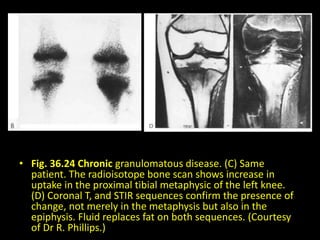
• Fig. 36.24 Chronic granulomatous disease. (C) Same
patient. The radioisotope bone scan shows increase in
uptake in the proximal tibial metaphysic of the left knee.
(D) Coronal T, and STIR sequences confirm the presence of
change, not merely in the metaphysis but also in the
epiphysis. Fluid replaces fat on both sequences. (Courtesy
of Dr R. Phillips.)
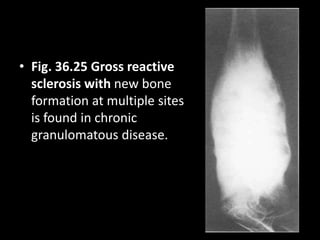
• Fig. 36.25 Gross reactive
sclerosis with new bone
formation at multiple sites
is found in chronic
granulomatous disease.
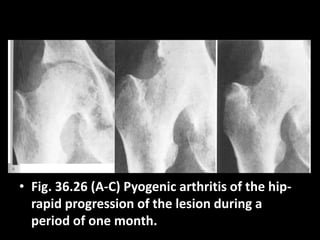
• Fig. 36.26 (A-C) Pyogenic arthritis of the hip-
rapid progression of the lesion during a
period of one month.
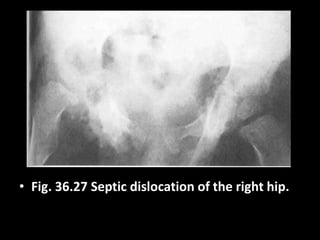
• Fig. 36.27 Septic dislocation of the right hip.
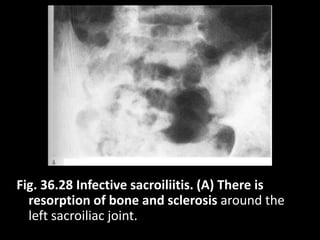
Fig. 36.28 Infective sacroiliitis. (A) There is
resorption of bone and sclerosis around the
left sacroiliac joint.
• Fig. 36.28 Infective sacroiliitis. The radioisotope
bone scan (B) shows the increase in uptake, and
the CT scan (C) shows the widened joint with
areas of irregular bone destruction and soft-
tissue swelling. (Courtesy of ProfessorH. Carty.)
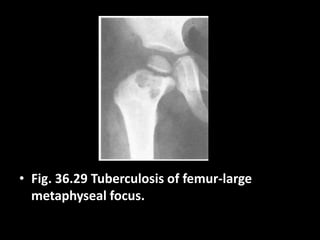
• Fig. 36.29 Tuberculosis of femur-large
metaphyseal focus.
• Fig. 36.30 Tuberculous focus in greate
trochanter. This type is less common than a
surface erosion.
Fig. 36.31 Tuberculous discitis. (A) The changes on the plain film are really quite
similar to those that would be seen with a simple infection. There is distal
destruction associated with irregularity of the overlying end-plates and some
reactive new bone formation. There is perhaps a suggestion on the plain film that
a soft-tissue mass is demonstrated anterior to the vertebral bodies. (B) The MR T,-
weighted axial image shows the end-plate defect seen so well on the plain film
but, in addition, psoas abscesses with central necrosis are demonstrated.
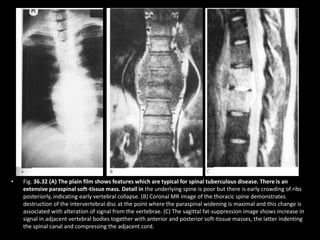
• Fig. 36.32 (A) The plain film shows features which are typical for spinal tuberculous disease. There is an
extensive paraspinal soft-tissue mass. Detail in the underlying spine is poor but there is early crowding of ribs
posteriorly, indicating early vertebral collapse. (B) Coronal MR image of the thoracic spine demonstrates
destruction of the intervertebral disc at the point where the paraspinal widening is maximal and this change is
associated with alteration of signal from the vertebrae. (C) The sagittal fat-suppression image shows increase in
signal in adjacent vertebral bodies together with anterior and posterior soft-tissue masses, the latter indenting
the spinal canal and compressing the adjacent cord.
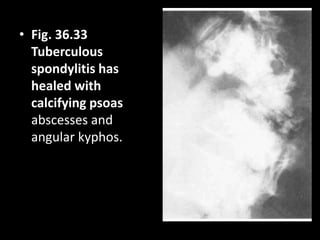
• Fig. 36.33
Tuberculous
spondylitis has
healed with
calcifying psoas
abscesses and
angular kyphos.
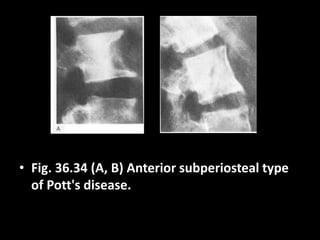
• Fig. 36.34 (A, B) Anterior subperiosteal type
of Pott's disease.
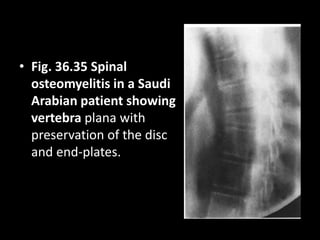
• Fig. 36.35 Spinal
osteomyelitis in a Saudi
Arabian patient showing
vertebra plana with
preservation of the disc
and end-plates.
• 36.36 A large abscess
displaces the right
ureter medially and
destroys the right
transverse process and
adjacent part of the
body of L5. Two and a
half pints of
tuberculous pus were
removed at operation.
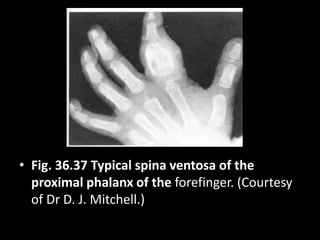
• Fig. 36.37 Typical spina ventosa of the
proximal phalanx of the forefinger. (Courtesy
of Dr D. J. Mitchell.)
• Fig. 36.38 Tuberculosis
of the skull vault. The
fairly well defined lytic
lesion was a solitary
finding but these
changes are often
multiple. Note the
gross tunnelling
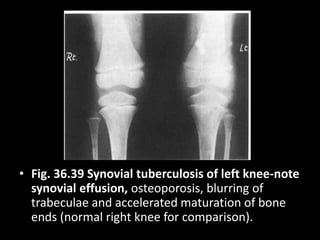
• Fig. 36.39 Synovial tuberculosis of left knee-note
synovial effusion, osteoporosis, blurring of
trabeculae and accelerated maturation of bone
ends (normal right knee for comparison).
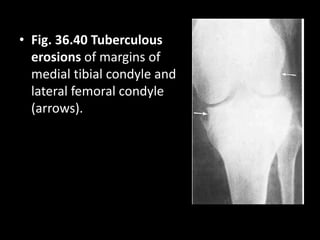
• Fig. 36.40 Tuberculous
erosions of margins of
medial tibial condyle and
lateral femoral condyle
(arrows).
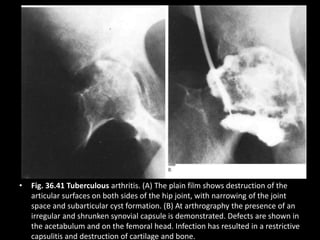
• Fig. 36.41 Tuberculous arthritis. (A) The plain film shows destruction of the
articular surfaces on both sides of the hip joint, with narrowing of the joint
space and subarticular cyst formation. (B) At arthrography the presence of an
irregular and shrunken synovial capsule is demonstrated. Defects are shown in
the acetabulum and on the femoral head. Infection has resulted in a restrictive
capsulitis and destruction of cartilage and bone.
• Fig. 36.44 Old tuberculosis of the carpus. No doubt this occurred
relatively early on in life as the metacarpals are shortened. The carpal
bones are fused following widespread osteoarticular destruction. The
tuberculous origin of the lesion is shown by soft-tissue and bone
calcification on the lateral view.
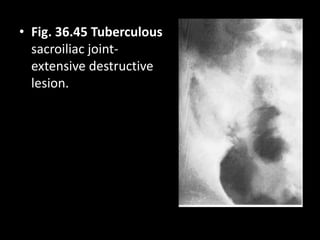
• Fig. 36.45 Tuberculous
sacroiliac joint-
extensive destructive
lesion.
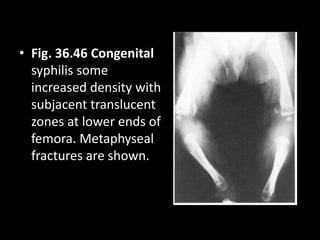
• Fig. 36.46 Congenital
syphilis some
increased density with
subjacent translucent
zones at lower ends of
femora. Metaphyseal
fractures are shown.
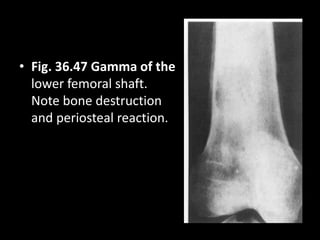
• Fig. 36.47 Gamma of the
lower femoral shaft.
Note bone destruction
and periosteal reaction.
• Fig. 36.48 Syphilitic
osteomyelitis of the
humerus. (Courtesy of Dr W.
Fowler.)
• Fig: 36.49 Gummatous osteomyelitis of the
skull
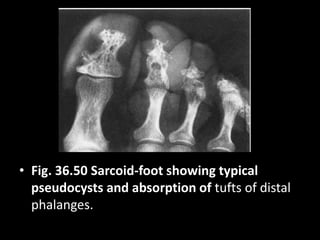
• Fig. 36.50 Sarcoid-foot showing typical
pseudocysts and absorption of tufts of distal
phalanges.
• Fig. 36.51 Sarcoid. (A) Multiple foci of sclerosis are a
recognised, if uncommon, feature of sarcoid. (B) Sclerotic
change in sarcoidosis demonstrated at CT scanning.
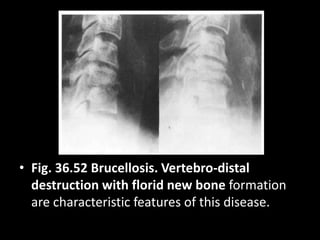
• Fig. 36.52 Brucellosis. Vertebro-distal
destruction with florid new bone formation
are characteristic features of this disease.
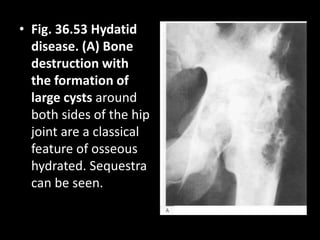
• Fig. 36.53 Hydatid
disease. (A) Bone
destruction with
the formation of
large cysts around
both sides of the hip
joint are a classical
feature of osseous
hydrated. Sequestra
can be seen.
• Fig. 36.53 Hydatid disease. At CT scanning (B)
and MRI (C), the cystic nature of the lesions is
demonstrated, together with destruction of
the hip joint from both sides.
• Fig. 36.54 This patient had never been outside
England but had hydatid disease of the spine.
Note the large paraspinal soft-tissue mass.
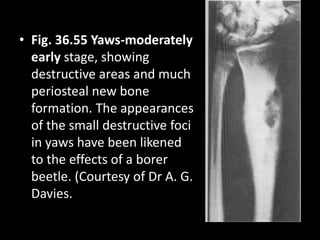
• Fig. 36.55 Yaws-moderately
early stage, showing
destructive areas and much
periosteal new bone
formation. The appearances
of the small destructive foci
in yaws have been likened
to the effects of a borer
beetle. (Courtesy of Dr A. G.
Davies.
Fig. 36.56 Leprosy. Some
small 'cysts' are seen,
e.g. in the head of the
proximal phalanx of the
fifth finger-this
condition is sometimes
called ' osteitis multiplex
cystica leprosa'. The
end-results of lepra
granulomas are seen in
the heads of the
proximal phalanges of
the third and fourth
fingers. (Courtesy of Dr.
D. E. Paterson.)
• Fig. 36.57 Leprosy.
'Cup and pencil' or
'licked candy stick'
appearances
demonstrated
associated with
thickening and
irregularity of the soft
tissues presumably
the result of chronic
infection in the soft
tissues.
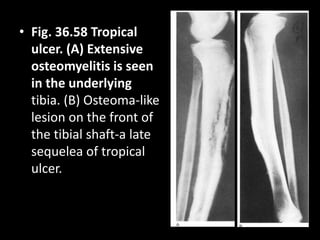
• Fig. 36.58 Tropical
ulcer. (A) Extensive
osteomyelitis is seen
in the underlying
tibia. (B) Osteoma-like
lesion on the front of
the tibial shaft-a late
sequelea of tropical
ulcer.
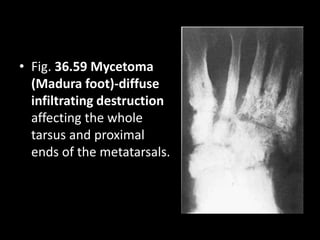
• Fig. 36.59 Mycetoma
(Madura foot)-diffuse
infiltrating destruction
affecting the whole
tarsus and proximal
ends of the metatarsals.
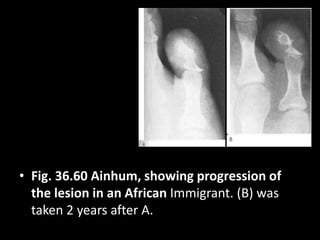
• Fig. 36.60 Ainhum, showing progression of
the lesion in an African Immigrant. (B) was
taken 2 years after A.
36 DAVID SUTTON PICTURES PERIOSTEAL REACTION BONE AND JOINT INFECTIONS: SARCOID

36 DAVID SUTTON PICTURES PERIOSTEAL REACTION BONE AND JOINT INFECTIONS: SARCOID

  • 1.
  • 2.
    DAVID SUTTON PICTURES DR.Muhammad Bin Zulfiqar PGR-FCPS III SIMS/SHL
  • 3.
    • Fig. 36.1Irregular periosteal new bone is demonstrated in a patient with varicose veins.
  • 4.
    Fig. 36.2 Polyarteritis nodosa.An exuberant periostitis is seen along both tibia and fibula-much more florid than that seen in hypertrophic osteoarthropathy.
  • 5.
    • Fig. 36.3Thyroid acropachy. Marked cortical thickening is demonstrated at the midshafts of the tubular bones of the hands (see Ch. 42).
  • 6.
    Fig. 36.4 Osteomyelitis.The three ages of infection and how change involves the joint.
  • 7.
    • Fig. 36.5(A) Early metaphyseal infection. There is very minimal focal destruction at the distal radial metaphysis. (B) With progressive bone destruction, metaphyseal abnormality is now very evident.
  • 8.
    • Fig. 36.6Advanced osteomyelitis involving the whole of the right tibia and lower end of fibula. Note sequestrum in tibia arrow) and further sequestrum being extruded from the fibula (arrow).
  • 9.
    • Fig. 36.7Chronic osteomyelitis. (A) The preliminary radiograph shows a deformed right femur. There is cortical thickening with evidence of intramedullary cavitation and angulation. Linear calcified densities in the soft tissues may represent extruded sequestra. (B) Coronal fat- suppression MR image shows muscle wasting; the deformity of the bone is again demonstrated. There is extensive increase in signal within the medulla, indicating a fluid collection. A band of high signal can be seen extending from the medulla superiorly, through the cortex laterally and into the adjacent soft tissues. There is an effusion in the knee joint and oedema of the subcutaneous soft tissues. (C) The sinogram shows contrast medium in the same distribution as the fluid in B.
  • 10.
    • Fig. 36.8Osteomyelitis of femur and septic arthritis of the hip in neonate. Note dislocation of hip, involucrum, cloaca and sequestrum.
  • 11.
    • Fig. 36.9Chronic osteomyelitis.(A) The plain film shows mottled medullary destruction and a smooth periosteal reaction. (B) The radionuclide bone scan shows gross increase in uptake locally.
  • 12.
    • Fig. 36.9Chronic osteomyelitis: (C) On CT scanning, gross periosteal reaction is demonstrated, causing considerable enlargement and sclerosis of bone.(D) The MR scan shows the grossly altered signal in the affected femoral neck and greater trochanter, with replacement of the normal bright marrow signal on the T 1 – weighted image. Cortical changes are demonstrated and a periostitis is seen.
  • 13.
    Fig. 36.10 Earlyosteomyelitis. (A) There is a barely discernible radiolucency affecting the distal shaft of the femur, but an early periostitis is demonstrated medially and laterally. (B) The radioisotope bone scan shows the extent of the pathological change.
  • 14.
    • Fig. 36.11Chronic osteomyelitis. The CT scan shows the left side to be normal, while on the right there is extreme cortical thickening and marrow oedema of the tibia.
  • 15.
    • Fig: 13.6osteomyelitis of the clavicle with an involucrum and sequestrum, demonstrated at CT.
  • 16.
    • Fig. 36.13Garre's type of osteomyelitis.
  • 17.
    • Fig. 36.14Brodie's abscess demonstrated at MR. On this fat- suppression image, the localized abscess is demonstrated as an area of extremely high signal.
  • 18.
    • Fig. 36,15' Tunnelling' in osteomyelitis. (A) A finger-like process of osteomyelitic bone destruction extends from the main focus. This is tunnelling, which usually indicates the presence of chronic infection. (B) In another patient, the sagittal fat-suppression MR sequence shows a vertically orientated and fluid-filled cavity in the proximal tibia. It is well defined and has all the features of a chronic infective lesion. (C) The chronically thickened cortex together with the central fluid-filled cavity lying within the medulla are demonstrated on this axial fat-suppression MR image.
  • 19.
    • Fig. 36.16Brodie's abscess. The plain film was not helpful. (A) The radioisotope bone scan confirms the presence of a focal lesion in the upper cervical spine.
  • 20.
    • Fig. 36.16Brodie's abscess. (B) The CT scan shows an appearance which could represent either an osteoid osteoma or a Brodie's abscess, that is, an area of osteolysis with central sclerosis and surrounding it a well-demarcated zone of reactive sclerosis. (C) Changes at MR mirror those seen at CT in the lateral mass of C2.
  • 21.
    • Fig. 36.17Multiple areas of bone destruction and reactive sclerosis (arrow) are seen in a patient with chronic osteomyelitis.
  • 22.
    • Fig. 36.18Bone destruction, sequestrum formation and periostitis follow implantation of oral organisms after a bite.
  • 23.
    • Fig. 36.19Infective discitis. (A) The initial film shows early bone destruction beneath the end-plates around a narrowed disc. (B) The later film shows progressive destruction of disc and bone with surrounding reactive sclerosis.
  • 24.
    • Fig. 36.20Infective discitis. The sagittal T,- weighted MR sequence shows vertebrodiscal destruction at [3/4 and replacement of marrow- fat signal by soft tissue. There is also expansion of the vertebrodiscal mass posteriorly into the canal.
  • 25.
    • Fig. 36.21End-plate destruction with distal loss and a kyphosis is associated with facet subluxation and a large anterior soft-tissue mass (arrow).
  • 26.
    • Fig. 36.22Infective discitis with progressive healing and reactive sclerotic change: (A) September; (B) October; (C) subsequent January.
  • 27.
    • Fig. 36.23Diabetic ulcer. Gas is seen in the defect adjacent to the fifth metatarsal head. The phalanges are subluxed and there is reactive periostitis around the proximal shaft of the little toe.
  • 28.
    • Fig. 36.24Chronic granulomatous disease. (A) There is a localised metaphyseal defect surrounded by sclerosis. These features are characteristic of chronic infection in a child. (B) The MR scan confirms the presence of localized metaphyseal abnormality with replacement of the local fat. There is a mixture of destruction of bone, oedema and reactive new bone formation at the margin of the lesion.
  • 29.
    • Fig. 36.24Chronic granulomatous disease. (C) Same patient. The radioisotope bone scan shows increase in uptake in the proximal tibial metaphysic of the left knee. (D) Coronal T, and STIR sequences confirm the presence of change, not merely in the metaphysis but also in the epiphysis. Fluid replaces fat on both sequences. (Courtesy of Dr R. Phillips.)
  • 30.
    • Fig. 36.25Gross reactive sclerosis with new bone formation at multiple sites is found in chronic granulomatous disease.
  • 31.
    • Fig. 36.26(A-C) Pyogenic arthritis of the hip- rapid progression of the lesion during a period of one month.
  • 32.
    • Fig. 36.27Septic dislocation of the right hip.
  • 33.
    Fig. 36.28 Infectivesacroiliitis. (A) There is resorption of bone and sclerosis around the left sacroiliac joint.
  • 34.
    • Fig. 36.28Infective sacroiliitis. The radioisotope bone scan (B) shows the increase in uptake, and the CT scan (C) shows the widened joint with areas of irregular bone destruction and soft- tissue swelling. (Courtesy of ProfessorH. Carty.)
  • 35.
    • Fig. 36.29Tuberculosis of femur-large metaphyseal focus.
  • 36.
    • Fig. 36.30Tuberculous focus in greate trochanter. This type is less common than a surface erosion.
  • 37.
    Fig. 36.31 Tuberculousdiscitis. (A) The changes on the plain film are really quite similar to those that would be seen with a simple infection. There is distal destruction associated with irregularity of the overlying end-plates and some reactive new bone formation. There is perhaps a suggestion on the plain film that a soft-tissue mass is demonstrated anterior to the vertebral bodies. (B) The MR T,- weighted axial image shows the end-plate defect seen so well on the plain film but, in addition, psoas abscesses with central necrosis are demonstrated.
  • 38.
    • Fig. 36.32(A) The plain film shows features which are typical for spinal tuberculous disease. There is an extensive paraspinal soft-tissue mass. Detail in the underlying spine is poor but there is early crowding of ribs posteriorly, indicating early vertebral collapse. (B) Coronal MR image of the thoracic spine demonstrates destruction of the intervertebral disc at the point where the paraspinal widening is maximal and this change is associated with alteration of signal from the vertebrae. (C) The sagittal fat-suppression image shows increase in signal in adjacent vertebral bodies together with anterior and posterior soft-tissue masses, the latter indenting the spinal canal and compressing the adjacent cord.
  • 39.
    • Fig. 36.33 Tuberculous spondylitishas healed with calcifying psoas abscesses and angular kyphos.
  • 40.
    • Fig. 36.34(A, B) Anterior subperiosteal type of Pott's disease.
  • 41.
    • Fig. 36.35Spinal osteomyelitis in a Saudi Arabian patient showing vertebra plana with preservation of the disc and end-plates.
  • 42.
    • 36.36 Alarge abscess displaces the right ureter medially and destroys the right transverse process and adjacent part of the body of L5. Two and a half pints of tuberculous pus were removed at operation.
  • 43.
    • Fig. 36.37Typical spina ventosa of the proximal phalanx of the forefinger. (Courtesy of Dr D. J. Mitchell.)
  • 44.
    • Fig. 36.38Tuberculosis of the skull vault. The fairly well defined lytic lesion was a solitary finding but these changes are often multiple. Note the gross tunnelling
  • 45.
    • Fig. 36.39Synovial tuberculosis of left knee-note synovial effusion, osteoporosis, blurring of trabeculae and accelerated maturation of bone ends (normal right knee for comparison).
  • 46.
    • Fig. 36.40Tuberculous erosions of margins of medial tibial condyle and lateral femoral condyle (arrows).
  • 47.
    • Fig. 36.41Tuberculous arthritis. (A) The plain film shows destruction of the articular surfaces on both sides of the hip joint, with narrowing of the joint space and subarticular cyst formation. (B) At arthrography the presence of an irregular and shrunken synovial capsule is demonstrated. Defects are shown in the acetabulum and on the femoral head. Infection has resulted in a restrictive capsulitis and destruction of cartilage and bone.
  • 48.
    • Fig. 36.44Old tuberculosis of the carpus. No doubt this occurred relatively early on in life as the metacarpals are shortened. The carpal bones are fused following widespread osteoarticular destruction. The tuberculous origin of the lesion is shown by soft-tissue and bone calcification on the lateral view.
  • 49.
    • Fig. 36.45Tuberculous sacroiliac joint- extensive destructive lesion.
  • 50.
    • Fig. 36.46Congenital syphilis some increased density with subjacent translucent zones at lower ends of femora. Metaphyseal fractures are shown.
  • 51.
    • Fig. 36.47Gamma of the lower femoral shaft. Note bone destruction and periosteal reaction.
  • 52.
    • Fig. 36.48Syphilitic osteomyelitis of the humerus. (Courtesy of Dr W. Fowler.)
  • 53.
    • Fig: 36.49Gummatous osteomyelitis of the skull
  • 54.
    • Fig. 36.50Sarcoid-foot showing typical pseudocysts and absorption of tufts of distal phalanges.
  • 55.
    • Fig. 36.51Sarcoid. (A) Multiple foci of sclerosis are a recognised, if uncommon, feature of sarcoid. (B) Sclerotic change in sarcoidosis demonstrated at CT scanning.
  • 56.
    • Fig. 36.52Brucellosis. Vertebro-distal destruction with florid new bone formation are characteristic features of this disease.
  • 57.
    • Fig. 36.53Hydatid disease. (A) Bone destruction with the formation of large cysts around both sides of the hip joint are a classical feature of osseous hydrated. Sequestra can be seen.
  • 58.
    • Fig. 36.53Hydatid disease. At CT scanning (B) and MRI (C), the cystic nature of the lesions is demonstrated, together with destruction of the hip joint from both sides.
  • 59.
    • Fig. 36.54This patient had never been outside England but had hydatid disease of the spine. Note the large paraspinal soft-tissue mass.
  • 60.
    • Fig. 36.55Yaws-moderately early stage, showing destructive areas and much periosteal new bone formation. The appearances of the small destructive foci in yaws have been likened to the effects of a borer beetle. (Courtesy of Dr A. G. Davies.
  • 61.
    Fig. 36.56 Leprosy.Some small 'cysts' are seen, e.g. in the head of the proximal phalanx of the fifth finger-this condition is sometimes called ' osteitis multiplex cystica leprosa'. The end-results of lepra granulomas are seen in the heads of the proximal phalanges of the third and fourth fingers. (Courtesy of Dr. D. E. Paterson.)
  • 62.
    • Fig. 36.57Leprosy. 'Cup and pencil' or 'licked candy stick' appearances demonstrated associated with thickening and irregularity of the soft tissues presumably the result of chronic infection in the soft tissues.
  • 63.
    • Fig. 36.58Tropical ulcer. (A) Extensive osteomyelitis is seen in the underlying tibia. (B) Osteoma-like lesion on the front of the tibial shaft-a late sequelea of tropical ulcer.
  • 64.
    • Fig. 36.59Mycetoma (Madura foot)-diffuse infiltrating destruction affecting the whole tarsus and proximal ends of the metatarsals.
  • 65.
    • Fig. 36.60Ainhum, showing progression of the lesion in an African Immigrant. (B) was taken 2 years after A.