
Clustering Protocols
For Heterogeneous WSN
Kianoosh Mada
(kianoosh-mada@mehrastan.ac.ir)
Sajjad Kazemi
(s.kazemi@mehrastan.ac.ir)
2
Outline
 Keywords (HWSN)
 Challenges (HWSN)
 Goals
 Classification and Attributes
 Heterogeneous Model
 Conference
 Simulator
 Laboratory
 Author
Keywords (HWSN)
 Multi-hop Routing
 Hot Spot(Energy Hole)
 Energy Consumption
 Energy Efficiency
 Heterogeneous
 Heterogeneous Environment
 Heterogeneity Efficient
 Heterogeneous Network
 Cluster heads
 Clustering
 Stability
 Network lifetime 3
Challenges (HWSN)
 Often Limited Energy
 Hot Spot(Energy Hole)
 Often Limited Abilities (Hardware. Normal node)
 Different Hardware Nodes (Energy)
 Types of nodes (normal,advanced,super,sonic)
 Base on CH selection
 Synchronisation
 Data Aggregation
 Quality of Service (QoS)
4
Goals
 Load Balancing
 Fault-Tolerance
 Energy Efficiency
 Network connectivity
5
Classification and Attributes
 Clustering Method
 Cluster Properties
 Cluster Formation
 Cluster Head Capabilities
 CH Selection criteria based on energy
6
Heterogeneous Model
7
 Types of Heterogeneous Resources
 Impact of Heterogeneous
 Performance Measures
Types of Heterogeneous Resources
 Computational
 Link
 Energy
8
Impact of Heterogeneous
 Prolonging Lifetime
 Improving Reliability
 Decreasing Latency
9
Performance Measures
 Network Lifetime
 Number of Alive Nodes
 Number of Cluster Heads
 Throughput
10
Conference
 SenSys - ACM Conference on Embedded Networked Sensor Systems
 IPSN - ACM/IEEE International Conference on Information Processing in
Sensor Networks
 EWSN - European Conference on Wireless Sensor Networks
 SECON - Annual IEEE Communications Society Conference on Sensor,
Mesh and Ad Hoc Communications and Networks
 MASS - IEEE International Conference on Mobile Ad-hoc and Sensor
Systems
11
Simulator
 NS2
 MATLAB
12
Laboratory
 Iot-lab
 Twist.tu-berlin
 Wisebed
 Flock lab
13
14
Author
15
Author
16
Author
DEEC protocol review
Sajjad Kazemi
(s.kazemi@mehrastan.ac.ir)
Distributed Energy Efficient Clustering (DEEC)
 Criteria for cluster head election
 Cluster-heads are elected by a probability based on the ratio
between residual energy of each node and the average energy of
the network.
 The epochs of being cluster-heads for nodes are different
according to their initial and residual energy.
 Heterogeneous network model
 Two-level heterogeneous networks - the advanced nodes and
normal nodes
18
Distributed Energy Efficient Clustering (DEEC)
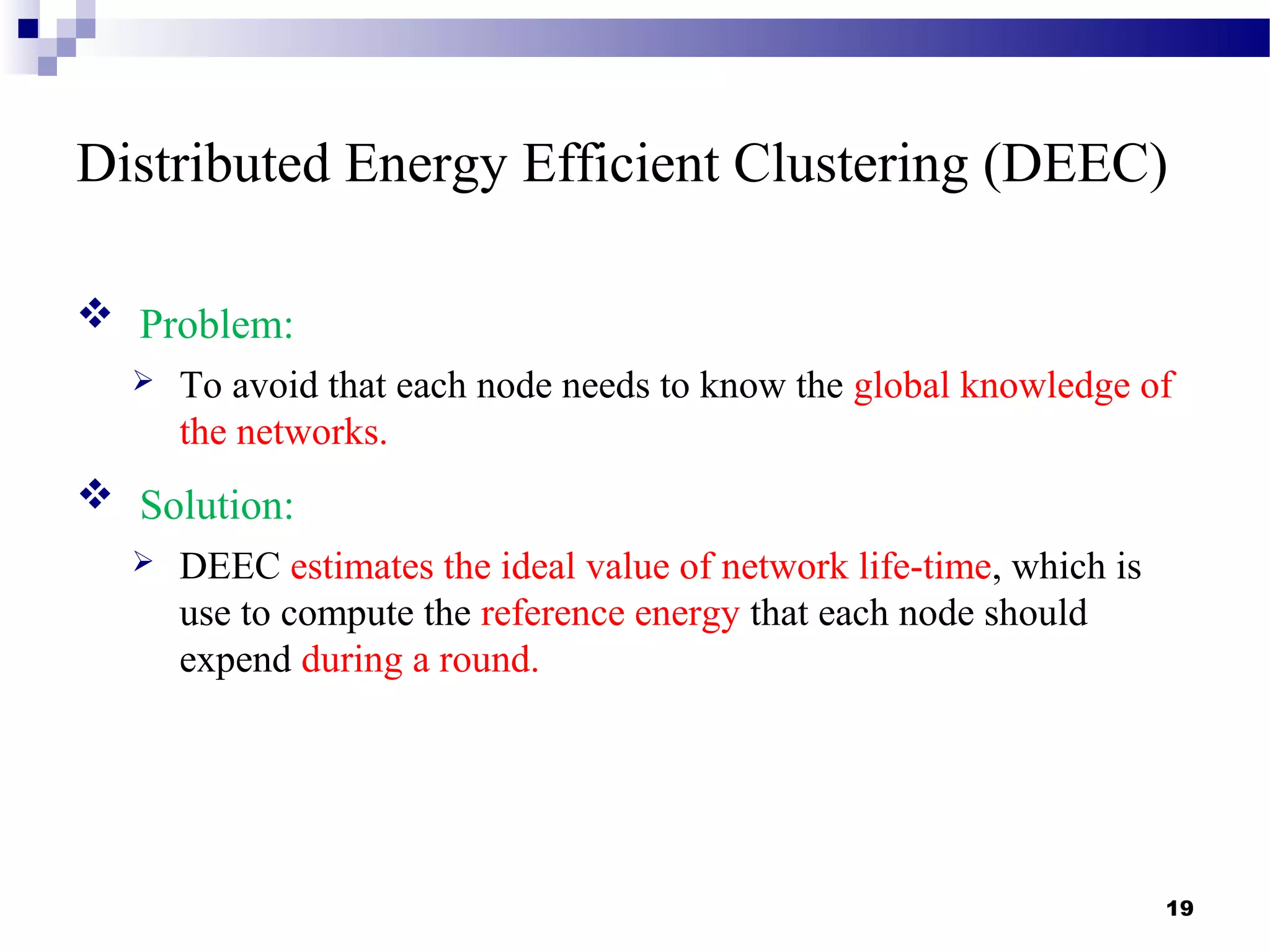
 Problem:
 To avoid that each node needs to know the global knowledge of
the networks.
 Solution:
 DEEC estimates the ideal value of network life-time, which is
use to compute the reference energy that each node should
expend during a round.
19
Distributed Energy Efficient Clustering (DEEC)
20
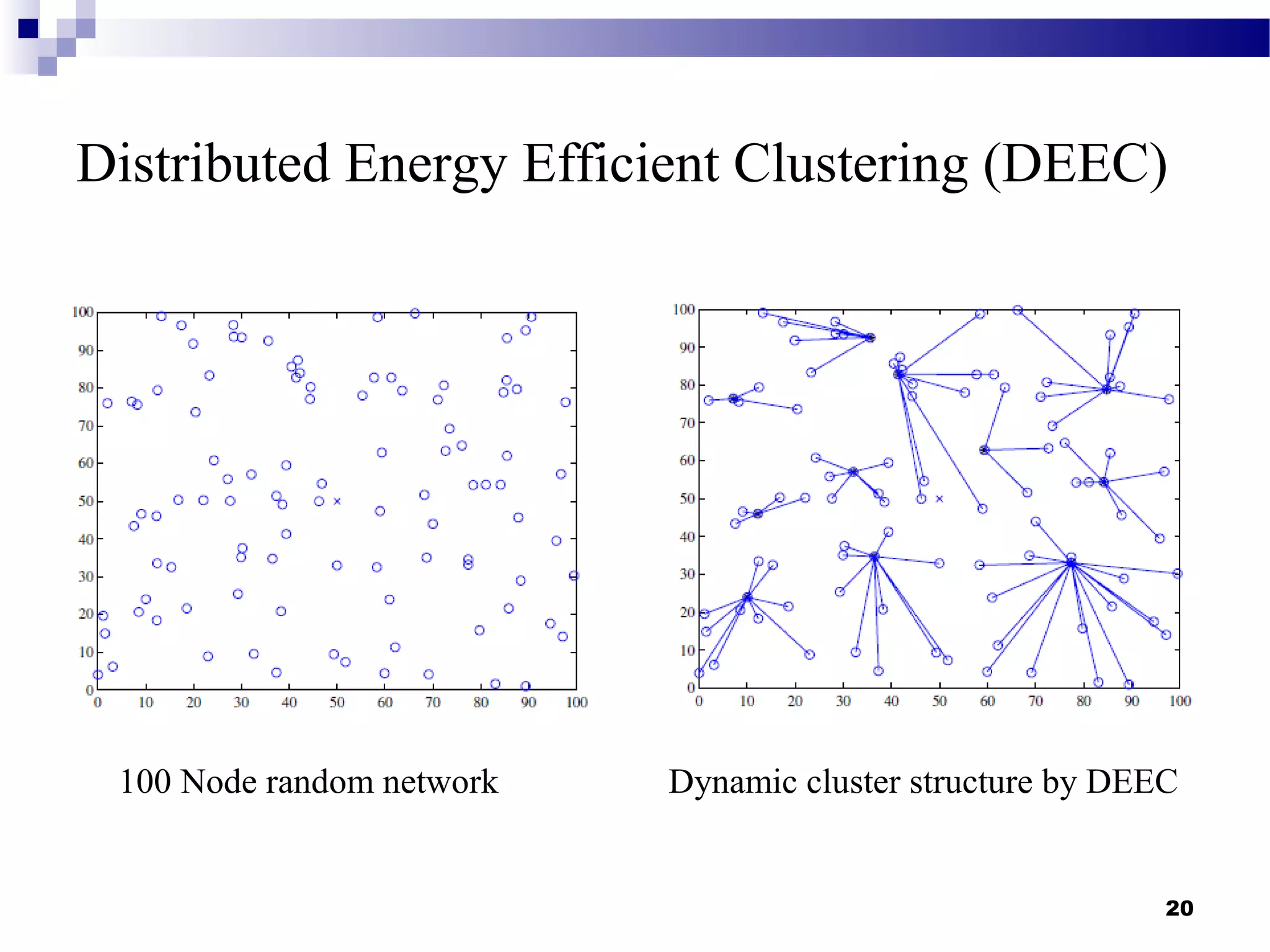
100 Node random network Dynamic cluster structure by DEEC
Distributed Energy Efficient Clustering (DEEC)
21
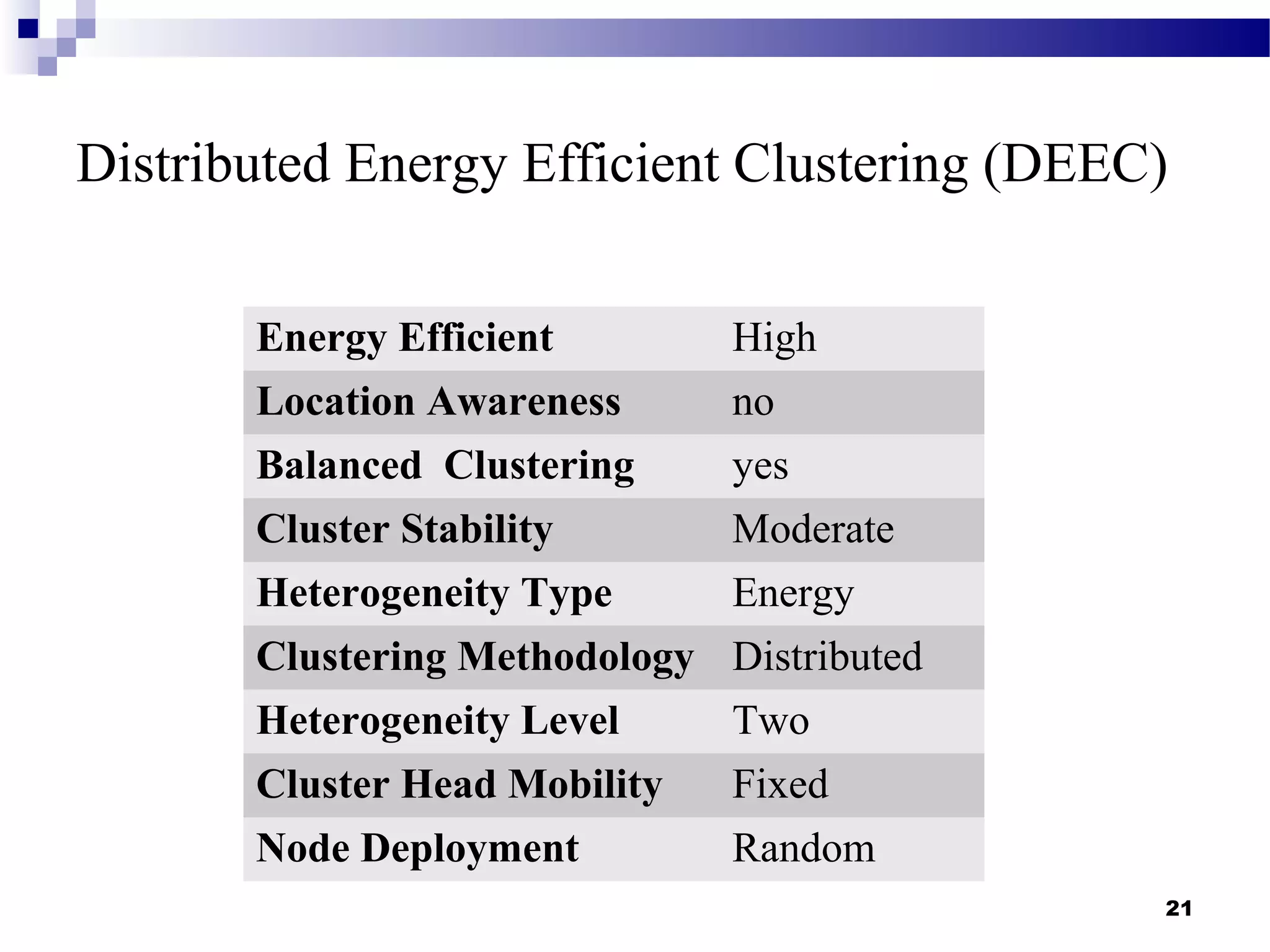
Energy Efficient High
Location Awareness no
Balanced Clustering yes
Cluster Stability Moderate
Heterogeneity Type Energy
Clustering Methodology Distributed
Heterogeneity Level Two
Cluster Head Mobility Fixed
Node Deployment Random
Improved protocols (DEEC)
 Stochastic Distributed Energy-Efficient Clustering (SDEEC)
 Developed Distributed Energy-Efficient Clustering (DDEEC)
 Stochastic and Balanced Distributed Energy-Efficient Clustering (SBDEEC)
 Stochastic and Equitable Distributed Energy-Efficient Clustering (SEDEEC)
 Enhanced Developed Distributed Energy-Efficient Clustering (EDDEEC)
 Enhanced Distributed Energy-Efficient Clustering (EDEEC)
22
Improved protocols (DEEC)
23
 Stochastic (SDEEC)
 This protocol is based on dividing the network into dynamic
clusters.
 where the cluster head election probability is more efficient.
 Developed (DDEEC)
 DDEEC implemented a balanced and dynamic way to distribute
the spent energy more equitably between nodes.
Improved protocols (DEEC)
24
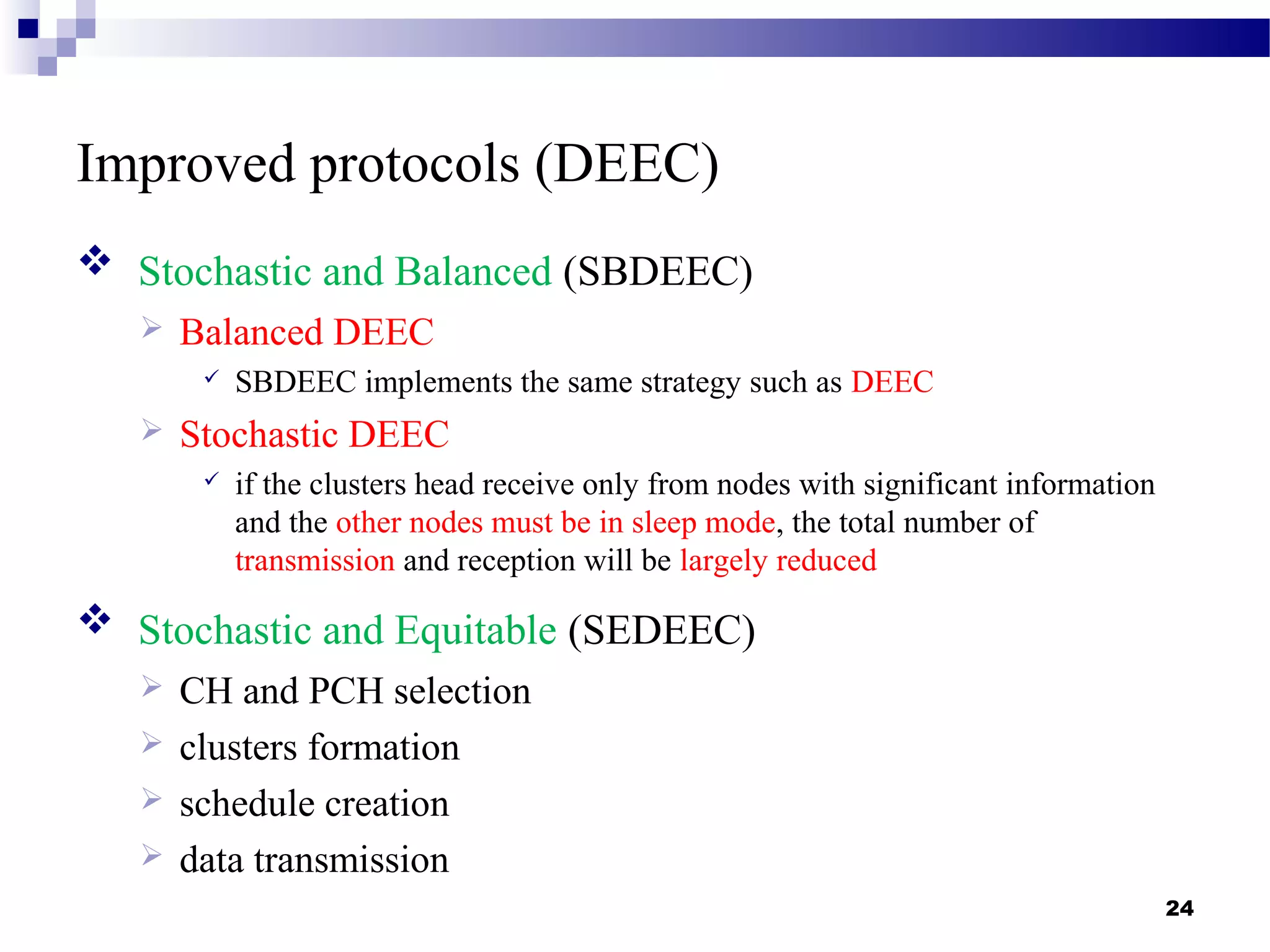
 Stochastic and Balanced (SBDEEC)
 Balanced DEEC
 SBDEEC implements the same strategy such as DEEC
 Stochastic DEEC
 if the clusters head receive only from nodes with significant information
and the other nodes must be in sleep mode, the total number of
transmission and reception will be largely reduced
 Stochastic and Equitable (SEDEEC)
 CH and PCH selection
 clusters formation
 schedule creation
 data transmission
Improved protocols (DEEC)
25
 Enhanced Developed (EDDEEC)
 The difference between DEEC, DDEEC, EDEEC and EDDEEC
is probabilities to become CH for current round.
 Aim of this expression is to distribute energy consumption over
network efficiently, increase stability period and lifetime of
network
 Enhanced (EDEEC)
 We propose EDEEC for three types of nodes in prolonging the
lifetime and stability of the network.
 Hence, it increases theheterogeneity and energy level of the
network.
 Ours E-DEEC follows the thoughts of DEEC and adds another
type of node called super nodes to increase the heterogeneity
Base article 2016
26
 Proposed 3-level heterogeneity network model
 protocol hetDEEC
Energy Efficient Unequal
Clustering Algorithms
For Heterogeneous WSN
Kianoosh Mada
(kianoosh-mada@mehrastan.ac.ir)
Unequal Clustering Algorithms For WSN
 The sensor nodes closer to the base station consume more
energy.
 The nodes closer to the base station die prematurely.
 causes the network partitions and then shortens the lifetime of
the network
 The phenomenon is called “hot spot” or “energy hole” problem.
28
29
Energy-Efficient Unequal Clustering (EEUC)
 Competitive Based Distributed Unequal Clustering Algorithm
 Cluster-Heads are Elected Based on The High Residual
Energy of Its Neighbor and Its Distance to The Base Station
 To Address The Hot Spot Problem
 EEUC divide the nodes into the cluster with unequal size
 cluster closer to the base station have smaller sizes that those
father away from the BS
Energy-Efficient Unequal Clustering (EEUC)
 Each node is assigned by competitive range
 EEUC algorithm is also a probabilistic clustering algorithm
 If a sensor node has decided to join to the cluster head
election, then it becomes a tentative cluster head.
 Tentative cluster head in local regions participate in order to
become an actual cluster head.
 This competition is based on the residual energy of each
tentative cluster-head.
30
Multihop Routing Protocol with Unequal
Clustering (MRPUC)
 Elects the CH in rounds with high residual energy
 There are three phases
 Cluster setup
 Inter-cluster multihop routing formation
 Data transmission
 To mitigate the hot spot problem
 assume the multihop data transmission
 construct an inter-cluster tree rooted at BS to save energy
31
Unequal Hierarchical Energy Efficient
Distributed Clustering (UHEED)
 Extended from HEED
 The unequal size is created based on the distance of the CH
from the BS
 The amount of intra-cluster traffic is considerably reduced
nearer to the BS
32
Unequal Hierarchical Energy Efficient
Distributed Clustering (UHEED)
 The hot spot problem is effectively mitigated in UHEED than
equal sized clusters
 Balances the Energy Consumption Among the Sensor Nodes
In the Network
33
Energy Efficient Distributed Unequal Clustering
(EEDUC)
 Cluster head can be distributed by using waiting time
 The waiting time is measured with:
 the parameters of residual energy
 number of neighborhood node
 The waiting time of each sensor node is synchronizing with the
node time.
 When it reaches 0, a node determined itself to be CH.
34
An Energy-Driven Unequal Clustering (EDUC)
 Nodes use uneven competition ranges to construct clusters of
uneven sizes
 Clusters farther away from the BS have smaller sizes
 The energy consumption among cluster heads is balanced
effectively
 Cluster head can be rotated based on the energy level of
cluster head
 Is not suitable for multihop networks
 because the energy level is assigned to be very precise.
35
An Unequal Cluster-based Routing (UCR)
 To mitigate the hot spot problem, the nodes are grouped into
unequal clusters.
 Consists of two parts:
 EEUC to mitigate the hot spot problem
 routing protocol for inter-cluster relay traffic
 Tentative CHs are randomly selected to compete for final CH.
 Each node chooses its nearby CH with largest received signal
strength
36
Unequal Clustering Size (UCS)
 N nodes are randomly distributed over a circular area of radius
R.
 BS is located at the centre of observed area and it receives all
collected information from the CH.
 It maintains more uniform energy consumption among the CH
by rotating the cluster head in every cluster.
37
An Energy-Aware Distributed Unequal
Clustering Protocol for WSN(EADUC)
 Elects cluster heads based on the ratio between:
 the average residual energy of neighbor nodes and the residual
energy of the node itself
 There are no isolate points in EADUC
 The cluster heads closer to the BS have smaller cluster sizes
38
An Energy-Aware Distributed Unequal
Clustering Protocol for WSN(EADUC)
 EADUC satisfies the properties of an effective clustering
algorithm and can prolong the lifetime of the network
significantly.
39
40
Base Article 2016

Kianoosh&sajjad

  • 1.
    Clustering Protocols For HeterogeneousWSN Kianoosh Mada (kianoosh-mada@mehrastan.ac.ir) Sajjad Kazemi (s.kazemi@mehrastan.ac.ir)
  • 2.
    2 Outline  Keywords (HWSN) Challenges (HWSN)  Goals  Classification and Attributes  Heterogeneous Model  Conference  Simulator  Laboratory  Author
  • 3.
    Keywords (HWSN)  Multi-hopRouting  Hot Spot(Energy Hole)  Energy Consumption  Energy Efficiency  Heterogeneous  Heterogeneous Environment  Heterogeneity Efficient  Heterogeneous Network  Cluster heads  Clustering  Stability  Network lifetime 3
  • 4.
    Challenges (HWSN)  OftenLimited Energy  Hot Spot(Energy Hole)  Often Limited Abilities (Hardware. Normal node)  Different Hardware Nodes (Energy)  Types of nodes (normal,advanced,super,sonic)  Base on CH selection  Synchronisation  Data Aggregation  Quality of Service (QoS) 4
  • 5.
    Goals  Load Balancing Fault-Tolerance  Energy Efficiency  Network connectivity 5
  • 6.
    Classification and Attributes Clustering Method  Cluster Properties  Cluster Formation  Cluster Head Capabilities  CH Selection criteria based on energy 6
  • 7.
    Heterogeneous Model 7  Typesof Heterogeneous Resources  Impact of Heterogeneous  Performance Measures
  • 8.
    Types of HeterogeneousResources  Computational  Link  Energy 8
  • 9.
    Impact of Heterogeneous Prolonging Lifetime  Improving Reliability  Decreasing Latency 9
  • 10.
    Performance Measures  NetworkLifetime  Number of Alive Nodes  Number of Cluster Heads  Throughput 10
  • 11.
    Conference  SenSys -ACM Conference on Embedded Networked Sensor Systems  IPSN - ACM/IEEE International Conference on Information Processing in Sensor Networks  EWSN - European Conference on Wireless Sensor Networks  SECON - Annual IEEE Communications Society Conference on Sensor, Mesh and Ad Hoc Communications and Networks  MASS - IEEE International Conference on Mobile Ad-hoc and Sensor Systems 11
  • 12.
  • 13.
  • 14.
  • 15.
  • 16.
  • 17.
    DEEC protocol review SajjadKazemi (s.kazemi@mehrastan.ac.ir)
  • 18.
    Distributed Energy EfficientClustering (DEEC)  Criteria for cluster head election  Cluster-heads are elected by a probability based on the ratio between residual energy of each node and the average energy of the network.  The epochs of being cluster-heads for nodes are different according to their initial and residual energy.  Heterogeneous network model  Two-level heterogeneous networks - the advanced nodes and normal nodes 18
  • 19.
    Distributed Energy EfficientClustering (DEEC)  Problem:  To avoid that each node needs to know the global knowledge of the networks.  Solution:  DEEC estimates the ideal value of network life-time, which is use to compute the reference energy that each node should expend during a round. 19
  • 20.
    Distributed Energy EfficientClustering (DEEC) 20 100 Node random network Dynamic cluster structure by DEEC
  • 21.
    Distributed Energy EfficientClustering (DEEC) 21 Energy Efficient High Location Awareness no Balanced Clustering yes Cluster Stability Moderate Heterogeneity Type Energy Clustering Methodology Distributed Heterogeneity Level Two Cluster Head Mobility Fixed Node Deployment Random
  • 22.
    Improved protocols (DEEC) Stochastic Distributed Energy-Efficient Clustering (SDEEC)  Developed Distributed Energy-Efficient Clustering (DDEEC)  Stochastic and Balanced Distributed Energy-Efficient Clustering (SBDEEC)  Stochastic and Equitable Distributed Energy-Efficient Clustering (SEDEEC)  Enhanced Developed Distributed Energy-Efficient Clustering (EDDEEC)  Enhanced Distributed Energy-Efficient Clustering (EDEEC) 22
  • 23.
    Improved protocols (DEEC) 23 Stochastic (SDEEC)  This protocol is based on dividing the network into dynamic clusters.  where the cluster head election probability is more efficient.  Developed (DDEEC)  DDEEC implemented a balanced and dynamic way to distribute the spent energy more equitably between nodes.
  • 24.
    Improved protocols (DEEC) 24 Stochastic and Balanced (SBDEEC)  Balanced DEEC  SBDEEC implements the same strategy such as DEEC  Stochastic DEEC  if the clusters head receive only from nodes with significant information and the other nodes must be in sleep mode, the total number of transmission and reception will be largely reduced  Stochastic and Equitable (SEDEEC)  CH and PCH selection  clusters formation  schedule creation  data transmission
  • 25.
    Improved protocols (DEEC) 25 Enhanced Developed (EDDEEC)  The difference between DEEC, DDEEC, EDEEC and EDDEEC is probabilities to become CH for current round.  Aim of this expression is to distribute energy consumption over network efficiently, increase stability period and lifetime of network  Enhanced (EDEEC)  We propose EDEEC for three types of nodes in prolonging the lifetime and stability of the network.  Hence, it increases theheterogeneity and energy level of the network.  Ours E-DEEC follows the thoughts of DEEC and adds another type of node called super nodes to increase the heterogeneity
  • 26.
    Base article 2016 26 Proposed 3-level heterogeneity network model  protocol hetDEEC
  • 27.
    Energy Efficient Unequal ClusteringAlgorithms For Heterogeneous WSN Kianoosh Mada (kianoosh-mada@mehrastan.ac.ir)
  • 28.
    Unequal Clustering AlgorithmsFor WSN  The sensor nodes closer to the base station consume more energy.  The nodes closer to the base station die prematurely.  causes the network partitions and then shortens the lifetime of the network  The phenomenon is called “hot spot” or “energy hole” problem. 28
  • 29.
    29 Energy-Efficient Unequal Clustering(EEUC)  Competitive Based Distributed Unequal Clustering Algorithm  Cluster-Heads are Elected Based on The High Residual Energy of Its Neighbor and Its Distance to The Base Station  To Address The Hot Spot Problem  EEUC divide the nodes into the cluster with unequal size  cluster closer to the base station have smaller sizes that those father away from the BS
  • 30.
    Energy-Efficient Unequal Clustering(EEUC)  Each node is assigned by competitive range  EEUC algorithm is also a probabilistic clustering algorithm  If a sensor node has decided to join to the cluster head election, then it becomes a tentative cluster head.  Tentative cluster head in local regions participate in order to become an actual cluster head.  This competition is based on the residual energy of each tentative cluster-head. 30
  • 31.
    Multihop Routing Protocolwith Unequal Clustering (MRPUC)  Elects the CH in rounds with high residual energy  There are three phases  Cluster setup  Inter-cluster multihop routing formation  Data transmission  To mitigate the hot spot problem  assume the multihop data transmission  construct an inter-cluster tree rooted at BS to save energy 31
  • 32.
    Unequal Hierarchical EnergyEfficient Distributed Clustering (UHEED)  Extended from HEED  The unequal size is created based on the distance of the CH from the BS  The amount of intra-cluster traffic is considerably reduced nearer to the BS 32
  • 33.
    Unequal Hierarchical EnergyEfficient Distributed Clustering (UHEED)  The hot spot problem is effectively mitigated in UHEED than equal sized clusters  Balances the Energy Consumption Among the Sensor Nodes In the Network 33
  • 34.
    Energy Efficient DistributedUnequal Clustering (EEDUC)  Cluster head can be distributed by using waiting time  The waiting time is measured with:  the parameters of residual energy  number of neighborhood node  The waiting time of each sensor node is synchronizing with the node time.  When it reaches 0, a node determined itself to be CH. 34
  • 35.
    An Energy-Driven UnequalClustering (EDUC)  Nodes use uneven competition ranges to construct clusters of uneven sizes  Clusters farther away from the BS have smaller sizes  The energy consumption among cluster heads is balanced effectively  Cluster head can be rotated based on the energy level of cluster head  Is not suitable for multihop networks  because the energy level is assigned to be very precise. 35
  • 36.
    An Unequal Cluster-basedRouting (UCR)  To mitigate the hot spot problem, the nodes are grouped into unequal clusters.  Consists of two parts:  EEUC to mitigate the hot spot problem  routing protocol for inter-cluster relay traffic  Tentative CHs are randomly selected to compete for final CH.  Each node chooses its nearby CH with largest received signal strength 36
  • 37.
    Unequal Clustering Size(UCS)  N nodes are randomly distributed over a circular area of radius R.  BS is located at the centre of observed area and it receives all collected information from the CH.  It maintains more uniform energy consumption among the CH by rotating the cluster head in every cluster. 37
  • 38.
    An Energy-Aware DistributedUnequal Clustering Protocol for WSN(EADUC)  Elects cluster heads based on the ratio between:  the average residual energy of neighbor nodes and the residual energy of the node itself  There are no isolate points in EADUC  The cluster heads closer to the BS have smaller cluster sizes 38
  • 39.
    An Energy-Aware DistributedUnequal Clustering Protocol for WSN(EADUC)  EADUC satisfies the properties of an effective clustering algorithm and can prolong the lifetime of the network significantly. 39
  • 40.