A survey on Routing
Protocols in WSN
CHOWDHURY, MD SOYKET (13-23214-2)
CHOWDHURY, TAUSIF UDDIN AHMED (13-24300-2)
GAFFER SAMI-AL (13-24723-2)
AKTER, FOUJIA (12-22681-3)
RAHMAN, MAHMUDA (13-22990-1)
Index
 Background
 Wireless Sensor Network
 Energy Efficient Routing Protocol
 Data-Centric Routing Protocol(s)
 Hierarchical Routing Protocol(s)
 Location Based Routing Protocol(s)
 Conclusion
Background
 The future of technology is envisioned to consist of hundreds and thousands of
devices each with thousands of low costs low power, highly integrated wireless
sensor nodes to sense the environment and report back with data in unattended
mode.
 So the medium for communication would largely be dependent on wireless
communication and this will be the technology of future.
 A WSN has constraints in design as well as resource.
Wireless Sensor Networks
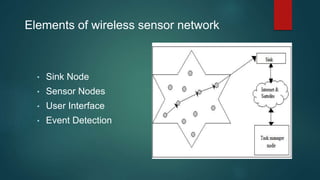
Elements of wireless sensor network
• Sink Node
• Sensor Nodes
• User Interface
• Event Detection
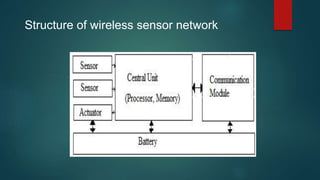
Structure of wireless sensor network
• All nodes have same initial energy
• Some advanced nodes have different energy level
Homogeneous vs. Heterogeneous WSN
Required Characteristics of WSN
 Large scale Deployment
 Heterogeneity of nodes
 Ability to withstand harsh environmental conditions
 Limited power Storage
 Dynamic network topology
 Ability to cope with node failures
 Unattended operation
 Communication failures
Challenges and Issues of WSN
 Energy Consumption
 Node Deployment
 Data Delivery Models
 Node Capability
 Network Dynamics
 Data Aggregation
Energy Efficient
Routing Protocols
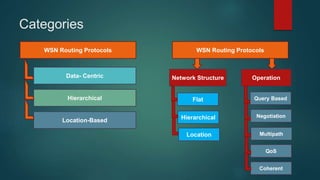
Categories
WSN Routing Protocols
Data- Centric
Hierarchical
Location-Based
WSN Routing Protocols
Network Structure Operation
Flat
Hierarchical
Location
Query Based
Negotiation
Multipath
QoS
Coherent
1. Data Centric Routing Protocol(s)
 WSN works with huge number of nodes which continuously passes data
from source to node or neighbor to neighbor.
 And it’s not possible for us to identify these nodes or assign different IP for
each node to identify them.
 To solve these problems data-centric or flat based routing protocol
approach is used.
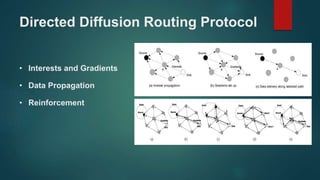
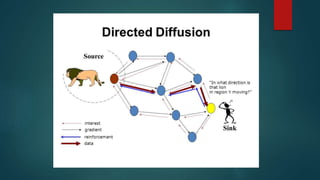
Directed Diffusion Routing Protocol
• Interests and Gradients
• Data Propagation
• Reinforcement
DD Drawbacks
 Overhead of flooding network
 Overhead of periodic flooding
 Overhead of matching data to query
 Low Network lifetime
 Selection of node to form path
 Not Applicable in all fields
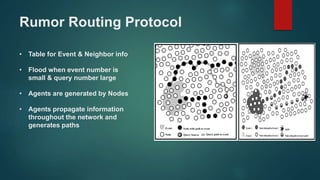
Rumor Routing Protocol
• Table for Event & Neighbor info
• Flood when event number is
small & query number large
• Agents are generated by Nodes
• Agents propagate information
throughout the network and
generates paths
RR Drawbacks
 Overhead of Maintaining table
 No Guarantee of Data Delivery
 Works when number of event is small
 Overhead of maintaining large number of agents
GRADIENT AND NODE REMAINING
ENERGY CONSTRAINED DD(GRE-
DD)
• Interests Generation with –
 Remaining Energy of nodes for retransmission Process
 From min hop count optimal delay metric generation
• Gradient Setup by Selecting next hop based on-
 Calculating min Node remaining energy
 Lowest Hop Count
 Not exceeding Gradient Diffusion Depth
GRE-DD Drawbacks
 Overhead of Calculating Max Diffusion Depth
 Setting Minimum energy at beginning
 Data Drop in-between might occur
ENERGY AWARE DIFFUSION (EAD)
• Generate Interests
• Gradient Setup & Remove Loops
• Selected path = min(Hop count) & min (Required Energy) & max(Path Energy)
• Forward Data in Selected path if Data = Interest
EAD Drawbacks
 Overhead of Calculating – Selected Path
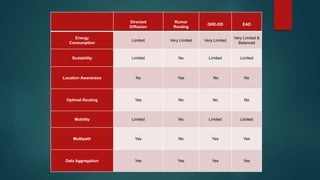
Directed
Diffusion
Rumor
Routing
GRE-DD EAD
Energy
Consumption
Limited Very Limited Very Limited
Very Limited &
Balanced
Scalability Limited No Limited Limited
Location Awareness No Yes No No
Optimal Routing Yes No No No
Mobility Limited No Limited Limited
Multipath Yes No Yes Yes
Data Aggregation Yes Yes Yes Yes
SPIN PROTOCOL WAS PLANNED TO IMPROVE CLASSIC FLOODING
PROTOCOLS AND OVERCOME THE TROUBLES THEY MAY CAUSE FOR
EXAMPLE, IMPLOSION, OVERLAP AND RESOURCE BLINDNESS
Spin Routing Protocol
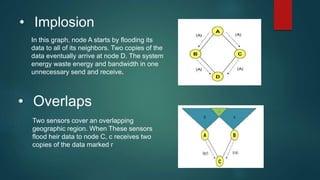
• Implosion
In this graph, node A starts by flooding its
data to all of its neighbors. Two copies of the
data eventually arrive at node D. The system
energy waste energy and bandwidth in one
unnecessary send and receive.
• Overlaps
Two sensors cover an overlapping
geographic region. When These sensors
flood heir data to node C, c receives two
copies of the data marked r
• Resource Blindness
In classic flooding, nodes do not alter their activities based on the amount of
energy usable to them at a given time. A network of imbedded sensors can be
“resource-aware” and adjust its communication and computation to the state
of its energy resources
SPIN Protocols
 SPIN-PP : a 3-stage handshake protocol for Point-to-
Point media
 SPIN-EC : SPIN-PP with a low energy threshold for Energy
Conservation.
 SPIN-BC : a 3-stage handshake protocol for Broadcast media
 SPIN-RL : SPIN-BC for lossy networks
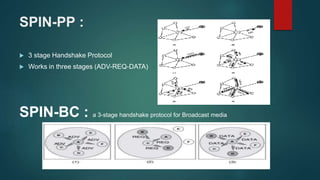
SPIN-PP :
 3 stage Handshake Protocol
 Works in three stages (ADV-REQ-DATA)
SPIN-BC : a 3-stage handshake protocol for Broadcast media
SPIN Drawbacks
 If the node interested in the data are far from the source, data will not be
delivered
 Large overhead
 Can not ensure delivery of data
2. Hierarchical Routing Protocol
 A number of routing protocols proposed based on cluster in WSNs
because of the scalability and energy efficiency.
 Sensor nodes form a cluster and there is a one cluster head in each
cluster. Cluster head is acted as a medium to transmit data to the base
station.
 Use multi hop communication and conduct data aggregation and fusion to
avoid redundant data
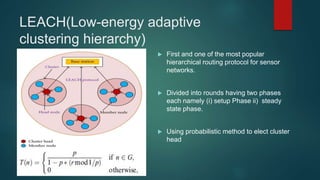
LEACH(Low-energy adaptive
clustering hierarchy)
 First and one of the most popular
hierarchical routing protocol for sensor
networks.
 Divided into rounds having two phases
each namely (i) setup Phase ii) steady
state phase.
 Using probabilistic method to elect cluster
head
Drawbacks
 Selection of a node is done based using energy and threshold conditions, not
amount of energy.
 low power node not used efficiently, more number of nodes has to be taken.
 Single hop clustering routing and cannot be used for larger networks.
 Nodes with low energy, elected as CH could cause energy holes and coverage
problems.
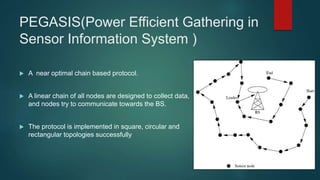
PEGASIS(Power Efficient Gathering in
Sensor Information System )
 A near optimal chain based protocol.
 A linear chain of all nodes are designed to collect data,
and nodes try to communicate towards the BS.
 The protocol is implemented in square, circular and
rectangular topologies successfully
Drawbacks
 Energy is not considered during selection of cluster head.
 Based on assumption that sensor nodes are static in behavior and all nodes have
global knowledge of the network.
 Required dynamic topology adjustment.
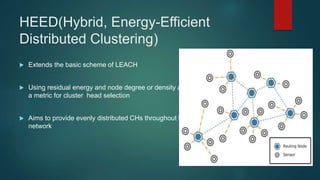
HEED(Hybrid, Energy-Efficient
Distributed Clustering)
 Extends the basic scheme of LEACH
 Using residual energy and node degree or density as
a metric for cluster head selection
 Aims to provide evenly distributed CHs throughout the
network
Drawbacks
 Nodes are not capable of location awareness.
 It cannot operate for different levels of energy considerations from the first
round.
 Performing of clustering in each round imposes significant overhead in the
network.
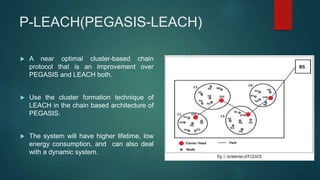
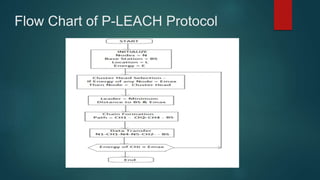
P-LEACH(PEGASIS-LEACH)
 A near optimal cluster-based chain
protocol that is an improvement over
PEGASIS and LEACH both.
 Use the cluster formation technique of
LEACH in the chain based architecture of
PEGASIS.
 The system will have higher lifetime, low
energy consumption, and can also deal
with a dynamic system.
Flow Chart of P-LEACH Protocol
Drawbacks
 Each Node uses its limited reserves of energy that causes depletion.
 If leader node dies, the data transmission between base station and leader
node will be cut off.
 Not fit for large scale network.
H-LEACH(HEED-LEACH)
 Uses residual and maximum energy of the nodes to elect a channel head
for each round.
 Find the life time of the nodes in terms of rounds.
 Considered threshold and energy conditions
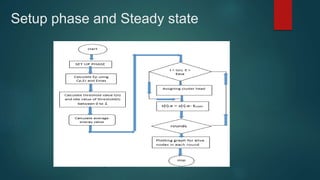
Setup phase and Steady state
Drawbacks
 Large scale development do not be possible.
 Used probabilistic value like LEACH to elect cluster head.
 Don’t have location awareness.
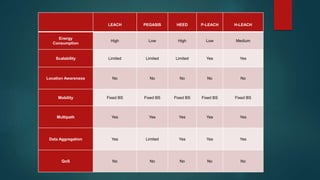
LEACH PEGASIS HEED P-LEACH H-LEACH
Energy
Consumption
High Low High Low Medium
Scalability Limited Limited Limited Yes Yes
Location Awareness No No No No No
Mobility Fixed BS Fixed BS Fixed BS Fixed BS Fixed BS
Multipath Yes Yes Yes Yes Yes
Data Aggregation Yes Limited Yes Yes Yes
QoS No No No No No
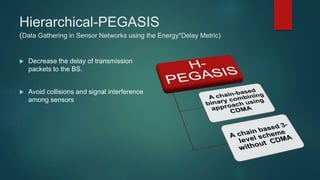
Hierarchical-PEGASIS
(Data Gathering in Sensor Networks using the Energy*Delay Metric)
 Decrease the delay of transmission
packets to the BS.
 Avoid collisions and signal interference
among sensors
Drawback
 Not suitable for heavy-loaded network.
 In WSN there are n number of nodes, delay in data transmission is very obvious.
So in this case PEGASIS and H-PEGASIS do not so scale good.
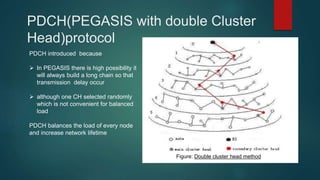
PDCH(PEGASIS with double Cluster
Head)protocol
PDCH introduced because
 In PEGASIS there is high possibility it
will always build a long chain so that
transmission delay occur
 although one CH selected randomly
which is not convenient for balanced
load
PDCH balances the load of every node
and increase network lifetime
Figure: Double cluster head method
Drawbacks
 Selection of two cluster heads might increase network overhead in terms
of delay.
 Nodes of secondary chain don’t get a chance to participate in the selection
of main cluster head.
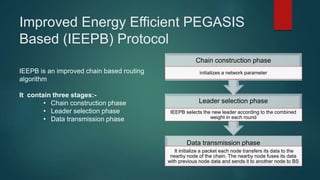
Improved Energy Efficient PEGASIS
Based (IEEPB) Protocol
IEEPB is an improved chain based routing
algorithm
It contain three stages:-
• Chain construction phase
• Leader selection phase
• Data transmission phase
Data transmission phase
It initialize a packet each node transfers its data to the
nearby node of the chain. The nearby node fuses its data
with previous node data and sends it to another node to BS
Leader selection phase
IEEPB selects the new leader according to the combined
weight in each round
Chain construction phase
initializes a network parameter
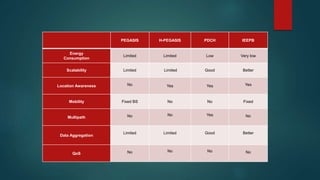
PEGASIS H-PEGASIS PDCH IEEPB
Energy
Consumption
Limited Limited Low Very low
Scalability Limited Limited Good Better
Location Awareness No Yes Yes Yes
Mobility Fixed BS No No Fixed
Multipath No No Yes No
Data Aggregation
Limited Limited Good Better
QoS No No No No
3. Location Based Routing Protocol(s)
 Location information is needed in most of the routing protocols for sensor nodes.
 This is useful to find out the energy consumption of two particular nodes by
calculating distance.
 Since, there is no addressing scheme for sensor networks like IP-addresses and
they are spatially deployed on a region, location information can be utilized in
routing data in an energy efficient way
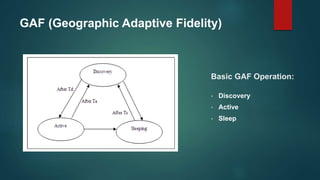
Basic GAF Operation:
• Discovery
• Active
• Sleep
GAF (Geographic Adaptive Fidelity)
Drawbacks of GAF
 Non-multitasking
 Redundant
 Scalability Long
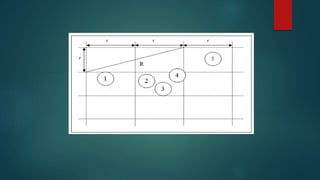
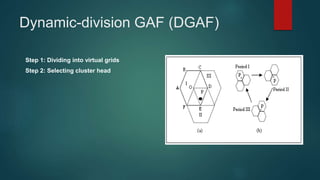
Step 1: Dividing into virtual grids
Step 2: Selecting cluster head
Dynamic-division GAF (DGAF)
Drawbacks of DGAF
 Performance Problem
 Scalability Long
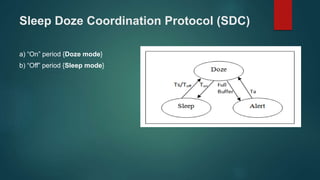
a) “On” period {Doze mode}
b) “Off” period {Sleep mode}
Sleep Doze Coordination Protocol (SDC)
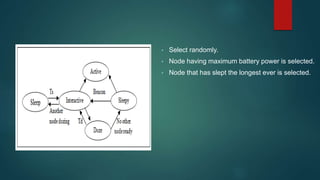
• Select randomly.
• Node having maximum battery power is selected.
• Node that has slept the longest ever is selected.
Drawbacks of SDC
 Scalability long
 Energy Inefficient
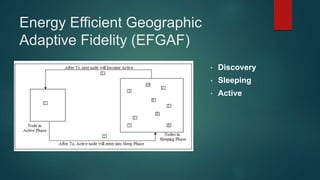
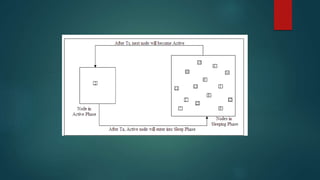
• Discovery
• Sleeping
• Active
Energy Efficient Geographic
Adaptive Fidelity (EFGAF)
Drawbacks of EFGAF
 Working One Time
 Data can be lost
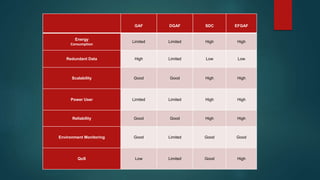
GAF DGAF SDC EFGAF
Energy
Consumption
Limited Limited High High
Redundant Data High Limited Low Low
Scalability Good Good High High
Power User Limited Limited High High
Reliability Good Good High High
Environment Monitoring Good Limited Good Good
QoS Low Limited Good High
Conclusion
Energy Aware Diffusion(EAD) is Better Compared to DD, GRE-DD, RR & Spin:
• Balanced Power Consumption
P-LEACH is Better Compared to H-LEACH, PEGASIS, H-PEGASIS, HEED,
LEACH, PDCH, IEEPB
• Chain Based, Formation technique within cluster for data transmission
• Dynamic
Energy Efficient Geographic Fidelity is Better Compared to GAF, DGAF & SDC
• Energy consumption & increase network life time.
- when its aided routing.
Thank you! 
Thesis-Final-slide
Thesis-Final-slide
Thesis-Final-slide

Thesis-Final-slide

  • 1.
    A survey onRouting Protocols in WSN CHOWDHURY, MD SOYKET (13-23214-2) CHOWDHURY, TAUSIF UDDIN AHMED (13-24300-2) GAFFER SAMI-AL (13-24723-2) AKTER, FOUJIA (12-22681-3) RAHMAN, MAHMUDA (13-22990-1)
  • 2.
    Index  Background  WirelessSensor Network  Energy Efficient Routing Protocol  Data-Centric Routing Protocol(s)  Hierarchical Routing Protocol(s)  Location Based Routing Protocol(s)  Conclusion
  • 3.
  • 4.
     The futureof technology is envisioned to consist of hundreds and thousands of devices each with thousands of low costs low power, highly integrated wireless sensor nodes to sense the environment and report back with data in unattended mode.  So the medium for communication would largely be dependent on wireless communication and this will be the technology of future.  A WSN has constraints in design as well as resource.
  • 6.
  • 7.
    Elements of wirelesssensor network • Sink Node • Sensor Nodes • User Interface • Event Detection
  • 8.
    Structure of wirelesssensor network
  • 9.
    • All nodeshave same initial energy • Some advanced nodes have different energy level Homogeneous vs. Heterogeneous WSN
  • 10.
    Required Characteristics ofWSN  Large scale Deployment  Heterogeneity of nodes  Ability to withstand harsh environmental conditions  Limited power Storage  Dynamic network topology  Ability to cope with node failures  Unattended operation  Communication failures
  • 11.
    Challenges and Issuesof WSN  Energy Consumption  Node Deployment  Data Delivery Models  Node Capability  Network Dynamics  Data Aggregation
  • 12.
  • 13.
    Categories WSN Routing Protocols Data-Centric Hierarchical Location-Based WSN Routing Protocols Network Structure Operation Flat Hierarchical Location Query Based Negotiation Multipath QoS Coherent
  • 14.
    1. Data CentricRouting Protocol(s)  WSN works with huge number of nodes which continuously passes data from source to node or neighbor to neighbor.  And it’s not possible for us to identify these nodes or assign different IP for each node to identify them.  To solve these problems data-centric or flat based routing protocol approach is used.
  • 15.
    Directed Diffusion RoutingProtocol • Interests and Gradients • Data Propagation • Reinforcement
  • 17.
    DD Drawbacks  Overheadof flooding network  Overhead of periodic flooding  Overhead of matching data to query  Low Network lifetime  Selection of node to form path  Not Applicable in all fields
  • 18.
    Rumor Routing Protocol •Table for Event & Neighbor info • Flood when event number is small & query number large • Agents are generated by Nodes • Agents propagate information throughout the network and generates paths
  • 19.
    RR Drawbacks  Overheadof Maintaining table  No Guarantee of Data Delivery  Works when number of event is small  Overhead of maintaining large number of agents
  • 20.
    GRADIENT AND NODEREMAINING ENERGY CONSTRAINED DD(GRE- DD) • Interests Generation with –  Remaining Energy of nodes for retransmission Process  From min hop count optimal delay metric generation • Gradient Setup by Selecting next hop based on-  Calculating min Node remaining energy  Lowest Hop Count  Not exceeding Gradient Diffusion Depth
  • 21.
    GRE-DD Drawbacks  Overheadof Calculating Max Diffusion Depth  Setting Minimum energy at beginning  Data Drop in-between might occur
  • 22.
    ENERGY AWARE DIFFUSION(EAD) • Generate Interests • Gradient Setup & Remove Loops • Selected path = min(Hop count) & min (Required Energy) & max(Path Energy) • Forward Data in Selected path if Data = Interest
  • 23.
    EAD Drawbacks  Overheadof Calculating – Selected Path
  • 24.
    Directed Diffusion Rumor Routing GRE-DD EAD Energy Consumption Limited VeryLimited Very Limited Very Limited & Balanced Scalability Limited No Limited Limited Location Awareness No Yes No No Optimal Routing Yes No No No Mobility Limited No Limited Limited Multipath Yes No Yes Yes Data Aggregation Yes Yes Yes Yes
  • 25.
    SPIN PROTOCOL WASPLANNED TO IMPROVE CLASSIC FLOODING PROTOCOLS AND OVERCOME THE TROUBLES THEY MAY CAUSE FOR EXAMPLE, IMPLOSION, OVERLAP AND RESOURCE BLINDNESS Spin Routing Protocol
  • 26.
    • Implosion In thisgraph, node A starts by flooding its data to all of its neighbors. Two copies of the data eventually arrive at node D. The system energy waste energy and bandwidth in one unnecessary send and receive. • Overlaps Two sensors cover an overlapping geographic region. When These sensors flood heir data to node C, c receives two copies of the data marked r
  • 27.
    • Resource Blindness Inclassic flooding, nodes do not alter their activities based on the amount of energy usable to them at a given time. A network of imbedded sensors can be “resource-aware” and adjust its communication and computation to the state of its energy resources
  • 28.
    SPIN Protocols  SPIN-PP: a 3-stage handshake protocol for Point-to- Point media  SPIN-EC : SPIN-PP with a low energy threshold for Energy Conservation.  SPIN-BC : a 3-stage handshake protocol for Broadcast media  SPIN-RL : SPIN-BC for lossy networks
  • 29.
    SPIN-PP :  3stage Handshake Protocol  Works in three stages (ADV-REQ-DATA) SPIN-BC : a 3-stage handshake protocol for Broadcast media
  • 30.
    SPIN Drawbacks  Ifthe node interested in the data are far from the source, data will not be delivered  Large overhead  Can not ensure delivery of data
  • 31.
    2. Hierarchical RoutingProtocol  A number of routing protocols proposed based on cluster in WSNs because of the scalability and energy efficiency.  Sensor nodes form a cluster and there is a one cluster head in each cluster. Cluster head is acted as a medium to transmit data to the base station.  Use multi hop communication and conduct data aggregation and fusion to avoid redundant data
  • 32.
    LEACH(Low-energy adaptive clustering hierarchy) First and one of the most popular hierarchical routing protocol for sensor networks.  Divided into rounds having two phases each namely (i) setup Phase ii) steady state phase.  Using probabilistic method to elect cluster head
  • 33.
    Drawbacks  Selection ofa node is done based using energy and threshold conditions, not amount of energy.  low power node not used efficiently, more number of nodes has to be taken.  Single hop clustering routing and cannot be used for larger networks.  Nodes with low energy, elected as CH could cause energy holes and coverage problems.
  • 34.
    PEGASIS(Power Efficient Gatheringin Sensor Information System )  A near optimal chain based protocol.  A linear chain of all nodes are designed to collect data, and nodes try to communicate towards the BS.  The protocol is implemented in square, circular and rectangular topologies successfully
  • 35.
    Drawbacks  Energy isnot considered during selection of cluster head.  Based on assumption that sensor nodes are static in behavior and all nodes have global knowledge of the network.  Required dynamic topology adjustment.
  • 36.
    HEED(Hybrid, Energy-Efficient Distributed Clustering) Extends the basic scheme of LEACH  Using residual energy and node degree or density as a metric for cluster head selection  Aims to provide evenly distributed CHs throughout the network
  • 37.
    Drawbacks  Nodes arenot capable of location awareness.  It cannot operate for different levels of energy considerations from the first round.  Performing of clustering in each round imposes significant overhead in the network.
  • 38.
    P-LEACH(PEGASIS-LEACH)  A nearoptimal cluster-based chain protocol that is an improvement over PEGASIS and LEACH both.  Use the cluster formation technique of LEACH in the chain based architecture of PEGASIS.  The system will have higher lifetime, low energy consumption, and can also deal with a dynamic system.
  • 39.
    Flow Chart ofP-LEACH Protocol
  • 40.
    Drawbacks  Each Nodeuses its limited reserves of energy that causes depletion.  If leader node dies, the data transmission between base station and leader node will be cut off.  Not fit for large scale network.
  • 41.
    H-LEACH(HEED-LEACH)  Uses residualand maximum energy of the nodes to elect a channel head for each round.  Find the life time of the nodes in terms of rounds.  Considered threshold and energy conditions
  • 42.
    Setup phase andSteady state
  • 43.
    Drawbacks  Large scaledevelopment do not be possible.  Used probabilistic value like LEACH to elect cluster head.  Don’t have location awareness.
  • 44.
    LEACH PEGASIS HEEDP-LEACH H-LEACH Energy Consumption High Low High Low Medium Scalability Limited Limited Limited Yes Yes Location Awareness No No No No No Mobility Fixed BS Fixed BS Fixed BS Fixed BS Fixed BS Multipath Yes Yes Yes Yes Yes Data Aggregation Yes Limited Yes Yes Yes QoS No No No No No
  • 45.
    Hierarchical-PEGASIS (Data Gathering inSensor Networks using the Energy*Delay Metric)  Decrease the delay of transmission packets to the BS.  Avoid collisions and signal interference among sensors
  • 46.
    Drawback  Not suitablefor heavy-loaded network.  In WSN there are n number of nodes, delay in data transmission is very obvious. So in this case PEGASIS and H-PEGASIS do not so scale good.
  • 47.
    PDCH(PEGASIS with doubleCluster Head)protocol PDCH introduced because  In PEGASIS there is high possibility it will always build a long chain so that transmission delay occur  although one CH selected randomly which is not convenient for balanced load PDCH balances the load of every node and increase network lifetime Figure: Double cluster head method
  • 48.
    Drawbacks  Selection oftwo cluster heads might increase network overhead in terms of delay.  Nodes of secondary chain don’t get a chance to participate in the selection of main cluster head.
  • 49.
    Improved Energy EfficientPEGASIS Based (IEEPB) Protocol IEEPB is an improved chain based routing algorithm It contain three stages:- • Chain construction phase • Leader selection phase • Data transmission phase Data transmission phase It initialize a packet each node transfers its data to the nearby node of the chain. The nearby node fuses its data with previous node data and sends it to another node to BS Leader selection phase IEEPB selects the new leader according to the combined weight in each round Chain construction phase initializes a network parameter
  • 50.
    PEGASIS H-PEGASIS PDCHIEEPB Energy Consumption Limited Limited Low Very low Scalability Limited Limited Good Better Location Awareness No Yes Yes Yes Mobility Fixed BS No No Fixed Multipath No No Yes No Data Aggregation Limited Limited Good Better QoS No No No No
  • 51.
    3. Location BasedRouting Protocol(s)  Location information is needed in most of the routing protocols for sensor nodes.  This is useful to find out the energy consumption of two particular nodes by calculating distance.  Since, there is no addressing scheme for sensor networks like IP-addresses and they are spatially deployed on a region, location information can be utilized in routing data in an energy efficient way
  • 52.
    Basic GAF Operation: •Discovery • Active • Sleep GAF (Geographic Adaptive Fidelity)
  • 54.
    Drawbacks of GAF Non-multitasking  Redundant  Scalability Long
  • 55.
    Step 1: Dividinginto virtual grids Step 2: Selecting cluster head Dynamic-division GAF (DGAF)
  • 56.
    Drawbacks of DGAF Performance Problem  Scalability Long
  • 57.
    a) “On” period{Doze mode} b) “Off” period {Sleep mode} Sleep Doze Coordination Protocol (SDC)
  • 58.
    • Select randomly. •Node having maximum battery power is selected. • Node that has slept the longest ever is selected.
  • 59.
    Drawbacks of SDC Scalability long  Energy Inefficient
  • 60.
    • Discovery • Sleeping •Active Energy Efficient Geographic Adaptive Fidelity (EFGAF)
  • 62.
    Drawbacks of EFGAF Working One Time  Data can be lost
  • 63.
    GAF DGAF SDCEFGAF Energy Consumption Limited Limited High High Redundant Data High Limited Low Low Scalability Good Good High High Power User Limited Limited High High Reliability Good Good High High Environment Monitoring Good Limited Good Good QoS Low Limited Good High
  • 64.
  • 65.
    Energy Aware Diffusion(EAD)is Better Compared to DD, GRE-DD, RR & Spin: • Balanced Power Consumption P-LEACH is Better Compared to H-LEACH, PEGASIS, H-PEGASIS, HEED, LEACH, PDCH, IEEPB • Chain Based, Formation technique within cluster for data transmission • Dynamic Energy Efficient Geographic Fidelity is Better Compared to GAF, DGAF & SDC • Energy consumption & increase network life time. - when its aided routing.
  • 66.