ENERGY EFFICIENT CLUSTERING
ALGORITHM FOR WSN
TEAM MEMBERS
Manonmani.A
Minu@ Maharayazhini.S
Priyadharshini.M
SandrineNadiad.B
UNDER THE GUIDANCE
OF
Mrs.C.P.Subha
Associate Professor & PG
Coordinate
CONTENTS
• OBJECTIVE
• EXISTING SYSTEM
• PROPOSED SYSTEM
• SIMULATION RESULTS
• CONCLUSION AND FUTURE SCOPE
• REFERENCE
OBJECTIVE
• To propose an energy efficient clustering algorithm for
extending the network lifetime in WSNs
INTRODUCTION
• Wireless sensor network (WSN) consists of spatially
distributed autonomous sensors.
• WSN is built of "nodes“ from a few to several
hundreds or even thousands.
• Monitor physical or environmental conditions, such
as temperature, sound, pressure.
CLUSTERING
• Clustering of nodes is an energy efficient approach
for wireless sensor networks.
• Nodes are grouped to form clusters.
• Each cluster has atleast one cluster head (CH).
• Nodes send data to their corresponding CH by single
or multi hop communication.
ADVANTAGES OF CLUSTERING
• Transmit aggregated data to the data sink
• Reducing number of nodes taking part in
transmission
• Useful energy consumption
• Scalability for large number of nodes
• Reduces communication overhead for both single
and multi hop
LITERATURE SURVEY OF CLUSTERING
ALGORITHMS
• HEED: A hybrid energy efficient distributed clustering
approach for ad-hoc sensor networks
• MRECA: Mobility resistant efficient clustering
approach for ad-hoc sensor networks
• Energy efficient dynamic clustering algorithm for ad-
hoc sensor networks
• LEACH-Energy efficient communication protocol for
WSN
• EEDC-Dynamic clustering and energy efficient routing
technique for WSN
EXISTING SYSTEM
• Distributed self-organization balanced clustering
algorithm(DSBCA).
• Purpose is to generate clusters with more balanced
energy and avoid creating excessive clusters with
many nodes.
• The basic idea of DSBCA is based on connectivity
density and clustering radius.
• Clustering radius is determined by distance.
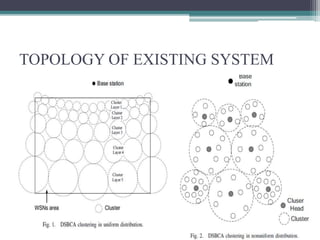
TOPOLOGY OF EXISTING SYSTEM
3 Stages of DSBCA
• Cluster head phase
• Cluster building phase
• Cycle phase
Cont…
Cluster head selecting phase:
Cluster head selection depends on
• Distance from the base station
• Node connection density
Cont…….
Cluster building phase:
• DSBCA sets the threshold of cluster size.
• Number of cluster node cannot exceed the threshold.
• Comparing the size of cluster with threshold to accept
new member and update the count of cluster nodes.
Cont…….
Cycle phase:
• Cluster is stable until the process of reelecting cluster
head.
• Cluster Head gathers the weight of all member nodes
and selects node with highest weight as next head
node.
• The average overall communication overhead in per
cluster is calculated.
DRAWBACKS
• Uniform cluster size
• Nodes dropout
• Packets dropout
PROPOSED WORK
• Energy efficient clustering algorithm elects the cluster
head based on average Residual energy of neighbor
nodes.
• Uses uneven competition ranges to form cluster of
unequal sizes.
• Cluster head near to BS/Sink have small cluster sizes
to preserve energy.
NETWORK MODEL
• Sensor nodes are randomly distributed in a circular
area
• Sink is located at the centre
SINK
RADIO MODEL
Fig. Radio Energy Dissipation Model
Power consumption during transmission is given by,
ET x(k, d) = ET x − elec(k) + ET x − amp(k, d)
= {k Eelec + kεfsd2, d < d0
{k Eelec + kεmpd4, d ≥ d0
Power consumption during reception is given by,
ERx(k) = Erx − elec(k) = kEelec
Transmit
Electronics
Tx
Amplifier
Receive
Electronics
K bit packetK bit packet
Erec(k)
Eelec *(k)εamp*k*dnEelec *(k)
ET x (k,d)
d
MECHANISM
SETUP PHASE
• Network Deployment
Phase
• Neighbor Node Phase
• Cluster Head Competition
Phase
• Cluster Formation Phase
DATA TRANSMISSION
PHASE
• Intra – Cluster
Communication
• Inter – Cluster
Communication
CLUSTER SETUP PHASE
NETWORK DEPLOYMENT PHASE
• Nodes are randomly deployed
• Sink broadcasts signal
• Each node compute its distance from BS
• Helps nodes to select the proper power level to
communicate with the BS
NEIGHBOR NODE PHASE
• Each node broadcasts Hello_Msg.
• Hello_Msg contains node id and Residual energy Er.
• At same time it recieves Hello_msg from its
neighbors.
• Each node calculates its average residual energy Ea.
d
Ea = (1/d)Σ si . Er
i=1
Cont….
Where Si - One of the neighbor node
Si . Er - Residual energy of Si
d - Number of neighbor node
• Each node calculates waiting time T1 for CH
competition phase.
T1 = [(1-α) *Ni/Nmax ]+[α*Vrandom]
Where Ni - number of neighborhood nodes of node i
Nmax -number of total sensor nodes
Vrandom -random number 0.9 and 1
α -constant coefficient between 0 and 1
CLUSTER COMPETITION PHASE
• After time T1 expires, nodes starts competition phase.
• All nodes calculate time T2 in this phase using
t = { (Ea/Er) T2 vr , Er≥Ea
{T2 Vr , Er<Ea
• Each node calculates its competition radius Rc .
dmax− d(si,BS)
Rc =1 – c ------------------------- Ro C
dmax− dmin
Cont….
Where dmax and dmin - maximum and minimum distance
b/w nodes and BS
c - weighted factor
RoC - maximum competition radius
Cluster Head Selection
• Final cluster Head elected based on Residual Energy.
• For any node Si, if it receives no Head_Msg when time T2
expires, it broadcasts the Head_Msg.
Cluster Head
ID
Residual
Energy
Distance from node to BS
(d)
No. of
Neighbor
Nodes
1
.
.
1.0
.
.
80
.
.
6
.
.
CLUSTER FORMATION PHASE
• Last subphase of cluster setup phase
• Each non cluster-head node chooses the nearest
cluster head and sends the Join _Msg
• Each cluster head creates a node schedule list
according to the received Join_Msgs
• Sends the schedule list to the cluster members by
broadcasting Sync_Msg
Cont…
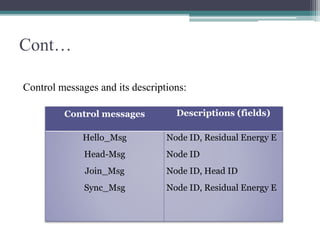
Control messages and its descriptions:
Control messages Descriptions (fields)
Hello_Msg
Head-Msg
Join_Msg
Sync_Msg
Node ID, Residual Energy E
Node ID
Node ID, Head ID
Node ID, Residual Energy E
DATA TRANSMISSION PHASE
INTRA-CLUSTER COMMUNICATION
• Cluster members sense and collect local data
• Send collected data to the cluster heads
INTER-CLUSTER COMMUNICATION
• Cluster heads receive and aggregate the data
• Threshold distance is used to find the distance from
cluster head Si to the BS.
• If the distance d is less than DTHR, Si communicates
with the BS directly.
• Otherwise, Si selects CH with high residual energy
from its neighborhood CH.
• To calculate the energy consumption Erelay
Erelay=d2(si, sj)+ d2(sj, BS)
Where, sj is the nearest CH with high residual energy
Cont..
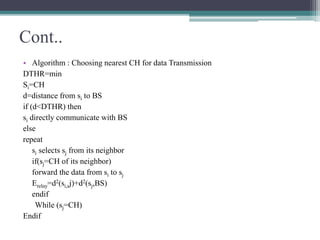
• Algorithm : Choosing nearest CH for data Transmission
DTHR=min
Si=CH
d=distance from si to BS
if (d<DTHR) then
si directly communicate with BS
else
repeat
si selects sj from its neighbor
if(sj=CH of its neighbor)
forward the data from si to sj
Erelay=d2(si,sj)+d2(sj,BS)
endif
While (sj=CH)
Endif
ADVANTAGES
• Consume less energy during the intra cluster and inter
cluster communication
• No “isolate points” and cover all the network nodes
• Unequal clusters generated by using Rc will be more
effective in prolonging the network lifetime
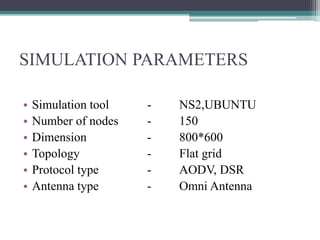
SIMULATION PARAMETERS
• Simulation tool - NS2,UBUNTU
• Number of nodes - 150
• Dimension - 800*600
• Topology - Flat grid
• Protocol type - AODV, DSR
• Antenna type - Omni Antenna
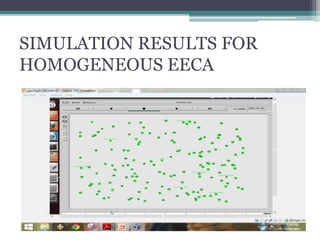
SIMULATION RESULTS FOR
HOMOGENEOUS EECA
NODE INITIALIZATION
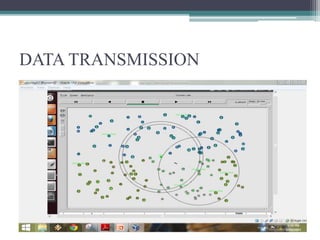
DATA TRANSMISSION
SIMULATION RESULT FOR
HETEROGENEOUS EECA
NODE INITIALIZATION
DATA TRANSMISSION
SIMULATED GRAPHS
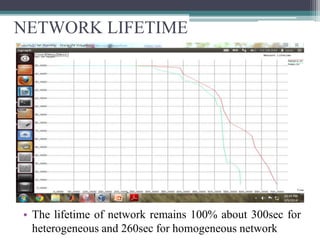
NETWORK LIFETIME
• The lifetime of network remains 100% about 300sec for
heterogeneous and 260sec for homogeneous network
EFFICIENCY
• Heterogeneous EECA gives upto 2750 rounds and Homogeneous
EECA gives only 2400 rounds. It shows that the efficiency of
heterogeneous network is higher than the homogeneous network.
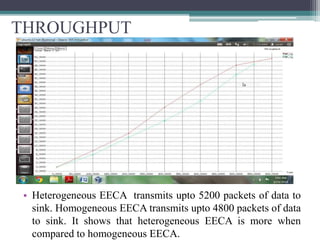
THROUGHPUT
• Heterogeneous EECA transmits upto 5200 packets of data to
sink. Homogeneous EECA transmits upto 4800 packets of data
to sink. It shows that heterogeneous EECA is more when
compared to homogeneous EECA.
CONCLUSION AND FUTURE SCOPE
• Our proposed work will consume less energy during
the intra cluster and inter cluster relay traffic which
can balance the energy consumption among cluster
heads and extend the lifetime of the network up to
85%.
• For further enhancement in network lifetime EECA
can be simulated using different table driven routing
protocols and on demand routing protocols.
REFERENCES
[1]Load-balanced Clustering Algorithm With Distributed Self-organization
For Wireless Sensor Networks. Ying Liao, Huan Qi, And Weiqun Li IEEE
Sensors Journal, Vol. 13, No. 5, May 2013.
[2]J. S. Lee and W. L. Cheng, “Fuzzy-logic-based clustering approach for
wireless sensor networks using energy predication,” IEEE Sensors J., vol.
11, no. 9, pp. 2891–2897, Sep. 2012.
[3]H. Bagci and A. Yazici, “An energy aware fuzzy unequal clustering
algorithm for wireless sensor networks,” in Proc. IEEE Int. Conf. Fuzzy
Syst., Jul. 2010, pp. 1–8.
[4]M.Youssef, A. Youssef, and M. Younis, “Overlapping multihop clustering
for wireless sensor networks,” IEEE Trans. Parallel Distrib. Syst., vol. 20,
no. 12, pp. 1844–1856, Dec. 2009.
[5] C. H. Lin and M. J. Tsai, “A comment on HEED: A hybrid, energy
efficient, distributed clustering approach for ad hoc sensor networks,”
IEEE Trans. Mobile Comput., vol. 5, no. 10, pp. 1471–1472, Oct. 2006.
[6] W. R. Heinzelman, “An application-specific protocol architecture for wireless
microsensor networks,” IEEE Trans. Wireless Commun., vol. 1, no. 4, pp. 660–
670, Oct. 2002.
[7] C. F. Li, M. Ye, G. H. Chen, and J. Wu, "An energy-efficient unequal
clustering mechanism for wireless sensor networks," in Proceedings of the
IEEE International Conference on Mobile Adhoc and Sensor Systems
Conference, pp. 1-8, IEEE Press, Washington, DC, USA, November.
[8]M. Ye, C. F. Li, G. H. Chen, and J. Wu, "EECS: An Energy Efficient
Clustering Scheme in Wireless Sensor Networks", in Proceedings of IEEE Int'l
Performance Computing and Communications Conference (IPCCC), 2005, pp.
535-540 .
[9]Jiguo Yu, Ying ying Qi, Gang Wang, Qiang Guo and Xin Gu, “An Energy-
Aware Distributed Unequal Clustering Protocol for Wireless Sensor
Networks”, International Journal of Distributed Sensor NetworksVolume 2011,
Article ID 202145.
[10]V. Mhatre, C. Rosenberg, "Homogeneous vs Heterogeneous Clustered
Networks: A Comparative Study", in Proceedings of IEEE ICC 2004, June
2004.

eeca

  • 1.
    ENERGY EFFICIENT CLUSTERING ALGORITHMFOR WSN TEAM MEMBERS Manonmani.A Minu@ Maharayazhini.S Priyadharshini.M SandrineNadiad.B UNDER THE GUIDANCE OF Mrs.C.P.Subha Associate Professor & PG Coordinate
  • 2.
    CONTENTS • OBJECTIVE • EXISTINGSYSTEM • PROPOSED SYSTEM • SIMULATION RESULTS • CONCLUSION AND FUTURE SCOPE • REFERENCE
  • 3.
    OBJECTIVE • To proposean energy efficient clustering algorithm for extending the network lifetime in WSNs
  • 4.
    INTRODUCTION • Wireless sensornetwork (WSN) consists of spatially distributed autonomous sensors. • WSN is built of "nodes“ from a few to several hundreds or even thousands. • Monitor physical or environmental conditions, such as temperature, sound, pressure.
  • 5.
    CLUSTERING • Clustering ofnodes is an energy efficient approach for wireless sensor networks. • Nodes are grouped to form clusters. • Each cluster has atleast one cluster head (CH). • Nodes send data to their corresponding CH by single or multi hop communication.
  • 6.
    ADVANTAGES OF CLUSTERING •Transmit aggregated data to the data sink • Reducing number of nodes taking part in transmission • Useful energy consumption • Scalability for large number of nodes • Reduces communication overhead for both single and multi hop
  • 7.
    LITERATURE SURVEY OFCLUSTERING ALGORITHMS • HEED: A hybrid energy efficient distributed clustering approach for ad-hoc sensor networks • MRECA: Mobility resistant efficient clustering approach for ad-hoc sensor networks • Energy efficient dynamic clustering algorithm for ad- hoc sensor networks • LEACH-Energy efficient communication protocol for WSN • EEDC-Dynamic clustering and energy efficient routing technique for WSN
  • 8.
    EXISTING SYSTEM • Distributedself-organization balanced clustering algorithm(DSBCA). • Purpose is to generate clusters with more balanced energy and avoid creating excessive clusters with many nodes. • The basic idea of DSBCA is based on connectivity density and clustering radius. • Clustering radius is determined by distance.
  • 9.
  • 10.
    3 Stages ofDSBCA • Cluster head phase • Cluster building phase • Cycle phase
  • 11.
    Cont… Cluster head selectingphase: Cluster head selection depends on • Distance from the base station • Node connection density
  • 12.
    Cont……. Cluster building phase: •DSBCA sets the threshold of cluster size. • Number of cluster node cannot exceed the threshold. • Comparing the size of cluster with threshold to accept new member and update the count of cluster nodes.
  • 13.
    Cont……. Cycle phase: • Clusteris stable until the process of reelecting cluster head. • Cluster Head gathers the weight of all member nodes and selects node with highest weight as next head node. • The average overall communication overhead in per cluster is calculated.
  • 14.
    DRAWBACKS • Uniform clustersize • Nodes dropout • Packets dropout
  • 15.
    PROPOSED WORK • Energyefficient clustering algorithm elects the cluster head based on average Residual energy of neighbor nodes. • Uses uneven competition ranges to form cluster of unequal sizes. • Cluster head near to BS/Sink have small cluster sizes to preserve energy.
  • 16.
    NETWORK MODEL • Sensornodes are randomly distributed in a circular area • Sink is located at the centre SINK
  • 17.
    RADIO MODEL Fig. RadioEnergy Dissipation Model Power consumption during transmission is given by, ET x(k, d) = ET x − elec(k) + ET x − amp(k, d) = {k Eelec + kεfsd2, d < d0 {k Eelec + kεmpd4, d ≥ d0 Power consumption during reception is given by, ERx(k) = Erx − elec(k) = kEelec Transmit Electronics Tx Amplifier Receive Electronics K bit packetK bit packet Erec(k) Eelec *(k)εamp*k*dnEelec *(k) ET x (k,d) d
  • 18.
    MECHANISM SETUP PHASE • NetworkDeployment Phase • Neighbor Node Phase • Cluster Head Competition Phase • Cluster Formation Phase DATA TRANSMISSION PHASE • Intra – Cluster Communication • Inter – Cluster Communication
  • 19.
  • 20.
    NETWORK DEPLOYMENT PHASE •Nodes are randomly deployed • Sink broadcasts signal • Each node compute its distance from BS • Helps nodes to select the proper power level to communicate with the BS
  • 21.
    NEIGHBOR NODE PHASE •Each node broadcasts Hello_Msg. • Hello_Msg contains node id and Residual energy Er. • At same time it recieves Hello_msg from its neighbors. • Each node calculates its average residual energy Ea. d Ea = (1/d)Σ si . Er i=1
  • 22.
    Cont…. Where Si -One of the neighbor node Si . Er - Residual energy of Si d - Number of neighbor node • Each node calculates waiting time T1 for CH competition phase. T1 = [(1-α) *Ni/Nmax ]+[α*Vrandom] Where Ni - number of neighborhood nodes of node i Nmax -number of total sensor nodes Vrandom -random number 0.9 and 1 α -constant coefficient between 0 and 1
  • 23.
    CLUSTER COMPETITION PHASE •After time T1 expires, nodes starts competition phase. • All nodes calculate time T2 in this phase using t = { (Ea/Er) T2 vr , Er≥Ea {T2 Vr , Er<Ea • Each node calculates its competition radius Rc . dmax− d(si,BS) Rc =1 – c ------------------------- Ro C dmax− dmin
  • 24.
    Cont…. Where dmax anddmin - maximum and minimum distance b/w nodes and BS c - weighted factor RoC - maximum competition radius Cluster Head Selection • Final cluster Head elected based on Residual Energy. • For any node Si, if it receives no Head_Msg when time T2 expires, it broadcasts the Head_Msg. Cluster Head ID Residual Energy Distance from node to BS (d) No. of Neighbor Nodes 1 . . 1.0 . . 80 . . 6 . .
  • 25.
    CLUSTER FORMATION PHASE •Last subphase of cluster setup phase • Each non cluster-head node chooses the nearest cluster head and sends the Join _Msg • Each cluster head creates a node schedule list according to the received Join_Msgs • Sends the schedule list to the cluster members by broadcasting Sync_Msg
  • 26.
    Cont… Control messages andits descriptions: Control messages Descriptions (fields) Hello_Msg Head-Msg Join_Msg Sync_Msg Node ID, Residual Energy E Node ID Node ID, Head ID Node ID, Residual Energy E
  • 27.
  • 28.
    INTRA-CLUSTER COMMUNICATION • Clustermembers sense and collect local data • Send collected data to the cluster heads
  • 29.
    INTER-CLUSTER COMMUNICATION • Clusterheads receive and aggregate the data • Threshold distance is used to find the distance from cluster head Si to the BS. • If the distance d is less than DTHR, Si communicates with the BS directly. • Otherwise, Si selects CH with high residual energy from its neighborhood CH. • To calculate the energy consumption Erelay Erelay=d2(si, sj)+ d2(sj, BS) Where, sj is the nearest CH with high residual energy
  • 30.
    Cont.. • Algorithm :Choosing nearest CH for data Transmission DTHR=min Si=CH d=distance from si to BS if (d<DTHR) then si directly communicate with BS else repeat si selects sj from its neighbor if(sj=CH of its neighbor) forward the data from si to sj Erelay=d2(si,sj)+d2(sj,BS) endif While (sj=CH) Endif
  • 31.
    ADVANTAGES • Consume lessenergy during the intra cluster and inter cluster communication • No “isolate points” and cover all the network nodes • Unequal clusters generated by using Rc will be more effective in prolonging the network lifetime
  • 32.
    SIMULATION PARAMETERS • Simulationtool - NS2,UBUNTU • Number of nodes - 150 • Dimension - 800*600 • Topology - Flat grid • Protocol type - AODV, DSR • Antenna type - Omni Antenna
  • 33.
  • 34.
  • 35.
  • 37.
  • 38.
  • 39.
  • 40.
  • 41.
    NETWORK LIFETIME • Thelifetime of network remains 100% about 300sec for heterogeneous and 260sec for homogeneous network
  • 42.
    EFFICIENCY • Heterogeneous EECAgives upto 2750 rounds and Homogeneous EECA gives only 2400 rounds. It shows that the efficiency of heterogeneous network is higher than the homogeneous network.
  • 43.
    THROUGHPUT • Heterogeneous EECAtransmits upto 5200 packets of data to sink. Homogeneous EECA transmits upto 4800 packets of data to sink. It shows that heterogeneous EECA is more when compared to homogeneous EECA.
  • 44.
    CONCLUSION AND FUTURESCOPE • Our proposed work will consume less energy during the intra cluster and inter cluster relay traffic which can balance the energy consumption among cluster heads and extend the lifetime of the network up to 85%. • For further enhancement in network lifetime EECA can be simulated using different table driven routing protocols and on demand routing protocols.
  • 45.
    REFERENCES [1]Load-balanced Clustering AlgorithmWith Distributed Self-organization For Wireless Sensor Networks. Ying Liao, Huan Qi, And Weiqun Li IEEE Sensors Journal, Vol. 13, No. 5, May 2013. [2]J. S. Lee and W. L. Cheng, “Fuzzy-logic-based clustering approach for wireless sensor networks using energy predication,” IEEE Sensors J., vol. 11, no. 9, pp. 2891–2897, Sep. 2012. [3]H. Bagci and A. Yazici, “An energy aware fuzzy unequal clustering algorithm for wireless sensor networks,” in Proc. IEEE Int. Conf. Fuzzy Syst., Jul. 2010, pp. 1–8. [4]M.Youssef, A. Youssef, and M. Younis, “Overlapping multihop clustering for wireless sensor networks,” IEEE Trans. Parallel Distrib. Syst., vol. 20, no. 12, pp. 1844–1856, Dec. 2009. [5] C. H. Lin and M. J. Tsai, “A comment on HEED: A hybrid, energy efficient, distributed clustering approach for ad hoc sensor networks,” IEEE Trans. Mobile Comput., vol. 5, no. 10, pp. 1471–1472, Oct. 2006.
  • 46.
    [6] W. R.Heinzelman, “An application-specific protocol architecture for wireless microsensor networks,” IEEE Trans. Wireless Commun., vol. 1, no. 4, pp. 660– 670, Oct. 2002. [7] C. F. Li, M. Ye, G. H. Chen, and J. Wu, "An energy-efficient unequal clustering mechanism for wireless sensor networks," in Proceedings of the IEEE International Conference on Mobile Adhoc and Sensor Systems Conference, pp. 1-8, IEEE Press, Washington, DC, USA, November. [8]M. Ye, C. F. Li, G. H. Chen, and J. Wu, "EECS: An Energy Efficient Clustering Scheme in Wireless Sensor Networks", in Proceedings of IEEE Int'l Performance Computing and Communications Conference (IPCCC), 2005, pp. 535-540 . [9]Jiguo Yu, Ying ying Qi, Gang Wang, Qiang Guo and Xin Gu, “An Energy- Aware Distributed Unequal Clustering Protocol for Wireless Sensor Networks”, International Journal of Distributed Sensor NetworksVolume 2011, Article ID 202145. [10]V. Mhatre, C. Rosenberg, "Homogeneous vs Heterogeneous Clustered Networks: A Comparative Study", in Proceedings of IEEE ICC 2004, June 2004.