PublicSlide 1 |
Keeping innovation moving
Lucas van Grinsven
Hoofd Communicatie
“Mobiliteit beweegt iedereen”, 17 november 2010
PublicSlide 2 |
Agenda
• Introducing ASML – a cornerstone of the chip industry
• Sustainability is a key driver of the chip industry
• Keeping innovation moving in the Netherlands
PublicSlide 3 |
Introducing ASML,
a cornerstone of the chip
industry
PublicSlide 4 |
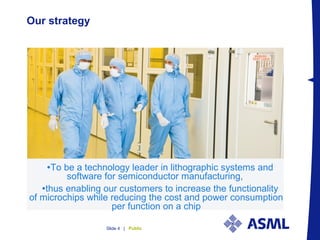
Our strategy
•“
•To be a technology leader in lithographic systems and
software for semiconductor manufacturing,
•thus enabling our customers to increase the functionality
of microchips while reducing the cost and power consumption
per function on a chip
PublicSlide 5 |
$300.3 B
Semiconductor
Chips in 2010
$228.4 B in 2009
$1,360 B Electronic Applications in 2010
$1,204 B in 2009
$6.1 B
Semiconductor
Litho market in 2010
$2.5 B in 2009
Source: Gartner Q3/10 and ASML
From silicon to smart electronics
PublicSlide 6 |
81 83 85 87 89 91 93 95 97 99 01 03 05 07 09
0
10
20
30
40
50
60
70
%
Continuous lithography innovation grows market share
1984
Total market: > € 6 billion
GCA
Ultratech
Eaton
Nikon
ASET
Hitachi
Perkin ElmerCanon
ASML
Nikon
Canon
2010*
Total market: > € 463 million
ASML
Technology leadership brings
increased market share
*estimates of independent market research firms
PublicSlide 7 |
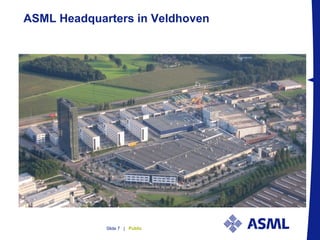
ASML Headquarters in Veldhoven
PublicSlide 8 |
Sustainability is a key driver of
the chip industry
PublicSlide 9 |
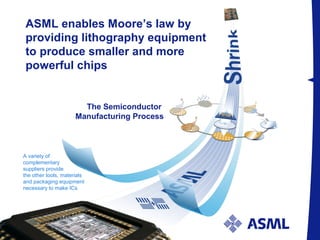
ASML enables Moore’s law by
providing lithography equipment
to produce smaller and more
powerful chips
The Semiconductor
Manufacturing Process
A variety of
complementary
suppliers provide
the other tools, materials
and packaging equipment
necessary to make ICs
PublicSlide 10 |
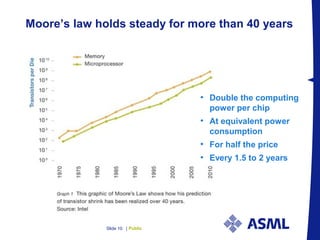
Moore’s law holds steady for more than 40 years
• Double the computing
power per chip
• At equivalent power
consumption
• For half the price
• Every 1.5 to 2 years
PublicSlide 11 |Slide 11 |
Moore’s law: what it means for consumers
Note: data iSupply, March 2009. High quality Flash
0
1
10
100
1000
10000
2000 2001 2002 2003 2004 2005 2006 2007 2008 2009 2010 2011 2012 2013 2014 2015
$2,305 for 1Gigabyte (GB)
$/GByte
$0.17 for 1 GB
PublicSlide 12 |
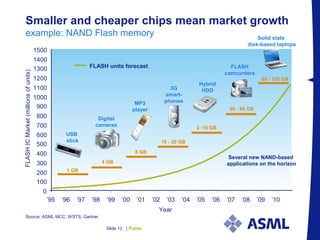
Smaller and cheaper chips mean market growth
example: NAND Flash memory
Source: ASML MCC, WSTS, Gartner
1 GB
USB
stick
4 GB
Digital
cameras
8 GB
MP3
player
10 - 20 GB
60 - 80 GB
Hybrid
HDD
FLASH
camcorders
Solid state
disk-based laptops
2 -16 GB
80 - 150 GB
0
100
200
300
400
500
600
700
800
900
1000
1100
1200
1300
1400
1500
’95 ’96 ’97 ’98 ’99 ’00 ’01 ’02 ’03 ’04 ’05 ’06 ’07 ’08 ’09 ’10
Year
FLASHICMarket(millionsofunits)
FLASH units forecast
Several new NAND-based
applications on the horizon
3G
smart-
phones
PublicSlide 13 |
Game changer of affordable advanced computing
Source: Morgan Stanley,
The Mobile Internet Report, Dec 2009
10
1000
100
10,000
100,000
1,000,000
0
1960 1970 1980 1990 2000 2010 2020
Devices/Users(MMinLogScale)
1
Minicomputers
10MM+ Units
PC
100MM+ Units
Desktop
Internet
1B+ Units /
Users
Mobile
Internet
10B+
Users???
Mainframes
1MM+ Units
Computing growth drivers over time, 1960 – 2020E
More than
Just phones
• Smartphone
• Kindle
• Tablet
• MP3
• Cell phone / PDA
• Car Electronics
GPS, ABS, A/V
• Mobile Video
• Home
entertainment
• Games
• Wireless home
appliances
Increasing integration
PublicSlide 14 |
Source: Jonathan Koomey, Lawrence
Berkeley National Laboratory and Stanford
University, 2009
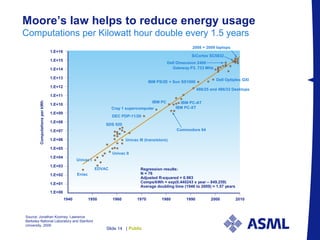
Moore’s law helps to reduce energy usage
Computations per Kilowatt hour double every 1.5 years
Dell Optiplex GXI
486/25 and 486/33 Desktops
IBM PC-AT
IBM PC-XT
Commodore 64
DEC PDP-11/20
Cray 1 supercomputer
IBM PC
SDS 920
Univac I
Eniac
EDVAC
Univac II
Univac III (transistors)
Regression results:
N = 76
Adjusted R-squared = 0.983
Comps/kWh = exp(0.440243 x year – 849.259)
Average doubling time (1946 to 2009) = 1.57 years
IBM PS/2E + Sun SS1000
Gateway P3. 733 MHz
Dell Dimension 2400
SiCortex SC5832
2008 + 2009 laptops
1.E+16
1.E+15
1.E+14
1.E+13
1.E+12
1.E+11
1.E+10
1.E+09
1.E+08
1.E+07
1.E+06
1.E+05
1.E+04
1.E+03
1.E+02
1.E+01
1.E+00
ComputationsperkWh
1940 1950 1960 1970 1980 1990 2000 2010
PublicSlide 15 |
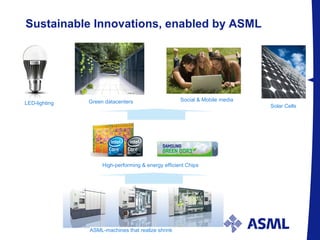
Sustainable Innovations, enabled by ASML
LED-lighting Green datacenters Social & Mobile media
Solar Cells
High-performing & energy efficient Chips
ASML-machines that realize shrink
PublicSlide 16 |
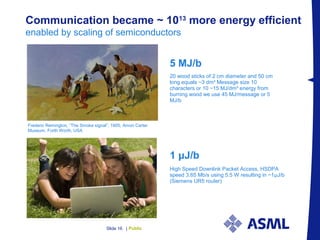
Communication became ~ 1013
more energy efficient
enabled by scaling of semiconductors
Frederic Remington, “The Smoke signal”, 1905, Amon Carter
Museum, Forth Worth, USA
5 MJ/b
20 wood sticks of 2 cm diameter and 50 cm
long equals ~3 dm³ Message size 10
characters or 10 ~15 MJ/dm³ energy from
burning wood we use 45 MJ/message or 5
MJ/b
High Speed Downlink Packet Access, HSDPA
speed 3.65 Mb/s using 5.5 W resulting in ~1μJ/b
(Siemens UR5 router)
1 μJ/b
PublicSlide 17 |
Keeping innovation moving
in the Netherlands
PublicSlide 18 |
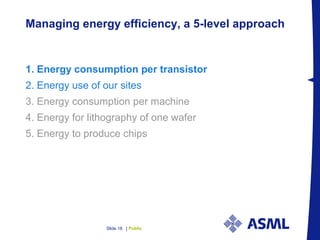
Managing energy efficiency, a 5-level approach
1. Energy consumption per transistor
2. Energy use of our sites
3. Energy consumption per machine
4. Energy for lithography of one wafer
5. Energy to produce chips
PublicSlide 19 |
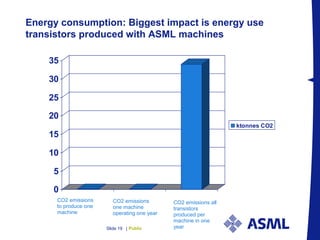
Energy consumption: Biggest impact is energy use
transistors produced with ASML machines
0
5
10
15
20
25
30
35
ktonnes CO2
CO2 emissions
to produce one
machine
CO2 emissions
one machine
operating one year
CO2 emissions all
transistors
produced per
machine in one
year
PublicSlide 20 |
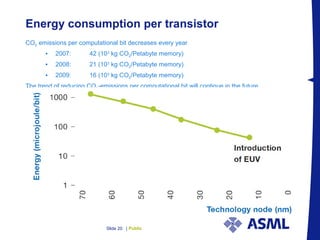
Energy consumption per transistor
CO2 emissions per computational bit decreases every year
• 2007: 42 (103
kg CO2/Petabyte memory)
• 2008: 21 (103
kg CO2/Petabyte memory)
• 2009: 16 (103
kg CO2/Petabyte memory)
The trend of reducing CO2-emissions per computational bit will continue in the future
PublicSlide 21 |
Lithography as main enabler of memory power savings
Source: Samsung (07/10)
PublicSlide 22 |
Managing energy efficiency, a 5-level approach
1. Energy consumption per transistor
2. Energy use of our sites
3. Energy consumption per machine
4. Energy for lithography of one wafer
5. Energy to produce chips
PublicSlide 23 |
CO2 emissions sites 2015 based on production estimates
(Business as usual scenario without CO2-saving measures)
0.0
20.0
40.0
60.0
80.0
100.0
120.0
140.0
160.0
2009 2010 2011 2012 2013 2014 2015
CS w w
ACE
Temp
Rich
Wil
VH
Target: < 45 kton CO2
in 2015
Employee mobility:
<5 kton CO2
PublicSlide 24 |
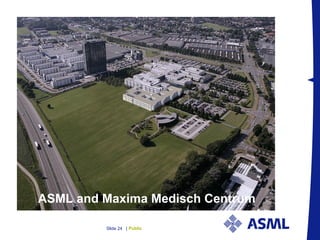
ASML and Maxima Medisch Centrum
PublicSlide 25 |
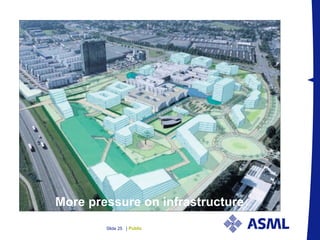
More pressure on infrastructure
PublicSlide 26 |
Mobility survey @ ASML
• Survey held in June 2010
• 2277 (of 3931) employees filled out the survey (fix and
flex employees); 58% respons.
• Most important results:
• Only 25% commutes by bike (62% lives within a radius of 15 km)
• Only 4% commutes by bus; public transport is experiences as
inefficient (buss stop is at ASML doorstep)
• 59% commutes by car
• 86% is flexible in start and end time of the working day
• 60% commutes during rush hour
• 13% of employees think that car pooling is an attractive way to
commute (9% is car pooler at the moment)
PublicSlide 27 |
Issues and potential for improvement
Issues:
• Commuter packages are not up to date
• Frequent requests by employees for full reimbursement of the
costs for public transport
• Rempte working is facilitated but not promoted
• Car pooling is not facilitated
• Cycling is not actively encouraged
• A new fiscal law will be implemented (1.4% regulation); policy
choices have to be made e.g. a higher amount of electric bikes
Potential for improvement:
• There is potential to increase the use of bike or public transport
and car pool activities
• Alternative ways for commuting are large; potential for change in
behavior is large, interest in car pooling is large
PublicSlide 28 |
What is required?
ASML’s Vision on Mobility & Campus:
‘’ASML strives the Veldhoven campus to
be a sustainable place where people can
work and meet, in a productive, safe and
pleasant way, supported by:
• free choice in ways of commuting
• a flexible work environment (in ups and downs)
• stimulus for employees to choose a healthy and
sustainable way of commuting
PublicSlide 29 |
Mobility actions
Short term actions:
1. Cycling plan (extension of current plan)
2. Encourage public transport (extension current plan)
3. Promote and support car pooling
4. Green lease car policy (company car park is very small anyway)
Mid term actions (under investigation):
1. Comprehensive employee mobility plan
2. Remote and Flexible work places (“Nieuwe Werken’’)
PublicSlide 30 |
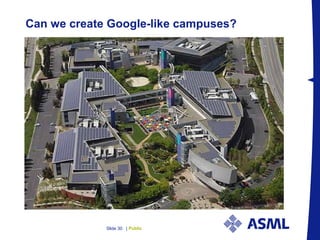
Can we create Google-like campuses?
PublicSlide 31 |
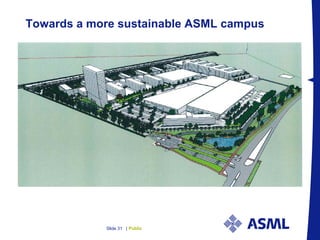
Towards a more sustainable ASML campus
PublicSlide 32 |

Keeping innovation moving asml

  • 1.
    PublicSlide 1 | Keepinginnovation moving Lucas van Grinsven Hoofd Communicatie “Mobiliteit beweegt iedereen”, 17 november 2010
  • 2.
    PublicSlide 2 | Agenda •Introducing ASML – a cornerstone of the chip industry • Sustainability is a key driver of the chip industry • Keeping innovation moving in the Netherlands
  • 3.
    PublicSlide 3 | IntroducingASML, a cornerstone of the chip industry
  • 4.
    PublicSlide 4 | Ourstrategy •“ •To be a technology leader in lithographic systems and software for semiconductor manufacturing, •thus enabling our customers to increase the functionality of microchips while reducing the cost and power consumption per function on a chip
  • 5.
    PublicSlide 5 | $300.3B Semiconductor Chips in 2010 $228.4 B in 2009 $1,360 B Electronic Applications in 2010 $1,204 B in 2009 $6.1 B Semiconductor Litho market in 2010 $2.5 B in 2009 Source: Gartner Q3/10 and ASML From silicon to smart electronics
  • 6.
    PublicSlide 6 | 8183 85 87 89 91 93 95 97 99 01 03 05 07 09 0 10 20 30 40 50 60 70 % Continuous lithography innovation grows market share 1984 Total market: > € 6 billion GCA Ultratech Eaton Nikon ASET Hitachi Perkin ElmerCanon ASML Nikon Canon 2010* Total market: > € 463 million ASML Technology leadership brings increased market share *estimates of independent market research firms
  • 7.
    PublicSlide 7 | ASMLHeadquarters in Veldhoven
  • 8.
    PublicSlide 8 | Sustainabilityis a key driver of the chip industry
  • 9.
    PublicSlide 9 | ASMLenables Moore’s law by providing lithography equipment to produce smaller and more powerful chips The Semiconductor Manufacturing Process A variety of complementary suppliers provide the other tools, materials and packaging equipment necessary to make ICs
  • 10.
    PublicSlide 10 | Moore’slaw holds steady for more than 40 years • Double the computing power per chip • At equivalent power consumption • For half the price • Every 1.5 to 2 years
  • 11.
    PublicSlide 11 |Slide11 | Moore’s law: what it means for consumers Note: data iSupply, March 2009. High quality Flash 0 1 10 100 1000 10000 2000 2001 2002 2003 2004 2005 2006 2007 2008 2009 2010 2011 2012 2013 2014 2015 $2,305 for 1Gigabyte (GB) $/GByte $0.17 for 1 GB
  • 12.
    PublicSlide 12 | Smallerand cheaper chips mean market growth example: NAND Flash memory Source: ASML MCC, WSTS, Gartner 1 GB USB stick 4 GB Digital cameras 8 GB MP3 player 10 - 20 GB 60 - 80 GB Hybrid HDD FLASH camcorders Solid state disk-based laptops 2 -16 GB 80 - 150 GB 0 100 200 300 400 500 600 700 800 900 1000 1100 1200 1300 1400 1500 ’95 ’96 ’97 ’98 ’99 ’00 ’01 ’02 ’03 ’04 ’05 ’06 ’07 ’08 ’09 ’10 Year FLASHICMarket(millionsofunits) FLASH units forecast Several new NAND-based applications on the horizon 3G smart- phones
  • 13.
    PublicSlide 13 | Gamechanger of affordable advanced computing Source: Morgan Stanley, The Mobile Internet Report, Dec 2009 10 1000 100 10,000 100,000 1,000,000 0 1960 1970 1980 1990 2000 2010 2020 Devices/Users(MMinLogScale) 1 Minicomputers 10MM+ Units PC 100MM+ Units Desktop Internet 1B+ Units / Users Mobile Internet 10B+ Users??? Mainframes 1MM+ Units Computing growth drivers over time, 1960 – 2020E More than Just phones • Smartphone • Kindle • Tablet • MP3 • Cell phone / PDA • Car Electronics GPS, ABS, A/V • Mobile Video • Home entertainment • Games • Wireless home appliances Increasing integration
  • 14.
    PublicSlide 14 | Source:Jonathan Koomey, Lawrence Berkeley National Laboratory and Stanford University, 2009 Moore’s law helps to reduce energy usage Computations per Kilowatt hour double every 1.5 years Dell Optiplex GXI 486/25 and 486/33 Desktops IBM PC-AT IBM PC-XT Commodore 64 DEC PDP-11/20 Cray 1 supercomputer IBM PC SDS 920 Univac I Eniac EDVAC Univac II Univac III (transistors) Regression results: N = 76 Adjusted R-squared = 0.983 Comps/kWh = exp(0.440243 x year – 849.259) Average doubling time (1946 to 2009) = 1.57 years IBM PS/2E + Sun SS1000 Gateway P3. 733 MHz Dell Dimension 2400 SiCortex SC5832 2008 + 2009 laptops 1.E+16 1.E+15 1.E+14 1.E+13 1.E+12 1.E+11 1.E+10 1.E+09 1.E+08 1.E+07 1.E+06 1.E+05 1.E+04 1.E+03 1.E+02 1.E+01 1.E+00 ComputationsperkWh 1940 1950 1960 1970 1980 1990 2000 2010
  • 15.
    PublicSlide 15 | SustainableInnovations, enabled by ASML LED-lighting Green datacenters Social & Mobile media Solar Cells High-performing & energy efficient Chips ASML-machines that realize shrink
  • 16.
    PublicSlide 16 | Communicationbecame ~ 1013 more energy efficient enabled by scaling of semiconductors Frederic Remington, “The Smoke signal”, 1905, Amon Carter Museum, Forth Worth, USA 5 MJ/b 20 wood sticks of 2 cm diameter and 50 cm long equals ~3 dm³ Message size 10 characters or 10 ~15 MJ/dm³ energy from burning wood we use 45 MJ/message or 5 MJ/b High Speed Downlink Packet Access, HSDPA speed 3.65 Mb/s using 5.5 W resulting in ~1μJ/b (Siemens UR5 router) 1 μJ/b
  • 17.
    PublicSlide 17 | Keepinginnovation moving in the Netherlands
  • 18.
    PublicSlide 18 | Managingenergy efficiency, a 5-level approach 1. Energy consumption per transistor 2. Energy use of our sites 3. Energy consumption per machine 4. Energy for lithography of one wafer 5. Energy to produce chips
  • 19.
    PublicSlide 19 | Energyconsumption: Biggest impact is energy use transistors produced with ASML machines 0 5 10 15 20 25 30 35 ktonnes CO2 CO2 emissions to produce one machine CO2 emissions one machine operating one year CO2 emissions all transistors produced per machine in one year
  • 20.
    PublicSlide 20 | Energyconsumption per transistor CO2 emissions per computational bit decreases every year • 2007: 42 (103 kg CO2/Petabyte memory) • 2008: 21 (103 kg CO2/Petabyte memory) • 2009: 16 (103 kg CO2/Petabyte memory) The trend of reducing CO2-emissions per computational bit will continue in the future
  • 21.
    PublicSlide 21 | Lithographyas main enabler of memory power savings Source: Samsung (07/10)
  • 22.
    PublicSlide 22 | Managingenergy efficiency, a 5-level approach 1. Energy consumption per transistor 2. Energy use of our sites 3. Energy consumption per machine 4. Energy for lithography of one wafer 5. Energy to produce chips
  • 23.
    PublicSlide 23 | CO2emissions sites 2015 based on production estimates (Business as usual scenario without CO2-saving measures) 0.0 20.0 40.0 60.0 80.0 100.0 120.0 140.0 160.0 2009 2010 2011 2012 2013 2014 2015 CS w w ACE Temp Rich Wil VH Target: < 45 kton CO2 in 2015 Employee mobility: <5 kton CO2
  • 24.
    PublicSlide 24 | ASMLand Maxima Medisch Centrum
  • 25.
    PublicSlide 25 | Morepressure on infrastructure
  • 26.
    PublicSlide 26 | Mobilitysurvey @ ASML • Survey held in June 2010 • 2277 (of 3931) employees filled out the survey (fix and flex employees); 58% respons. • Most important results: • Only 25% commutes by bike (62% lives within a radius of 15 km) • Only 4% commutes by bus; public transport is experiences as inefficient (buss stop is at ASML doorstep) • 59% commutes by car • 86% is flexible in start and end time of the working day • 60% commutes during rush hour • 13% of employees think that car pooling is an attractive way to commute (9% is car pooler at the moment)
  • 27.
    PublicSlide 27 | Issuesand potential for improvement Issues: • Commuter packages are not up to date • Frequent requests by employees for full reimbursement of the costs for public transport • Rempte working is facilitated but not promoted • Car pooling is not facilitated • Cycling is not actively encouraged • A new fiscal law will be implemented (1.4% regulation); policy choices have to be made e.g. a higher amount of electric bikes Potential for improvement: • There is potential to increase the use of bike or public transport and car pool activities • Alternative ways for commuting are large; potential for change in behavior is large, interest in car pooling is large
  • 28.
    PublicSlide 28 | Whatis required? ASML’s Vision on Mobility & Campus: ‘’ASML strives the Veldhoven campus to be a sustainable place where people can work and meet, in a productive, safe and pleasant way, supported by: • free choice in ways of commuting • a flexible work environment (in ups and downs) • stimulus for employees to choose a healthy and sustainable way of commuting
  • 29.
    PublicSlide 29 | Mobilityactions Short term actions: 1. Cycling plan (extension of current plan) 2. Encourage public transport (extension current plan) 3. Promote and support car pooling 4. Green lease car policy (company car park is very small anyway) Mid term actions (under investigation): 1. Comprehensive employee mobility plan 2. Remote and Flexible work places (“Nieuwe Werken’’)
  • 30.
    PublicSlide 30 | Canwe create Google-like campuses?
  • 31.
    PublicSlide 31 | Towardsa more sustainable ASML campus
  • 32.

Editor's Notes

  • #5 This is our strategy
  • #6 The electronics world is very large. In 2008 a total of nearly1,550 billion US dollars in electronic applications have been sold. This ranges from computers, camera’s, mp3 players to Blu-ray players and industrial electronics. Nearly all electronic equipment contains chips. That total market was 262 billion dollars. For the production of chips many different production systems are used. The lithography equipment ASML makes is only one of them, but it is the most critical step and the systems are also relatively expensive. The total market for lithography equipment to make chips was 5.5 billion dollars of which ASML had a share of more than 65% according to various research firms. This whole system we call the ‘food chain’ of the electronics industry. For 2009 the situation is much different because of the economic crisis. The data presented is from Gartner and gives data that is always delayed. The reduction in sales of electronics goods is quite dramatic, but the deeper you get into the foodchain the larger the reductions in revenues are. The same happens when the market is growing: also then the deeper you get in the foodchain the larger the gains are. Conclusion: the deeper you get into the foodchain of the electronics industry, the larger the swings are.
  • #7 We are a growing market: market share is growing within an expanding market
  • #8 Proof of the pudding locations
  • #10 We make the systems that make it able to follow Moore’s law
  • #11 Moore’s law means: see bullets and has been proven to be correct in the last 40 years
  • #12 For you and me when we’re in the Media Market, Moore’s law means that we can get more gigs for less and less money
  • #13 And one thing leads to another: the smaller and cheaper the chips are, new applications are possible, requiring more and more memory, leading to market growth
  • #15 By helping reducing the size and cost of memory, we also help reduce the energy needed to calculate.