Silicon Valley
America’s Pathbreaking Cluster Economy


                           Russell Hancock
                  President & Chief Executive Officer
                         Joint Venture Silicon Valley

                                   10 October 2011
What is
Silicon Valley?
Some things Silicon
Valley is NOT:
 •NOT a place you can point to on a
 map
 •NOT a place with a defined identity
 •NOT a planned phenomenon
 •NOT characterized by silicon or
 semiconductors
So, what is
Silicon Valley?
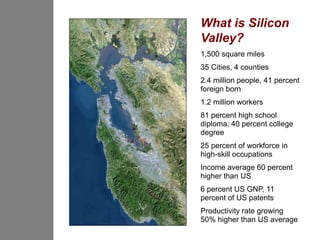
What is Silicon
Valley?
1,500 square miles
35 Cities, 4 counties
2.4 million people, 41 percent
foreign born
1.2 million workers
81 percent high school
diploma; 40 percent college
degree
25 percent of workforce in
high-skill occupations
Income average 60 percent
higher than US
6 percent US GNP, 11
percent of US patents
Productivity rate growing
50% higher than US average
So what is Silicon Valley?


A remarkably
enduring hotbed of
innovation and
entrepreneurship
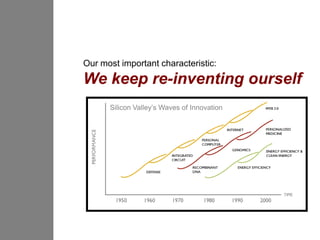
Our most important characteristic:
We keep re-inventing ourself
      Silicon Valley’s Waves of Innovation
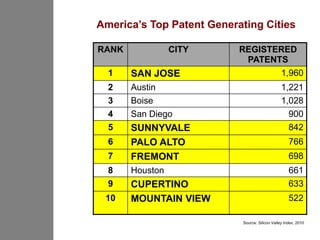
America’s Top Patent Generating Cities

RANK             CITY      REGISTERED
                            PATENTS
  1    SAN JOSE                   1,960
  2    Austin                                    1,221
  3    Boise                                     1,028
  4    San Diego                                   900
  5    SUNNYVALE                                   842
  6    PALO ALTO                                     766
  7    FREMONT                                       698
  8    Houston                                       661
  9    CUPERTINO                                     633
 10    MOUNTAIN VIEW                                 522

                            Source: Silicon Valley Index, 2010
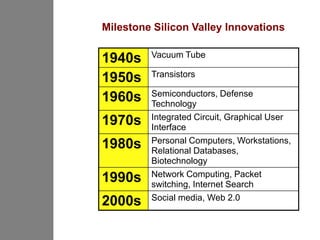
Milestone Silicon Valley Innovations

         Vacuum Tube
1940s
         Transistors
1950s
         Semiconductors, Defense
1960s    Technology
         Integrated Circuit, Graphical User
1970s    Interface
         Personal Computers, Workstations,
1980s    Relational Databases,
         Biotechnology
         Network Computing, Packet
1990s    switching, Internet Search
         Social media, Web 2.0
2000s
However, the
Valley’s edge
doesn’t stem from
innovation alone
…
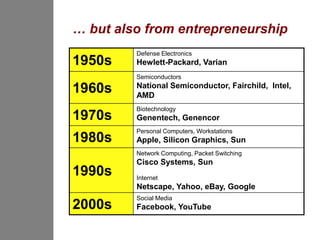
… but also from entrepreneurship
         Defense Electronics
1950s    Hewlett-Packard, Varian
         Semiconductors

1960s    National Semiconductor, Fairchild, Intel,
         AMD
         Biotechnology
1970s    Genentech, Genencor
         Personal Computers, Workstations
1980s    Apple, Silicon Graphics, Sun
         Network Computing, Packet Switching
         Cisco Systems, Sun
1990s    Internet
         Netscape, Yahoo, eBay, Google
         Social Media
2000s    Facebook, YouTube
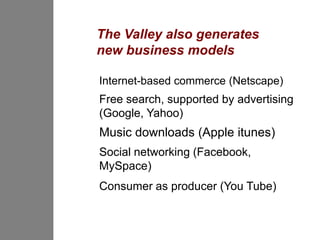
The Valley also generates
new business models

Internet-based commerce (Netscape)
Free search, supported by advertising
(Google, Yahoo)
Music downloads (Apple itunes)
Social networking (Facebook,
MySpace)
Consumer as producer (You Tube)
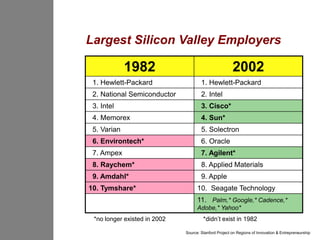
Largest Silicon Valley Employers

             1982                                      2002
 1. Hewlett-Packard                   1. Hewlett-Packard
 2. National Semiconductor            2. Intel
 3. Intel                             3. Cisco*
 4. Memorex                           4. Sun*
 5. Varian                            5. Solectron
 6. Environtech*                      6. Oracle
 7. Ampex                             7. Agilent*
 8. Raychem*                          8. Applied Materials
 9. Amdahl*                           9. Apple
10. Tymshare*                       10. Seagate Technology
                                    11. Palm,* Google,* Cadence,*
                                    Adobe,* Yahoo*
 *no longer existed in 2002            *didn’t exist in 1982

                              Source: Stanford Project on Regions of Innovation & Entrepreneurship
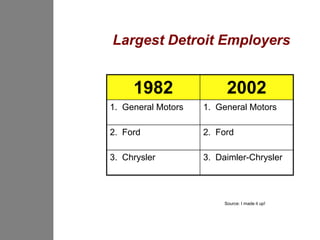
Largest Detroit Employers


     1982                 2002
1. General Motors   1. General Motors

2. Ford             2. Ford

3. Chrysler         3. Daimler-Chrysler


                         Source: I made it up!
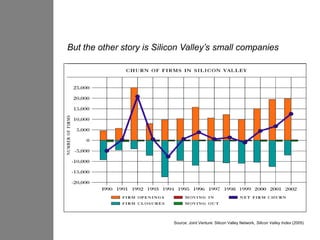
But the other story is Silicon Valley’s small companies


                           Source: Joint Venture: Silicon Valley Network, Silicon Valley Index (2005)
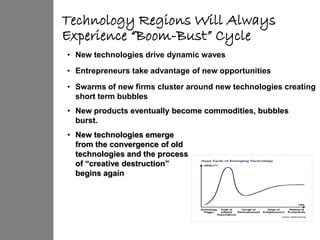
Technology Regions Will Always
Experience “Boom-Bust” Cycle
• New technologies drive dynamic waves

• Entrepreneurs take advantage of new opportunities

• Swarms of new firms cluster around new technologies creating
  short term bubbles
• New products eventually become commodities, bubbles
  burst.
• New technologies emerge
  from the convergence of old
  technologies and the process
  of “creative destruction”
  begins again
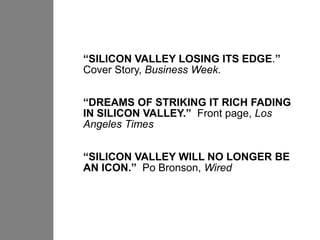
“SILICON VALLEY LOSING ITS EDGE.”
Cover Story, Business Week.


“DREAMS OF STRIKING IT RICH FADING
IN SILICON VALLEY.” Front page, Los
Angeles Times


“SILICON VALLEY WILL NO LONGER BE
AN ICON.” Po Bronson, Wired
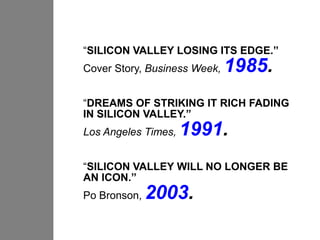
“SILICON VALLEY LOSING ITS EDGE.”
Cover Story, Business Week,   1985.
“DREAMS OF STRIKING IT RICH FADING
IN SILICON VALLEY.”
Los Angeles Times,   1991.
“SILICON VALLEY WILL NO LONGER BE
AN ICON.”
Po Bronson,   2003.
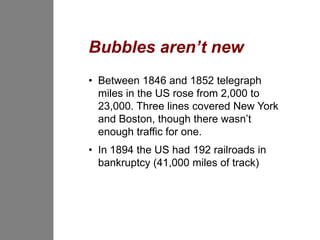
Bubbles aren’t new
• Between 1846 and 1852 telegraph
  miles in the US rose from 2,000 to
  23,000. Three lines covered New York
  and Boston, though there wasn’t
  enough traffic for one.
• In 1894 the US had 192 railroads in
  bankruptcy (41,000 miles of track)
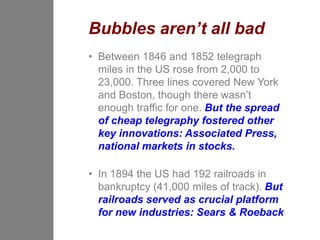
Bubbles aren’t all bad
• Between 1846 and 1852 telegraph
  miles in the US rose from 2,000 to
  23,000. Three lines covered New York
  and Boston, though there wasn’t
  enough traffic for one. But the spread
  of cheap telegraphy fostered other
  key innovations: Associated Press,
  national markets in stocks.

• In 1894 the US had 192 railroads in
  bankruptcy (41,000 miles of track). But
  railroads served as crucial platform
  for new industries: Sears & Roeback
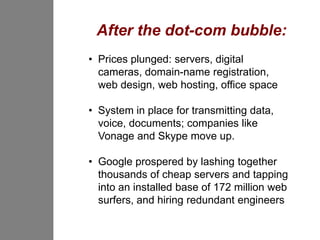
After the dot-com bubble:
• Prices plunged: servers, digital
  cameras, domain-name registration,
  web design, web hosting, office space

• System in place for transmitting data,
  voice, documents; companies like
  Vonage and Skype move up.

• Google prospered by lashing together
  thousands of cheap servers and tapping
  into an installed base of 172 million web
  surfers, and hiring redundant engineers
So what’s the secret?
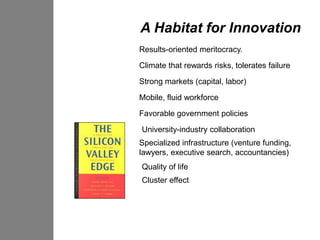
A Habitat for Innovation
Results-oriented meritocracy.

Climate that rewards risks, tolerates failure

Strong markets (capital, labor)
Mobile, fluid workforce

Favorable government policies

University-industry collaboration
Specialized infrastructure (venture funding,
lawyers, executive search, accountancies)
Quality of life
Cluster effect
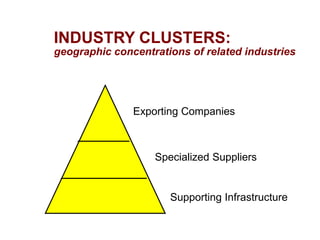
INDUSTRY CLUSTERS:
geographic concentrations of related industries


               Exporting Companies


                   Specialized Suppliers


                      Supporting Infrastructure
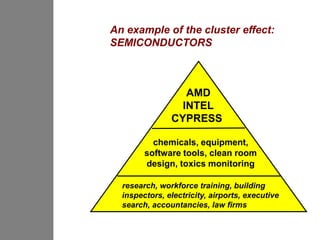
An example of the cluster effect:
SEMICONDUCTORS


                  AMD
                 INTEL
               CYPRESS

          chemicals, equipment,
        software tools, clean room
        design, toxics monitoring

  research, workforce training, building
  inspectors, electricity, airports, executive
  search, accountancies, law firms
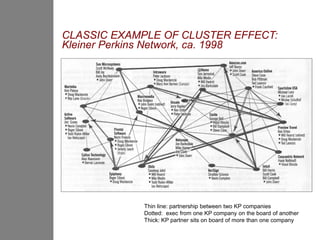
CLASSIC EXAMPLE OF CLUSTER EFFECT:
Kleiner Perkins Network, ca. 1998


            Thin line: partnership between two KP companies
            Dotted: exec from one KP company on the board of another
            Thick: KP partner sits on board of more than one company
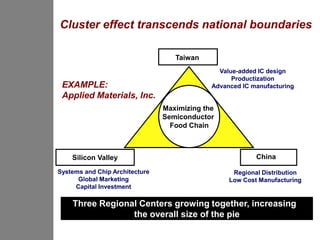
Cluster effect transcends national boundaries

                                   Taiwan
                                               Value-added IC design
                                                   Productization
 EXAMPLE:                                    Advanced IC manufacturing
 Applied Materials, Inc.
                                Maximizing the
                                Semiconductor
                                  Food Chain


    Silicon Valley                                        China

Systems and Chip Architecture                      Regional Distribution
      Global Marketing                            Low Cost Manufacturing
     Capital Investment

    Three Regional Centers growing together, increasing
                 the overall size of the pie
So what’s
happening
right now in
Silicon
Valley?
We are building
new clusters in
renewable
energy
and clean
technology
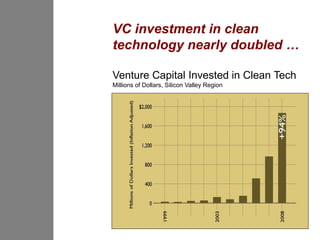
VC investment in clean
technology nearly doubled …

Venture Capital Invested in Clean Tech
Millions of Dollars, Silicon Valley Region
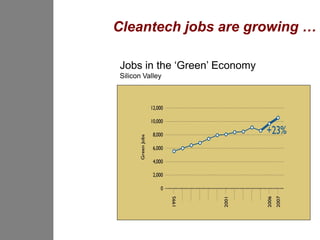
Cleantech jobs are growing …

Jobs in the ‘Green’ Economy
Silicon Valley
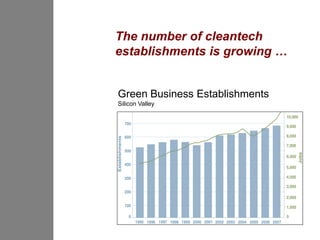
The number of cleantech
establishments is growing …


Green Business Establishments
Silicon Valley
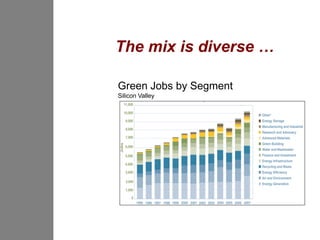
The mix is diverse …

Green Jobs by Segment
Silicon Valley
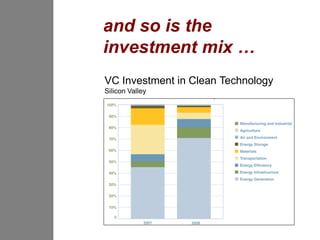
and so is the
investment mix …
VC Investment in Clean Technology
Silicon Valley
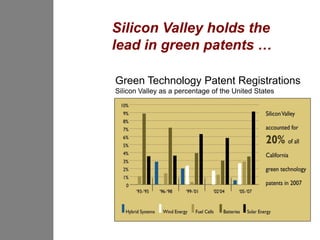
Silicon Valley holds the
lead in green patents …

Green Technology Patent Registrations
Silicon Valley as a percentage of the United States
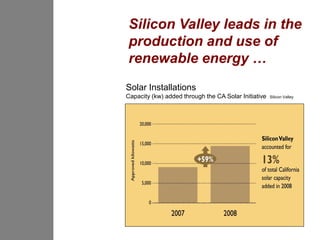
Silicon Valley leads in the
production and use of
renewable energy …
Solar Installations
Capacity (kw) added through the CA Solar Initiative   Silicon Valley
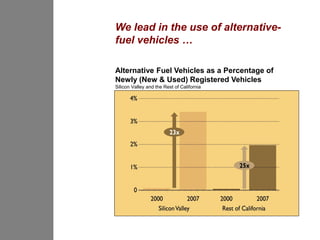
We lead in the use of alternative-
fuel vehicles …

Alternative Fuel Vehicles as a Percentage of
Newly (New & Used) Registered Vehicles
Silicon Valley and the Rest of California
However …
Silicon
Valley has
significant
challenges
to address.
Our Litany of Troubles:
Transportation
Affordable Housing
Infrastructure
Quality of Life
Health care, health insurance
Education
Workforce development
Environment
Dysfunction in Sacramento
Even more importantly, we
have some very serious
non-local issues:
    Cleantech is not like IT

    Federal Funding: we’re losing

    Talent drain

    Dysfunction in government
Yet Silicon
Valley has no
overarching
framework for
regional
decision
making.
Joint Venture:
Silicon Valley
Network was
established to fill
this void.
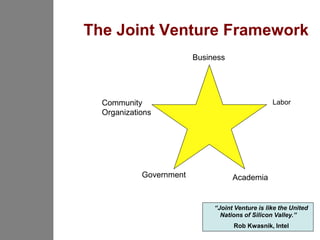
The Joint Venture Framework
                         Business


  Community                                       Labor
  Organizations


            Government              Academia


                              “Joint Venture is like the United
                                Nations of Silicon Valley.”
                                    Rob Kwasnik, Intel
The mission of Joint Venture is to:

1.Convene the region’s leaders, across
every major sector.

1.Provide data and analysis.

1.Launch initiatives that deliver
measurable results.
We are applying
the model to the
emergence of the
clean-tech sector
We issued a
“greenprint”
outlining our
 strategy
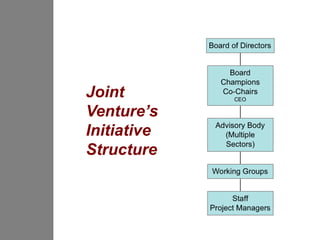
Joint
Venture’s
Initiative
Structure
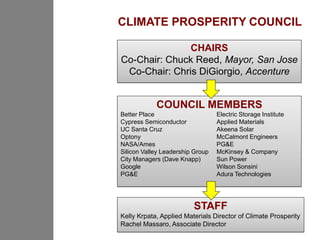
CLIMATE PROSPERITY COUNCIL

               CHAIRS
Co-Chair: Chuck Reed, Mayor, San Jose
 Co-Chair: Chris DiGiorgio, Accenture


            COUNCIL MEMBERS
Better Place                      Electric Storage Institute
Cypress Semiconductor             Applied Materials
UC Santa Cruz                     Akeena Solar
Optony                            McCalmont Engineers
NASA/Ames                         PG&E
Silicon Valley Leadership Group   McKinsey & Company
City Managers (Dave Knapp)        Sun Power
Google                            Wilson Sonsini
PG&E                              Adura Technologies


                         STAFF
Kelly Krpata, Applied Materials Director of Climate Prosperity
Rachel Massaro, Associate Director
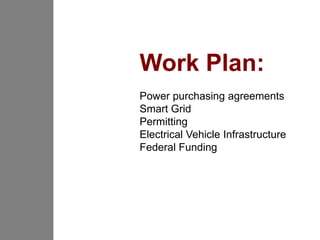
Work Plan:
Power purchasing agreements
Smart Grid
Permitting
Electrical Vehicle Infrastructure
Federal Funding
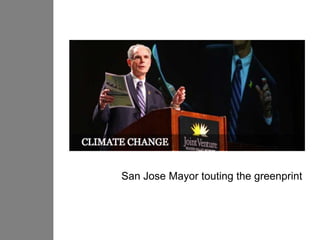
San Jose Mayor touting the greenprint
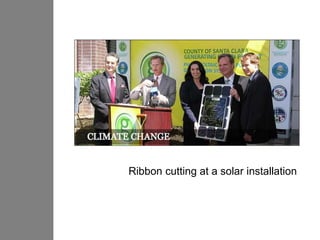
Ribbon cutting at a solar installation
Thank you for the honor
of your invitation.


Russell Hancock
President & Chief Executive Officer
Joint Venture: Silicon Valley Network
100 West San Fernando Street, Suite 310
San Jose, California 95113
(408) 298-9330


www.jointventure.org

Russell Hancock about Silicon Valley 10-10-2011 at AIM event

  • 1.
    Silicon Valley America’s PathbreakingCluster Economy Russell Hancock President & Chief Executive Officer Joint Venture Silicon Valley 10 October 2011
  • 2.
  • 3.
    Some things Silicon Valleyis NOT: •NOT a place you can point to on a map •NOT a place with a defined identity •NOT a planned phenomenon •NOT characterized by silicon or semiconductors
  • 4.
  • 5.
    What is Silicon Valley? 1,500square miles 35 Cities, 4 counties 2.4 million people, 41 percent foreign born 1.2 million workers 81 percent high school diploma; 40 percent college degree 25 percent of workforce in high-skill occupations Income average 60 percent higher than US 6 percent US GNP, 11 percent of US patents Productivity rate growing 50% higher than US average
  • 6.
    So what isSilicon Valley? A remarkably enduring hotbed of innovation and entrepreneurship
  • 7.
    Our most importantcharacteristic: We keep re-inventing ourself Silicon Valley’s Waves of Innovation
  • 8.
    America’s Top PatentGenerating Cities RANK CITY REGISTERED PATENTS 1 SAN JOSE 1,960 2 Austin 1,221 3 Boise 1,028 4 San Diego 900 5 SUNNYVALE 842 6 PALO ALTO 766 7 FREMONT 698 8 Houston 661 9 CUPERTINO 633 10 MOUNTAIN VIEW 522 Source: Silicon Valley Index, 2010
  • 9.
    Milestone Silicon ValleyInnovations Vacuum Tube 1940s Transistors 1950s Semiconductors, Defense 1960s Technology Integrated Circuit, Graphical User 1970s Interface Personal Computers, Workstations, 1980s Relational Databases, Biotechnology Network Computing, Packet 1990s switching, Internet Search Social media, Web 2.0 2000s
  • 10.
    However, the Valley’s edge doesn’tstem from innovation alone …
  • 11.
    … but alsofrom entrepreneurship Defense Electronics 1950s Hewlett-Packard, Varian Semiconductors 1960s National Semiconductor, Fairchild, Intel, AMD Biotechnology 1970s Genentech, Genencor Personal Computers, Workstations 1980s Apple, Silicon Graphics, Sun Network Computing, Packet Switching Cisco Systems, Sun 1990s Internet Netscape, Yahoo, eBay, Google Social Media 2000s Facebook, YouTube
  • 12.
    The Valley alsogenerates new business models Internet-based commerce (Netscape) Free search, supported by advertising (Google, Yahoo) Music downloads (Apple itunes) Social networking (Facebook, MySpace) Consumer as producer (You Tube)
  • 13.
    Largest Silicon ValleyEmployers 1982 2002 1. Hewlett-Packard 1. Hewlett-Packard 2. National Semiconductor 2. Intel 3. Intel 3. Cisco* 4. Memorex 4. Sun* 5. Varian 5. Solectron 6. Environtech* 6. Oracle 7. Ampex 7. Agilent* 8. Raychem* 8. Applied Materials 9. Amdahl* 9. Apple 10. Tymshare* 10. Seagate Technology 11. Palm,* Google,* Cadence,* Adobe,* Yahoo* *no longer existed in 2002 *didn’t exist in 1982 Source: Stanford Project on Regions of Innovation & Entrepreneurship
  • 14.
    Largest Detroit Employers 1982 2002 1. General Motors 1. General Motors 2. Ford 2. Ford 3. Chrysler 3. Daimler-Chrysler Source: I made it up!
  • 15.
    But the otherstory is Silicon Valley’s small companies Source: Joint Venture: Silicon Valley Network, Silicon Valley Index (2005)
  • 16.
    Technology Regions WillAlways Experience “Boom-Bust” Cycle • New technologies drive dynamic waves • Entrepreneurs take advantage of new opportunities • Swarms of new firms cluster around new technologies creating short term bubbles • New products eventually become commodities, bubbles burst. • New technologies emerge from the convergence of old technologies and the process of “creative destruction” begins again
  • 17.
    “SILICON VALLEY LOSINGITS EDGE.” Cover Story, Business Week. “DREAMS OF STRIKING IT RICH FADING IN SILICON VALLEY.” Front page, Los Angeles Times “SILICON VALLEY WILL NO LONGER BE AN ICON.” Po Bronson, Wired
  • 18.
    “SILICON VALLEY LOSINGITS EDGE.” Cover Story, Business Week, 1985. “DREAMS OF STRIKING IT RICH FADING IN SILICON VALLEY.” Los Angeles Times, 1991. “SILICON VALLEY WILL NO LONGER BE AN ICON.” Po Bronson, 2003.
  • 19.
    Bubbles aren’t new •Between 1846 and 1852 telegraph miles in the US rose from 2,000 to 23,000. Three lines covered New York and Boston, though there wasn’t enough traffic for one. • In 1894 the US had 192 railroads in bankruptcy (41,000 miles of track)
  • 20.
    Bubbles aren’t allbad • Between 1846 and 1852 telegraph miles in the US rose from 2,000 to 23,000. Three lines covered New York and Boston, though there wasn’t enough traffic for one. But the spread of cheap telegraphy fostered other key innovations: Associated Press, national markets in stocks. • In 1894 the US had 192 railroads in bankruptcy (41,000 miles of track). But railroads served as crucial platform for new industries: Sears & Roeback
  • 21.
    After the dot-combubble: • Prices plunged: servers, digital cameras, domain-name registration, web design, web hosting, office space • System in place for transmitting data, voice, documents; companies like Vonage and Skype move up. • Google prospered by lashing together thousands of cheap servers and tapping into an installed base of 172 million web surfers, and hiring redundant engineers
  • 22.
  • 23.
    A Habitat forInnovation Results-oriented meritocracy. Climate that rewards risks, tolerates failure Strong markets (capital, labor) Mobile, fluid workforce Favorable government policies University-industry collaboration Specialized infrastructure (venture funding, lawyers, executive search, accountancies) Quality of life Cluster effect
  • 24.
    INDUSTRY CLUSTERS: geographic concentrationsof related industries Exporting Companies Specialized Suppliers Supporting Infrastructure
  • 25.
    An example ofthe cluster effect: SEMICONDUCTORS AMD INTEL CYPRESS chemicals, equipment, software tools, clean room design, toxics monitoring research, workforce training, building inspectors, electricity, airports, executive search, accountancies, law firms
  • 26.
    CLASSIC EXAMPLE OFCLUSTER EFFECT: Kleiner Perkins Network, ca. 1998 Thin line: partnership between two KP companies Dotted: exec from one KP company on the board of another Thick: KP partner sits on board of more than one company
  • 27.
    Cluster effect transcendsnational boundaries Taiwan Value-added IC design Productization EXAMPLE: Advanced IC manufacturing Applied Materials, Inc. Maximizing the Semiconductor Food Chain Silicon Valley China Systems and Chip Architecture Regional Distribution Global Marketing Low Cost Manufacturing Capital Investment Three Regional Centers growing together, increasing the overall size of the pie
  • 28.
  • 29.
    We are building newclusters in renewable energy and clean technology
  • 30.
    VC investment inclean technology nearly doubled … Venture Capital Invested in Clean Tech Millions of Dollars, Silicon Valley Region
  • 31.
    Cleantech jobs aregrowing … Jobs in the ‘Green’ Economy Silicon Valley
  • 32.
    The number ofcleantech establishments is growing … Green Business Establishments Silicon Valley
  • 33.
    The mix isdiverse … Green Jobs by Segment Silicon Valley
  • 34.
    and so isthe investment mix … VC Investment in Clean Technology Silicon Valley
  • 35.
    Silicon Valley holdsthe lead in green patents … Green Technology Patent Registrations Silicon Valley as a percentage of the United States
  • 36.
    Silicon Valley leadsin the production and use of renewable energy … Solar Installations Capacity (kw) added through the CA Solar Initiative Silicon Valley
  • 37.
    We lead inthe use of alternative- fuel vehicles … Alternative Fuel Vehicles as a Percentage of Newly (New & Used) Registered Vehicles Silicon Valley and the Rest of California
  • 38.
  • 39.
  • 40.
    Our Litany ofTroubles: Transportation Affordable Housing Infrastructure Quality of Life Health care, health insurance Education Workforce development Environment Dysfunction in Sacramento
  • 41.
    Even more importantly,we have some very serious non-local issues: Cleantech is not like IT Federal Funding: we’re losing Talent drain Dysfunction in government
  • 42.
    Yet Silicon Valley hasno overarching framework for regional decision making.
  • 43.
    Joint Venture: Silicon Valley Networkwas established to fill this void.
  • 44.
    The Joint VentureFramework Business Community Labor Organizations Government Academia “Joint Venture is like the United Nations of Silicon Valley.” Rob Kwasnik, Intel
  • 45.
    The mission ofJoint Venture is to: 1.Convene the region’s leaders, across every major sector. 1.Provide data and analysis. 1.Launch initiatives that deliver measurable results.
  • 46.
    We are applying themodel to the emergence of the clean-tech sector
  • 47.
  • 48.
  • 49.
    CLIMATE PROSPERITY COUNCIL CHAIRS Co-Chair: Chuck Reed, Mayor, San Jose Co-Chair: Chris DiGiorgio, Accenture COUNCIL MEMBERS Better Place Electric Storage Institute Cypress Semiconductor Applied Materials UC Santa Cruz Akeena Solar Optony McCalmont Engineers NASA/Ames PG&E Silicon Valley Leadership Group McKinsey & Company City Managers (Dave Knapp) Sun Power Google Wilson Sonsini PG&E Adura Technologies STAFF Kelly Krpata, Applied Materials Director of Climate Prosperity Rachel Massaro, Associate Director
  • 50.
    Work Plan: Power purchasingagreements Smart Grid Permitting Electrical Vehicle Infrastructure Federal Funding
  • 51.
    San Jose Mayortouting the greenprint
  • 52.
    Ribbon cutting ata solar installation
  • 53.
    Thank you forthe honor of your invitation. Russell Hancock President & Chief Executive Officer Joint Venture: Silicon Valley Network 100 West San Fernando Street, Suite 310 San Jose, California 95113 (408) 298-9330 www.jointventure.org