© Fraunhofer ·· Seite 1
Prof. Dr. Boris Otto
Dortmund, March 4, 2015
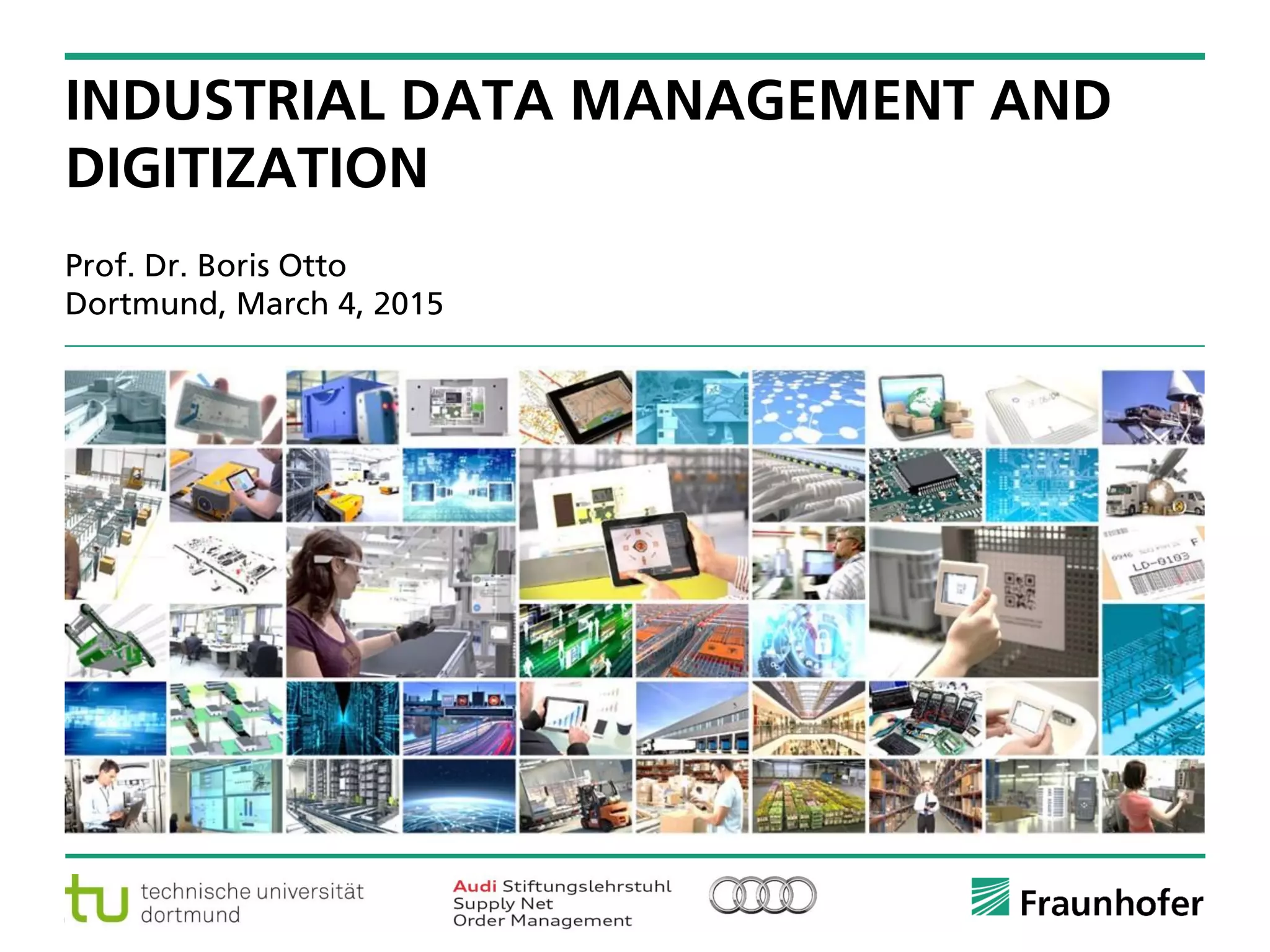
INDUSTRIAL DATA MANAGEMENT AND
DIGITIZATION
© Fraunhofer ·· Seite 2
CONTENT
 »Industrie 4.0«
 Industrial Data Space
 Fraunhofer Data Innovation Lab
© Fraunhofer ·· Seite 3
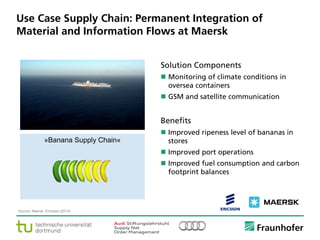
Use Case Supply Chain: Permanent Integration of
Material and Information Flows at Maersk
Source: Maersk, Ericsson (2014).
Solution Components
 Monitoring of climate conditions in
oversea containers
 GSM and satellite communication
Benefits
 Improved ripeness level of bananas in
stores
 Improved port operations
 Improved fuel consumption and carbon
footprint balances
»Banana Supply Chain«
© Fraunhofer ·· Seite 4
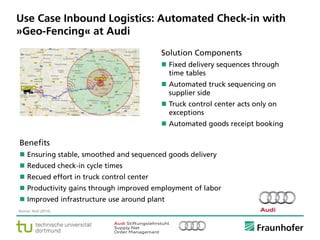
Use Case Inbound Logistics: Automated Check-in with
»Geo-Fencing« at Audi
Solution Components
 Fixed delivery sequences through
time tables
 Automated truck sequencing on
supplier side
 Truck control center acts only on
exceptions
 Automated goods receipt booking
Source: Audi (2014).
Benefits
 Ensuring stable, smoothed and sequenced goods delivery
 Reduced check-in cycle times
 Recued effort in truck control center
 Productivity gains through improved employment of labor
 Improved infrastructure use around plant
© Fraunhofer ·· Seite 5
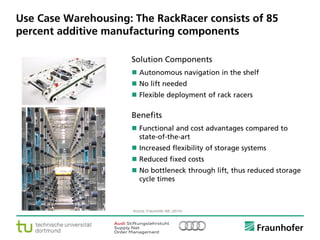
Use Case Warehousing: The RackRacer consists of 85
percent additive manufacturing components
Solution Components
 Autonomous navigation in the shelf
 No lift needed
 Flexible deployment of rack racers
Benefits
 Functional and cost advantages compared to
state-of-the-art
 Increased flexibility of storage systems
 Reduced fixed costs
 No bottleneck through lift, thus reduced storage
cycle times
Source: Fraunhofer IML (2014).
© Fraunhofer ·· Seite 6
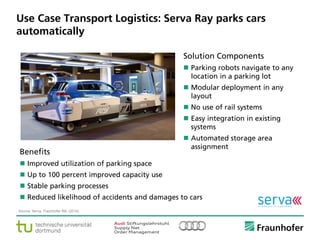
Use Case Transport Logistics: Serva Ray parks cars
automatically
Benefits
 Improved utilization of parking space
 Up to 100 percent improved capacity use
 Stable parking processes
 Reduced likelihood of accidents and damages to cars
Solution Components
 Parking robots navigate to any
location in a parking lot
 Modular deployment in any
layout
 No use of rail systems
 Easy integration in existing
systems
 Automated storage area
assignment
Source: Serva, Fraunhofer IML (2014).
© Fraunhofer ·· Seite 7
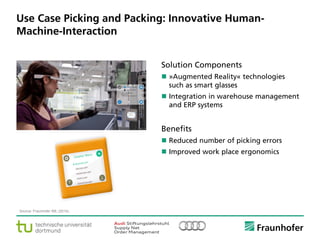
Use Case Picking and Packing: Innovative Human-
Machine-Interaction
Source: Fraunhofer IML (2014).
Solution Components
 »Augmented Reality« technologies
such as smart glasses
 Integration in warehouse management
and ERP systems
Benefits
 Reduced number of picking errors
 Improved work place ergonomics
© Fraunhofer ·· Seite 8
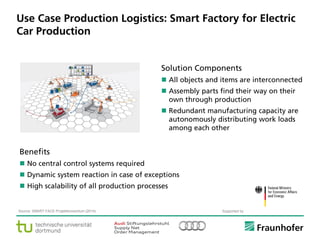
Use Case Production Logistics: Smart Factory for Electric
Car Production
Solution Components
 All objects and items are interconnected
 Assembly parts find their way on their
own through production
 Redundant manufacturing capacity are
autonomously distributing work loads
among each other
Benefits
 No central control systems required
 Dynamic system reaction in case of exceptions
 High scalability of all production processes
Source: SMART FACE-Projektkonsortium (2014). Supported by
© Fraunhofer ·· Seite 9
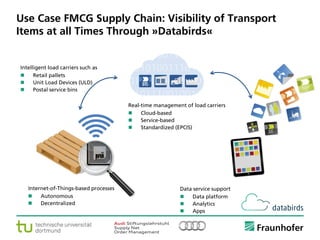
Use Case FMCG Supply Chain: Visibility of Transport
Items at all Times Through »Databirds«
Real-time management of load carriers
 Cloud-based
 Service-based
 Standardized (EPCIS)
Intelligent load carriers such as
 Retail pallets
 Unit Load Devices (ULD)
 Postal service bins
Internet-of-Things-based processes
 Autonomous
 Decentralized
Data service support
 Data platform
 Analytics
 Apps
© Fraunhofer ·· Seite 10
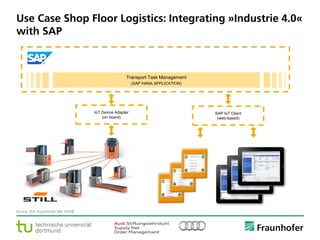
Use Case Shop Floor Logistics: Integrating »Industrie 4.0«
with SAP
Transport Task Management
(SAP HANA APPLICATION)
IoT Device Adapter
(on board)
SAP IoT Client
(web-based)
Source: Still; Fraunhofer IML (2014).
© Fraunhofer ·· Seite 11
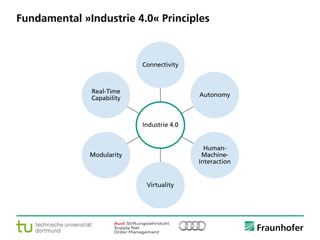
Fundamental »Industrie 4.0« Principles
Industrie 4.0
Connectivity
Autonomy
Human-
Machine-
Interaction
Virtuality
Modularity
Real-Time
Capability
© Fraunhofer ·· Seite 12
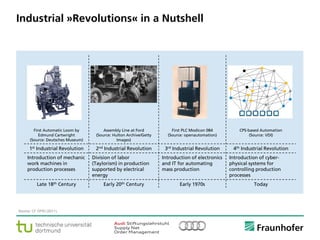
Industrial »Revolutions« in a Nutshell
Source: Cf. DFKI (2011).
First Automatic Loom by
Edmund Cartwright
(Source: Deutsches Museum)
Assembly Line at Ford
(Source: Hulton Archive/Getty
Images)
First PLC Modicon 084
(Source: openautomation)
CPS-based Automation
(Source: VDI)
1st Industrial Revolution 2nd Industrial Revolution 3rd Industrial Revolution 4th Industrial Revolution
Introduction of mechanic
work machines in
production processes
Division of labor
(Taylorism) in production
supported by electrical
energy
Introduction of electronics
and IT for automating
mass production
Introduction of cyber-
physical systems for
controlling production
processes
Late 18th Century Early 20th Century Early 1970s Today
© Fraunhofer ·· Seite 13
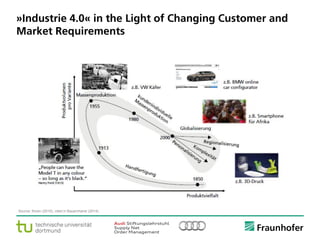
»Industrie 4.0« in the Light of Changing Customer and
Market Requirements
Source: Koren (2010), cited in Bauernhansl (2014).
© Fraunhofer ·· Seite 14
CONTENT
 »Industrie 4.0«
 Industrial Data Space
 Fraunhofer Data Innovation Lab
© Fraunhofer ·· Seite 15
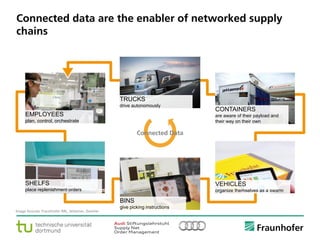
EMPLOYEES
plan, control, orchestrate
Connected data are the enabler of networked supply
chains
Image Sources: Fraunhofer IML, Jettainer, Daimler
BINS
give picking instructions
CONTAINERS
are aware of their payload and
their way on their own
TRUCKS
drive autonomously
VEHICLES
organize themselves as a swarm
SHELFS
place replenishment orders
Connected Data
© Fraunhofer ·· Seite 16
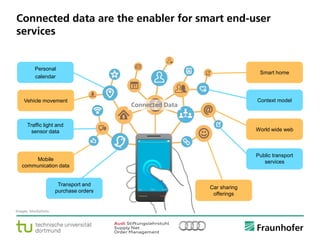
Connected data are the enabler for smart end-user
services
Smart home
Context model
World wide web
Personal
calendar
Public transport
services
Traffic light and
sensor data
Transport and
purchase orders
Connected Data
Car sharing
offerings
Mobile
communication data
Vehicle movement
Images: Istockphoto
© Fraunhofer ·· Seite 17
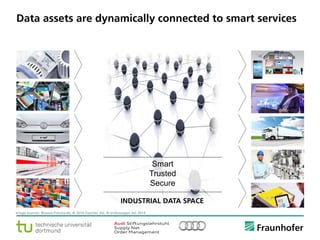
Image sources: ©www.Fotolia.de, © 2014 Daimler AG, © Volkswagen AG 2014
Smart
Trusted
Secure
INDUSTRIAL DATA SPACE
Data assets are dynamically connected to smart services
© Fraunhofer ·· Seite 18
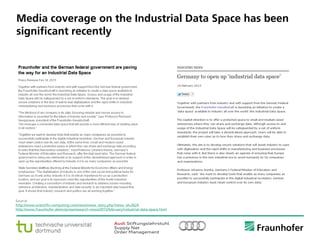
Source:
http://www.scientific-computing.com/news/news_story.php?news_id=2624
http://www.fraunhofer.de/en/press/research-news/2015/february/industrial-data-space.html
Media coverage on the Industrial Data Space has been
significant recently
© Fraunhofer ·· Seite 19
CONTENT
 »Industrie 4.0«
 Industrial Data Space
 Fraunhofer Data Innovation Lab
© Fraunhofer ·· Seite 20
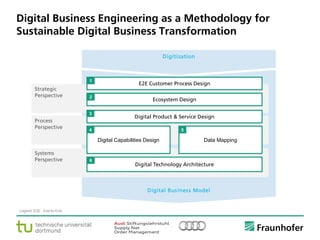
Digital Business Engineering as a Methodology for
Sustainable Digital Business Transformation
Digitization
Digital Business Model
Strategic
Perspective
Process
Perspective
Systems
Perspective
E2E Customer Process Design
Ecosystem Design
Digital Product & Service Design
Digital Capabilities Design Data Mapping
Digital Technology Architecture
1
2
3
4 5
6
Legend: E2E - End-to-End.
© Fraunhofer ·· Seite 21
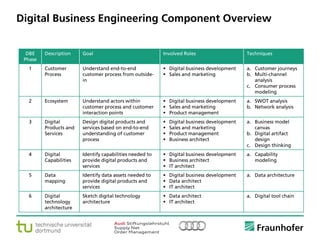
Digital Business Engineering Component Overview
DBE
Phase
Description Goal Involved Roles Techniques
1 Customer
Process
Understand end-to-end
customer process from outside-
in
 Digital business development
 Sales and marketing
a. Customer journeys
b. Multi-channel
analysis
c. Consumer process
modeling
2 Ecosystem Understand actors within
customer process and customer
interaction points
 Digital business development
 Sales and marketing
 Product management
a. SWOT analysis
b. Network analysis
3 Digital
Products and
Services
Design digital products and
services based on end-to-end
understanding of customer
process
 Digital business development
 Sales and marketing
 Product management
 Business architect
a. Business model
canvas
b. Digital artifact
design
c. Design thinking
4 Digital
Capabilities
Identify capabilities needed to
provide digital products and
services
 Digital business development
 Business architect
 IT architect
a. Capability
modeling
5 Data
mapping
Identify data assets needed to
provide digital products and
services
 Digital business development
 Data architect
 IT architect
a. Data architecture
6 Digital
technology
architecture
Sketch digital technology
architecture
 Data architect
 IT architect
a. Digital tool chain
© Fraunhofer ·· Seite 22
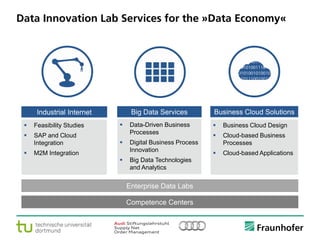
Data Innovation Lab Services for the »Data Economy«
Business Cloud SolutionsBig Data ServicesIndustrial Internet
 Business Cloud Design
 Cloud-based Business
Processes
 Cloud-based Applications
 Data-Driven Business
Processes
 Digital Business Process
Innovation
 Big Data Technologies
and Analytics
 Feasibility Studies
 SAP and Cloud
Integration
 M2M Integration
Enterprise Data Labs
Competence Centers
© Fraunhofer ·· Seite 23
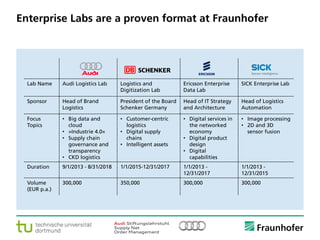
Enterprise Labs are a proven format at Fraunhofer
Lab Name Audi Logistics Lab Logistics and
Digitization Lab
Ericsson Enterprise
Data Lab
SICK Enterprise Lab
Sponsor Head of Brand
Logistics
President of the Board
Schenker Germany
Head of IT Strategy
and Architecture
Head of Logistics
Automation
Focus
Topics
• Big data and
cloud
• »Industrie 4.0«
• Supply chain
governance and
transparency
• CKD logistics
• Customer-centric
logistics
• Digital supply
chains
• Intelligent assets
• Digital services in
the networked
economy
• Digital product
design
• Digital
capabilities
• Image processing
• 2D and 3D
sensor fusion
Duration 9/1/2013 - 8/31/2018 1/1/2015-12/31/2017 1/1/2013 -
12/31/2017
1/1/2013 -
12/31/2015
© Fraunhofer ·· Seite 24
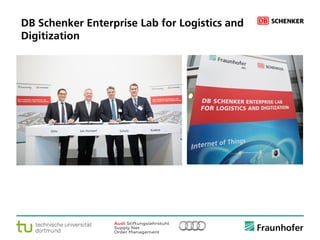
DB Schenker Enterprise Lab for Logistics and
Digitization
© Fraunhofer ·· Seite 25
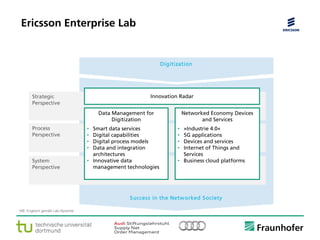
Ericsson Enterprise Lab
Digitization
Success in the Networked Society
Strategic
Perspective
Process
Perspective
System
Perspective
Data Management for
Digitization
• Smart data services
• Digital capabilities
• Digital process models
• Data and integration
architectures
• Innovative data
management technologies
Networked Economy Devices
and Services
• »Industrie 4.0«
• 5G applications
• Devices and services
• Internet of Things and
Services
• Business cloud platforms
Innovation Radar
NB: Englisch gemäß Lab-Sprache.
© Fraunhofer ·· Seite 26
Prof. Dr. Boris Otto
Dortmund, March 4, 2015
INDUSTRIAL DATA MANAGEMENT AND
DIGITIZATION

Industrial Data Management and Digitization

  • 1.
    © Fraunhofer ··Seite 1 Prof. Dr. Boris Otto Dortmund, March 4, 2015 INDUSTRIAL DATA MANAGEMENT AND DIGITIZATION
  • 2.
    © Fraunhofer ··Seite 2 CONTENT  »Industrie 4.0«  Industrial Data Space  Fraunhofer Data Innovation Lab
  • 3.
    © Fraunhofer ··Seite 3 Use Case Supply Chain: Permanent Integration of Material and Information Flows at Maersk Source: Maersk, Ericsson (2014). Solution Components  Monitoring of climate conditions in oversea containers  GSM and satellite communication Benefits  Improved ripeness level of bananas in stores  Improved port operations  Improved fuel consumption and carbon footprint balances »Banana Supply Chain«
  • 4.
    © Fraunhofer ··Seite 4 Use Case Inbound Logistics: Automated Check-in with »Geo-Fencing« at Audi Solution Components  Fixed delivery sequences through time tables  Automated truck sequencing on supplier side  Truck control center acts only on exceptions  Automated goods receipt booking Source: Audi (2014). Benefits  Ensuring stable, smoothed and sequenced goods delivery  Reduced check-in cycle times  Recued effort in truck control center  Productivity gains through improved employment of labor  Improved infrastructure use around plant
  • 5.
    © Fraunhofer ··Seite 5 Use Case Warehousing: The RackRacer consists of 85 percent additive manufacturing components Solution Components  Autonomous navigation in the shelf  No lift needed  Flexible deployment of rack racers Benefits  Functional and cost advantages compared to state-of-the-art  Increased flexibility of storage systems  Reduced fixed costs  No bottleneck through lift, thus reduced storage cycle times Source: Fraunhofer IML (2014).
  • 6.
    © Fraunhofer ··Seite 6 Use Case Transport Logistics: Serva Ray parks cars automatically Benefits  Improved utilization of parking space  Up to 100 percent improved capacity use  Stable parking processes  Reduced likelihood of accidents and damages to cars Solution Components  Parking robots navigate to any location in a parking lot  Modular deployment in any layout  No use of rail systems  Easy integration in existing systems  Automated storage area assignment Source: Serva, Fraunhofer IML (2014).
  • 7.
    © Fraunhofer ··Seite 7 Use Case Picking and Packing: Innovative Human- Machine-Interaction Source: Fraunhofer IML (2014). Solution Components  »Augmented Reality« technologies such as smart glasses  Integration in warehouse management and ERP systems Benefits  Reduced number of picking errors  Improved work place ergonomics
  • 8.
    © Fraunhofer ··Seite 8 Use Case Production Logistics: Smart Factory for Electric Car Production Solution Components  All objects and items are interconnected  Assembly parts find their way on their own through production  Redundant manufacturing capacity are autonomously distributing work loads among each other Benefits  No central control systems required  Dynamic system reaction in case of exceptions  High scalability of all production processes Source: SMART FACE-Projektkonsortium (2014). Supported by
  • 9.
    © Fraunhofer ··Seite 9 Use Case FMCG Supply Chain: Visibility of Transport Items at all Times Through »Databirds« Real-time management of load carriers  Cloud-based  Service-based  Standardized (EPCIS) Intelligent load carriers such as  Retail pallets  Unit Load Devices (ULD)  Postal service bins Internet-of-Things-based processes  Autonomous  Decentralized Data service support  Data platform  Analytics  Apps
  • 10.
    © Fraunhofer ··Seite 10 Use Case Shop Floor Logistics: Integrating »Industrie 4.0« with SAP Transport Task Management (SAP HANA APPLICATION) IoT Device Adapter (on board) SAP IoT Client (web-based) Source: Still; Fraunhofer IML (2014).
  • 11.
    © Fraunhofer ··Seite 11 Fundamental »Industrie 4.0« Principles Industrie 4.0 Connectivity Autonomy Human- Machine- Interaction Virtuality Modularity Real-Time Capability
  • 12.
    © Fraunhofer ··Seite 12 Industrial »Revolutions« in a Nutshell Source: Cf. DFKI (2011). First Automatic Loom by Edmund Cartwright (Source: Deutsches Museum) Assembly Line at Ford (Source: Hulton Archive/Getty Images) First PLC Modicon 084 (Source: openautomation) CPS-based Automation (Source: VDI) 1st Industrial Revolution 2nd Industrial Revolution 3rd Industrial Revolution 4th Industrial Revolution Introduction of mechanic work machines in production processes Division of labor (Taylorism) in production supported by electrical energy Introduction of electronics and IT for automating mass production Introduction of cyber- physical systems for controlling production processes Late 18th Century Early 20th Century Early 1970s Today
  • 13.
    © Fraunhofer ··Seite 13 »Industrie 4.0« in the Light of Changing Customer and Market Requirements Source: Koren (2010), cited in Bauernhansl (2014).
  • 14.
    © Fraunhofer ··Seite 14 CONTENT  »Industrie 4.0«  Industrial Data Space  Fraunhofer Data Innovation Lab
  • 15.
    © Fraunhofer ··Seite 15 EMPLOYEES plan, control, orchestrate Connected data are the enabler of networked supply chains Image Sources: Fraunhofer IML, Jettainer, Daimler BINS give picking instructions CONTAINERS are aware of their payload and their way on their own TRUCKS drive autonomously VEHICLES organize themselves as a swarm SHELFS place replenishment orders Connected Data
  • 16.
    © Fraunhofer ··Seite 16 Connected data are the enabler for smart end-user services Smart home Context model World wide web Personal calendar Public transport services Traffic light and sensor data Transport and purchase orders Connected Data Car sharing offerings Mobile communication data Vehicle movement Images: Istockphoto
  • 17.
    © Fraunhofer ··Seite 17 Image sources: ©www.Fotolia.de, © 2014 Daimler AG, © Volkswagen AG 2014 Smart Trusted Secure INDUSTRIAL DATA SPACE Data assets are dynamically connected to smart services
  • 18.
    © Fraunhofer ··Seite 18 Source: http://www.scientific-computing.com/news/news_story.php?news_id=2624 http://www.fraunhofer.de/en/press/research-news/2015/february/industrial-data-space.html Media coverage on the Industrial Data Space has been significant recently
  • 19.
    © Fraunhofer ··Seite 19 CONTENT  »Industrie 4.0«  Industrial Data Space  Fraunhofer Data Innovation Lab
  • 20.
    © Fraunhofer ··Seite 20 Digital Business Engineering as a Methodology for Sustainable Digital Business Transformation Digitization Digital Business Model Strategic Perspective Process Perspective Systems Perspective E2E Customer Process Design Ecosystem Design Digital Product & Service Design Digital Capabilities Design Data Mapping Digital Technology Architecture 1 2 3 4 5 6 Legend: E2E - End-to-End.
  • 21.
    © Fraunhofer ··Seite 21 Digital Business Engineering Component Overview DBE Phase Description Goal Involved Roles Techniques 1 Customer Process Understand end-to-end customer process from outside- in  Digital business development  Sales and marketing a. Customer journeys b. Multi-channel analysis c. Consumer process modeling 2 Ecosystem Understand actors within customer process and customer interaction points  Digital business development  Sales and marketing  Product management a. SWOT analysis b. Network analysis 3 Digital Products and Services Design digital products and services based on end-to-end understanding of customer process  Digital business development  Sales and marketing  Product management  Business architect a. Business model canvas b. Digital artifact design c. Design thinking 4 Digital Capabilities Identify capabilities needed to provide digital products and services  Digital business development  Business architect  IT architect a. Capability modeling 5 Data mapping Identify data assets needed to provide digital products and services  Digital business development  Data architect  IT architect a. Data architecture 6 Digital technology architecture Sketch digital technology architecture  Data architect  IT architect a. Digital tool chain
  • 22.
    © Fraunhofer ··Seite 22 Data Innovation Lab Services for the »Data Economy« Business Cloud SolutionsBig Data ServicesIndustrial Internet  Business Cloud Design  Cloud-based Business Processes  Cloud-based Applications  Data-Driven Business Processes  Digital Business Process Innovation  Big Data Technologies and Analytics  Feasibility Studies  SAP and Cloud Integration  M2M Integration Enterprise Data Labs Competence Centers
  • 23.
    © Fraunhofer ··Seite 23 Enterprise Labs are a proven format at Fraunhofer Lab Name Audi Logistics Lab Logistics and Digitization Lab Ericsson Enterprise Data Lab SICK Enterprise Lab Sponsor Head of Brand Logistics President of the Board Schenker Germany Head of IT Strategy and Architecture Head of Logistics Automation Focus Topics • Big data and cloud • »Industrie 4.0« • Supply chain governance and transparency • CKD logistics • Customer-centric logistics • Digital supply chains • Intelligent assets • Digital services in the networked economy • Digital product design • Digital capabilities • Image processing • 2D and 3D sensor fusion Duration 9/1/2013 - 8/31/2018 1/1/2015-12/31/2017 1/1/2013 - 12/31/2017 1/1/2013 - 12/31/2015
  • 24.
    © Fraunhofer ··Seite 24 DB Schenker Enterprise Lab for Logistics and Digitization
  • 25.
    © Fraunhofer ··Seite 25 Ericsson Enterprise Lab Digitization Success in the Networked Society Strategic Perspective Process Perspective System Perspective Data Management for Digitization • Smart data services • Digital capabilities • Digital process models • Data and integration architectures • Innovative data management technologies Networked Economy Devices and Services • »Industrie 4.0« • 5G applications • Devices and services • Internet of Things and Services • Business cloud platforms Innovation Radar NB: Englisch gemäß Lab-Sprache.
  • 26.
    © Fraunhofer ··Seite 26 Prof. Dr. Boris Otto Dortmund, March 4, 2015 INDUSTRIAL DATA MANAGEMENT AND DIGITIZATION