© Fraunhofer
Prof. Dr. Boris Otto
Fraunhofer IML/ISST
TU Dortmund University
Birmingham · April 14th, 2016
THE INDUSTRIAL DATA SPACE
© Fraunhofer 2
AGENDA
 Towards a »Smart Service Welt«
 »Industrie 4.0« and Smart Manufacturing
 The Industrial Data Space
© Fraunhofer 3
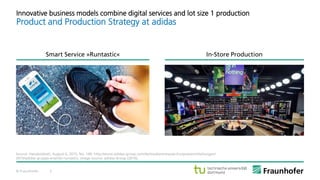
Innovative business models combine digital services and lot size 1 production
Product and Production Strategy at adidas
In-Store ProductionSmart Service »Runtastic«
Source: Handelsblatt, August 6, 2015, No. 149; http://www.adidas-group.com/de/medien/newsarchiv/pressemitteilungen/
2015/adidas-gruppe-erwirbt-runtastic; image source: adidas Group (2016).
© Fraunhofer 4
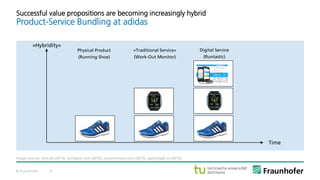
Successful value propositions are becoming increasingly hybrid
Product-Service Bundling at adidas
Image sources: otto.de (2015), techglam.com (2015), soccerreviews.com (2015), appfullapk.co (2015).
Time
»Hybridity«
Physical Product
(Running Shoe)
»Traditional Service«
(Work-Out Monitor)
Digital Service
(Runtastic)
© Fraunhofer 5
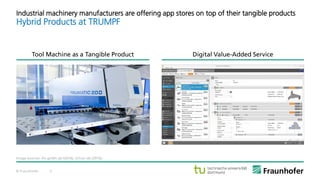
Industrial machinery manufacturers are offering app stores on top of their tangible products
Hybrid Products at TRUMPF
Image sources: ihs-gmbh.de (2016); silicon.de (2016).
Digital Value-Added ServiceTool Machine as a Tangible Product
© Fraunhofer 6
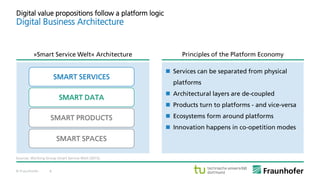
Digital value propositions follow a platform logic
Digital Business Architecture
Sources: Working Group Smart Service Welt (2015).
Principles of the Platform Economy»Smart Service Welt« Architecture
 Services can be separated from physical
platforms
 Architectural layers are de-coupled
 Products turn to platforms - and vice-versa
 Ecosystems form around platforms
 Innovation happens in co-opetition modes
SMART PRODUCTS
SMART SPACES
SMART DATA
SMART SERVICES
© Fraunhofer 7
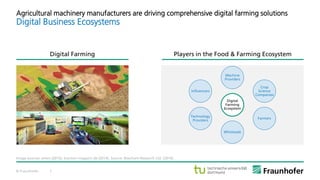
Agricultural machinery manufacturers are driving comprehensive digital farming solutions
Digital Business Ecosystems
Image sources: wiwo (2015), traction-magazin.de (2014). Source: Beecham Research Ltd. (2014).
Players in the Food & Farming EcosystemDigital Farming
Digital
Farming
Ecosystem
Machine
Providers
Crop
Science
Companies
Farmers
Wholesale
Technology
Providers
Influencers
© Fraunhofer 8
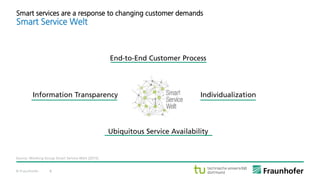
Smart services are a response to changing customer demands
Smart Service Welt
End-to-End Customer Process
Individualization
Ubiquitous Service Availability
Information Transparency
Source: Working Group Smart Service Welt (2015).
© Fraunhofer 9
AGENDA
 Towards a »Smart Service Welt«
 »Industrie 4.0« and Smart Manufacturing
 The Industrial Data Space
© Fraunhofer 10
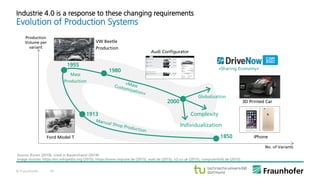
Industrie 4.0 is a response to these changing requirements
Evolution of Production Systems
Source: Koren (2010), cited in Bauernhansl (2014).
Image sources: https://en.wikipedia.org (2015), https://www.impulse.de (2015), audi.de (2015), o2.co.uk (2015), computerbild.de (2015).
Production
Volume per
variant
No. of Variants
1850
1913
1955
1980
2000
Ford Model T
VW Beetle
Production
Audi Configurator
Mass
Production
Individualization
»Sharing Economy«
Complexity
Globalization
iPhone
3D Printed Car
© Fraunhofer 11
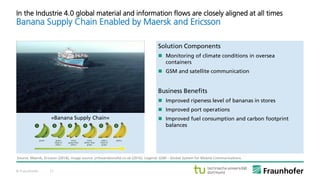
In the Industrie 4.0 global material and information flows are closely aligned at all times
Banana Supply Chain Enabled by Maersk and Ericsson
Solution Components
 Monitoring of climate conditions in oversea
containers
 GSM and satellite communication
Business Benefits
 Improved ripeness level of bananas in stores
 Improved port operations
 Improved fuel consumption and carbon footprint
balances
»Banana Supply Chain«
Source: Maersk, Ericsson (2014); image source: jnfoxandsonsltd.co.uk (2016). Legend: GSM – Global System for Mobile Communications.
© Fraunhofer 12
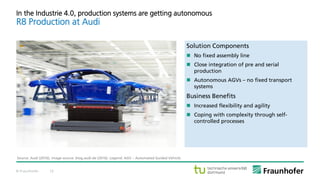
In the Industrie 4.0, production systems are getting autonomous
Solution Components
 No fixed assembly line
 Close integration of pre and serial
production
 Autonomous AGVs – no fixed transport
systems
Business Benefits
 Increased flexibility and agility
 Coping with complexity through self-
controlled processes
R8 Production at Audi
Source: Audi (2016); image source: blog.audi.de (2016). Legend: AGV – Automated Guided Vehicle.
© Fraunhofer 13
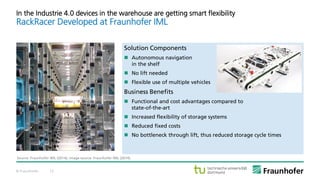
In the Industrie 4.0 devices in the warehouse are getting smart flexibility
Solution Components
 Autonomous navigation
in the shelf
 No lift needed
 Flexible use of multiple vehicles
Business Benefits
 Functional and cost advantages compared to
state-of-the-art
 Increased flexibility of storage systems
 Reduced fixed costs
 No bottleneck through lift, thus reduced storage cycle times
RackRacer Developed at Fraunhofer IML
Source: Fraunhofer IML (2014); image source: Fraunhofer IML (2014).
© Fraunhofer 14
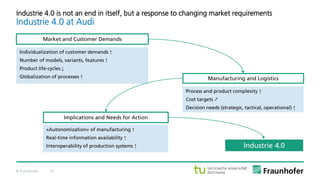
Industrie 4.0 is not an end in itself, but a response to changing market requirements
Industrie 4.0 at Audi
Individualization of customer demands ↑
Number of models, variants, features ↑
Product life-cycles ↓
Globalization of processes ↑
Process and product complexity ↑
Cost targets ↗
Decision needs (strategic, tactical, operational) ↑
»Autonomization« of manufacturing ↑
Real-time information availability ↑
Interoperability of production systems ↑
Market and Customer Demands
Manufacturing and Logistics
Implications and Needs for Action
Industrie 4.0
© Fraunhofer 15
AGENDA
 Towards a »Smart Service Welt«
 »Industrie 4.0« and Smart Manufacturing
 The Industrial Data Space
© Fraunhofer 16
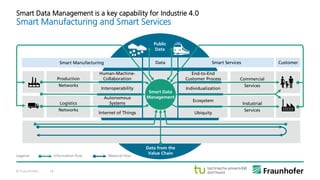
Smart Data Management is a key capability for Industrie 4.0
Smart Manufacturing and Smart Services
Public
Data
Data from the
Value Chain
Commercial
Services
Industrial
Services
Individualization
End-to-End
Customer Process
Ecosystem
Ubiquity
Smart Data
Management
Interoperability
Human-Machine-
Collaboration
Autonomous
Systems
Internet of Things
Customer
Production
Networks
Logistics
Networks
Smart ServicesDataSmart Manufacturing
Information flow Material flowLegend:
© Fraunhofer 17
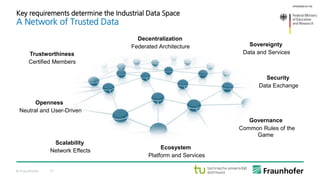
Key requirements determine the Industrial Data Space
A Network of Trusted Data
Sovereignty
Data and ServicesTrustworthiness
Certified Members
Decentralization
Federated Architecture
Openness
Governance
Common Rules of the
Game
Scalability
Network Effects
Ecosystem
Platform and Services
Security
Data Exchange
Neutral and User-Driven
© Fraunhofer 18
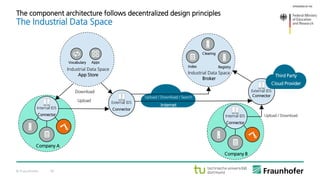
Company A
Internal IDS
Connector
Upload / Download / Search
Internet
Industrial Data Space
Broker
Clearing
RegistryIndex
AppsVocabulary
Industrial Data Space
App Store
External IDS
Connector
Upload
Download
Upload / Download
Company B
Internal IDS
Connector
External IDS
Connector
Third Party
Cloud Provider
The component architecture follows decentralized design principles
The Industrial Data Space
© Fraunhofer 19
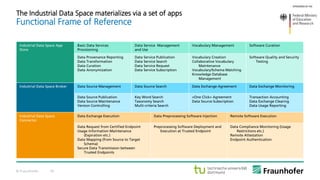
The Industrial Data Space materializes via a set of apps
Functional Frame of Reference
Industrial Data Space App
Store
Basic Data Services
Provisioning
Data Service Management
and Use
Vocabulary Management Software Curation
Data Provenance Reporting
Data Transformation
Data Curation
Data Anonymization
Data Service Publication
Data Service Search
Data Service Request
Data Service Subscription
Vocabulary Creation
Collaborative Vocabulary
Maintenance
Vocabulary/Schema Matching
Knowledge Database
Management
Software Quality and Security
Testing
Industrial Data Space Broker Data Source Management Data Source Search Data Exchange Agreement Data Exchange Monitoring
Data Source Publication
Data Source Maintenance
Version Controlling
Key Word Search
Taxonomy Search
Multi-criteria Search
»One Click« Agreement
Data Source Subscription
Transaction Accounting
Data Exchange Clearing
Data Usage Reporting
Industrial Data Space
Connector
Data Exchange Execution Data Preprocessing Software Injection Remote Software Execution
Data Request from Certified Endpoint
Usage Information Maintenance
(Expiration etc.)
Data Mapping (from Source to Target
Schema)
Secure Data Transmission between
Trusted Endpoints
Preprocessing Software Deployment and
Execution at Trusted Endpoint
Data Compliance Monitoring (Usage
Restrictions etc.)
Remote Attestation
Endpoint Authentication
© Fraunhofer 20
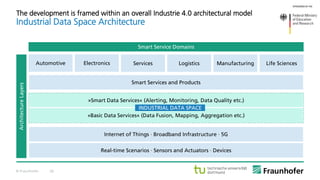
The development is framed within an overall Industrie 4.0 architectural model
Industrial Data Space Architecture
Automotive Electronics Services Logistics Manufacturing Life Sciences
Smart Service Domains
Smart Services and Products
»Smart Data Services« (Alerting, Monitoring, Data Quality etc.)
»Basic Data Services« (Data Fusion, Mapping, Aggregation etc.)
Internet of Things ∙ Broadband Infrastructure ∙ 5G
Real-time Scenarios ∙ Sensors and Actuators ∙ Devices
ArchitectureLayers
INDUSTRIAL DATA SPACE
© Fraunhofer 21
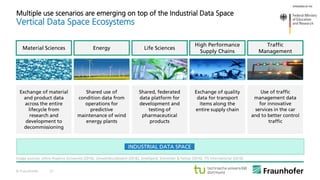
Multiple use scenarios are emerging on top of the Industrial Data Space
Vertical Data Space Ecosystems
Image sources: Johns Hopkins University (2016), Umweltbundesamt (2016), Smellgard, Schneider & Farkas (2016), ITS International (2016).
Material Sciences Energy Life Sciences
High Performance
Supply Chains
Traffic
Management
Exchange of material
and product data
across the entire
lifecycle from
research and
development to
decommissioning
Shared use of
condition data from
operations for
predictive
maintenance of wind
energy plants
Shared, federated
data platform for
development and
testing of
pharmaceutical
products
Exchange of quality
data for transport
items along the
entire supply chain
Use of traffic
management data
for innovative
services in the car
and to better control
traffic
INDUSTRIAL DATA SPACE
© Fraunhofer 22
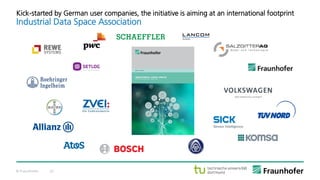
Kick-started by German user companies, the initiative is aiming at an international footprint
Industrial Data Space Association
© Fraunhofer 23
Industrial Data Space Video
http://www.fraunhofer.de/de/forschung/fraunhofer-initiativen/industrial-data-space.html
© Fraunhofer 24
Prof. Dr. Boris Otto
Fraunhofer IML & ISST
TU Dortmund University
Boris.Otto@iml.fraunhofer.de
https://de.linkedin.com/pub/boris-otto/1/1b5/570
https://twitter.com/drborisotto
https://www.xing.com/profile/Boris_Otto
http://www.researchgate.net/profile/Boris_Otto
http://de.slideshare.net/borisotto
Thank you very much for your attention!
Your Speaker
© Fraunhofer
Prof. Dr. Boris Otto
Fraunhofer IML/ISST
TU Dortmund University
Birmingham · April 14th, 2016
THE INDUSTRIAL DATA SPACE

Industrial Data Space

  • 1.
    © Fraunhofer Prof. Dr.Boris Otto Fraunhofer IML/ISST TU Dortmund University Birmingham · April 14th, 2016 THE INDUSTRIAL DATA SPACE
  • 2.
    © Fraunhofer 2 AGENDA Towards a »Smart Service Welt«  »Industrie 4.0« and Smart Manufacturing  The Industrial Data Space
  • 3.
    © Fraunhofer 3 Innovativebusiness models combine digital services and lot size 1 production Product and Production Strategy at adidas In-Store ProductionSmart Service »Runtastic« Source: Handelsblatt, August 6, 2015, No. 149; http://www.adidas-group.com/de/medien/newsarchiv/pressemitteilungen/ 2015/adidas-gruppe-erwirbt-runtastic; image source: adidas Group (2016).
  • 4.
    © Fraunhofer 4 Successfulvalue propositions are becoming increasingly hybrid Product-Service Bundling at adidas Image sources: otto.de (2015), techglam.com (2015), soccerreviews.com (2015), appfullapk.co (2015). Time »Hybridity« Physical Product (Running Shoe) »Traditional Service« (Work-Out Monitor) Digital Service (Runtastic)
  • 5.
    © Fraunhofer 5 Industrialmachinery manufacturers are offering app stores on top of their tangible products Hybrid Products at TRUMPF Image sources: ihs-gmbh.de (2016); silicon.de (2016). Digital Value-Added ServiceTool Machine as a Tangible Product
  • 6.
    © Fraunhofer 6 Digitalvalue propositions follow a platform logic Digital Business Architecture Sources: Working Group Smart Service Welt (2015). Principles of the Platform Economy»Smart Service Welt« Architecture  Services can be separated from physical platforms  Architectural layers are de-coupled  Products turn to platforms - and vice-versa  Ecosystems form around platforms  Innovation happens in co-opetition modes SMART PRODUCTS SMART SPACES SMART DATA SMART SERVICES
  • 7.
    © Fraunhofer 7 Agriculturalmachinery manufacturers are driving comprehensive digital farming solutions Digital Business Ecosystems Image sources: wiwo (2015), traction-magazin.de (2014). Source: Beecham Research Ltd. (2014). Players in the Food & Farming EcosystemDigital Farming Digital Farming Ecosystem Machine Providers Crop Science Companies Farmers Wholesale Technology Providers Influencers
  • 8.
    © Fraunhofer 8 Smartservices are a response to changing customer demands Smart Service Welt End-to-End Customer Process Individualization Ubiquitous Service Availability Information Transparency Source: Working Group Smart Service Welt (2015).
  • 9.
    © Fraunhofer 9 AGENDA Towards a »Smart Service Welt«  »Industrie 4.0« and Smart Manufacturing  The Industrial Data Space
  • 10.
    © Fraunhofer 10 Industrie4.0 is a response to these changing requirements Evolution of Production Systems Source: Koren (2010), cited in Bauernhansl (2014). Image sources: https://en.wikipedia.org (2015), https://www.impulse.de (2015), audi.de (2015), o2.co.uk (2015), computerbild.de (2015). Production Volume per variant No. of Variants 1850 1913 1955 1980 2000 Ford Model T VW Beetle Production Audi Configurator Mass Production Individualization »Sharing Economy« Complexity Globalization iPhone 3D Printed Car
  • 11.
    © Fraunhofer 11 Inthe Industrie 4.0 global material and information flows are closely aligned at all times Banana Supply Chain Enabled by Maersk and Ericsson Solution Components  Monitoring of climate conditions in oversea containers  GSM and satellite communication Business Benefits  Improved ripeness level of bananas in stores  Improved port operations  Improved fuel consumption and carbon footprint balances »Banana Supply Chain« Source: Maersk, Ericsson (2014); image source: jnfoxandsonsltd.co.uk (2016). Legend: GSM – Global System for Mobile Communications.
  • 12.
    © Fraunhofer 12 Inthe Industrie 4.0, production systems are getting autonomous Solution Components  No fixed assembly line  Close integration of pre and serial production  Autonomous AGVs – no fixed transport systems Business Benefits  Increased flexibility and agility  Coping with complexity through self- controlled processes R8 Production at Audi Source: Audi (2016); image source: blog.audi.de (2016). Legend: AGV – Automated Guided Vehicle.
  • 13.
    © Fraunhofer 13 Inthe Industrie 4.0 devices in the warehouse are getting smart flexibility Solution Components  Autonomous navigation in the shelf  No lift needed  Flexible use of multiple vehicles Business Benefits  Functional and cost advantages compared to state-of-the-art  Increased flexibility of storage systems  Reduced fixed costs  No bottleneck through lift, thus reduced storage cycle times RackRacer Developed at Fraunhofer IML Source: Fraunhofer IML (2014); image source: Fraunhofer IML (2014).
  • 14.
    © Fraunhofer 14 Industrie4.0 is not an end in itself, but a response to changing market requirements Industrie 4.0 at Audi Individualization of customer demands ↑ Number of models, variants, features ↑ Product life-cycles ↓ Globalization of processes ↑ Process and product complexity ↑ Cost targets ↗ Decision needs (strategic, tactical, operational) ↑ »Autonomization« of manufacturing ↑ Real-time information availability ↑ Interoperability of production systems ↑ Market and Customer Demands Manufacturing and Logistics Implications and Needs for Action Industrie 4.0
  • 15.
    © Fraunhofer 15 AGENDA Towards a »Smart Service Welt«  »Industrie 4.0« and Smart Manufacturing  The Industrial Data Space
  • 16.
    © Fraunhofer 16 SmartData Management is a key capability for Industrie 4.0 Smart Manufacturing and Smart Services Public Data Data from the Value Chain Commercial Services Industrial Services Individualization End-to-End Customer Process Ecosystem Ubiquity Smart Data Management Interoperability Human-Machine- Collaboration Autonomous Systems Internet of Things Customer Production Networks Logistics Networks Smart ServicesDataSmart Manufacturing Information flow Material flowLegend:
  • 17.
    © Fraunhofer 17 Keyrequirements determine the Industrial Data Space A Network of Trusted Data Sovereignty Data and ServicesTrustworthiness Certified Members Decentralization Federated Architecture Openness Governance Common Rules of the Game Scalability Network Effects Ecosystem Platform and Services Security Data Exchange Neutral and User-Driven
  • 18.
    © Fraunhofer 18 CompanyA Internal IDS Connector Upload / Download / Search Internet Industrial Data Space Broker Clearing RegistryIndex AppsVocabulary Industrial Data Space App Store External IDS Connector Upload Download Upload / Download Company B Internal IDS Connector External IDS Connector Third Party Cloud Provider The component architecture follows decentralized design principles The Industrial Data Space
  • 19.
    © Fraunhofer 19 TheIndustrial Data Space materializes via a set of apps Functional Frame of Reference Industrial Data Space App Store Basic Data Services Provisioning Data Service Management and Use Vocabulary Management Software Curation Data Provenance Reporting Data Transformation Data Curation Data Anonymization Data Service Publication Data Service Search Data Service Request Data Service Subscription Vocabulary Creation Collaborative Vocabulary Maintenance Vocabulary/Schema Matching Knowledge Database Management Software Quality and Security Testing Industrial Data Space Broker Data Source Management Data Source Search Data Exchange Agreement Data Exchange Monitoring Data Source Publication Data Source Maintenance Version Controlling Key Word Search Taxonomy Search Multi-criteria Search »One Click« Agreement Data Source Subscription Transaction Accounting Data Exchange Clearing Data Usage Reporting Industrial Data Space Connector Data Exchange Execution Data Preprocessing Software Injection Remote Software Execution Data Request from Certified Endpoint Usage Information Maintenance (Expiration etc.) Data Mapping (from Source to Target Schema) Secure Data Transmission between Trusted Endpoints Preprocessing Software Deployment and Execution at Trusted Endpoint Data Compliance Monitoring (Usage Restrictions etc.) Remote Attestation Endpoint Authentication
  • 20.
    © Fraunhofer 20 Thedevelopment is framed within an overall Industrie 4.0 architectural model Industrial Data Space Architecture Automotive Electronics Services Logistics Manufacturing Life Sciences Smart Service Domains Smart Services and Products »Smart Data Services« (Alerting, Monitoring, Data Quality etc.) »Basic Data Services« (Data Fusion, Mapping, Aggregation etc.) Internet of Things ∙ Broadband Infrastructure ∙ 5G Real-time Scenarios ∙ Sensors and Actuators ∙ Devices ArchitectureLayers INDUSTRIAL DATA SPACE
  • 21.
    © Fraunhofer 21 Multipleuse scenarios are emerging on top of the Industrial Data Space Vertical Data Space Ecosystems Image sources: Johns Hopkins University (2016), Umweltbundesamt (2016), Smellgard, Schneider & Farkas (2016), ITS International (2016). Material Sciences Energy Life Sciences High Performance Supply Chains Traffic Management Exchange of material and product data across the entire lifecycle from research and development to decommissioning Shared use of condition data from operations for predictive maintenance of wind energy plants Shared, federated data platform for development and testing of pharmaceutical products Exchange of quality data for transport items along the entire supply chain Use of traffic management data for innovative services in the car and to better control traffic INDUSTRIAL DATA SPACE
  • 22.
    © Fraunhofer 22 Kick-startedby German user companies, the initiative is aiming at an international footprint Industrial Data Space Association
  • 23.
    © Fraunhofer 23 IndustrialData Space Video http://www.fraunhofer.de/de/forschung/fraunhofer-initiativen/industrial-data-space.html
  • 24.
    © Fraunhofer 24 Prof.Dr. Boris Otto Fraunhofer IML & ISST TU Dortmund University Boris.Otto@iml.fraunhofer.de https://de.linkedin.com/pub/boris-otto/1/1b5/570 https://twitter.com/drborisotto https://www.xing.com/profile/Boris_Otto http://www.researchgate.net/profile/Boris_Otto http://de.slideshare.net/borisotto Thank you very much for your attention! Your Speaker
  • 25.
    © Fraunhofer Prof. Dr.Boris Otto Fraunhofer IML/ISST TU Dortmund University Birmingham · April 14th, 2016 THE INDUSTRIAL DATA SPACE