








University	
  of	
  Bath	
  
Faculty	
  of	
  Engineering	
  and	
  Design	
  
Department	
  of	
  Architecture	
  and	
  Civil	
  Engineering	


Causes,	
  Effects	
  and	
  Methods	
  of	
  Minimizing	
  Delays	
  in	
  Dubai	
  
High-­‐Rise	
  Construction	
  Projects	


This	
  Dissertation	
  is	
  submitted	
  in	
  Accordance	
  with	
  the	
  
Requirement	
  for	
  the	
  Degree	
  of	
  Master	
  of	
  Science	
  in	
  International	
  
Construction	
  Management	
  in	
  the	
  University	
  of	
  Bath	
  2016	


Sameh	
  Kandil	
  Mohammed	
  Ibrahim	


Supervisor:	
  Dr.	
  Vaughan	
  Coffey	


April	
  2016	


2	
  
“If you fail to plan, you are planning to fail!”
	
  
Benjamin Franklin, (1706-1790) American statesman, scientist and
philosopher


3	
  
Copyright Notice
Attention is drawn to the fact that copyright of this dissertation rests with its
author. This copy of the dissertation has been supplied on condition that
anyone who consults it is understood to recognize that its copyright rests
with its author and that no quotation from the dissertation and no
information derived from it may be published without the prior written
consent of the author.
Restrictions on Use
This dissertation may be made available for consultation within the
University Library and may be photocopied or lent to other libraries for the
purpose of consultation.
Signature: ………………………….
Disclaimer
The opinions expressed in this work are entirely those of the author except
where indicated in the text.


Sameh Ibrahim
4	
  
Abstract
Delays happen regularly and have been perceived to have become a
normal occurrence in most construction projects worldwide and in the
Emirate of Dubai. This study, a first for Dubai, focuses on identifying the
factors that most contribute to the delays of high-rise projects in Dubai,
evaluates the effect of these delays and examines some effective methods
of minimizing their impacts. A comprehensive literature review on these
issues was conducted and a questionnaire survey prepared.
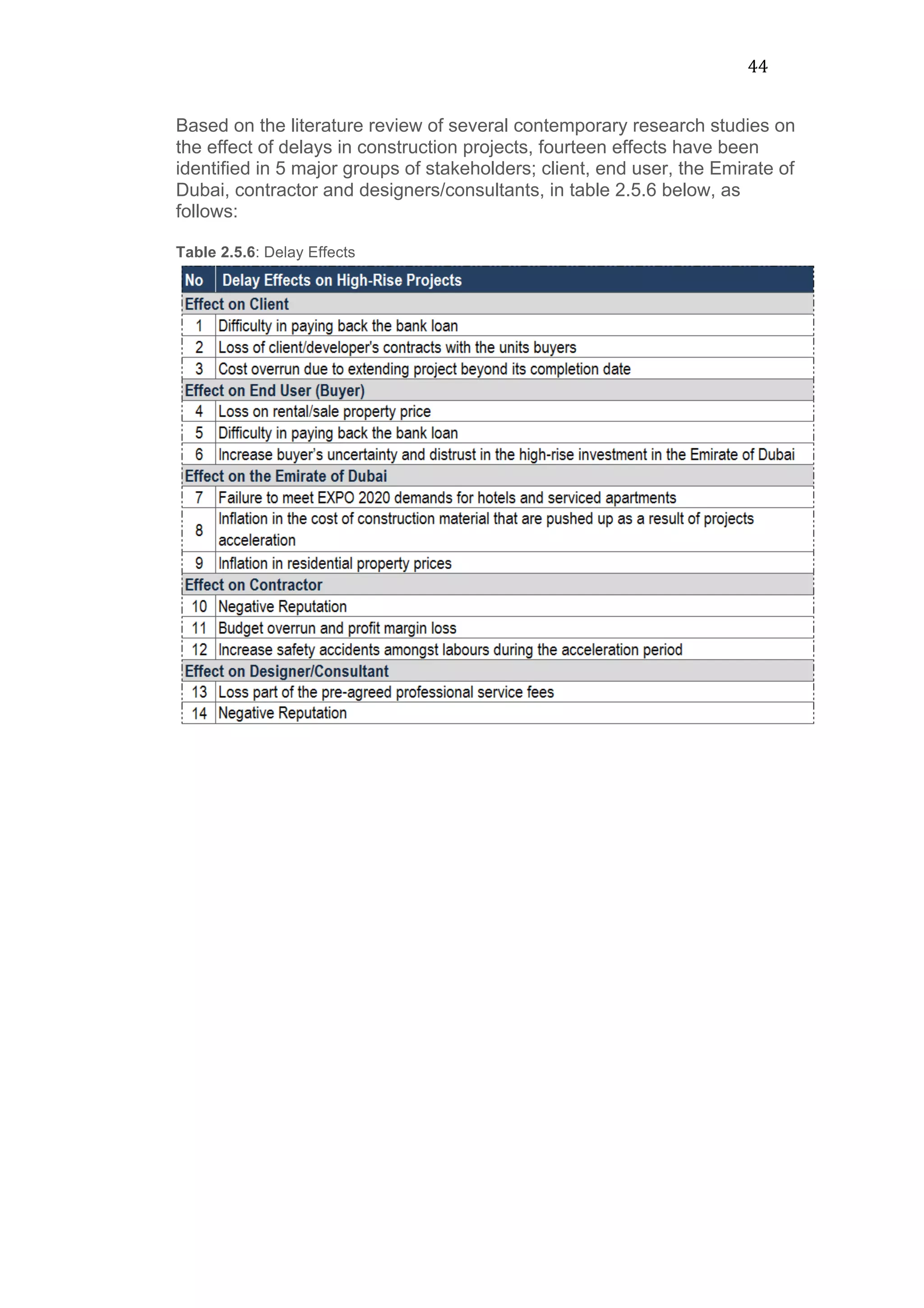
A total of 60 causes that contribute to the delays were identified and
categorized into five major groups, 14 effects have been identified into five
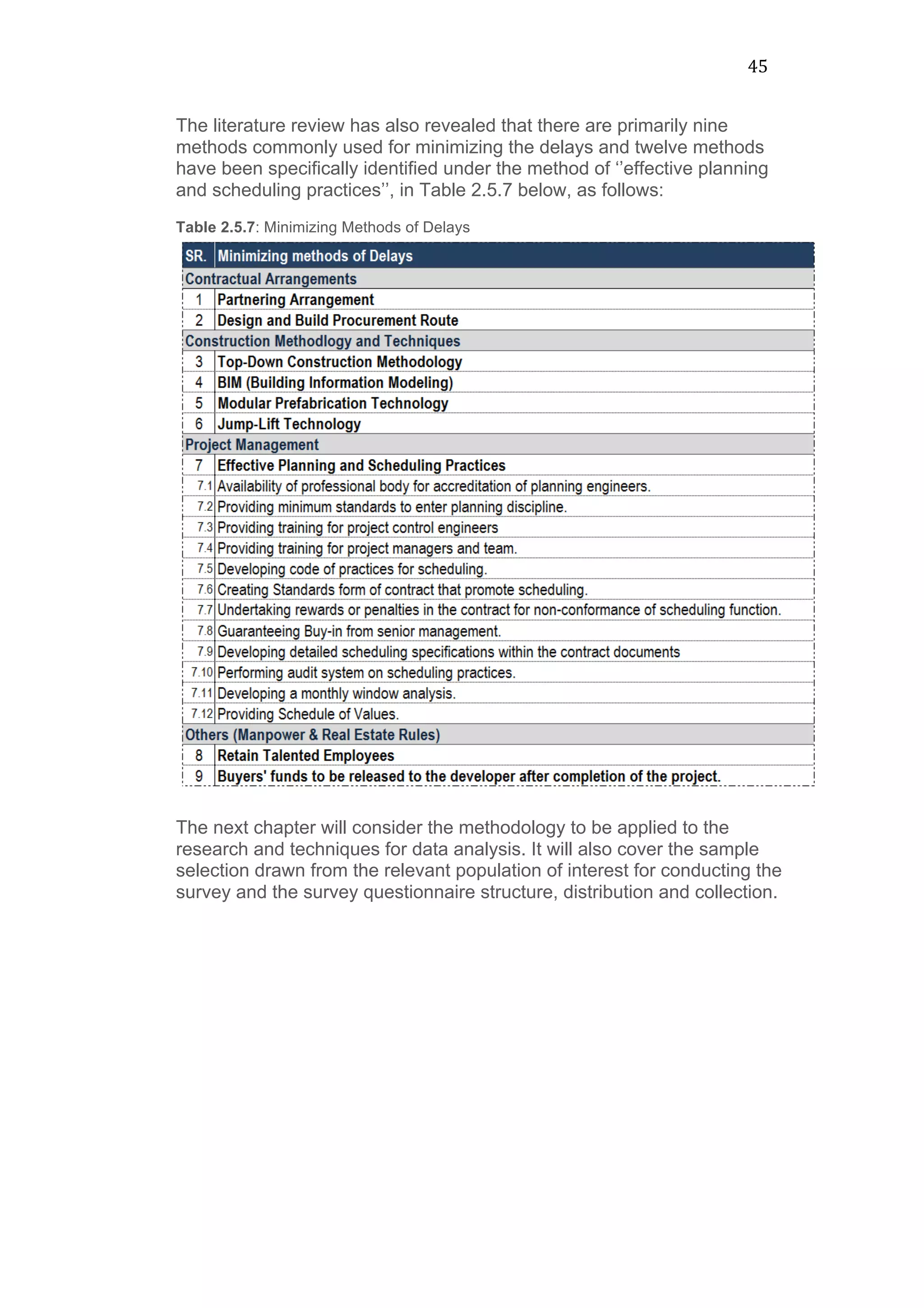
major groups, and 9 methods have been identified for minimizing the
delays and 12 methods have been specifically identified under the
methods of “effective planning and scheduling practices”.
A survey questionnaire was distributed to 16 clients, 27
consultants/designers and 25 contractors working on large high-rise
projects in Dubai. Participants were asked to indicate the level of
importance of each cause, the level of occurrence of each effect and the
effectiveness of each minimizing method. The delay causes, effects and
minimizing methods were then analyzed and ranked based on the Relative
Importance Index.
Finally, recommendations are made that will assist high-rise practitioners
to reduce, control and avoid delays and thus improve the performance of
Dubai’s high-rise sector in attracting more investors and assisting the
sectors of tourism and business, meeting the EXPO 2020 demands and
stabilizing the Dubai real estate market prices.


5	
  
Acknowledgements
I would like to thank GOD who gives me the health, patience and strength
to write my dissertation.
Special thanks for my supervisor Dr. Vaughan Coffey at the Queensland
University of Technology in Australia for his support, guidance, advices
and patience.
I am thankful for all ICM program team at the University of Bath in the
United Kingdom for their tremendous support during my two years study
period.
I am very grateful to my wife May, my daughters Karen and Helen and my
parents too for their understanding and continuous support.
Finally, I would like to show my deepest appreciation and gratitude for
whoever contributed in the supplied questionnaire in favor of concluding
this dissertation.


6	
  
Table of Contents
Abstract 4
Acknowledgement 5
List of Figures 8
List of Tables 9
List of Appendices 10
Chapter 1: Introduction 11
1.1 - Background of the Study 11
1.2 - Statement of the Problem 12
1.3 - Aims and Objectives 13
1.4 - Limitations 13
1.5 - Research Methodology 14
1.6 - Research Potential Significance 15
1.7 - Research Structure 15
	
  
Chapter 2: Literature Review 17
	
  
2.1 - Chapter Introduction 17
2.2 - Three Dimensions of Delay Causes
2.2.1 - The Characteristics of Construction Industry Globally and 18
Associated Delay Causes
2.2.2 - The Characteristics of Construction Market in Dubai and 21
Associated Delay Causes
2.2.3 - The Characteristics of High-Rise Building Projects Globally and 26
Associated Delay Causes
2.3 - Effects of Delays 28
2.4 - Methods of Minimizing Delays 30
2.5 - Chapter Summary 40	
  
Chapter 3: Research Methodology 46
	
  
3.1 - Chapter Introduction 46
3.2 - Research Methods 46
3.3 - Literature Review 47
3.4 - Data Collection 48
3.5 - Questionnaire Design and Structure 48
3.6 - Pilot Study 49
7	
  
3.7 - Selection of Participants 50
3.8 - Questionnaire Distribution and Collection 50
3.9 - The survey Sample 50
3.10 - Data Analysis 51
3.11 – Chapter Summary 53
Chapter 4: Results and Discussion 54
	
  
4.1 - Chapter Introduction 54
4.2 - Survey Questionnaire Results 54
4.2.1 – Respondents’ Profile 54
4.2.2 – Causes of High-Rises Delays in Dubai 59
4.2.3 – Effects of Delays 61
4.2.4 – Minimizing Delay Methods 63
4.3 – Results Discussion 66
4.4 – Testing of the Original Hypotheses 71
4.5 – Chapter Summary 73
	
  
Chapter 5: Conclusions and Recommendations 74
	
  
5.1 - Chapter Introduction 74
5.2 - Research Conclusions 74
5.3 - Research Recommendations 77
5.4 – Recommendations for Future Research 82
5.5 – Chapter Summary 83	
  
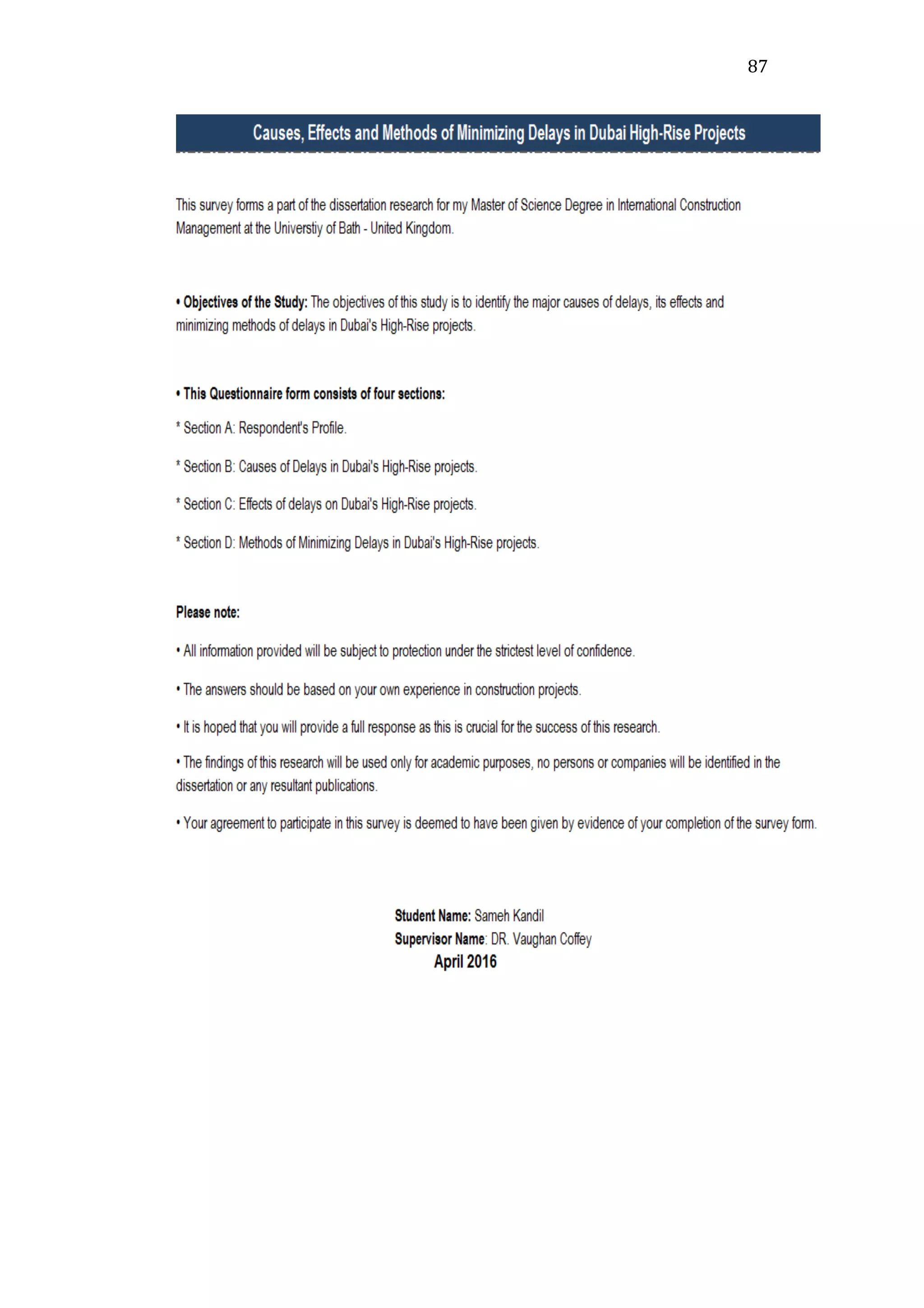
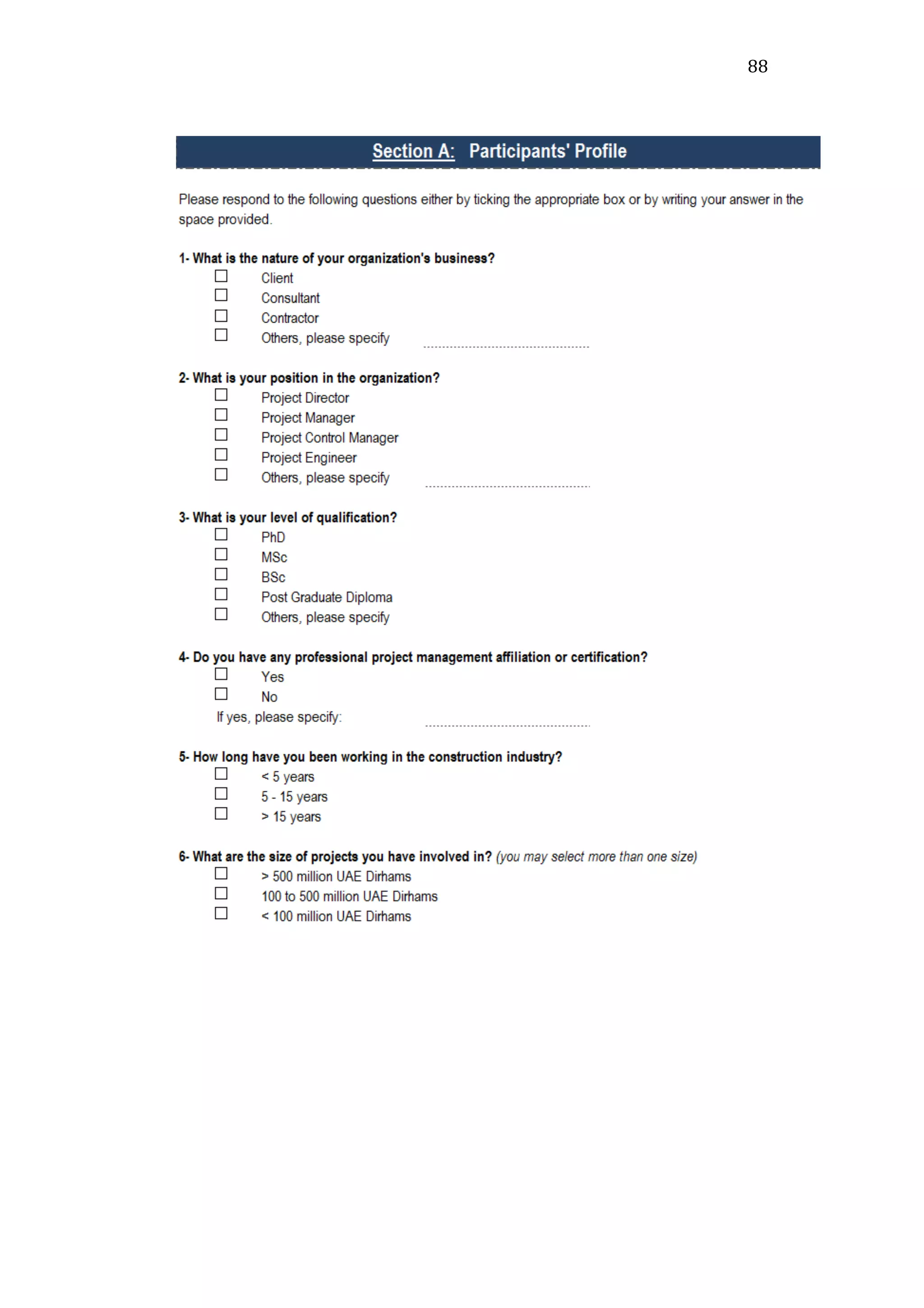
Appendix - A The Cover Letter of Questionnaire 84
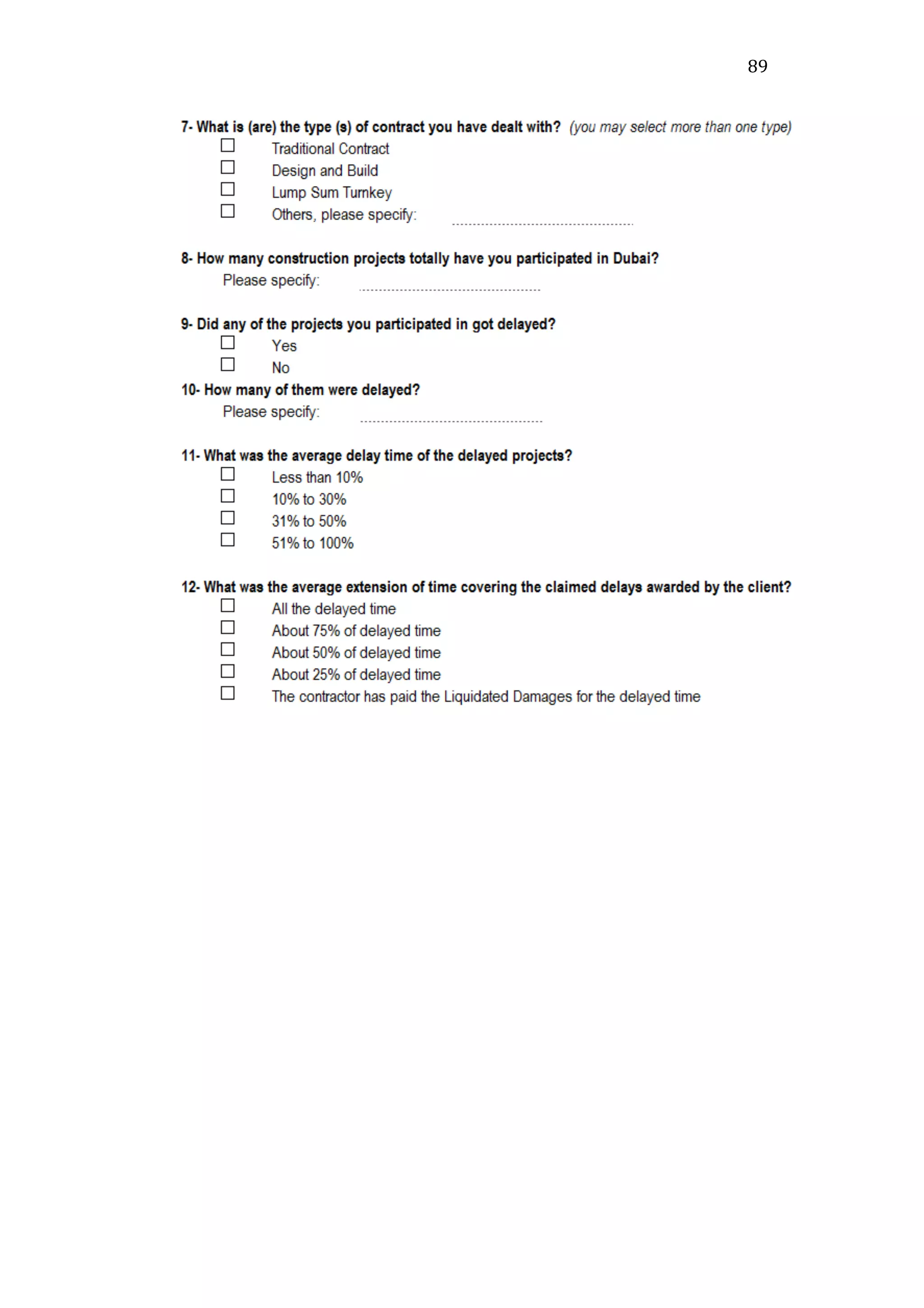
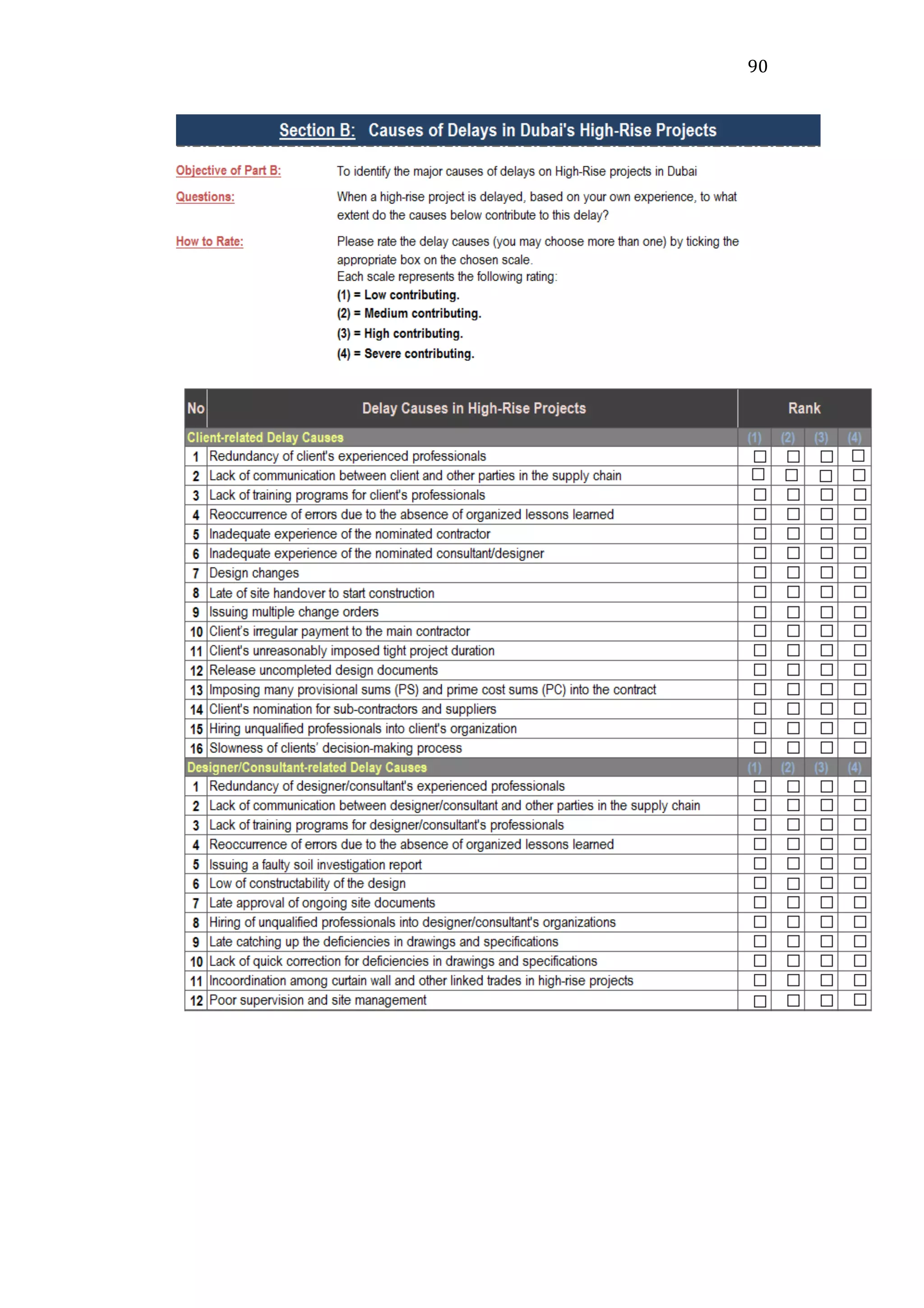
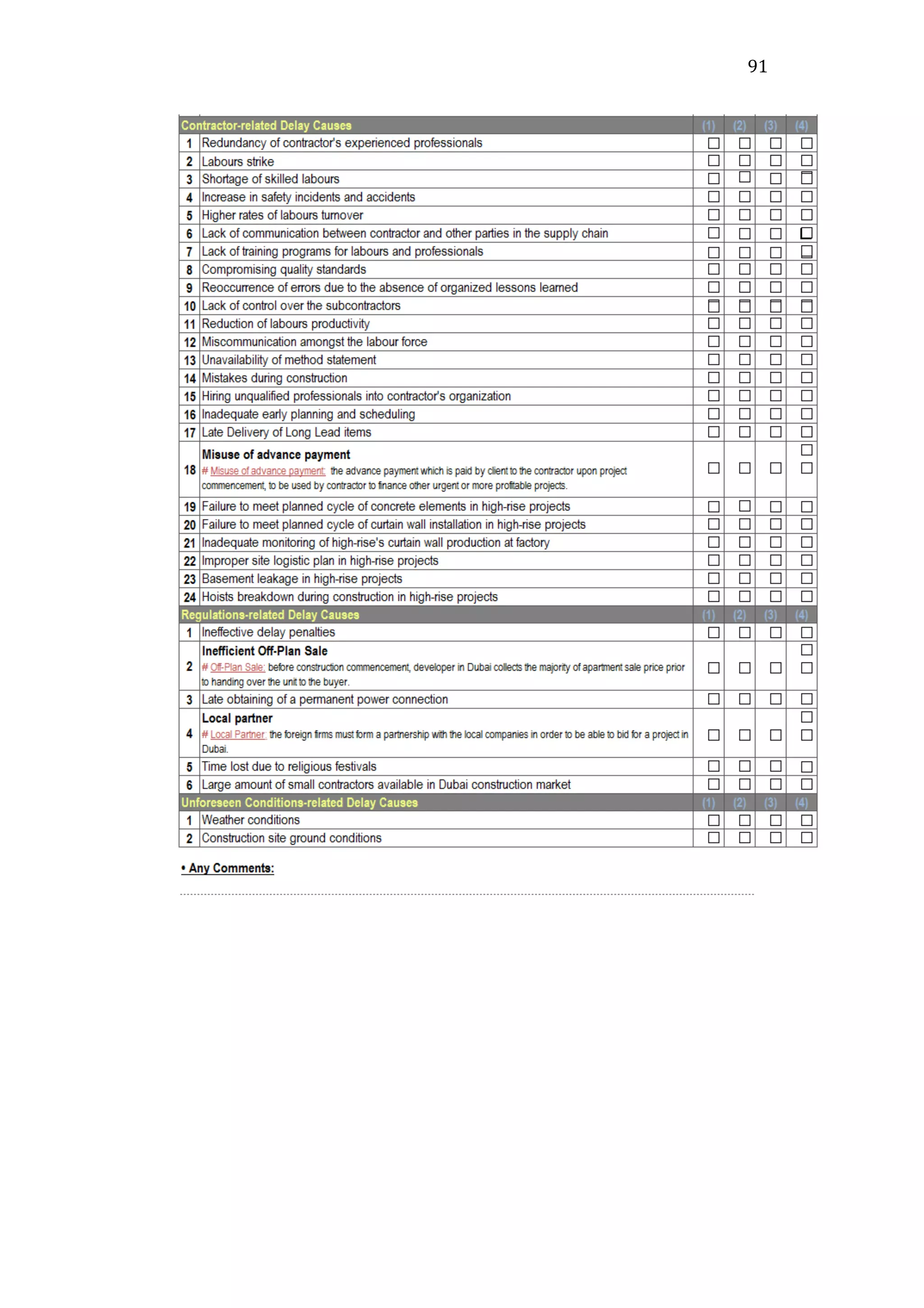
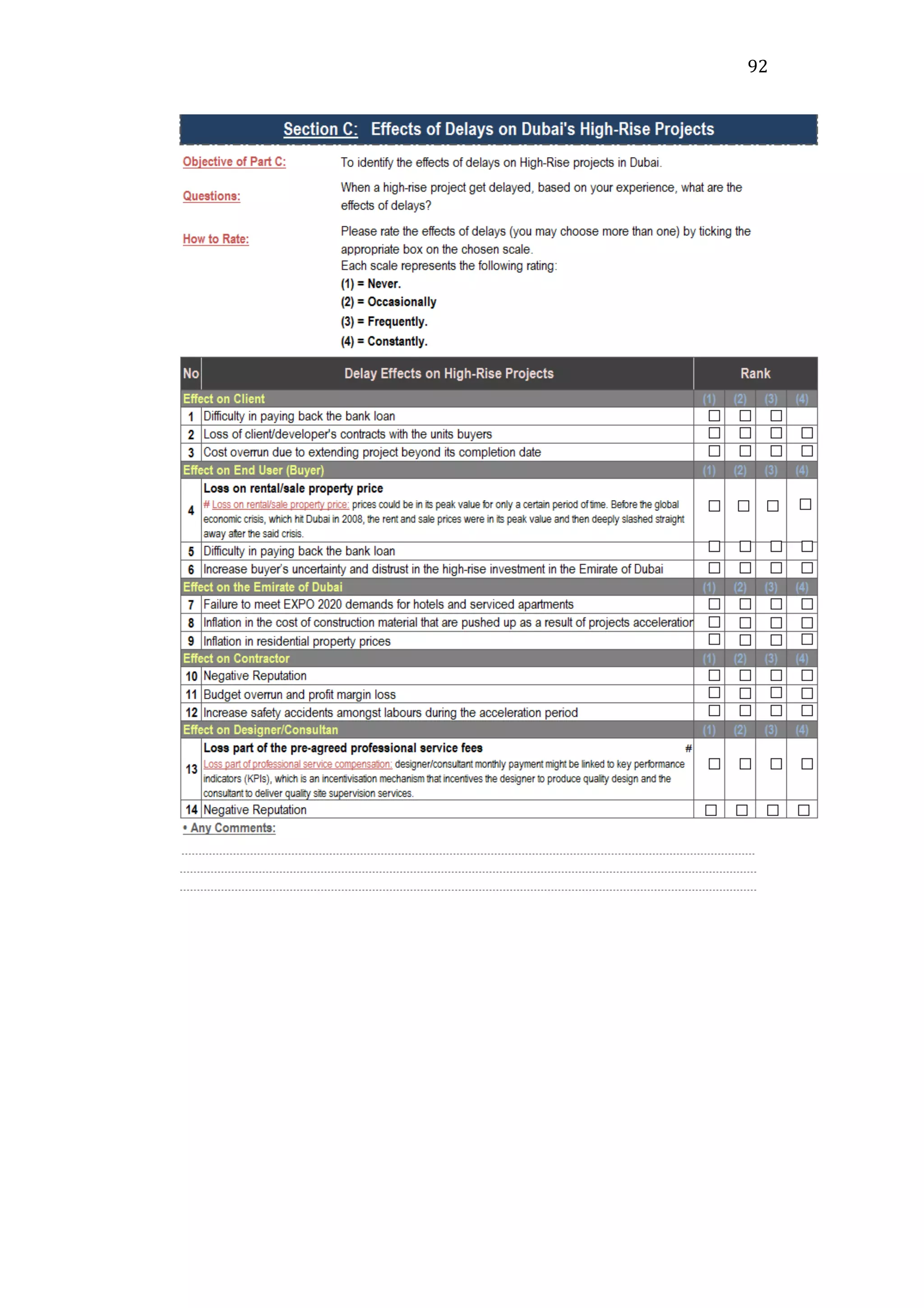
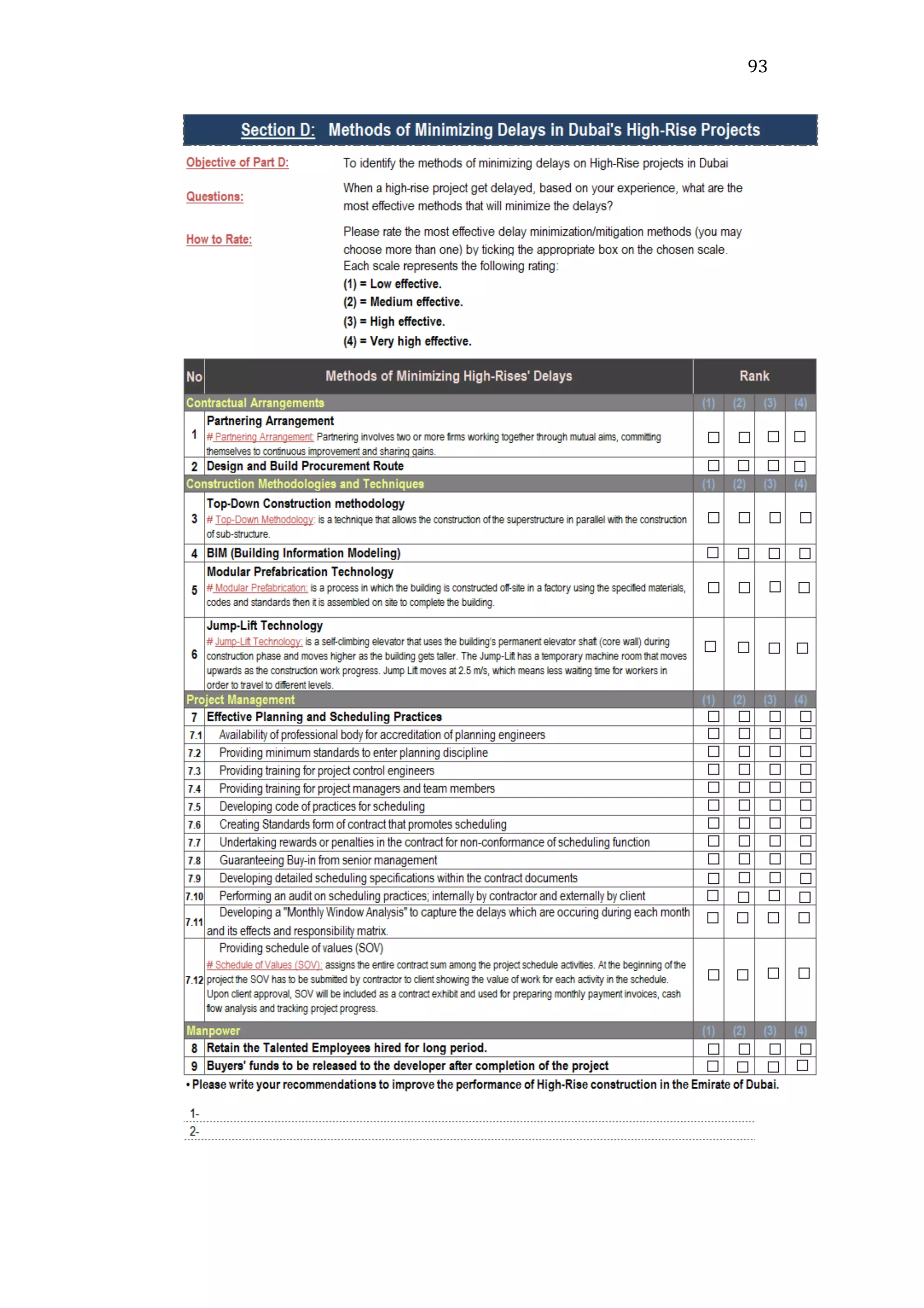
Appendix - B The Survey Questionnaire Form 86
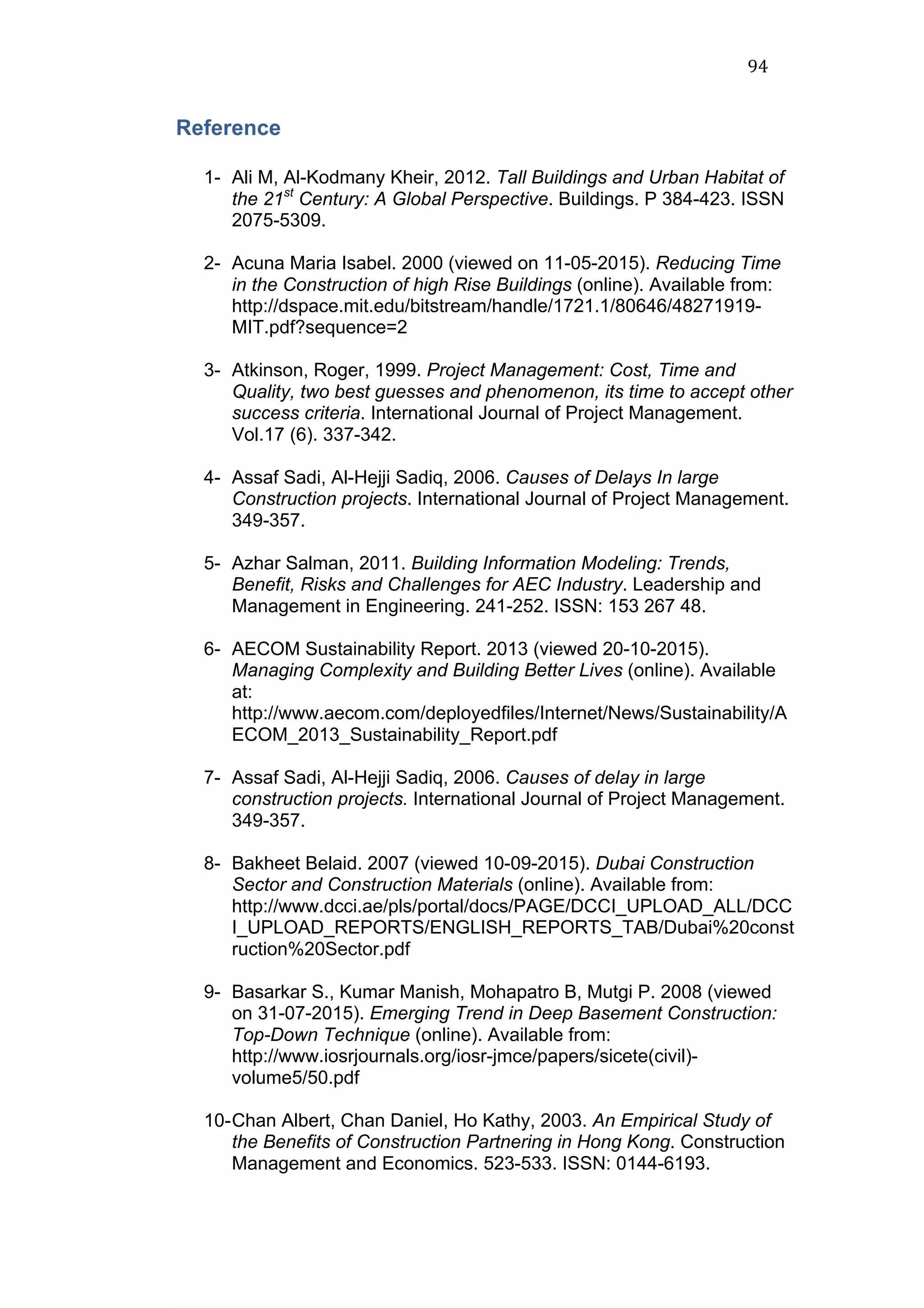
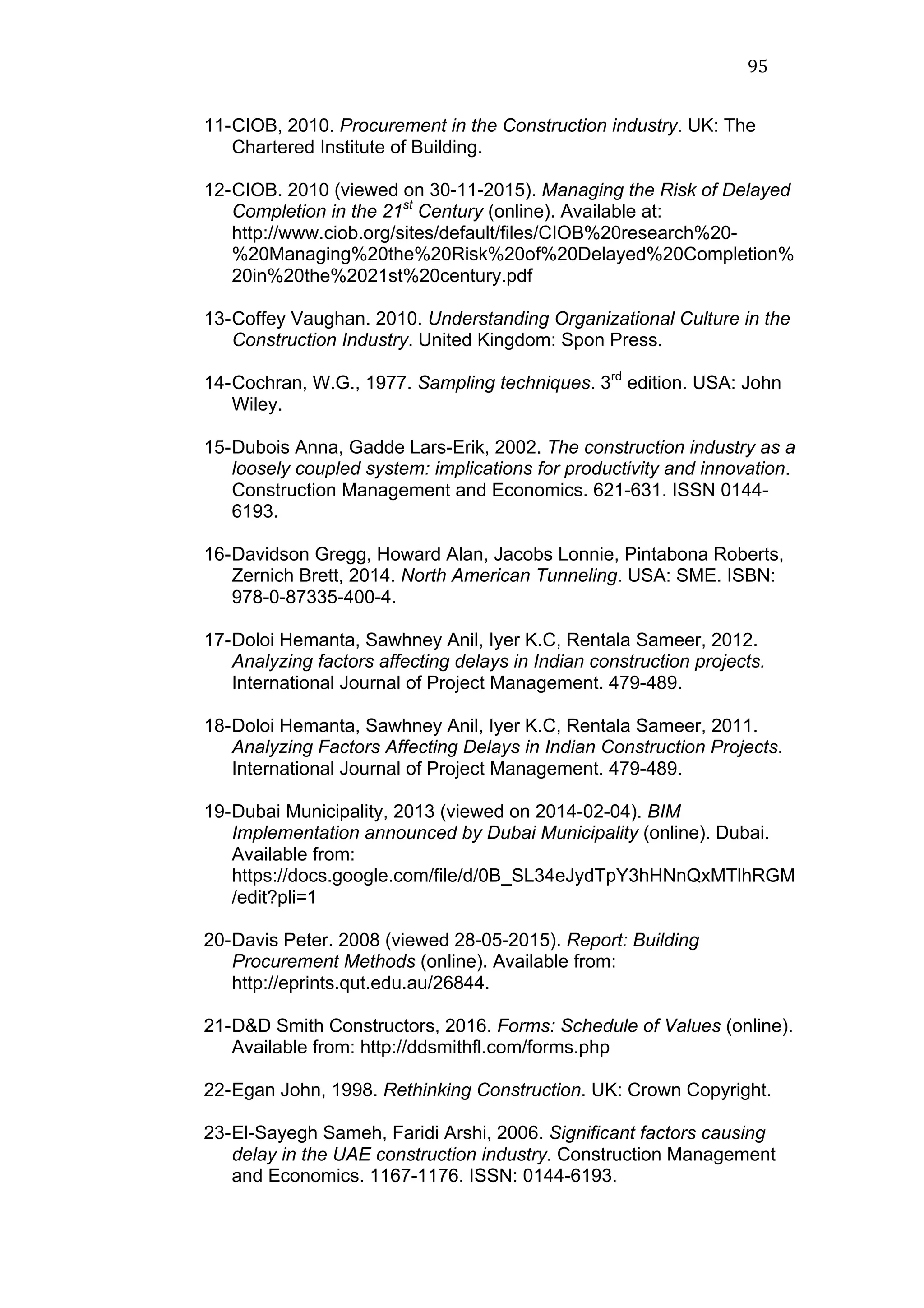
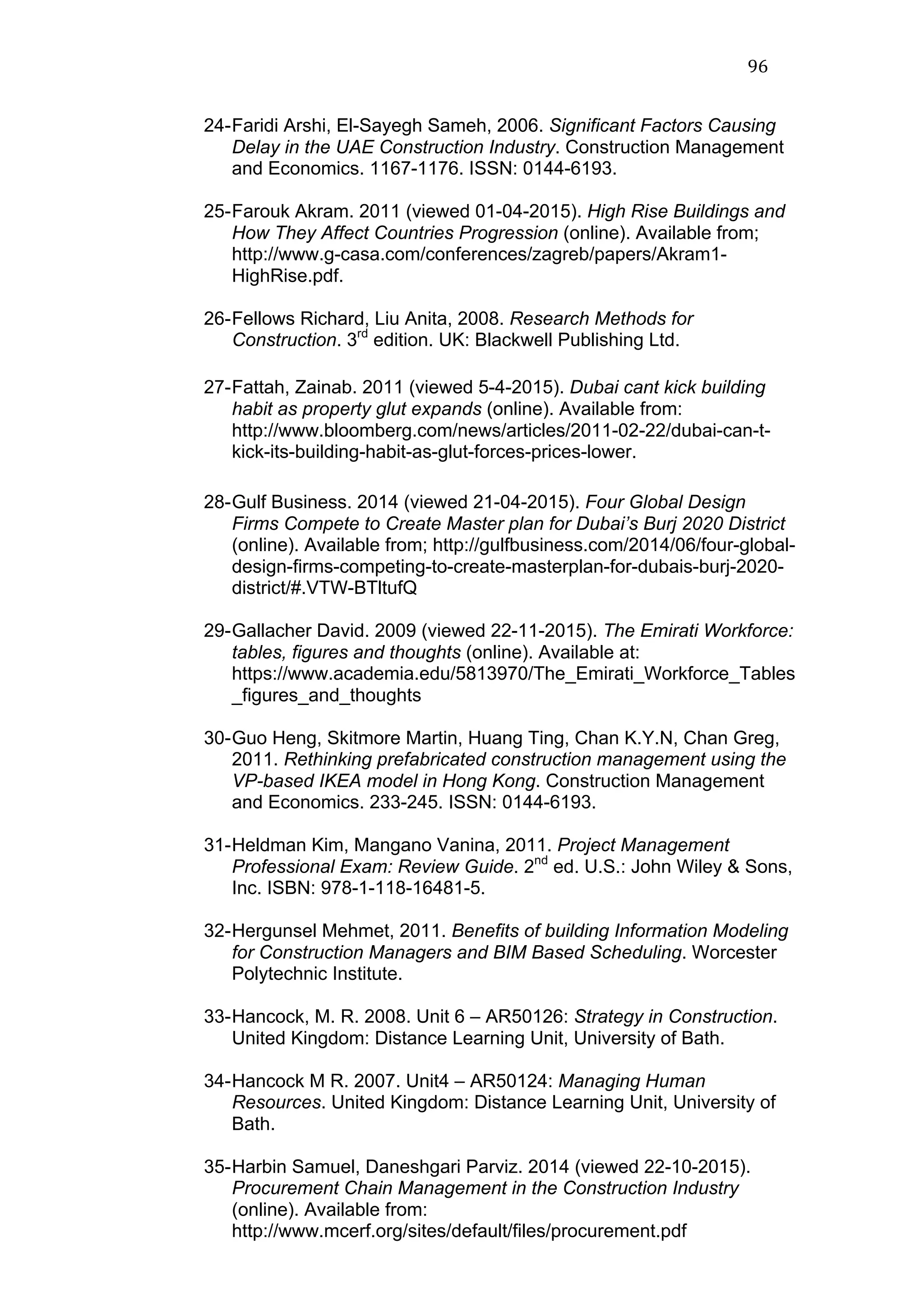
References 94


8	
  
List of Figures


  Page
Figure No. 1.5.1 Schematic Diagram of Research Methodology 14	
  
Figure No. 2.4.1 Procurement Routes for Projects over £50m 31	
  
Figure No. 2.4.2 Procurement Routes for Projects between 5&£50m 32	
  
Figure No. 2.4.3 Comparison between Site-built & Modular Schedule 35 	
  
Figure No. 2.4.4 KONE Jump-Lift 36	
  
Figure No. 2.4.5 Schedule of Values 38	


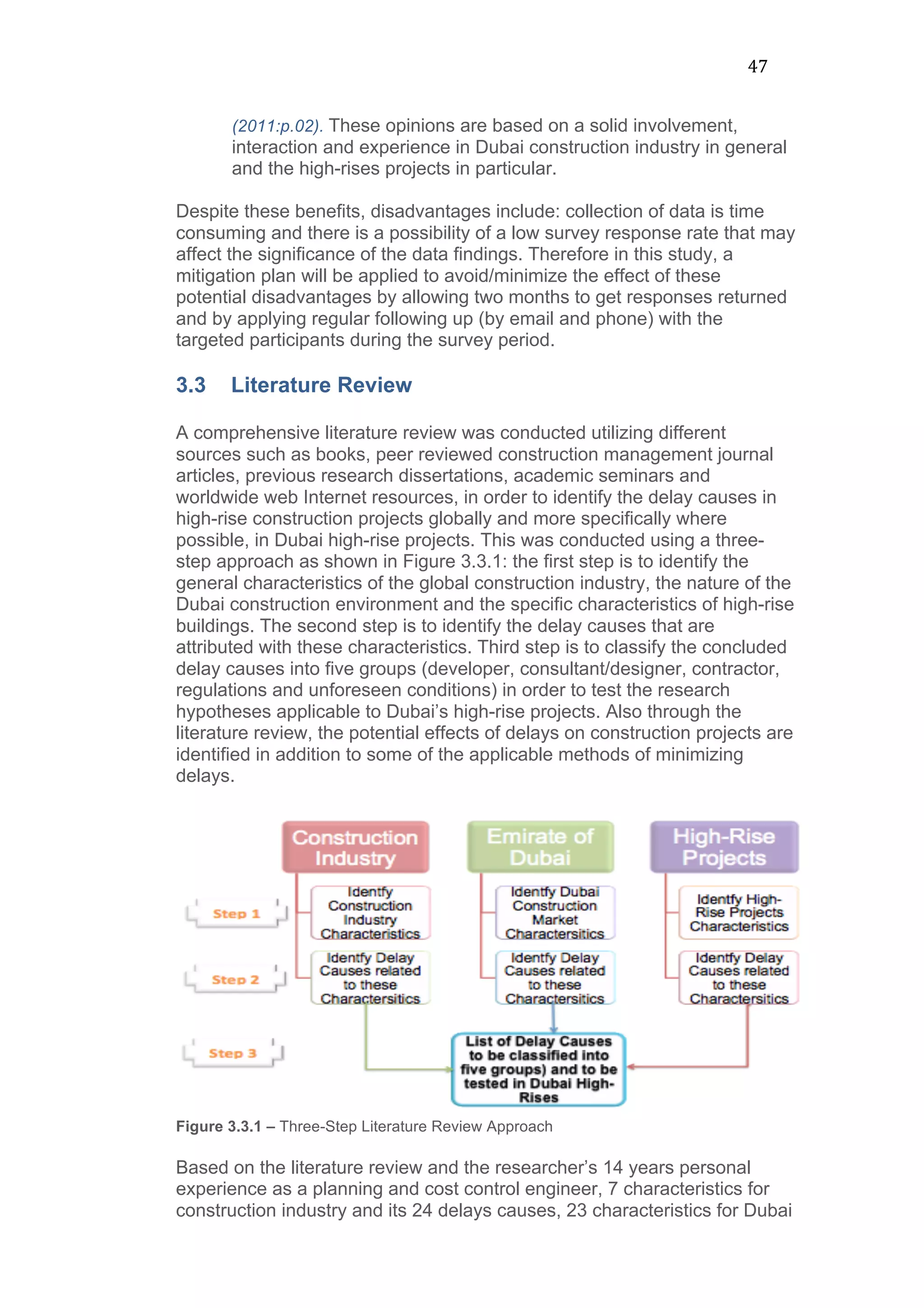
Figure No. 3.3.1 Three-Step Literature Review Approach 47
	
  
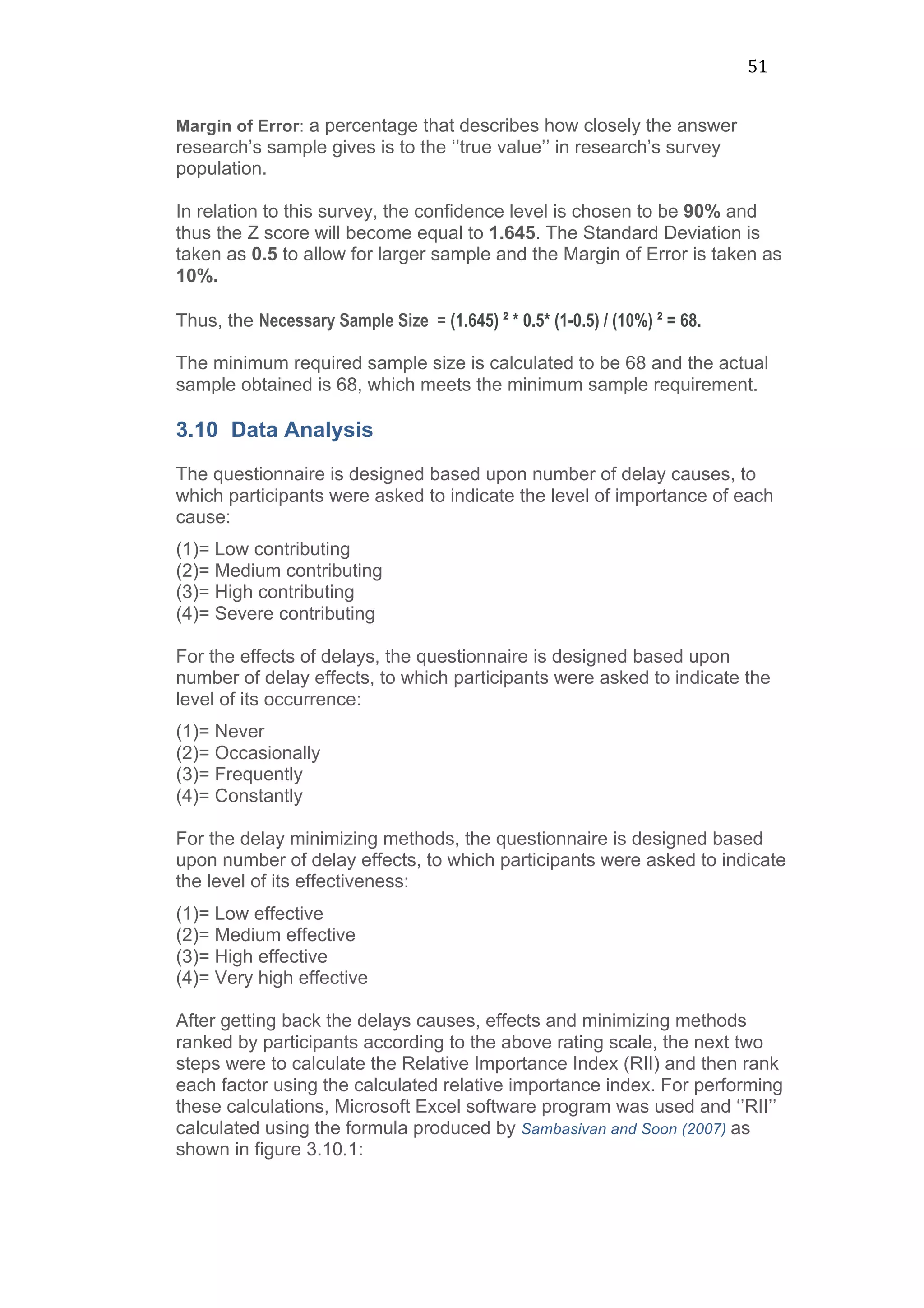
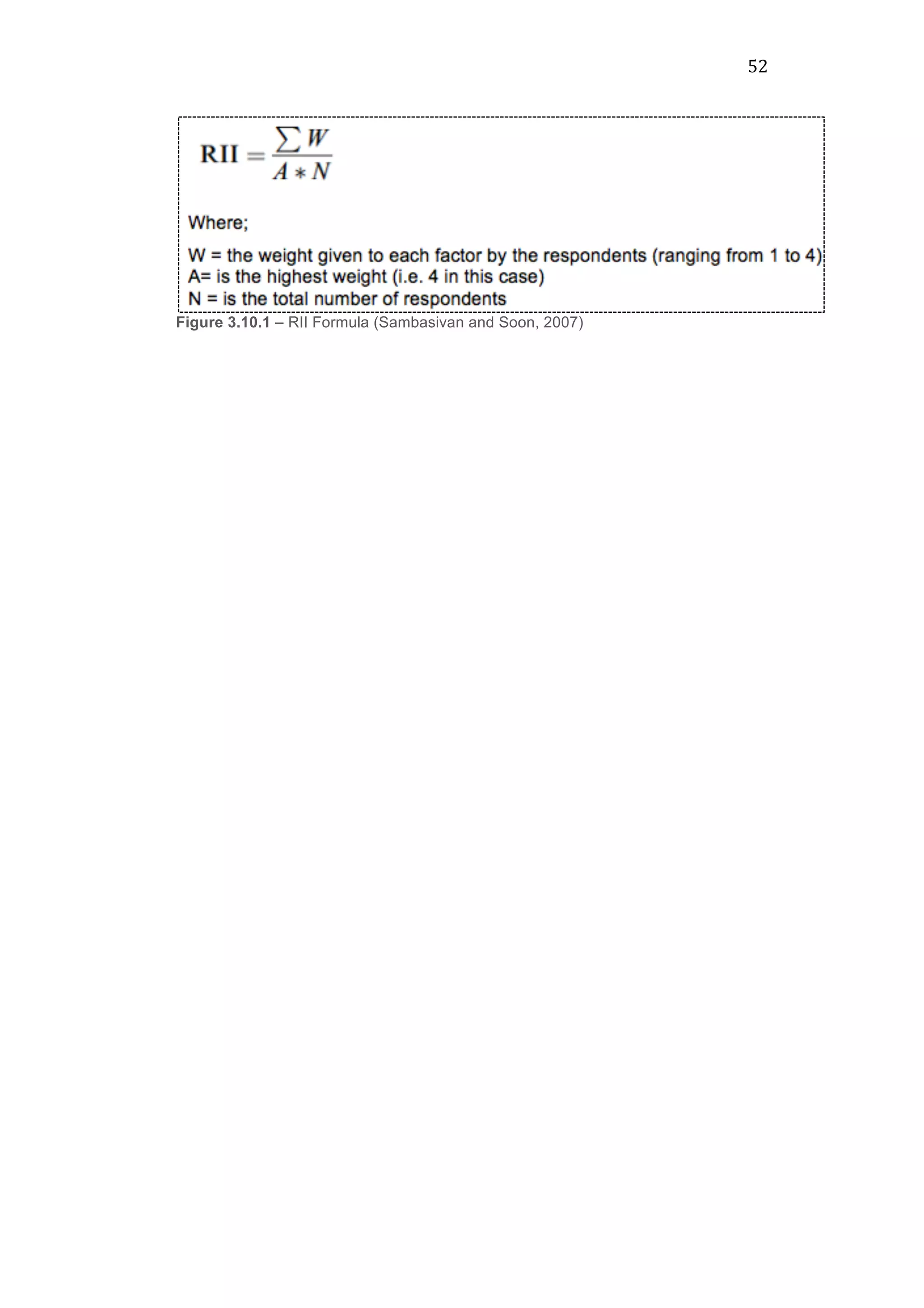
Figure No. 3.10.1 Relative Importance Index Formula 52
	
  
Figure No. 4.2.2 Type of Respondents’ Organizations 55	
  
Figure No. 4.2.3 Positions of Respondents’ Organizations 55
	
  
Figure No. 4.2.4 Education Level of Respondents 56
	
  
Figure No. 4.2.5 Respondents’ Experience Level 56
	
  
Figure No. 4.2.6 Participants’ Projects Size 56
	
  
Figure No. 4.2.7 Type of Contracts 57
	
  
Figure No. 4.2.8 Number of Projects 57
	
  
Figure No. 4.2.9 Respondents’ Delay Experience 58
	
  
Figure No. 4.2.10 Average Delayed Time 58
	
  
Figure No. 4.2.11 Average Delayed Time Granted 59	


9	
  
List of Tables


  Page
Table No. 2.1.1 Summary of Previous Studies of Project Delay Causes 17	
  
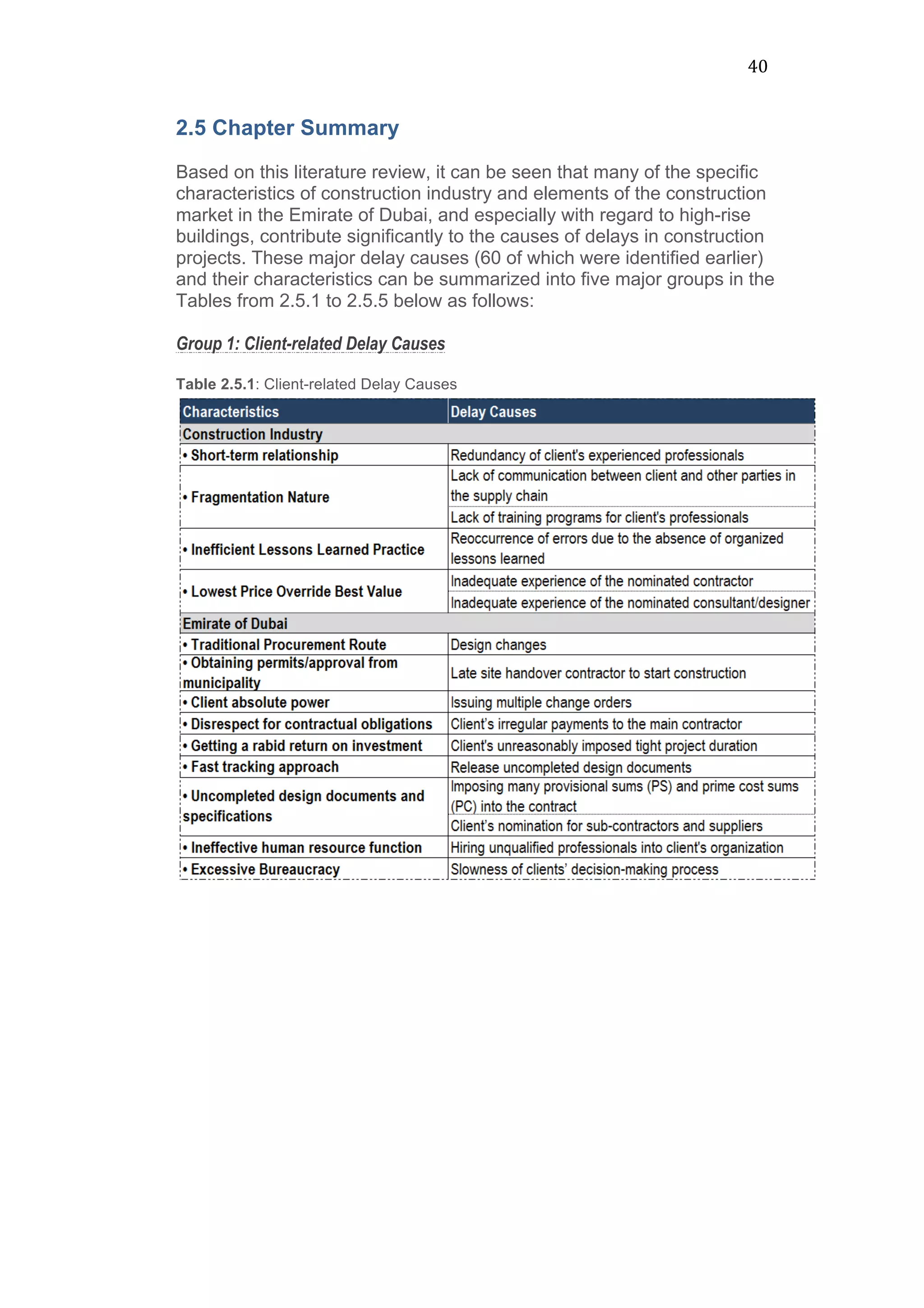
Table No. 2.5.1 Client-related Delay Causes 40	
  
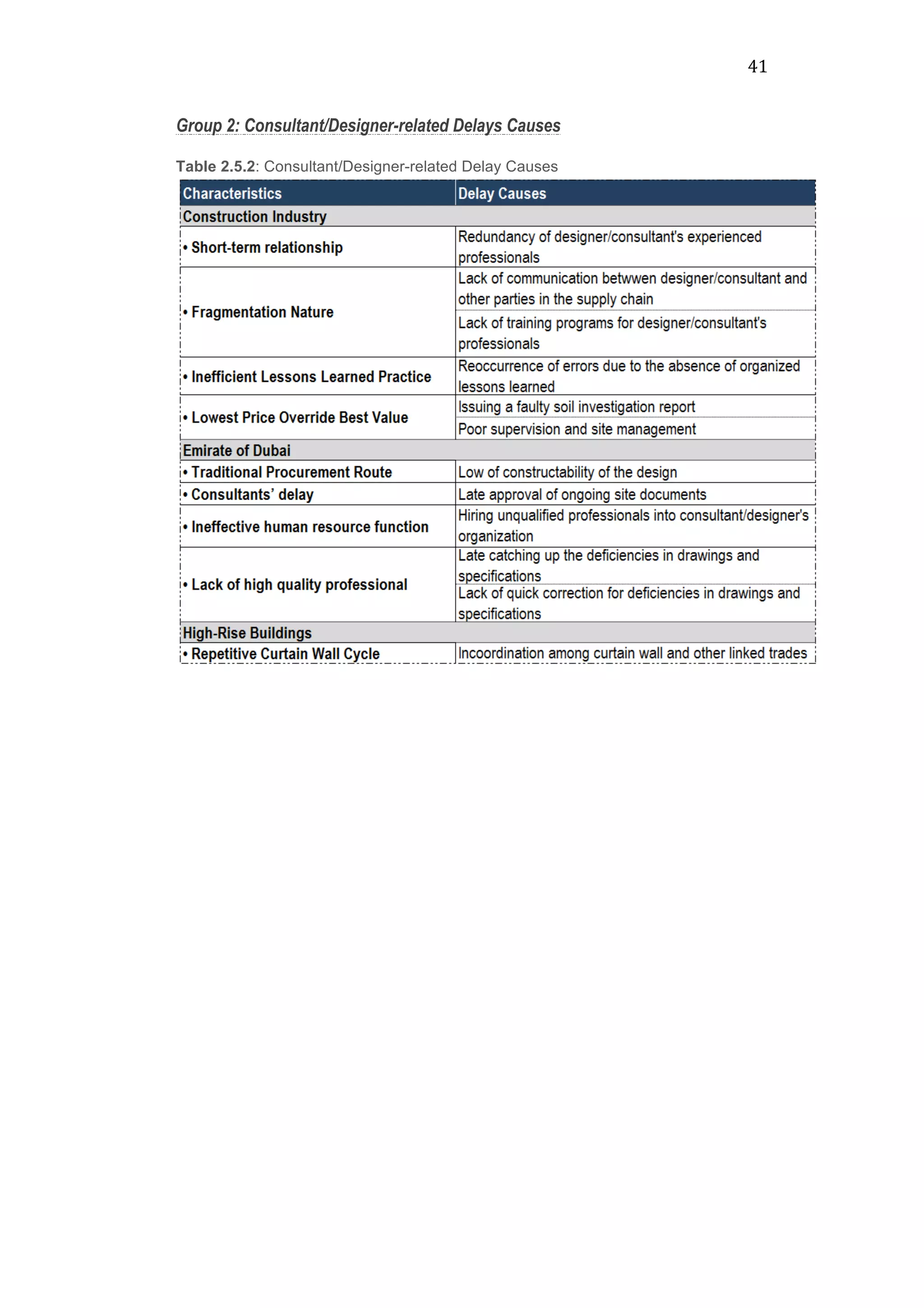
Table No. 2.5.2 Consultant/Designer-related Delay Causes 41	
  
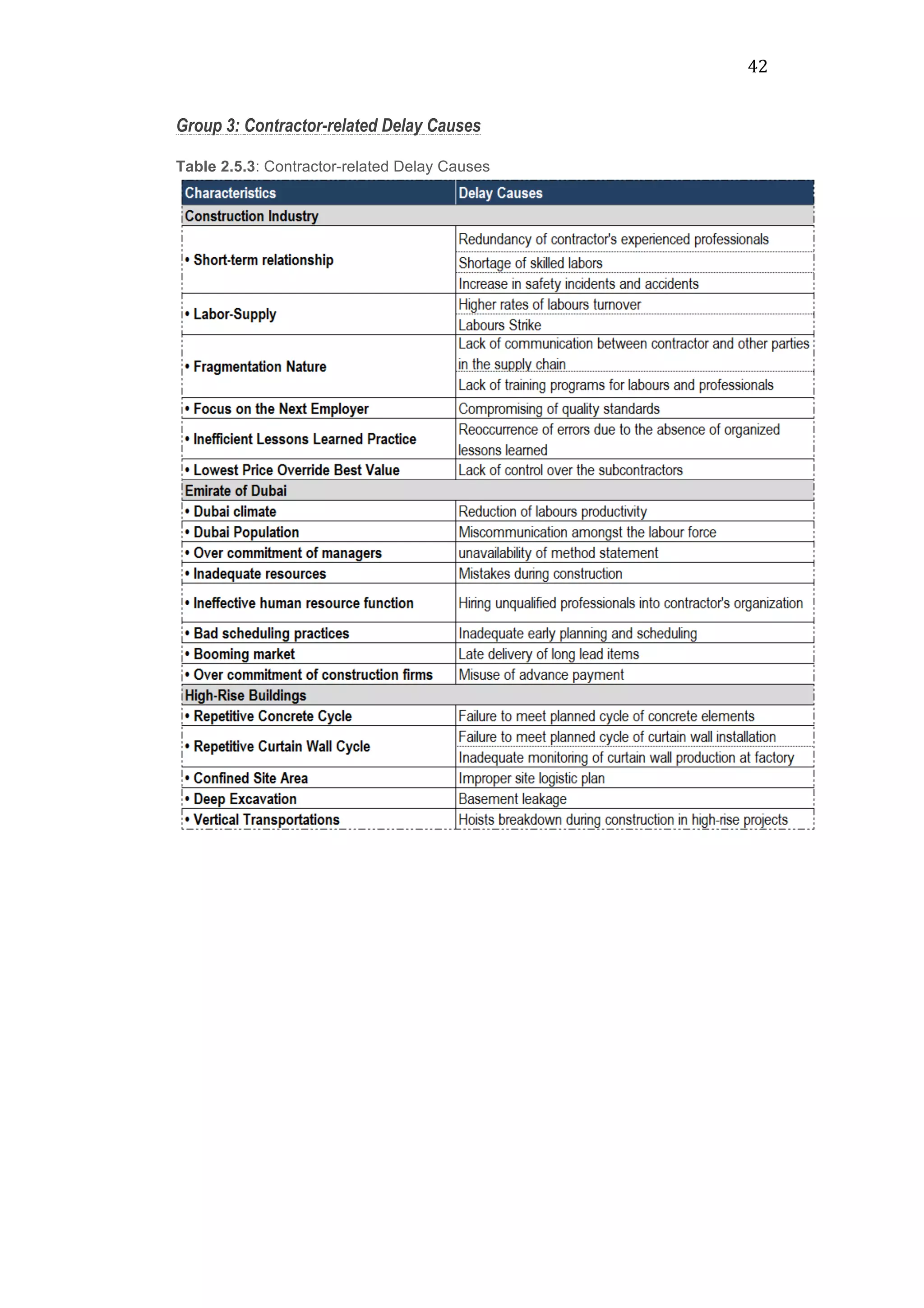
Table No. 2.5.3 Contractor-related Delay Causes 42	
  
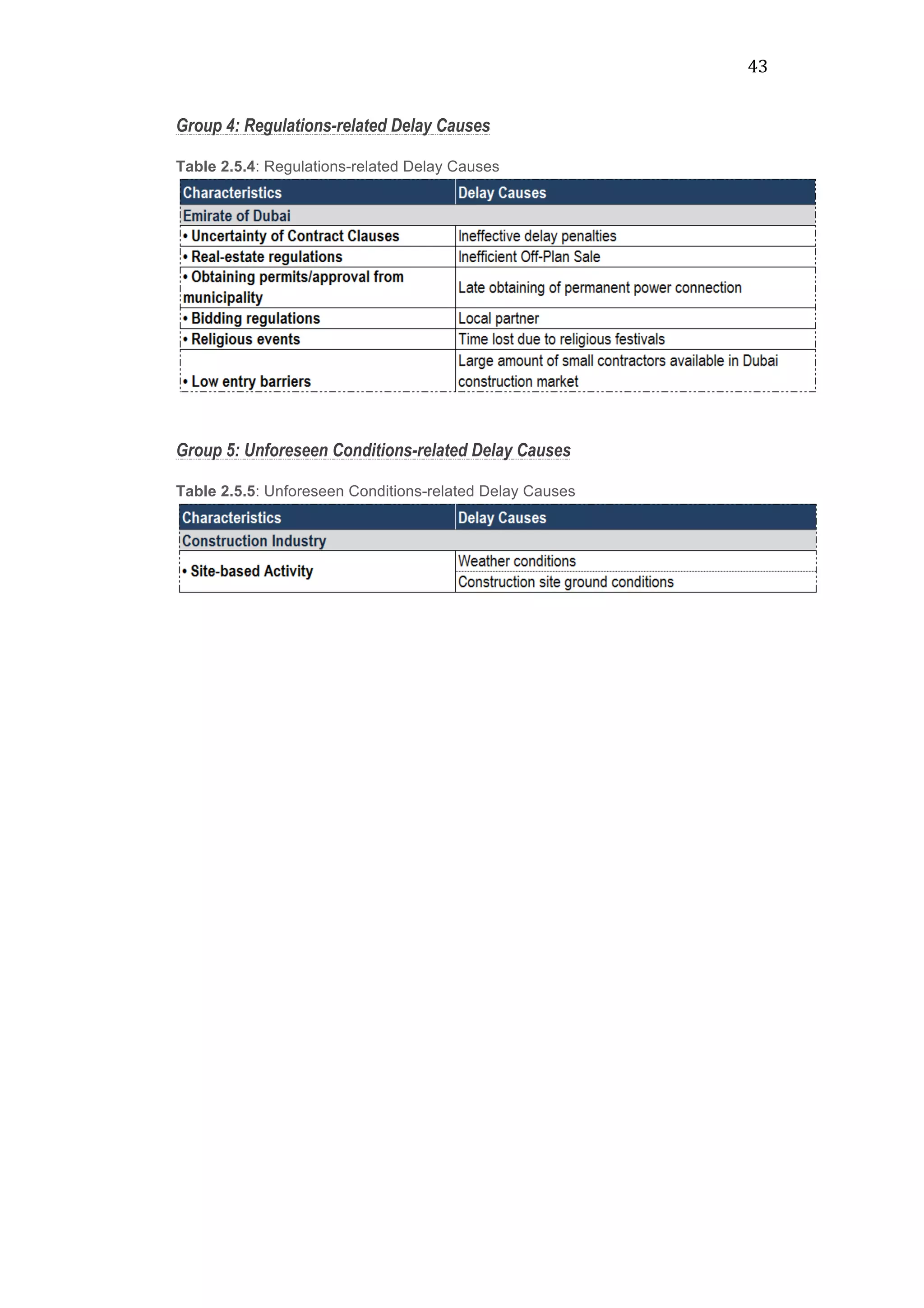
Table No. 2.5.4 Regulations-related Delay Causes 43
	
  
Table No. 2.5.5 Unforeseen Conditions-related Delay Causes 43	
  
Table No. 2.5.6 Delay Effects 44	
  
Table No. 2.5.7 Minimizing Methods of Delays 45	
  
Table No. 3.9.1 Z-Score 50	
  
Table No. 4.2.1 Questionnaire Response Rate 54
Table No. 4.2.2.1 RII and Ranking of Delay Causes 59
	
  
Table No. 4.2.2.2 Top 15 Delay Causes 61
	
  
Table No. 4.2.3.1 RII and Ranking of Delay Effects 62
	
  
Table No. 4.2.3.2 Top Seven Delay Effects 62
Table No. 4.2.4.1 RII & Ranking of Main Minimizing Methods 63
Table No. 4.2.4.2 Top Five Main-Minimizing Methods 64
Table No. 4.2.4.3 RII and Ranking of Sub-Minimizing Methods 64
Table No. 4.2.4.4 Top Six Sub-Minimizing Methods 65
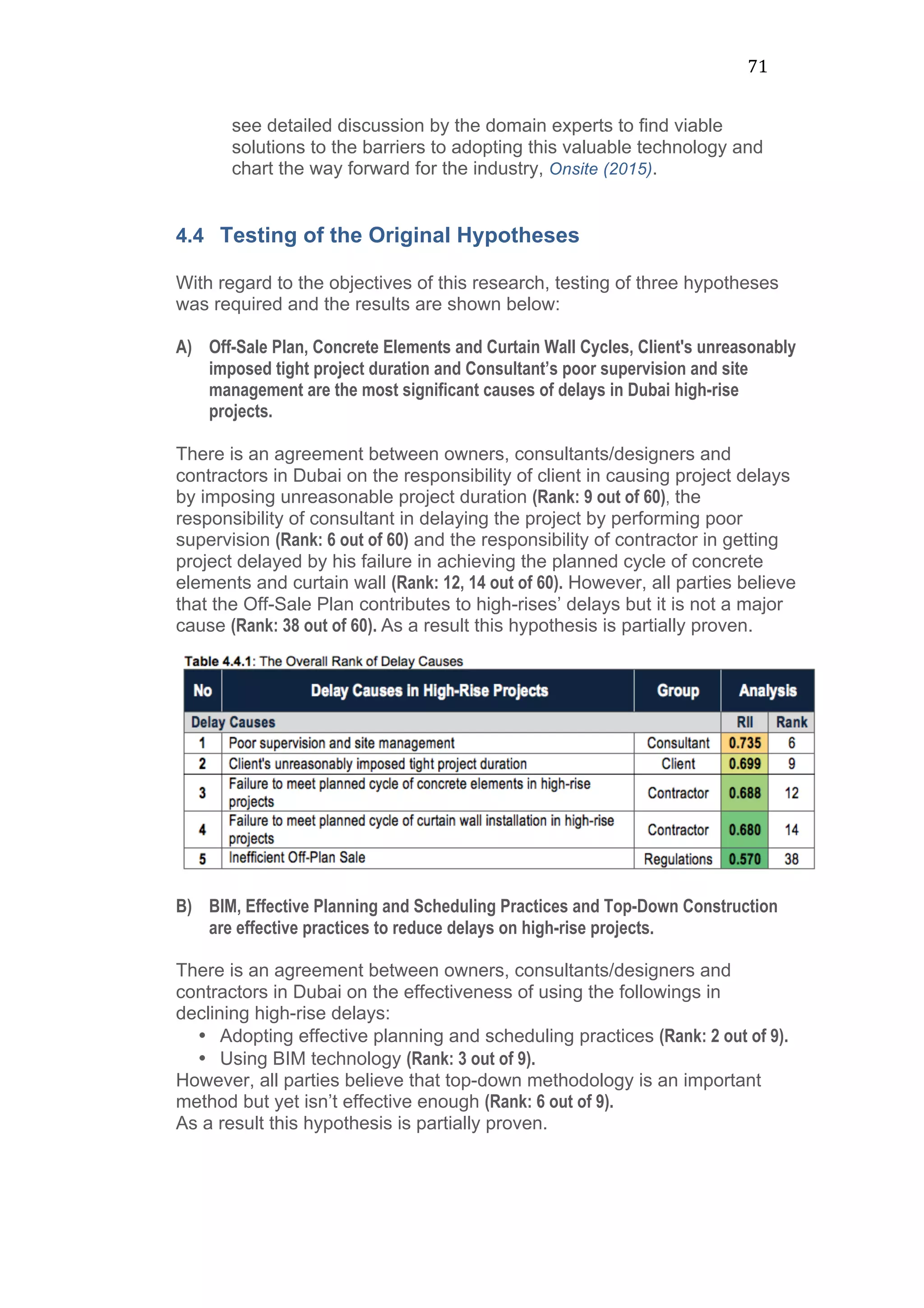
Table No. 4.4.1 The Overall Rank of Delay Causes 71	
  
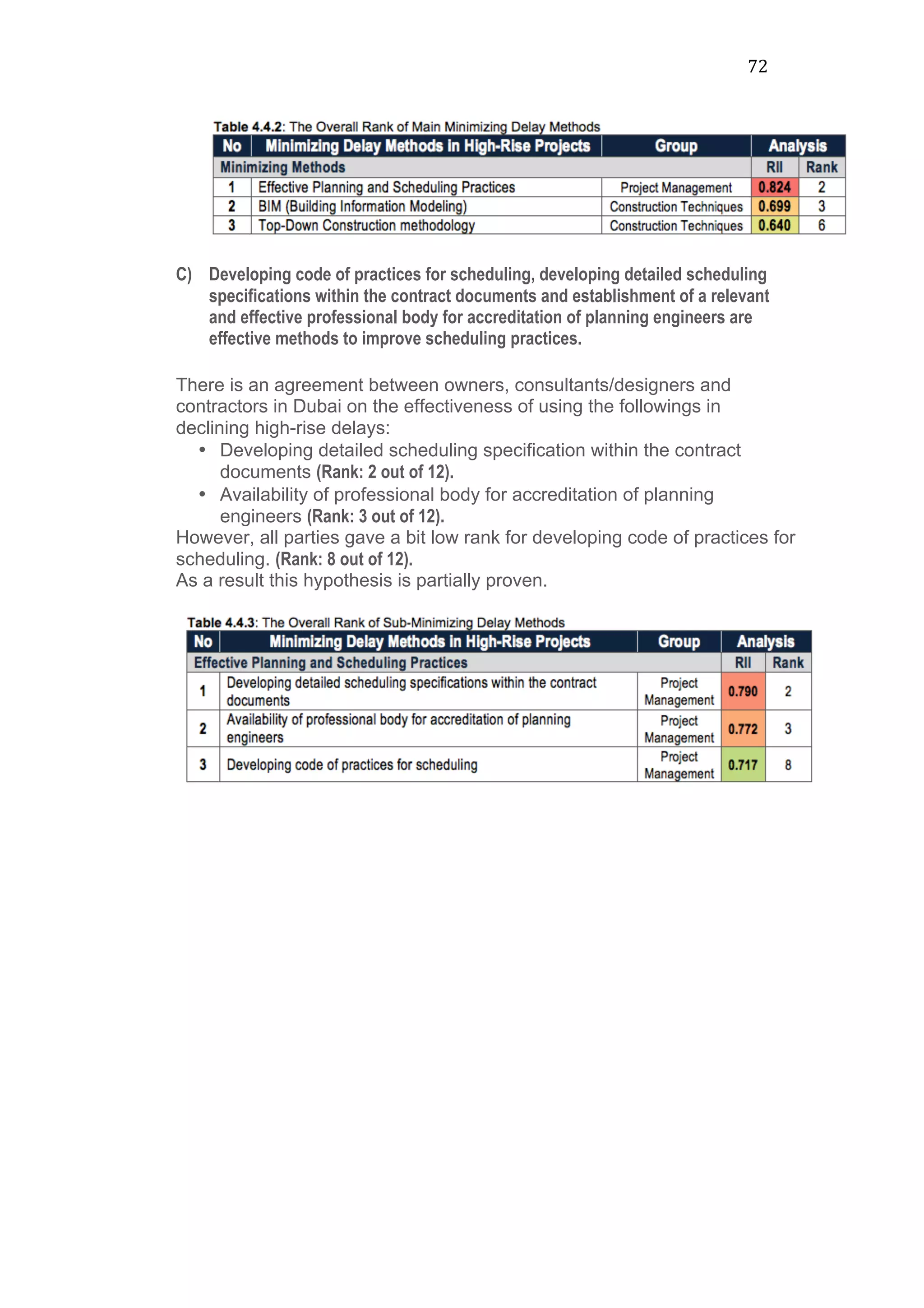
Table No. 4.4.2 The Overall Rank of Main Minimizing Delay Methods 72	
  
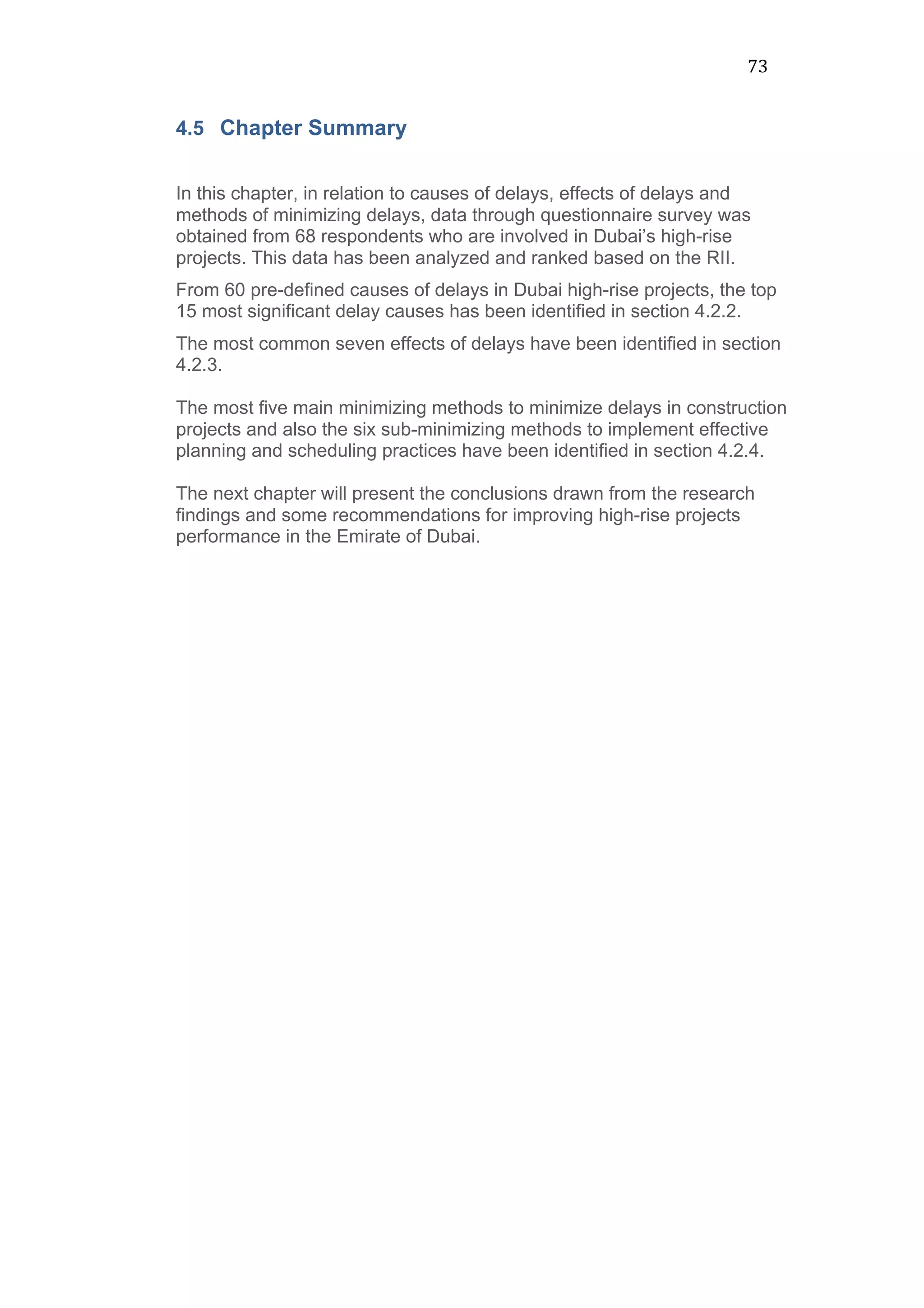
Table No. 4.4.3 The Overall Rank of Sub-Minimizing Delay Methods 72	
  
10	
  
List of Appendices


  Page
Appendix A The Cover Letter of Questionnaire 84	
  
Appendix B The Survey Questionnaire Form 86	
  
11	
  
Chapter 1
Introduction
1.1 Background of the Study
The places that we live, work and play in have an influence over the quality
of our lives and so the construction industry has a significant role to play in
society in availing a better-built environment through the creation of
facilities such as residential, office, hotel, retail, hospital and school
buildings. It can also provide infrastructure facilities, such as rail, bridge,
road, power and water plants. “Construction is an integrated process that
utilizes the full construction team, bringing the skills of all the participants
together in delivering value to the client”, Williams (1998:p.201).
The delivery of this value to the client can be attained through utilizing a
work system called the project. A project is a temporary in nature and has
clear start and end dates and specific objectives. The project offers a
unique product, service or outcome that didn’t exist before the project
initiation. The project can be considered successfully completed when the
targeted objectives are accomplished to the satisfaction of the client,
Heldman and Mangano (2011:p.2-3).
The project should achieve the objectives to the client’s satisfaction within
the specified time, cost and quality, Atkinson (1999:p.338). Therefore, time,
cost, quality and client satisfaction are generally bundled as success
criteria for any construction project. However, these objectives can be
jeopardized by delays that in most construction projects worldwide happen
regularly and have been perceived to become the norm. According to
Sweis (2008:p.666), a delay is defined as the time overrun beyond the
contract date that the parties agreed upon for delivery of the project.
Delays result in extension of project duration, which subsequently leads to
cost overrun paid for by the client, or loss of revenues encountered by the
contractor.
Doloi et al. (2011:p.480) noted that 55% of the construction projects in the
India encounter delays and are not delivered on the completion date that
has been stipulated in the contract. Also, Assaf and Al-Hejji (2006:p.349)
confirmed that the time overrun in Saudi Arabia’s construction projects is
70%, which means that 45 out of 76 projects, considered in this study,
were delayed beyond contractual completion dates.
The causes of delays in the construction industry are many and varied but
can be grouped mainly under six categories, namely; client delays,
consultants/designers delays, contractor delays, third parties delays,
unforeseen conditions and ‘Acts of God’ (i.e., force majeure).
Delays in construction projects have profound effects and repercussions
on the developers, the builders, consultants/designers, end users and
ultimately the country where the project is located. Thus the need to
identify the causes of delays becomes crucial due to the importance of
delivering projects considering the bottom lines of time, cost, quality, safety
12	
  
and client satisfaction. Identifying these causes will assist the construction
practitioners in UAE and globally to reduce, control and avoid delays and
thus improve the construction industry performance in serving the
community.
1.2 Statement of the Problem
	
  
High-rise buildings represent Dubai’s economic power. Many cities such as
Hong Kong, China, India, Malaysia and Singapore amongst others, have
achieved their economic progress through the preparation and
implementation of comprehensive plans to establish successful high-rise
investment projects, Farouk (2011:p.01).
The government of Dubai has created a strategy of diversity from a purely
oil-based economy to a service-oriented and tourism-based one thus being
able to draw substantial foreign investment into the Emirate, Ali and Al-
Kodmany (2012:p.405). Based on this strategy and due to the scarcity of
land in urban areas and the rise in land prices Revekar and Pippal (2013:
p.02), there is a growing need for buildings that rise on a smaller footprint of
land, than spread over a wider area. The need for high-rise buildings has
also emerged to serve the tourism, business and real estate sectors by
providing hotels/serviced apartments, commercial offices and residential
apartments.
Recently, the award of hosting EXPO 2020 to the city of Dubai has
provided the stimulus for more growth in building of high rise structures to
accommodate the rising needs for more hotels and serviced apartments
offering accommodation for the 25 million visitors anticipated to travel to
Dubai during the Exhibition period between October 2020 to April 2021,
MEED Insight (2013:p.20). A plan has also been established to build, in the
wake of hosting EXPO 2020, the world’s tallest commercial tower (Burj
2020), which will offer a substantial number of commercial office spaces
and proximity to metro stations, cargo facilities, airport and ports, Gulf
Business (2014).
Despite the importance of high-rise projects, for the Emirate of Dubai to
achieve the aforementioned diversification strategy and meet EXPO 2020
requirements, the construction of high-rise buildings in Dubai faces the
problem of delay throughout project execution. As mentioned by Ren et al.
(2008:p.749), delay is a common problem in the construction industry in
Dubai and this is reinforced by another study Faridi and El-Sayegh
(2006:p.1167), which indicated that 50% of the construction projects in the
UAE encounter delays that extend the time completion beyond the target
date stipulated in the contract.
Delays in the completion of high-rise projects in Dubai affect all those
involved in projects and the city itself in a such way that actionable
solutions need to be proposed and recommended urgently in order to
achieve the Emirate’s strategic aims for building high-rises.
13	
  
The current and growing importance of high-rise buildings for the Emirate
of Dubai and the effects of its late delivery were the starting point for this
research.
1.3 Aims and Objectives
In view of the criticality of 50% of Dubai construction projects being
delayed, this study was conceived and focuses on identifying the factors
that most contribute to the delays of high-rise projects in the emirate,
evaluates the effect of these delays and examines some effective methods
of minimizing their impacts. The point of departure of this research is in
proposing improvements to boost the performance of the high-rises sector
in order to ensure attraction of more investors, serve the sectors of tourism
and business, meet EXPO 2020 demands and stabilize Dubai’s variable
real estate market prices.
To attain the aims of this research, the following objectives have been
identified:
1- To identify the characteristics of construction industry, Dubai
construction environment and high-rise projects.
2- To identify the major causes of delays in Dubai high-rise projects
that result from each character and the effects of these major
causes.	
  
3- To identify the methods of minimizing these delays in Dubai high-
rise projects.	
  
Three Hypotheses are identified to realize these aims and these are:
1- Off-the plan sales, concrete elements and curtain wall cycles,
Client's unreasonably imposed tight project duration and
consultant’s poor supervision and site management are the most
significant causes of delays in Dubai High-rise projects.
2- BIM, effective planning and scheduling practices and Top-Down
construction are effective practices to reduce delays on high-rise
projects.
3- Developing codes of practice for scheduling, developing detailed
scheduling specifications within the contract documents and
establishment of a relevant and effective professional body for
accreditation of planning engineers are effective methods to
improve scheduling practices.
	
  
1.4 Limitations
	
  
The research will be limited to the following:
1- The major causes of delays only.
2- High-rise buildings only.
14	
  
3- High-rise projects in the Emirate of Dubai only.
1.5 Research Methodology
	
  
The methodology that has been adopted for this research is to identify the
problem, set up the aims and objectives and perform a comprehensive
literature review to identify the characteristics of construction industry,
Dubai construction environment and high-rise projects and the related
major delays causes attributed with these characteristics. Also identify
through the literature review, the potential effects of delays in addition to
some of the applicable methods of minimizing delays.
After performing the literature review, a survey through a questionnaire will
be distributed to professionals representatives from the client,
consultants/designers and contractor organizations then the data collected
from the questionnaire will be analyzed to draw conclusions, test
hypotheses and make recommendations for better practices in
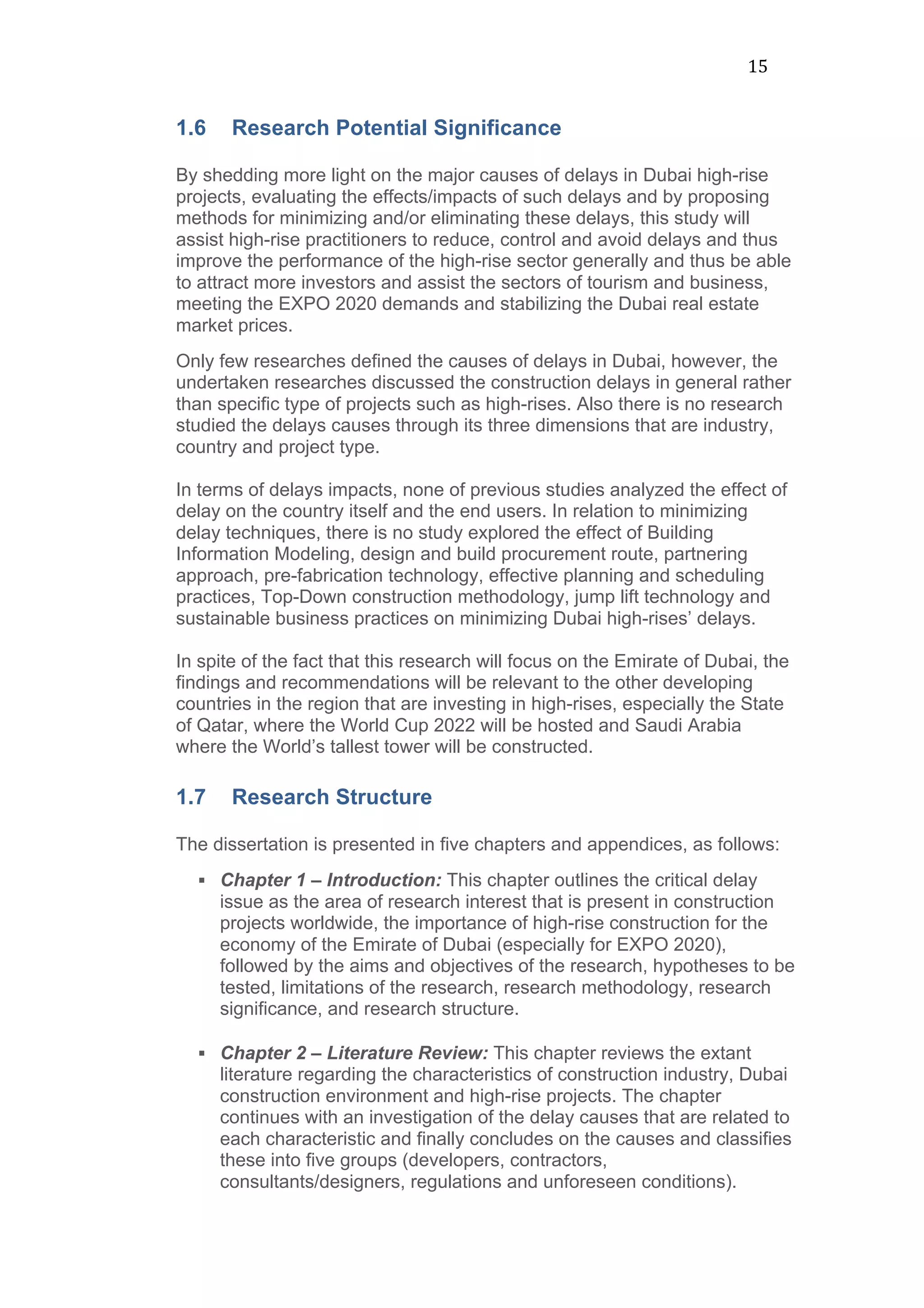
developing/constructing high-rise buildings at the Emirate of Dubai. Figure
1.5.1 below presents a schematic diagram of research methodology.
	
  
Figure 1.5.1 - Schematic Diagram of Research Methodology
15	
  
1.6 Research Potential Significance
	
  
By shedding more light on the major causes of delays in Dubai high-rise
projects, evaluating the effects/impacts of such delays and by proposing
methods for minimizing and/or eliminating these delays, this study will
assist high-rise practitioners to reduce, control and avoid delays and thus
improve the performance of the high-rise sector generally and thus be able
to attract more investors and assist the sectors of tourism and business,
meeting the EXPO 2020 demands and stabilizing the Dubai real estate
market prices.
Only few researches defined the causes of delays in Dubai, however, the
undertaken researches discussed the construction delays in general rather
than specific type of projects such as high-rises. Also there is no research
studied the delays causes through its three dimensions that are industry,
country and project type.
In terms of delays impacts, none of previous studies analyzed the effect of
delay on the country itself and the end users. In relation to minimizing
delay techniques, there is no study explored the effect of Building
Information Modeling, design and build procurement route, partnering
approach, pre-fabrication technology, effective planning and scheduling
practices, Top-Down construction methodology, jump lift technology and
sustainable business practices on minimizing Dubai high-rises’ delays.
In spite of the fact that this research will focus on the Emirate of Dubai, the
findings and recommendations will be relevant to the other developing
countries in the region that are investing in high-rises, especially the State
of Qatar, where the World Cup 2022 will be hosted and Saudi Arabia
where the World’s tallest tower will be constructed.
	
  
1.7 Research Structure
	
  
The dissertation is presented in five chapters and appendices, as follows:
§ Chapter 1 – Introduction: This chapter outlines the critical delay
issue as the area of research interest that is present in construction
projects worldwide, the importance of high-rise construction for the
economy of the Emirate of Dubai (especially for EXPO 2020),
followed by the aims and objectives of the research, hypotheses to be
tested, limitations of the research, research methodology, research
significance, and research structure. 	


§ Chapter 2 – Literature Review: This chapter reviews the extant
literature regarding the characteristics of construction industry, Dubai
construction environment and high-rise projects. The chapter
continues with an investigation of the delay causes that are related to
each characteristic and finally concludes on the causes and classifies
these into five groups (developers, contractors,
consultants/designers, regulations and unforeseen conditions).	
  
16	
  
Effect of these delays on the Emirate of Dubai, end users, developers
and other project stakeholders are also considered from the literature.
Methods for minimizing of delays are proposed to reduce or eliminate
the causes of the identified delays.
Finally, a list of major delays causes (classified into five groups) in
Dubai high-rise projects, effects of these delays and minimizing
methods are concluded for the sake of preparing the questionnaire
survey.	


§ Chapter 3 – Research Methodology: This chapter outlines the
rationale behind the selected research method, how the questionnaire
is designed, how the participants are selected, methods of
questionnaire distribution and collection, sample size determination
and data analysis methodology.
§ Chapter 4 – Results and Discussion: This chapter presents the
data collected from the questionnaire, details the analysis of the data
and discusses the results of the analysis and the results of testing the
three hypotheses.
§ Chapter 5 – Conclusions and Recommendations: This chapter
provides conclusions for the research and makes recommendations
for future study and for improvements in high-rise construction
projects in the Emirate of Dubai.
§ Appendices: The appendices will be made up of references and
survey questionnaire cover letter and form.
17	
  
Chapter 2
Literature Review
	
  
2.1 Chapter Introduction
In chapter 1, the background and rationale for the research was
presented, aims, objectives and significance discussed and the basic
research problem and areas of interest were outlined. Chapter 2 now
reviews relevant literatures on the subject of delays in construction projects
in an attempt to examine the delay causes, effects and minimizing
methods in Dubai projects in order to fill the gap in the area of knowledge
related to the subject of construction delays in Dubai’s high rise projects.
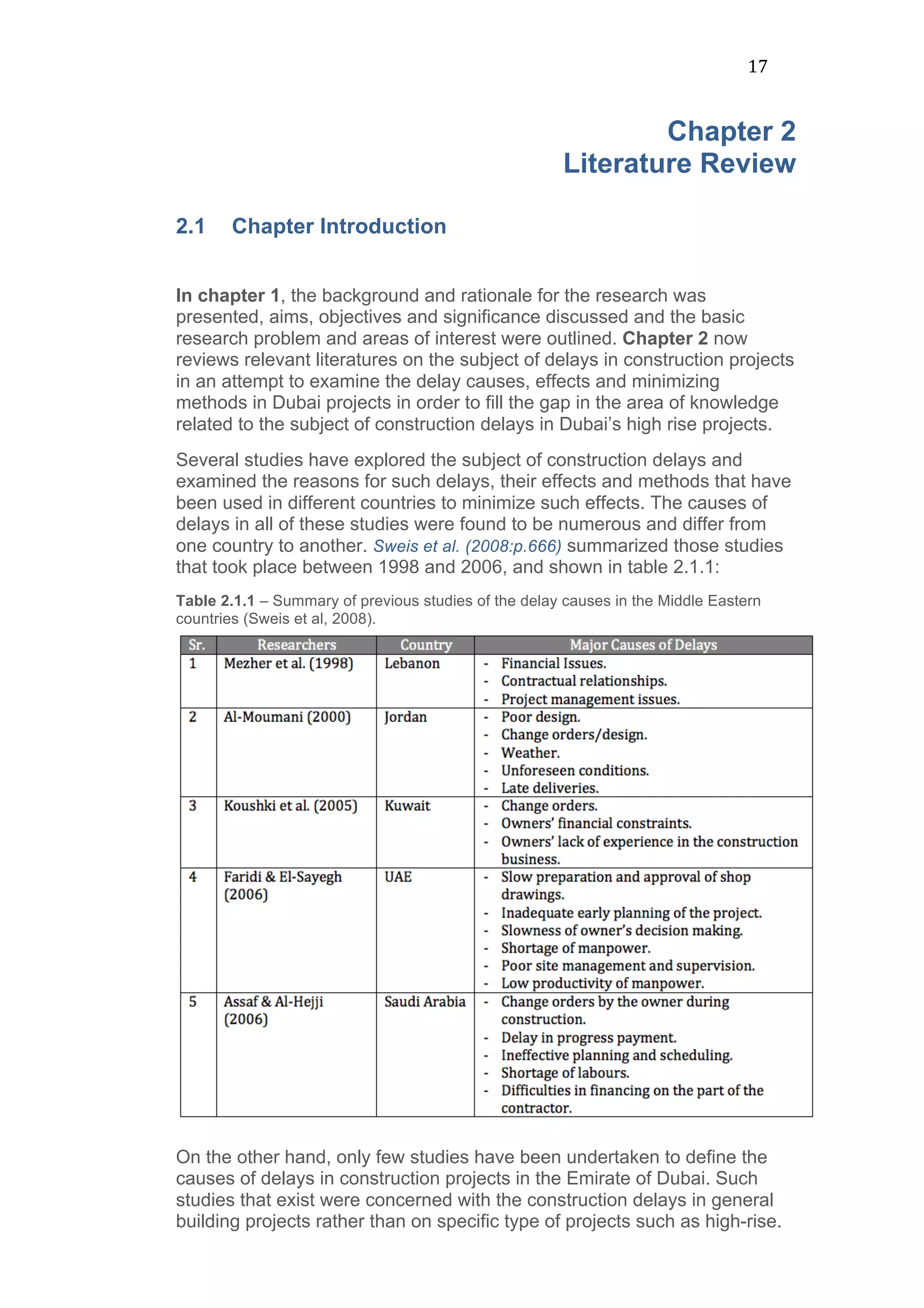
Several studies have explored the subject of construction delays and
examined the reasons for such delays, their effects and methods that have
been used in different countries to minimize such effects. The causes of
delays in all of these studies were found to be numerous and differ from
one country to another. Sweis et al. (2008:p.666) summarized those studies
that took place between 1998 and 2006, and shown in table 2.1.1:
Table 2.1.1 – Summary of previous studies of the delay causes in the Middle Eastern
countries (Sweis et al, 2008).
On the other hand, only few studies have been undertaken to define the
causes of delays in construction projects in the Emirate of Dubai. Such
studies that exist were concerned with the construction delays in general
building projects rather than on specific type of projects such as high-rise.
18	
  
To date, no formal studies have identified the causes of delays in relation
to Dubai’s high-rise projects with their unique features and challenges.
Moreover, no study has actually analyzed the main sources of delay
causes in construction projects. The delay causes need to be scanned
through specific dimensions in a similar fashion to a PEST analysis, which
analyses the four dimensions of a commercial market (Political, Economic,
Social and Technology), where the business will take place, Hancock (2008:
p.8-5).
The delay causes on construction projects covered in this study are
examined through the three dimensions of a construction market (industry
characteristics, country characteristics and project type characteristics).
Most of the previous studies in UAE focused on particular delay effects
such as cost, time, quality, disputes, etc., but none of the previous
research shed light on the effects of delay on the country itself or the
project end users.
Previous studies recommended several methods for minimizing delays in
the UAE but amongst them there is no study exploring the effects of
utilizing BIM (Building Information Modeling) techniques, design and build
procurement methodologies, partnering approach, pre-fabrication
technology (modular technique), effective planning and scheduling
practices, Top-Down construction methodology, jump lift technology and
sustainable business practices on minimizing high-rises’ delays in the
Emirate of Dubai.
2.2 Three Dimensions of Delay Causes
2.2.1 The Characteristics of the Construction Industry Globally and
Associated Delay Causes
	
  
The construction industry has unique characteristics that differ from other
industries, e.g. manufacturing. It is therefore important to first understand
the specific characteristics of the construction industry in order to conclude
the potential delay causes attributed with these characteristics. These
characteristics and the potential demerits within them are listed below:
Characteristic 1: Short-term relationship: the construction projects have a start
and end date for carrying out the pre-agreed scope of work between the
developer and the contractor, thus the project is temporary in nature and
the relationship between the project team members can be described as a
short-term relationship. This short-term relationship more than any other,
has labeled the construction industry as having a lack of continuity, Nawi et
al. (2014:p.03). The potential delay causes associated with the short-term
relationship are as follows:
• “Redundancy of experienced professionals’’- It is difficult to make
use of the team members full experience that has been gained in
previous projects, because they are continually changing, Dubois
and Gadde (2002:p.629). Nesan (2012:p.48) confirmed that the
19	
  
construction knowledge is often tacit and although initially retained
by the individuals undertaking a project, disappears once the project
is completed. Also, William (1998:p.201) pointed out that many firms
choose a new team for each project, which ultimately may destroy
the experience and development of knowledge that has been
gained by any one team on its previous projects. Laterally, this
happens in cases where the team members cannot be mobilized to
another project within the same firm; this happens often in the
construction industry due to the fluctuation of workload that makes it
very difficult to keep all the workers employed on a permanent
basis, Myers (2007:p.2-11).
• “Shortage of skilled labours’’- as many skilled labours are obliged to
become self-employed, or to leave the industry when they have
been terminated upon project completion, often they become unable
to secure another job, especially during recession times. Moreover,
a shortage of skilled labours can also happen when contractors are
unwilling to provide development training to the workers, as there is
a likely chance to lose more experienced workers to other firms in
case of failure in securing more projects in the future, International
Labour Office Geneva (2001:p.39). Egan (1998:p.19) confirmed that it is
specifically the short-term relationship that inhibits the development
of skilled and experienced teams.
• “Increase in safety incidents and accidents’’- the numbers of safety
incidents and accidents among temporary workers often can
increase as the short-term relationship encourages the workers to
work for longer hours in order to make the most money through the
overtime rates paid, International Labour Office Geneva (2001:p.36).
Also, due to them being temporarily employed, often they are less
likely to be provided with the training or instruction needed to work
safely. Safety incidents and accidents consume project time as they
affect the labour productivity due to the investigating and reporting
that takes place after an accident, Doloi et al. (2012:p.483).
Characteristic 2: Labour-Supply: labour supply refers to the practice of
outsourcing labourers to the contractor. In the construction industry the use
of sub-contracted labour-supply has now became the norm as confirmed
by, Hancock (2007:p.1-7). The majority of contractors across the world prefer
the option of subcontracted labour-supply because it is cheaper than
employing and being responsible for the welfare of direct labourers, as
these temporary workers are not entitled to holiday pay, redundancy
money, sick leave, pension rights and the other benefits that are linked
with permanent work positions, Myers (2007:p.87).
The potential delay causes associated with labour-supply approach is
“higher rates of labour turnover’’ as the labourers employed through
subcontractors are not treated the same way as directly employed
labourers so that the job search in another firms is always pursued for
seeking permanent positions and more competitive wages, Svedaite and
Tamosiunas (2013:p.66). Also “labour strikes” are a result for the unfair
wages, which could be associated with the subcontractor labour-supply
practice.
20	
  
Characteristic 3: Fragmentation Nature: Nawi et al. (2014:p.03), have described
fragmentation, as being due to the large number of firms involved overall
on construction projects. Coffey (2010:p.116), referred to up to nine levels of
sub-contractors employed to undertake various portions of the work in
Hong Kong residential projects under a main contractor who managed the
project.
In Dubai, there are 8,170 construction companies listed by the Dubai
Chamber of Commerce and 73% of these are small firms with less than 20
employees, Bakheet (2007:p.05).
Nawi et al. (2014:p.01) added that fragmentation refers also to the problem
of coordination between different organizations (client, local authorities,
consultant, contractors, subcontractors, etc.) during design and
construction.
The potential delay causes associated with fragmentation in both of its
forms are as follows:
• “Lack of communication in the supply chain’’- poor communication
has been recognized in the fragmented industry among the client,
local authorities, designers, main contractor, subcontractors,
quantity surveyor, suppliers, facility manager and specialists during
design and construction phases and even in handover phases, Nawi
et al. (2014:p.04). The poor communication leads to increases in
design and construction time in addition to cost increase variations.
• “Lack of training programs’’- due to the small size of majority of
construction firms, there is no budget allocated for training the
labour force or providing continuing professional education to
professionals employed within contractor organizations.
Characteristic 4: Focus on the Next Employer: the construction industry tends
not to care so much about the current client, once a contract is progressing
but is already looking for tendering for the next one. Construction
companies perform little researches into what their clients are actually
looking for, Egan (1998:p.13) and Myers (2007:p.86). Furthermore, the
construction industry has no defined process for auditing client satisfaction
comparable with other industries such as in electronics or car
manufacturing.
The potential delay causes associated with focusing on the next employer
are generally the “compromising of quality standards’’ whilst undertaking
construction tasks leading to rework that causes delays to the project, Doloi
et al. (2012:p.485).
Characteristic 5: Inefficient Lessons Learned Practice: in construction projects,
the lessons learned are not well organized so that it is not easy to capture
and transfer these lessons to other projects, Egan (1998:p.27).
The potential delay causes associated with the absence of this practice is
the “Reoccurrence of errors due to the absence of organized lessons
learned’’ during the project execution, several unprecedented problems are
21	
  
solved, which are not documented for others to learn. This will give chance
for repeating the same mistakes and get projects delayed.
Characteristic 6: Site-based Activity: unlike manufacturing industry, which is a
factory-based, construction is an open site-based activity. Being an open
site activity generally means there are external factors that influence the
construction process. These factors are weather that affects the
construction of super structure and ground conditions that affect the
construction of sub-structure.
The associated delay causes with construction being a site-based activity
are termed “ weather conditions’’ and “ground conditions’’ which both set
back the project progress and cause delay to the overall project completion
date, El-Sayegh and Faridi (2006:p.1167-1172).
Characteristic 7: Lowest Price Overriding Best Value: In the construction
industry, clients tend to not differentiate between obtaining the best value
and selecting the lowest price. In his report ‘’Rethinking Construction’’ Egan
(1998:p.07) confirmed that the majority of clients are selecting
designers/consultants and contractors exclusively on the basis of lowest
tendered price.
The potential delay causes associated with focusing on the lowest bids
are:
• “Inadequate experience of the nominated contractor’’ and
“Inadequate experience of the nominated consultant/designer’’- as
there is difficulty in providing quality and good service when the
contractors and designers/consultants have been selected on the
basis of lowest cost and not the previous project experience or
delivered quality levels, Egan (1998:p.14). Furthermore, this
perceived inadequacy of experience of contractors and consultants
leads to the phenomenon of “consultant’s poor supervision and site
management’’ and “lack of main contractor’s control over the
subcontractors’’. In addition there is the preparing and issuing of “a
faulty soil investigation report’’, which is the responsibility of the
nominated designer and is considered to be one of the main
reasons for increased project durations and adds more risks for
contractors, Doloi et al. (2012:p.482).
2.2.2 The Characteristics of Construction Market in Dubai and
Associated Delay Causes
	
  
Dubai has unique characteristics that differ from other countries. It is quite
important to understand these characteristics in order to conclude the
potential delays causes attributed with them. These characteristics have
been specifically discussed in articles by Ren et al. (2008:p.749-751) and El-
Sayegh and Faridi (2006:p.1167-1176) and these characteristics are listed
below:
22	
  
Characteristic A: Contractual relationship
• Traditional procurement approach- most of the construction projects in
Dubai adopt the traditional procurement approach where the designer is
responsible for design and then the contractor for execution.
The potential delay causes associated with this approach are “design
changes’’ and “low of constructability of the design’’ as explained by Kong
and Gray (2012:p.51) and Nawi et al. (2014:p.03). Design changes during
construction issued by clients occur relatively easily and often in the
traditional procurement approach, which causes delay to the project as
discussed in the research of Assaf and Al-Hejji (2006:p.353). Also the low
constructability of design due to the absence of contractor input into the
design, leads to rework, increasing costs and longer construction duration,
Nawi et al. (2014:p.03).
Characteristic B: Climate:
	
  
• Dubai climate- Dubai has dry hot weather and humid environment
especially during the summer.
The associated delay cause is “reduction of labour productivity’’, Ren et al.
(2008:p.750). The declining levels of labour productivity lead to delay in the
site progress as confirmed by El-Sayegh and Faridi (2006:p.1167-1174).
Characteristic C: Laws and Regulations
• Uncertainty of Contract Clauses- the use of liquidated damages (LDs)
globally is an incentive (or a threat) to contractors to facilitate delivery of
projects on time and for avoidance of delay. As confirmed by Mullen (2013),
the application of LDs under UAE law presents a degree of uncertainty as
the enforceability of the LDs clause is handled differently in Dubai to most
places elsewhere in the world. Simply the judge can on own
recognizances, revise the original contract agreement between the two
parties in the favor of either client or contractor.
The associated delay cause is “ineffective delay penalties’’; hence
increasing the probability of extending project completion, as confirmed by
Assaf and Al-Hejji (2006:p.352).
• Real-estate regulations- the regulations governing escrow1
accounts help
developers to collect the majority of apartment sale price prior to handing
over the unit to the buyer, contrary to the regulations in other jurisdictions,
for example in Canada, where the developer can only receive the balance
of 80% of unit selling price just after the unit handover, Naini (2011:p.130).
The associated delay cause is “Inefficient Off-Plan Sale’’, that is declining
the developer’s incentive to deliver the units on time since the trustee
allows a release of 95% of the purchasers’ payments held to the developer


1	
  A	
  deed,	
  a	
  bond,	
  money,	
  or	
  a	
  piece	
  of	
  property	
  held	
  in	
  trust	
  by	
  a	
  third	
  party	
  to	
  be	
  turned	
  over	
  to	
  
the	
  grantee	
  only	
  upon	
  fulfillment	
  of	
  a	
  condition	
  (Merriam	
  Webster,	
  2016)	
  http://www.merriam-­‐
webster.com/dictionary/escrow	


23	
  
before the units are even registered in the name of the purchasers and
therefore often buyers wait an unusually long time for their development
that they have already largely paid for in advance, Naini (2011:p.132).
• Obtaining permits/approval from municipality- the obtaining of approval from
the municipality to start construction activities and connect different utilities
into the completed buildings such as potable water, power, drainage, gas
and communication sometimes involves a long period of administration
causing inactivity on projects, especially if there is no early planning, or
there is inefficient preparation by developers and insufficient time
dedicated by contractor to obtaining these permits. 	
  
The associated delay causes of this phenomenon are “late of site
handover to start construction’’ and “late obtaining of a permanent power
connection’’. The permanent electricity connection to the completed
buildings is always very late and the developers are regularly struggling to
connect power to their buildings. Some properties in Dubai have stood
empty for more than a year while waiting for electricity to be connected, as
confirmed by McGinley (2012).	


• Bidding regulations- according to UAE law, foreign firms wishing to bid for
projects must form a Joint Venture (JV) or other partnership with the local
companies.
The associated delay cause due to the current bidding regulations is
termed “local partner’’ as there always differences in the work procedures
and systems between the foreign firm and its local partner. The local
partner must have at least 51% share of the joint venture, which gives him
the authority to make immediate decisions and in case conflict arises it is
not easy to change the local partner’s decision. This can affect the work
progress at site, Ren et al. (2008:p.750).
Characteristic D: Demographic:
• Dubai population- Emiratis make up only 20% of the total population of
UAE and the other 80% are basically comprised of expatriate labourers
and professionals who are on work visas provided by UAE Immigration
Department, Gallacher (2009:p.13). The workforce in construction industry in
the UAE is made up of mixed nationalities, which often results in confusion
due to critical languages barriers among labourers.
The associated delays cause is termed “miscommunication amongst the
labour force’’ as often affects the work progress at site, Ren et al.
(2008:p.756).
Characteristic E: Cultural Norms:
• Client absolute power- it is normal in Dubai for clients to issue a change
order after undertaking a site visit without considering taking the necessary
prompt action with respect to their contractual obligations. The associated
delay cause is “issuing multiple change orders’’.
24	
  
• Disrespect for contractual obligations- some of clients in Dubai don’t always
take a swift action with respect to their contractual obligations related to
payments to their contractors, Ren et al. (2008:p.756). 	
  
The associated delay is “client’s irregular payments to the main
contractor’’ as it is common in Dubai for contractors to experience delays
in the monthly payment from clients, which disturbs their cash flow and
subsequently affects their payment to sub-contractors and suppliers. Late
payments are one of the critical delay causes in Dubai projects, El-Sayegh
and Faridi (2006:p.1172).	
  
• Religious events- like Christmas festive in the West that has an impact on
the project progress, in the UAE and during the Holy month of Ramadan it
was found that there is a serious decline in the progress at site.
The associated delay cause is “time lost due to religious festivals’’ is
further compounded by contractors producing optimistic schedules without
considering these interruptions.
Characteristic F: Operation Environment:
• Low entry barriers- with bid/tender list entry thresholds set at a capital
requirement of less than one million dirhams, there are large numbers of
small contractors that win bids who are not able to eventually execute large
or medium size projects. The associated delay cause with the low entry
barrier is ‘‘large amount of small contractors’’.
• Getting a rapid return on investment- developers often impose unrealistic
contract duration times in order to start realizing rapid return on their
investment, El-Sayegh and Faridi (2006:p.1171). The associated delay is
“unreasonably imposed tight project duration’’. Mistakes made regarding
setting of a realistic project time estimation, or the intentional imposition of
compressed contract durations cause delays later to the project
• Fast tracking approach- it is usual for developers in Dubai to urge their
designers to complete design work within a very short period of time, which
prevents the designer providing a complete set of design documents for
subsequent construction.
The delay associated with such client behavior is “release incomplete
design documents’’. The effect of unreasonable timeframes for design
teams to produce clear and complete design output, is producing
documentation that contain errors and discrepancies, which later hinder
the project progress, Zaneldin (2006:p.458).
• Incomplete design documents and specifications- either due incomplete
materials selection/specification, or specialized works descriptions, at the
time the contract commences, the developer isn’t always in position to
specify or select these materials for purchase. 	
  
The associated delay is ‘‘imposing many provisional sums (PS) and prime
cost sums (PC) into the contract’’ the subsequent ratification of PS and PC
sums later on downstream during project execution stages, disturbs the
25	
  
project schedule and hinders the contractor achieving a timely project
completion. Another associated delay is the “developer’s nomination for
sub-contractors and suppliers’’ as the developers prefer to hire their own
sub-contractors and suppliers for the specialized works, they often,
according to the contract agreement, instruct the main contractor to enter
into a sub-contract agreement based on certain conditions such as
advance payment, duration and penalties that in most cases don’t suit the
main contractor and later on causes conflicts and delays until the final
agreement is signed.	


• Consultants’ delay- it is time-consuming for consultants in Dubai to
approve documents submitted by the contractor such as; requests for
information, material submittals, shop drawings and method statements.
The associated delay is “late approval of ongoing site documents’’.
• Over commitment of managers- most of contractors’ project managers in
Dubai are over committed as they often have more than one role to play
within the same project or they may be engaged in more than one project.
The associated delay is “unavailability of method statement’’ as the
contractors’ project managers don’t have the enough time to prepare the
method statements. The method statement may hinder the contractor from
commencement of work in case the method statement is not available or
approved.
• Inadequate resources- due to the high demand for labourers in Dubai
projects, the majority of hired labourers are from South Asia and may have
inadequate training or limited experience. The associated delay is
“mistakes during construction’’.
	
  
• Ineffective human resource function- most of site roles cannot be filled by
professionals with the required experience or knowledge due to the lack of
experienced human resources staff who have the ability to hire talents
within tight time constraints on the majority of projects. The associated
delay is “hiring unqualified professionals’’.
• Bad scheduling practices- in several projects, there was a lack of data
available for estimating activity duration, resource overestimation of
productivity, inadequate progress monitoring and the lack of incorporating
requirements for schedule control in the contract documents, El-Sayegh and
Faridi (2006:p.1172). The associated delay cause is “inadequate early
planning and scheduling’’ Assaf and Al-Hejji (2006:p.356).	
  
• Lack of high quality professional- some of the consultant’s site staff in Dubai
don’t have enough experience in design practices thus the design
problems can’t be discovered until the contractor raises queries.
Furthermore they don’t always possess confidence in issuing instructions
to correct errors in the drawings and any discrepancies in the contract
documents until they consult with their managers. The associated delay is
“late catching up the deficiencies in drawings and specifications’’ and “lack
of quick correction for deficiencies in drawings and specifications’’. The
late catching/correction of contract documents errors leads to more delay
26	
  
as the progress will be declined and furthermore, the municipality needs
extra time to approve the new design solution/modification, Ren et al.
(2008:749-p.755).
• Excessive bureaucracy- the excessive bureaucracy in making the
decisions in the client side leads always to “slowness of clients’ decision-
making process’’, Assaf and Al-Hejji (2006:p.352), which affects the progress
at site.	
  
Characteristic G: Booming:
	
  
• Booming market- the construction market in UAE is currently booming and
therefore all major suppliers are busy to satisfy the on-going projects
concurrently. The associated delay with the booming period is “late
delivery of long lead items”. Mismanaging procurement of long-lead items
that need longer delivery periods, leads to project delay, Harbin and
Daneshgari (2014:p.45).
• Over commitment of construction firms- given the current high demand in
the Dubai construction market, most of the construction firms are over-
loaded by taking on more projects than they can judiciously manage so
that it is common in Dubai that the advance payment which is paid by client
to the contractor upon project commencement, is used by contractor to
finance other urgent or more profitable projects, other projects therefore
suffer delays. The associated delay is “misuse of advance payment’’.
2.2.3 The Characteristics of High-Rise Building Projects and
Associated Delay Causes
	
  
High-rise buildings have unique characteristics that differ from the other
types of buildings. It is crucial to understand these characteristics in order
to draw conclusions about the potential delay causes attributed to them.
These characteristics are listed below:
	
  
Characteristic I: Repetitive Concrete Elements Cycle:
Due to the repetitive nature of high-rise building, one-day delay in
executing concrete elements (slabs, columns and core walls) for a high-
rise of 60 stories in the first floor cast, potentially means 60 days
accumulated delays if the delay continues and hasn’t been mitigated in the
construction of subsequent floors. However, in a low-rise building of 8
stories the comparative delay effect is only 8 days, which can more easily
be mitigated. This means that the concrete elements cycle in high-rise
projects is a major cause for delays if it is not planned and executed
properly from the outset. According to Leung et al (2003:p.01), in
construction of high-rise buildings, one of the most critical topics is to
ensure the completion of the structural frame in order to form floor areas
for the execution of finishing and electromechanical services works. The
structural frame is on the critical path in the overall schedule of work, Leung
et al (2003:p.01).
27	
  
The associated delay is “failure to meet planned cycle of concrete
elements’’, which will delay delivering the high-rise concrete structure and
subsequently the project completion date will slip considerably.
Characteristic II: Repetitive Curtain Wall Cycle:
External cladding on high-rise buildings maintains indoor air quality, during
the construction phase, Acuna (2000:p.31). Suitable indoor air quality is
compulsory to provide in order to start the finishing and fit out work inside
each floor. For instance, the gypsum board ceiling needs before the
installation commencement, an airtight area to avoid the humidity and sea
spray, which can cause severe damage to the ceiling panels, as illustrated
by Knauf (2014:p.13).
The associated potential delays are “failure to meet planned cycle of
curtain wall installation’’ which will delay the dependent finishing works and
thus delay the project completion. Also “inadequate monitoring of curtain
wall production at factory’’ which will affect the timely delivery of material to
site to commence panels installation and thus achieve the planned cycle of
curtain wall panels. Finally, “lack of coordination among curtain wall and
other linked trades’’ such as façade lighting, which will delay the glazing
panel production and thus delay the planned cycle at site.
Characteristic III: Confined Site Area:
The allocated area for material storage at site is a common logistic
challenge in construction of most high-rise buildings due to the often-
limited size of construction site, often in urban or city centre conditions,
Kumar and Singhal (2011:p.179).
The associated delay is ‘‘improper site logistic plan’’ which leads to
disruption and project delay.
Characteristic IV: Deep Excavation:
High-rise buildings need deep excavation for the foundations and in Dubai;
this nearly always experiences a ground water table that adds uplift
pressure on foundations after being cast. The ground water table and its
uplift pressure affect the building if serious cracks in concrete are existed.
The associated delay is “basement leakage’’ as these cracks offer a
pathway for ingress of ground water inside the basements due to concrete
shrinkage and/or foundation settlement, Davidson at el. (2014:p.245). Water
leakage in basements of high-rise buildings has an impact on the timely
delivery of the building, as it delays the other trades (finishing and
electrometrical services) at underground levels (parking levels).
Characteristic V: Vertical Transportation:
The use of exterior hoists for vertical transportation up to and between
working areas during construction is an important process. Moving the
required workers and materials with these hoists at the right time is crucial
to the work progress on any high-rise project.
28	
  
The associated delay is “hoist breakdowns during construction’’ as these
inoperative hoists may cause project delay due to cables becoming twisted
in the high winds, Kone (2014:p.01).	
  
2.3 Effect of Delays
Delays in completion of high-rise projects in Dubai affect the developer, the
end user, the builder, the designer/consultant and the city itself. The
adverse effects of delays on different stakeholders are as follows:
Developer: the delays in handing over the high-rise projects on time will
affect adversely the developer as it will cause substantial monetary
damages as explained below;
1. Cost overruns resulting from extending the project beyond its
completion date and the cost of acceleration in order to mitigate the
delays as confirmed by Sambasivan and Soon (2007:p.517). Both costs
have to be paid by the developer they influence or cause the delays.
2. High-rise developers always take loans from the banks to build and
pay back the loan by collecting money from the apartments buyers
using an ‘’Off-Plan Sale’’, Fattah (2011). Off-plan sale offers the
developer the opportunity to collect a percentage of the apartment
sale value early from the buyer, even before the commencement of
the construction on site.
Apartment buyers in Dubai pay 10% to 15% of sale contract price
upfront and make further installments based on how much work has
been completed (progress at site). This means the less progress at
site, the less payment comes from buyer to the developer and thus
the more difficulty for the developer in paying back the loan to the
bank plus the burden of increasing the borrowing cost due to the
longer duration of interest charges.
3. Developers may suffer losing their contracts with the buyers if they
delay handing over the purchased apartments to those buyers in
accordance with formal contract periods and by agreed legal
completion dates. This is exacerbated by the fact that buyers now
have the right according to the new law drafted by Dubai Land
Department, Standard Chartered (2013:p.04), to cancel their contracts
with the developer and have all of their paid money refunded.
End User (Buyer): the delay in handing over the apartment units to the end
user (buyer) on the date stipulated in the Purchase Sales Agreement
(PSA) between the developer and buyer, will cause, according to Naini
(2011:p.132), substantial monetary damages to the buyer due to:
1- Loss on potential rental/sale property price, which it may be at peak
value for only a certain period of time. For instance, before the
global financial crisis, which hit Dubai in 2008, the rent and sale
prices were at peak value and then were deeply slashed due to the
crisis, Irwin and Shukurov (2014:p.04). Buyers who were delivered the
29	
  
keys late after at this time, lost the opportunity to rent or sale their
own property at elevated prices as they originally planned. As
mentioned previously, around half of the projects in Dubai before
the crisis of 2008 underperformed as explained by John (2007) who
noted that during 2007, 50% of the on-going Dubai residential
projects were expected to be delayed by up to two years beyond
their original scheduled completion dates.
2- Difficulty in paying-back the bank loan due to the delay of getting
return on their investment.
3- Increase buyer’s frustration, uncertainty and distrust of high-rise
investment activity in Dubai.
The Emirate of Dubai: the delays in handing over the high-rise buildings on
time will affect the Emirate of Dubai as explained below:
1- The inflation may become a real consequence of any failure in
handing over the EXPO 2020 focused high-rises projects on time.
This inflation could result from a need arising to accelerate the
delayed projects, as the only option available for developers to
deliver on time. However, this acceleration will push the cost of
materials and labour up, especially given that another global-scale
event, the FIFA World Cup, will take place in neighboring Qatar in
2022, Irwin and Shukurov (2014:p.11). These increases will fuel
inflation through the Emirate of Dubai.
2- Residential property prices have increased at a fast pace with the
returned investors confidence in Dubai real estate market, improved
construction market regulations, population growth, Slim (2013:p.03)
and winning of the bid to host the EXPO 2020 event, Irwin and
Shukurov (2014:p.04). These prices will keep going up because
EXPO 2020 is expected to create 300,000 jobs and a high
percentage of these jobs will be converted into permanent ones as
confirmed by Slim (2013:p.05), and this will generate an increase in
the demand for residential units during and after EXPO 2020. As a
result, the Dubai real estate market needs more supply of residential
units in order to meet the increased demand and also to control the
price inflation in the real estate sector. Availing these units on time
without ‘’delay’’ will stabilize the market earlier and reduce
overheating of real estate prices, Standard Chartered (2013).
3- There will be a significant impact on Dubai resulting from any delays
in handing over on time the high-rise buildings for hotels and hotels
serviced apartments that are dedicated for EXPO 2020. The failure
to meet EXPO 2020 construction demands will affect negatively the
Emirate’s image and after recovering from the 2008 financial crisis,
weaken again the trend of returning confidence in Dubai’s economy
worldwide. This confidence is enviable as confirmed by Irwin and
Shukurov (2014:p.09), as it will lead to more tourists and businesses
attracted to the emirate of Dubai.
30	
  
Builder (Contractor): the delays in handing over the high-rise projects on time
due to builder influence and contribution can cause the following issues to
occur:
1- Cost overruns, inflation in labour and materials prices and the
application of liquidated damages, which may significantly reduce
builders’ profit margins.
2- Increase the safety incidents and accidents amongst labourers on
site due to compromising of safety standards when fostering the
option of acceleration in order to catch up on the delays.
3- Impose an adverse effect on builder reputation as confirmed by
Afshari et al. (2011:p.42), as contractor reputation is important for
winning future business but the inability to deliver on time will limit
the chance of securing more business in the future, especially with
the same developer, KPMG (2009:p.2).
Designer/Consultant: late handing over the high-rise projects on time due to
designer/consultant influence and contribution in delays can cause the
following:
1- Loss of part of the pre-agreed professional service fees as the
designers/consultants monthly payment might be linked with Key
Performance Indicators (KPIs). The loss of fees might be a result to:
ü Incidence of claims awarded to contractor due to design
errors and negligence.
ü Failure of designer to predict accurately time and cost for the
project.
ü Incidence of claims awarded to contractor due to late
response and negligence by consultant related to the cycle of
review, approvals and inspections during the construction
period.
2- Loss of consultant/designer reputation is a result of the project
delays.
2.4 Methods of Minimizing Delays
There is a need to establish methods that help in minimizing the
construction project delays and the knock-on impact on cost, quality and
client satisfaction. Several researchers have provided research-based
recommendations on suitable methods for minimizing delays on
construction projects.
These methods offal within the domains of contractual arrangements,
construction methodology and techniques, project management and
manpower/real estate rules. Some of the more successful methods that
can be used to tackle individually or collectively these four categories are:
31	
  
Method 1: Partnering: “It is essential to create long-term relationships
throughout the supply chain on the basis of mutual interest in order to
improve the construction delivery in terms of time, cost and quality”, Egan
(1998:p.29). The CIOB describes partnering as ‘’ a management approach
used by two or more organization to achieve specific objectives by
maximizing the effectiveness of each participant’s resources’’, CIOB
(2010:p.06).
Partnering can tackle the fragmentation issue as confirmed by the findings
of an earlier study by Chan et al. (2003:p.523). Apparently, partnering can
reduce the requirement for contract award based solely on competitive
tendering; hence clients can be assured that they are getting value for
money in terms of the efficiency and quality of the deliverables, Egan
(1998:p.31).
Egan (1998:09) confirmed in his report ‘’Rethinking Construction’’ that
where the partnering is used over a series of construction projects, the
expected cost savings could reach 50% and the time reduction could reach
80%.
In the UK, AGENT (a major commercial developer) has used a partnering
approach in order to reduce its capital costs by 33% and total project time
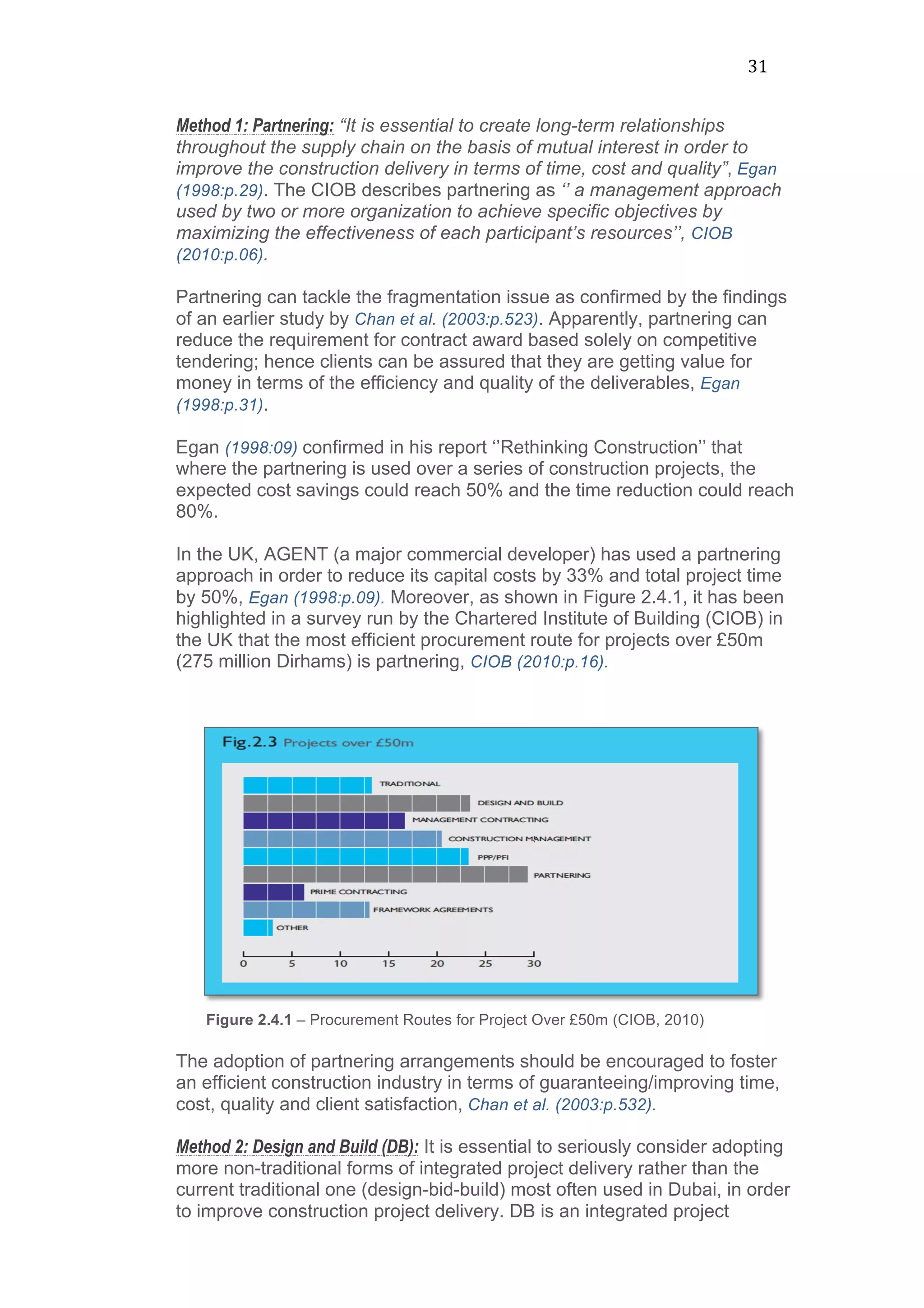
by 50%, Egan (1998:p.09). Moreover, as shown in Figure 2.4.1, it has been
highlighted in a survey run by the Chartered Institute of Building (CIOB) in
the UK that the most efficient procurement route for projects over £50m
(275 million Dirhams) is partnering, CIOB (2010:p.16).
Figure 2.4.1 – Procurement Routes for Project Over £50m (CIOB, 2010)
The adoption of partnering arrangements should be encouraged to foster
an efficient construction industry in terms of guaranteeing/improving time,
cost, quality and client satisfaction, Chan et al. (2003:p.532).
Method 2: Design and Build (DB): It is essential to seriously consider adopting
more non-traditional forms of integrated project delivery rather than the
current traditional one (design-bid-build) most often used in Dubai, in order
to improve construction project delivery. DB is an integrated project
32	
  
delivery approach, where the contractor is involved in the design stage,
Koch et al. (2010:p.01). This allows the contractor’s experience and
constructability knowledge to be harnessed right at the front end of a
project, which helps to achieve a better back-end (Execution Stage)
delivery.
DB is a procurement route where the client has to provide a brief that
consists of clear and comprehensive bid documents (RFP) and design
sketches prepared by the client’s appointed consultant, Ling (2012:p.12).
The appointed contractor then undertakes the detailed design based on
the client’s brief, Davis (2008:p.11), and subsequently is engaged for the
construction of the project.
The DB route allows the contractor to offer their clients a guaranteed price,
high level of quality, project time reduction, single point of responsibility,
constructability, better co-ordination and control on the type of materials
and method of construction without the need to add a large contingency to
the offered price, Ling (2012:p.12-16).
The DB route is being used at an increasingly rapid pace, as made evident
from different countries. In the last ten years in the UK, the use of DB has
increased, and it is estimated that up to 25% of all new build construction
work is based on this form of procurement. In the USA, 33% of the current
construction projects are using DB.
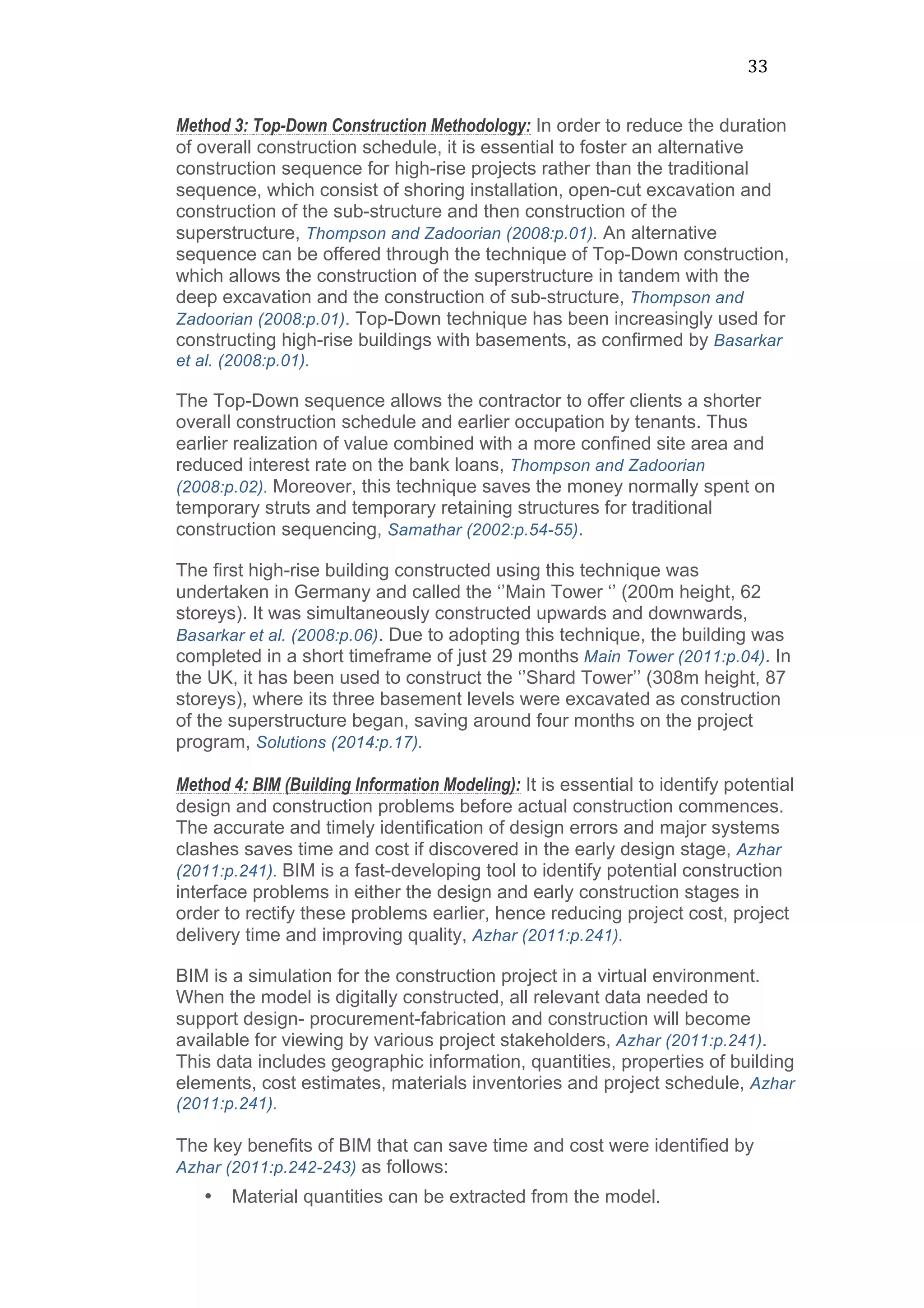
As shown in Figure 2.4.2, it has been highlighted in a survey run by the
CIOB in the UK that the most efficient procurement route for projects
between £5m and £50m (28-275 million Dirhams) is DB, CIOB (2010:p.16).
The efficacy of the use of DB in large projects has been confirmed also in
study for Ling (2012:p.13-14).
Figure 2.4.2 – Procurement Route for Projects between £5m and £50m (CIOB, 2010)
The adoption of DB should be encouraged for construction globally in order
to expedite the delivery time, maintain budget, sustain quality and enhance
constructability alike, Davis (2008:p.13).
33	
  
Method 3: Top-Down Construction Methodology: In order to reduce the duration
of overall construction schedule, it is essential to foster an alternative
construction sequence for high-rise projects rather than the traditional
sequence, which consist of shoring installation, open-cut excavation and
construction of the sub-structure and then construction of the
superstructure, Thompson and Zadoorian (2008:p.01). An alternative
sequence can be offered through the technique of Top-Down construction,
which allows the construction of the superstructure in tandem with the
deep excavation and the construction of sub-structure, Thompson and
Zadoorian (2008:p.01). Top-Down technique has been increasingly used for
constructing high-rise buildings with basements, as confirmed by Basarkar
et al. (2008:p.01).
The Top-Down sequence allows the contractor to offer clients a shorter
overall construction schedule and earlier occupation by tenants. Thus
earlier realization of value combined with a more confined site area and
reduced interest rate on the bank loans, Thompson and Zadoorian
(2008:p.02). Moreover, this technique saves the money normally spent on
temporary struts and temporary retaining structures for traditional
construction sequencing, Samathar (2002:p.54-55).
The first high-rise building constructed using this technique was
undertaken in Germany and called the ‘’Main Tower ‘’ (200m height, 62
storeys). It was simultaneously constructed upwards and downwards,
Basarkar et al. (2008:p.06). Due to adopting this technique, the building was
completed in a short timeframe of just 29 months Main Tower (2011:p.04). In
the UK, it has been used to construct the ‘’Shard Tower’’ (308m height, 87
storeys), where its three basement levels were excavated as construction
of the superstructure began, saving around four months on the project
program, Solutions (2014:p.17).
Method 4: BIM (Building Information Modeling): It is essential to identify potential
design and construction problems before actual construction commences.
The accurate and timely identification of design errors and major systems
clashes saves time and cost if discovered in the early design stage, Azhar
(2011:p.241). BIM is a fast-developing tool to identify potential construction
interface problems in either the design and early construction stages in
order to rectify these problems earlier, hence reducing project cost, project
delivery time and improving quality, Azhar (2011:p.241).
BIM is a simulation for the construction project in a virtual environment.
When the model is digitally constructed, all relevant data needed to
support design- procurement-fabrication and construction will become
available for viewing by various project stakeholders, Azhar (2011:p.241).
This data includes geographic information, quantities, properties of building
elements, cost estimates, materials inventories and project schedule, Azhar
(2011:p.241).
The key benefits of BIM that can save time and cost were identified by
Azhar (2011:p.242-243) as follows:
• Material quantities can be extracted from the model.
34	
  
• Fabrication and shop drawings can be generated for various
building systems.
• Interferences/clashes can be detected for all major building
systems.
In a nutshell, BIM offers a model that is described as an accurate
representation of the building elements and systems in an integrated data
environment, which enable earlier checking for the design and thus
catching up the clashes before construction commencement in order to
save costs and taper off the delivery time.
According to Azhar (2011:p.244-245), in USA, the general contractor for the
Aquarium Hilton Garden Inn project used BIM to develop architectural,
structural and MEP models. During the design development stage, 55
clashes were identified, which resulted in cost avoidance of $124,500.
Later in the construction phase, the model was updated and 590 clashes
were detected before actual construction began, which resulted in cost
avoidance of $801,565, Azhar (2011:p.244-245). If these clashes had been
left and only identified during construction, an extra cost would have been
unavoidable as well as a considerable delay.
Method 5: Modular Prefabrication Technology: It essential to identify advanced
practices in construction industry that can supplant the current ones that
are labour-intensive and surrounded by significant risks associated with
site and weather conditions, Yap et al. (2013:p.ii). Modular prefabrication
provides a transformative effect on reducing time and cost in the
construction industry and ensuring improved construction quality, Guo et al.
(2011:p.233).
Modular prefabrication technology is a process in which the building is
constructed to a high quality off-site using the same specified materials,
codes and standards as conventionally built buildings. Prefabricated
Modules are box-shipped units containing walls, floors and roofs with the
interior finishes, electromechanical systems and external façade. They are
all built in factories, shipped to site, installed and connected to form a
complete building, Yap et al. (2013:p.01).
Modular prefabrication technology allows contractors to offer their clients
various advantages according to Yap et al. (2013:p.50-56), such as:
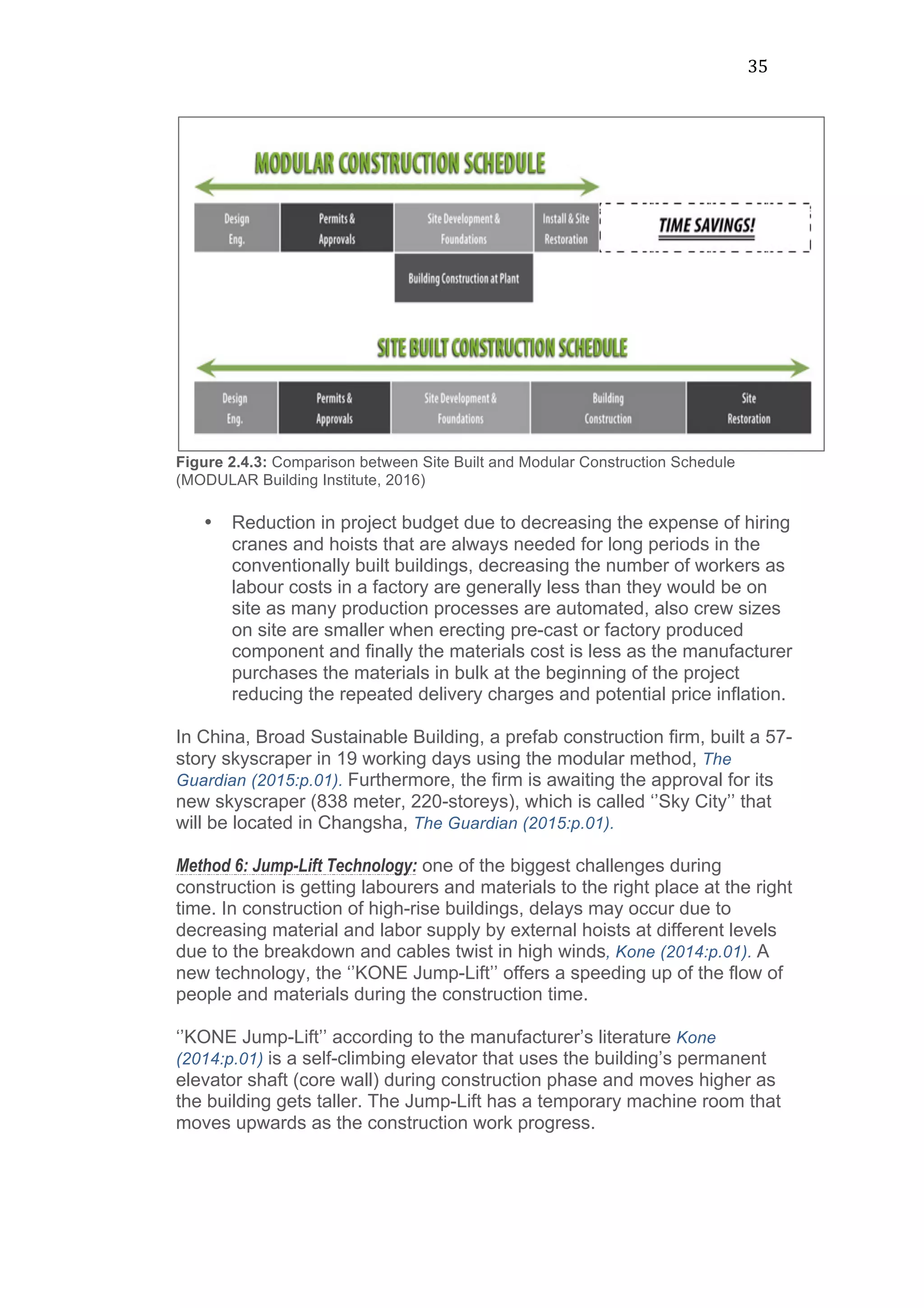
• Compression of construction schedules due to the overlapping
between module construction and site work as shown in Figure
2.4.3. This means fewer weather delays and less on-site material
staging.
35	
  
Figure 2.4.3: Comparison between Site Built and Modular Construction Schedule
(MODULAR Building Institute, 2016)
• Reduction in project budget due to decreasing the expense of hiring
cranes and hoists that are always needed for long periods in the
conventionally built buildings, decreasing the number of workers as
labour costs in a factory are generally less than they would be on
site as many production processes are automated, also crew sizes
on site are smaller when erecting pre-cast or factory produced
component and finally the materials cost is less as the manufacturer
purchases the materials in bulk at the beginning of the project
reducing the repeated delivery charges and potential price inflation.
In China, Broad Sustainable Building, a prefab construction firm, built a 57-
story skyscraper in 19 working days using the modular method, The
Guardian (2015:p.01). Furthermore, the firm is awaiting the approval for its
new skyscraper (838 meter, 220-storeys), which is called ‘’Sky City’’ that
will be located in Changsha, The Guardian (2015:p.01).
Method 6: Jump-Lift Technology: one of the biggest challenges during
construction is getting labourers and materials to the right place at the right
time. In construction of high-rise buildings, delays may occur due to
decreasing material and labor supply by external hoists at different levels
due to the breakdown and cables twist in high winds, Kone (2014:p.01). A
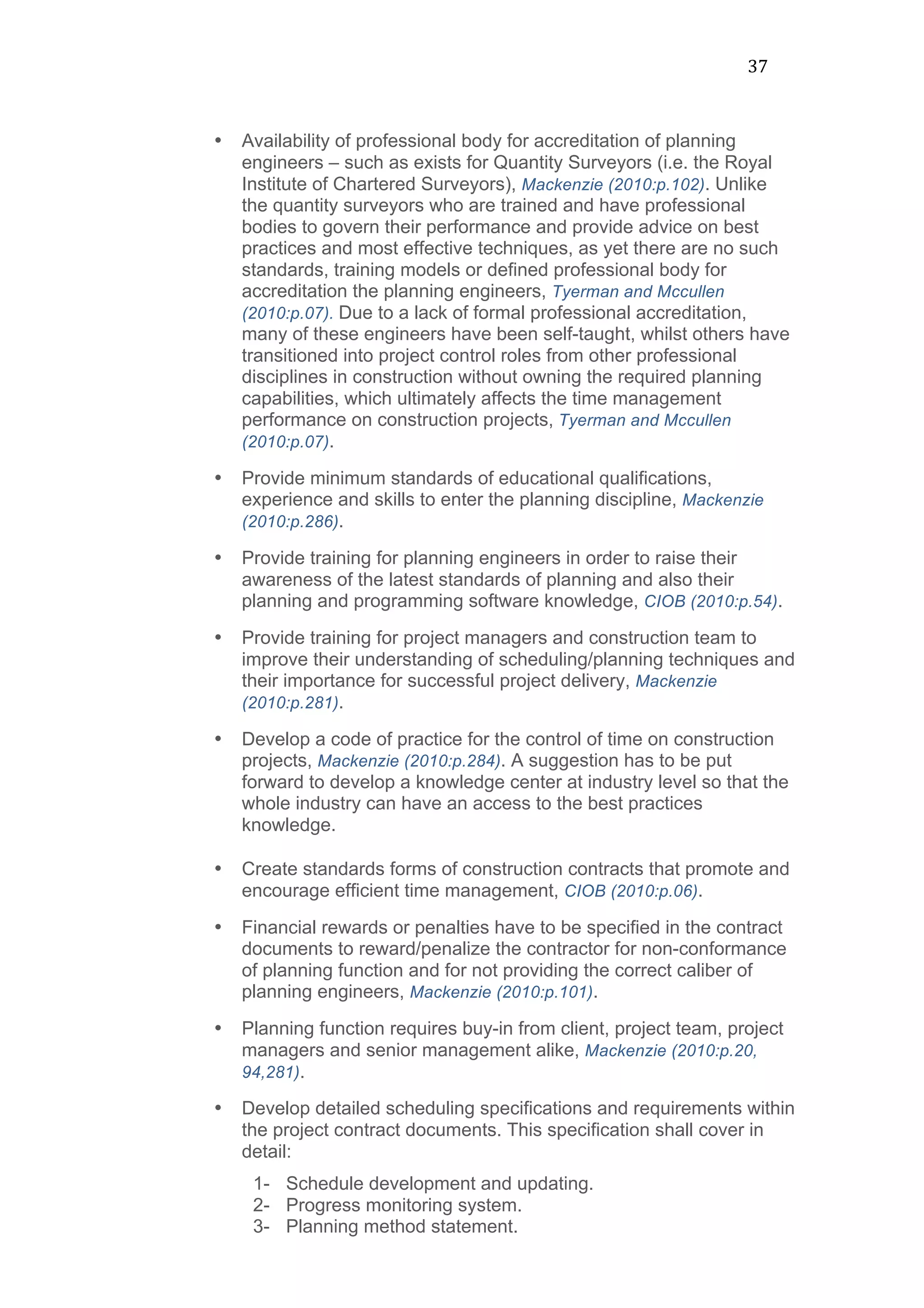
new technology, the ‘’KONE Jump-Lift’’ offers a speeding up of the flow of
people and materials during the construction time.
‘’KONE Jump-Lift’’ according to the manufacturer’s literature Kone
(2014:p.01) is a self-climbing elevator that uses the building’s permanent
elevator shaft (core wall) during construction phase and moves higher as
the building gets taller. The Jump-Lift has a temporary machine room that
moves upwards as the construction work progress.
36	
  
Figure 2.4.4: KONE Jump-Lift (KONE, 2014)
The Jump Lift can offer the following benefits, Kone (2014:p.03):
• Improved progress at site as the Jump Lift moves at 2.5 m/s, which
means less waiting time for workers in order to travel to different
levels. Also it means faster material delivery to different floors.
• Jump Lift can be used in any kind of weather, which improves the
progress at site and reduce the effect of inclement weather on site
progress.
• With all vertical transportation taking place inside the building itself,
all floors can be enclosed and finished sooner which isn’t the case
in using the exterior hoists that are attached to the building and
thus hinder the early completion of façade work and interior
finishing.
There have been several recent examples of the benefits of this new
innovative technology:
• In Singapore, during the construction of Marina Bay Sands Towers
(55-storeys), thirteen KONE Jump-Lifts were used during
construction.
• In Dubai, two KONE Jump Lifts were used during the construction of
Princess Tower (101-Storeys), Kone (2014:p.07).
Method 7: Effective Planning and Scheduling Practices: In general there is an
acute lack of efficient and effective scheduling practices, professional
standards, training and accreditation amongst the programming and
scheduling disciplines, Tyerman and Mccullen (2010:p.05). There is an
increasing need to develop new procedures for scheduling system and
process improvement to control the projects and assist in more timely
delivery, Mackenzie (2010:p.280).
Scheduling practices are the procedures, systems and process that are
used to undertake successfully the management of time on projects. Some
of the recommended best scheduling practices from extant literature
reviewed are listed below:
37	
  
• Availability of professional body for accreditation of planning
engineers – such as exists for Quantity Surveyors (i.e. the Royal
Institute of Chartered Surveyors), Mackenzie (2010:p.102). Unlike
the quantity surveyors who are trained and have professional
bodies to govern their performance and provide advice on best
practices and most effective techniques, as yet there are no such
standards, training models or defined professional body for
accreditation the planning engineers, Tyerman and Mccullen
(2010:p.07). Due to a lack of formal professional accreditation,
many of these engineers have been self-taught, whilst others have
transitioned into project control roles from other professional
disciplines in construction without owning the required planning
capabilities, which ultimately affects the time management
performance on construction projects, Tyerman and Mccullen
(2010:p.07).
• Provide minimum standards of educational qualifications,
experience and skills to enter the planning discipline, Mackenzie
(2010:p.286).
• Provide training for planning engineers in order to raise their
awareness of the latest standards of planning and also their
planning and programming software knowledge, CIOB (2010:p.54).
• Provide training for project managers and construction team to
improve their understanding of scheduling/planning techniques and
their importance for successful project delivery, Mackenzie
(2010:p.281).
• Develop a code of practice for the control of time on construction
projects, Mackenzie (2010:p.284). A suggestion has to be put
forward to develop a knowledge center at industry level so that the
whole industry can have an access to the best practices
knowledge.
• Create standards forms of construction contracts that promote and
encourage efficient time management, CIOB (2010:p.06).
• Financial rewards or penalties have to be specified in the contract
documents to reward/penalize the contractor for non-conformance
of planning function and for not providing the correct caliber of
planning engineers, Mackenzie (2010:p.101).
• Planning function requires buy-in from client, project team, project
managers and senior management alike, Mackenzie (2010:p.20,
94,281).
• Develop detailed scheduling specifications and requirements within
the project contract documents. This specification shall cover in
detail:
1- Schedule development and updating.
2- Progress monitoring system.
3- Planning method statement.
38	
  
4- Reporting formats.
5- Cash flow preparation.
6- Extension of time (EOT) technique that has to be used in
case of lodging EOT claims.
• Audit systems to be developed by contractors and by clients - this
would lead to planning engineers being audited against the
schedule procedures that were embedded in the contract and non-
conformance notes to be issued where appropriate, Mackenzie
(2010:p.46).
• Develop a regular window analysis on a monthly basis to capture
all delays, effects and identify ownership of these delays.
Gathering the information and then doing the analysis on a real-
time basis is fundamentally more accurate and objective than
doing it later during the course of the project, Tyerman and Mccullen
(2010:p.06).
• In the Standard Form of Contract produced by the American
Institute of Architects (AIA), a schedule of values (SOV) is widely
used; Levy (2010:p.137). The SOV is inserted into either lump sum
or GMP (Guaranteed Maximum Price) contracts for tracking
progress, preparing cash flow and preparing the monthly progress
payments.
The SOV assigns the entire contract sum across the project’s
scheduled activities. At the beginning of the project the SOV has to
be submitted by contractor to client showing the value of works for
each activity in the schedule. Upon client approval, SOV is
included as a contract ‘exhibit’. In case any value comes into
question, the contractor will submit sufficient supporting documents
to justify it, Levy (2010:p.138).
With each activity possessing a value, this helps with the
preparation of progress payments by inserting percentage of
completion value for every activity and then evolve the progress
payment amount in any given month as shown in Figure 2.4.5.
Moreover, with each activity possessing a value in the schedule,
the forecasting of the value of work in each month is better
facilitated allowing accurate forecasting of the project cash flow.
Figure 2.4.5 - Schedule of Values (D&D Smith Constructors, 2016)
39	
  
Method 8: Retain Talented Employees:
One of the most important elements for sustainable business practices is
the employee. In order to manage and deliver successful construction
projects and achieve the bottom lines of time, cost and quality, then
employees who have the capabilities to commit to, and provide a value-
adding contribution to successful delivery have to be engaged. Yet hiring is
only the first step but it is also necessary to suitably motivate these
employees in order to retain them for the duration of the project.
Meeting the basic needs of employees requires motivation schemes that
provide continuous training and offer professional development and
alongside these, employees need to also feel empowered and respected,
thus potentially retaining them for longer periods of time, AECOM
Sustainability Report (2013:p.06, 14).
Method 9: Buyers’ fund to be released to developer after completion of the project:
The current system of escrow accounting allow Dubai’s developers to
collect the majority of an apartment sale price prior to handing over the unit
to the buyers, contrary to the regulations in other jurisdictions (e.g.
Australia, USA and Canada), where the developers only receive the
balance of 80% of a unit selling price just after handing over the completed
purchased units to the buyers. The current system has to be adjusted and
thus allow for release of 80% of buyers’ fund to developer only after
handing over the units.
40	
  
2.5 Chapter Summary
Based on this literature review, it can be seen that many of the specific
characteristics of construction industry and elements of the construction
market in the Emirate of Dubai, and especially with regard to high-rise
buildings, contribute significantly to the causes of delays in construction
projects. These major delay causes (60 of which were identified earlier)
and their characteristics can be summarized into five major groups in the
Tables from 2.5.1 to 2.5.5 below as follows:
Group 1: Client-related Delay Causes
Table 2.5.1: Client-related Delay Causes
41	
  
Group 2: Consultant/Designer-related Delays Causes
Table 2.5.2: Consultant/Designer-related Delay Causes
42	
  
Group 3: Contractor-related Delay Causes
Table 2.5.3: Contractor-related Delay Causes	
  
43	
  
Group 4: Regulations-related Delay Causes
Table 2.5.4: Regulations-related Delay Causes
Group 5: Unforeseen Conditions-related Delay Causes
Table 2.5.5: Unforeseen Conditions-related Delay Causes
44	
  
Based on the literature review of several contemporary research studies on
the effect of delays in construction projects, fourteen effects have been
identified in 5 major groups of stakeholders; client, end user, the Emirate of
Dubai, contractor and designers/consultants, in table 2.5.6 below, as
follows:
Table 2.5.6: Delay Effects
45	
  
The literature review has also revealed that there are primarily nine
methods commonly used for minimizing the delays and twelve methods
have been specifically identified under the method of ‘’effective planning
and scheduling practices’’, in Table 2.5.7 below, as follows:
Table 2.5.7: Minimizing Methods of Delays
The next chapter will consider the methodology to be applied to the
research and techniques for data analysis. It will also cover the sample
selection drawn from the relevant population of interest for conducting the
survey and the survey questionnaire structure, distribution and collection.
46	
  
Chapter 3
Research Methodology
3.1 Chapter Introduction
Chapter 2 presented relevant literature on the subject of delays in
construction projects in order to examine the delays causes, effects and
minimizing methods in Dubai high-rise projects. Chapter 3 describes
various possible research methods available for use in the study and
justifies the methodology selected. The required data was obtained initially
through conducting a literature review followed by the undertaking of a
survey questionnaire. This chapter also illustrates the structure of survey
questionnaire, the basis of respondent selection, how the survey was
distributed and collected, sample size determination and how the collected
data was analyzed.
3.2 Research Methods
“When undertaking research study, it is vital to pick the most suitable
research method in order to ensure that the research maximizes the
chance of realizing its pre-defined aims and objectives”, Fellows and Liu
(2008:p.20). In general there are two basic approaches to research,
quantitative and qualitative.
The Quantitative method “seeks gathering factual data to study
relationships between facts and how such facts and relationships accord
with theories and the finding of any research executed previously
(literature)”, Fellows and Liu (2008:p.27). Scientific techniques are used to
get quantified data and then the analysis of data leads to conclusions
derived from evaluation of the results in the light of the pertinent theory and
literature, Fellows and Liu (2008:p.27).
The Qualitative method seeks to gain insights and to understand people’s
perceptions, opinions and views into the phenomena of interest. Forms are
used to collect data that are subjective containing many uncertainties and
variance in the perceptions of participants; this data requires sorting and
filtering in order to make it ready for application of subsequent analytical
techniques, which leads to conclusions on meaning of the data and finally
recommendations for course of actions.
In relation to this research, the qualitative method is adopted for the
following reasons:
• It is more economical, as compared to other methods.
• It gives the researcher an opportunity to access a wider number of
industry professionals and thus possessing their insights into the
subject of matter.
• The data collected through the questionnaire are directly related to
the professionals’ past experience and opinions, Kirklees Council
47	
  
(2011:p.02). These opinions are based on a solid involvement,
interaction and experience in Dubai construction industry in general
and the high-rises projects in particular.
Despite these benefits, disadvantages include: collection of data is time
consuming and there is a possibility of a low survey response rate that may
affect the significance of the data findings. Therefore in this study, a
mitigation plan will be applied to avoid/minimize the effect of these
potential disadvantages by allowing two months to get responses returned
and by applying regular following up (by email and phone) with the
targeted participants during the survey period.
3.3 Literature Review
A comprehensive literature review was conducted utilizing different
sources such as books, peer reviewed construction management journal
articles, previous research dissertations, academic seminars and
worldwide web Internet resources, in order to identify the delay causes in
high-rise construction projects globally and more specifically where
possible, in Dubai high-rise projects. This was conducted using a three-
step approach as shown in Figure 3.3.1: the first step is to identify the
general characteristics of the global construction industry, the nature of the
Dubai construction environment and the specific characteristics of high-rise
buildings. The second step is to identify the delay causes that are
attributed with these characteristics. Third step is to classify the concluded
delay causes into five groups (developer, consultant/designer, contractor,
regulations and unforeseen conditions) in order to test the research
hypotheses applicable to Dubai’s high-rise projects. Also through the
literature review, the potential effects of delays on construction projects are
identified in addition to some of the applicable methods of minimizing
delays.
Figure 3.3.1 – Three-Step Literature Review Approach
Based on the literature review and the researcher’s 14 years personal
experience as a planning and cost control engineer, 7 characteristics for
construction industry and its 24 delays causes, 23 characteristics for Dubai
48	
  
construction environment and its 29 delays causes and 5 characteristics
for high-rise projects and its 7 delays causes were identified. In addition to
14 effects of delays and 9 main minimizing methods and 12 sub methods
were identified.
The outcome of this literature review was used to develop the research
hypotheses and a survey questionnaire in order to collect data from the
targeted participants involved in the high-rise construction projects in
Dubai.
3.4 Data Collection
The data collection is the corner stone of any research. A survey, as
explained earlier in section 3.2, conducted through the distribution of a
questionnaire is considered one of the best methods of collecting data
about the subject of interest. The concluded delay causes, effects and
minimizing methods from the literature review formed the basis for design
and formulation of the survey questionnaire, which investigates the
problem of delay causes in Dubai high-rise projects from a real world
perspective as seen through the perspectives of clients,
consultants/designers and contractors.
3.5 Questionnaire Design and Structure
A structured questionnaire was developed in order to meet the research
aims and objectives and to test the three pre-defined research hypotheses.
The questionnaire identifies and ranks the causes of delays in high-rise
projects in Dubai, and also draws views on the effects of and methods for
minimizing high-rise project delays.
The questionnaire (attached at Appendix B of this dissertation) consisted of
both closed and open-ended questions. In this research an ‘even-
numbered’ scale from (1) to (4), instead of a scale from (1) to (5), was
selected to ensure that the participant didn’t for ease of filling the survey,
just select the average scale number (3) as can be the case of a scale
rated from (1) to (5), Fellows and Liu (2008:p.171).
The questionnaire consists of two parts. Firstly, a covering “letter for
questionnaire” and secondly the “survey questionnaire form”. The “letter of
questionnaire”, informs participants about the objectives of the study and
gives some information regarding the confidentiality and importance of the
participants’ contribution towards the study success. The “survey
questionnaire form” consists of four sections as follows:
• Section A: Participant Profile
This section is structured to obtain general information about each
respondent. It contains questions about the type of organization, position in
the organization, level of qualification, years of experience in the
construction industry, size of projects involved in, the type of contracts
dealt with, number of projects participated in Dubai, the number of projects
49	
  
that were delayed, the average time of delay and the average extension of
time awarded.
• Section B: Causes of Delays in Dubai’s High-Rise Projects
This section explores the major causes of delays in Dubai high-rise
projects. It contains 60 major high-rise projects delay causes, pre-identified
from the literature review. These causes are categorized into five groups
according to the main sources of delays. The participants are requested to
rate each cause according to level of contribution using a 4-point scale
ranging from (1) low contribution to (4) severe contribution. Finally, the
participants are asked to detail any more causes of delays based on their
perspective/experience through an open-ended question at the end of
section B of the questionnaire.
• Section C: Effects of Delays
This section examines the major effects of delays. It contains 14 major
effects of delays pre-identified from the literature review and these effects
are categorized into five groups. The participants are requested to rate
each delay effect according to its frequency of occurrence using a 4-point
scale ranging from (1) never to (4) constantly. Finally, the participants are
requested to insert any more effects of delays from their perspectives
through an open-ended question at the bottom of section C of the
questionnaire.
• Section D: Minimizing Delays Methods in Dubai’s High-Rise Projects
This section is designed to explore the methods of minimizing high-rise
projects delays. It contains nine main methods of minimizing delays plus
12 sub methods. These methods are categorized into 4 groups. The
participants are requested to rate each method according to its
effectiveness in minimizing high-rise projects delays using a 4-point scale
ranging from (1) low effectiveness to (4) very high effectiveness. Finally,
the participants are requested to insert their recommendations, through an
open-ended question, to improve the performance of high-rise construction
projects in Dubai.
3.6 Pilot Study
Before forwarding the survey questionnaire to all identified participants, the
questionnaire was tested with three participants from the three target-
groups (clients, consultants/designers and contractors), in order to ensure
that the questionnaire was clear, unambiguous and to ascertain relevance
of the questions to the subject matter.
The result of the pilot study revealed minor inconsistencies that required
amendment before the questionnaire was released to all participants. A
copy of the final amended questionnaire form is shown in Appendices B.
50	
  
3.7 Selection of Participants
The participants targeted to participate in this research are confined in a
holistic sense to clients, consultants/designers and contractors. They
represent a wide range of experience level, from seven to more than 15
years, the majority possess Bachelor’s degrees in Engineering and have
been involved in high-rise projects many with a value of more than 500
million UAE Dirhams and they represent all industry practitioners including
project directors, project managers, project control managers, planning
engineers, quantity surveyors, architects, civil, mechanical and electrical
engineers.
3.8 Questionnaire Distribution and Collection
In order to guarantee a wide number of participants, the questionnaire was
introduced and distributed using several methods such as; personal
meetings, phone calls and emails. These methods of communication
allowed for direct interaction between the researcher and the participants
and clarification of the participants’ queries about the questionnaire. A
period of two months was allowed for communication, distribution and
collection of the questionnaire.
3.9 The Survey Sample
The size of sample required for conducting the research was calculated
based on statistical principles typically used for this type of exploratory
research study.
The sample size was calculated as recommended by Smith (2013) and
Cochran (1977) as follows:
Necessary Sample Size = (Z-score) ² * StdDev*(1-StdDev) / (margin of error) ²
Where:
Z-Score: a constant value for the above equation and its value depend on
the chosen confidence level. Confidence level could be 90%, 95% or 99%.
The table below shows how to find the right Z score to use based on
desired confidence level:
Table 3.9.1: Z-Score
Desired	
  
Confidence	
  Level	
   Z-­‐Score	
  
90%	
   1.645	
  
95%	
   1.96	
  
99%	
   2.58	
  
Standard Deviation: variance that is expected in the responses.
51	
  
Margin of Error: a percentage that describes how closely the answer
research’s sample gives is to the ‘’true value’’ in research’s survey
population.
In relation to this survey, the confidence level is chosen to be 90% and
thus the Z score will become equal to 1.645. The Standard Deviation is
taken as 0.5 to allow for larger sample and the Margin of Error is taken as
10%.
Thus, the Necessary Sample Size = (1.645) ² * 0.5* (1-0.5) / (10%) ² = 68.
The minimum required sample size is calculated to be 68 and the actual
sample obtained is 68, which meets the minimum sample requirement.
3.10 Data Analysis
The questionnaire is designed based upon number of delay causes, to
which participants were asked to indicate the level of importance of each
cause:
(1)= Low contributing
(2)= Medium contributing
(3)= High contributing
(4)= Severe contributing
For the effects of delays, the questionnaire is designed based upon
number of delay effects, to which participants were asked to indicate the
level of its occurrence:
(1)= Never
(2)= Occasionally
(3)= Frequently
(4)= Constantly
For the delay minimizing methods, the questionnaire is designed based
upon number of delay effects, to which participants were asked to indicate
the level of its effectiveness:
(1)= Low effective
(2)= Medium effective
(3)= High effective
(4)= Very high effective
After getting back the delays causes, effects and minimizing methods
ranked by participants according to the above rating scale, the next two
steps were to calculate the Relative Importance Index (RII) and then rank
each factor using the calculated relative importance index. For performing
these calculations, Microsoft Excel software program was used and ‘’RII’’
calculated using the formula produced by Sambasivan and Soon (2007) as
shown in figure 3.10.1:
52	
  
Figure 3.10.1 – RII Formula (Sambasivan and Soon, 2007)
53	
  
3.11 Chapter Summary
This chapter has detailed the qualitative research method selected and
justified it due to the exploratory nature of the research. The data was
collected through conducting a literature review then the findings were
formulated into a range of survey questions that were distributed to
targeted participants. The participants were chosen based on their years of
experience, engineering qualifications and levels of involvement in high-
rise projects in Dubai.
The data collected from the participants will be analyzed using Microsoft
Excel to calculate the Relative Importance Index (RII) and rank delay
causes, their effects and any proposed minimizing methods.
The next chapter will consider the information collected through survey
questionnaire in order to run an analysis for the purpose of ranking the
delays causes, effects of delays and minimizing delays methods in Dubai’s
high-rise projects.
54	
  
Chapter 4
Results and Discussion
4.1 Chapter Introduction
In chapter 3, the qualitative research method selected and justified.
Through conducting a literature review, the data will be collected and then
formulated into a range of survey questions that will be distributed to
targeted participants. The data collected from participants will be analyzed
to calculate the Relative Importance Index (RII) in order to rank delay
causes, their effects and proposed minimizing methods.
In this chapter, the data collected through the questionnaire survey is
analyzed to show overall response rate, statistics related to the
respondents’ personal information and their companies’ profiles. Then the
ranking of delay causes, effect of delays and methods used to minimize
delays in Dubai’s high-rise projects is presented and discussed.
4.2 Survey Questionnaire Results
4.2.1 Respondents’ Profile
This section shows the questionnaire response rates and demographic
information regarding the respondents’ organizations, positions, levels of
education, experience, project sizes, numbers of projects they have been
involved in, delay experienced in any such projects, average delay time
and average extensions of time granted. This section also helps to
demonstrate the degree of reliability of the data supplied by respondents
through highlighting their relevant professional experience and
qualifications.
•Questionnaire Response Rate
The questionnaire was distributed to different participants who have
experience in the construction of high-rise projects in Dubai. Of the 87
questionnaires sent out, the total number of respondents who have
completed the survey was 68, giving a 78% response rate as shown in
Table 4.2.1 below:
Table 4.2.1: Questionnaire Response Rate
55	
  
•Type of Organization
The respondents were asked the type of organization that they are
working for. The majority of respondents were from the
consultants/designers and contractors’ organizations. Figure 4.2.2
shows these results.
•Respondents’ Positions in the Organizations
The respondents were asked to indicate their positions in the
organizations they are working for. Figure 4.2.3 below shows the results.
The respondents from the managerial level accounts for 56% and the
other 44% of respondents were from a senior discipline level. The
individuals from these two levels can provide reliable information on
project issues as they always involved in all the management activities
across the company and can see the big picture of construction activity.
•Education Level of Respondents
The respondents were asked to indicate their level of qualification and
Figure 4.2.4 below shows the result. It can be concluded that the
majority of respondents had obtained bachelor and master degrees in
different engineering disciplines, which proves the participants’
construction-related knowledge and helps to assure the quality of
supplied information.
23%	
  
40%	
  
37%	
  
Figure 4.2.2: Type of Respondents’ Organizations
Client
Consultant
Contractor
3%	
  
19%	
  
31%	
  
3%	
  
9%	
  
5%	
  
7%	
  
7%	
   16%	
  
Figure 4.2.3: Positions of Respondents’ Organizations
Project Director
Project Manager
Project Control Manager
Commercial Manager
Senior Planning Engineer
Senior Quantity Surveyor
Senior Architect
Senior Mechanical Engineer
Senior Structural Engineer
56	
  
•Respondents’ Experience Level
The respondents were asked to indicate their level of experience in
construction of high-rises in the Emirate of Dubai. The results obtained
are shown in Figure 4.2.5 below and indicate that the majority of
respondents have spent more than 15 years in the Dubai construction
market, which helps to assure the validity and quality of supplied
information.
•Respondents’ Project Size
Figure 4.2.6 below indicates the size of high-rise projects that the
respondents have been involved in. Based on these results, it can be
concluded that 61 percent of respondents have been involved in very
large projects with a value of more than 500 million UAE Dirhams.
3%	
  
22%	
  
72%	
  
3%	
  
Figure 4.2.4: Education Level of Respondents
PhD
MSc
BSc
Post Graduate Diploma
3%	
  
31%	
  
66%	
  
Figure 4.2.5: Respondents' Experience Level
Less than 5 Years
5 - 15 Years
More than 15 Years
61%	
  
27%	
  
12%	
  
Figure 4.2.6: Participants' Projects Size
> 500 million UAE Dirhams
100 to 500 million UAE
Dirhams
< 100 million UAE Dirhams
57	
  
•Type of Contract
The respondents were asked to indicate the type of contracts that have
been used in high-rise projects that they were involved in. The results
are presented below in Figure 4.2.7. The respondents (3%) involved in
“other” projects cited different types of contracts such as GMP and
contracting management.
Based on these results, clearly the majority of respondents were
involved in projects with a traditional contract, followed by design and
build contracts.
•Respondents’ Number of Projects
Respondents indicated the number of high-rise projects they had been
involved in as shown in Figure 4.2.8 below. These results reflect the
experience each participant possesses in Dubai’s high-rise projects.
38%	
  
28%	
  
31%	
  
3%	
  
Figure 4.2.7: Type of Contract
Traditional Contract
Design and Build
Lump Sum Turnkey
Other
0
50
100
150
200
250
Client Consultant Contractor
Number of Projects Respondent
Participated In
123 159 204
No.ofProjects
Figure 4.2.8: Number of Projects
58	
  
•Delay Experience
Respondents reported that a total of 318 (65%) projects were delayed
and 168 (35%) projects were delivered on time as shown in Figure 4.2.9
below.
•Average Delayed Time
The respondents were asked to indicate the average delayed time they
have experienced in high-rise projects in Dubai. As shown in Figure
4.2.10 below, 54 respondents (79%) reported project delays of
between10% to 50% of contract period.
•Average Extension to Time Granted
51 out of 68 respondents (76%) pointed out that the average extension
of time that granted by the clients to the contractors was between 25%
and 75% of the actual program delay. The results are displayed in
Figure 4.2.11.
65%	
  
35%	
  
Figure 4.2.9: Respondents' Delay Experience
Projects Delivered Late
Projects Delivered on Time
10%	
  
61%	
  
18%	
  
11%	
  
Figure 4.2.10: Average Delayed Time
Less than 10%
10% to 30%
31% to 50%
51% to 100%
59	
  
4.2.2 Causes of High-Rises Delays in Dubai
This section presents the ranking of each delay cause within the pre-
defined five groups (client, consultant/designer, contractor, regulations,
unforeseen conditions) using the relative importance index (RII). The RII of
each delay cause was calculated to identify the most important causes that
contribute to high-rise projects’ delays in Dubai.
60 causes that contribute to the delays were identified and ranked from the
perspective of clients, consultants/designers and contractors. The results
of analysis and ranking of these causes are shown in Table 4.2.2.1 below:
Table 4.2.2.1: RII and Ranking of Delay Causes
16%	
  
27%	
  
25%	
  
24%	
  
8%	
  
Figure 4.2.11 - Average Delayed Time Granted
All the delayed time
About 75% of delayed time
About 50% of delayed time
About 25% of delayed time
LDs Implemented
60	


61	
  
The ranking (in order top to bottom) shows that the top 15 delays causes
are:
Table 4.2.2.2: Top 15 delay causes
4.2.3 Effects of Delays
This section shows the ranking of each delay effect on the pre-defined five
groups (client, end user, Emirate of Dubai, contractor, consultant/designer)
using the relative importance index (RII). The RII of each delay effect was
calculated to identify the most significant effects on different parties
involved in the sector of high-rise in Dubai.
62	
  
14 delay effects were identified and ranked from the perspective of clients,
consultants/designers and contractors.
The results of analysis and ranking of these effects are shown in Table
4.2.3.1 below:
The ranking shows that the top seven delays effects are:
Table 4.2.3.2: Top seven delay effects
63	
  
4.2.4 Minimizing Delay Methods
This section presents the ranking of methods used to minimize delays by
the pre-defined four groups (contractual arrangement, construction
methodology and techniques, project management and others) using the
relative importance index (RII). The RII of each minimizing method was
calculated to identify the most important methods that could prevent the
delays in high-rise projects in Dubai.
Nine main-minimizing methods were identified and ranked from the
perspective of clients, consultants/designers and contractors.
The results of analysis and ranking of these methods are shown in Table
4.2.4.1 below:
64	
  
The ranking shows that the top five main-minimizing methods are:
Table 4.2.4.2: Top Five Main-Minimizing Methods
Also sub-minimizing methods were identified and ranked from the
perspective of clients, consultants/designers and contractors.
The results of analysis and ranking of these methods are shown in Table
4.2.4.3 below:
Table 4.2.4.3: RII and Ranking of Sub-Minimizing Methods
65	
  
The ranking shows that the top six sub-minimizing methods are:
Table 4.2.4.4: Top Six Sub-Minimizing Methods
The respondent had a chance to suggest their own minimizing methods
and the ones that were mentioned by many are listed below:
• Developers should specify intermediate milestones in the contract
that are related to the delivery of different work packages and
assign liquidated damages to each of them, as It became clear in
Dubai construction market that the liquidated damages that are
dedicated for only completion date milestone isn’t effective enough
for timely delivery.
• Developers to conduct periodic risk management workshops across
the supply chain so that there are no surprises.
• Developers to allow for Peer Review of design integration by third
party.
• The local authorities should ensure that the progress percentage
that is recorded by client truly reflect the reality. The current
practices are not effective enough as the land department relays
only on the progress percentage that reported by client and based
on this percentage a payment is released to the client from the trust
account. To achieve this, the land department should establish an
organized system for tracking the performance of all projects, which
can be audited regularly by the department itself.
66	
  
4.3 Results Discussion
4.3.1 Delay Causes
The following discussion places emphasis on the top 15 delay causes as
perceived by all the three parties:
Client-related Delay Causes
• “Design changes” and “Issuing multiple change orders” ranked the 1st
and 2nd
delay causes respectively, due to the wide use of traditional
procurement approach in Dubai’s high-rise projects that allows for
change in client’s mind (scope and design) and often leads to a lack
of contractor inputs into the design that later might cause a lack of
design constructability. In addition to the fact that Dubai’s
developers’ absolute power allows them to issue change orders by
adding to or deleting from the original scope of work without
considering or taking prompt actions with respect to their contractual
obligations.
Also, the errors and omissions may exist in the original design and
the discrepancies between design drawings and specifications that
result from not availing a reasonable timeframe for the designer, due
to Dubai’s fast tracking approach, to complete proper design
documents.
All of these factors lead to design changes and issuing change
orders during the course of construction phase, which in turn affects
the work progression at site and causes extension to the project
completion date.
• In Dubai, the fast tracking approach and clients’ aims to get a rapid
return on their investment in high-rise buildings, always leads the
client to impose unrealistic contract durations and issue
uncompleted designs for tendering that have an impact later on the
project progress. As a result, the “client unreasonable imposed tight
project duration” ranked as the 9th
delay cause in the list of top 15
delay causes.
• In Dubai’s high-rise projects, “client’s slowness in decision making”
ranked as the 11th
delay cause due to the excessive bureaucracy in
making decisions due to using lengthy decision-making, excessive
paperwork and lack of experience of client personnel also contribute
to this delay in making decisions at the right time.
Consultant/Designer-related Delay Causes
• “Consultant’s poor supervision and site management” ranked as the 6th
delay cause, as the majority of clients in Dubai select
designers/consultants on the basis of lowest tendered price, which
brings on board unqualified entities, moreover, some consultants in
Dubai face problems with hiring qualified personal who have the
right capabilities to review contractor’s work for deficiencies and
67	
  
deviations from the specifications, follow-up contractor time
schedules, identify the project risks and advise the developers
accordingly and manage the safety and quality matters at site. The
poor supervision leads to miss the control over the critical project
bottom lines (time, cost, quality and safety).
• Selecting unqualified designers/consultants and the failure to hire
qualified project team individuals for Dubai’ high-rise projects leads
to “late catching up the deficiencies in drawings and specifications” and
“late approval of ongoing site documents” which have been ranked as
the 7th
and 10th
delay causes in Dubai’s high-rise projects due to
their impact on the progress of works at site.
Contractor-related Delay Causes
• “Lack of main contractor’s control over the subcontractors” ranked the 3rd
delay cause in Dubai’s high rise projects, as some developers in
Dubai tend to select the lowest bid price rather than considering the
contractor’s past experience and qualifications. As a result, the lack
of experience of the nominated contractor leads to a loss of control
over the subcontractors who are working under that company’s
umbrella, which definitely affects the overall progress at site.
• “Inadequate early planning and scheduling” ranked the 4th
delay cause in
Dubai’s high-rise projects. The inadequate planning and bad
scheduling practices that are prevailing in many high-rise projects in
Dubai are a result of a lack of the followings: detailed scheduling
specifications within the contract documents, an accredited
professional body for certification of planning engineers, lack of use
of a schedule of values (SOV) in forecasting the project cash flow
and certifying the monthly payment invoices, lack of a Monthly
Window Analysis that captures the delay as, real time, as possible
during the reported month and finally there is a critical need for
development training for planning engineers and project team
members.
The lack of the aforementioned practices hinders the value that
planning function should offer to such a complex environment as
high-rise projects in terms of delivering the project on time.
• “Late of delivery of long lead items” ranked the 8th
delay cause in the
construction of high-rises in Dubai, as the contractors often delay in
releasing the purchase orders, due to improper early procurement
planning, for the material/equipment that needs a long time for
delivery thus resulting in late delivery and subsequent delay in its
installation at site. Moreover, during the period of the construction
boom in Dubai, the contractor’s delays in releasing the purchase
orders for the long-lead items have even more excessive delay
effects because the suppliers in this period are normally busy to
satisfy other on-going projects concurrently.
68	
  
• “Failure to meet planned cycle of concrete elements in high-rise projects”
ranked the12th
delay cause in Dubai’s high-rise projects due to the
criticality of structure frame that forms floor areas for execution of
the subsequent trades. Also “Failure to meet planned cycle of curtain
wall installation in high-rise projects” ranked the 14th
delay cause due to
the importance of maintaining indoor air quality, during the
construction especially in Dubai where the weather is dry and
humid. On top of that the indoor air quality is compulsory to start the
sensitive finishing (humidity-free) works inside each floor. The
failure to meet both planned cycles leads to project delays.
• “Reduction of labour productivity” ranked the 13th
delay cause in high-
rise projects due to the effects of the dry hot summer and humid
environment that is found in Dubai.
• “Hiring unqualified professionals into contractor’s organization” ranked the
15th
delay cause in Dubai’s high-rise projects due to the lack of
experienced human resource staff to undertake labour recruitment
and also the tight imposed time constraints by developers that
accelerate the mobilization of professionals, which doesn’t allow for
sufficient time to allocate high-quality professionals.
Regulations-related Delay Causes
• “Late obtaining of a permanent power connection” ranked the 5th
delay
cause in Dubai’s high-rise projects as some properties in Dubai are
standing empty for more than a year while waiting for electricity to
be connected. The reason behind this long waiting time is the
lengthy process required for the granting of approval to connect the
service to the completed building besides the improper planning
from the designer and contractor for the timely preparation and
submission the required drawings for DEWA’s (Dubai Electricity and
Water Authority) approval.
4.3.2 Delay Effects
The following discussion places emphasis on the top seven delay effects
as perceived by all the three parties:
Group 1: Effects on Client
• The “cost overrun” is the most significant effect on clients (rank 2),
due to extending project beyond its completion date and thus the
need to pay to a contractor claimed prolongation costs if the client is
responsible for the delay.
Group 2: Effects on End User
• The “loss on rental/sale property price” (rank 3) is the most significant
effect on unit buyer. The late handover of the purchased unit to the
69	
  
buyer could prevent gaining the benefit of selling/renting their units
during periods of time where the prices reach peak value.
• The late handover of units to the buyer on time fuels “buyer’s
distrust” in the real estate market in Dubai (rank 5) and it results also
in “buyer’s difficulty in paying back the bank loan” (rank 6) due to losing
an earlier expected return on investment.
Group 3: Effects on Contractor
• The “profit margin loss’’ is the most significant effect on contractor
(rank 1). The late handover of the high-rise on time leads the
contractor to pay to client the stipulated liquidated damages if the
contractor is responsible for the delay. Also the contractor shall
incur, in the period of delays, more losses in spending on the site
running costs until handing over the project.
• Also the failure of contractor to deliver on time diminishes the
“contractor reputation” (rank 4) as it declines his chance for securing
more projects in the future.
Group 4: Effects on Emirate of Dubai
• The late handover of the high-rise projects on time (rank 7) leads to
fueling the “inflation in properties prices”, which in turn affect the
availability of residential units in affordable prices for the residents in
the Emirate of Dubai.
4.3.3 Minimizing Methods
From the survey response the following top five minimizing methods as
perceived by respondents are a mix of:
• “Retaining the talented employees” ranked the 1st
minimizing method for
delay. This means the lack of regarding talented employees as
valued partners in the business, respecting their right for fair
salaries and development opportunities to help in retaining them
employed for long time - so summarized the problem of not making
the best use of their experience and skills.
• Fostering robust project management approaches such as “effective
planning and scheduling practices” (rank 2). Some practices were
concluded in this research to improve the planning and scheduling
function. These practices are as follow:
ü Contractor to develop on monthly basis for
developer/consultant review a “Window Analysis” (rank 1) to
catch up the occurring delays during the reported month in
order to help in analyzing these delays in a “real time” and
thus adopting early mitigation plans.
ü Developers and designers do not always spend the time
necessary, during the design phase, to draft detailed
70	
  
scheduling specifications within the contract documents (rank
2). It is axiomatic that contractors rarely volunteer to do more
than what is clearly required in the contract.
ü On the industry level, there is a need for establishment of a
professional body for accreditation of planning engineers
(rank 3). A body similar to the Royal Institute of Chartered
Surveyors (RICS) in the UK and worldwide that train and
govern the performance of quantity surveyors and advise
them on best practice techniques.
ü Contractors to submit for developer/consultant approval a
“Schedule of Value” (SOV) that showing the value of work for
each activity in the schedule. The SOV, upon
developer/consultant approval, will be included as a contract
exhibit and be used for cash flow forecasting, tracking
progress and contractor’s monthly payments (rank 4).
ü Contractors to provide training for project managers and
team members to improve their understanding of planning
techniques (rank 5).
ü Contractors to provide training for planning engineers to
improve their understanding of activities sequences at site
and to raise the awareness of latest planning standards and
to develop the planning software knowledge, such as
Primavera (rank 6).
• Adopting new technologies and construction techniques such as
“BIM- Building Information Modeling” (rank 3), “Jump-lift Technology”
(rank: 4) and “Modular Prefabrication Technology” (rank: 5).
Currently the use of BIM is still being developed on many Dubai
high-rise projects. Dubai Municipality formally informed all design
and construction companies operating in Dubai that it has been
decided to “mandate BIM for architectural and electromechanical
works for all buildings 40 stories or higher” Dubai Municipality (2013).
The use of BIM helps the developers in minimizing or eliminating the
design changes and change orders by early catching up the
deficiencies during the design stage. Also it helps the
designers/consultants in early catching up the deficiencies during
the construction stage.
On the other hand, Jump-Lift technology is currently used on few
projects in Dubai, as it has been used in the construction of
Princess Tower (101-story) that is considered the world’s tallest
residential building. In this project, two Jump-Lifts have been used
and proved a success in improving logistics, labourers’ productivity
and flow between different floors, also it helped the contractor to
keep to the project schedule.
Finally, the Modular Prefabrication isn’t widely used in Dubai’s high-
rise sector, however, the “Middle East Prefabrication and Modular
Construction Summit 2016” that will be held in Conrad Dubai, will
71	
  
see detailed discussion by the domain experts to find viable
solutions to the barriers to adopting this valuable technology and
chart the way forward for the industry, Onsite (2015).
4.4 Testing of the Original Hypotheses
With regard to the objectives of this research, testing of three hypotheses
was required and the results are shown below:
A) Off-Sale Plan, Concrete Elements and Curtain Wall Cycles, Client's unreasonably
imposed tight project duration and Consultant’s poor supervision and site
management are the most significant causes of delays in Dubai high-rise
projects.
There is an agreement between owners, consultants/designers and
contractors in Dubai on the responsibility of client in causing project delays
by imposing unreasonable project duration (Rank: 9 out of 60), the
responsibility of consultant in delaying the project by performing poor
supervision (Rank: 6 out of 60) and the responsibility of contractor in getting
project delayed by his failure in achieving the planned cycle of concrete
elements and curtain wall (Rank: 12, 14 out of 60). However, all parties believe
that the Off-Sale Plan contributes to high-rises’ delays but it is not a major
cause (Rank: 38 out of 60). As a result this hypothesis is partially proven.
B) BIM, Effective Planning and Scheduling Practices and Top-Down Construction
are effective practices to reduce delays on high-rise projects.
There is an agreement between owners, consultants/designers and
contractors in Dubai on the effectiveness of using the followings in
declining high-rise delays:
• Adopting effective planning and scheduling practices (Rank: 2 out of 9).
• Using BIM technology (Rank: 3 out of 9).
However, all parties believe that top-down methodology is an important
method but yet isn’t effective enough (Rank: 6 out of 9).
As a result this hypothesis is partially proven.
72	
  
C) Developing code of practices for scheduling, developing detailed scheduling
specifications within the contract documents and establishment of a relevant
and effective professional body for accreditation of planning engineers are
effective methods to improve scheduling practices.
There is an agreement between owners, consultants/designers and
contractors in Dubai on the effectiveness of using the followings in
declining high-rise delays:
• Developing detailed scheduling specification within the contract
documents (Rank: 2 out of 12).
• Availability of professional body for accreditation of planning
engineers (Rank: 3 out of 12).
However, all parties gave a bit low rank for developing code of practices for
scheduling. (Rank: 8 out of 12).
As a result this hypothesis is partially proven.
73	
  
4.5 Chapter Summary
In this chapter, in relation to causes of delays, effects of delays and
methods of minimizing delays, data through questionnaire survey was
obtained from 68 respondents who are involved in Dubai’s high-rise
projects. This data has been analyzed and ranked based on the RII.
From 60 pre-defined causes of delays in Dubai high-rise projects, the top
15 most significant delay causes has been identified in section 4.2.2.
The most common seven effects of delays have been identified in section
4.2.3.
The most five main minimizing methods to minimize delays in construction
projects and also the six sub-minimizing methods to implement effective
planning and scheduling practices have been identified in section 4.2.4.
The next chapter will present the conclusions drawn from the research
findings and some recommendations for improving high-rise projects
performance in the Emirate of Dubai.
74	
  
Chapter 5
Conclusions and Recommendations
5.1 Chapter Introduction
In chapter 4, the data collected through the questionnaire survey is
analyzed to show the ranking of delay causes, effect of delays and
methods used to minimize delays in Dubai’s high-rise projects.
This chapter presents the conclusions drawn from the overall research
findings and also provides tangible recommendations that could help in
improving the performance of high-rise sector projects in the Emirate of
Dubai.
5.2 Research Conclusions
Valuable and accurate data was provided for 486 high-rise projects in
Dubai drawn from a series of responses to survey questionnaire provided
by 68 experienced professionals (clients, designers/consultants and
contractors). 56% of professionals were from the managerial level, 66% of
professionals had spent more than 15 years in Dubai construction industry
and 61% of professionals were engaged in very large high-rise projects
with a value of more than 500 million UAE Dirhams. The professionals had
all experienced working on different types of contracts (traditional contract,
design and build, lump sum turnkey, GMP and contracting management
amongst them).
The research has succeeded in addressing the three pre-defined
objectives that have been listed in Chapter 1 of the dissertation and are
summarized and further discussed below:
Objective one: To identify the characteristics of construction industry, Dubai
construction environment and high-rise projects.
To truly address this objective, a comprehensive literature review was
conducted to identify the particular characteristics found exclusively in an
important and vital industry such as construction, the specific
characteristics of the construction environment in the Emirate of Dubai
(where the study is conducted) and the unique characteristics of high-rise
projects, which are the subject matter of this research.
As a result, a total of 35 characteristics were concluded through the
literature review; seven characteristics were identified for the construction
industry, 23 characteristics for the construction environment in Dubai and
five characteristics for the high-rise projects.
It can be concluded that the first objective has been fulfilled successfully.
75	
  
Objective two: To identify the major causes of delays in Dubai high-rise
projects that result from each character and the effects of these major delay causes.
In pursuance to the second objective, a thorough literature review was
conducted to identify the major causes of delay associated with the pre-
defined 35 characteristics that are related to construction industry, and
specifically the Emirate of Dubai and its high-rise projects and to assess
any effects on client, contractor, consultant/designer, the Emirate and end
user (buyer).
As a result, the literature review revealed a total of 60 major delay causes
in Dubai’s high-rise projects; 24 delay causes were related to the
characteristics of construction industry, 29 delays causes were associated
to the characteristics of Dubai construction environment and seven delay
causes were related to the characteristics of high-rise projects. These were
then redistributed into five groups (client, consultant/designer, contractor,
regulations and unforeseen conditions) in order to formulate the order of
the survey questionnaire.
Data collected through survey questionnaire from clients, designers,
consultants and contractors were analyzed and the results revealed that:
• In relation to Dubai’s developers, design changes was the most
important delay cause followed by issuing multiple changes orders,
imposing unreasonable project duration and slowness in making
decisions.
• In relation to consultants/designers, the poor supervision was the
most important delay cause followed by late catching up the
deficiencies in drawings and specifications and late approval of
ongoing site documents.
• Lack of main contractor’s control over the subcontractors was the
most important delay cause related to the contractors followed by
inadequate early planning and scheduling, late purchasing the long
lead items, inability to meet the planned cycle of concrete elements,
reduction in labour productivity, failure to meet the curtain wall
planned cycle and hiring unqualified professionals.
• Finally, Dubai’s lengthy process share a bit of responsibility for the
delay in connecting the permanent power into the completed
buildings. Moreover, the improper planning of the project designer
and contractor share a big portion of that responsibility.
Also, the literature review clearly revealed that in total 14 effects of major
delay causes could be identified; three delay effects attributed to each of
clients, buyers, the Emirate of Dubai and contractors and in addition to two
delay effects attributable to consultants/designers were also identified.
Data collected through survey questionnaire were analyzed and the results
showed that:
• In relation to developers, the budget overrun was the most
significant effect of delays.
76	
  
• In relation to end users, the loss on rental/sale property price was
the most significant effect of delays on end users, followed by
increasing their distrust and uncertainty in the investment in Dubai’
high-rises and experiencing difficulty in paying back the bank loan.
• The most significant effect on contractor was losing the profit
margin, followed by the loss of reputation in Dubai construction
market.
• Finally, the inflation in property prices was the most significant
effect of delays on the Emirate of Dubai
The concluded delay causes and noted effects prove that the second
objective of this research has been accomplished successfully.
Objective three: To identify the methods of minimizing delays in Dubai high-
rise projects.
In relation to the third objective, a total of nine main minimizing methods
and 12 sub-main methods were identified, all based on the comprehensive
literature review that has been described in Chapter 2.
Data collected through survey questionnaire were analyzed and the results
revealed that:
• Retain the talented employees hired within the company for a long
period, is the most significant method to minimize delays, followed
by using effective planning and scheduling practices, make the best
use of the technologies of BIM, Jump lift and Modular
Prefabrication.
In relation to the best practices that will improve the planning and
scheduling function, the collected data through survey questionnaire
revealed that:
• Developing a Window Analysis on monthly basis is the most
significant method for improving the planning and scheduling
function, followed by developing detailed scheduling specifications
within the contract documents, availing a professional body for
accreditation of planning engineers, using schedule of values for
cash flow estimating and monthly payments and providing training
for project managers, project team and planning engineers.
It is pretty clear that the third objective of this research has been
successfully achieved.
77	
  
In relation to the three hypotheses that are identified in the research, the
research has succeeded in addressing them as follow:
1- It was fully proven that the concrete elements and curtain wall
cycles, Client's unreasonably imposed tight project duration and
consultant’s poor supervision and site management are the most
significant causes of delays in Dubai High-rise projects. However,
the Off-the plan sales wasn’t proven.
2- It was fully proven that the BIM, effective planning and scheduling
practices are effective practices to reduce delays on high-rise
projects. However, the Top-Down construction methodology wasn’t
proven.
3- It was fully proven that developing detailed scheduling specifications
within the contract documents and establishment of a relevant and
effective professional body for accreditation of planning engineers,
are effective methods to improve scheduling practices. However,
the developing code of practice for scheduling wasn’t proven.
5.3 Research Recommendations
Based on the major findings of this research and the conclusions above,
together with the advice provided by participants in the questionnaire,
several recommendations can be given that could help to minimize or even
negate delays in the high-rise projects in Dubai. These recommendations,
which form a set of practical guidelines, are as follows:
Dubai Authorities’ Responsibilities
The performance of high-rise project in the Emirate of Dubai is
influenced by numerous systems made by Dubai Authorities. In this
regard, Dubai Municipality should:
• Establish a robust system for listing contractors and grouping them
according to technical capacity and financial capability such as
exists in many other jurisdictions. Although this may not always be
the list used by private sector, at least it would establish a greater
awareness of ‘good’ and ‘bad’ companies and have some effect on
who is placed on tender lists in the future.
Hong Kong (PASS), Singapore (CONQUAS) and Malaysia
(QLASSIC) successfully operate systems that add the consideration
of performance as well as price to the contractor selection and
tender award processes that could if a similar system were
developed in Dubai, greatly improve the matching of the most
capable contractor to particular projects, Kam and Hamid
(2012:p.8525).
• Dubai Land Department should establish an organized system for
tracking the project progress percentage, as this percentage is used
to release the payment to the client from the trust account.
78	
  
Dubai Developers’ Responsibilities
The failure and success of any high-rise project in the Emirate of
Dubai is influenced by numerous decisions made by the developers.
These decisions are taken at different stages of project
development, from tender, design and construction.
During Tender Stage:
• Dubai developers should adjust the pre-determined selection criteria
and bid evaluation process which in turn will help in selecting the
project designers, supervisory consultants and main contractors
based on their managerial capability, technical expertise, safety
record, relevancy of experience and financial stability rather than the
selection that is being done based on the lowest price. In this way
the developer will guarantee a robust supervision and site
management directed by the selected consultant and will guarantee
the full of control of the selected contractor over his own project
suppliers and subcontractors.
During Design Stage:
• Dubai developers and their design consultants should avail all
necessary information and stakeholders requirements, involving the
contractor’s experience and insight into the design stage of projects
to guarantee good constructability, coordinate the design among
specialists (peer review by third party), assure the consistency
between drawings and specifications and ensure an exchange of
information on time to the other specialists who participate in the
design process to avoid unnecessary assumptions. In this way the
design changes can be frozen and issuing of multiple change orders
during construction can be minimized.
• Dubai developers and their design consultants should spend the
time to estimate the most reasonable practicable time for project
delivery taking into consideration the required time for liaising with
local authorities, site ground conditions, complexity of the job, hot
and humid weather effects, testing and commissioning, work
inspections, supply problems, time lost due to religious festivals and
all other potential factors that may affect the project delivery time. In
this way the developer will estimate a fair time for completion and
thus the contractor will have a greater chance to be able to deliver
the project on time.
• Dubai developers should spend the time necessary to draft detailed
scheduling specifications within the contract documents. The
scheduling specification should be aligned with the project
complexity and designed on a project-by-project basis. The time and
effort spent on this task will guarantee the improvement of
scheduling practices and thus the project timely delivery. The need
for getting a “Monthly Window Analysis” (MWA) and “Schedule of
79	
  
Values” (SOV) prepared by contractors should be specified clearly
in the contract.
• Dubai developers should impose intermediate milestones in the
contract that are related to the delivery of different work packages
and assign liquidated damages to each of them, as historically the
imposition of liquidated damages for only missing of the completion
date proved to be ineffectual for attaining a timely delivery.
During Construction Stage:
• Dubai developers should expedite their key decisions and delegate
decision-making authority to experienced, authorized and qualified
professional to facilitate quicker decision-making.
• Dubai developers to conduct periodic risk management workshops
and maintain a dynamic updated risk register across the supply
chain to avoid any surprises during procurement and construction.
Dubai Consultants/Designers’ Responsibilities
The decisions are taken by consultants/designers at different stages
of project development; from design to construction affect the
success of any high-rise project in the Emirate of Dubai.
During Design Stage:
• Dubai designers should perform a peer review on the integration
and coordination of all project design packages (civil, architectural,
electromechanical, etc.) to catch up the discrepancies during the
design stage that have repercussions downstream during
construction. BIM technology can assist in the exercise of review
design integration and coordination.
During Construction Stage:
• Dubai supervisory consultants should employ experienced and
competent professionals who have both of technical and
management capabilities in order to catch up and perform instant
correction for the deficiencies in the project drawings and
specifications, approve ongoing site documents on time and
supervise and manage the project contractors. This could happen
by establishing a robust human resource department, which is able
to recruit the right quantity and quality of professionals, keep them
motivated and committed and improve their professional
performance. Also the practice of only employing engineers with
professional affiliations with accredited discipline bodies and based
more on previous reputation and successful commissions should be
applied more often when selecting the project team.
80	
  
Dubai Contractors’ Responsibilities
The decisions are taken by contractor during the construction stage
affect the success of any high-rise project in the Emirate of Dubai as
follows:
During Construction Stage:
• Contractors should hire experienced and competed professionals
who possess relevant technical expertise and also managerial and
supervision knowledge and skills in order to manage and control the
subcontractors. This can be attained as discussed earlier by
establishing a robust human resource department and giving
realistic recruitment timeframes to allow proper selection of
experienced people. The human resource department should avail
motivation schemes to keep the hired people motivated and
committed.
• Contractors should hire experienced planning engineers who have
the right qualifications, experience and skills to create and perform
the project schedules, cost control management, risk management
and claims analysis. To hire a truly qualified planning engineer,
he/she must have an engineering degree, to be PMP (Project
Management Professional) certified, have a solid experience as a
site engineer for a couple of years before starting the planning
career, possess in-depth knowledge of scheduling, construction law,
cost control, risk analysis and extension of time analysis techniques,
be able to anticipate problems and effective solutions, In-hands
skills in data analysis and presentation, possess computer skills in
scheduling software in addition to other software related to cost
control and risk disciplines.
• Contractors should ensure the availability of all long lead items
required for construction of their high-rise projects to ensure delivery
from different suppliers on time. This can be attained by producing
from the outset a time scale plan for getting approval on the material
submittal, issuing the purchase orders, performing tests at factory
and the lead time for material/equipment delivery to site.
After release of the purchase order, contractors should closely
monitor the production rate (and quality of output) in the suppliers’
factories in order to ensure timely delivery for the materials,
especially the critical ones in high-rise buildings such as curtain wall
panels.
• Contractors should prepare a practical plan to achieve the planned
concrete and curtain wall targeted floor cycles as the sub structure,
super structure and curtain wall are always to be found on the
critical path of high-rise projects’ schedules, which means any delay
in those work packages will certainly slip the project completion
date.
The planned cycles can be met by assigning the right number of
labourers, mobilizing an efficient slip-form or Jump-Lift system that
can rise up quickly, monitoring the production rate at factory and
81	
  
ensure the availability of material on time, ensuring the availability of
approved shop drawings and method statement and mobilizing the
required equipment.
• Contractors should ensure from the outset, the allocation of ideal
number of labourers in the project. This can be attained by
estimating the required number of labourers based on labours
productivity taking into consideration the potential reduction in their
productivity due to the hot summer and humid environment in Dubai
and due to the religious events such as Ramadan where the normal
working-hours are reduced.
Joint Responsibilities
• DEWA (Dubai Electricity and Water Authority) has lengthy process
to connect the permanent power to the new high-rise building.
According to the feedback from the respondents through the survey
questionnaire, there is nothing to be done with DEWA lengthy
process rather than executing a proper planning from the designer
and contractor in order to submit at the earliest the required designs
and then shop drawings for DEWA approval in order to enable
DEWA delivering the transformers and power cables at site on time.
Also the contractor has to ensure that the low-voltage electrical
works inside the building are installed on time to enable DEWA
inspecting and connecting the permanent power to the building
before the project completion date.
• The government and major developers in Dubai should initiate a
movement for change. The use of new techniques and
technologies in the construction of high-rises against a background
of delays in these types of projects is a movement for change and
improvement. BIM technology, Top Down construction technique,
Jump Lift technology and modular prefabrication technology have a
significance impact on the timely delivery of high-rise projects, as
discussed in detail in chapter 2.
• Retaining the talent employees hired for long period in is a way to
guarantee the highest and stable performance of the project team.
This can be achieved by adopting the sustainable business
practices (SBP) as follows:
ü Practice one: giving the employee his basic rights of
competitive salaries, fair annual salary increment and work-
life balance environment.
ü Practice two: giving rewards to the employee in order to
motivate him for a better performance.
ü Practice three: promoting employee development through
specific technical training programs, which will enhance
employee’s skills.
82	
  
• It is vital to sustain radical improvement in the scheduling and
project control practices through the commitment of major
developers and the Government to step forward towards availing a
professional body for accreditation of planning engineers, availing
training programs for project managers, project team members and
planning engineers.
5.4 Recommendations for Future Research
While this study has discovered a lot of new knowledge about the causes
of delays and negative effects in the Dubai construction industry and will
prove useful for the professionals engaged in the high-rise sector in Dubai,
there are still many areas of further study that can and should be explored.
The more important topics for future focus are:
1- From the survey results, it was noticeable that the technique of
“Top-Down Construction” that is widely used and proved a
success in shortening the project duration of the “Shard Tower” in
the UK and in the “Main Tower” in Germany, has got a low rank
amongst the other suggested minimizing methods. This is an
interesting result that needs more investigation to work out the
barriers and challenges of adopting this technique in constructing
high-rises projects in Dubai.
2- Another relevant topic that needs to be examined further is the real-
estate regulation of “release of buyers’ fund to the developer
only after handing over the purchased unit to the buyer”. It was
noticed through the questionnaire survey that a low rank was given
to this suggested regulation, despite the fact that this is the norm in
many countries elsewhere in the world such as United States of
America, Canada, Australia and other countries. In these countries,
the down payment should be paid to the client in a range of 10% to
20% of the unit price; however, the client will not obtain the balance
of 80% until the handing over the unit to the buyer. Surveying End-
Users (purchasers) would probably produce a different result.
83	
  
5.5 Chapter Summary
The objectives of this research were successfully attained by identification
of the major delay causes in Dubai high-rise projects alongside with
identification of the effects of these delays and the methods that help in
minimizing and controlling their impacts. The three research hypotheses
were partially proven.
Conclusions were drawn from the discussion chapter and summarized to
act as foundation for a series of recommendations for improvement Dubai
high-rise sector performance. These were presented as a set of practical
guidelines and indications provided as to how they could be achieved. If
such recommendations can be actioned by construction practitioners;
clients, supervisory consultants, designers, contractors and governmental
authorities, then the performance of high-rise can be substantially
improved and can avail more successful project outcomes and greater
prosperity for all project stakeholders, end users and ultimately the Emirate
of Dubai.
WORD COUNTS: 19,943
84	
  
Appendix A
The Cover Letter of Questionnaire
85	


Date:	
  18	
  September	
  2015	


Subject:	
  Survey	
  on	
  the	
  Delays	
  on	
  High-­‐Rise	
  Construction	
  Projects	
  in	
  
Dubai	


Dear	
  Sir,	


I	
  am	
  presently	
  carrying	
  out	
  a	
  research	
  titled	
  ‘’Causes,	
  Effects	
  and	
  Methods	
  for	
  
Minimizing	
  Delays	
  in	
  Dubai	
  High-­‐Rise	
  Projects’’	
  as	
  part	
  of	
  my	
  Masters	
  of	
  
Science	
  Degree	
  in	
  International	
  Construction	
  Management	
  at	
  the	
  University	
  of	
  
Bath	
  –	
  United	
  Kingdom.	


An	
  essential	
  part	
  of	
  my	
  research	
  is	
  to	
  carry	
  out	
  a	
  field	
  survey	
  to	
  assess	
  the	
  
causes	
  of	
  delays,	
  its	
  effects	
  and	
  methods	
  of	
  minimizing	
  these	
  delays	
  on	
  high-­‐
rise	
  construction	
  projects	
  in	
  the	
  Emirate	
  of	
  Dubai	
  as	
  actually	
  experienced	
  by	
  
construction	
  practitioners.	


Please	
  find	
  enclosed	
  a	
  questionnaire	
  and	
  based	
  on	
  your	
  experience	
  as	
  a	
  
professional	
  in	
  the	
  construction	
  industry,	
  kindly	
  spend	
  part	
  of	
  your	
  valuable	
  
time	
  to	
  complete	
  the	
  questionnaire.	


Please	
  note	
  that	
  this	
  is	
  a	
  confidential	
  and	
  anonymous	
  survey.	
  Your	
  name,	
  
your	
  company’s	
  name	
  and	
  all	
  information	
  provided	
  will	
  remain	
  confidential	
  
and	
  used	
  only	
  for	
  carrying	
  out	
  this	
  survey.	


The	
  collected	
  data	
  will	
  be	
  statistically	
  analyzed	
  and	
  a	
  conclusion	
  will	
  be	
  
finalized.	
  The	
  final	
  results	
  of	
  this	
  study	
  will	
  be	
  available	
  upon	
  request	
  to	
  all	
  
who	
  participated	
  in	
  the	
  study.	


Your	
  reply	
  to	
  this	
  questionnaire	
  is	
  very	
  essential	
  to	
  my	
  study	
  and	
  your	
  
cooperation	
  is	
  highly	
  appreciated.	


Thank	
  you.	


Sameh Kandil, BSc Civil Engineering, PMP®, MIEAust.
Senior Project Control Engineer
Milsons Point, NSW-Australia
P.O. Box: 2061
T: +61 415 638 548
E: samooh316@hotmail.com
86	
  
Appendix B
The Survey Questionnaire Form
87	
  
88	
  
89	
  
90	


91	


92	
  
93	
  
94	
  
Reference
1- Ali M, Al-Kodmany Kheir, 2012. Tall Buildings and Urban Habitat of
the 21st
Century: A Global Perspective. Buildings. P 384-423. ISSN
2075-5309.
2- Acuna Maria Isabel. 2000 (viewed on 11-05-2015). Reducing Time
in the Construction of high Rise Buildings (online). Available from:
http://dspace.mit.edu/bitstream/handle/1721.1/80646/48271919-
MIT.pdf?sequence=2
3- Atkinson, Roger, 1999. Project Management: Cost, Time and
Quality, two best guesses and phenomenon, its time to accept other
success criteria. International Journal of Project Management.
Vol.17 (6). 337-342.
4- Assaf Sadi, Al-Hejji Sadiq, 2006. Causes of Delays In large
Construction projects. International Journal of Project Management.
349-357.
5- Azhar Salman, 2011. Building Information Modeling: Trends,
Benefit, Risks and Challenges for AEC Industry. Leadership and
Management in Engineering. 241-252. ISSN: 153 267 48.
6- AECOM Sustainability Report. 2013 (viewed 20-10-2015).
Managing Complexity and Building Better Lives (online). Available
at:
http://www.aecom.com/deployedfiles/Internet/News/Sustainability/A
ECOM_2013_Sustainability_Report.pdf
7- Assaf Sadi, Al-Hejji Sadiq, 2006. Causes of delay in large
construction projects. International Journal of Project Management.
349-357.
8- Bakheet Belaid. 2007 (viewed 10-09-2015). Dubai Construction
Sector and Construction Materials (online). Available from:
http://www.dcci.ae/pls/portal/docs/PAGE/DCCI_UPLOAD_ALL/DCC
I_UPLOAD_REPORTS/ENGLISH_REPORTS_TAB/Dubai%20const
ruction%20Sector.pdf
9- Basarkar S., Kumar Manish, Mohapatro B, Mutgi P. 2008 (viewed
on 31-07-2015). Emerging Trend in Deep Basement Construction:
Top-Down Technique (online). Available from:
http://www.iosrjournals.org/iosr-jmce/papers/sicete(civil)-
volume5/50.pdf
10-Chan Albert, Chan Daniel, Ho Kathy, 2003. An Empirical Study of
the Benefits of Construction Partnering in Hong Kong. Construction
Management and Economics. 523-533. ISSN: 0144-6193.
95	
  
11-CIOB, 2010. Procurement in the Construction industry. UK: The
Chartered Institute of Building.
12-CIOB. 2010 (viewed on 30-11-2015). Managing the Risk of Delayed
Completion in the 21st
Century (online). Available at:
http://www.ciob.org/sites/default/files/CIOB%20research%20-
%20Managing%20the%20Risk%20of%20Delayed%20Completion%
20in%20the%2021st%20century.pdf
13-Coffey Vaughan. 2010. Understanding Organizational Culture in the
Construction Industry. United Kingdom: Spon Press.
14-Cochran, W.G., 1977. Sampling techniques. 3rd
edition. USA: John
Wiley.
15-Dubois Anna, Gadde Lars-Erik, 2002. The construction industry as a
loosely coupled system: implications for productivity and innovation.
Construction Management and Economics. 621-631. ISSN 0144-
6193.
16-Davidson Gregg, Howard Alan, Jacobs Lonnie, Pintabona Roberts,
Zernich Brett, 2014. North American Tunneling. USA: SME. ISBN:
978-0-87335-400-4.
17-Doloi Hemanta, Sawhney Anil, Iyer K.C, Rentala Sameer, 2012.
Analyzing factors affecting delays in Indian construction projects.
International Journal of Project Management. 479-489.
18-Doloi Hemanta, Sawhney Anil, Iyer K.C, Rentala Sameer, 2011.
Analyzing Factors Affecting Delays in Indian Construction Projects.
International Journal of Project Management. 479-489.
19-Dubai Municipality, 2013 (viewed on 2014-02-04). BIM
Implementation announced by Dubai Municipality (online). Dubai.
Available from:
https://docs.google.com/file/d/0B_SL34eJydTpY3hHNnQxMTlhRGM
/edit?pli=1
20-Davis Peter. 2008 (viewed 28-05-2015). Report: Building
Procurement Methods (online). Available from:
http://eprints.qut.edu.au/26844.
21-D&D Smith Constructors, 2016. Forms: Schedule of Values (online).
Available from: http://ddsmithfl.com/forms.php
22-Egan John, 1998. Rethinking Construction. UK: Crown Copyright.
23-El-Sayegh Sameh, Faridi Arshi, 2006. Significant factors causing
delay in the UAE construction industry. Construction Management
and Economics. 1167-1176. ISSN: 0144-6193.
96	
  
24-Faridi Arshi, El-Sayegh Sameh, 2006. Significant Factors Causing
Delay in the UAE Construction Industry. Construction Management
and Economics. 1167-1176. ISSN: 0144-6193.
25-Farouk Akram. 2011 (viewed 01-04-2015). High Rise Buildings and
How They Affect Countries Progression (online). Available from;
http://www.g-casa.com/conferences/zagreb/papers/Akram1-
HighRise.pdf.
26-Fellows Richard, Liu Anita, 2008. Research Methods for
Construction. 3rd
edition. UK: Blackwell Publishing Ltd.
27-Fattah, Zainab. 2011 (viewed 5-4-2015). Dubai cant kick building
habit as property glut expands (online). Available from:
http://www.bloomberg.com/news/articles/2011-02-22/dubai-can-t-
kick-its-building-habit-as-glut-forces-prices-lower.
	
  
28-Gulf Business. 2014 (viewed 21-04-2015). Four Global Design
Firms Compete to Create Master plan for Dubai’s Burj 2020 District
(online). Available from; http://gulfbusiness.com/2014/06/four-global-
design-firms-competing-to-create-masterplan-for-dubais-burj-2020-
district/#.VTW-BTltufQ
29-Gallacher David. 2009 (viewed 22-11-2015). The Emirati Workforce:
tables, figures and thoughts (online). Available at:
https://www.academia.edu/5813970/The_Emirati_Workforce_Tables
_figures_and_thoughts
30-Guo Heng, Skitmore Martin, Huang Ting, Chan K.Y.N, Chan Greg,
2011. Rethinking prefabricated construction management using the
VP-based IKEA model in Hong Kong. Construction Management
and Economics. 233-245. ISSN: 0144-6193.
31-Heldman Kim, Mangano Vanina, 2011. Project Management
Professional Exam: Review Guide. 2nd
ed. U.S.: John Wiley & Sons,
Inc. ISBN: 978-1-118-16481-5.
32-Hergunsel Mehmet, 2011. Benefits of building Information Modeling
for Construction Managers and BIM Based Scheduling. Worcester
Polytechnic Institute.
33-Hancock, M. R. 2008. Unit 6 – AR50126: Strategy in Construction.
United Kingdom: Distance Learning Unit, University of Bath.
34-Hancock M R. 2007. Unit4 – AR50124: Managing Human
Resources. United Kingdom: Distance Learning Unit, University of
Bath.
35-Harbin Samuel, Daneshgari Parviz. 2014 (viewed 22-10-2015).
Procurement Chain Management in the Construction Industry
(online). Available from:
http://www.mcerf.org/sites/default/files/procurement.pdf
97	
  
36-International Labor Office Geneva. 2001 (viewed 21-08-2015). The
Construction Industry in the 21th Century: Its Image, Employment
Prospects and Skill Requirements (online). Available from:
http://www.ilo.org/public/english/standards/relm/gb/docs/gb283/pdf/t
mcitr.pdf
37-Irwin T., Shukurov B. (2014). United Arab Emirates: Report No.
14/188. USA: International Monetary Fund.
38-John Issac. 2007 (viewed 09-04-2015). Project Delays to Avert
Oversupply (online). Available from:
http://www.khaleejtimes.com/DisplayArticleNew.asp?xfile=data/busi
ness/2007/February/business_February447.xml&section=business
39-Kong Ann, Gray Jason, 2012. Traditional Procurement is too slow.
Australian Journal for Construction Economics and Building. 51-62.
ISSN: 1835-6354.
40-Kumar Amitabh, Singhal Amit. 2011 (viewed 20-05-2015). High-Rise
Sky Towers, Mumbai: Construction Challenges (online). Available
from:
http://ctbuh.org/Portals/0/Repository/Kumar_2011_HighRiseSKYTo
wers,Mumbai-ConstructionChallenges.3a2bb361-6d96-418e-8bca-
8340dce0a704.pdf
41-Kirklees Council. 2014 (viewed 19-05-2015). Questionnaires
(online). Available from:
https://www.kirklees.gov.uk/community/yoursay/Questionnaires.pdf
42-Kone. 2014 (viewed 16-12-2015). Keeping Construction on
Schedule (online). Available from:
http://cdn.kone.com/www.kone.ae/en/Images/brochure-kone-
construction-time-use-solutions.pdf?v=1
43-Knauf. 2014 (viewed 15-05-2015). Technical Manual: Plasterboard
Systems (online). Available from:
http://www.knaufplasterboard.com.au/uploads/resourcedocuments/_
KNAUF%20Technical%20Manual_Jan2014.pdf
44-Koch James, Gransberg Douglas, Robert Keith, 2010. Project
Administration for Design-Build Contracts a Primer for Owners,
Engineers and Contractors. ASCE Press/American Society of
Engineers. ISBN: 9780784472507.
45-Kam Kenn, Hamid Ahmad, 2012. Malaysia, Singapore and Hong
Kong approach towards quality assurance initiative in the building
construction industry; the three major countries, which have the
small land for fast development progress. Elixir International
Journal. 8525-8529. ISSN: 2229-712X.
98	
  
46-KPMG. 2009 (viewed 07-04-2015). Bonding issues Faced by
Construction Companies in Australia (online). Available from;
http://www.constructors.com.au/publications/bonding-issues-
faced/Bonding-Issues-Faced-by-Construction-Companies-in-
Australia.pdf.
	
  
47-Leung Arthur WT, Tam C M. 2003 (viewed 12-05-2015). Scheduling
for High-Rise Building Construction using Simulation Techniques
(online). Available from: http://itc.scix.net/data/works/att/w78-2003-
186.content.pdf
48-Ling Florence, 2012. Design-Build: How to increase its usage and
its impact on Architects and Contractors in Singapore. Australian
Journal of Construction Economics and Building.12-24. ISSN 1835-
6354.
49-Latham, Michael, 1994. Constructing the Team: Joint Review of
Procurement and Contractual Arrangements in the United Kingdom
Construction Industry. UK: HMSO Publications. ISBN 0-11 -75
2994-X.
50-Levy Sidney M, 2010. Construction Process Planning and
Management: an Owner’s Guide to Successful Projects. USA:
Amsterdam; Boston: Butterworth-Heinemann. ISBN: 978185617-
548-7.
51-MODULAR Building Institute, 2016. First, let's describe what
modular construction is (online). Available from:
http://www.modular.org/htmlPage.aspx?name=why_modular
52-Myers D, 2007. Unit 2 - AR50122: Economics in
Construction, Distance Learning Unit-University of Bath.
53-MEED Insight. 2013 (viewed 06-04-2015). Expo 2020 and beyond
(online). Available from:
http://www.meed.com/Journals/2015/01/13/z/n/r/Table-of-Contents-
Expo-2020-and-beyond-2015-report.pdf.
54-Mackenzie, Ian, 2010. A Review of Project Controls in the UK:
Methodologies to Improve the Processes. UK: Teesside University.
55-Mullen James. 2013 (viewed on 10-05-2015). Liquidated Damages
under UAE and UK Law: Comparison (online). Available from:
http://www.fenwickelliott.com/research-insight/annual-
review/2013/liquidated-damages-uae-uk-law-comparison
56-McGinley Shane. 2012 (viewed 10-10-2015). Dubai Land contractor
mulls legal action over power woes (online). Available from:
http://www.arabianbusiness.com/dubailand-contractor-mulls-legal-
action-over-power-woes-440065.html
99	
  
57-Main Tower. 2011 (viewed on 31-09-2015). Main Tower (online).
Available from:
http://www.maintower.de/fileadmin/user_upload/pdf/MAINTOWER-
Broschure-en.pdf
58-Nani Abbas, 2011. Assessment of Dubai Real Trust Accounts Law
and Issues of Business: Evidence from Ontario and Utah. The
Journal of Business Inquiry. 120-134. ISSN: 2155-4056.
59-Nesan Jawahar L, 2012. Factors Influencing Tacit Knowledge in
Construction. Australian Journal of Construction Economics and
Building. 48-57. ISSN 1835-6354
60-Nawi Mohd, Baluch Nazim, Bahauddin Ahmad, 2014. Impact of
Fragmentation Issue in Construction Industry: An Overview. MATEC
Web of Conferences. ISSN 2261-236X.
61-Odeh Abdalla, Battaineh Hussien, 2002. Causes of construction
delay: traditional contracts. International Journal of Project
Management. 67-73.
62-Onsite. 2015 (viewed 31-03-2016). Middle East Construction
Industry Burgeoning; MODCON2016 Summit to Host Leading
Player (online). Available from:	
  
https://www.venturesonsite.com/news/tag/middle-east-
prefabrication-modular-construction-summit-2016/
63-Revekar Akshay, Pippal Durgesh. 2013 (viewed 01-04-2015). High
Rise Structural Systems (online). Available from:
http://www.slideshare.net/aks254447/highrise-structural-
systems?related=1
64-Ren z., Atout M., Jones J., 2008. Root Causes of Construction
Project Delays in Dubai. Association of Researchers in Construction
Management. 749-757.
65-Ren Z., Atout M., Jones J, 2008. Root Causes of Construction
Project Delays in Dubai. United Kingdom: Glamorgan University.
66-Standard Chartered Global Property Guide. 2015 (viewed 08-04-
2015). The UAE’s house price Rises are Slowing (online). Available
from: http://www.globalpropertyguide.com/Middle-East/United-Arab-
Emirates.
67-Slim, Carla. 2013 (viewed 08-04-2015). Dubai Housing:
Fundamentals not speculation (online). Available from:
https://research.standardchartered.com/configuration/ROW%20Doc
uments/Dubai_housing__Fundamentals_not_speculation_04_09_13
_01_29.pdf
68-Svedaite Erika, Tamosiunas Teodoras. 2013 (viewed 20-09-2015).
Investigation of the Advantages and Disadvantages of Temporary
100	
  
Employment (online). Available from:
http://vddb.library.lt/fedora/get/LT-eLABa-
0001:J.04~2013~ISSN_1392-3110.N_1_30.PG_64-
70/DS.002.1.01.ARTIC
69-Sambasivan Murali, Soon Yau, 2007. Causes and Effects of Delays
in Malaysian Construction Industry. International Journal of Project
Management.
70-Sweis G., Sweis R., Abu Hammad A., Shboul A., 2008. Delays In
Construction Projects: The Case of Jordan. International Journal of
Project Management. 665-674. ISSN: 0263-7863.
71-Smith, Scott. 2013 (viewed 03-10-2015). Determining Sample Size:
How to Ensure You Get the Correct Sample Size (online). Available
from: https://www.qualtrics.com/blog/determining-sample-size/
72-Samathar V.S. 2002 (viewed on 31-08-2015). Top Down
Construction for Deep Basements (online). Available from:
http://iesl.ceylonhost.com/IESL_publications/Civil%20Engineering/C
onstruction%20Engineering%20&%20Management/Top-
Down%20Construction%20For%20Deep%20Basements%20by%20
V.S.%20Samathar%202002.PDF
73-Solutions. 2014 (viewed on 31-08-2015). WSP: High-Rise Solutions
(online). Available from:
http://www.wspgroup.com/Globaln/WSP_Group/High-
Rise/Solutions_High-Rise.pdf
74-Tyerman David, Mccullen Michael. 2010 (viewed on 30-10-2015).
Time for Change: Reducing Delay and Disruption Risks by
Transforming Construction Time and Project Management (online).
Available at: http://www.astadev.com/wp-
content/uploads/2013/09/DD-whitepaper-refresh-Aug-2013.pdf
75-Thompson Jason, Zadoorian Chris. 2008 (viewed on 31-07-2015). A
case study for Up-Down Design and Construction Methodology for a
High-Rise Development in Los Angeles, California (online).
Available from:
http://www.skylinesteel.com/File%20Library/Case%20Studies/CS_L
ot_114_EN.pdf
76-The Guardian, 2015 (viewed on 31-09-2015). Chinese construction
firm erects 57-storey skyscraper in 19 days. Available from:
http://www.theguardian.com/world/2015/apr/30/chinese-
construction-firm-erects-57-storey-skyscraper-in-19-days
77- Williams, David, 1998. ICE Briefing Sheet. Rethinking Construction-
the report of Construction Task Force. 199-203.
78-Yap Jason, Strobel Kristen, Markert Debra, Javanifard Naomi. 2013
(viewed on 30-10-2015). Modular Prefabricated Residential
101	
  
Construction: Constraints and opportunities. USA: University of
Washington. Available form:
http://cm.be.washington.edu/Documents/Final%20Report_%20Skan
ska_08082013.pdf
79-Zaneldin Essam, 2006. Construction claims in United Arab
Emirates: Types, causes and frequency. International journal of
Project Management. 453-459.


Kandil Mohammed Ibrahim_Sameh_Dissertation

  • 1.
      University  of  Bath   Faculty  of  Engineering  and  Design   Department  of  Architecture  and  Civil  Engineering             Causes,  Effects  and  Methods  of  Minimizing  Delays  in  Dubai   High-­‐Rise  Construction  Projects             This  Dissertation  is  submitted  in  Accordance  with  the   Requirement  for  the  Degree  of  Master  of  Science  in  International   Construction  Management  in  the  University  of  Bath  2016               Sameh  Kandil  Mohammed  Ibrahim     Supervisor:  Dr.  Vaughan  Coffey       April  2016      
  • 2.
    2   “If youfail to plan, you are planning to fail!”   Benjamin Franklin, (1706-1790) American statesman, scientist and philosopher                                      
  • 3.
    3   Copyright Notice Attentionis drawn to the fact that copyright of this dissertation rests with its author. This copy of the dissertation has been supplied on condition that anyone who consults it is understood to recognize that its copyright rests with its author and that no quotation from the dissertation and no information derived from it may be published without the prior written consent of the author. Restrictions on Use This dissertation may be made available for consultation within the University Library and may be photocopied or lent to other libraries for the purpose of consultation. Signature: …………………………. Disclaimer The opinions expressed in this work are entirely those of the author except where indicated in the text.                   Sameh Ibrahim
  • 4.
    4   Abstract Delays happenregularly and have been perceived to have become a normal occurrence in most construction projects worldwide and in the Emirate of Dubai. This study, a first for Dubai, focuses on identifying the factors that most contribute to the delays of high-rise projects in Dubai, evaluates the effect of these delays and examines some effective methods of minimizing their impacts. A comprehensive literature review on these issues was conducted and a questionnaire survey prepared. A total of 60 causes that contribute to the delays were identified and categorized into five major groups, 14 effects have been identified into five major groups, and 9 methods have been identified for minimizing the delays and 12 methods have been specifically identified under the methods of “effective planning and scheduling practices”. A survey questionnaire was distributed to 16 clients, 27 consultants/designers and 25 contractors working on large high-rise projects in Dubai. Participants were asked to indicate the level of importance of each cause, the level of occurrence of each effect and the effectiveness of each minimizing method. The delay causes, effects and minimizing methods were then analyzed and ranked based on the Relative Importance Index. Finally, recommendations are made that will assist high-rise practitioners to reduce, control and avoid delays and thus improve the performance of Dubai’s high-rise sector in attracting more investors and assisting the sectors of tourism and business, meeting the EXPO 2020 demands and stabilizing the Dubai real estate market prices.        
  • 5.
    5   Acknowledgements I wouldlike to thank GOD who gives me the health, patience and strength to write my dissertation. Special thanks for my supervisor Dr. Vaughan Coffey at the Queensland University of Technology in Australia for his support, guidance, advices and patience. I am thankful for all ICM program team at the University of Bath in the United Kingdom for their tremendous support during my two years study period. I am very grateful to my wife May, my daughters Karen and Helen and my parents too for their understanding and continuous support. Finally, I would like to show my deepest appreciation and gratitude for whoever contributed in the supplied questionnaire in favor of concluding this dissertation.                                    
  • 6.
    6   Table ofContents Abstract 4 Acknowledgement 5 List of Figures 8 List of Tables 9 List of Appendices 10 Chapter 1: Introduction 11 1.1 - Background of the Study 11 1.2 - Statement of the Problem 12 1.3 - Aims and Objectives 13 1.4 - Limitations 13 1.5 - Research Methodology 14 1.6 - Research Potential Significance 15 1.7 - Research Structure 15   Chapter 2: Literature Review 17   2.1 - Chapter Introduction 17 2.2 - Three Dimensions of Delay Causes 2.2.1 - The Characteristics of Construction Industry Globally and 18 Associated Delay Causes 2.2.2 - The Characteristics of Construction Market in Dubai and 21 Associated Delay Causes 2.2.3 - The Characteristics of High-Rise Building Projects Globally and 26 Associated Delay Causes 2.3 - Effects of Delays 28 2.4 - Methods of Minimizing Delays 30 2.5 - Chapter Summary 40   Chapter 3: Research Methodology 46   3.1 - Chapter Introduction 46 3.2 - Research Methods 46 3.3 - Literature Review 47 3.4 - Data Collection 48 3.5 - Questionnaire Design and Structure 48 3.6 - Pilot Study 49
  • 7.
    7   3.7 -Selection of Participants 50 3.8 - Questionnaire Distribution and Collection 50 3.9 - The survey Sample 50 3.10 - Data Analysis 51 3.11 – Chapter Summary 53 Chapter 4: Results and Discussion 54   4.1 - Chapter Introduction 54 4.2 - Survey Questionnaire Results 54 4.2.1 – Respondents’ Profile 54 4.2.2 – Causes of High-Rises Delays in Dubai 59 4.2.3 – Effects of Delays 61 4.2.4 – Minimizing Delay Methods 63 4.3 – Results Discussion 66 4.4 – Testing of the Original Hypotheses 71 4.5 – Chapter Summary 73   Chapter 5: Conclusions and Recommendations 74   5.1 - Chapter Introduction 74 5.2 - Research Conclusions 74 5.3 - Research Recommendations 77 5.4 – Recommendations for Future Research 82 5.5 – Chapter Summary 83   Appendix - A The Cover Letter of Questionnaire 84 Appendix - B The Survey Questionnaire Form 86 References 94            
  • 8.
    8   List ofFigures                    Page Figure No. 1.5.1 Schematic Diagram of Research Methodology 14   Figure No. 2.4.1 Procurement Routes for Projects over £50m 31   Figure No. 2.4.2 Procurement Routes for Projects between 5&£50m 32   Figure No. 2.4.3 Comparison between Site-built & Modular Schedule 35   Figure No. 2.4.4 KONE Jump-Lift 36   Figure No. 2.4.5 Schedule of Values 38     Figure No. 3.3.1 Three-Step Literature Review Approach 47   Figure No. 3.10.1 Relative Importance Index Formula 52   Figure No. 4.2.2 Type of Respondents’ Organizations 55   Figure No. 4.2.3 Positions of Respondents’ Organizations 55   Figure No. 4.2.4 Education Level of Respondents 56   Figure No. 4.2.5 Respondents’ Experience Level 56   Figure No. 4.2.6 Participants’ Projects Size 56   Figure No. 4.2.7 Type of Contracts 57   Figure No. 4.2.8 Number of Projects 57   Figure No. 4.2.9 Respondents’ Delay Experience 58   Figure No. 4.2.10 Average Delayed Time 58   Figure No. 4.2.11 Average Delayed Time Granted 59                    
  • 9.
    9   List ofTables                Page Table No. 2.1.1 Summary of Previous Studies of Project Delay Causes 17   Table No. 2.5.1 Client-related Delay Causes 40   Table No. 2.5.2 Consultant/Designer-related Delay Causes 41   Table No. 2.5.3 Contractor-related Delay Causes 42   Table No. 2.5.4 Regulations-related Delay Causes 43   Table No. 2.5.5 Unforeseen Conditions-related Delay Causes 43   Table No. 2.5.6 Delay Effects 44   Table No. 2.5.7 Minimizing Methods of Delays 45   Table No. 3.9.1 Z-Score 50   Table No. 4.2.1 Questionnaire Response Rate 54 Table No. 4.2.2.1 RII and Ranking of Delay Causes 59   Table No. 4.2.2.2 Top 15 Delay Causes 61   Table No. 4.2.3.1 RII and Ranking of Delay Effects 62   Table No. 4.2.3.2 Top Seven Delay Effects 62 Table No. 4.2.4.1 RII & Ranking of Main Minimizing Methods 63 Table No. 4.2.4.2 Top Five Main-Minimizing Methods 64 Table No. 4.2.4.3 RII and Ranking of Sub-Minimizing Methods 64 Table No. 4.2.4.4 Top Six Sub-Minimizing Methods 65 Table No. 4.4.1 The Overall Rank of Delay Causes 71   Table No. 4.4.2 The Overall Rank of Main Minimizing Delay Methods 72   Table No. 4.4.3 The Overall Rank of Sub-Minimizing Delay Methods 72  
  • 10.
    10   List ofAppendices              Page Appendix A The Cover Letter of Questionnaire 84   Appendix B The Survey Questionnaire Form 86  
  • 11.
    11   Chapter 1 Introduction 1.1Background of the Study The places that we live, work and play in have an influence over the quality of our lives and so the construction industry has a significant role to play in society in availing a better-built environment through the creation of facilities such as residential, office, hotel, retail, hospital and school buildings. It can also provide infrastructure facilities, such as rail, bridge, road, power and water plants. “Construction is an integrated process that utilizes the full construction team, bringing the skills of all the participants together in delivering value to the client”, Williams (1998:p.201). The delivery of this value to the client can be attained through utilizing a work system called the project. A project is a temporary in nature and has clear start and end dates and specific objectives. The project offers a unique product, service or outcome that didn’t exist before the project initiation. The project can be considered successfully completed when the targeted objectives are accomplished to the satisfaction of the client, Heldman and Mangano (2011:p.2-3). The project should achieve the objectives to the client’s satisfaction within the specified time, cost and quality, Atkinson (1999:p.338). Therefore, time, cost, quality and client satisfaction are generally bundled as success criteria for any construction project. However, these objectives can be jeopardized by delays that in most construction projects worldwide happen regularly and have been perceived to become the norm. According to Sweis (2008:p.666), a delay is defined as the time overrun beyond the contract date that the parties agreed upon for delivery of the project. Delays result in extension of project duration, which subsequently leads to cost overrun paid for by the client, or loss of revenues encountered by the contractor. Doloi et al. (2011:p.480) noted that 55% of the construction projects in the India encounter delays and are not delivered on the completion date that has been stipulated in the contract. Also, Assaf and Al-Hejji (2006:p.349) confirmed that the time overrun in Saudi Arabia’s construction projects is 70%, which means that 45 out of 76 projects, considered in this study, were delayed beyond contractual completion dates. The causes of delays in the construction industry are many and varied but can be grouped mainly under six categories, namely; client delays, consultants/designers delays, contractor delays, third parties delays, unforeseen conditions and ‘Acts of God’ (i.e., force majeure). Delays in construction projects have profound effects and repercussions on the developers, the builders, consultants/designers, end users and ultimately the country where the project is located. Thus the need to identify the causes of delays becomes crucial due to the importance of delivering projects considering the bottom lines of time, cost, quality, safety
  • 12.
    12   and clientsatisfaction. Identifying these causes will assist the construction practitioners in UAE and globally to reduce, control and avoid delays and thus improve the construction industry performance in serving the community. 1.2 Statement of the Problem   High-rise buildings represent Dubai’s economic power. Many cities such as Hong Kong, China, India, Malaysia and Singapore amongst others, have achieved their economic progress through the preparation and implementation of comprehensive plans to establish successful high-rise investment projects, Farouk (2011:p.01). The government of Dubai has created a strategy of diversity from a purely oil-based economy to a service-oriented and tourism-based one thus being able to draw substantial foreign investment into the Emirate, Ali and Al- Kodmany (2012:p.405). Based on this strategy and due to the scarcity of land in urban areas and the rise in land prices Revekar and Pippal (2013: p.02), there is a growing need for buildings that rise on a smaller footprint of land, than spread over a wider area. The need for high-rise buildings has also emerged to serve the tourism, business and real estate sectors by providing hotels/serviced apartments, commercial offices and residential apartments. Recently, the award of hosting EXPO 2020 to the city of Dubai has provided the stimulus for more growth in building of high rise structures to accommodate the rising needs for more hotels and serviced apartments offering accommodation for the 25 million visitors anticipated to travel to Dubai during the Exhibition period between October 2020 to April 2021, MEED Insight (2013:p.20). A plan has also been established to build, in the wake of hosting EXPO 2020, the world’s tallest commercial tower (Burj 2020), which will offer a substantial number of commercial office spaces and proximity to metro stations, cargo facilities, airport and ports, Gulf Business (2014). Despite the importance of high-rise projects, for the Emirate of Dubai to achieve the aforementioned diversification strategy and meet EXPO 2020 requirements, the construction of high-rise buildings in Dubai faces the problem of delay throughout project execution. As mentioned by Ren et al. (2008:p.749), delay is a common problem in the construction industry in Dubai and this is reinforced by another study Faridi and El-Sayegh (2006:p.1167), which indicated that 50% of the construction projects in the UAE encounter delays that extend the time completion beyond the target date stipulated in the contract. Delays in the completion of high-rise projects in Dubai affect all those involved in projects and the city itself in a such way that actionable solutions need to be proposed and recommended urgently in order to achieve the Emirate’s strategic aims for building high-rises.
  • 13.
    13   The currentand growing importance of high-rise buildings for the Emirate of Dubai and the effects of its late delivery were the starting point for this research. 1.3 Aims and Objectives In view of the criticality of 50% of Dubai construction projects being delayed, this study was conceived and focuses on identifying the factors that most contribute to the delays of high-rise projects in the emirate, evaluates the effect of these delays and examines some effective methods of minimizing their impacts. The point of departure of this research is in proposing improvements to boost the performance of the high-rises sector in order to ensure attraction of more investors, serve the sectors of tourism and business, meet EXPO 2020 demands and stabilize Dubai’s variable real estate market prices. To attain the aims of this research, the following objectives have been identified: 1- To identify the characteristics of construction industry, Dubai construction environment and high-rise projects. 2- To identify the major causes of delays in Dubai high-rise projects that result from each character and the effects of these major causes.   3- To identify the methods of minimizing these delays in Dubai high- rise projects.   Three Hypotheses are identified to realize these aims and these are: 1- Off-the plan sales, concrete elements and curtain wall cycles, Client's unreasonably imposed tight project duration and consultant’s poor supervision and site management are the most significant causes of delays in Dubai High-rise projects. 2- BIM, effective planning and scheduling practices and Top-Down construction are effective practices to reduce delays on high-rise projects. 3- Developing codes of practice for scheduling, developing detailed scheduling specifications within the contract documents and establishment of a relevant and effective professional body for accreditation of planning engineers are effective methods to improve scheduling practices.   1.4 Limitations   The research will be limited to the following: 1- The major causes of delays only. 2- High-rise buildings only.
  • 14.
    14   3- High-riseprojects in the Emirate of Dubai only. 1.5 Research Methodology   The methodology that has been adopted for this research is to identify the problem, set up the aims and objectives and perform a comprehensive literature review to identify the characteristics of construction industry, Dubai construction environment and high-rise projects and the related major delays causes attributed with these characteristics. Also identify through the literature review, the potential effects of delays in addition to some of the applicable methods of minimizing delays. After performing the literature review, a survey through a questionnaire will be distributed to professionals representatives from the client, consultants/designers and contractor organizations then the data collected from the questionnaire will be analyzed to draw conclusions, test hypotheses and make recommendations for better practices in developing/constructing high-rise buildings at the Emirate of Dubai. Figure 1.5.1 below presents a schematic diagram of research methodology.   Figure 1.5.1 - Schematic Diagram of Research Methodology
  • 15.
    15   1.6 ResearchPotential Significance   By shedding more light on the major causes of delays in Dubai high-rise projects, evaluating the effects/impacts of such delays and by proposing methods for minimizing and/or eliminating these delays, this study will assist high-rise practitioners to reduce, control and avoid delays and thus improve the performance of the high-rise sector generally and thus be able to attract more investors and assist the sectors of tourism and business, meeting the EXPO 2020 demands and stabilizing the Dubai real estate market prices. Only few researches defined the causes of delays in Dubai, however, the undertaken researches discussed the construction delays in general rather than specific type of projects such as high-rises. Also there is no research studied the delays causes through its three dimensions that are industry, country and project type. In terms of delays impacts, none of previous studies analyzed the effect of delay on the country itself and the end users. In relation to minimizing delay techniques, there is no study explored the effect of Building Information Modeling, design and build procurement route, partnering approach, pre-fabrication technology, effective planning and scheduling practices, Top-Down construction methodology, jump lift technology and sustainable business practices on minimizing Dubai high-rises’ delays. In spite of the fact that this research will focus on the Emirate of Dubai, the findings and recommendations will be relevant to the other developing countries in the region that are investing in high-rises, especially the State of Qatar, where the World Cup 2022 will be hosted and Saudi Arabia where the World’s tallest tower will be constructed.   1.7 Research Structure   The dissertation is presented in five chapters and appendices, as follows: § Chapter 1 – Introduction: This chapter outlines the critical delay issue as the area of research interest that is present in construction projects worldwide, the importance of high-rise construction for the economy of the Emirate of Dubai (especially for EXPO 2020), followed by the aims and objectives of the research, hypotheses to be tested, limitations of the research, research methodology, research significance, and research structure.     § Chapter 2 – Literature Review: This chapter reviews the extant literature regarding the characteristics of construction industry, Dubai construction environment and high-rise projects. The chapter continues with an investigation of the delay causes that are related to each characteristic and finally concludes on the causes and classifies these into five groups (developers, contractors, consultants/designers, regulations and unforeseen conditions).  
  • 16.
    16   Effect ofthese delays on the Emirate of Dubai, end users, developers and other project stakeholders are also considered from the literature. Methods for minimizing of delays are proposed to reduce or eliminate the causes of the identified delays. Finally, a list of major delays causes (classified into five groups) in Dubai high-rise projects, effects of these delays and minimizing methods are concluded for the sake of preparing the questionnaire survey.     § Chapter 3 – Research Methodology: This chapter outlines the rationale behind the selected research method, how the questionnaire is designed, how the participants are selected, methods of questionnaire distribution and collection, sample size determination and data analysis methodology. § Chapter 4 – Results and Discussion: This chapter presents the data collected from the questionnaire, details the analysis of the data and discusses the results of the analysis and the results of testing the three hypotheses. § Chapter 5 – Conclusions and Recommendations: This chapter provides conclusions for the research and makes recommendations for future study and for improvements in high-rise construction projects in the Emirate of Dubai. § Appendices: The appendices will be made up of references and survey questionnaire cover letter and form.
  • 17.
    17   Chapter 2 LiteratureReview   2.1 Chapter Introduction In chapter 1, the background and rationale for the research was presented, aims, objectives and significance discussed and the basic research problem and areas of interest were outlined. Chapter 2 now reviews relevant literatures on the subject of delays in construction projects in an attempt to examine the delay causes, effects and minimizing methods in Dubai projects in order to fill the gap in the area of knowledge related to the subject of construction delays in Dubai’s high rise projects. Several studies have explored the subject of construction delays and examined the reasons for such delays, their effects and methods that have been used in different countries to minimize such effects. The causes of delays in all of these studies were found to be numerous and differ from one country to another. Sweis et al. (2008:p.666) summarized those studies that took place between 1998 and 2006, and shown in table 2.1.1: Table 2.1.1 – Summary of previous studies of the delay causes in the Middle Eastern countries (Sweis et al, 2008). On the other hand, only few studies have been undertaken to define the causes of delays in construction projects in the Emirate of Dubai. Such studies that exist were concerned with the construction delays in general building projects rather than on specific type of projects such as high-rise.
  • 18.
    18   To date,no formal studies have identified the causes of delays in relation to Dubai’s high-rise projects with their unique features and challenges. Moreover, no study has actually analyzed the main sources of delay causes in construction projects. The delay causes need to be scanned through specific dimensions in a similar fashion to a PEST analysis, which analyses the four dimensions of a commercial market (Political, Economic, Social and Technology), where the business will take place, Hancock (2008: p.8-5). The delay causes on construction projects covered in this study are examined through the three dimensions of a construction market (industry characteristics, country characteristics and project type characteristics). Most of the previous studies in UAE focused on particular delay effects such as cost, time, quality, disputes, etc., but none of the previous research shed light on the effects of delay on the country itself or the project end users. Previous studies recommended several methods for minimizing delays in the UAE but amongst them there is no study exploring the effects of utilizing BIM (Building Information Modeling) techniques, design and build procurement methodologies, partnering approach, pre-fabrication technology (modular technique), effective planning and scheduling practices, Top-Down construction methodology, jump lift technology and sustainable business practices on minimizing high-rises’ delays in the Emirate of Dubai. 2.2 Three Dimensions of Delay Causes 2.2.1 The Characteristics of the Construction Industry Globally and Associated Delay Causes   The construction industry has unique characteristics that differ from other industries, e.g. manufacturing. It is therefore important to first understand the specific characteristics of the construction industry in order to conclude the potential delay causes attributed with these characteristics. These characteristics and the potential demerits within them are listed below: Characteristic 1: Short-term relationship: the construction projects have a start and end date for carrying out the pre-agreed scope of work between the developer and the contractor, thus the project is temporary in nature and the relationship between the project team members can be described as a short-term relationship. This short-term relationship more than any other, has labeled the construction industry as having a lack of continuity, Nawi et al. (2014:p.03). The potential delay causes associated with the short-term relationship are as follows: • “Redundancy of experienced professionals’’- It is difficult to make use of the team members full experience that has been gained in previous projects, because they are continually changing, Dubois and Gadde (2002:p.629). Nesan (2012:p.48) confirmed that the
  • 19.
    19   construction knowledgeis often tacit and although initially retained by the individuals undertaking a project, disappears once the project is completed. Also, William (1998:p.201) pointed out that many firms choose a new team for each project, which ultimately may destroy the experience and development of knowledge that has been gained by any one team on its previous projects. Laterally, this happens in cases where the team members cannot be mobilized to another project within the same firm; this happens often in the construction industry due to the fluctuation of workload that makes it very difficult to keep all the workers employed on a permanent basis, Myers (2007:p.2-11). • “Shortage of skilled labours’’- as many skilled labours are obliged to become self-employed, or to leave the industry when they have been terminated upon project completion, often they become unable to secure another job, especially during recession times. Moreover, a shortage of skilled labours can also happen when contractors are unwilling to provide development training to the workers, as there is a likely chance to lose more experienced workers to other firms in case of failure in securing more projects in the future, International Labour Office Geneva (2001:p.39). Egan (1998:p.19) confirmed that it is specifically the short-term relationship that inhibits the development of skilled and experienced teams. • “Increase in safety incidents and accidents’’- the numbers of safety incidents and accidents among temporary workers often can increase as the short-term relationship encourages the workers to work for longer hours in order to make the most money through the overtime rates paid, International Labour Office Geneva (2001:p.36). Also, due to them being temporarily employed, often they are less likely to be provided with the training or instruction needed to work safely. Safety incidents and accidents consume project time as they affect the labour productivity due to the investigating and reporting that takes place after an accident, Doloi et al. (2012:p.483). Characteristic 2: Labour-Supply: labour supply refers to the practice of outsourcing labourers to the contractor. In the construction industry the use of sub-contracted labour-supply has now became the norm as confirmed by, Hancock (2007:p.1-7). The majority of contractors across the world prefer the option of subcontracted labour-supply because it is cheaper than employing and being responsible for the welfare of direct labourers, as these temporary workers are not entitled to holiday pay, redundancy money, sick leave, pension rights and the other benefits that are linked with permanent work positions, Myers (2007:p.87). The potential delay causes associated with labour-supply approach is “higher rates of labour turnover’’ as the labourers employed through subcontractors are not treated the same way as directly employed labourers so that the job search in another firms is always pursued for seeking permanent positions and more competitive wages, Svedaite and Tamosiunas (2013:p.66). Also “labour strikes” are a result for the unfair wages, which could be associated with the subcontractor labour-supply practice.
  • 20.
    20   Characteristic 3:Fragmentation Nature: Nawi et al. (2014:p.03), have described fragmentation, as being due to the large number of firms involved overall on construction projects. Coffey (2010:p.116), referred to up to nine levels of sub-contractors employed to undertake various portions of the work in Hong Kong residential projects under a main contractor who managed the project. In Dubai, there are 8,170 construction companies listed by the Dubai Chamber of Commerce and 73% of these are small firms with less than 20 employees, Bakheet (2007:p.05). Nawi et al. (2014:p.01) added that fragmentation refers also to the problem of coordination between different organizations (client, local authorities, consultant, contractors, subcontractors, etc.) during design and construction. The potential delay causes associated with fragmentation in both of its forms are as follows: • “Lack of communication in the supply chain’’- poor communication has been recognized in the fragmented industry among the client, local authorities, designers, main contractor, subcontractors, quantity surveyor, suppliers, facility manager and specialists during design and construction phases and even in handover phases, Nawi et al. (2014:p.04). The poor communication leads to increases in design and construction time in addition to cost increase variations. • “Lack of training programs’’- due to the small size of majority of construction firms, there is no budget allocated for training the labour force or providing continuing professional education to professionals employed within contractor organizations. Characteristic 4: Focus on the Next Employer: the construction industry tends not to care so much about the current client, once a contract is progressing but is already looking for tendering for the next one. Construction companies perform little researches into what their clients are actually looking for, Egan (1998:p.13) and Myers (2007:p.86). Furthermore, the construction industry has no defined process for auditing client satisfaction comparable with other industries such as in electronics or car manufacturing. The potential delay causes associated with focusing on the next employer are generally the “compromising of quality standards’’ whilst undertaking construction tasks leading to rework that causes delays to the project, Doloi et al. (2012:p.485). Characteristic 5: Inefficient Lessons Learned Practice: in construction projects, the lessons learned are not well organized so that it is not easy to capture and transfer these lessons to other projects, Egan (1998:p.27). The potential delay causes associated with the absence of this practice is the “Reoccurrence of errors due to the absence of organized lessons learned’’ during the project execution, several unprecedented problems are
  • 21.
    21   solved, whichare not documented for others to learn. This will give chance for repeating the same mistakes and get projects delayed. Characteristic 6: Site-based Activity: unlike manufacturing industry, which is a factory-based, construction is an open site-based activity. Being an open site activity generally means there are external factors that influence the construction process. These factors are weather that affects the construction of super structure and ground conditions that affect the construction of sub-structure. The associated delay causes with construction being a site-based activity are termed “ weather conditions’’ and “ground conditions’’ which both set back the project progress and cause delay to the overall project completion date, El-Sayegh and Faridi (2006:p.1167-1172). Characteristic 7: Lowest Price Overriding Best Value: In the construction industry, clients tend to not differentiate between obtaining the best value and selecting the lowest price. In his report ‘’Rethinking Construction’’ Egan (1998:p.07) confirmed that the majority of clients are selecting designers/consultants and contractors exclusively on the basis of lowest tendered price. The potential delay causes associated with focusing on the lowest bids are: • “Inadequate experience of the nominated contractor’’ and “Inadequate experience of the nominated consultant/designer’’- as there is difficulty in providing quality and good service when the contractors and designers/consultants have been selected on the basis of lowest cost and not the previous project experience or delivered quality levels, Egan (1998:p.14). Furthermore, this perceived inadequacy of experience of contractors and consultants leads to the phenomenon of “consultant’s poor supervision and site management’’ and “lack of main contractor’s control over the subcontractors’’. In addition there is the preparing and issuing of “a faulty soil investigation report’’, which is the responsibility of the nominated designer and is considered to be one of the main reasons for increased project durations and adds more risks for contractors, Doloi et al. (2012:p.482). 2.2.2 The Characteristics of Construction Market in Dubai and Associated Delay Causes   Dubai has unique characteristics that differ from other countries. It is quite important to understand these characteristics in order to conclude the potential delays causes attributed with them. These characteristics have been specifically discussed in articles by Ren et al. (2008:p.749-751) and El- Sayegh and Faridi (2006:p.1167-1176) and these characteristics are listed below:
  • 22.
    22   Characteristic A:Contractual relationship • Traditional procurement approach- most of the construction projects in Dubai adopt the traditional procurement approach where the designer is responsible for design and then the contractor for execution. The potential delay causes associated with this approach are “design changes’’ and “low of constructability of the design’’ as explained by Kong and Gray (2012:p.51) and Nawi et al. (2014:p.03). Design changes during construction issued by clients occur relatively easily and often in the traditional procurement approach, which causes delay to the project as discussed in the research of Assaf and Al-Hejji (2006:p.353). Also the low constructability of design due to the absence of contractor input into the design, leads to rework, increasing costs and longer construction duration, Nawi et al. (2014:p.03). Characteristic B: Climate:   • Dubai climate- Dubai has dry hot weather and humid environment especially during the summer. The associated delay cause is “reduction of labour productivity’’, Ren et al. (2008:p.750). The declining levels of labour productivity lead to delay in the site progress as confirmed by El-Sayegh and Faridi (2006:p.1167-1174). Characteristic C: Laws and Regulations • Uncertainty of Contract Clauses- the use of liquidated damages (LDs) globally is an incentive (or a threat) to contractors to facilitate delivery of projects on time and for avoidance of delay. As confirmed by Mullen (2013), the application of LDs under UAE law presents a degree of uncertainty as the enforceability of the LDs clause is handled differently in Dubai to most places elsewhere in the world. Simply the judge can on own recognizances, revise the original contract agreement between the two parties in the favor of either client or contractor. The associated delay cause is “ineffective delay penalties’’; hence increasing the probability of extending project completion, as confirmed by Assaf and Al-Hejji (2006:p.352). • Real-estate regulations- the regulations governing escrow1 accounts help developers to collect the majority of apartment sale price prior to handing over the unit to the buyer, contrary to the regulations in other jurisdictions, for example in Canada, where the developer can only receive the balance of 80% of unit selling price just after the unit handover, Naini (2011:p.130). The associated delay cause is “Inefficient Off-Plan Sale’’, that is declining the developer’s incentive to deliver the units on time since the trustee allows a release of 95% of the purchasers’ payments held to the developer                                                                                                                 1  A  deed,  a  bond,  money,  or  a  piece  of  property  held  in  trust  by  a  third  party  to  be  turned  over  to   the  grantee  only  upon  fulfillment  of  a  condition  (Merriam  Webster,  2016)  http://www.merriam-­‐ webster.com/dictionary/escrow    
  • 23.
    23   before theunits are even registered in the name of the purchasers and therefore often buyers wait an unusually long time for their development that they have already largely paid for in advance, Naini (2011:p.132). • Obtaining permits/approval from municipality- the obtaining of approval from the municipality to start construction activities and connect different utilities into the completed buildings such as potable water, power, drainage, gas and communication sometimes involves a long period of administration causing inactivity on projects, especially if there is no early planning, or there is inefficient preparation by developers and insufficient time dedicated by contractor to obtaining these permits.   The associated delay causes of this phenomenon are “late of site handover to start construction’’ and “late obtaining of a permanent power connection’’. The permanent electricity connection to the completed buildings is always very late and the developers are regularly struggling to connect power to their buildings. Some properties in Dubai have stood empty for more than a year while waiting for electricity to be connected, as confirmed by McGinley (2012).     • Bidding regulations- according to UAE law, foreign firms wishing to bid for projects must form a Joint Venture (JV) or other partnership with the local companies. The associated delay cause due to the current bidding regulations is termed “local partner’’ as there always differences in the work procedures and systems between the foreign firm and its local partner. The local partner must have at least 51% share of the joint venture, which gives him the authority to make immediate decisions and in case conflict arises it is not easy to change the local partner’s decision. This can affect the work progress at site, Ren et al. (2008:p.750). Characteristic D: Demographic: • Dubai population- Emiratis make up only 20% of the total population of UAE and the other 80% are basically comprised of expatriate labourers and professionals who are on work visas provided by UAE Immigration Department, Gallacher (2009:p.13). The workforce in construction industry in the UAE is made up of mixed nationalities, which often results in confusion due to critical languages barriers among labourers. The associated delays cause is termed “miscommunication amongst the labour force’’ as often affects the work progress at site, Ren et al. (2008:p.756). Characteristic E: Cultural Norms: • Client absolute power- it is normal in Dubai for clients to issue a change order after undertaking a site visit without considering taking the necessary prompt action with respect to their contractual obligations. The associated delay cause is “issuing multiple change orders’’.
  • 24.
    24   • Disrespectfor contractual obligations- some of clients in Dubai don’t always take a swift action with respect to their contractual obligations related to payments to their contractors, Ren et al. (2008:p.756).   The associated delay is “client’s irregular payments to the main contractor’’ as it is common in Dubai for contractors to experience delays in the monthly payment from clients, which disturbs their cash flow and subsequently affects their payment to sub-contractors and suppliers. Late payments are one of the critical delay causes in Dubai projects, El-Sayegh and Faridi (2006:p.1172).   • Religious events- like Christmas festive in the West that has an impact on the project progress, in the UAE and during the Holy month of Ramadan it was found that there is a serious decline in the progress at site. The associated delay cause is “time lost due to religious festivals’’ is further compounded by contractors producing optimistic schedules without considering these interruptions. Characteristic F: Operation Environment: • Low entry barriers- with bid/tender list entry thresholds set at a capital requirement of less than one million dirhams, there are large numbers of small contractors that win bids who are not able to eventually execute large or medium size projects. The associated delay cause with the low entry barrier is ‘‘large amount of small contractors’’. • Getting a rapid return on investment- developers often impose unrealistic contract duration times in order to start realizing rapid return on their investment, El-Sayegh and Faridi (2006:p.1171). The associated delay is “unreasonably imposed tight project duration’’. Mistakes made regarding setting of a realistic project time estimation, or the intentional imposition of compressed contract durations cause delays later to the project • Fast tracking approach- it is usual for developers in Dubai to urge their designers to complete design work within a very short period of time, which prevents the designer providing a complete set of design documents for subsequent construction. The delay associated with such client behavior is “release incomplete design documents’’. The effect of unreasonable timeframes for design teams to produce clear and complete design output, is producing documentation that contain errors and discrepancies, which later hinder the project progress, Zaneldin (2006:p.458). • Incomplete design documents and specifications- either due incomplete materials selection/specification, or specialized works descriptions, at the time the contract commences, the developer isn’t always in position to specify or select these materials for purchase.   The associated delay is ‘‘imposing many provisional sums (PS) and prime cost sums (PC) into the contract’’ the subsequent ratification of PS and PC sums later on downstream during project execution stages, disturbs the
  • 25.
    25   project scheduleand hinders the contractor achieving a timely project completion. Another associated delay is the “developer’s nomination for sub-contractors and suppliers’’ as the developers prefer to hire their own sub-contractors and suppliers for the specialized works, they often, according to the contract agreement, instruct the main contractor to enter into a sub-contract agreement based on certain conditions such as advance payment, duration and penalties that in most cases don’t suit the main contractor and later on causes conflicts and delays until the final agreement is signed.     • Consultants’ delay- it is time-consuming for consultants in Dubai to approve documents submitted by the contractor such as; requests for information, material submittals, shop drawings and method statements. The associated delay is “late approval of ongoing site documents’’. • Over commitment of managers- most of contractors’ project managers in Dubai are over committed as they often have more than one role to play within the same project or they may be engaged in more than one project. The associated delay is “unavailability of method statement’’ as the contractors’ project managers don’t have the enough time to prepare the method statements. The method statement may hinder the contractor from commencement of work in case the method statement is not available or approved. • Inadequate resources- due to the high demand for labourers in Dubai projects, the majority of hired labourers are from South Asia and may have inadequate training or limited experience. The associated delay is “mistakes during construction’’.   • Ineffective human resource function- most of site roles cannot be filled by professionals with the required experience or knowledge due to the lack of experienced human resources staff who have the ability to hire talents within tight time constraints on the majority of projects. The associated delay is “hiring unqualified professionals’’. • Bad scheduling practices- in several projects, there was a lack of data available for estimating activity duration, resource overestimation of productivity, inadequate progress monitoring and the lack of incorporating requirements for schedule control in the contract documents, El-Sayegh and Faridi (2006:p.1172). The associated delay cause is “inadequate early planning and scheduling’’ Assaf and Al-Hejji (2006:p.356).   • Lack of high quality professional- some of the consultant’s site staff in Dubai don’t have enough experience in design practices thus the design problems can’t be discovered until the contractor raises queries. Furthermore they don’t always possess confidence in issuing instructions to correct errors in the drawings and any discrepancies in the contract documents until they consult with their managers. The associated delay is “late catching up the deficiencies in drawings and specifications’’ and “lack of quick correction for deficiencies in drawings and specifications’’. The late catching/correction of contract documents errors leads to more delay
  • 26.
    26   as theprogress will be declined and furthermore, the municipality needs extra time to approve the new design solution/modification, Ren et al. (2008:749-p.755). • Excessive bureaucracy- the excessive bureaucracy in making the decisions in the client side leads always to “slowness of clients’ decision- making process’’, Assaf and Al-Hejji (2006:p.352), which affects the progress at site.   Characteristic G: Booming:   • Booming market- the construction market in UAE is currently booming and therefore all major suppliers are busy to satisfy the on-going projects concurrently. The associated delay with the booming period is “late delivery of long lead items”. Mismanaging procurement of long-lead items that need longer delivery periods, leads to project delay, Harbin and Daneshgari (2014:p.45). • Over commitment of construction firms- given the current high demand in the Dubai construction market, most of the construction firms are over- loaded by taking on more projects than they can judiciously manage so that it is common in Dubai that the advance payment which is paid by client to the contractor upon project commencement, is used by contractor to finance other urgent or more profitable projects, other projects therefore suffer delays. The associated delay is “misuse of advance payment’’. 2.2.3 The Characteristics of High-Rise Building Projects and Associated Delay Causes   High-rise buildings have unique characteristics that differ from the other types of buildings. It is crucial to understand these characteristics in order to draw conclusions about the potential delay causes attributed to them. These characteristics are listed below:   Characteristic I: Repetitive Concrete Elements Cycle: Due to the repetitive nature of high-rise building, one-day delay in executing concrete elements (slabs, columns and core walls) for a high- rise of 60 stories in the first floor cast, potentially means 60 days accumulated delays if the delay continues and hasn’t been mitigated in the construction of subsequent floors. However, in a low-rise building of 8 stories the comparative delay effect is only 8 days, which can more easily be mitigated. This means that the concrete elements cycle in high-rise projects is a major cause for delays if it is not planned and executed properly from the outset. According to Leung et al (2003:p.01), in construction of high-rise buildings, one of the most critical topics is to ensure the completion of the structural frame in order to form floor areas for the execution of finishing and electromechanical services works. The structural frame is on the critical path in the overall schedule of work, Leung et al (2003:p.01).
  • 27.
    27   The associateddelay is “failure to meet planned cycle of concrete elements’’, which will delay delivering the high-rise concrete structure and subsequently the project completion date will slip considerably. Characteristic II: Repetitive Curtain Wall Cycle: External cladding on high-rise buildings maintains indoor air quality, during the construction phase, Acuna (2000:p.31). Suitable indoor air quality is compulsory to provide in order to start the finishing and fit out work inside each floor. For instance, the gypsum board ceiling needs before the installation commencement, an airtight area to avoid the humidity and sea spray, which can cause severe damage to the ceiling panels, as illustrated by Knauf (2014:p.13). The associated potential delays are “failure to meet planned cycle of curtain wall installation’’ which will delay the dependent finishing works and thus delay the project completion. Also “inadequate monitoring of curtain wall production at factory’’ which will affect the timely delivery of material to site to commence panels installation and thus achieve the planned cycle of curtain wall panels. Finally, “lack of coordination among curtain wall and other linked trades’’ such as façade lighting, which will delay the glazing panel production and thus delay the planned cycle at site. Characteristic III: Confined Site Area: The allocated area for material storage at site is a common logistic challenge in construction of most high-rise buildings due to the often- limited size of construction site, often in urban or city centre conditions, Kumar and Singhal (2011:p.179). The associated delay is ‘‘improper site logistic plan’’ which leads to disruption and project delay. Characteristic IV: Deep Excavation: High-rise buildings need deep excavation for the foundations and in Dubai; this nearly always experiences a ground water table that adds uplift pressure on foundations after being cast. The ground water table and its uplift pressure affect the building if serious cracks in concrete are existed. The associated delay is “basement leakage’’ as these cracks offer a pathway for ingress of ground water inside the basements due to concrete shrinkage and/or foundation settlement, Davidson at el. (2014:p.245). Water leakage in basements of high-rise buildings has an impact on the timely delivery of the building, as it delays the other trades (finishing and electrometrical services) at underground levels (parking levels). Characteristic V: Vertical Transportation: The use of exterior hoists for vertical transportation up to and between working areas during construction is an important process. Moving the required workers and materials with these hoists at the right time is crucial to the work progress on any high-rise project.
  • 28.
    28   The associateddelay is “hoist breakdowns during construction’’ as these inoperative hoists may cause project delay due to cables becoming twisted in the high winds, Kone (2014:p.01).   2.3 Effect of Delays Delays in completion of high-rise projects in Dubai affect the developer, the end user, the builder, the designer/consultant and the city itself. The adverse effects of delays on different stakeholders are as follows: Developer: the delays in handing over the high-rise projects on time will affect adversely the developer as it will cause substantial monetary damages as explained below; 1. Cost overruns resulting from extending the project beyond its completion date and the cost of acceleration in order to mitigate the delays as confirmed by Sambasivan and Soon (2007:p.517). Both costs have to be paid by the developer they influence or cause the delays. 2. High-rise developers always take loans from the banks to build and pay back the loan by collecting money from the apartments buyers using an ‘’Off-Plan Sale’’, Fattah (2011). Off-plan sale offers the developer the opportunity to collect a percentage of the apartment sale value early from the buyer, even before the commencement of the construction on site. Apartment buyers in Dubai pay 10% to 15% of sale contract price upfront and make further installments based on how much work has been completed (progress at site). This means the less progress at site, the less payment comes from buyer to the developer and thus the more difficulty for the developer in paying back the loan to the bank plus the burden of increasing the borrowing cost due to the longer duration of interest charges. 3. Developers may suffer losing their contracts with the buyers if they delay handing over the purchased apartments to those buyers in accordance with formal contract periods and by agreed legal completion dates. This is exacerbated by the fact that buyers now have the right according to the new law drafted by Dubai Land Department, Standard Chartered (2013:p.04), to cancel their contracts with the developer and have all of their paid money refunded. End User (Buyer): the delay in handing over the apartment units to the end user (buyer) on the date stipulated in the Purchase Sales Agreement (PSA) between the developer and buyer, will cause, according to Naini (2011:p.132), substantial monetary damages to the buyer due to: 1- Loss on potential rental/sale property price, which it may be at peak value for only a certain period of time. For instance, before the global financial crisis, which hit Dubai in 2008, the rent and sale prices were at peak value and then were deeply slashed due to the crisis, Irwin and Shukurov (2014:p.04). Buyers who were delivered the
  • 29.
    29   keys lateafter at this time, lost the opportunity to rent or sale their own property at elevated prices as they originally planned. As mentioned previously, around half of the projects in Dubai before the crisis of 2008 underperformed as explained by John (2007) who noted that during 2007, 50% of the on-going Dubai residential projects were expected to be delayed by up to two years beyond their original scheduled completion dates. 2- Difficulty in paying-back the bank loan due to the delay of getting return on their investment. 3- Increase buyer’s frustration, uncertainty and distrust of high-rise investment activity in Dubai. The Emirate of Dubai: the delays in handing over the high-rise buildings on time will affect the Emirate of Dubai as explained below: 1- The inflation may become a real consequence of any failure in handing over the EXPO 2020 focused high-rises projects on time. This inflation could result from a need arising to accelerate the delayed projects, as the only option available for developers to deliver on time. However, this acceleration will push the cost of materials and labour up, especially given that another global-scale event, the FIFA World Cup, will take place in neighboring Qatar in 2022, Irwin and Shukurov (2014:p.11). These increases will fuel inflation through the Emirate of Dubai. 2- Residential property prices have increased at a fast pace with the returned investors confidence in Dubai real estate market, improved construction market regulations, population growth, Slim (2013:p.03) and winning of the bid to host the EXPO 2020 event, Irwin and Shukurov (2014:p.04). These prices will keep going up because EXPO 2020 is expected to create 300,000 jobs and a high percentage of these jobs will be converted into permanent ones as confirmed by Slim (2013:p.05), and this will generate an increase in the demand for residential units during and after EXPO 2020. As a result, the Dubai real estate market needs more supply of residential units in order to meet the increased demand and also to control the price inflation in the real estate sector. Availing these units on time without ‘’delay’’ will stabilize the market earlier and reduce overheating of real estate prices, Standard Chartered (2013). 3- There will be a significant impact on Dubai resulting from any delays in handing over on time the high-rise buildings for hotels and hotels serviced apartments that are dedicated for EXPO 2020. The failure to meet EXPO 2020 construction demands will affect negatively the Emirate’s image and after recovering from the 2008 financial crisis, weaken again the trend of returning confidence in Dubai’s economy worldwide. This confidence is enviable as confirmed by Irwin and Shukurov (2014:p.09), as it will lead to more tourists and businesses attracted to the emirate of Dubai.
  • 30.
    30   Builder (Contractor):the delays in handing over the high-rise projects on time due to builder influence and contribution can cause the following issues to occur: 1- Cost overruns, inflation in labour and materials prices and the application of liquidated damages, which may significantly reduce builders’ profit margins. 2- Increase the safety incidents and accidents amongst labourers on site due to compromising of safety standards when fostering the option of acceleration in order to catch up on the delays. 3- Impose an adverse effect on builder reputation as confirmed by Afshari et al. (2011:p.42), as contractor reputation is important for winning future business but the inability to deliver on time will limit the chance of securing more business in the future, especially with the same developer, KPMG (2009:p.2). Designer/Consultant: late handing over the high-rise projects on time due to designer/consultant influence and contribution in delays can cause the following: 1- Loss of part of the pre-agreed professional service fees as the designers/consultants monthly payment might be linked with Key Performance Indicators (KPIs). The loss of fees might be a result to: ü Incidence of claims awarded to contractor due to design errors and negligence. ü Failure of designer to predict accurately time and cost for the project. ü Incidence of claims awarded to contractor due to late response and negligence by consultant related to the cycle of review, approvals and inspections during the construction period. 2- Loss of consultant/designer reputation is a result of the project delays. 2.4 Methods of Minimizing Delays There is a need to establish methods that help in minimizing the construction project delays and the knock-on impact on cost, quality and client satisfaction. Several researchers have provided research-based recommendations on suitable methods for minimizing delays on construction projects. These methods offal within the domains of contractual arrangements, construction methodology and techniques, project management and manpower/real estate rules. Some of the more successful methods that can be used to tackle individually or collectively these four categories are:
  • 31.
    31   Method 1:Partnering: “It is essential to create long-term relationships throughout the supply chain on the basis of mutual interest in order to improve the construction delivery in terms of time, cost and quality”, Egan (1998:p.29). The CIOB describes partnering as ‘’ a management approach used by two or more organization to achieve specific objectives by maximizing the effectiveness of each participant’s resources’’, CIOB (2010:p.06). Partnering can tackle the fragmentation issue as confirmed by the findings of an earlier study by Chan et al. (2003:p.523). Apparently, partnering can reduce the requirement for contract award based solely on competitive tendering; hence clients can be assured that they are getting value for money in terms of the efficiency and quality of the deliverables, Egan (1998:p.31). Egan (1998:09) confirmed in his report ‘’Rethinking Construction’’ that where the partnering is used over a series of construction projects, the expected cost savings could reach 50% and the time reduction could reach 80%. In the UK, AGENT (a major commercial developer) has used a partnering approach in order to reduce its capital costs by 33% and total project time by 50%, Egan (1998:p.09). Moreover, as shown in Figure 2.4.1, it has been highlighted in a survey run by the Chartered Institute of Building (CIOB) in the UK that the most efficient procurement route for projects over £50m (275 million Dirhams) is partnering, CIOB (2010:p.16). Figure 2.4.1 – Procurement Routes for Project Over £50m (CIOB, 2010) The adoption of partnering arrangements should be encouraged to foster an efficient construction industry in terms of guaranteeing/improving time, cost, quality and client satisfaction, Chan et al. (2003:p.532). Method 2: Design and Build (DB): It is essential to seriously consider adopting more non-traditional forms of integrated project delivery rather than the current traditional one (design-bid-build) most often used in Dubai, in order to improve construction project delivery. DB is an integrated project
  • 32.
    32   delivery approach,where the contractor is involved in the design stage, Koch et al. (2010:p.01). This allows the contractor’s experience and constructability knowledge to be harnessed right at the front end of a project, which helps to achieve a better back-end (Execution Stage) delivery. DB is a procurement route where the client has to provide a brief that consists of clear and comprehensive bid documents (RFP) and design sketches prepared by the client’s appointed consultant, Ling (2012:p.12). The appointed contractor then undertakes the detailed design based on the client’s brief, Davis (2008:p.11), and subsequently is engaged for the construction of the project. The DB route allows the contractor to offer their clients a guaranteed price, high level of quality, project time reduction, single point of responsibility, constructability, better co-ordination and control on the type of materials and method of construction without the need to add a large contingency to the offered price, Ling (2012:p.12-16). The DB route is being used at an increasingly rapid pace, as made evident from different countries. In the last ten years in the UK, the use of DB has increased, and it is estimated that up to 25% of all new build construction work is based on this form of procurement. In the USA, 33% of the current construction projects are using DB. As shown in Figure 2.4.2, it has been highlighted in a survey run by the CIOB in the UK that the most efficient procurement route for projects between £5m and £50m (28-275 million Dirhams) is DB, CIOB (2010:p.16). The efficacy of the use of DB in large projects has been confirmed also in study for Ling (2012:p.13-14). Figure 2.4.2 – Procurement Route for Projects between £5m and £50m (CIOB, 2010) The adoption of DB should be encouraged for construction globally in order to expedite the delivery time, maintain budget, sustain quality and enhance constructability alike, Davis (2008:p.13).
  • 33.
    33   Method 3:Top-Down Construction Methodology: In order to reduce the duration of overall construction schedule, it is essential to foster an alternative construction sequence for high-rise projects rather than the traditional sequence, which consist of shoring installation, open-cut excavation and construction of the sub-structure and then construction of the superstructure, Thompson and Zadoorian (2008:p.01). An alternative sequence can be offered through the technique of Top-Down construction, which allows the construction of the superstructure in tandem with the deep excavation and the construction of sub-structure, Thompson and Zadoorian (2008:p.01). Top-Down technique has been increasingly used for constructing high-rise buildings with basements, as confirmed by Basarkar et al. (2008:p.01). The Top-Down sequence allows the contractor to offer clients a shorter overall construction schedule and earlier occupation by tenants. Thus earlier realization of value combined with a more confined site area and reduced interest rate on the bank loans, Thompson and Zadoorian (2008:p.02). Moreover, this technique saves the money normally spent on temporary struts and temporary retaining structures for traditional construction sequencing, Samathar (2002:p.54-55). The first high-rise building constructed using this technique was undertaken in Germany and called the ‘’Main Tower ‘’ (200m height, 62 storeys). It was simultaneously constructed upwards and downwards, Basarkar et al. (2008:p.06). Due to adopting this technique, the building was completed in a short timeframe of just 29 months Main Tower (2011:p.04). In the UK, it has been used to construct the ‘’Shard Tower’’ (308m height, 87 storeys), where its three basement levels were excavated as construction of the superstructure began, saving around four months on the project program, Solutions (2014:p.17). Method 4: BIM (Building Information Modeling): It is essential to identify potential design and construction problems before actual construction commences. The accurate and timely identification of design errors and major systems clashes saves time and cost if discovered in the early design stage, Azhar (2011:p.241). BIM is a fast-developing tool to identify potential construction interface problems in either the design and early construction stages in order to rectify these problems earlier, hence reducing project cost, project delivery time and improving quality, Azhar (2011:p.241). BIM is a simulation for the construction project in a virtual environment. When the model is digitally constructed, all relevant data needed to support design- procurement-fabrication and construction will become available for viewing by various project stakeholders, Azhar (2011:p.241). This data includes geographic information, quantities, properties of building elements, cost estimates, materials inventories and project schedule, Azhar (2011:p.241). The key benefits of BIM that can save time and cost were identified by Azhar (2011:p.242-243) as follows: • Material quantities can be extracted from the model.
  • 34.
    34   • Fabricationand shop drawings can be generated for various building systems. • Interferences/clashes can be detected for all major building systems. In a nutshell, BIM offers a model that is described as an accurate representation of the building elements and systems in an integrated data environment, which enable earlier checking for the design and thus catching up the clashes before construction commencement in order to save costs and taper off the delivery time. According to Azhar (2011:p.244-245), in USA, the general contractor for the Aquarium Hilton Garden Inn project used BIM to develop architectural, structural and MEP models. During the design development stage, 55 clashes were identified, which resulted in cost avoidance of $124,500. Later in the construction phase, the model was updated and 590 clashes were detected before actual construction began, which resulted in cost avoidance of $801,565, Azhar (2011:p.244-245). If these clashes had been left and only identified during construction, an extra cost would have been unavoidable as well as a considerable delay. Method 5: Modular Prefabrication Technology: It essential to identify advanced practices in construction industry that can supplant the current ones that are labour-intensive and surrounded by significant risks associated with site and weather conditions, Yap et al. (2013:p.ii). Modular prefabrication provides a transformative effect on reducing time and cost in the construction industry and ensuring improved construction quality, Guo et al. (2011:p.233). Modular prefabrication technology is a process in which the building is constructed to a high quality off-site using the same specified materials, codes and standards as conventionally built buildings. Prefabricated Modules are box-shipped units containing walls, floors and roofs with the interior finishes, electromechanical systems and external façade. They are all built in factories, shipped to site, installed and connected to form a complete building, Yap et al. (2013:p.01). Modular prefabrication technology allows contractors to offer their clients various advantages according to Yap et al. (2013:p.50-56), such as: • Compression of construction schedules due to the overlapping between module construction and site work as shown in Figure 2.4.3. This means fewer weather delays and less on-site material staging.
  • 35.
    35   Figure 2.4.3:Comparison between Site Built and Modular Construction Schedule (MODULAR Building Institute, 2016) • Reduction in project budget due to decreasing the expense of hiring cranes and hoists that are always needed for long periods in the conventionally built buildings, decreasing the number of workers as labour costs in a factory are generally less than they would be on site as many production processes are automated, also crew sizes on site are smaller when erecting pre-cast or factory produced component and finally the materials cost is less as the manufacturer purchases the materials in bulk at the beginning of the project reducing the repeated delivery charges and potential price inflation. In China, Broad Sustainable Building, a prefab construction firm, built a 57- story skyscraper in 19 working days using the modular method, The Guardian (2015:p.01). Furthermore, the firm is awaiting the approval for its new skyscraper (838 meter, 220-storeys), which is called ‘’Sky City’’ that will be located in Changsha, The Guardian (2015:p.01). Method 6: Jump-Lift Technology: one of the biggest challenges during construction is getting labourers and materials to the right place at the right time. In construction of high-rise buildings, delays may occur due to decreasing material and labor supply by external hoists at different levels due to the breakdown and cables twist in high winds, Kone (2014:p.01). A new technology, the ‘’KONE Jump-Lift’’ offers a speeding up of the flow of people and materials during the construction time. ‘’KONE Jump-Lift’’ according to the manufacturer’s literature Kone (2014:p.01) is a self-climbing elevator that uses the building’s permanent elevator shaft (core wall) during construction phase and moves higher as the building gets taller. The Jump-Lift has a temporary machine room that moves upwards as the construction work progress.
  • 36.
    36   Figure 2.4.4:KONE Jump-Lift (KONE, 2014) The Jump Lift can offer the following benefits, Kone (2014:p.03): • Improved progress at site as the Jump Lift moves at 2.5 m/s, which means less waiting time for workers in order to travel to different levels. Also it means faster material delivery to different floors. • Jump Lift can be used in any kind of weather, which improves the progress at site and reduce the effect of inclement weather on site progress. • With all vertical transportation taking place inside the building itself, all floors can be enclosed and finished sooner which isn’t the case in using the exterior hoists that are attached to the building and thus hinder the early completion of façade work and interior finishing. There have been several recent examples of the benefits of this new innovative technology: • In Singapore, during the construction of Marina Bay Sands Towers (55-storeys), thirteen KONE Jump-Lifts were used during construction. • In Dubai, two KONE Jump Lifts were used during the construction of Princess Tower (101-Storeys), Kone (2014:p.07). Method 7: Effective Planning and Scheduling Practices: In general there is an acute lack of efficient and effective scheduling practices, professional standards, training and accreditation amongst the programming and scheduling disciplines, Tyerman and Mccullen (2010:p.05). There is an increasing need to develop new procedures for scheduling system and process improvement to control the projects and assist in more timely delivery, Mackenzie (2010:p.280). Scheduling practices are the procedures, systems and process that are used to undertake successfully the management of time on projects. Some of the recommended best scheduling practices from extant literature reviewed are listed below:
  • 37.
    37   • Availabilityof professional body for accreditation of planning engineers – such as exists for Quantity Surveyors (i.e. the Royal Institute of Chartered Surveyors), Mackenzie (2010:p.102). Unlike the quantity surveyors who are trained and have professional bodies to govern their performance and provide advice on best practices and most effective techniques, as yet there are no such standards, training models or defined professional body for accreditation the planning engineers, Tyerman and Mccullen (2010:p.07). Due to a lack of formal professional accreditation, many of these engineers have been self-taught, whilst others have transitioned into project control roles from other professional disciplines in construction without owning the required planning capabilities, which ultimately affects the time management performance on construction projects, Tyerman and Mccullen (2010:p.07). • Provide minimum standards of educational qualifications, experience and skills to enter the planning discipline, Mackenzie (2010:p.286). • Provide training for planning engineers in order to raise their awareness of the latest standards of planning and also their planning and programming software knowledge, CIOB (2010:p.54). • Provide training for project managers and construction team to improve their understanding of scheduling/planning techniques and their importance for successful project delivery, Mackenzie (2010:p.281). • Develop a code of practice for the control of time on construction projects, Mackenzie (2010:p.284). A suggestion has to be put forward to develop a knowledge center at industry level so that the whole industry can have an access to the best practices knowledge. • Create standards forms of construction contracts that promote and encourage efficient time management, CIOB (2010:p.06). • Financial rewards or penalties have to be specified in the contract documents to reward/penalize the contractor for non-conformance of planning function and for not providing the correct caliber of planning engineers, Mackenzie (2010:p.101). • Planning function requires buy-in from client, project team, project managers and senior management alike, Mackenzie (2010:p.20, 94,281). • Develop detailed scheduling specifications and requirements within the project contract documents. This specification shall cover in detail: 1- Schedule development and updating. 2- Progress monitoring system. 3- Planning method statement.
  • 38.
    38   4- Reportingformats. 5- Cash flow preparation. 6- Extension of time (EOT) technique that has to be used in case of lodging EOT claims. • Audit systems to be developed by contractors and by clients - this would lead to planning engineers being audited against the schedule procedures that were embedded in the contract and non- conformance notes to be issued where appropriate, Mackenzie (2010:p.46). • Develop a regular window analysis on a monthly basis to capture all delays, effects and identify ownership of these delays. Gathering the information and then doing the analysis on a real- time basis is fundamentally more accurate and objective than doing it later during the course of the project, Tyerman and Mccullen (2010:p.06). • In the Standard Form of Contract produced by the American Institute of Architects (AIA), a schedule of values (SOV) is widely used; Levy (2010:p.137). The SOV is inserted into either lump sum or GMP (Guaranteed Maximum Price) contracts for tracking progress, preparing cash flow and preparing the monthly progress payments. The SOV assigns the entire contract sum across the project’s scheduled activities. At the beginning of the project the SOV has to be submitted by contractor to client showing the value of works for each activity in the schedule. Upon client approval, SOV is included as a contract ‘exhibit’. In case any value comes into question, the contractor will submit sufficient supporting documents to justify it, Levy (2010:p.138). With each activity possessing a value, this helps with the preparation of progress payments by inserting percentage of completion value for every activity and then evolve the progress payment amount in any given month as shown in Figure 2.4.5. Moreover, with each activity possessing a value in the schedule, the forecasting of the value of work in each month is better facilitated allowing accurate forecasting of the project cash flow. Figure 2.4.5 - Schedule of Values (D&D Smith Constructors, 2016)
  • 39.
    39   Method 8:Retain Talented Employees: One of the most important elements for sustainable business practices is the employee. In order to manage and deliver successful construction projects and achieve the bottom lines of time, cost and quality, then employees who have the capabilities to commit to, and provide a value- adding contribution to successful delivery have to be engaged. Yet hiring is only the first step but it is also necessary to suitably motivate these employees in order to retain them for the duration of the project. Meeting the basic needs of employees requires motivation schemes that provide continuous training and offer professional development and alongside these, employees need to also feel empowered and respected, thus potentially retaining them for longer periods of time, AECOM Sustainability Report (2013:p.06, 14). Method 9: Buyers’ fund to be released to developer after completion of the project: The current system of escrow accounting allow Dubai’s developers to collect the majority of an apartment sale price prior to handing over the unit to the buyers, contrary to the regulations in other jurisdictions (e.g. Australia, USA and Canada), where the developers only receive the balance of 80% of a unit selling price just after handing over the completed purchased units to the buyers. The current system has to be adjusted and thus allow for release of 80% of buyers’ fund to developer only after handing over the units.
  • 40.
    40   2.5 ChapterSummary Based on this literature review, it can be seen that many of the specific characteristics of construction industry and elements of the construction market in the Emirate of Dubai, and especially with regard to high-rise buildings, contribute significantly to the causes of delays in construction projects. These major delay causes (60 of which were identified earlier) and their characteristics can be summarized into five major groups in the Tables from 2.5.1 to 2.5.5 below as follows: Group 1: Client-related Delay Causes Table 2.5.1: Client-related Delay Causes
  • 41.
    41   Group 2:Consultant/Designer-related Delays Causes Table 2.5.2: Consultant/Designer-related Delay Causes
  • 42.
    42   Group 3:Contractor-related Delay Causes Table 2.5.3: Contractor-related Delay Causes  
  • 43.
    43   Group 4:Regulations-related Delay Causes Table 2.5.4: Regulations-related Delay Causes Group 5: Unforeseen Conditions-related Delay Causes Table 2.5.5: Unforeseen Conditions-related Delay Causes
  • 44.
    44   Based onthe literature review of several contemporary research studies on the effect of delays in construction projects, fourteen effects have been identified in 5 major groups of stakeholders; client, end user, the Emirate of Dubai, contractor and designers/consultants, in table 2.5.6 below, as follows: Table 2.5.6: Delay Effects
  • 45.
    45   The literaturereview has also revealed that there are primarily nine methods commonly used for minimizing the delays and twelve methods have been specifically identified under the method of ‘’effective planning and scheduling practices’’, in Table 2.5.7 below, as follows: Table 2.5.7: Minimizing Methods of Delays The next chapter will consider the methodology to be applied to the research and techniques for data analysis. It will also cover the sample selection drawn from the relevant population of interest for conducting the survey and the survey questionnaire structure, distribution and collection.
  • 46.
    46   Chapter 3 ResearchMethodology 3.1 Chapter Introduction Chapter 2 presented relevant literature on the subject of delays in construction projects in order to examine the delays causes, effects and minimizing methods in Dubai high-rise projects. Chapter 3 describes various possible research methods available for use in the study and justifies the methodology selected. The required data was obtained initially through conducting a literature review followed by the undertaking of a survey questionnaire. This chapter also illustrates the structure of survey questionnaire, the basis of respondent selection, how the survey was distributed and collected, sample size determination and how the collected data was analyzed. 3.2 Research Methods “When undertaking research study, it is vital to pick the most suitable research method in order to ensure that the research maximizes the chance of realizing its pre-defined aims and objectives”, Fellows and Liu (2008:p.20). In general there are two basic approaches to research, quantitative and qualitative. The Quantitative method “seeks gathering factual data to study relationships between facts and how such facts and relationships accord with theories and the finding of any research executed previously (literature)”, Fellows and Liu (2008:p.27). Scientific techniques are used to get quantified data and then the analysis of data leads to conclusions derived from evaluation of the results in the light of the pertinent theory and literature, Fellows and Liu (2008:p.27). The Qualitative method seeks to gain insights and to understand people’s perceptions, opinions and views into the phenomena of interest. Forms are used to collect data that are subjective containing many uncertainties and variance in the perceptions of participants; this data requires sorting and filtering in order to make it ready for application of subsequent analytical techniques, which leads to conclusions on meaning of the data and finally recommendations for course of actions. In relation to this research, the qualitative method is adopted for the following reasons: • It is more economical, as compared to other methods. • It gives the researcher an opportunity to access a wider number of industry professionals and thus possessing their insights into the subject of matter. • The data collected through the questionnaire are directly related to the professionals’ past experience and opinions, Kirklees Council
  • 47.
    47   (2011:p.02). Theseopinions are based on a solid involvement, interaction and experience in Dubai construction industry in general and the high-rises projects in particular. Despite these benefits, disadvantages include: collection of data is time consuming and there is a possibility of a low survey response rate that may affect the significance of the data findings. Therefore in this study, a mitigation plan will be applied to avoid/minimize the effect of these potential disadvantages by allowing two months to get responses returned and by applying regular following up (by email and phone) with the targeted participants during the survey period. 3.3 Literature Review A comprehensive literature review was conducted utilizing different sources such as books, peer reviewed construction management journal articles, previous research dissertations, academic seminars and worldwide web Internet resources, in order to identify the delay causes in high-rise construction projects globally and more specifically where possible, in Dubai high-rise projects. This was conducted using a three- step approach as shown in Figure 3.3.1: the first step is to identify the general characteristics of the global construction industry, the nature of the Dubai construction environment and the specific characteristics of high-rise buildings. The second step is to identify the delay causes that are attributed with these characteristics. Third step is to classify the concluded delay causes into five groups (developer, consultant/designer, contractor, regulations and unforeseen conditions) in order to test the research hypotheses applicable to Dubai’s high-rise projects. Also through the literature review, the potential effects of delays on construction projects are identified in addition to some of the applicable methods of minimizing delays. Figure 3.3.1 – Three-Step Literature Review Approach Based on the literature review and the researcher’s 14 years personal experience as a planning and cost control engineer, 7 characteristics for construction industry and its 24 delays causes, 23 characteristics for Dubai
  • 48.
    48   construction environmentand its 29 delays causes and 5 characteristics for high-rise projects and its 7 delays causes were identified. In addition to 14 effects of delays and 9 main minimizing methods and 12 sub methods were identified. The outcome of this literature review was used to develop the research hypotheses and a survey questionnaire in order to collect data from the targeted participants involved in the high-rise construction projects in Dubai. 3.4 Data Collection The data collection is the corner stone of any research. A survey, as explained earlier in section 3.2, conducted through the distribution of a questionnaire is considered one of the best methods of collecting data about the subject of interest. The concluded delay causes, effects and minimizing methods from the literature review formed the basis for design and formulation of the survey questionnaire, which investigates the problem of delay causes in Dubai high-rise projects from a real world perspective as seen through the perspectives of clients, consultants/designers and contractors. 3.5 Questionnaire Design and Structure A structured questionnaire was developed in order to meet the research aims and objectives and to test the three pre-defined research hypotheses. The questionnaire identifies and ranks the causes of delays in high-rise projects in Dubai, and also draws views on the effects of and methods for minimizing high-rise project delays. The questionnaire (attached at Appendix B of this dissertation) consisted of both closed and open-ended questions. In this research an ‘even- numbered’ scale from (1) to (4), instead of a scale from (1) to (5), was selected to ensure that the participant didn’t for ease of filling the survey, just select the average scale number (3) as can be the case of a scale rated from (1) to (5), Fellows and Liu (2008:p.171). The questionnaire consists of two parts. Firstly, a covering “letter for questionnaire” and secondly the “survey questionnaire form”. The “letter of questionnaire”, informs participants about the objectives of the study and gives some information regarding the confidentiality and importance of the participants’ contribution towards the study success. The “survey questionnaire form” consists of four sections as follows: • Section A: Participant Profile This section is structured to obtain general information about each respondent. It contains questions about the type of organization, position in the organization, level of qualification, years of experience in the construction industry, size of projects involved in, the type of contracts dealt with, number of projects participated in Dubai, the number of projects
  • 49.
    49   that weredelayed, the average time of delay and the average extension of time awarded. • Section B: Causes of Delays in Dubai’s High-Rise Projects This section explores the major causes of delays in Dubai high-rise projects. It contains 60 major high-rise projects delay causes, pre-identified from the literature review. These causes are categorized into five groups according to the main sources of delays. The participants are requested to rate each cause according to level of contribution using a 4-point scale ranging from (1) low contribution to (4) severe contribution. Finally, the participants are asked to detail any more causes of delays based on their perspective/experience through an open-ended question at the end of section B of the questionnaire. • Section C: Effects of Delays This section examines the major effects of delays. It contains 14 major effects of delays pre-identified from the literature review and these effects are categorized into five groups. The participants are requested to rate each delay effect according to its frequency of occurrence using a 4-point scale ranging from (1) never to (4) constantly. Finally, the participants are requested to insert any more effects of delays from their perspectives through an open-ended question at the bottom of section C of the questionnaire. • Section D: Minimizing Delays Methods in Dubai’s High-Rise Projects This section is designed to explore the methods of minimizing high-rise projects delays. It contains nine main methods of minimizing delays plus 12 sub methods. These methods are categorized into 4 groups. The participants are requested to rate each method according to its effectiveness in minimizing high-rise projects delays using a 4-point scale ranging from (1) low effectiveness to (4) very high effectiveness. Finally, the participants are requested to insert their recommendations, through an open-ended question, to improve the performance of high-rise construction projects in Dubai. 3.6 Pilot Study Before forwarding the survey questionnaire to all identified participants, the questionnaire was tested with three participants from the three target- groups (clients, consultants/designers and contractors), in order to ensure that the questionnaire was clear, unambiguous and to ascertain relevance of the questions to the subject matter. The result of the pilot study revealed minor inconsistencies that required amendment before the questionnaire was released to all participants. A copy of the final amended questionnaire form is shown in Appendices B.
  • 50.
    50   3.7 Selectionof Participants The participants targeted to participate in this research are confined in a holistic sense to clients, consultants/designers and contractors. They represent a wide range of experience level, from seven to more than 15 years, the majority possess Bachelor’s degrees in Engineering and have been involved in high-rise projects many with a value of more than 500 million UAE Dirhams and they represent all industry practitioners including project directors, project managers, project control managers, planning engineers, quantity surveyors, architects, civil, mechanical and electrical engineers. 3.8 Questionnaire Distribution and Collection In order to guarantee a wide number of participants, the questionnaire was introduced and distributed using several methods such as; personal meetings, phone calls and emails. These methods of communication allowed for direct interaction between the researcher and the participants and clarification of the participants’ queries about the questionnaire. A period of two months was allowed for communication, distribution and collection of the questionnaire. 3.9 The Survey Sample The size of sample required for conducting the research was calculated based on statistical principles typically used for this type of exploratory research study. The sample size was calculated as recommended by Smith (2013) and Cochran (1977) as follows: Necessary Sample Size = (Z-score) ² * StdDev*(1-StdDev) / (margin of error) ² Where: Z-Score: a constant value for the above equation and its value depend on the chosen confidence level. Confidence level could be 90%, 95% or 99%. The table below shows how to find the right Z score to use based on desired confidence level: Table 3.9.1: Z-Score Desired   Confidence  Level   Z-­‐Score   90%   1.645   95%   1.96   99%   2.58   Standard Deviation: variance that is expected in the responses.
  • 51.
    51   Margin ofError: a percentage that describes how closely the answer research’s sample gives is to the ‘’true value’’ in research’s survey population. In relation to this survey, the confidence level is chosen to be 90% and thus the Z score will become equal to 1.645. The Standard Deviation is taken as 0.5 to allow for larger sample and the Margin of Error is taken as 10%. Thus, the Necessary Sample Size = (1.645) ² * 0.5* (1-0.5) / (10%) ² = 68. The minimum required sample size is calculated to be 68 and the actual sample obtained is 68, which meets the minimum sample requirement. 3.10 Data Analysis The questionnaire is designed based upon number of delay causes, to which participants were asked to indicate the level of importance of each cause: (1)= Low contributing (2)= Medium contributing (3)= High contributing (4)= Severe contributing For the effects of delays, the questionnaire is designed based upon number of delay effects, to which participants were asked to indicate the level of its occurrence: (1)= Never (2)= Occasionally (3)= Frequently (4)= Constantly For the delay minimizing methods, the questionnaire is designed based upon number of delay effects, to which participants were asked to indicate the level of its effectiveness: (1)= Low effective (2)= Medium effective (3)= High effective (4)= Very high effective After getting back the delays causes, effects and minimizing methods ranked by participants according to the above rating scale, the next two steps were to calculate the Relative Importance Index (RII) and then rank each factor using the calculated relative importance index. For performing these calculations, Microsoft Excel software program was used and ‘’RII’’ calculated using the formula produced by Sambasivan and Soon (2007) as shown in figure 3.10.1:
  • 52.
    52   Figure 3.10.1– RII Formula (Sambasivan and Soon, 2007)
  • 53.
    53   3.11 ChapterSummary This chapter has detailed the qualitative research method selected and justified it due to the exploratory nature of the research. The data was collected through conducting a literature review then the findings were formulated into a range of survey questions that were distributed to targeted participants. The participants were chosen based on their years of experience, engineering qualifications and levels of involvement in high- rise projects in Dubai. The data collected from the participants will be analyzed using Microsoft Excel to calculate the Relative Importance Index (RII) and rank delay causes, their effects and any proposed minimizing methods. The next chapter will consider the information collected through survey questionnaire in order to run an analysis for the purpose of ranking the delays causes, effects of delays and minimizing delays methods in Dubai’s high-rise projects.
  • 54.
    54   Chapter 4 Resultsand Discussion 4.1 Chapter Introduction In chapter 3, the qualitative research method selected and justified. Through conducting a literature review, the data will be collected and then formulated into a range of survey questions that will be distributed to targeted participants. The data collected from participants will be analyzed to calculate the Relative Importance Index (RII) in order to rank delay causes, their effects and proposed minimizing methods. In this chapter, the data collected through the questionnaire survey is analyzed to show overall response rate, statistics related to the respondents’ personal information and their companies’ profiles. Then the ranking of delay causes, effect of delays and methods used to minimize delays in Dubai’s high-rise projects is presented and discussed. 4.2 Survey Questionnaire Results 4.2.1 Respondents’ Profile This section shows the questionnaire response rates and demographic information regarding the respondents’ organizations, positions, levels of education, experience, project sizes, numbers of projects they have been involved in, delay experienced in any such projects, average delay time and average extensions of time granted. This section also helps to demonstrate the degree of reliability of the data supplied by respondents through highlighting their relevant professional experience and qualifications. •Questionnaire Response Rate The questionnaire was distributed to different participants who have experience in the construction of high-rise projects in Dubai. Of the 87 questionnaires sent out, the total number of respondents who have completed the survey was 68, giving a 78% response rate as shown in Table 4.2.1 below: Table 4.2.1: Questionnaire Response Rate
  • 55.
    55   •Type ofOrganization The respondents were asked the type of organization that they are working for. The majority of respondents were from the consultants/designers and contractors’ organizations. Figure 4.2.2 shows these results. •Respondents’ Positions in the Organizations The respondents were asked to indicate their positions in the organizations they are working for. Figure 4.2.3 below shows the results. The respondents from the managerial level accounts for 56% and the other 44% of respondents were from a senior discipline level. The individuals from these two levels can provide reliable information on project issues as they always involved in all the management activities across the company and can see the big picture of construction activity. •Education Level of Respondents The respondents were asked to indicate their level of qualification and Figure 4.2.4 below shows the result. It can be concluded that the majority of respondents had obtained bachelor and master degrees in different engineering disciplines, which proves the participants’ construction-related knowledge and helps to assure the quality of supplied information. 23%   40%   37%   Figure 4.2.2: Type of Respondents’ Organizations Client Consultant Contractor 3%   19%   31%   3%   9%   5%   7%   7%   16%   Figure 4.2.3: Positions of Respondents’ Organizations Project Director Project Manager Project Control Manager Commercial Manager Senior Planning Engineer Senior Quantity Surveyor Senior Architect Senior Mechanical Engineer Senior Structural Engineer
  • 56.
    56   •Respondents’ ExperienceLevel The respondents were asked to indicate their level of experience in construction of high-rises in the Emirate of Dubai. The results obtained are shown in Figure 4.2.5 below and indicate that the majority of respondents have spent more than 15 years in the Dubai construction market, which helps to assure the validity and quality of supplied information. •Respondents’ Project Size Figure 4.2.6 below indicates the size of high-rise projects that the respondents have been involved in. Based on these results, it can be concluded that 61 percent of respondents have been involved in very large projects with a value of more than 500 million UAE Dirhams. 3%   22%   72%   3%   Figure 4.2.4: Education Level of Respondents PhD MSc BSc Post Graduate Diploma 3%   31%   66%   Figure 4.2.5: Respondents' Experience Level Less than 5 Years 5 - 15 Years More than 15 Years 61%   27%   12%   Figure 4.2.6: Participants' Projects Size > 500 million UAE Dirhams 100 to 500 million UAE Dirhams < 100 million UAE Dirhams
  • 57.
    57   •Type ofContract The respondents were asked to indicate the type of contracts that have been used in high-rise projects that they were involved in. The results are presented below in Figure 4.2.7. The respondents (3%) involved in “other” projects cited different types of contracts such as GMP and contracting management. Based on these results, clearly the majority of respondents were involved in projects with a traditional contract, followed by design and build contracts. •Respondents’ Number of Projects Respondents indicated the number of high-rise projects they had been involved in as shown in Figure 4.2.8 below. These results reflect the experience each participant possesses in Dubai’s high-rise projects. 38%   28%   31%   3%   Figure 4.2.7: Type of Contract Traditional Contract Design and Build Lump Sum Turnkey Other 0 50 100 150 200 250 Client Consultant Contractor Number of Projects Respondent Participated In 123 159 204 No.ofProjects Figure 4.2.8: Number of Projects
  • 58.
    58   •Delay Experience Respondentsreported that a total of 318 (65%) projects were delayed and 168 (35%) projects were delivered on time as shown in Figure 4.2.9 below. •Average Delayed Time The respondents were asked to indicate the average delayed time they have experienced in high-rise projects in Dubai. As shown in Figure 4.2.10 below, 54 respondents (79%) reported project delays of between10% to 50% of contract period. •Average Extension to Time Granted 51 out of 68 respondents (76%) pointed out that the average extension of time that granted by the clients to the contractors was between 25% and 75% of the actual program delay. The results are displayed in Figure 4.2.11. 65%   35%   Figure 4.2.9: Respondents' Delay Experience Projects Delivered Late Projects Delivered on Time 10%   61%   18%   11%   Figure 4.2.10: Average Delayed Time Less than 10% 10% to 30% 31% to 50% 51% to 100%
  • 59.
    59   4.2.2 Causesof High-Rises Delays in Dubai This section presents the ranking of each delay cause within the pre- defined five groups (client, consultant/designer, contractor, regulations, unforeseen conditions) using the relative importance index (RII). The RII of each delay cause was calculated to identify the most important causes that contribute to high-rise projects’ delays in Dubai. 60 causes that contribute to the delays were identified and ranked from the perspective of clients, consultants/designers and contractors. The results of analysis and ranking of these causes are shown in Table 4.2.2.1 below: Table 4.2.2.1: RII and Ranking of Delay Causes 16%   27%   25%   24%   8%   Figure 4.2.11 - Average Delayed Time Granted All the delayed time About 75% of delayed time About 50% of delayed time About 25% of delayed time LDs Implemented
  • 60.
  • 61.
    61   The ranking(in order top to bottom) shows that the top 15 delays causes are: Table 4.2.2.2: Top 15 delay causes 4.2.3 Effects of Delays This section shows the ranking of each delay effect on the pre-defined five groups (client, end user, Emirate of Dubai, contractor, consultant/designer) using the relative importance index (RII). The RII of each delay effect was calculated to identify the most significant effects on different parties involved in the sector of high-rise in Dubai.
  • 62.
    62   14 delayeffects were identified and ranked from the perspective of clients, consultants/designers and contractors. The results of analysis and ranking of these effects are shown in Table 4.2.3.1 below: The ranking shows that the top seven delays effects are: Table 4.2.3.2: Top seven delay effects
  • 63.
    63   4.2.4 MinimizingDelay Methods This section presents the ranking of methods used to minimize delays by the pre-defined four groups (contractual arrangement, construction methodology and techniques, project management and others) using the relative importance index (RII). The RII of each minimizing method was calculated to identify the most important methods that could prevent the delays in high-rise projects in Dubai. Nine main-minimizing methods were identified and ranked from the perspective of clients, consultants/designers and contractors. The results of analysis and ranking of these methods are shown in Table 4.2.4.1 below:
  • 64.
    64   The rankingshows that the top five main-minimizing methods are: Table 4.2.4.2: Top Five Main-Minimizing Methods Also sub-minimizing methods were identified and ranked from the perspective of clients, consultants/designers and contractors. The results of analysis and ranking of these methods are shown in Table 4.2.4.3 below: Table 4.2.4.3: RII and Ranking of Sub-Minimizing Methods
  • 65.
    65   The rankingshows that the top six sub-minimizing methods are: Table 4.2.4.4: Top Six Sub-Minimizing Methods The respondent had a chance to suggest their own minimizing methods and the ones that were mentioned by many are listed below: • Developers should specify intermediate milestones in the contract that are related to the delivery of different work packages and assign liquidated damages to each of them, as It became clear in Dubai construction market that the liquidated damages that are dedicated for only completion date milestone isn’t effective enough for timely delivery. • Developers to conduct periodic risk management workshops across the supply chain so that there are no surprises. • Developers to allow for Peer Review of design integration by third party. • The local authorities should ensure that the progress percentage that is recorded by client truly reflect the reality. The current practices are not effective enough as the land department relays only on the progress percentage that reported by client and based on this percentage a payment is released to the client from the trust account. To achieve this, the land department should establish an organized system for tracking the performance of all projects, which can be audited regularly by the department itself.
  • 66.
    66   4.3 ResultsDiscussion 4.3.1 Delay Causes The following discussion places emphasis on the top 15 delay causes as perceived by all the three parties: Client-related Delay Causes • “Design changes” and “Issuing multiple change orders” ranked the 1st and 2nd delay causes respectively, due to the wide use of traditional procurement approach in Dubai’s high-rise projects that allows for change in client’s mind (scope and design) and often leads to a lack of contractor inputs into the design that later might cause a lack of design constructability. In addition to the fact that Dubai’s developers’ absolute power allows them to issue change orders by adding to or deleting from the original scope of work without considering or taking prompt actions with respect to their contractual obligations. Also, the errors and omissions may exist in the original design and the discrepancies between design drawings and specifications that result from not availing a reasonable timeframe for the designer, due to Dubai’s fast tracking approach, to complete proper design documents. All of these factors lead to design changes and issuing change orders during the course of construction phase, which in turn affects the work progression at site and causes extension to the project completion date. • In Dubai, the fast tracking approach and clients’ aims to get a rapid return on their investment in high-rise buildings, always leads the client to impose unrealistic contract durations and issue uncompleted designs for tendering that have an impact later on the project progress. As a result, the “client unreasonable imposed tight project duration” ranked as the 9th delay cause in the list of top 15 delay causes. • In Dubai’s high-rise projects, “client’s slowness in decision making” ranked as the 11th delay cause due to the excessive bureaucracy in making decisions due to using lengthy decision-making, excessive paperwork and lack of experience of client personnel also contribute to this delay in making decisions at the right time. Consultant/Designer-related Delay Causes • “Consultant’s poor supervision and site management” ranked as the 6th delay cause, as the majority of clients in Dubai select designers/consultants on the basis of lowest tendered price, which brings on board unqualified entities, moreover, some consultants in Dubai face problems with hiring qualified personal who have the right capabilities to review contractor’s work for deficiencies and
  • 67.
    67   deviations fromthe specifications, follow-up contractor time schedules, identify the project risks and advise the developers accordingly and manage the safety and quality matters at site. The poor supervision leads to miss the control over the critical project bottom lines (time, cost, quality and safety). • Selecting unqualified designers/consultants and the failure to hire qualified project team individuals for Dubai’ high-rise projects leads to “late catching up the deficiencies in drawings and specifications” and “late approval of ongoing site documents” which have been ranked as the 7th and 10th delay causes in Dubai’s high-rise projects due to their impact on the progress of works at site. Contractor-related Delay Causes • “Lack of main contractor’s control over the subcontractors” ranked the 3rd delay cause in Dubai’s high rise projects, as some developers in Dubai tend to select the lowest bid price rather than considering the contractor’s past experience and qualifications. As a result, the lack of experience of the nominated contractor leads to a loss of control over the subcontractors who are working under that company’s umbrella, which definitely affects the overall progress at site. • “Inadequate early planning and scheduling” ranked the 4th delay cause in Dubai’s high-rise projects. The inadequate planning and bad scheduling practices that are prevailing in many high-rise projects in Dubai are a result of a lack of the followings: detailed scheduling specifications within the contract documents, an accredited professional body for certification of planning engineers, lack of use of a schedule of values (SOV) in forecasting the project cash flow and certifying the monthly payment invoices, lack of a Monthly Window Analysis that captures the delay as, real time, as possible during the reported month and finally there is a critical need for development training for planning engineers and project team members. The lack of the aforementioned practices hinders the value that planning function should offer to such a complex environment as high-rise projects in terms of delivering the project on time. • “Late of delivery of long lead items” ranked the 8th delay cause in the construction of high-rises in Dubai, as the contractors often delay in releasing the purchase orders, due to improper early procurement planning, for the material/equipment that needs a long time for delivery thus resulting in late delivery and subsequent delay in its installation at site. Moreover, during the period of the construction boom in Dubai, the contractor’s delays in releasing the purchase orders for the long-lead items have even more excessive delay effects because the suppliers in this period are normally busy to satisfy other on-going projects concurrently.
  • 68.
    68   • “Failureto meet planned cycle of concrete elements in high-rise projects” ranked the12th delay cause in Dubai’s high-rise projects due to the criticality of structure frame that forms floor areas for execution of the subsequent trades. Also “Failure to meet planned cycle of curtain wall installation in high-rise projects” ranked the 14th delay cause due to the importance of maintaining indoor air quality, during the construction especially in Dubai where the weather is dry and humid. On top of that the indoor air quality is compulsory to start the sensitive finishing (humidity-free) works inside each floor. The failure to meet both planned cycles leads to project delays. • “Reduction of labour productivity” ranked the 13th delay cause in high- rise projects due to the effects of the dry hot summer and humid environment that is found in Dubai. • “Hiring unqualified professionals into contractor’s organization” ranked the 15th delay cause in Dubai’s high-rise projects due to the lack of experienced human resource staff to undertake labour recruitment and also the tight imposed time constraints by developers that accelerate the mobilization of professionals, which doesn’t allow for sufficient time to allocate high-quality professionals. Regulations-related Delay Causes • “Late obtaining of a permanent power connection” ranked the 5th delay cause in Dubai’s high-rise projects as some properties in Dubai are standing empty for more than a year while waiting for electricity to be connected. The reason behind this long waiting time is the lengthy process required for the granting of approval to connect the service to the completed building besides the improper planning from the designer and contractor for the timely preparation and submission the required drawings for DEWA’s (Dubai Electricity and Water Authority) approval. 4.3.2 Delay Effects The following discussion places emphasis on the top seven delay effects as perceived by all the three parties: Group 1: Effects on Client • The “cost overrun” is the most significant effect on clients (rank 2), due to extending project beyond its completion date and thus the need to pay to a contractor claimed prolongation costs if the client is responsible for the delay. Group 2: Effects on End User • The “loss on rental/sale property price” (rank 3) is the most significant effect on unit buyer. The late handover of the purchased unit to the
  • 69.
    69   buyer couldprevent gaining the benefit of selling/renting their units during periods of time where the prices reach peak value. • The late handover of units to the buyer on time fuels “buyer’s distrust” in the real estate market in Dubai (rank 5) and it results also in “buyer’s difficulty in paying back the bank loan” (rank 6) due to losing an earlier expected return on investment. Group 3: Effects on Contractor • The “profit margin loss’’ is the most significant effect on contractor (rank 1). The late handover of the high-rise on time leads the contractor to pay to client the stipulated liquidated damages if the contractor is responsible for the delay. Also the contractor shall incur, in the period of delays, more losses in spending on the site running costs until handing over the project. • Also the failure of contractor to deliver on time diminishes the “contractor reputation” (rank 4) as it declines his chance for securing more projects in the future. Group 4: Effects on Emirate of Dubai • The late handover of the high-rise projects on time (rank 7) leads to fueling the “inflation in properties prices”, which in turn affect the availability of residential units in affordable prices for the residents in the Emirate of Dubai. 4.3.3 Minimizing Methods From the survey response the following top five minimizing methods as perceived by respondents are a mix of: • “Retaining the talented employees” ranked the 1st minimizing method for delay. This means the lack of regarding talented employees as valued partners in the business, respecting their right for fair salaries and development opportunities to help in retaining them employed for long time - so summarized the problem of not making the best use of their experience and skills. • Fostering robust project management approaches such as “effective planning and scheduling practices” (rank 2). Some practices were concluded in this research to improve the planning and scheduling function. These practices are as follow: ü Contractor to develop on monthly basis for developer/consultant review a “Window Analysis” (rank 1) to catch up the occurring delays during the reported month in order to help in analyzing these delays in a “real time” and thus adopting early mitigation plans. ü Developers and designers do not always spend the time necessary, during the design phase, to draft detailed
  • 70.
    70   scheduling specificationswithin the contract documents (rank 2). It is axiomatic that contractors rarely volunteer to do more than what is clearly required in the contract. ü On the industry level, there is a need for establishment of a professional body for accreditation of planning engineers (rank 3). A body similar to the Royal Institute of Chartered Surveyors (RICS) in the UK and worldwide that train and govern the performance of quantity surveyors and advise them on best practice techniques. ü Contractors to submit for developer/consultant approval a “Schedule of Value” (SOV) that showing the value of work for each activity in the schedule. The SOV, upon developer/consultant approval, will be included as a contract exhibit and be used for cash flow forecasting, tracking progress and contractor’s monthly payments (rank 4). ü Contractors to provide training for project managers and team members to improve their understanding of planning techniques (rank 5). ü Contractors to provide training for planning engineers to improve their understanding of activities sequences at site and to raise the awareness of latest planning standards and to develop the planning software knowledge, such as Primavera (rank 6). • Adopting new technologies and construction techniques such as “BIM- Building Information Modeling” (rank 3), “Jump-lift Technology” (rank: 4) and “Modular Prefabrication Technology” (rank: 5). Currently the use of BIM is still being developed on many Dubai high-rise projects. Dubai Municipality formally informed all design and construction companies operating in Dubai that it has been decided to “mandate BIM for architectural and electromechanical works for all buildings 40 stories or higher” Dubai Municipality (2013). The use of BIM helps the developers in minimizing or eliminating the design changes and change orders by early catching up the deficiencies during the design stage. Also it helps the designers/consultants in early catching up the deficiencies during the construction stage. On the other hand, Jump-Lift technology is currently used on few projects in Dubai, as it has been used in the construction of Princess Tower (101-story) that is considered the world’s tallest residential building. In this project, two Jump-Lifts have been used and proved a success in improving logistics, labourers’ productivity and flow between different floors, also it helped the contractor to keep to the project schedule. Finally, the Modular Prefabrication isn’t widely used in Dubai’s high- rise sector, however, the “Middle East Prefabrication and Modular Construction Summit 2016” that will be held in Conrad Dubai, will
  • 71.
    71   see detaileddiscussion by the domain experts to find viable solutions to the barriers to adopting this valuable technology and chart the way forward for the industry, Onsite (2015). 4.4 Testing of the Original Hypotheses With regard to the objectives of this research, testing of three hypotheses was required and the results are shown below: A) Off-Sale Plan, Concrete Elements and Curtain Wall Cycles, Client's unreasonably imposed tight project duration and Consultant’s poor supervision and site management are the most significant causes of delays in Dubai high-rise projects. There is an agreement between owners, consultants/designers and contractors in Dubai on the responsibility of client in causing project delays by imposing unreasonable project duration (Rank: 9 out of 60), the responsibility of consultant in delaying the project by performing poor supervision (Rank: 6 out of 60) and the responsibility of contractor in getting project delayed by his failure in achieving the planned cycle of concrete elements and curtain wall (Rank: 12, 14 out of 60). However, all parties believe that the Off-Sale Plan contributes to high-rises’ delays but it is not a major cause (Rank: 38 out of 60). As a result this hypothesis is partially proven. B) BIM, Effective Planning and Scheduling Practices and Top-Down Construction are effective practices to reduce delays on high-rise projects. There is an agreement between owners, consultants/designers and contractors in Dubai on the effectiveness of using the followings in declining high-rise delays: • Adopting effective planning and scheduling practices (Rank: 2 out of 9). • Using BIM technology (Rank: 3 out of 9). However, all parties believe that top-down methodology is an important method but yet isn’t effective enough (Rank: 6 out of 9). As a result this hypothesis is partially proven.
  • 72.
    72   C) Developingcode of practices for scheduling, developing detailed scheduling specifications within the contract documents and establishment of a relevant and effective professional body for accreditation of planning engineers are effective methods to improve scheduling practices. There is an agreement between owners, consultants/designers and contractors in Dubai on the effectiveness of using the followings in declining high-rise delays: • Developing detailed scheduling specification within the contract documents (Rank: 2 out of 12). • Availability of professional body for accreditation of planning engineers (Rank: 3 out of 12). However, all parties gave a bit low rank for developing code of practices for scheduling. (Rank: 8 out of 12). As a result this hypothesis is partially proven.
  • 73.
    73   4.5 ChapterSummary In this chapter, in relation to causes of delays, effects of delays and methods of minimizing delays, data through questionnaire survey was obtained from 68 respondents who are involved in Dubai’s high-rise projects. This data has been analyzed and ranked based on the RII. From 60 pre-defined causes of delays in Dubai high-rise projects, the top 15 most significant delay causes has been identified in section 4.2.2. The most common seven effects of delays have been identified in section 4.2.3. The most five main minimizing methods to minimize delays in construction projects and also the six sub-minimizing methods to implement effective planning and scheduling practices have been identified in section 4.2.4. The next chapter will present the conclusions drawn from the research findings and some recommendations for improving high-rise projects performance in the Emirate of Dubai.
  • 74.
    74   Chapter 5 Conclusionsand Recommendations 5.1 Chapter Introduction In chapter 4, the data collected through the questionnaire survey is analyzed to show the ranking of delay causes, effect of delays and methods used to minimize delays in Dubai’s high-rise projects. This chapter presents the conclusions drawn from the overall research findings and also provides tangible recommendations that could help in improving the performance of high-rise sector projects in the Emirate of Dubai. 5.2 Research Conclusions Valuable and accurate data was provided for 486 high-rise projects in Dubai drawn from a series of responses to survey questionnaire provided by 68 experienced professionals (clients, designers/consultants and contractors). 56% of professionals were from the managerial level, 66% of professionals had spent more than 15 years in Dubai construction industry and 61% of professionals were engaged in very large high-rise projects with a value of more than 500 million UAE Dirhams. The professionals had all experienced working on different types of contracts (traditional contract, design and build, lump sum turnkey, GMP and contracting management amongst them). The research has succeeded in addressing the three pre-defined objectives that have been listed in Chapter 1 of the dissertation and are summarized and further discussed below: Objective one: To identify the characteristics of construction industry, Dubai construction environment and high-rise projects. To truly address this objective, a comprehensive literature review was conducted to identify the particular characteristics found exclusively in an important and vital industry such as construction, the specific characteristics of the construction environment in the Emirate of Dubai (where the study is conducted) and the unique characteristics of high-rise projects, which are the subject matter of this research. As a result, a total of 35 characteristics were concluded through the literature review; seven characteristics were identified for the construction industry, 23 characteristics for the construction environment in Dubai and five characteristics for the high-rise projects. It can be concluded that the first objective has been fulfilled successfully.
  • 75.
    75   Objective two:To identify the major causes of delays in Dubai high-rise projects that result from each character and the effects of these major delay causes. In pursuance to the second objective, a thorough literature review was conducted to identify the major causes of delay associated with the pre- defined 35 characteristics that are related to construction industry, and specifically the Emirate of Dubai and its high-rise projects and to assess any effects on client, contractor, consultant/designer, the Emirate and end user (buyer). As a result, the literature review revealed a total of 60 major delay causes in Dubai’s high-rise projects; 24 delay causes were related to the characteristics of construction industry, 29 delays causes were associated to the characteristics of Dubai construction environment and seven delay causes were related to the characteristics of high-rise projects. These were then redistributed into five groups (client, consultant/designer, contractor, regulations and unforeseen conditions) in order to formulate the order of the survey questionnaire. Data collected through survey questionnaire from clients, designers, consultants and contractors were analyzed and the results revealed that: • In relation to Dubai’s developers, design changes was the most important delay cause followed by issuing multiple changes orders, imposing unreasonable project duration and slowness in making decisions. • In relation to consultants/designers, the poor supervision was the most important delay cause followed by late catching up the deficiencies in drawings and specifications and late approval of ongoing site documents. • Lack of main contractor’s control over the subcontractors was the most important delay cause related to the contractors followed by inadequate early planning and scheduling, late purchasing the long lead items, inability to meet the planned cycle of concrete elements, reduction in labour productivity, failure to meet the curtain wall planned cycle and hiring unqualified professionals. • Finally, Dubai’s lengthy process share a bit of responsibility for the delay in connecting the permanent power into the completed buildings. Moreover, the improper planning of the project designer and contractor share a big portion of that responsibility. Also, the literature review clearly revealed that in total 14 effects of major delay causes could be identified; three delay effects attributed to each of clients, buyers, the Emirate of Dubai and contractors and in addition to two delay effects attributable to consultants/designers were also identified. Data collected through survey questionnaire were analyzed and the results showed that: • In relation to developers, the budget overrun was the most significant effect of delays.
  • 76.
    76   • Inrelation to end users, the loss on rental/sale property price was the most significant effect of delays on end users, followed by increasing their distrust and uncertainty in the investment in Dubai’ high-rises and experiencing difficulty in paying back the bank loan. • The most significant effect on contractor was losing the profit margin, followed by the loss of reputation in Dubai construction market. • Finally, the inflation in property prices was the most significant effect of delays on the Emirate of Dubai The concluded delay causes and noted effects prove that the second objective of this research has been accomplished successfully. Objective three: To identify the methods of minimizing delays in Dubai high- rise projects. In relation to the third objective, a total of nine main minimizing methods and 12 sub-main methods were identified, all based on the comprehensive literature review that has been described in Chapter 2. Data collected through survey questionnaire were analyzed and the results revealed that: • Retain the talented employees hired within the company for a long period, is the most significant method to minimize delays, followed by using effective planning and scheduling practices, make the best use of the technologies of BIM, Jump lift and Modular Prefabrication. In relation to the best practices that will improve the planning and scheduling function, the collected data through survey questionnaire revealed that: • Developing a Window Analysis on monthly basis is the most significant method for improving the planning and scheduling function, followed by developing detailed scheduling specifications within the contract documents, availing a professional body for accreditation of planning engineers, using schedule of values for cash flow estimating and monthly payments and providing training for project managers, project team and planning engineers. It is pretty clear that the third objective of this research has been successfully achieved.
  • 77.
    77   In relationto the three hypotheses that are identified in the research, the research has succeeded in addressing them as follow: 1- It was fully proven that the concrete elements and curtain wall cycles, Client's unreasonably imposed tight project duration and consultant’s poor supervision and site management are the most significant causes of delays in Dubai High-rise projects. However, the Off-the plan sales wasn’t proven. 2- It was fully proven that the BIM, effective planning and scheduling practices are effective practices to reduce delays on high-rise projects. However, the Top-Down construction methodology wasn’t proven. 3- It was fully proven that developing detailed scheduling specifications within the contract documents and establishment of a relevant and effective professional body for accreditation of planning engineers, are effective methods to improve scheduling practices. However, the developing code of practice for scheduling wasn’t proven. 5.3 Research Recommendations Based on the major findings of this research and the conclusions above, together with the advice provided by participants in the questionnaire, several recommendations can be given that could help to minimize or even negate delays in the high-rise projects in Dubai. These recommendations, which form a set of practical guidelines, are as follows: Dubai Authorities’ Responsibilities The performance of high-rise project in the Emirate of Dubai is influenced by numerous systems made by Dubai Authorities. In this regard, Dubai Municipality should: • Establish a robust system for listing contractors and grouping them according to technical capacity and financial capability such as exists in many other jurisdictions. Although this may not always be the list used by private sector, at least it would establish a greater awareness of ‘good’ and ‘bad’ companies and have some effect on who is placed on tender lists in the future. Hong Kong (PASS), Singapore (CONQUAS) and Malaysia (QLASSIC) successfully operate systems that add the consideration of performance as well as price to the contractor selection and tender award processes that could if a similar system were developed in Dubai, greatly improve the matching of the most capable contractor to particular projects, Kam and Hamid (2012:p.8525). • Dubai Land Department should establish an organized system for tracking the project progress percentage, as this percentage is used to release the payment to the client from the trust account.
  • 78.
    78   Dubai Developers’Responsibilities The failure and success of any high-rise project in the Emirate of Dubai is influenced by numerous decisions made by the developers. These decisions are taken at different stages of project development, from tender, design and construction. During Tender Stage: • Dubai developers should adjust the pre-determined selection criteria and bid evaluation process which in turn will help in selecting the project designers, supervisory consultants and main contractors based on their managerial capability, technical expertise, safety record, relevancy of experience and financial stability rather than the selection that is being done based on the lowest price. In this way the developer will guarantee a robust supervision and site management directed by the selected consultant and will guarantee the full of control of the selected contractor over his own project suppliers and subcontractors. During Design Stage: • Dubai developers and their design consultants should avail all necessary information and stakeholders requirements, involving the contractor’s experience and insight into the design stage of projects to guarantee good constructability, coordinate the design among specialists (peer review by third party), assure the consistency between drawings and specifications and ensure an exchange of information on time to the other specialists who participate in the design process to avoid unnecessary assumptions. In this way the design changes can be frozen and issuing of multiple change orders during construction can be minimized. • Dubai developers and their design consultants should spend the time to estimate the most reasonable practicable time for project delivery taking into consideration the required time for liaising with local authorities, site ground conditions, complexity of the job, hot and humid weather effects, testing and commissioning, work inspections, supply problems, time lost due to religious festivals and all other potential factors that may affect the project delivery time. In this way the developer will estimate a fair time for completion and thus the contractor will have a greater chance to be able to deliver the project on time. • Dubai developers should spend the time necessary to draft detailed scheduling specifications within the contract documents. The scheduling specification should be aligned with the project complexity and designed on a project-by-project basis. The time and effort spent on this task will guarantee the improvement of scheduling practices and thus the project timely delivery. The need for getting a “Monthly Window Analysis” (MWA) and “Schedule of
  • 79.
    79   Values” (SOV)prepared by contractors should be specified clearly in the contract. • Dubai developers should impose intermediate milestones in the contract that are related to the delivery of different work packages and assign liquidated damages to each of them, as historically the imposition of liquidated damages for only missing of the completion date proved to be ineffectual for attaining a timely delivery. During Construction Stage: • Dubai developers should expedite their key decisions and delegate decision-making authority to experienced, authorized and qualified professional to facilitate quicker decision-making. • Dubai developers to conduct periodic risk management workshops and maintain a dynamic updated risk register across the supply chain to avoid any surprises during procurement and construction. Dubai Consultants/Designers’ Responsibilities The decisions are taken by consultants/designers at different stages of project development; from design to construction affect the success of any high-rise project in the Emirate of Dubai. During Design Stage: • Dubai designers should perform a peer review on the integration and coordination of all project design packages (civil, architectural, electromechanical, etc.) to catch up the discrepancies during the design stage that have repercussions downstream during construction. BIM technology can assist in the exercise of review design integration and coordination. During Construction Stage: • Dubai supervisory consultants should employ experienced and competent professionals who have both of technical and management capabilities in order to catch up and perform instant correction for the deficiencies in the project drawings and specifications, approve ongoing site documents on time and supervise and manage the project contractors. This could happen by establishing a robust human resource department, which is able to recruit the right quantity and quality of professionals, keep them motivated and committed and improve their professional performance. Also the practice of only employing engineers with professional affiliations with accredited discipline bodies and based more on previous reputation and successful commissions should be applied more often when selecting the project team.
  • 80.
    80   Dubai Contractors’Responsibilities The decisions are taken by contractor during the construction stage affect the success of any high-rise project in the Emirate of Dubai as follows: During Construction Stage: • Contractors should hire experienced and competed professionals who possess relevant technical expertise and also managerial and supervision knowledge and skills in order to manage and control the subcontractors. This can be attained as discussed earlier by establishing a robust human resource department and giving realistic recruitment timeframes to allow proper selection of experienced people. The human resource department should avail motivation schemes to keep the hired people motivated and committed. • Contractors should hire experienced planning engineers who have the right qualifications, experience and skills to create and perform the project schedules, cost control management, risk management and claims analysis. To hire a truly qualified planning engineer, he/she must have an engineering degree, to be PMP (Project Management Professional) certified, have a solid experience as a site engineer for a couple of years before starting the planning career, possess in-depth knowledge of scheduling, construction law, cost control, risk analysis and extension of time analysis techniques, be able to anticipate problems and effective solutions, In-hands skills in data analysis and presentation, possess computer skills in scheduling software in addition to other software related to cost control and risk disciplines. • Contractors should ensure the availability of all long lead items required for construction of their high-rise projects to ensure delivery from different suppliers on time. This can be attained by producing from the outset a time scale plan for getting approval on the material submittal, issuing the purchase orders, performing tests at factory and the lead time for material/equipment delivery to site. After release of the purchase order, contractors should closely monitor the production rate (and quality of output) in the suppliers’ factories in order to ensure timely delivery for the materials, especially the critical ones in high-rise buildings such as curtain wall panels. • Contractors should prepare a practical plan to achieve the planned concrete and curtain wall targeted floor cycles as the sub structure, super structure and curtain wall are always to be found on the critical path of high-rise projects’ schedules, which means any delay in those work packages will certainly slip the project completion date. The planned cycles can be met by assigning the right number of labourers, mobilizing an efficient slip-form or Jump-Lift system that can rise up quickly, monitoring the production rate at factory and
  • 81.
    81   ensure theavailability of material on time, ensuring the availability of approved shop drawings and method statement and mobilizing the required equipment. • Contractors should ensure from the outset, the allocation of ideal number of labourers in the project. This can be attained by estimating the required number of labourers based on labours productivity taking into consideration the potential reduction in their productivity due to the hot summer and humid environment in Dubai and due to the religious events such as Ramadan where the normal working-hours are reduced. Joint Responsibilities • DEWA (Dubai Electricity and Water Authority) has lengthy process to connect the permanent power to the new high-rise building. According to the feedback from the respondents through the survey questionnaire, there is nothing to be done with DEWA lengthy process rather than executing a proper planning from the designer and contractor in order to submit at the earliest the required designs and then shop drawings for DEWA approval in order to enable DEWA delivering the transformers and power cables at site on time. Also the contractor has to ensure that the low-voltage electrical works inside the building are installed on time to enable DEWA inspecting and connecting the permanent power to the building before the project completion date. • The government and major developers in Dubai should initiate a movement for change. The use of new techniques and technologies in the construction of high-rises against a background of delays in these types of projects is a movement for change and improvement. BIM technology, Top Down construction technique, Jump Lift technology and modular prefabrication technology have a significance impact on the timely delivery of high-rise projects, as discussed in detail in chapter 2. • Retaining the talent employees hired for long period in is a way to guarantee the highest and stable performance of the project team. This can be achieved by adopting the sustainable business practices (SBP) as follows: ü Practice one: giving the employee his basic rights of competitive salaries, fair annual salary increment and work- life balance environment. ü Practice two: giving rewards to the employee in order to motivate him for a better performance. ü Practice three: promoting employee development through specific technical training programs, which will enhance employee’s skills.
  • 82.
    82   • Itis vital to sustain radical improvement in the scheduling and project control practices through the commitment of major developers and the Government to step forward towards availing a professional body for accreditation of planning engineers, availing training programs for project managers, project team members and planning engineers. 5.4 Recommendations for Future Research While this study has discovered a lot of new knowledge about the causes of delays and negative effects in the Dubai construction industry and will prove useful for the professionals engaged in the high-rise sector in Dubai, there are still many areas of further study that can and should be explored. The more important topics for future focus are: 1- From the survey results, it was noticeable that the technique of “Top-Down Construction” that is widely used and proved a success in shortening the project duration of the “Shard Tower” in the UK and in the “Main Tower” in Germany, has got a low rank amongst the other suggested minimizing methods. This is an interesting result that needs more investigation to work out the barriers and challenges of adopting this technique in constructing high-rises projects in Dubai. 2- Another relevant topic that needs to be examined further is the real- estate regulation of “release of buyers’ fund to the developer only after handing over the purchased unit to the buyer”. It was noticed through the questionnaire survey that a low rank was given to this suggested regulation, despite the fact that this is the norm in many countries elsewhere in the world such as United States of America, Canada, Australia and other countries. In these countries, the down payment should be paid to the client in a range of 10% to 20% of the unit price; however, the client will not obtain the balance of 80% until the handing over the unit to the buyer. Surveying End- Users (purchasers) would probably produce a different result.
  • 83.
    83   5.5 ChapterSummary The objectives of this research were successfully attained by identification of the major delay causes in Dubai high-rise projects alongside with identification of the effects of these delays and the methods that help in minimizing and controlling their impacts. The three research hypotheses were partially proven. Conclusions were drawn from the discussion chapter and summarized to act as foundation for a series of recommendations for improvement Dubai high-rise sector performance. These were presented as a set of practical guidelines and indications provided as to how they could be achieved. If such recommendations can be actioned by construction practitioners; clients, supervisory consultants, designers, contractors and governmental authorities, then the performance of high-rise can be substantially improved and can avail more successful project outcomes and greater prosperity for all project stakeholders, end users and ultimately the Emirate of Dubai. WORD COUNTS: 19,943
  • 84.
    84   Appendix A TheCover Letter of Questionnaire
  • 85.
    85       Date:  18  September  2015       Subject:  Survey  on  the  Delays  on  High-­‐Rise  Construction  Projects  in   Dubai     Dear  Sir,     I  am  presently  carrying  out  a  research  titled  ‘’Causes,  Effects  and  Methods  for   Minimizing  Delays  in  Dubai  High-­‐Rise  Projects’’  as  part  of  my  Masters  of   Science  Degree  in  International  Construction  Management  at  the  University  of   Bath  –  United  Kingdom.     An  essential  part  of  my  research  is  to  carry  out  a  field  survey  to  assess  the   causes  of  delays,  its  effects  and  methods  of  minimizing  these  delays  on  high-­‐ rise  construction  projects  in  the  Emirate  of  Dubai  as  actually  experienced  by   construction  practitioners.     Please  find  enclosed  a  questionnaire  and  based  on  your  experience  as  a   professional  in  the  construction  industry,  kindly  spend  part  of  your  valuable   time  to  complete  the  questionnaire.       Please  note  that  this  is  a  confidential  and  anonymous  survey.  Your  name,   your  company’s  name  and  all  information  provided  will  remain  confidential   and  used  only  for  carrying  out  this  survey.     The  collected  data  will  be  statistically  analyzed  and  a  conclusion  will  be   finalized.  The  final  results  of  this  study  will  be  available  upon  request  to  all   who  participated  in  the  study.     Your  reply  to  this  questionnaire  is  very  essential  to  my  study  and  your   cooperation  is  highly  appreciated.     Thank  you.     Sameh Kandil, BSc Civil Engineering, PMP®, MIEAust. Senior Project Control Engineer Milsons Point, NSW-Australia P.O. Box: 2061 T: +61 415 638 548 E: samooh316@hotmail.com
  • 86.
    86   Appendix B TheSurvey Questionnaire Form
  • 87.
  • 88.
  • 89.
  • 90.
    90        
  • 91.
    91                    
  • 92.
  • 93.
  • 94.
    94   Reference 1- AliM, Al-Kodmany Kheir, 2012. Tall Buildings and Urban Habitat of the 21st Century: A Global Perspective. Buildings. P 384-423. ISSN 2075-5309. 2- Acuna Maria Isabel. 2000 (viewed on 11-05-2015). Reducing Time in the Construction of high Rise Buildings (online). Available from: http://dspace.mit.edu/bitstream/handle/1721.1/80646/48271919- MIT.pdf?sequence=2 3- Atkinson, Roger, 1999. Project Management: Cost, Time and Quality, two best guesses and phenomenon, its time to accept other success criteria. International Journal of Project Management. Vol.17 (6). 337-342. 4- Assaf Sadi, Al-Hejji Sadiq, 2006. Causes of Delays In large Construction projects. International Journal of Project Management. 349-357. 5- Azhar Salman, 2011. Building Information Modeling: Trends, Benefit, Risks and Challenges for AEC Industry. Leadership and Management in Engineering. 241-252. ISSN: 153 267 48. 6- AECOM Sustainability Report. 2013 (viewed 20-10-2015). Managing Complexity and Building Better Lives (online). Available at: http://www.aecom.com/deployedfiles/Internet/News/Sustainability/A ECOM_2013_Sustainability_Report.pdf 7- Assaf Sadi, Al-Hejji Sadiq, 2006. Causes of delay in large construction projects. International Journal of Project Management. 349-357. 8- Bakheet Belaid. 2007 (viewed 10-09-2015). Dubai Construction Sector and Construction Materials (online). Available from: http://www.dcci.ae/pls/portal/docs/PAGE/DCCI_UPLOAD_ALL/DCC I_UPLOAD_REPORTS/ENGLISH_REPORTS_TAB/Dubai%20const ruction%20Sector.pdf 9- Basarkar S., Kumar Manish, Mohapatro B, Mutgi P. 2008 (viewed on 31-07-2015). Emerging Trend in Deep Basement Construction: Top-Down Technique (online). Available from: http://www.iosrjournals.org/iosr-jmce/papers/sicete(civil)- volume5/50.pdf 10-Chan Albert, Chan Daniel, Ho Kathy, 2003. An Empirical Study of the Benefits of Construction Partnering in Hong Kong. Construction Management and Economics. 523-533. ISSN: 0144-6193.
  • 95.
    95   11-CIOB, 2010.Procurement in the Construction industry. UK: The Chartered Institute of Building. 12-CIOB. 2010 (viewed on 30-11-2015). Managing the Risk of Delayed Completion in the 21st Century (online). Available at: http://www.ciob.org/sites/default/files/CIOB%20research%20- %20Managing%20the%20Risk%20of%20Delayed%20Completion% 20in%20the%2021st%20century.pdf 13-Coffey Vaughan. 2010. Understanding Organizational Culture in the Construction Industry. United Kingdom: Spon Press. 14-Cochran, W.G., 1977. Sampling techniques. 3rd edition. USA: John Wiley. 15-Dubois Anna, Gadde Lars-Erik, 2002. The construction industry as a loosely coupled system: implications for productivity and innovation. Construction Management and Economics. 621-631. ISSN 0144- 6193. 16-Davidson Gregg, Howard Alan, Jacobs Lonnie, Pintabona Roberts, Zernich Brett, 2014. North American Tunneling. USA: SME. ISBN: 978-0-87335-400-4. 17-Doloi Hemanta, Sawhney Anil, Iyer K.C, Rentala Sameer, 2012. Analyzing factors affecting delays in Indian construction projects. International Journal of Project Management. 479-489. 18-Doloi Hemanta, Sawhney Anil, Iyer K.C, Rentala Sameer, 2011. Analyzing Factors Affecting Delays in Indian Construction Projects. International Journal of Project Management. 479-489. 19-Dubai Municipality, 2013 (viewed on 2014-02-04). BIM Implementation announced by Dubai Municipality (online). Dubai. Available from: https://docs.google.com/file/d/0B_SL34eJydTpY3hHNnQxMTlhRGM /edit?pli=1 20-Davis Peter. 2008 (viewed 28-05-2015). Report: Building Procurement Methods (online). Available from: http://eprints.qut.edu.au/26844. 21-D&D Smith Constructors, 2016. Forms: Schedule of Values (online). Available from: http://ddsmithfl.com/forms.php 22-Egan John, 1998. Rethinking Construction. UK: Crown Copyright. 23-El-Sayegh Sameh, Faridi Arshi, 2006. Significant factors causing delay in the UAE construction industry. Construction Management and Economics. 1167-1176. ISSN: 0144-6193.
  • 96.
    96   24-Faridi Arshi,El-Sayegh Sameh, 2006. Significant Factors Causing Delay in the UAE Construction Industry. Construction Management and Economics. 1167-1176. ISSN: 0144-6193. 25-Farouk Akram. 2011 (viewed 01-04-2015). High Rise Buildings and How They Affect Countries Progression (online). Available from; http://www.g-casa.com/conferences/zagreb/papers/Akram1- HighRise.pdf. 26-Fellows Richard, Liu Anita, 2008. Research Methods for Construction. 3rd edition. UK: Blackwell Publishing Ltd. 27-Fattah, Zainab. 2011 (viewed 5-4-2015). Dubai cant kick building habit as property glut expands (online). Available from: http://www.bloomberg.com/news/articles/2011-02-22/dubai-can-t- kick-its-building-habit-as-glut-forces-prices-lower.   28-Gulf Business. 2014 (viewed 21-04-2015). Four Global Design Firms Compete to Create Master plan for Dubai’s Burj 2020 District (online). Available from; http://gulfbusiness.com/2014/06/four-global- design-firms-competing-to-create-masterplan-for-dubais-burj-2020- district/#.VTW-BTltufQ 29-Gallacher David. 2009 (viewed 22-11-2015). The Emirati Workforce: tables, figures and thoughts (online). Available at: https://www.academia.edu/5813970/The_Emirati_Workforce_Tables _figures_and_thoughts 30-Guo Heng, Skitmore Martin, Huang Ting, Chan K.Y.N, Chan Greg, 2011. Rethinking prefabricated construction management using the VP-based IKEA model in Hong Kong. Construction Management and Economics. 233-245. ISSN: 0144-6193. 31-Heldman Kim, Mangano Vanina, 2011. Project Management Professional Exam: Review Guide. 2nd ed. U.S.: John Wiley & Sons, Inc. ISBN: 978-1-118-16481-5. 32-Hergunsel Mehmet, 2011. Benefits of building Information Modeling for Construction Managers and BIM Based Scheduling. Worcester Polytechnic Institute. 33-Hancock, M. R. 2008. Unit 6 – AR50126: Strategy in Construction. United Kingdom: Distance Learning Unit, University of Bath. 34-Hancock M R. 2007. Unit4 – AR50124: Managing Human Resources. United Kingdom: Distance Learning Unit, University of Bath. 35-Harbin Samuel, Daneshgari Parviz. 2014 (viewed 22-10-2015). Procurement Chain Management in the Construction Industry (online). Available from: http://www.mcerf.org/sites/default/files/procurement.pdf
  • 97.
    97   36-International LaborOffice Geneva. 2001 (viewed 21-08-2015). The Construction Industry in the 21th Century: Its Image, Employment Prospects and Skill Requirements (online). Available from: http://www.ilo.org/public/english/standards/relm/gb/docs/gb283/pdf/t mcitr.pdf 37-Irwin T., Shukurov B. (2014). United Arab Emirates: Report No. 14/188. USA: International Monetary Fund. 38-John Issac. 2007 (viewed 09-04-2015). Project Delays to Avert Oversupply (online). Available from: http://www.khaleejtimes.com/DisplayArticleNew.asp?xfile=data/busi ness/2007/February/business_February447.xml&section=business 39-Kong Ann, Gray Jason, 2012. Traditional Procurement is too slow. Australian Journal for Construction Economics and Building. 51-62. ISSN: 1835-6354. 40-Kumar Amitabh, Singhal Amit. 2011 (viewed 20-05-2015). High-Rise Sky Towers, Mumbai: Construction Challenges (online). Available from: http://ctbuh.org/Portals/0/Repository/Kumar_2011_HighRiseSKYTo wers,Mumbai-ConstructionChallenges.3a2bb361-6d96-418e-8bca- 8340dce0a704.pdf 41-Kirklees Council. 2014 (viewed 19-05-2015). Questionnaires (online). Available from: https://www.kirklees.gov.uk/community/yoursay/Questionnaires.pdf 42-Kone. 2014 (viewed 16-12-2015). Keeping Construction on Schedule (online). Available from: http://cdn.kone.com/www.kone.ae/en/Images/brochure-kone- construction-time-use-solutions.pdf?v=1 43-Knauf. 2014 (viewed 15-05-2015). Technical Manual: Plasterboard Systems (online). Available from: http://www.knaufplasterboard.com.au/uploads/resourcedocuments/_ KNAUF%20Technical%20Manual_Jan2014.pdf 44-Koch James, Gransberg Douglas, Robert Keith, 2010. Project Administration for Design-Build Contracts a Primer for Owners, Engineers and Contractors. ASCE Press/American Society of Engineers. ISBN: 9780784472507. 45-Kam Kenn, Hamid Ahmad, 2012. Malaysia, Singapore and Hong Kong approach towards quality assurance initiative in the building construction industry; the three major countries, which have the small land for fast development progress. Elixir International Journal. 8525-8529. ISSN: 2229-712X.
  • 98.
    98   46-KPMG. 2009(viewed 07-04-2015). Bonding issues Faced by Construction Companies in Australia (online). Available from; http://www.constructors.com.au/publications/bonding-issues- faced/Bonding-Issues-Faced-by-Construction-Companies-in- Australia.pdf.   47-Leung Arthur WT, Tam C M. 2003 (viewed 12-05-2015). Scheduling for High-Rise Building Construction using Simulation Techniques (online). Available from: http://itc.scix.net/data/works/att/w78-2003- 186.content.pdf 48-Ling Florence, 2012. Design-Build: How to increase its usage and its impact on Architects and Contractors in Singapore. Australian Journal of Construction Economics and Building.12-24. ISSN 1835- 6354. 49-Latham, Michael, 1994. Constructing the Team: Joint Review of Procurement and Contractual Arrangements in the United Kingdom Construction Industry. UK: HMSO Publications. ISBN 0-11 -75 2994-X. 50-Levy Sidney M, 2010. Construction Process Planning and Management: an Owner’s Guide to Successful Projects. USA: Amsterdam; Boston: Butterworth-Heinemann. ISBN: 978185617- 548-7. 51-MODULAR Building Institute, 2016. First, let's describe what modular construction is (online). Available from: http://www.modular.org/htmlPage.aspx?name=why_modular 52-Myers D, 2007. Unit 2 - AR50122: Economics in Construction, Distance Learning Unit-University of Bath. 53-MEED Insight. 2013 (viewed 06-04-2015). Expo 2020 and beyond (online). Available from: http://www.meed.com/Journals/2015/01/13/z/n/r/Table-of-Contents- Expo-2020-and-beyond-2015-report.pdf. 54-Mackenzie, Ian, 2010. A Review of Project Controls in the UK: Methodologies to Improve the Processes. UK: Teesside University. 55-Mullen James. 2013 (viewed on 10-05-2015). Liquidated Damages under UAE and UK Law: Comparison (online). Available from: http://www.fenwickelliott.com/research-insight/annual- review/2013/liquidated-damages-uae-uk-law-comparison 56-McGinley Shane. 2012 (viewed 10-10-2015). Dubai Land contractor mulls legal action over power woes (online). Available from: http://www.arabianbusiness.com/dubailand-contractor-mulls-legal- action-over-power-woes-440065.html
  • 99.
    99   57-Main Tower.2011 (viewed on 31-09-2015). Main Tower (online). Available from: http://www.maintower.de/fileadmin/user_upload/pdf/MAINTOWER- Broschure-en.pdf 58-Nani Abbas, 2011. Assessment of Dubai Real Trust Accounts Law and Issues of Business: Evidence from Ontario and Utah. The Journal of Business Inquiry. 120-134. ISSN: 2155-4056. 59-Nesan Jawahar L, 2012. Factors Influencing Tacit Knowledge in Construction. Australian Journal of Construction Economics and Building. 48-57. ISSN 1835-6354 60-Nawi Mohd, Baluch Nazim, Bahauddin Ahmad, 2014. Impact of Fragmentation Issue in Construction Industry: An Overview. MATEC Web of Conferences. ISSN 2261-236X. 61-Odeh Abdalla, Battaineh Hussien, 2002. Causes of construction delay: traditional contracts. International Journal of Project Management. 67-73. 62-Onsite. 2015 (viewed 31-03-2016). Middle East Construction Industry Burgeoning; MODCON2016 Summit to Host Leading Player (online). Available from:   https://www.venturesonsite.com/news/tag/middle-east- prefabrication-modular-construction-summit-2016/ 63-Revekar Akshay, Pippal Durgesh. 2013 (viewed 01-04-2015). High Rise Structural Systems (online). Available from: http://www.slideshare.net/aks254447/highrise-structural- systems?related=1 64-Ren z., Atout M., Jones J., 2008. Root Causes of Construction Project Delays in Dubai. Association of Researchers in Construction Management. 749-757. 65-Ren Z., Atout M., Jones J, 2008. Root Causes of Construction Project Delays in Dubai. United Kingdom: Glamorgan University. 66-Standard Chartered Global Property Guide. 2015 (viewed 08-04- 2015). The UAE’s house price Rises are Slowing (online). Available from: http://www.globalpropertyguide.com/Middle-East/United-Arab- Emirates. 67-Slim, Carla. 2013 (viewed 08-04-2015). Dubai Housing: Fundamentals not speculation (online). Available from: https://research.standardchartered.com/configuration/ROW%20Doc uments/Dubai_housing__Fundamentals_not_speculation_04_09_13 _01_29.pdf 68-Svedaite Erika, Tamosiunas Teodoras. 2013 (viewed 20-09-2015). Investigation of the Advantages and Disadvantages of Temporary
  • 100.
    100   Employment (online).Available from: http://vddb.library.lt/fedora/get/LT-eLABa- 0001:J.04~2013~ISSN_1392-3110.N_1_30.PG_64- 70/DS.002.1.01.ARTIC 69-Sambasivan Murali, Soon Yau, 2007. Causes and Effects of Delays in Malaysian Construction Industry. International Journal of Project Management. 70-Sweis G., Sweis R., Abu Hammad A., Shboul A., 2008. Delays In Construction Projects: The Case of Jordan. International Journal of Project Management. 665-674. ISSN: 0263-7863. 71-Smith, Scott. 2013 (viewed 03-10-2015). Determining Sample Size: How to Ensure You Get the Correct Sample Size (online). Available from: https://www.qualtrics.com/blog/determining-sample-size/ 72-Samathar V.S. 2002 (viewed on 31-08-2015). Top Down Construction for Deep Basements (online). Available from: http://iesl.ceylonhost.com/IESL_publications/Civil%20Engineering/C onstruction%20Engineering%20&%20Management/Top- Down%20Construction%20For%20Deep%20Basements%20by%20 V.S.%20Samathar%202002.PDF 73-Solutions. 2014 (viewed on 31-08-2015). WSP: High-Rise Solutions (online). Available from: http://www.wspgroup.com/Globaln/WSP_Group/High- Rise/Solutions_High-Rise.pdf 74-Tyerman David, Mccullen Michael. 2010 (viewed on 30-10-2015). Time for Change: Reducing Delay and Disruption Risks by Transforming Construction Time and Project Management (online). Available at: http://www.astadev.com/wp- content/uploads/2013/09/DD-whitepaper-refresh-Aug-2013.pdf 75-Thompson Jason, Zadoorian Chris. 2008 (viewed on 31-07-2015). A case study for Up-Down Design and Construction Methodology for a High-Rise Development in Los Angeles, California (online). Available from: http://www.skylinesteel.com/File%20Library/Case%20Studies/CS_L ot_114_EN.pdf 76-The Guardian, 2015 (viewed on 31-09-2015). Chinese construction firm erects 57-storey skyscraper in 19 days. Available from: http://www.theguardian.com/world/2015/apr/30/chinese- construction-firm-erects-57-storey-skyscraper-in-19-days 77- Williams, David, 1998. ICE Briefing Sheet. Rethinking Construction- the report of Construction Task Force. 199-203. 78-Yap Jason, Strobel Kristen, Markert Debra, Javanifard Naomi. 2013 (viewed on 30-10-2015). Modular Prefabricated Residential
  • 101.
    101   Construction: Constraintsand opportunities. USA: University of Washington. Available form: http://cm.be.washington.edu/Documents/Final%20Report_%20Skan ska_08082013.pdf 79-Zaneldin Essam, 2006. Construction claims in United Arab Emirates: Types, causes and frequency. International journal of Project Management. 453-459.