Get Started with Kanbanery
Justyna Pindel | Marketing & PR Manager at Kanbanery
First steps
What is Kanban?
The idea of the kanban board was originally used in Japan in
production processes. This method inspired the Kanban Method
which is gaining traction as a way to smoothly implement Agile and
Lean management methods in tech and non-tech companies.
Kanban step by step
3 Kanban rules
Visualize your
workflow
Limit Work in
Progress
(WIP)
Measure,
improve the
flow of value
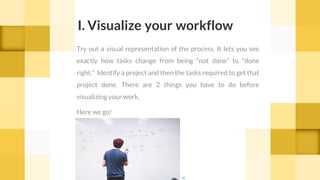
I. Visualize your workflow
Try out a visual representation of the process. It lets you see
exactly how tasks change from being “not done” to “done
right.” Identify a project and then the tasks required to get that
project done. There are 2 things you have to do before
visualizing your work.
Here we go!
cc
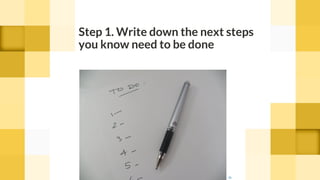
Step 1. Write down the next steps
you know need to be done
cc
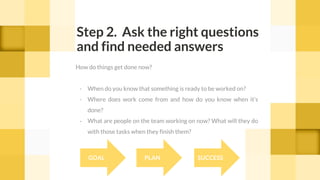
Step 2. Ask the right questions
and find needed answers
How do things get done now?
- When do you know that something is ready to be worked on?
- Where does work come from and how do you know when it’s
done?
- What are people on the team working on now? What will they do
with those tasks when they finish them?
GOAL PLAN SUCCESS
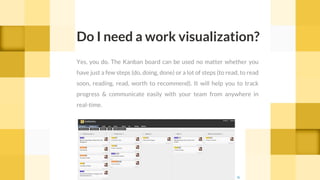
Yes, you do. The Kanban board can be used no matter whether you
have just a few steps (do, doing, done) or a lot of steps (to read, to read
soon, reading, read, worth to recommend). It will help you to track
progress & communicate easily with your team from anywhere in
real-time.
Do I need a work visualization?
cc
How vizualize work on your
Kanban board?
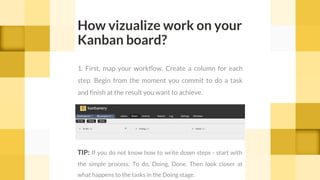
1. First, map your workflow. Create a column for each
step. Begin from the moment you commit to do a task
and finish at the result you want to achieve.
TIP: If you do not know how to write down steps - start with
the simple process: To do, Doing, Done. Then look closer at
what happens to the tasks in the Doing stage.
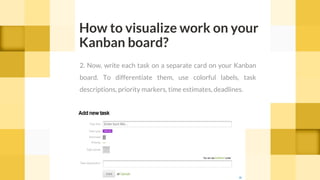
2. Now, write each task on a separate card on your Kanban
board. To differentiate them, use colorful labels, task
descriptions, priority markers, time estimates, deadlines.
How to visualize work on your
Kanban board?
cc
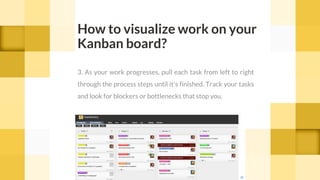
3. As your work progresses, pull each task from left to right
through the process steps until it's finished. Track your tasks
and look for blockers or bottlenecks that stop you.
How to visualize work on your
Kanban board?
cc
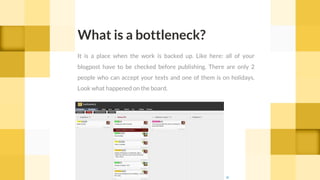
What is a bottleneck?
It is a place when the work is backed up. Like here: all of your
blogpost have to be checked before publishing. There are only 2
people who can accept your texts and one of them is on holidays.
Look what happened on the board.
cc
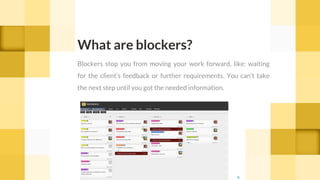
What are blockers?
Blockers stop you from moving your work forward, like: waiting
for the client’s feedback or further requirements. You can’t take
the next step until you got the needed information.
cc
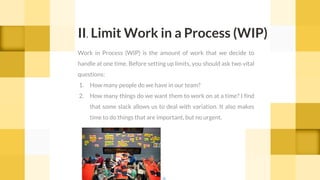
Work in Process (WIP) is the amount of work that we decide to
handle at one time. Before setting up limits, you should ask two vital
questions:
1. How many people do we have in our team?
2. How many things do we want them to work on at a time? I find
that some slack allows us to deal with variation. It also makes
time to do things that are important, but no urgent.
II. Limit Work in a Process (WIP)
cc
Don’t try to be a superhero and do everything. Get more done by
doing less. It is counterintuitive, but it is a powerful idea. Leaving
some slack in a system allows team for learning, improving and
dealing with the unforeseen.
How to limit my work?
cc
How to use slack time?
Slack time doesn’t equal to idle time. A capacity of 100%
doesn’t bring us to 100% productivity. Why? Because we are
too busy to start improving. By doing things the way we are
doing right now, we won’t get better results.
cc
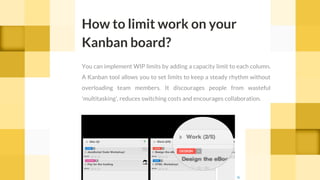
You can implement WIP limits by adding a capacity limit to each column.
A Kanban tool allows you to set limits to keep a steady rhythm without
overloading team members. It discourages people from wasteful
'multitasking', reduces switching costs and encourages collaboration.
How to limit work on your
Kanban board?
c cc
Limiting WIP helps you to complete tasks faster. By focusing on
only one task, you achieve a better completion time than by
working on two tasks at the same time.
Why should you limit WIP?
cc
Improvement should be based on objective measurements.
Why? It increases our chance to make a change that matters
and it brings us measurable results.
III. Measure, improve and
adapt a new flow
cc
How to measure progress on
your Kanban board?
Each day, review the status of the tasks on the Kanban board
working from right to left. Ask yourself the questions: Where are the
bottlenecks? Are any tasks blocked? Is anyone multitasking? Which
tasks seems stuck?
cc
How to measure progress on
your Kanban board?
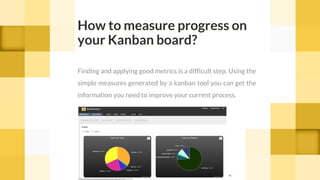
Finding and applying good metrics is a difficult step. Using the
simple measures generated by a kanban tool you can get the
information you need to improve your current process.
cc
How to measure progress on
your Kanban board?
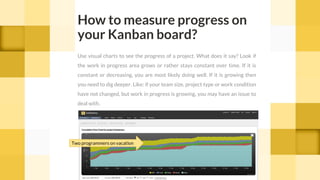
Use visual charts to see the progress of a project. What does it say? Look if
the work in progress area grows or rather stays constant over time. If it is
constant or decreasing, you are most likely doing well. If it is growing then
you need to dig deeper. Like: if your team size, project type or work condition
have not changed, but work in progress is growing, you may have an issue to
deal with.
Two programmers on vacation
Visualization helps you to see
problems
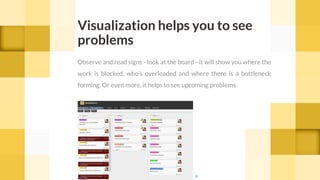
Observe and read signs - look at the board - it will show you where the
work is blocked, who’s overloaded and where there is a bottleneck
forming. Or even more, it helps to see upcoming problems.
cc
Get started with a Kanban board today
Check out Kanbanery.com
www.kanbanery.com
Any questions?
Let me know at: justyna@kanbanery.com

Kanban step bystep

  • 1.
    Get Started withKanbanery Justyna Pindel | Marketing & PR Manager at Kanbanery First steps
  • 2.
    What is Kanban? Theidea of the kanban board was originally used in Japan in production processes. This method inspired the Kanban Method which is gaining traction as a way to smoothly implement Agile and Lean management methods in tech and non-tech companies.
  • 3.
  • 4.
    3 Kanban rules Visualizeyour workflow Limit Work in Progress (WIP) Measure, improve the flow of value
  • 5.
    I. Visualize yourworkflow Try out a visual representation of the process. It lets you see exactly how tasks change from being “not done” to “done right.” Identify a project and then the tasks required to get that project done. There are 2 things you have to do before visualizing your work. Here we go! cc
  • 6.
    Step 1. Writedown the next steps you know need to be done cc
  • 7.
    Step 2. Askthe right questions and find needed answers How do things get done now? - When do you know that something is ready to be worked on? - Where does work come from and how do you know when it’s done? - What are people on the team working on now? What will they do with those tasks when they finish them? GOAL PLAN SUCCESS
  • 8.
    Yes, you do.The Kanban board can be used no matter whether you have just a few steps (do, doing, done) or a lot of steps (to read, to read soon, reading, read, worth to recommend). It will help you to track progress & communicate easily with your team from anywhere in real-time. Do I need a work visualization? cc
  • 9.
    How vizualize workon your Kanban board? 1. First, map your workflow. Create a column for each step. Begin from the moment you commit to do a task and finish at the result you want to achieve. TIP: If you do not know how to write down steps - start with the simple process: To do, Doing, Done. Then look closer at what happens to the tasks in the Doing stage.
  • 10.
    2. Now, writeeach task on a separate card on your Kanban board. To differentiate them, use colorful labels, task descriptions, priority markers, time estimates, deadlines. How to visualize work on your Kanban board? cc
  • 11.
    3. As yourwork progresses, pull each task from left to right through the process steps until it's finished. Track your tasks and look for blockers or bottlenecks that stop you. How to visualize work on your Kanban board? cc
  • 12.
    What is abottleneck? It is a place when the work is backed up. Like here: all of your blogpost have to be checked before publishing. There are only 2 people who can accept your texts and one of them is on holidays. Look what happened on the board. cc
  • 13.
    What are blockers? Blockersstop you from moving your work forward, like: waiting for the client’s feedback or further requirements. You can’t take the next step until you got the needed information. cc
  • 14.
    Work in Process(WIP) is the amount of work that we decide to handle at one time. Before setting up limits, you should ask two vital questions: 1. How many people do we have in our team? 2. How many things do we want them to work on at a time? I find that some slack allows us to deal with variation. It also makes time to do things that are important, but no urgent. II. Limit Work in a Process (WIP) cc
  • 15.
    Don’t try tobe a superhero and do everything. Get more done by doing less. It is counterintuitive, but it is a powerful idea. Leaving some slack in a system allows team for learning, improving and dealing with the unforeseen. How to limit my work? cc
  • 16.
    How to useslack time? Slack time doesn’t equal to idle time. A capacity of 100% doesn’t bring us to 100% productivity. Why? Because we are too busy to start improving. By doing things the way we are doing right now, we won’t get better results. cc
  • 17.
    You can implementWIP limits by adding a capacity limit to each column. A Kanban tool allows you to set limits to keep a steady rhythm without overloading team members. It discourages people from wasteful 'multitasking', reduces switching costs and encourages collaboration. How to limit work on your Kanban board? c cc
  • 18.
    Limiting WIP helpsyou to complete tasks faster. By focusing on only one task, you achieve a better completion time than by working on two tasks at the same time. Why should you limit WIP? cc
  • 19.
    Improvement should bebased on objective measurements. Why? It increases our chance to make a change that matters and it brings us measurable results. III. Measure, improve and adapt a new flow cc
  • 20.
    How to measureprogress on your Kanban board? Each day, review the status of the tasks on the Kanban board working from right to left. Ask yourself the questions: Where are the bottlenecks? Are any tasks blocked? Is anyone multitasking? Which tasks seems stuck? cc
  • 21.
    How to measureprogress on your Kanban board? Finding and applying good metrics is a difficult step. Using the simple measures generated by a kanban tool you can get the information you need to improve your current process. cc
  • 22.
    How to measureprogress on your Kanban board? Use visual charts to see the progress of a project. What does it say? Look if the work in progress area grows or rather stays constant over time. If it is constant or decreasing, you are most likely doing well. If it is growing then you need to dig deeper. Like: if your team size, project type or work condition have not changed, but work in progress is growing, you may have an issue to deal with. Two programmers on vacation
  • 23.
    Visualization helps youto see problems Observe and read signs - look at the board - it will show you where the work is blocked, who’s overloaded and where there is a bottleneck forming. Or even more, it helps to see upcoming problems. cc
  • 24.
    Get started witha Kanban board today Check out Kanbanery.com
  • 25.
    www.kanbanery.com Any questions? Let meknow at: justyna@kanbanery.com