T04
BASIC LEAN TRAINING
Principle 4
“Pull” production
Objectives
The objectives of this chapter are:
 To show pull and push effect in Lean.
 To show how to give the customer added
value by avoiding waiting and unnecessary
costs but at the same time avoid large
stocks and unnecessary waste.
 To show how one piece flow and Kanban
can be used instead of large badges.
Principle 4
Let the customer ask
“PULL” PRODUCTION
 Pull system
 Kanban
 One Piece Flow
Tools:
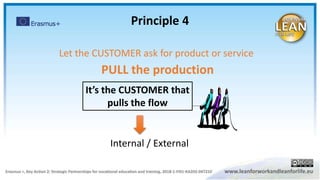
It’s the CUSTOMER that
pulls the flow
Internal / External
Let the CUSTOMER ask for product or service
PULL the production
Principle 4
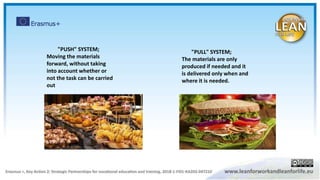
"PUSH" SYSTEM;
Moving the materials
forward, without taking
into account whether or
not the task can be carried
out
"PULL" SYSTEM;
The materials are only
produced if needed and it
is delivered only when and
where it is needed.
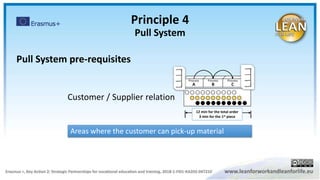
Pull System pre-requisites
Areas where the customer can pick-up material
Customer / Supplier relation
Principle 4
Pull System
Process
A
Process
B
Process
C
12 min for the total order
3 min for the 1st piece
LIDL
VODAFONE
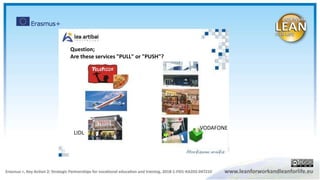
Question;
Are these services "PULL" or "PUSH"?
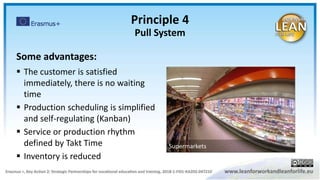
Some advantages:
 The customer is satisfied
immediately, there is no waiting
time
 Production scheduling is simplified
and self-regulating (Kanban)
 Service or production rhythm
defined by Takt Time
 Inventory is reduced
Principle 4
Pull System
Supermarkets
Principle 4
Kanban
What is Kanban?
• Kanban is a visual system for managing work as it moves through a process. Kanban
visualizes both the process (the workflow) and the actual work passing through that
process. The goal of Kanban is to identify potential bottlenecks in the process and fix
them, so work can flow through it cost-effectively at an optimal speed or throughput.
https://www.youtube.com/watch?v=Mdyyyu41dZ4
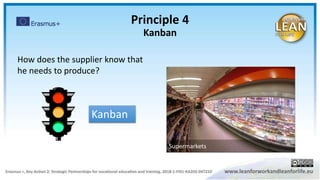
How does the supplier know that
he needs to produce?
Kanban
Principle 4
Kanban
Supermarkets
Supplier
Kanban cards
Customer
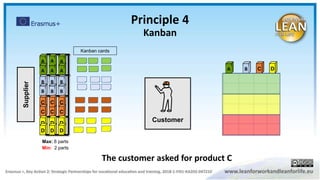
Max: 6 parts
Min: 2 parts
A
AA A
A A B
B B
B
B
B
C DA
B
C
CC
CC
C
DD
DD
D
D
Principle 4
Kanban
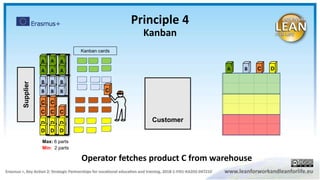
The customer asked for product C
Customer
A
AA A
A A B
B B
B
B
B
C DA
B C
CC
CC
C
DD
DD
D
D
Supplier
Kanban cards
Max: 6 parts
Min: 2 parts
Principle 4
Kanban
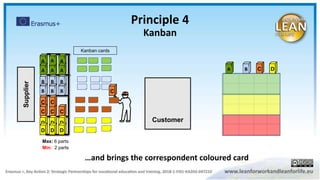
Operator fetches product C from warehouse
A
AA A
A A B
B B
B
B
B
C DA
B
CC
CC
C
C
DD
DD
D
D
Supplier
Kanban cards
Max: 6 parts
Min: 2 parts
Principle 4
Kanban
Customer
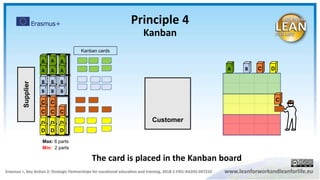
…and brings the correspondent coloured card
A
AA A
A A B
B B
B
B
B
C DA
B
CC
CC
C
C
DD
DD
D
D
Supplier
Kanban cards
Max: 6 parts
Min: 2 parts
Principle 4
Kanban
Customer
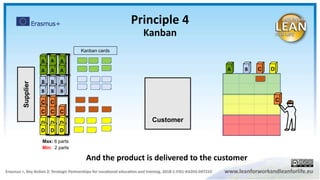
The card is placed in the Kanban board
Customer
A
AA A
A A B
B B
B
B
B
C DA
B
CC
CC
C
C
DD
DD
D
D
Supplier
Kanban cards
Max: 6 parts
Min: 2 parts
Principle 4
Kanban
And the product is delivered to the customer
Customer
A
AA A
A A B
B B
B
B
B
C DA
B
C
C
C
C
DD
DD
D
D
C
C
Supplier
Kanban cards
Control
Principle 4
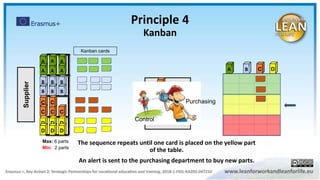
Kanban
Purchasing
Max: 6 parts
Min: 2 parts
The sequence repeats until one card is placed on the yellow part
of the table.
An alert is sent to the purchasing department to buy new parts.
A
AA A
A A B
B B
B
B
B
C DA
B
C
C
C
DD
DD
D
D
CC
CC
Supplier
Kanban cards
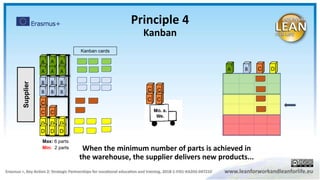
Principle 4
Kanban
Max: 6 parts
Min: 2 parts When the minimum number of parts is achieved in
the warehouse, the supplier delivers new products...
A
AA A
A A B
B B
B
B
B
C DA
B
C
C
DD
DD
D
D
C
C
C
C
Supplier
Kanban cards
Max: 6 parts
Min: 2 parts
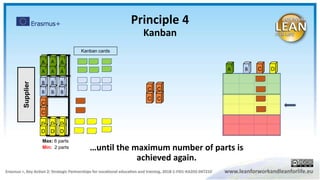
Principle 4
Kanban
…until the maximum number of parts is
achieved again.
A
AA A
A A
B
B B
B
B
B
C DA
B
DD
DD
D
D
C
C
CC
CC
Supplier
Kanban cards
Max: 6 parts
Min: 2 parts
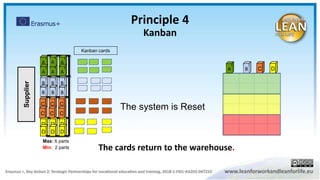
Principle 4
Kanban
The cards return to the warehouse.
The system is Reset
Principle 4
Kanban
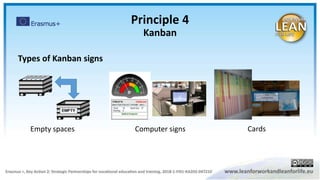
Types of Kanban signs
Empty spaces Computer signs Cards
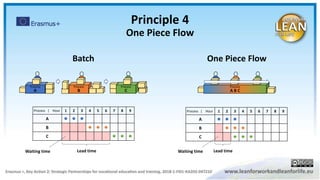
Process | Hour 1 2 3 4 5 6 7 8 9
A   
B   
C   
Waiting time Lead time
Batch
Process
A
Process
B
Process
C
Process | Hour 1 2 3 4 5 6 7 8 9
A   
B   
C   
One Piece Flow
Process
A B C
Waiting time Lead time
Principle 4
One Piece Flow
 T04-G Envelope game
LEAN FOR WORK AND LEAN FOR LIFE
Train the trainer to teach Lean skills in VET

Lean for work and Lean for life - 4 - Pull

  • 1.
    T04 BASIC LEAN TRAINING Principle4 “Pull” production
  • 2.
    Objectives The objectives ofthis chapter are:  To show pull and push effect in Lean.  To show how to give the customer added value by avoiding waiting and unnecessary costs but at the same time avoid large stocks and unnecessary waste.  To show how one piece flow and Kanban can be used instead of large badges.
  • 3.
    Principle 4 Let thecustomer ask “PULL” PRODUCTION  Pull system  Kanban  One Piece Flow Tools:
  • 4.
    It’s the CUSTOMERthat pulls the flow Internal / External Let the CUSTOMER ask for product or service PULL the production Principle 4
  • 5.
    "PUSH" SYSTEM; Moving thematerials forward, without taking into account whether or not the task can be carried out "PULL" SYSTEM; The materials are only produced if needed and it is delivered only when and where it is needed.
  • 6.
    Pull System pre-requisites Areaswhere the customer can pick-up material Customer / Supplier relation Principle 4 Pull System Process A Process B Process C 12 min for the total order 3 min for the 1st piece
  • 7.
  • 8.
    Some advantages:  Thecustomer is satisfied immediately, there is no waiting time  Production scheduling is simplified and self-regulating (Kanban)  Service or production rhythm defined by Takt Time  Inventory is reduced Principle 4 Pull System Supermarkets
  • 9.
    Principle 4 Kanban What isKanban? • Kanban is a visual system for managing work as it moves through a process. Kanban visualizes both the process (the workflow) and the actual work passing through that process. The goal of Kanban is to identify potential bottlenecks in the process and fix them, so work can flow through it cost-effectively at an optimal speed or throughput.
  • 10.
  • 11.
    How does thesupplier know that he needs to produce? Kanban Principle 4 Kanban Supermarkets
  • 13.
    Supplier Kanban cards Customer Max: 6parts Min: 2 parts A AA A A A B B B B B B C DA B C CC CC C DD DD D D Principle 4 Kanban The customer asked for product C
  • 14.
    Customer A AA A A AB B B B B B C DA B C CC CC C DD DD D D Supplier Kanban cards Max: 6 parts Min: 2 parts Principle 4 Kanban Operator fetches product C from warehouse
  • 15.
    A AA A A AB B B B B B C DA B CC CC C C DD DD D D Supplier Kanban cards Max: 6 parts Min: 2 parts Principle 4 Kanban Customer …and brings the correspondent coloured card
  • 16.
    A AA A A AB B B B B B C DA B CC CC C C DD DD D D Supplier Kanban cards Max: 6 parts Min: 2 parts Principle 4 Kanban Customer The card is placed in the Kanban board
  • 17.
    Customer A AA A A AB B B B B B C DA B CC CC C C DD DD D D Supplier Kanban cards Max: 6 parts Min: 2 parts Principle 4 Kanban And the product is delivered to the customer
  • 18.
    Customer A AA A A AB B B B B B C DA B C C C C DD DD D D C C Supplier Kanban cards Control Principle 4 Kanban Purchasing Max: 6 parts Min: 2 parts The sequence repeats until one card is placed on the yellow part of the table. An alert is sent to the purchasing department to buy new parts.
  • 19.
    A AA A A AB B B B B B C DA B C C C DD DD D D CC CC Supplier Kanban cards Principle 4 Kanban Max: 6 parts Min: 2 parts When the minimum number of parts is achieved in the warehouse, the supplier delivers new products...
  • 20.
    A AA A A AB B B B B B C DA B C C DD DD D D C C C C Supplier Kanban cards Max: 6 parts Min: 2 parts Principle 4 Kanban …until the maximum number of parts is achieved again.
  • 21.
    A AA A A A B BB B B B C DA B DD DD D D C C CC CC Supplier Kanban cards Max: 6 parts Min: 2 parts Principle 4 Kanban The cards return to the warehouse. The system is Reset
  • 22.
    Principle 4 Kanban Types ofKanban signs Empty spaces Computer signs Cards
  • 23.
    Process | Hour1 2 3 4 5 6 7 8 9 A    B    C    Waiting time Lead time Batch Process A Process B Process C Process | Hour 1 2 3 4 5 6 7 8 9 A    B    C    One Piece Flow Process A B C Waiting time Lead time Principle 4 One Piece Flow
  • 24.
  • 25.
    LEAN FOR WORKAND LEAN FOR LIFE Train the trainer to teach Lean skills in VET

Editor's Notes

  • #6 In the pictures above: For the “ push” system a buffet of food is provided. The food and the amounts are made without the restaurant knowing how many guests are asking for it. (this will result in unneccesary waste) In the pull system the food is made first when the customer orders it (this will result in minimal waste)
  • #7 Where do we as consumers go get several products at the same time and have direct and immediate access to them?
  • #8 Teacher: Makes the question to the students: Are this services “Pull” or “Push”? Telepizza is Pull Flight is Push Tesco (Supermarket) is Pull Urgencys in the Hospital is Pull Library is a Push system Bank might be a Push or Pull service Keep in mind that the perspective changes dedpending on if you are analising it from the cliente’s perspective or the suppliers perspective
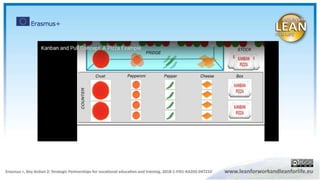
  • #11 T04-V1 Pizza Kanban Video
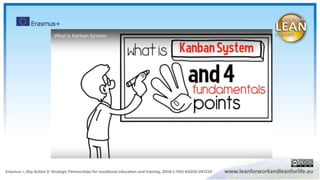
  • #13 T04-V2 What is Kanban video
  • #24 With batch production, the operations are separated so that it is decided to carry out the work in series. This leads to an increase in work in progress (interim stock) and long Lead Times. At One Piece Flow, operations are performed directly one after the other in single pieces. The product is constantly being processed. As a result, interim stocks decrease, speed and productivity increase.
  • #25 The Envelope Game