1
Kaizen (改善)
 Translated from Japanese, the word “kaizen” translates to “changing something for the
better”
 Kaizen (改善) is the Sino-Japanese word used for "improvement". In
business, kaizen refers to activities that continuously improve all functions and involve
all employees from the CEO to the assembly line workers
 Ongoing improvement involves everyone
 Top management
 Managers
 Workers
 A culture of supporting quality improvement
 more important than the use of any specific tools
2
History
 The “birth” of the Kaizen process can actually be attributed to American manager
William Edwards Deming (1900-1993) who came to Japan after the end of war to
help the country rebuild its economy.
 And was originally used by Japanese businesses after World War II, influenced by
teachings in American business and quality management, and became adopted by
the Toyota Production System (also known as TPS), where employees are famously
required to stop the line if an abnormality arises (known as Jidoka) and, along with
their supervisors, suggest an improvement.
3
Process and elements
 Kaizen is an approach to creating continuous improvement based on the idea that
small, ongoing positive changes can reap major improvements. Typically, it is
based on cooperation and commitment and stands in contrast to approaches that
use radical changes or top-down edicts to achieve transformation
Key elements of Kaizen. Are
 quality
 effort
 involvement of all employees
 willingness to change
 communication
4
Kaizen tools
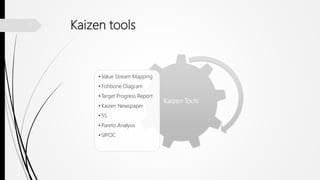
Kaizen Tools
• Value Stream Mapping
• Fishbone Diagram
• Target Progress Report
• Kaizen Newspaper
• 5S
• Pareto Analysis
• SIPOC
5
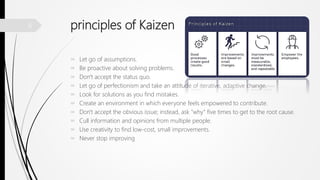
principles of Kaizen
 Let go of assumptions.
 Be proactive about solving problems.
 Don't accept the status quo.
 Let go of perfectionism and take an attitude of iterative, adaptive change.
 Look for solutions as you find mistakes.
 Create an environment in which everyone feels empowered to contribute.
 Don't accept the obvious issue; instead, ask "why" five times to get to the root cause.
 Cull information and opinions from multiple people.
 Use creativity to find low-cost, small improvements.
 Never stop improving
6
Implementing Kaizen
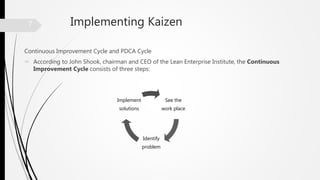
Continuous Improvement Cycle and PDCA Cycle
 According to John Shook, chairman and CEO of the Lean Enterprise Institute, the Continuous
Improvement Cycle consists of three steps:
See the
work place
Identify
problem
Implement
solutions
7
Implementing Kaizen
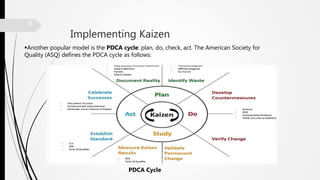
PDCA Cycle
Another popular model is the PDCA cycle: plan, do, check, act. The American Society for
Quality (ASQ) defines the PDCA cycle as follows:
8
Kaizen advantages:
Kaizen results in many benefits not only to a company’s operations and output, but also
to its overall culture and communication, Like…
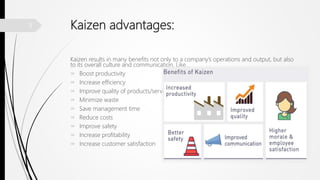
 Boost productivity
 Increase efficiency
 Improve quality of products/services
 Minimize waste
 Save management time
 Reduce costs
 Improve safety
 Increase profitability
 Increase customer satisfaction
9
Kaizen disadvantages:
 Companies with cultures of territorialism and closed communication may first
need to focus on cultural changes to create a receptive environment.
 Short-term Kaizen events may create a burst of excitement that is shallow and
short-lived and, therefore, gets abandoned before long.
10
Real-life Kaizen examples
 Toyota is arguably the most-famous for its use of Kaizen, but other companies
have used the approach successfully. Here are three examples:
 Lockheed Martin. The aerospace company is a well-known proponent of Kaizen.
Through the use of Kaizen, it has successfully reduced manufacturing costs,
reduced inventory and cut delivery time.
 Ford Motor Company. When lean devotee Alan Mulally became CEO of Ford in
2006, the auto giant was on the brink of bankruptcy. Mulally used Kaizen to
execute one of the most famous corporate turnarounds in history.
 Pixar Animation Studios. Pixar has taken a continuous improvement model that
reduced risks of expensive movie failure by using quality control checks and
iterative processes
11
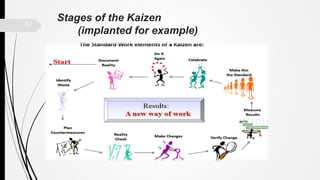
Stages of the Kaizen
(implanted for example)
12

13

kaizen presentation

  • 1.
  • 2.
    Kaizen (改善)  Translatedfrom Japanese, the word “kaizen” translates to “changing something for the better”  Kaizen (改善) is the Sino-Japanese word used for "improvement". In business, kaizen refers to activities that continuously improve all functions and involve all employees from the CEO to the assembly line workers  Ongoing improvement involves everyone  Top management  Managers  Workers  A culture of supporting quality improvement  more important than the use of any specific tools 2
  • 3.
    History  The “birth”of the Kaizen process can actually be attributed to American manager William Edwards Deming (1900-1993) who came to Japan after the end of war to help the country rebuild its economy.  And was originally used by Japanese businesses after World War II, influenced by teachings in American business and quality management, and became adopted by the Toyota Production System (also known as TPS), where employees are famously required to stop the line if an abnormality arises (known as Jidoka) and, along with their supervisors, suggest an improvement. 3
  • 4.
    Process and elements Kaizen is an approach to creating continuous improvement based on the idea that small, ongoing positive changes can reap major improvements. Typically, it is based on cooperation and commitment and stands in contrast to approaches that use radical changes or top-down edicts to achieve transformation Key elements of Kaizen. Are  quality  effort  involvement of all employees  willingness to change  communication 4
  • 5.
    Kaizen tools Kaizen Tools •Value Stream Mapping • Fishbone Diagram • Target Progress Report • Kaizen Newspaper • 5S • Pareto Analysis • SIPOC 5
  • 6.
    principles of Kaizen Let go of assumptions.  Be proactive about solving problems.  Don't accept the status quo.  Let go of perfectionism and take an attitude of iterative, adaptive change.  Look for solutions as you find mistakes.  Create an environment in which everyone feels empowered to contribute.  Don't accept the obvious issue; instead, ask "why" five times to get to the root cause.  Cull information and opinions from multiple people.  Use creativity to find low-cost, small improvements.  Never stop improving 6
  • 7.
    Implementing Kaizen Continuous ImprovementCycle and PDCA Cycle  According to John Shook, chairman and CEO of the Lean Enterprise Institute, the Continuous Improvement Cycle consists of three steps: See the work place Identify problem Implement solutions 7
  • 8.
    Implementing Kaizen PDCA Cycle Anotherpopular model is the PDCA cycle: plan, do, check, act. The American Society for Quality (ASQ) defines the PDCA cycle as follows: 8
  • 9.
    Kaizen advantages: Kaizen resultsin many benefits not only to a company’s operations and output, but also to its overall culture and communication, Like…  Boost productivity  Increase efficiency  Improve quality of products/services  Minimize waste  Save management time  Reduce costs  Improve safety  Increase profitability  Increase customer satisfaction 9
  • 10.
    Kaizen disadvantages:  Companieswith cultures of territorialism and closed communication may first need to focus on cultural changes to create a receptive environment.  Short-term Kaizen events may create a burst of excitement that is shallow and short-lived and, therefore, gets abandoned before long. 10
  • 11.
    Real-life Kaizen examples Toyota is arguably the most-famous for its use of Kaizen, but other companies have used the approach successfully. Here are three examples:  Lockheed Martin. The aerospace company is a well-known proponent of Kaizen. Through the use of Kaizen, it has successfully reduced manufacturing costs, reduced inventory and cut delivery time.  Ford Motor Company. When lean devotee Alan Mulally became CEO of Ford in 2006, the auto giant was on the brink of bankruptcy. Mulally used Kaizen to execute one of the most famous corporate turnarounds in history.  Pixar Animation Studios. Pixar has taken a continuous improvement model that reduced risks of expensive movie failure by using quality control checks and iterative processes 11
  • 12.
    Stages of theKaizen (implanted for example) 12
  • 13.