SUBMITTED TO:
Karan deep Kaur
SUBMITTED by:
NAME: ROLL NO:
AHMAD KHALID IBRAHIM KHIL 19421210
SCHOOL OF MANAGEMENT STUDIES
P U N J A B I U N I V E R S I T Y PAT I A L A
(SESSION 2019-2021)
KAIZEN
“Continues Improvement”
Introduction
• Efficient work and quality require clean environment, safety and discipline. So,
the Japanese philosophy of Kaizen is simple and effective for tidiness.
• The Kaizen is prerequisites for any improvement program.
• Kaizen focuses on small, gradual and frequent improvements over the long term
with minimum financial investment and participation by everyone.
What is Kaizen?
3
⦁ The Japanese word “Kaizen” (改 善 ) means change (KAI) to
become good (ZEN).
Kai Zen
改 善
Change Good
 Kaizen means improvement. Improvements without spending much money,
involving everyone from managers to employees, and using much common
sense.
 The aspect of Kaizen is that it is on-going and never-ending improvement
process.
Origin of Kaizen
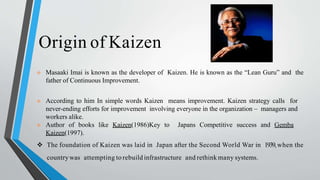
 Masaaki Imai is known as the developer of Kaizen. He is known as the “Lean Guru” and the
father of Continuous Improvement.
 According to him In simple words Kaizen means improvement. Kaizen strategy calls for
never-ending efforts for improvement involving everyone in the organization – managers and
workers alike.
 Author of books like Kaizen(1986)Key to Japans Competitive success and Gemba
Kaizen(1997).
 The foundation of Kaizen was laid in Japan after the Second World War in 1939,when the
country was attempting to rebuild infrastructure and rethink many systems.
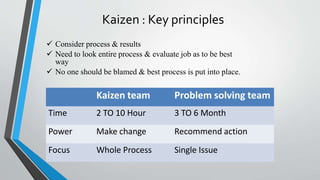
Kaizen : Key principles
 Consider process & results
 Need to look entire process & evaluate job as to be best
way
 No one should be blamed & best process is put into place.
Kaizen team Problem solving team
Time 2 TO 10 Hour 3 TO 6 Month
Power Make change Recommend action
Focus Whole Process Single Issue
KAIZEN METHODOLOGY
 Finding out the pain area
 Analysis of the pain area
 3Ms Considered with the 4Ms
 3Ms MURA, MURI, MUDA
 Muda ("non-value-adding work" Waste)
 Muri ("overburden" over load )
 Mura ("unevenness" imbalance)
 4Ms MAN, MACHINE, MATERIAL, METHOD
Kaizen : Implementation Concepts
 The term KAIZEN is based on some concepts as
stated below:
1. 5S (Seiri, Seiton, Seiso, Seiketsu & Shitsuke)
2. PDCA CYCLE (Plan,Do,Check,Act)
3. QUALITY CIRCLE
4. KANBAN
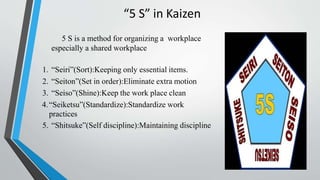
“5 S” in Kaizen
5 S is a method for organizing a workplace
especially a shared workplace
1. “Seiri”(Sort):Keeping only essential items.
2. “Seiton”(Set in order):Eliminate extra motion
3. “Seiso”(Shine):Keep the work place clean
4.“Seiketsu”(Standardize):Standardize work
practices
5. “Shitsuke”(Self discipline):Maintaining discipline
• PLAN
Collect the data
• DO
Implementation
• CHECK
Evaluate the result
• ACT
Apply the change
PDCACYCLE
QUALITY CIRCLES
• A quality circle is a volunteer group composed
of employees, who are trained to identify,
analyse and solve work-related problems and
present their solutions to management
• This improves the performance of the
organization
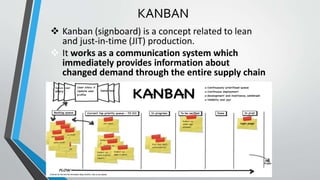
KANBAN
 Kanban (signboard) is a concept related to lean
and just-in-time (JIT) production.
 It works as a communication system which
immediately provides information about
changed demand through the entire supply chain
BenefitsOf Kaizen
12
• Kaizen reduces waste - like inventory waste, time
waste and workers motion.
• Kaizen improves space utilization and product
quality.
• Results in higher employee moral and job
satisfaction.
• Teaches workers how to solve everyday
problems.
Kaizen inToyota
 In the earlier 1990,Toyota was facing acute labour shortage
 toyota’s initial mangement focus was on increasing production
efficiency through higher production levels with less number of
workers.this resulted in increased stress & worker exodus
 The global upsurge in car demand during 1987-1991 led to drastic
increase in demand for labors
 Toyota realized that it is the time to implement Kaizen for modifying
existing assembly lines to attract workers
 The company decided to change its working conditions to
accommodate workers of more diverse nature
 Toyota is well known one of the leaders in using Kaizen.In 1999 at
one U.S plant 7000 toyota employee submitted over 75000
suggestions of which 99% were implemented
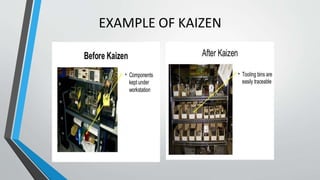
EXAMPLE OF KAIZEN
KAIZEN IN DAYTO DAY LIFE
Consider the case of a student’s bag. The items can be classified into
1.Notes and assignments
2.Stationary (pens, notepads etc.)
3.Other items like calculators, pen drive etc.
 Regular checking of the stationary items ensures that the note
making is not affected due to lack of stationary.
 Keeping notes and assignments organized enables faster access to
them.
 Overall checking of bag at regular intervals ensures that no
necessary items are missing
Conclusion
 The concept is simple but if properly applied can lead to
significant efficiency improvements for organizations.
 “Kaizen” or “continuous improvement” should be a part of
our everyday life.
 Good is never good enough , kaizen is never- ending
journey to excellence.
 It helps to turn problems into profit.
KAIZEN HELPS YOU TO ….
SEE THE WASTE.
TURN PROBLEMS INTO PROFIT.
CONSTANTLY CHANGE FOR THE BETTER..

Kaizen

  • 1.
    SUBMITTED TO: Karan deepKaur SUBMITTED by: NAME: ROLL NO: AHMAD KHALID IBRAHIM KHIL 19421210 SCHOOL OF MANAGEMENT STUDIES P U N J A B I U N I V E R S I T Y PAT I A L A (SESSION 2019-2021) KAIZEN “Continues Improvement”
  • 2.
    Introduction • Efficient workand quality require clean environment, safety and discipline. So, the Japanese philosophy of Kaizen is simple and effective for tidiness. • The Kaizen is prerequisites for any improvement program. • Kaizen focuses on small, gradual and frequent improvements over the long term with minimum financial investment and participation by everyone.
  • 3.
    What is Kaizen? 3 ⦁The Japanese word “Kaizen” (改 善 ) means change (KAI) to become good (ZEN). Kai Zen 改 善 Change Good  Kaizen means improvement. Improvements without spending much money, involving everyone from managers to employees, and using much common sense.  The aspect of Kaizen is that it is on-going and never-ending improvement process.
  • 4.
    Origin of Kaizen Masaaki Imai is known as the developer of Kaizen. He is known as the “Lean Guru” and the father of Continuous Improvement.  According to him In simple words Kaizen means improvement. Kaizen strategy calls for never-ending efforts for improvement involving everyone in the organization – managers and workers alike.  Author of books like Kaizen(1986)Key to Japans Competitive success and Gemba Kaizen(1997).  The foundation of Kaizen was laid in Japan after the Second World War in 1939,when the country was attempting to rebuild infrastructure and rethink many systems.
  • 5.
    Kaizen : Keyprinciples  Consider process & results  Need to look entire process & evaluate job as to be best way  No one should be blamed & best process is put into place. Kaizen team Problem solving team Time 2 TO 10 Hour 3 TO 6 Month Power Make change Recommend action Focus Whole Process Single Issue
  • 6.
    KAIZEN METHODOLOGY  Findingout the pain area  Analysis of the pain area  3Ms Considered with the 4Ms  3Ms MURA, MURI, MUDA  Muda ("non-value-adding work" Waste)  Muri ("overburden" over load )  Mura ("unevenness" imbalance)  4Ms MAN, MACHINE, MATERIAL, METHOD
  • 7.
    Kaizen : ImplementationConcepts  The term KAIZEN is based on some concepts as stated below: 1. 5S (Seiri, Seiton, Seiso, Seiketsu & Shitsuke) 2. PDCA CYCLE (Plan,Do,Check,Act) 3. QUALITY CIRCLE 4. KANBAN
  • 8.
    “5 S” inKaizen 5 S is a method for organizing a workplace especially a shared workplace 1. “Seiri”(Sort):Keeping only essential items. 2. “Seiton”(Set in order):Eliminate extra motion 3. “Seiso”(Shine):Keep the work place clean 4.“Seiketsu”(Standardize):Standardize work practices 5. “Shitsuke”(Self discipline):Maintaining discipline
  • 9.
    • PLAN Collect thedata • DO Implementation • CHECK Evaluate the result • ACT Apply the change PDCACYCLE
  • 10.
    QUALITY CIRCLES • Aquality circle is a volunteer group composed of employees, who are trained to identify, analyse and solve work-related problems and present their solutions to management • This improves the performance of the organization
  • 11.
    KANBAN  Kanban (signboard)is a concept related to lean and just-in-time (JIT) production.  It works as a communication system which immediately provides information about changed demand through the entire supply chain
  • 12.
    BenefitsOf Kaizen 12 • Kaizenreduces waste - like inventory waste, time waste and workers motion. • Kaizen improves space utilization and product quality. • Results in higher employee moral and job satisfaction. • Teaches workers how to solve everyday problems.
  • 13.
    Kaizen inToyota  Inthe earlier 1990,Toyota was facing acute labour shortage  toyota’s initial mangement focus was on increasing production efficiency through higher production levels with less number of workers.this resulted in increased stress & worker exodus  The global upsurge in car demand during 1987-1991 led to drastic increase in demand for labors  Toyota realized that it is the time to implement Kaizen for modifying existing assembly lines to attract workers  The company decided to change its working conditions to accommodate workers of more diverse nature  Toyota is well known one of the leaders in using Kaizen.In 1999 at one U.S plant 7000 toyota employee submitted over 75000 suggestions of which 99% were implemented
  • 14.
  • 15.
    KAIZEN IN DAYTODAY LIFE Consider the case of a student’s bag. The items can be classified into 1.Notes and assignments 2.Stationary (pens, notepads etc.) 3.Other items like calculators, pen drive etc.  Regular checking of the stationary items ensures that the note making is not affected due to lack of stationary.  Keeping notes and assignments organized enables faster access to them.  Overall checking of bag at regular intervals ensures that no necessary items are missing
  • 16.
    Conclusion  The conceptis simple but if properly applied can lead to significant efficiency improvements for organizations.  “Kaizen” or “continuous improvement” should be a part of our everyday life.  Good is never good enough , kaizen is never- ending journey to excellence.  It helps to turn problems into profit.
  • 17.
    KAIZEN HELPS YOUTO …. SEE THE WASTE. TURN PROBLEMS INTO PROFIT. CONSTANTLY CHANGE FOR THE BETTER..