Download to read offline
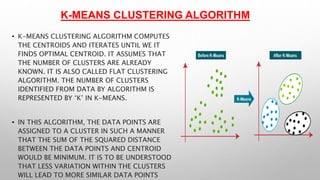
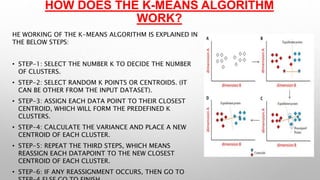
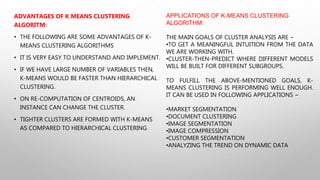


The document discusses the k-means clustering algorithm, which partitions data into clusters based on centroids, minimizing the sum of squared distances between data points and centroids. It outlines the steps for implementing the algorithm and highlights its advantages, such as ease of understanding and faster performance with large datasets compared to hierarchical clustering. Additionally, k-means has various applications including market segmentation, document clustering, and image compression.


![COMIPLER_DESIGN_1[1].pdf](https://cdn.slidesharecdn.com/ss_thumbnails/comiplerdesign11-230417141259-412c931b-thumbnail.jpg?width=640&height=640&fit=bounds)


