Poultry
Miss Kay
What An Ideal Chicken!
• Techno Chicken
Objectives
• Define poultry terms.
• Differentiate between a productive hen and a
non- laying hen
• Identify parts of a chicken.
• Evaluate eggs.
Basic Terms
• Scientific Name: Galine
• Chick: Newborn chicken
• Pullet: Young, immature female chicken less
than 5-6 months of age
• Hen: Mature female chicken
• Rooster: Mature male chicken
• Roaster: male or female chicken 3-5 months of
age and raised for the production of meat
More Terms
• Capon: Castrated male chicken
• Layer: Hen used for laying eggs
• Broiler/Flyer: Chickens grown for meat
production
• Group Name: Flock
• Candling: examining a shell egg’s content by
holding it between one’s eye and a light source
• Clutch: Nest of eggs
More Terms
• Egg: hard- shelled; reproductive body produced by a
bird
• Green: description of chicks that have recently hatched
• Axial feather: short wing feather that separates primaries
from secondaries
• Molt: To shed feathers periodically
• Oviposition: laying of an egg by a bird
• Plumage: Feathers of a bird
Egg- Type Hens
• Characteristics to look for when examining hens:
 Bleaching of yellow pigment in the shanks, feet, and
beak
 Condition and capacity of the abdomen
 Condition of plumage and rate of molt of the wing
primaries
 Vigor and vitality
 Head characteristics
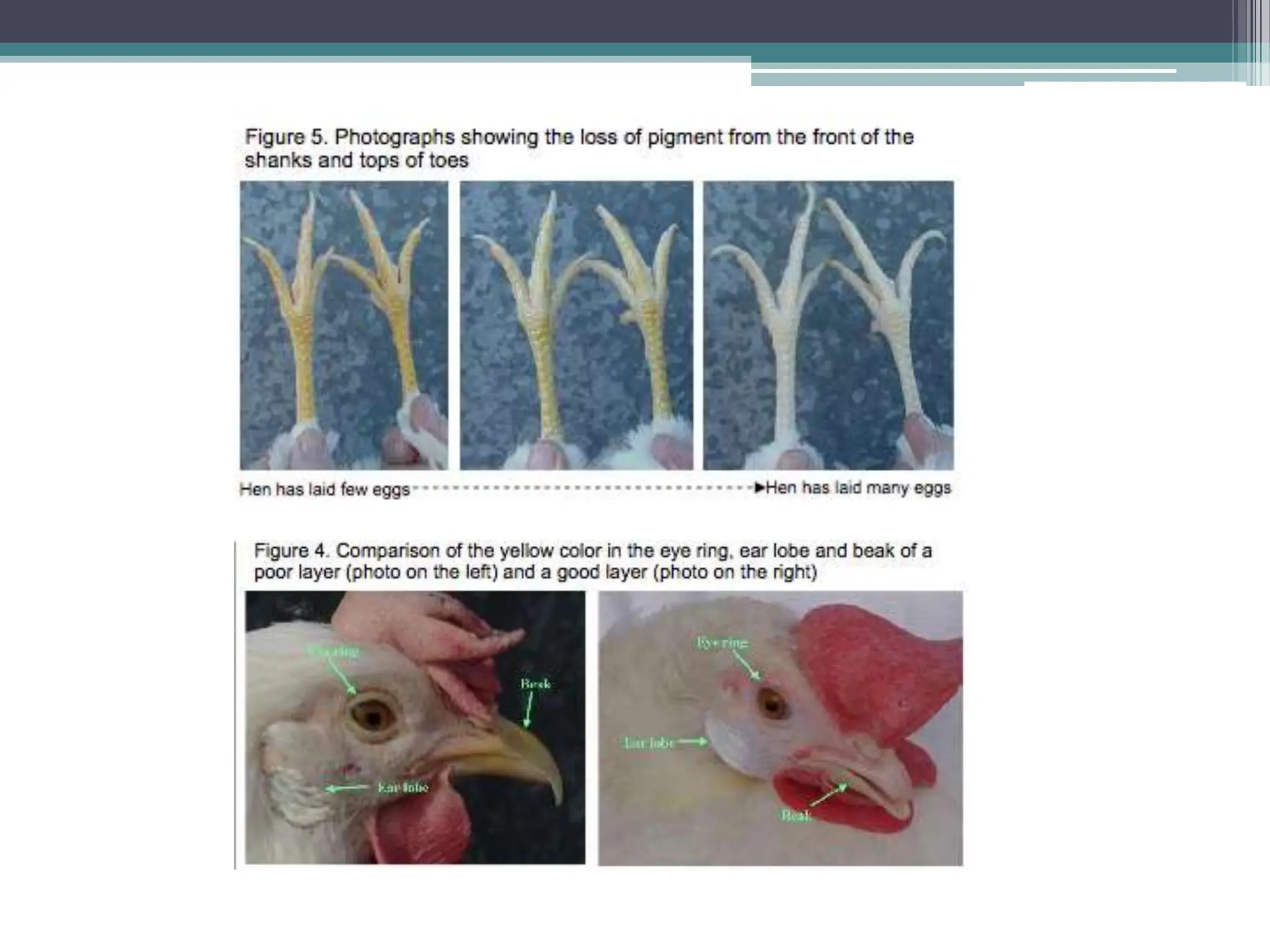
Bleaching of Body Pigment
• Order that the body pigment
fades:
▫ Vent
▫ Eye Ring
▫ Earlobe
▫ Base of Beak
▫ Tip of Beak
▫ Bottom of Foot
▫ Shank
▫ Hock and Tip of Toe
Bleaching of Body Pigment
• Hens that show signs of returning pigment are
decreasing in egg production
• Pigment returns to the body parts in the same
order it faded
▫ Returns 3 times quicker
▫ Four factors:
 Amount of pigment in feed
 Health and vitality of hen
 Whether the hen is confined or not
 Size and coarseness of the hen
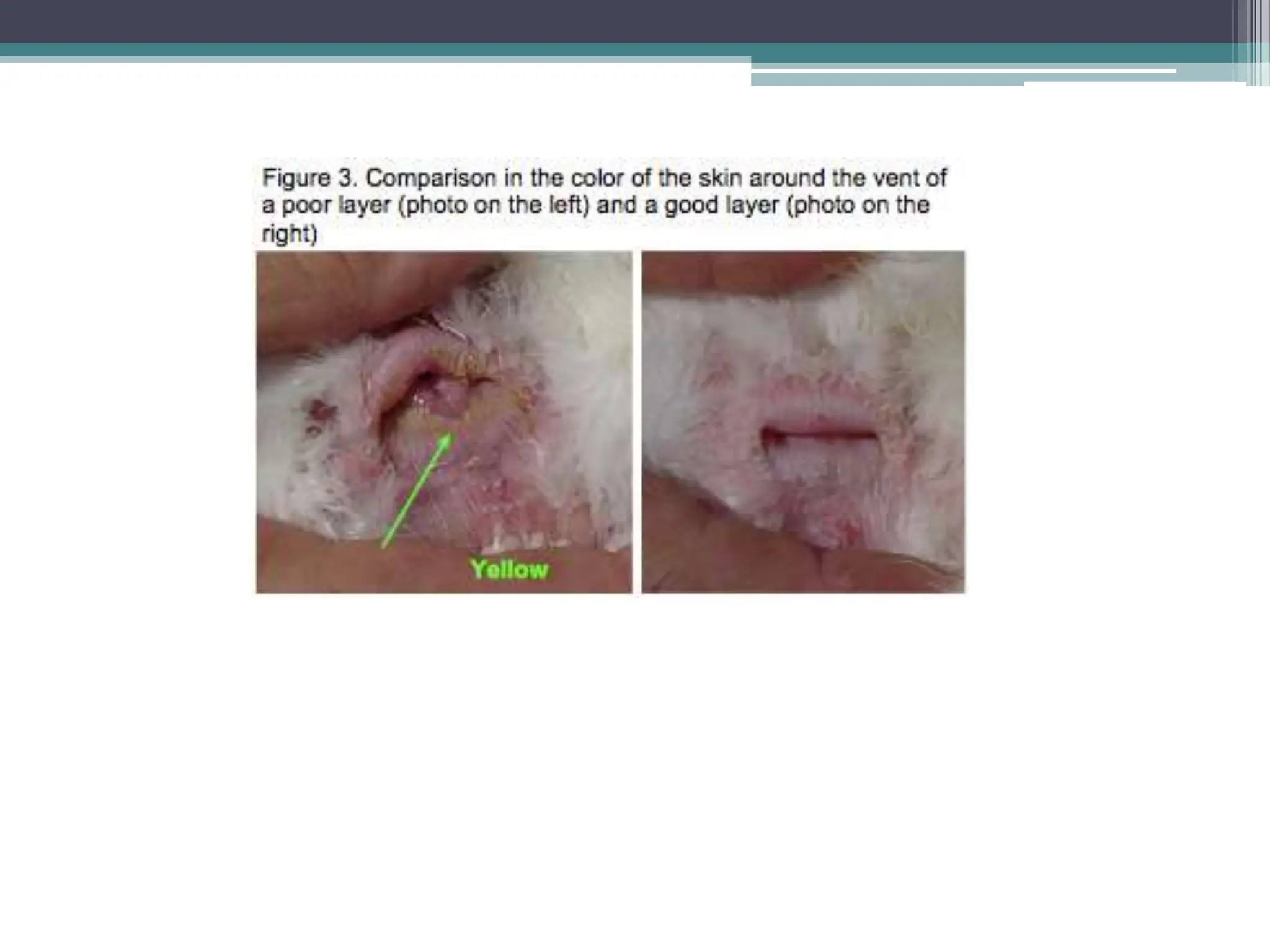
Condition and Capacity of Abdomen
• Good indicator of egg
production
▫ Abdomen of a layer is wide,
soft (lacks fat), and expanded
▫ Pelvic bones are thin and
flexible
▫ Vent is moist, large, and
oblong in shape
• Non-layer
▫ Narrow, hard (fatty), and
contracted
▫ Pelvic bones are thick and
rigid
▫ Vent has some moistness but
is small and round in shape
Abdominal Capacity
• Abdominal capacity of a hen is measured and
expressed by ones fingers width.
▫ Normal- 3 fingers width by 4 fingers width
Plumage and Rate of Molt
• Two factors considered in appraising the
plumage of hens include condition (feather
appearance) and molting rate (speed of
shedding feathers)
Vigor and Vitality
• A high producing hen appears vigorous, alert,
and quick in movement
• Non-producing hen is sluggish
Head and Head Parts
• If not trimmed- a productive
hen’s beak is short
▫ The hens eyes are bright,
alert and round.
▫ Her skull is flat from side to
side
▫ Her comb and wattles are
large, bright red, and glossy
▫ They feel velvety soft and
warm when touched.
• Non-producing hens beak is
long
▫ The hens eyes are dull,
sleepy, and oblong.
▫ Her skull is rounded from
side to side
▫ Her comb and wattles are
shrunken and dull
▫ They feel rough and cool
when touched
Parts of A Chicken
Who can come up here and label the
parts of a chicken?
Wing
Comb and Wattles
Comb
Wattles
Hock, Shank, And Feet
Vent
Crop
Parts of a Chicken
Eggs
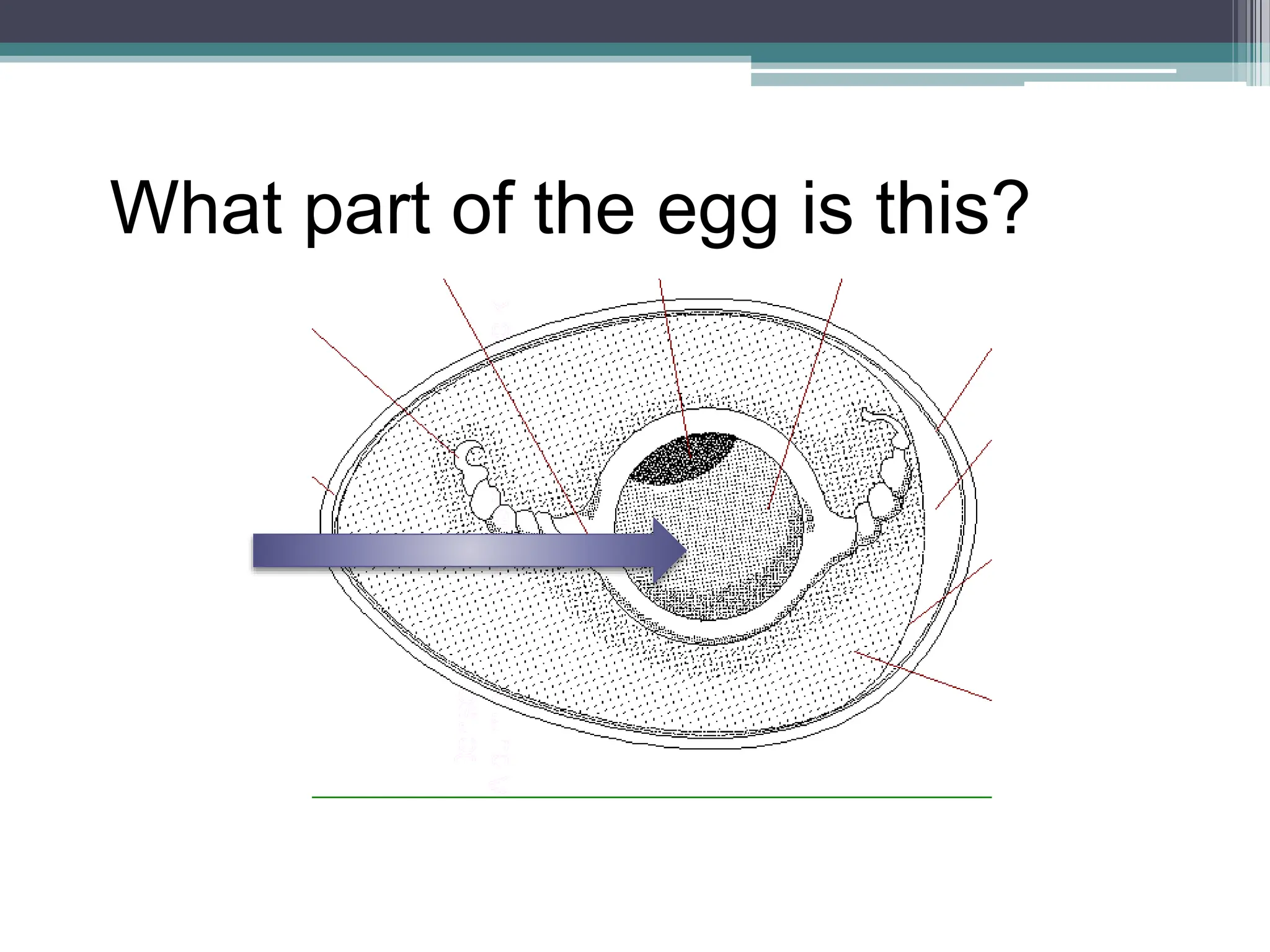
Egg and Its Parts
Egg Dissection?
• Would you want to look inside of the egg?
• How can we look at the contents inside?
▫ Why is it important to look at the contents inside?
• What is the process called that allows us to look
inside the egg?
Candling Eggs
• Candling Demo
• What do we look for when we candle eggs?
▫ Air Cell
▫ Yolk
▫ Cracks in shell
▫ Blood spots and other foreign matter
Before We Candle Eggs
Air Cell Yolk
• Temperature- 105 degrees
• Is normally at the large end of
the egg
• Quality Grades:
▫ AA- up to 1/8”
▫ A- 1/8”-3/16”
▫ B- > 3/16”
• Yolk size and shape
• Distinctness of yolk shadow
outline
• Yolk defects and germ
development
What Does Your Egg Look Like?
Objectives
• Define poultry terms.
• Differentiate between a productive hen and a
non- laying hen
• Identify parts of a chicken.
• Evaluate eggs.
Now… GAMETIME!!!
We are playing
What is the
scientific name
of poultry?
What is this part
of the chicken
called?
What Grade will the
egg have if it has up
to a 1/8” air cell?
Do chickens gain
pigment quicker than
losing it or do
chickens lose
pigment quicker than
gaining it?
What is this part of the chicken called?
What is this process called?
What part of the egg is this?
What is the name of the
pigment found in the
chicken?
What is this part of the chicken called?
What is a
layer?
What type of
feathers are
these?
What do we
look for when
we candle
eggs?
What are the top
3 areas that
molt?
What part of the egg is this?
What Grade will the
egg have if it has
greater than 3/16”
air cell?
What is this part of the chicken called?
Name 3 body parts
that fade in pigment.
What is the
temperature of
an egg when it
is laid?
Name 2
characteristics that
we look for when
examining hens.
What is this breed of chicken?
Where is
the air cell
found in
the egg?
What is a
pullet?
How many
times faster
does pigment
gained then
lost?
What part of the egg is this?
What is a
broiler?
What is
candling?
What is this part of the chicken called?
What Grade will the
egg have if it has
1/8”- 3/16” air cell?
What is this
type of
feather?
How is the
abdominal
cavity on a hen
measured?
What type of
feathers are
these?
What is the
normal
measurement of
the abdominal
capacity?
What part of the egg is this?
What is plumage?
What is
Oviposition?
What is this part of the chicken called?
What does
“green”
mean?
Name one
characteristic about
the head of a hen that
shows that it is a
productive hen.
Name one of the
things we look for
when evaluating yolk.
What is this called?

Poultry Production - How to Raise a Chicken.ppt

  • 1.
  • 2.
    What An IdealChicken! • Techno Chicken
  • 3.
    Objectives • Define poultryterms. • Differentiate between a productive hen and a non- laying hen • Identify parts of a chicken. • Evaluate eggs.
  • 4.
    Basic Terms • ScientificName: Galine • Chick: Newborn chicken • Pullet: Young, immature female chicken less than 5-6 months of age • Hen: Mature female chicken • Rooster: Mature male chicken • Roaster: male or female chicken 3-5 months of age and raised for the production of meat
  • 5.
    More Terms • Capon:Castrated male chicken • Layer: Hen used for laying eggs • Broiler/Flyer: Chickens grown for meat production • Group Name: Flock • Candling: examining a shell egg’s content by holding it between one’s eye and a light source • Clutch: Nest of eggs
  • 6.
    More Terms • Egg:hard- shelled; reproductive body produced by a bird • Green: description of chicks that have recently hatched • Axial feather: short wing feather that separates primaries from secondaries • Molt: To shed feathers periodically • Oviposition: laying of an egg by a bird • Plumage: Feathers of a bird
  • 7.
    Egg- Type Hens •Characteristics to look for when examining hens:  Bleaching of yellow pigment in the shanks, feet, and beak  Condition and capacity of the abdomen  Condition of plumage and rate of molt of the wing primaries  Vigor and vitality  Head characteristics
  • 8.
    Bleaching of BodyPigment • Order that the body pigment fades: ▫ Vent ▫ Eye Ring ▫ Earlobe ▫ Base of Beak ▫ Tip of Beak ▫ Bottom of Foot ▫ Shank ▫ Hock and Tip of Toe
  • 11.
    Bleaching of BodyPigment • Hens that show signs of returning pigment are decreasing in egg production • Pigment returns to the body parts in the same order it faded ▫ Returns 3 times quicker ▫ Four factors:  Amount of pigment in feed  Health and vitality of hen  Whether the hen is confined or not  Size and coarseness of the hen
  • 12.
    Condition and Capacityof Abdomen • Good indicator of egg production ▫ Abdomen of a layer is wide, soft (lacks fat), and expanded ▫ Pelvic bones are thin and flexible ▫ Vent is moist, large, and oblong in shape • Non-layer ▫ Narrow, hard (fatty), and contracted ▫ Pelvic bones are thick and rigid ▫ Vent has some moistness but is small and round in shape
  • 13.
    Abdominal Capacity • Abdominalcapacity of a hen is measured and expressed by ones fingers width. ▫ Normal- 3 fingers width by 4 fingers width
  • 14.
    Plumage and Rateof Molt • Two factors considered in appraising the plumage of hens include condition (feather appearance) and molting rate (speed of shedding feathers)
  • 16.
    Vigor and Vitality •A high producing hen appears vigorous, alert, and quick in movement • Non-producing hen is sluggish
  • 17.
    Head and HeadParts • If not trimmed- a productive hen’s beak is short ▫ The hens eyes are bright, alert and round. ▫ Her skull is flat from side to side ▫ Her comb and wattles are large, bright red, and glossy ▫ They feel velvety soft and warm when touched. • Non-producing hens beak is long ▫ The hens eyes are dull, sleepy, and oblong. ▫ Her skull is rounded from side to side ▫ Her comb and wattles are shrunken and dull ▫ They feel rough and cool when touched
  • 18.
    Parts of AChicken
  • 19.
    Who can comeup here and label the parts of a chicken?
  • 20.
  • 21.
  • 22.
  • 23.
  • 24.
  • 25.
    Parts of aChicken
  • 26.
  • 27.
  • 28.
    Egg Dissection? • Wouldyou want to look inside of the egg? • How can we look at the contents inside? ▫ Why is it important to look at the contents inside? • What is the process called that allows us to look inside the egg?
  • 29.
    Candling Eggs • CandlingDemo • What do we look for when we candle eggs? ▫ Air Cell ▫ Yolk ▫ Cracks in shell ▫ Blood spots and other foreign matter
  • 30.
    Before We CandleEggs Air Cell Yolk • Temperature- 105 degrees • Is normally at the large end of the egg • Quality Grades: ▫ AA- up to 1/8” ▫ A- 1/8”-3/16” ▫ B- > 3/16” • Yolk size and shape • Distinctness of yolk shadow outline • Yolk defects and germ development
  • 31.
    What Does YourEgg Look Like?
  • 32.
    Objectives • Define poultryterms. • Differentiate between a productive hen and a non- laying hen • Identify parts of a chicken. • Evaluate eggs.
  • 33.
  • 34.
    What is the scientificname of poultry?
  • 35.
    What is thispart of the chicken called?
  • 36.
    What Grade willthe egg have if it has up to a 1/8” air cell?
  • 37.
    Do chickens gain pigmentquicker than losing it or do chickens lose pigment quicker than gaining it?
  • 38.
    What is thispart of the chicken called?
  • 39.
    What is thispart of the chicken called?
  • 40.
    What is thisprocess called?
  • 41.
    What part ofthe egg is this?
  • 42.
    What is thename of the pigment found in the chicken?
  • 43.
    What is thispart of the chicken called?
  • 44.
    What is thispart of the chicken called?
  • 45.
    What is thispart of the chicken called?
  • 46.
  • 47.
  • 48.
    What do we lookfor when we candle eggs?
  • 49.
    What are thetop 3 areas that molt?
  • 50.
    What part ofthe egg is this?
  • 51.
    What Grade willthe egg have if it has greater than 3/16” air cell?
  • 52.
    What is thispart of the chicken called?
  • 53.
    Name 3 bodyparts that fade in pigment.
  • 54.
    What is the temperatureof an egg when it is laid?
  • 55.
    Name 2 characteristics that welook for when examining hens.
  • 56.
    What is thisbreed of chicken?
  • 57.
    Where is the aircell found in the egg?
  • 58.
  • 59.
    How many times faster doespigment gained then lost?
  • 60.
    What part ofthe egg is this?
  • 61.
  • 62.
  • 63.
    What is thispart of the chicken called?
  • 64.
    What Grade willthe egg have if it has 1/8”- 3/16” air cell?
  • 65.
    What is this typeof feather?
  • 66.
    How is the abdominal cavityon a hen measured?
  • 67.
  • 68.
    What is the normal measurementof the abdominal capacity?
  • 69.
    What part ofthe egg is this?
  • 70.
  • 71.
  • 72.
    What is thispart of the chicken called?
  • 73.
  • 74.
    Name one characteristic about thehead of a hen that shows that it is a productive hen.
  • 75.
    Name one ofthe things we look for when evaluating yolk.
  • 76.
    What is thiscalled?