QUALITATIVE AND
QUANTITATIVE TRAITS IN
POULTRY
11/19/2020 GURRAM SRINIVAS
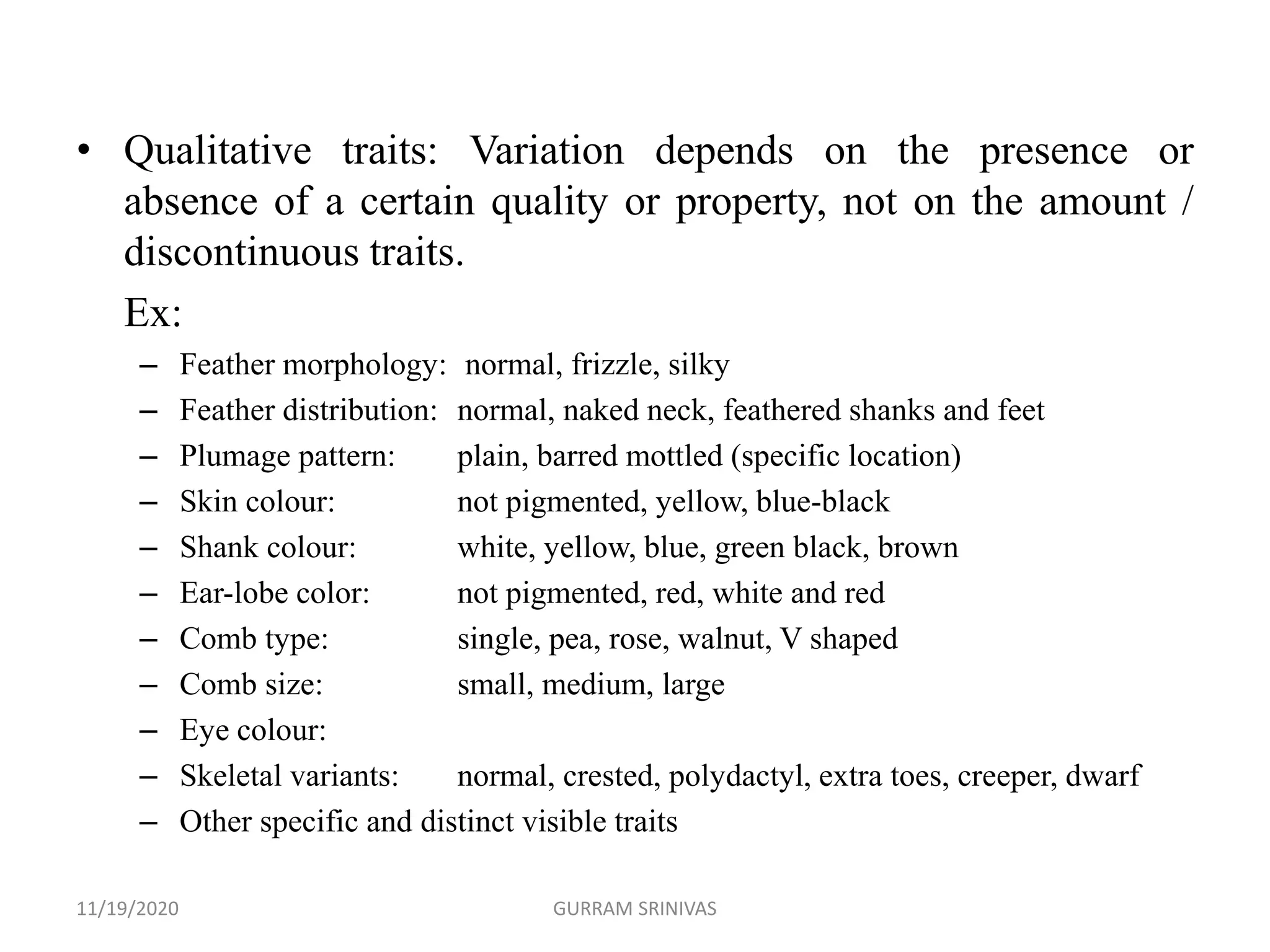
• Qualitative traits: Variation depends on the presence or
absence of a certain quality or property, not on the amount /
discontinuous traits.
Ex:
– Feather morphology: normal, frizzle, silky
– Feather distribution: normal, naked neck, feathered shanks and feet
– Plumage pattern: plain, barred mottled (specific location)
– Skin colour: not pigmented, yellow, blue-black
– Shank colour: white, yellow, blue, green black, brown
– Ear-lobe color: not pigmented, red, white and red
– Comb type: single, pea, rose, walnut, V shaped
– Comb size: small, medium, large
– Eye colour:
– Skeletal variants: normal, crested, polydactyl, extra toes, creeper, dwarf
– Other specific and distinct visible traits
11/19/2020 GURRAM SRINIVAS
Incomplete Dominance
• Feathers stand up stiffly, shafts curling outward
• Wing and tail feathers are less curved
• Heterozygous for a dominant gene F
Frizzle fowl
11/19/2020 GURRAM SRINIVAS
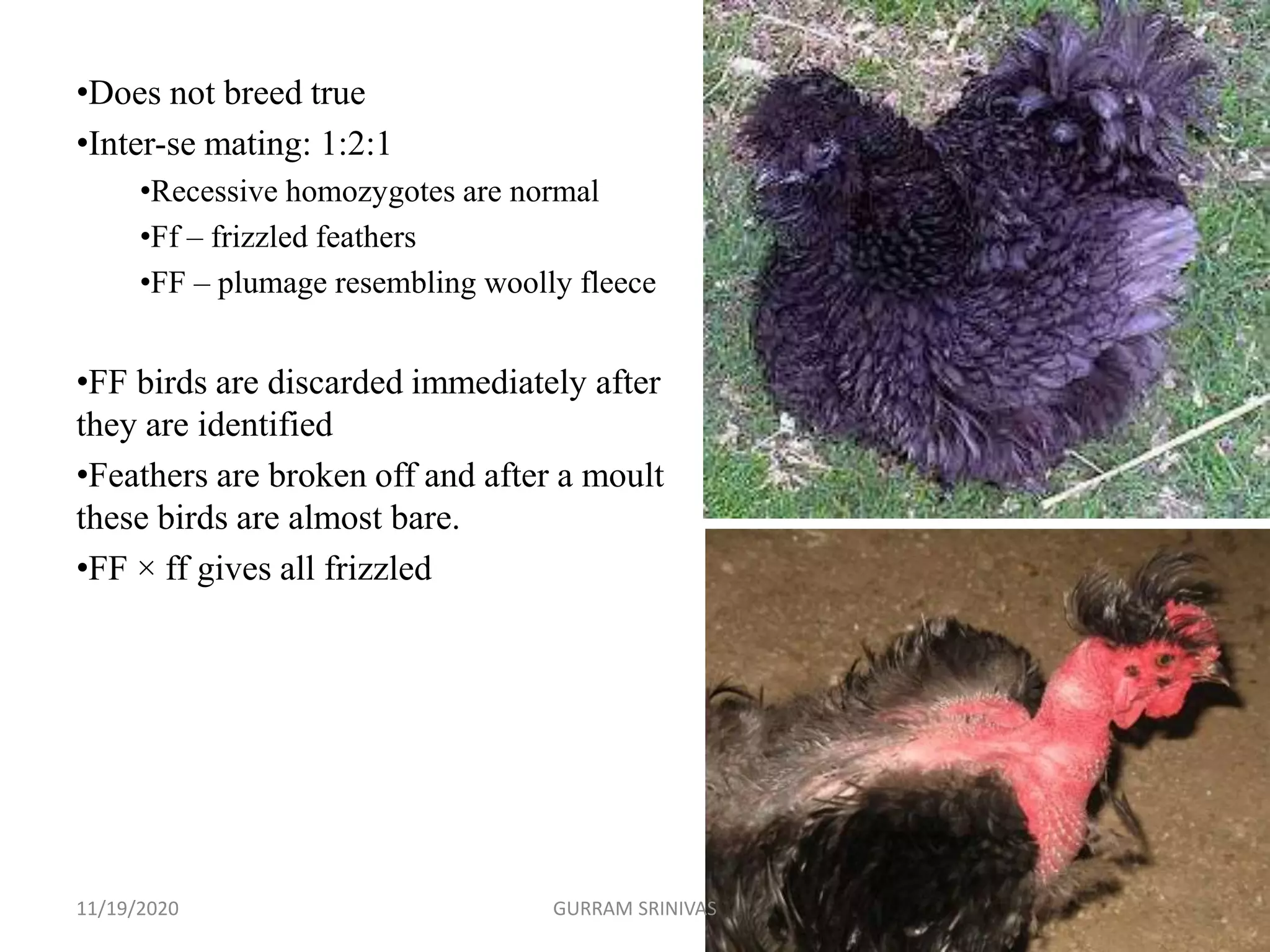
•Does not breed true
•Inter-se mating: 1:2:1
•Recessive homozygotes are normal
•Ff – frizzled feathers
•FF – plumage resembling woolly fleece
•FF birds are discarded immediately after
they are identified
•Feathers are broken off and after a moult
these birds are almost bare.
•FF × ff gives all frizzled
11/19/2020 GURRAM SRINIVAS
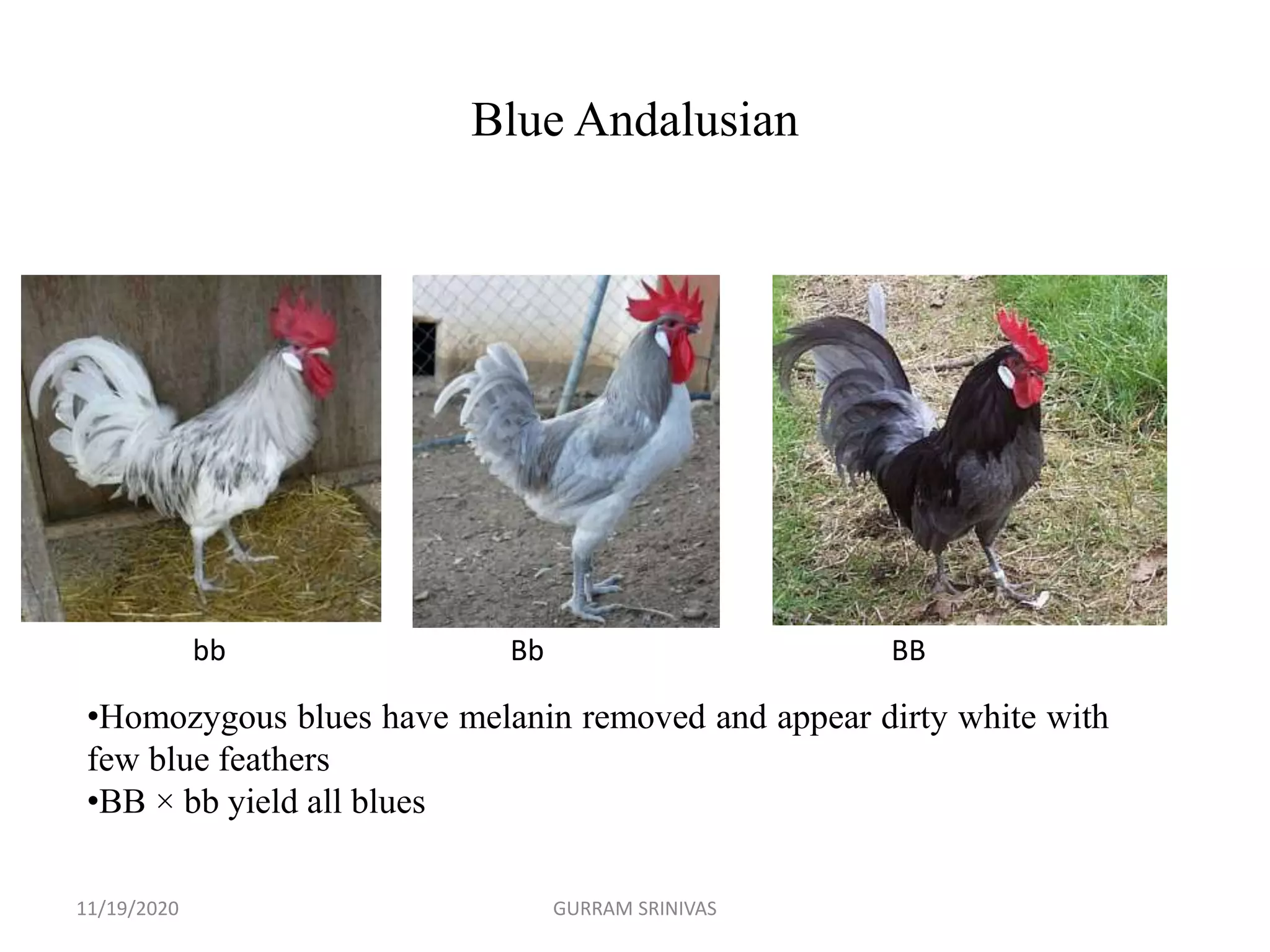
Blue Andalusian
•Homozygous blues have melanin removed and appear dirty white with
few blue feathers
•BB × bb yield all blues
bb Bb BB
11/19/2020 GURRAM SRINIVAS
GENE INTERACTION
• Interactions:
– Two different genes ( not alleles) produce by their combined action, a
phenotype different from that induced by either gene alone.
– On gene may prevent the expression of others
11/19/2020 GURRAM SRINIVAS
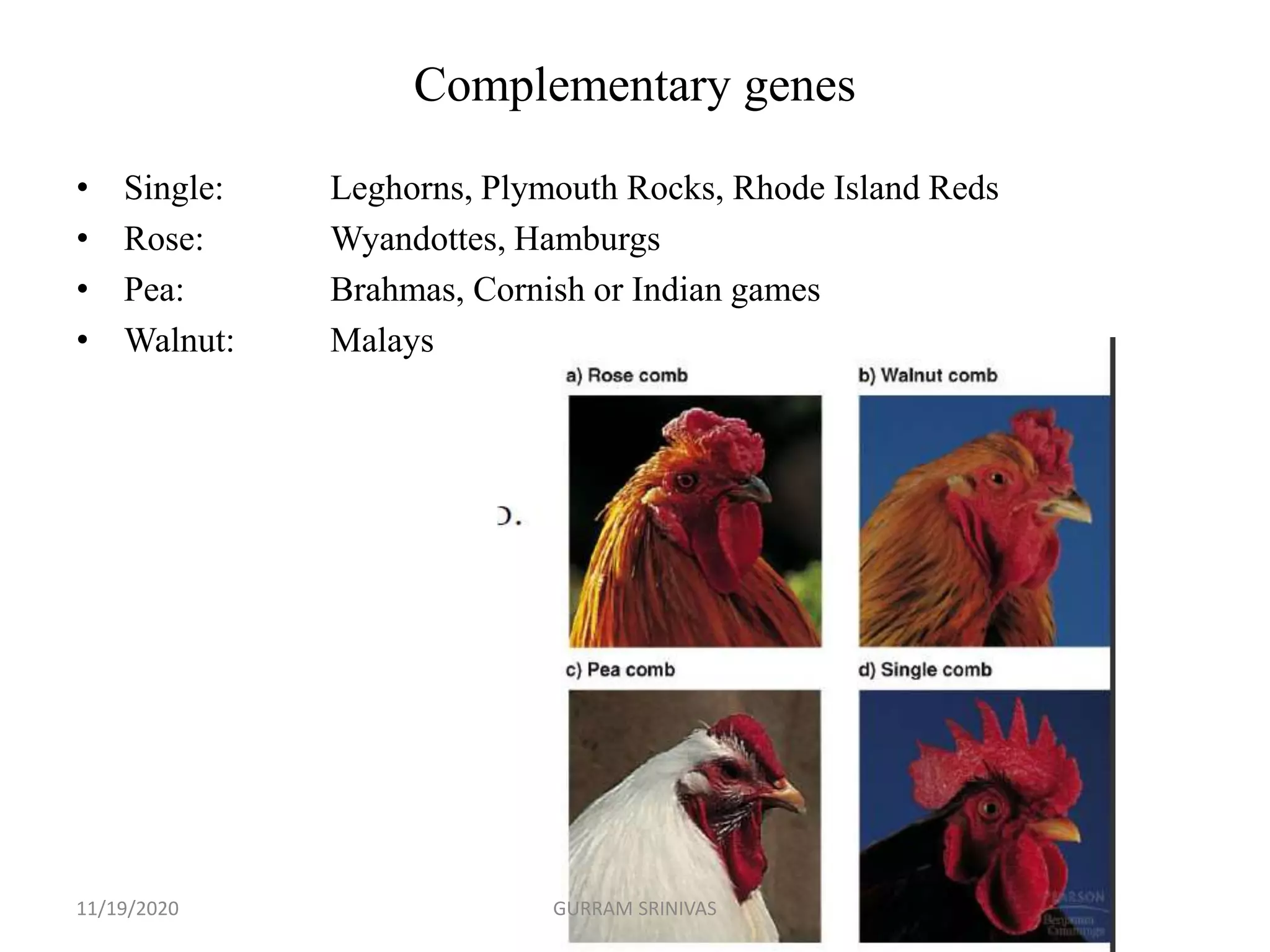
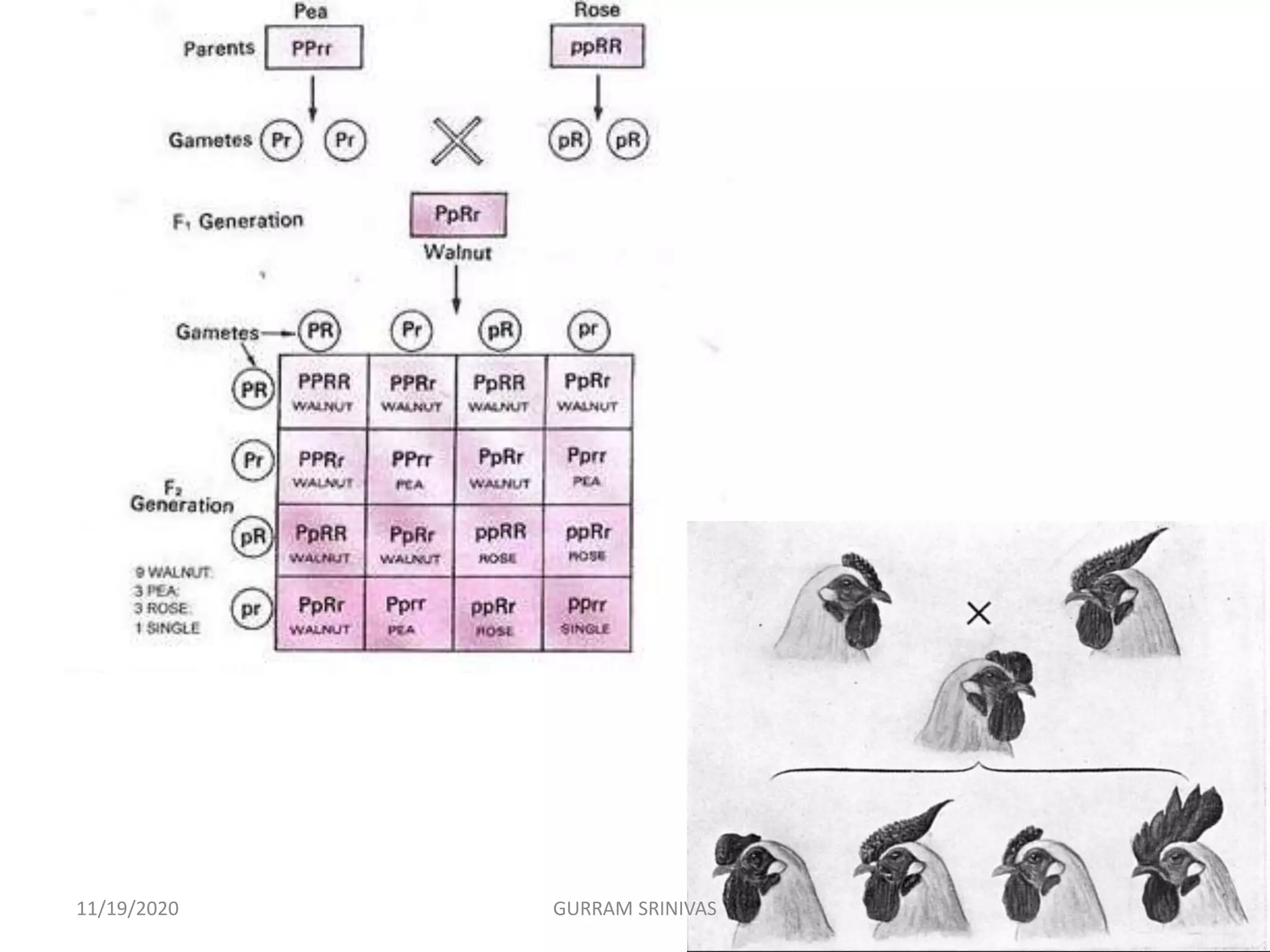
Complementary genes
• Single: Leghorns, Plymouth Rocks, Rhode Island Reds
• Rose: Wyandottes, Hamburgs
• Pea: Brahmas, Cornish or Indian games
• Walnut: Malays
11/19/2020 GURRAM SRINIVAS
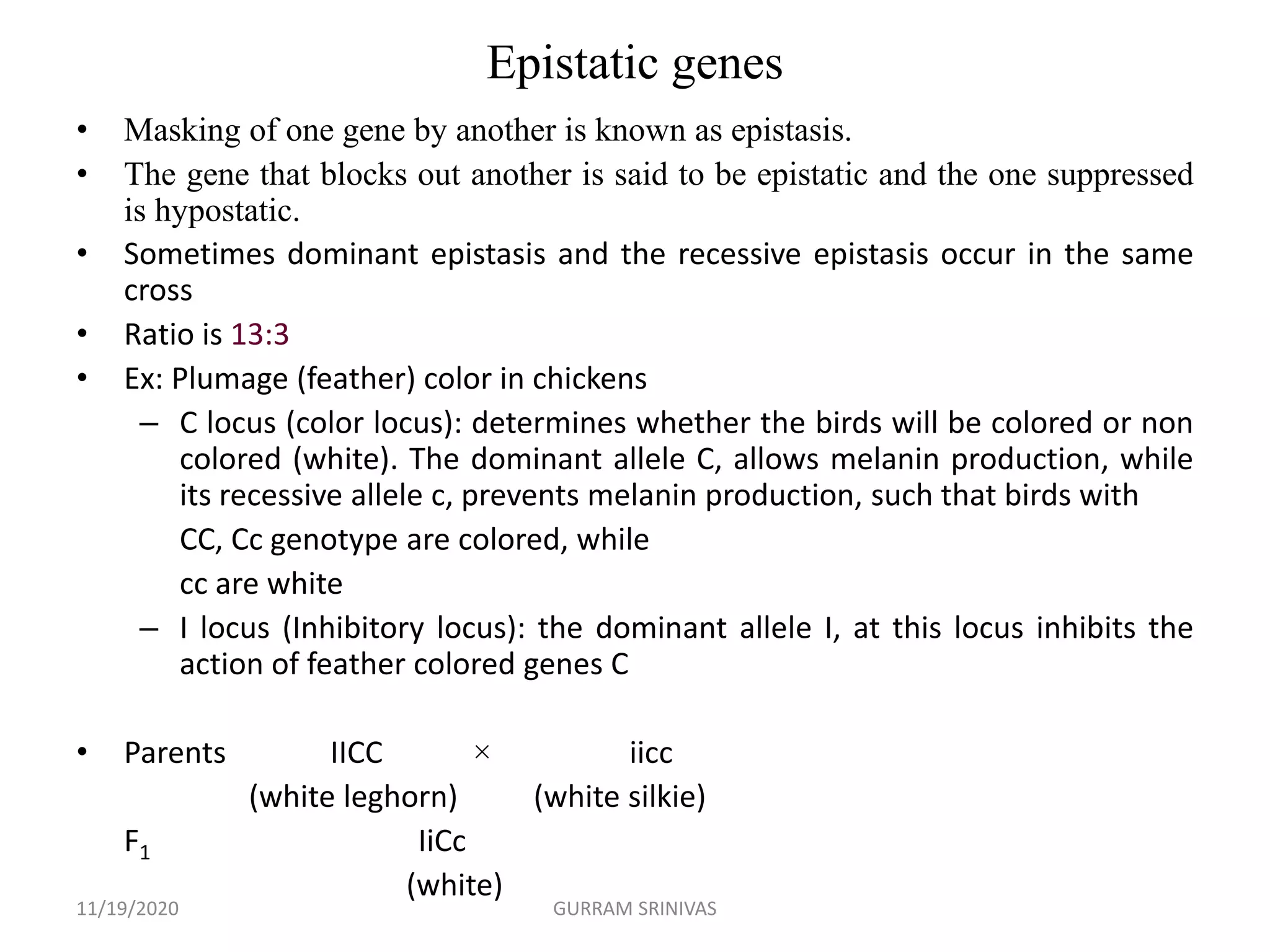
Epistatic genes
• Masking of one gene by another is known as epistasis.
• The gene that blocks out another is said to be epistatic and the one suppressed
is hypostatic.
• Sometimes dominant epistasis and the recessive epistasis occur in the same
cross
• Ratio is 13:3
• Ex: Plumage (feather) color in chickens
– C locus (color locus): determines whether the birds will be colored or non
colored (white). The dominant allele C, allows melanin production, while
its recessive allele c, prevents melanin production, such that birds with
CC, Cc genotype are colored, while
cc are white
– I locus (Inhibitory locus): the dominant allele I, at this locus inhibits the
action of feather colored genes C
• Parents IICC × iicc
(white leghorn) (white silkie)
F1 IiCc
(white)
11/19/2020 GURRAM SRINIVAS
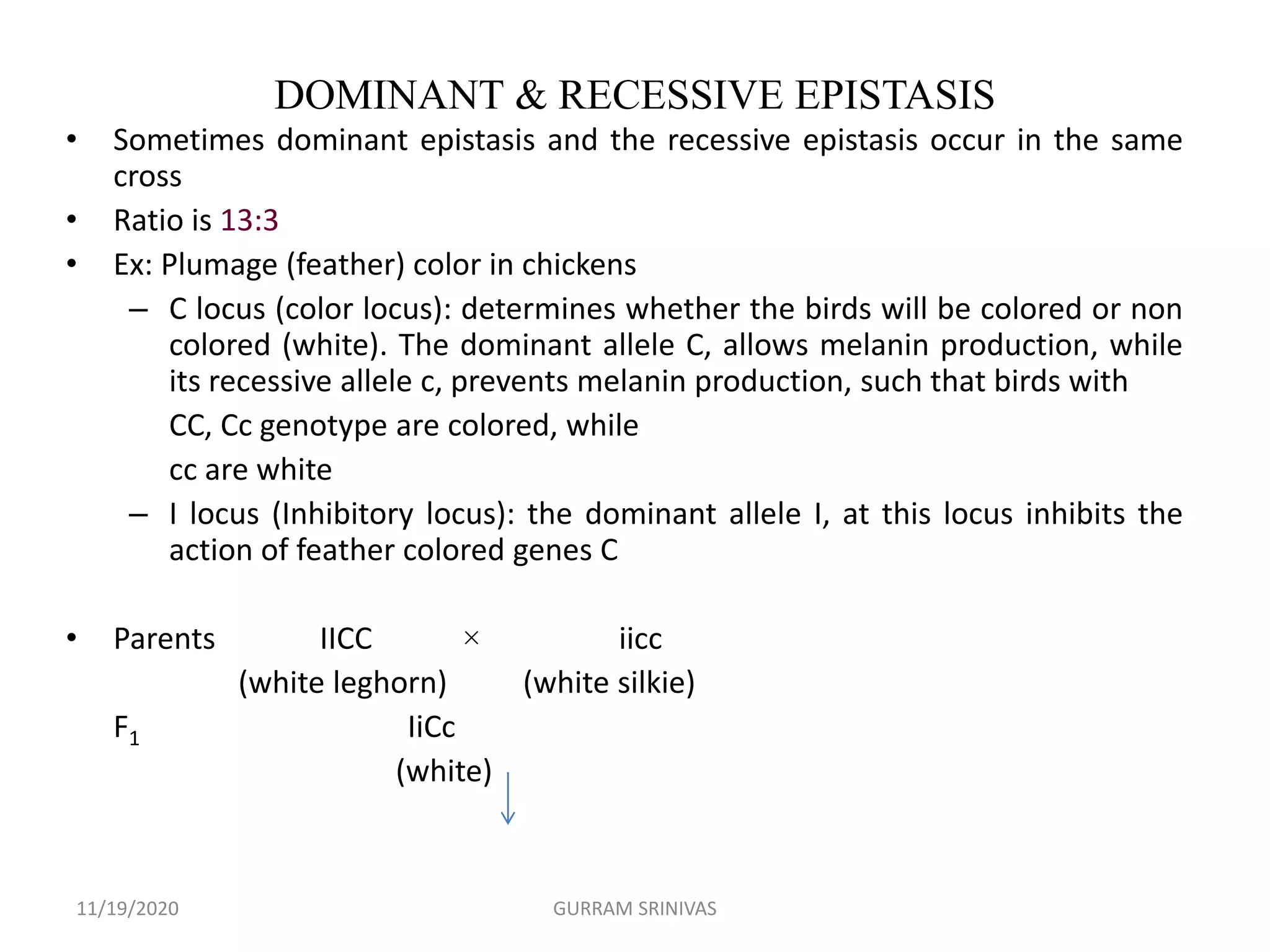
DOMINANT & RECESSIVE EPISTASIS
• Sometimes dominant epistasis and the recessive epistasis occur in the same
cross
• Ratio is 13:3
• Ex: Plumage (feather) color in chickens
– C locus (color locus): determines whether the birds will be colored or non
colored (white). The dominant allele C, allows melanin production, while
its recessive allele c, prevents melanin production, such that birds with
CC, Cc genotype are colored, while
cc are white
– I locus (Inhibitory locus): the dominant allele I, at this locus inhibits the
action of feather colored genes C
• Parents IICC × iicc
(white leghorn) (white silkie)
F1 IiCc
(white)
11/19/2020 GURRAM SRINIVAS
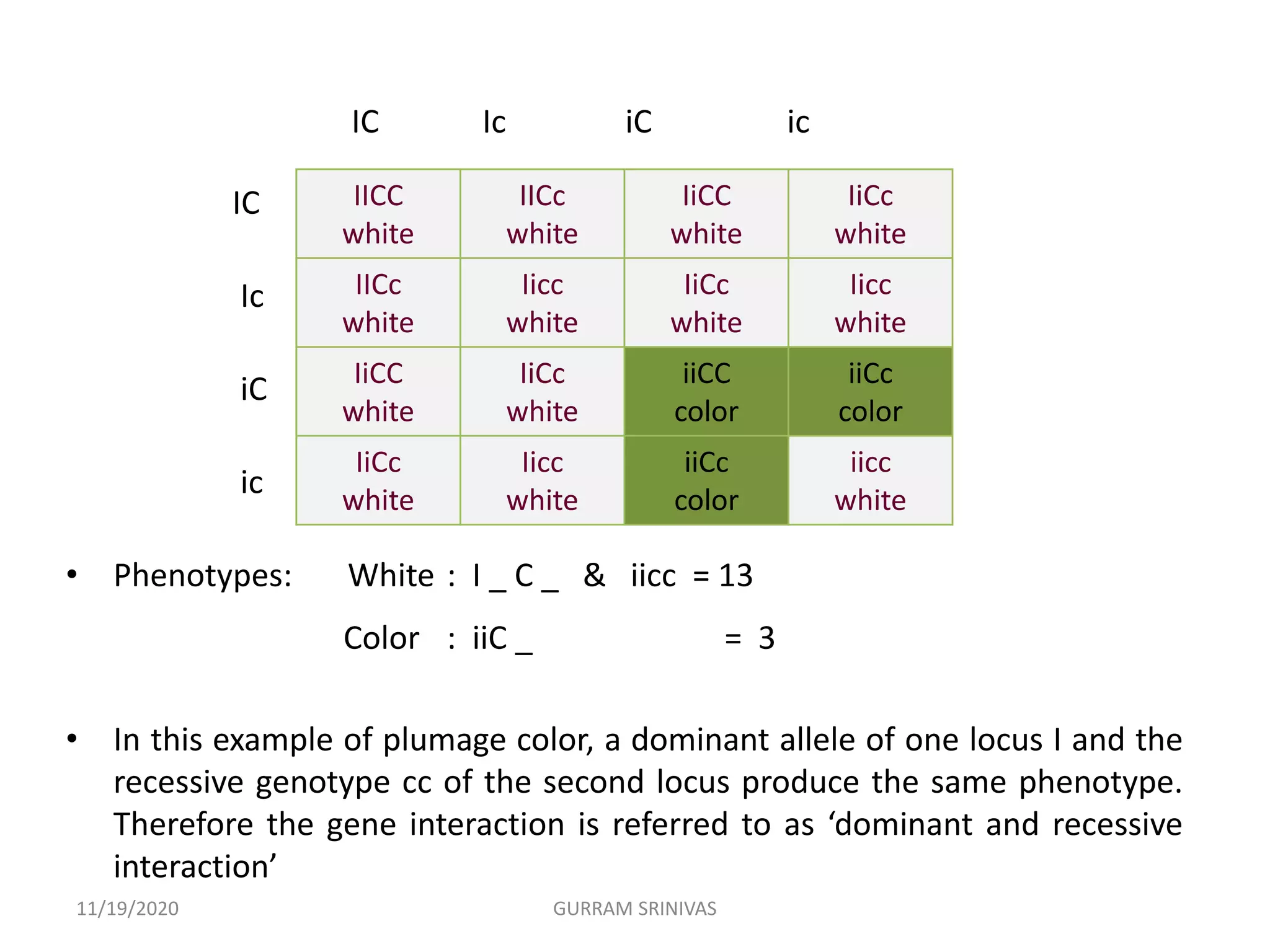
IC Ic iC ic
IC
Ic
iC
ic
• Phenotypes: White : I _ C _ & iicc = 13
Color : iiC _ = 3
• In this example of plumage color, a dominant allele of one locus I and the
recessive genotype cc of the second locus produce the same phenotype.
Therefore the gene interaction is referred to as ‘dominant and recessive
interaction’
IICC
white
IICc
white
IiCC
white
IiCc
white
IICc
white
Iicc
white
IiCc
white
Iicc
white
IiCC
white
IiCc
white
iiCC
color
iiCc
color
IiCc
white
Iicc
white
iiCc
color
iicc
white
11/19/2020 GURRAM SRINIVAS
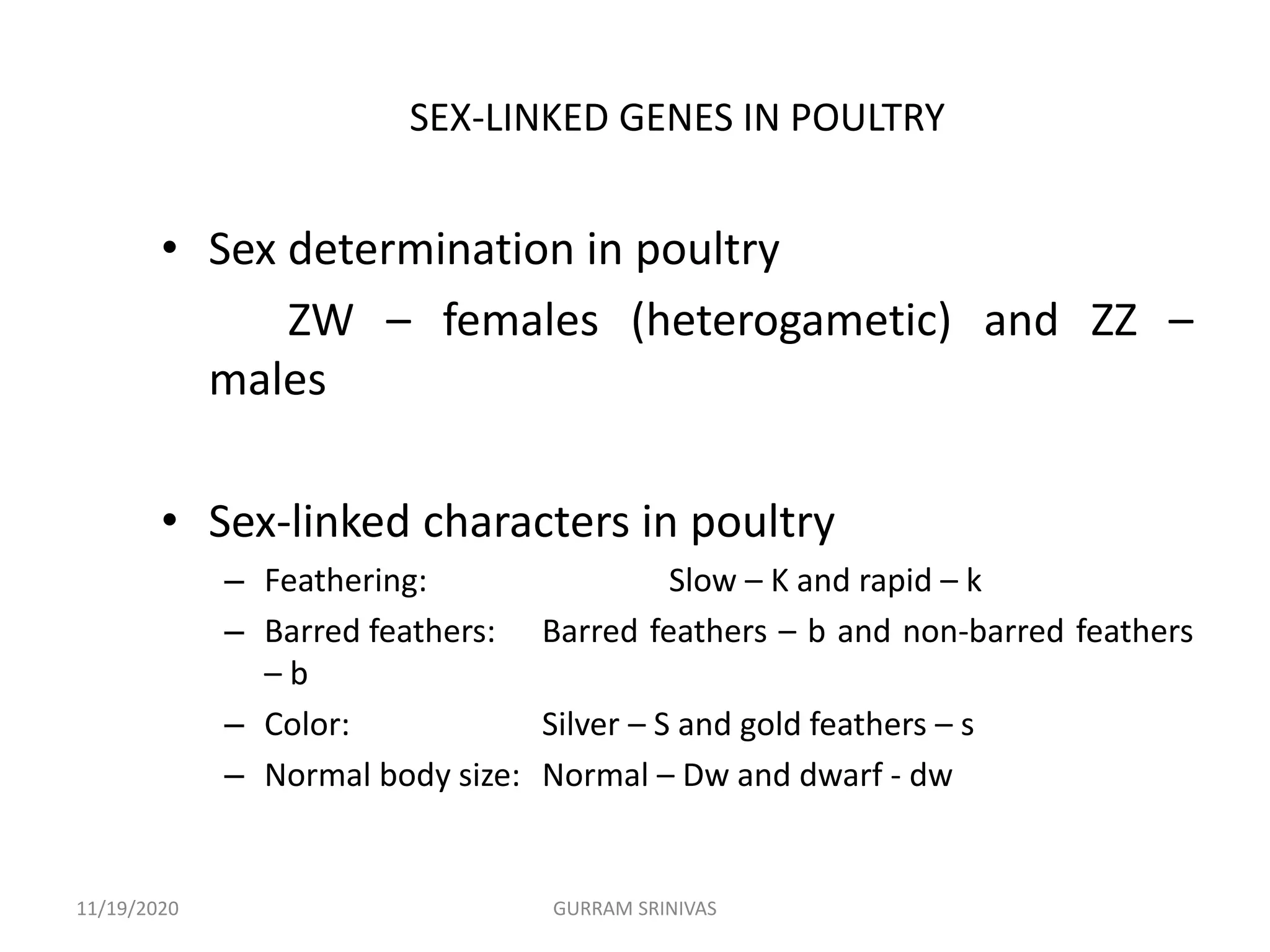
SEX-LINKED GENES IN POULTRY
• Sex determination in poultry
ZW – females (heterogametic) and ZZ –
males
• Sex-linked characters in poultry
– Feathering: Slow – K and rapid – k
– Barred feathers: Barred feathers – b and non-barred feathers
– b
– Color: Silver – S and gold feathers – s
– Normal body size: Normal – Dw and dwarf - dw
11/19/2020 GURRAM SRINIVAS
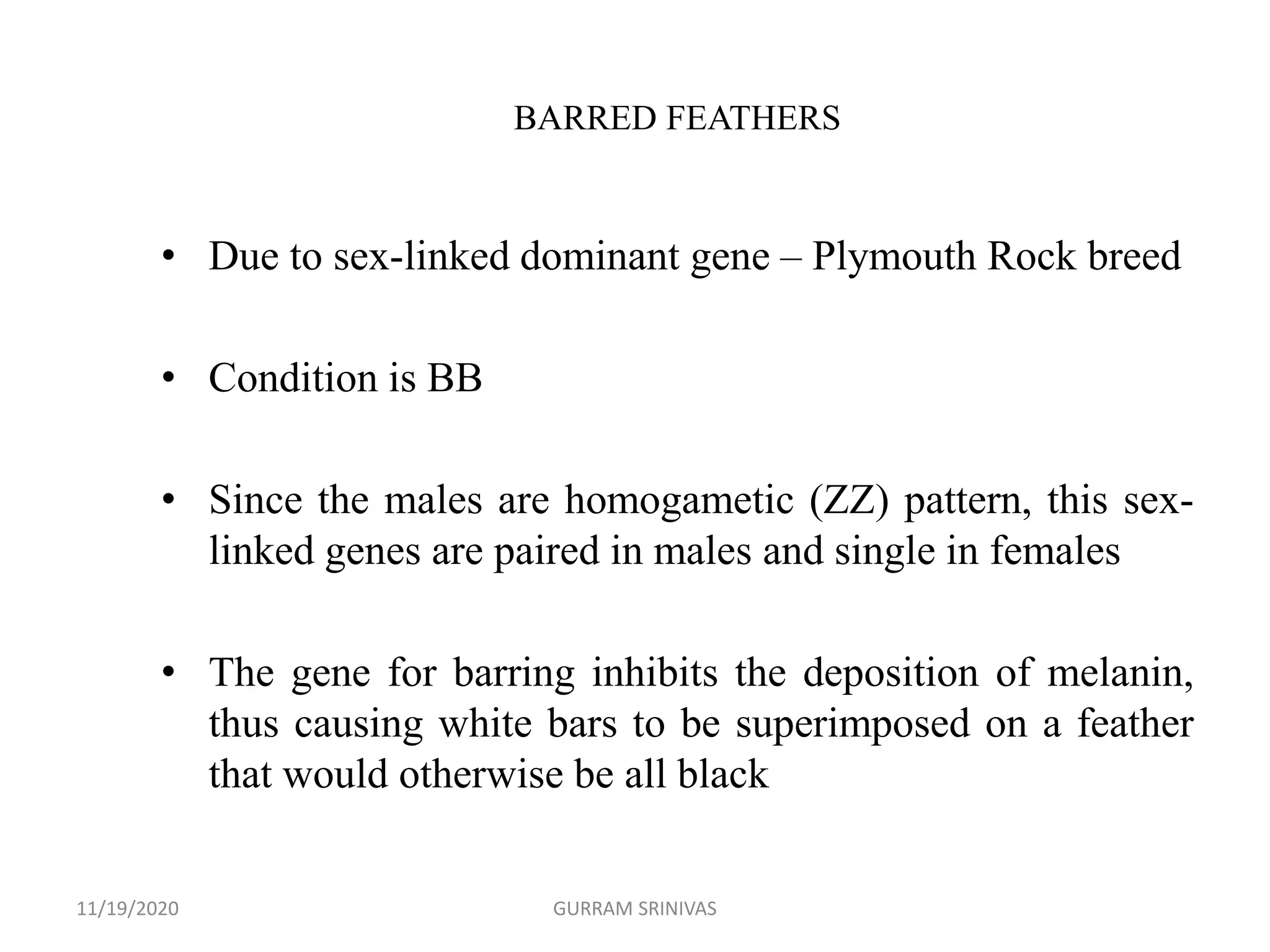
BARRED FEATHERS
• Due to sex-linked dominant gene – Plymouth Rock breed
• Condition is BB
• Since the males are homogametic (ZZ) pattern, this sex-
linked genes are paired in males and single in females
• The gene for barring inhibits the deposition of melanin,
thus causing white bars to be superimposed on a feather
that would otherwise be all black
11/19/2020 GURRAM SRINIVAS
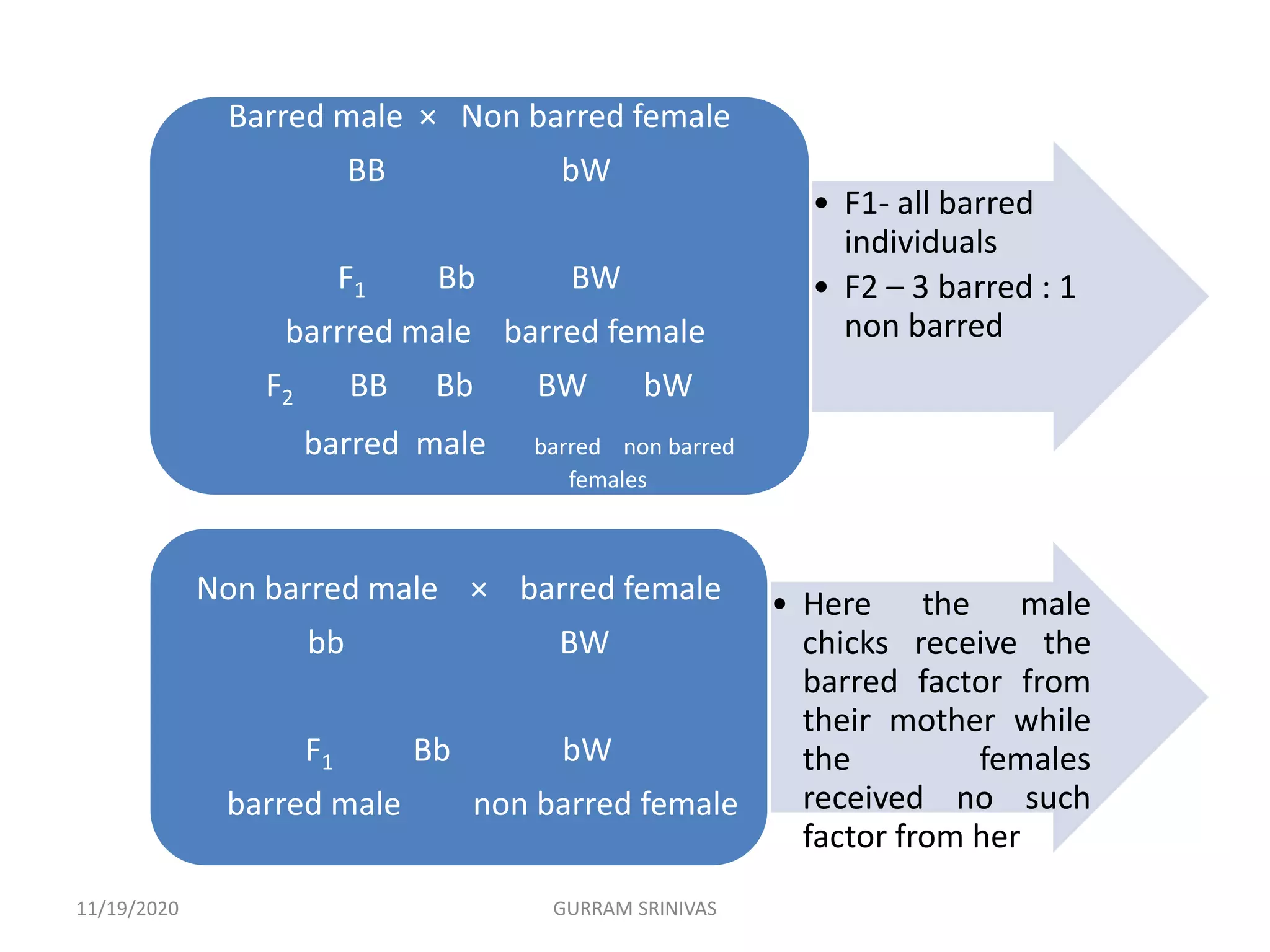
• F1- all barred
individuals
• F2 – 3 barred : 1
non barred
Barred male × Non barred female
BB bW
F1 Bb BW
barrred male barred female
F2 BB Bb BW bW
barred male barred non barred
females
• Here the male
chicks receive the
barred factor from
their mother while
the females
received no such
factor from her
Non barred male × barred female
bb BW
F1 Bb bW
barred male non barred female
11/19/2020 GURRAM SRINIVAS
Practical application:
• Usually sexing of the day old chick – vent sexing
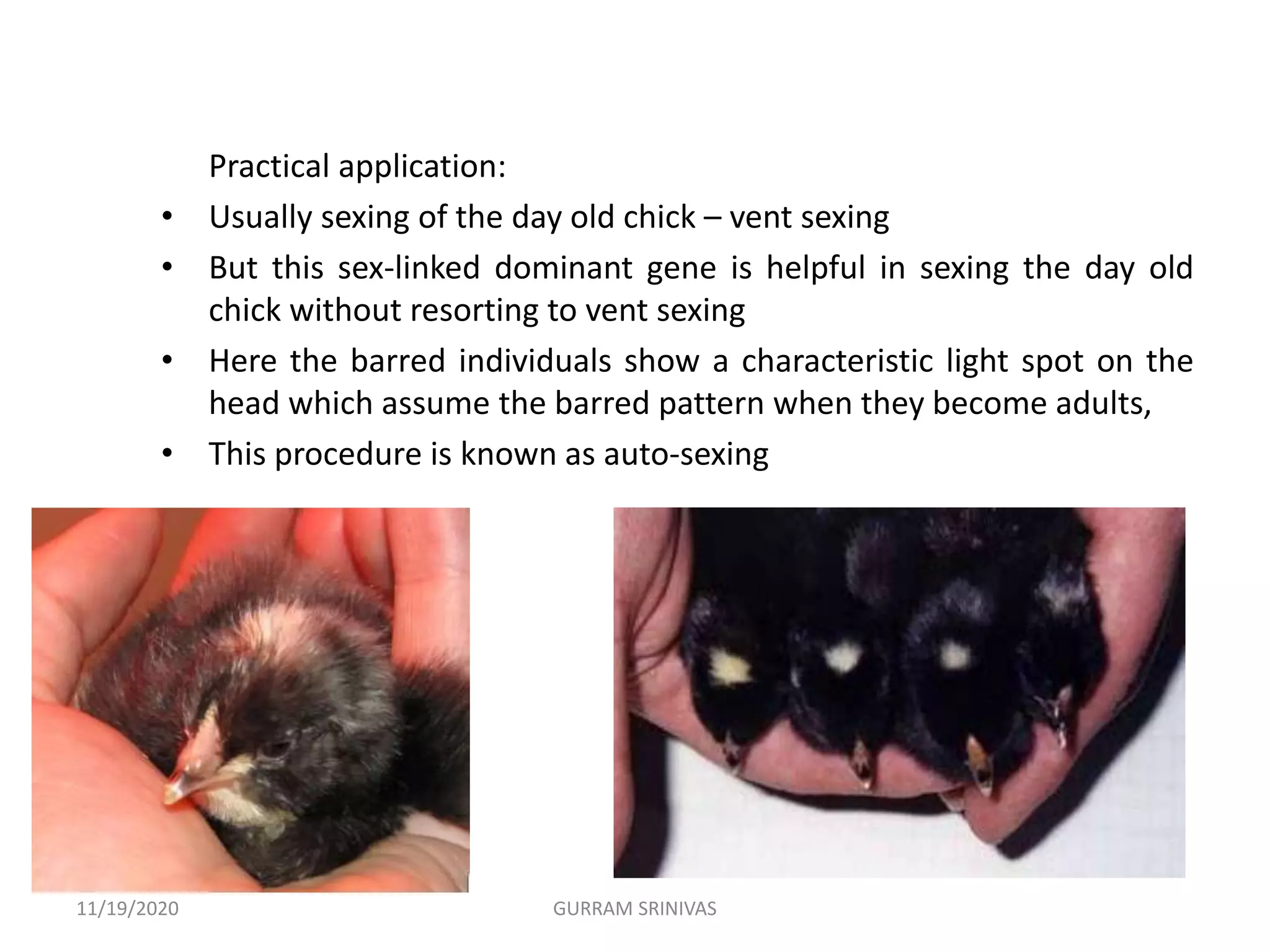
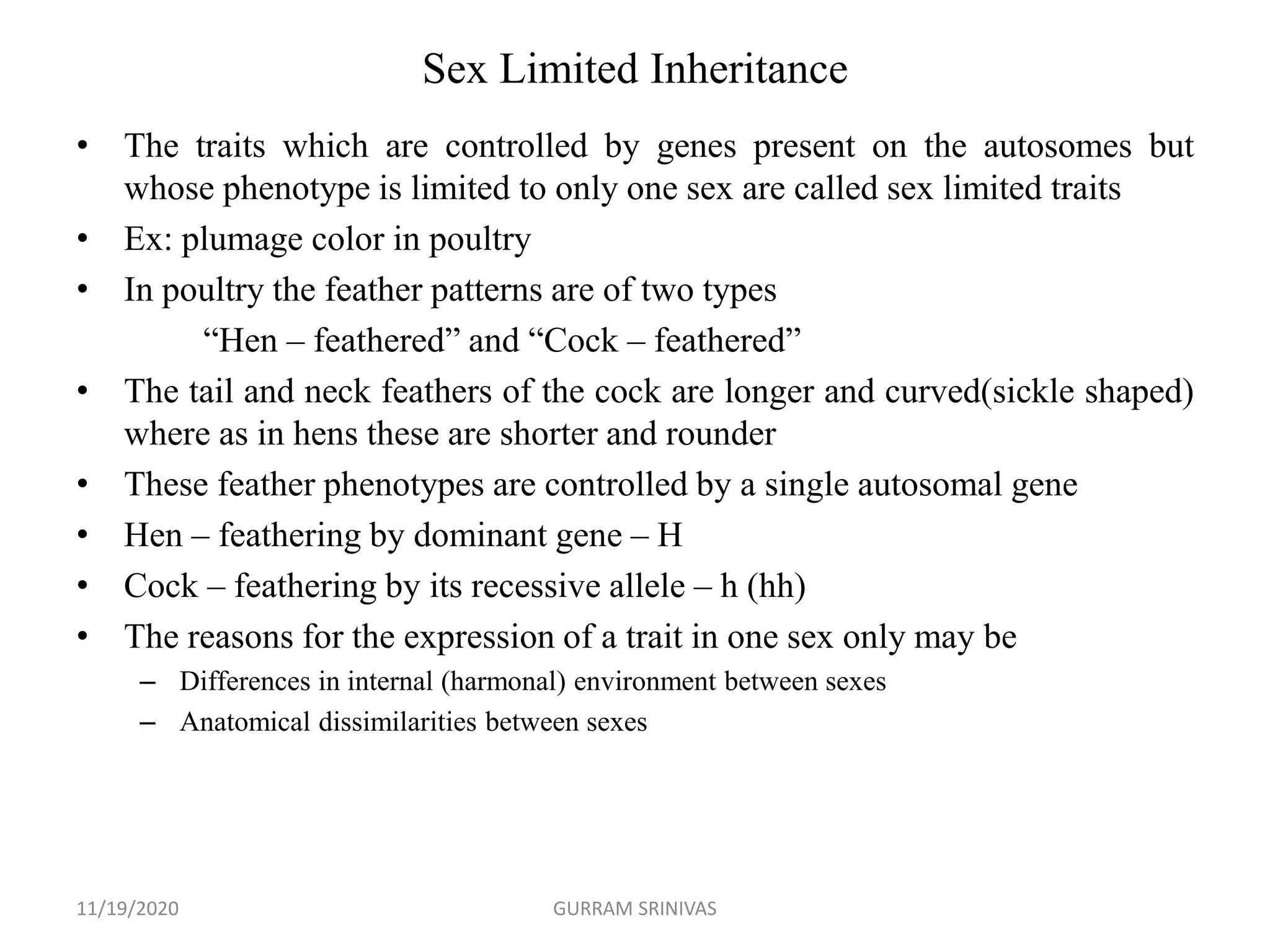
• But this sex-linked dominant gene is helpful in sexing the day old
chick without resorting to vent sexing
• Here the barred individuals show a characteristic light spot on the
head which assume the barred pattern when they become adults,
• This procedure is known as auto-sexing
11/19/2020 GURRAM SRINIVAS
Sex Limited Inheritance
• The traits which are controlled by genes present on the autosomes but
whose phenotype is limited to only one sex are called sex limited traits
• Ex: plumage color in poultry
• In poultry the feather patterns are of two types
“Hen – feathered” and “Cock – feathered”
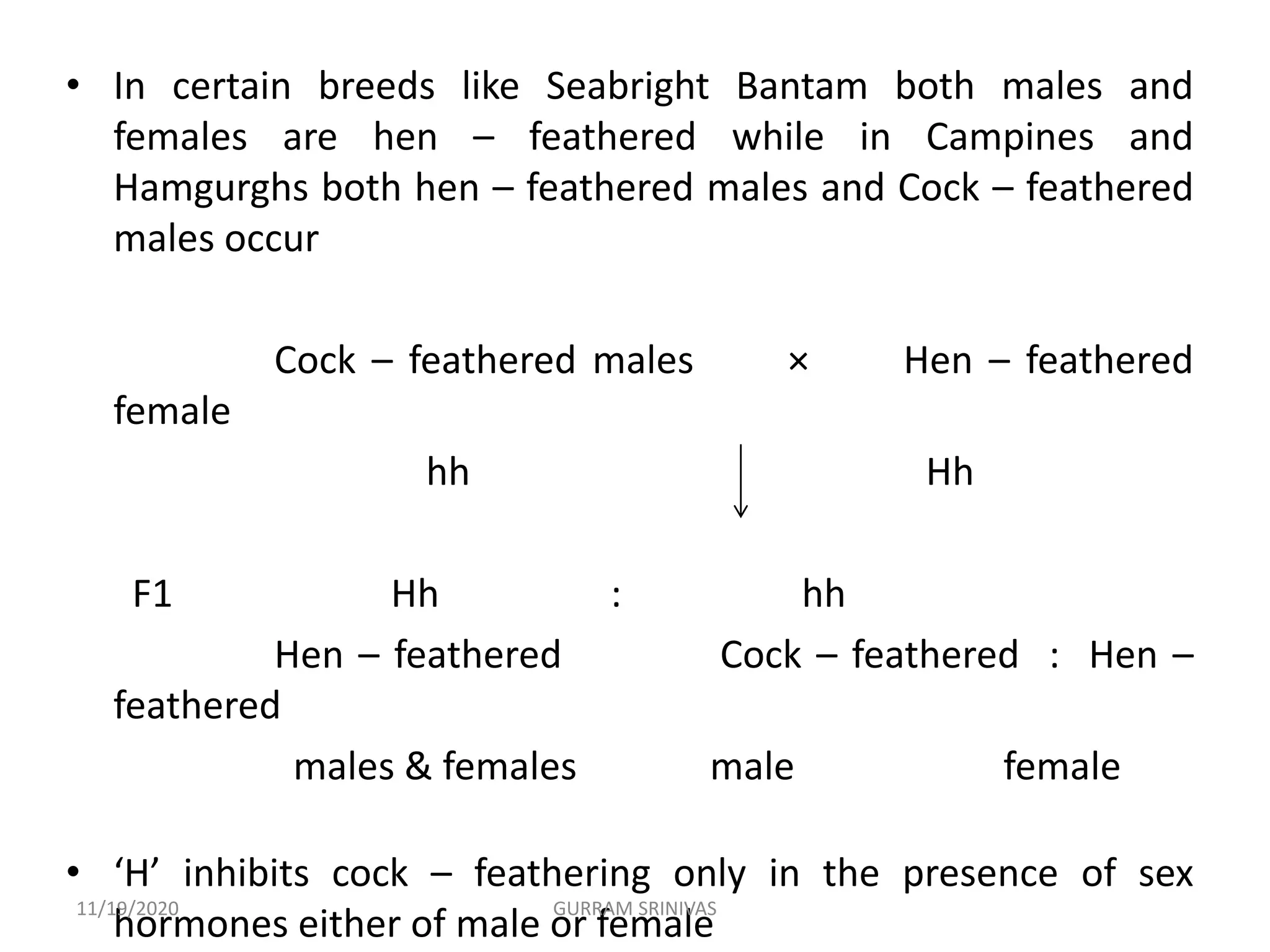
• The tail and neck feathers of the cock are longer and curved(sickle shaped)
where as in hens these are shorter and rounder
• These feather phenotypes are controlled by a single autosomal gene
• Hen – feathering by dominant gene – H
• Cock – feathering by its recessive allele – h (hh)
• The reasons for the expression of a trait in one sex only may be
– Differences in internal (harmonal) environment between sexes
– Anatomical dissimilarities between sexes
11/19/2020 GURRAM SRINIVAS
• In certain breeds like Seabright Bantam both males and
females are hen – feathered while in Campines and
Hamgurghs both hen – feathered males and Cock – feathered
males occur
Cock – feathered males × Hen – feathered
female
hh Hh
F1 Hh : hh
Hen – feathered Cock – feathered : Hen –
feathered
males & females male female
• ‘H’ inhibits cock – feathering only in the presence of sex
hormones either of male or female
11/19/2020 GURRAM SRINIVAS
• ‘h’ does not inhibit cock – feathering but it can show its effect only
in the absence of female sex hormones
• This indicates that certain genotypes, even though homozygous
express only in one sex and fail to express in opposite sex
• Ordinary breeds of poultry like the Leghorns , RIR and others in
which males are cock – feathered and females are hen – feathered
would be all of the genotype ‘hh’
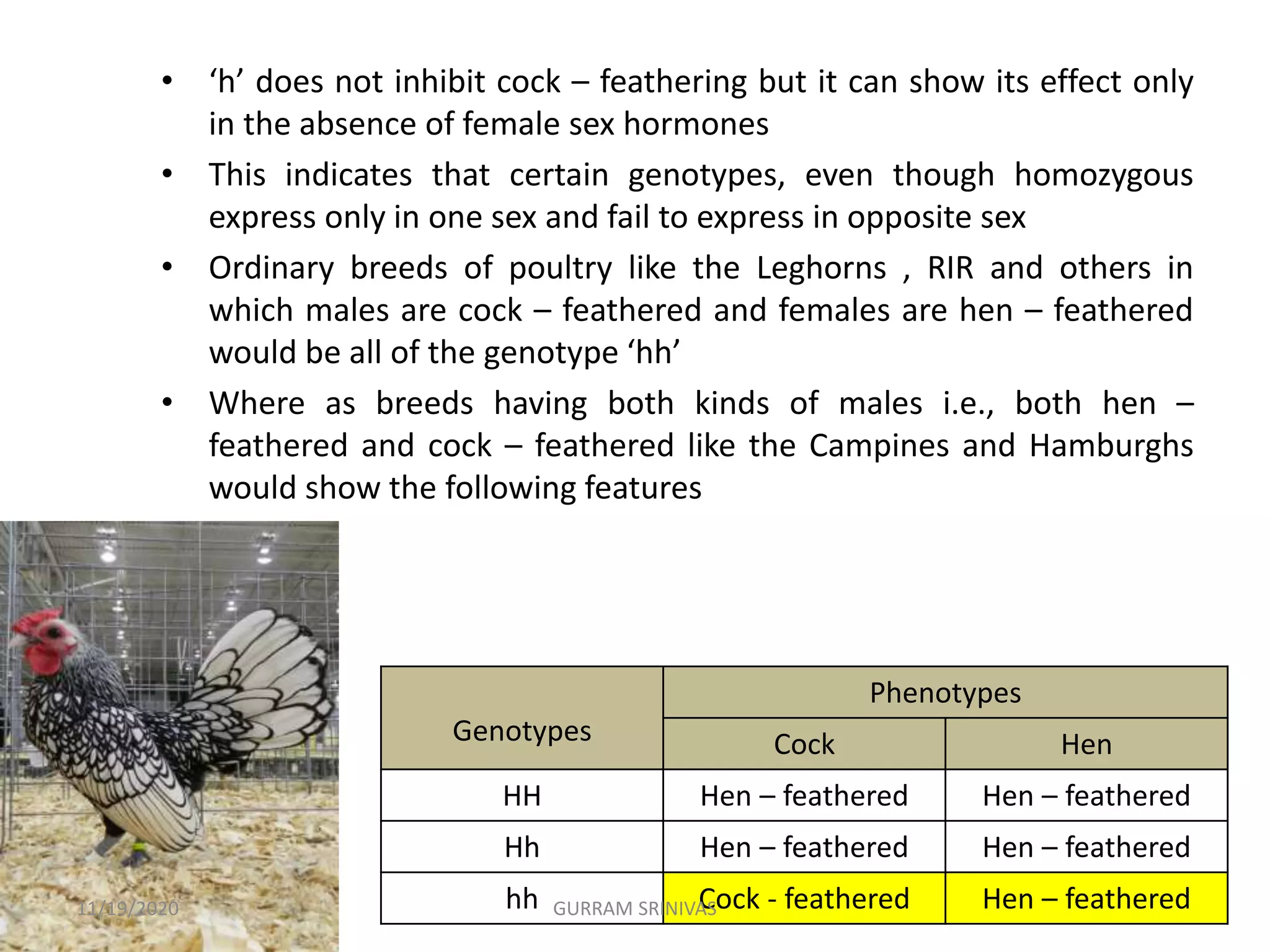
• Where as breeds having both kinds of males i.e., both hen –
feathered and cock – feathered like the Campines and Hamburghs
would show the following features
Genotypes
Phenotypes
Cock Hen
HH Hen – feathered Hen – feathered
Hh Hen – feathered Hen – feathered
hh Cock - feathered Hen – feathered11/19/2020 GURRAM SRINIVAS
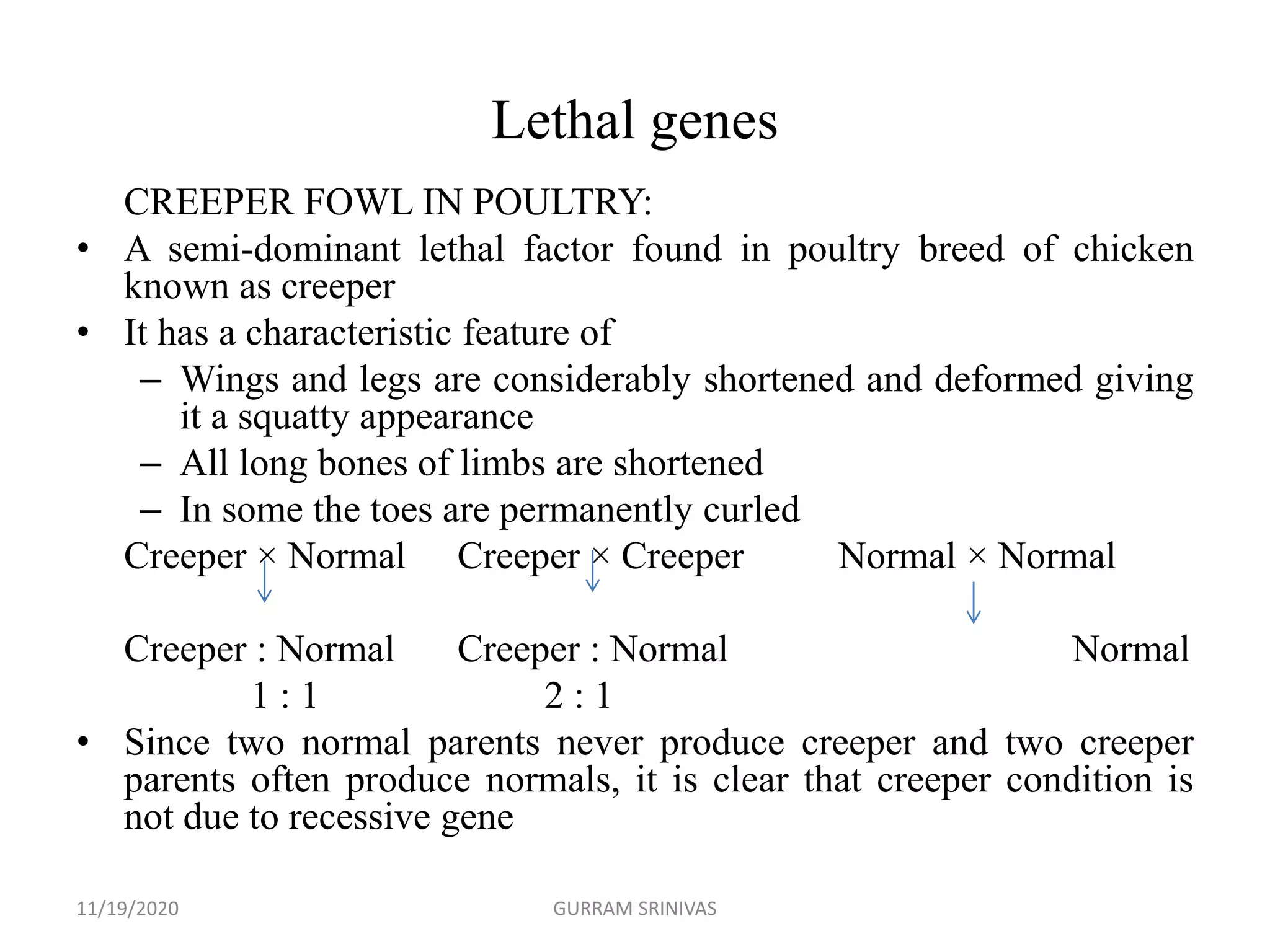
Lethal genes
CREEPER FOWL IN POULTRY:
• A semi-dominant lethal factor found in poultry breed of chicken
known as creeper
• It has a characteristic feature of
– Wings and legs are considerably shortened and deformed giving
it a squatty appearance
– All long bones of limbs are shortened
– In some the toes are permanently curled
Creeper × Normal Creeper × Creeper Normal × Normal
Creeper : Normal Creeper : Normal Normal
1 : 1 2 : 1
• Since two normal parents never produce creeper and two creeper
parents often produce normals, it is clear that creeper condition is
not due to recessive gene
11/19/2020 GURRAM SRINIVAS
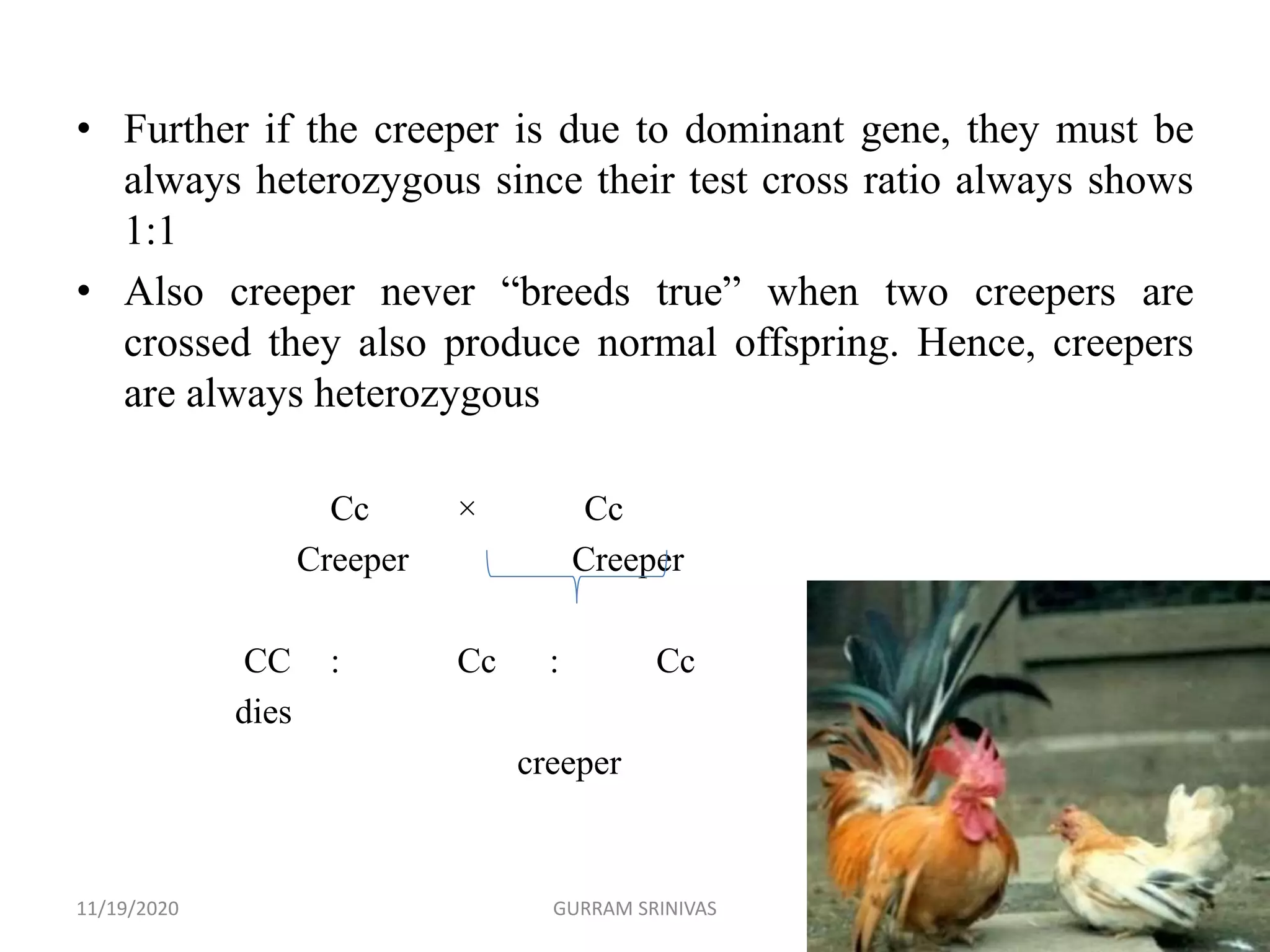
• Further if the creeper is due to dominant gene, they must be
always heterozygous since their test cross ratio always shows
1:1
• Also creeper never “breeds true” when two creepers are
crossed they also produce normal offspring. Hence, creepers
are always heterozygous
Cc × Cc
Creeper Creeper
CC : Cc : Cc : cc
dies normal
creeper
11/19/2020 GURRAM SRINIVAS
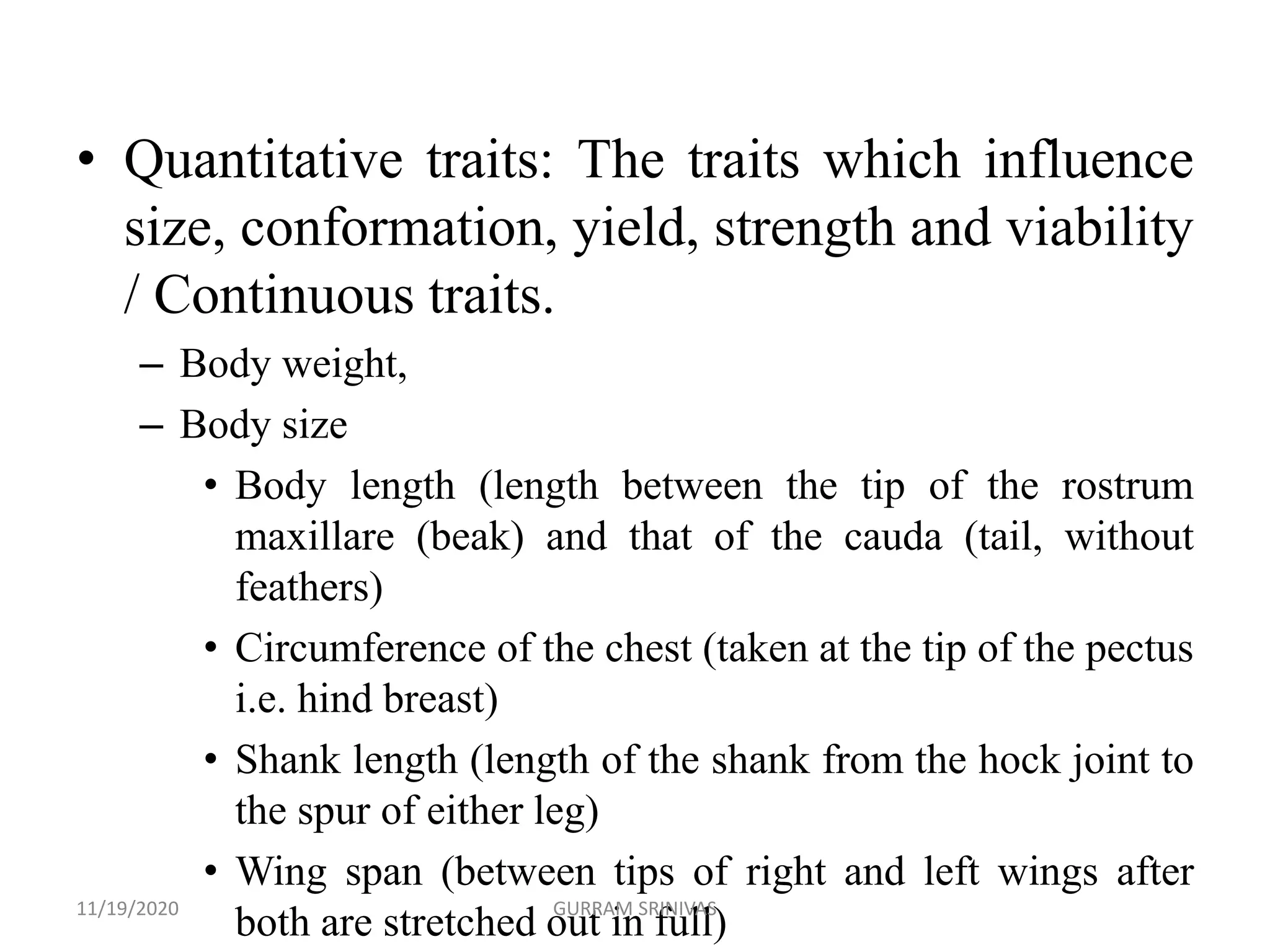
• Quantitative traits: The traits which influence
size, conformation, yield, strength and viability
/ Continuous traits.
– Body weight,
– Body size
• Body length (length between the tip of the rostrum
maxillare (beak) and that of the cauda (tail, without
feathers)
• Circumference of the chest (taken at the tip of the pectus
i.e. hind breast)
• Shank length (length of the shank from the hock joint to
the spur of either leg)
• Wing span (between tips of right and left wings after
both are stretched out in full)11/19/2020 GURRAM SRINIVAS
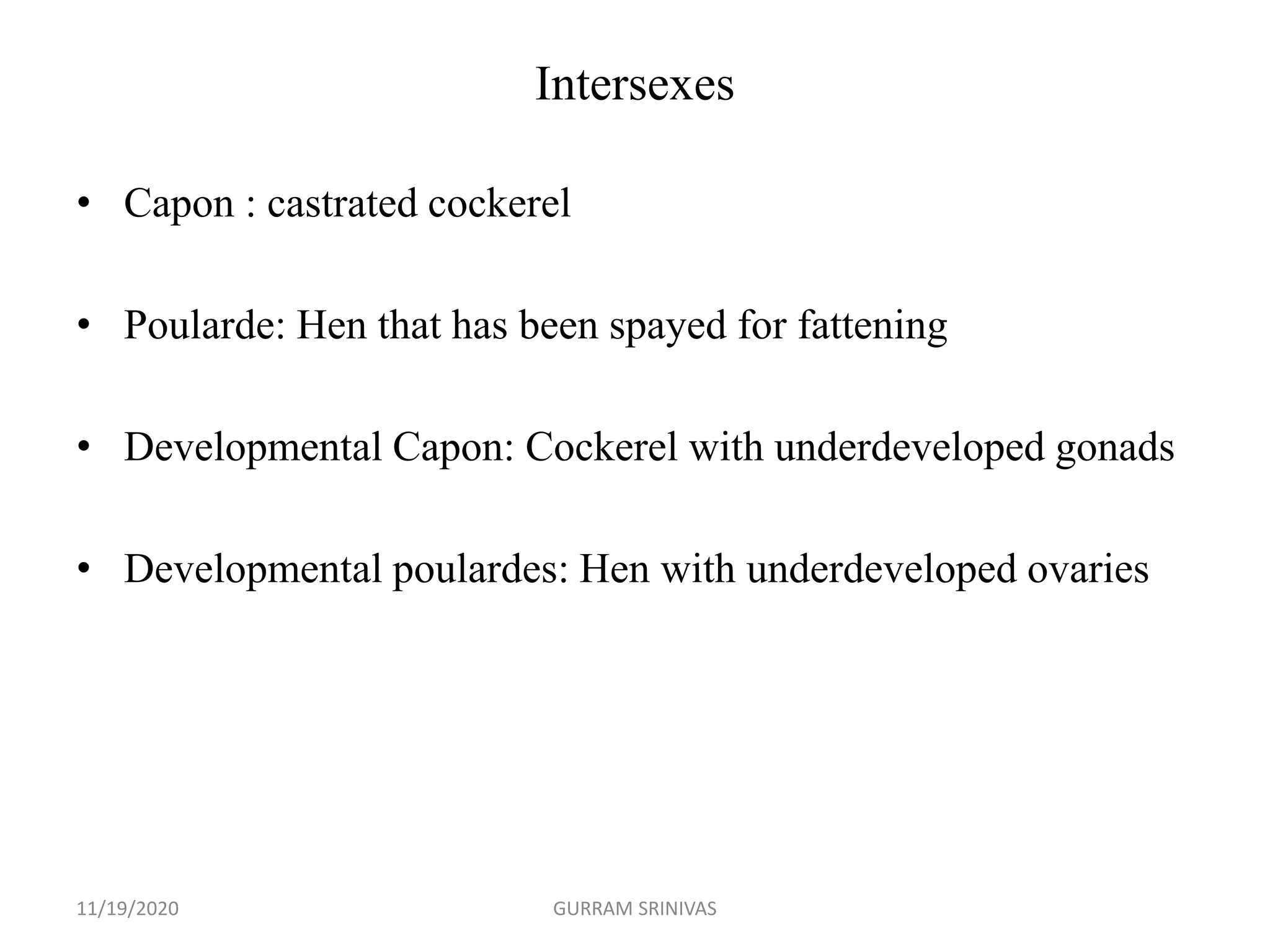
Intersexes
• Capon : castrated cockerel
• Poularde: Hen that has been spayed for fattening
• Developmental Capon: Cockerel with underdeveloped gonads
• Developmental poulardes: Hen with underdeveloped ovaries
11/19/2020 GURRAM SRINIVAS
SEX REVERSAL:
• Reported by Crew
• A Buff Orpington female served as a layer for 3½ years, later
became a sire of two chicks
• On PM: large testes with vasa differentia and ovary is almost
destroyed with a small oviduct on left side.
11/19/2020 GURRAM SRINIVAS
THANK YOU
11/19/2020 GURRAM SRINIVAS

Qualitative and quantitative traits in poultry breeding kavitha (1)

  • 1.
    QUALITATIVE AND QUANTITATIVE TRAITSIN POULTRY 11/19/2020 GURRAM SRINIVAS
  • 2.
    • Qualitative traits:Variation depends on the presence or absence of a certain quality or property, not on the amount / discontinuous traits. Ex: – Feather morphology: normal, frizzle, silky – Feather distribution: normal, naked neck, feathered shanks and feet – Plumage pattern: plain, barred mottled (specific location) – Skin colour: not pigmented, yellow, blue-black – Shank colour: white, yellow, blue, green black, brown – Ear-lobe color: not pigmented, red, white and red – Comb type: single, pea, rose, walnut, V shaped – Comb size: small, medium, large – Eye colour: – Skeletal variants: normal, crested, polydactyl, extra toes, creeper, dwarf – Other specific and distinct visible traits 11/19/2020 GURRAM SRINIVAS
  • 3.
  • 4.
  • 5.
    Incomplete Dominance • Feathersstand up stiffly, shafts curling outward • Wing and tail feathers are less curved • Heterozygous for a dominant gene F Frizzle fowl 11/19/2020 GURRAM SRINIVAS
  • 6.
    •Does not breedtrue •Inter-se mating: 1:2:1 •Recessive homozygotes are normal •Ff – frizzled feathers •FF – plumage resembling woolly fleece •FF birds are discarded immediately after they are identified •Feathers are broken off and after a moult these birds are almost bare. •FF × ff gives all frizzled 11/19/2020 GURRAM SRINIVAS
  • 7.
    Blue Andalusian •Homozygous blueshave melanin removed and appear dirty white with few blue feathers •BB × bb yield all blues bb Bb BB 11/19/2020 GURRAM SRINIVAS
  • 8.
    GENE INTERACTION • Interactions: –Two different genes ( not alleles) produce by their combined action, a phenotype different from that induced by either gene alone. – On gene may prevent the expression of others 11/19/2020 GURRAM SRINIVAS
  • 9.
    Complementary genes • Single:Leghorns, Plymouth Rocks, Rhode Island Reds • Rose: Wyandottes, Hamburgs • Pea: Brahmas, Cornish or Indian games • Walnut: Malays 11/19/2020 GURRAM SRINIVAS
  • 10.
  • 11.
    Epistatic genes • Maskingof one gene by another is known as epistasis. • The gene that blocks out another is said to be epistatic and the one suppressed is hypostatic. • Sometimes dominant epistasis and the recessive epistasis occur in the same cross • Ratio is 13:3 • Ex: Plumage (feather) color in chickens – C locus (color locus): determines whether the birds will be colored or non colored (white). The dominant allele C, allows melanin production, while its recessive allele c, prevents melanin production, such that birds with CC, Cc genotype are colored, while cc are white – I locus (Inhibitory locus): the dominant allele I, at this locus inhibits the action of feather colored genes C • Parents IICC × iicc (white leghorn) (white silkie) F1 IiCc (white) 11/19/2020 GURRAM SRINIVAS
  • 12.
    DOMINANT & RECESSIVEEPISTASIS • Sometimes dominant epistasis and the recessive epistasis occur in the same cross • Ratio is 13:3 • Ex: Plumage (feather) color in chickens – C locus (color locus): determines whether the birds will be colored or non colored (white). The dominant allele C, allows melanin production, while its recessive allele c, prevents melanin production, such that birds with CC, Cc genotype are colored, while cc are white – I locus (Inhibitory locus): the dominant allele I, at this locus inhibits the action of feather colored genes C • Parents IICC × iicc (white leghorn) (white silkie) F1 IiCc (white) 11/19/2020 GURRAM SRINIVAS
  • 13.
    IC Ic iCic IC Ic iC ic • Phenotypes: White : I _ C _ & iicc = 13 Color : iiC _ = 3 • In this example of plumage color, a dominant allele of one locus I and the recessive genotype cc of the second locus produce the same phenotype. Therefore the gene interaction is referred to as ‘dominant and recessive interaction’ IICC white IICc white IiCC white IiCc white IICc white Iicc white IiCc white Iicc white IiCC white IiCc white iiCC color iiCc color IiCc white Iicc white iiCc color iicc white 11/19/2020 GURRAM SRINIVAS
  • 14.
    SEX-LINKED GENES INPOULTRY • Sex determination in poultry ZW – females (heterogametic) and ZZ – males • Sex-linked characters in poultry – Feathering: Slow – K and rapid – k – Barred feathers: Barred feathers – b and non-barred feathers – b – Color: Silver – S and gold feathers – s – Normal body size: Normal – Dw and dwarf - dw 11/19/2020 GURRAM SRINIVAS
  • 15.
    BARRED FEATHERS • Dueto sex-linked dominant gene – Plymouth Rock breed • Condition is BB • Since the males are homogametic (ZZ) pattern, this sex- linked genes are paired in males and single in females • The gene for barring inhibits the deposition of melanin, thus causing white bars to be superimposed on a feather that would otherwise be all black 11/19/2020 GURRAM SRINIVAS
  • 16.
    • F1- allbarred individuals • F2 – 3 barred : 1 non barred Barred male × Non barred female BB bW F1 Bb BW barrred male barred female F2 BB Bb BW bW barred male barred non barred females • Here the male chicks receive the barred factor from their mother while the females received no such factor from her Non barred male × barred female bb BW F1 Bb bW barred male non barred female 11/19/2020 GURRAM SRINIVAS
  • 17.
    Practical application: • Usuallysexing of the day old chick – vent sexing • But this sex-linked dominant gene is helpful in sexing the day old chick without resorting to vent sexing • Here the barred individuals show a characteristic light spot on the head which assume the barred pattern when they become adults, • This procedure is known as auto-sexing 11/19/2020 GURRAM SRINIVAS
  • 18.
    Sex Limited Inheritance •The traits which are controlled by genes present on the autosomes but whose phenotype is limited to only one sex are called sex limited traits • Ex: plumage color in poultry • In poultry the feather patterns are of two types “Hen – feathered” and “Cock – feathered” • The tail and neck feathers of the cock are longer and curved(sickle shaped) where as in hens these are shorter and rounder • These feather phenotypes are controlled by a single autosomal gene • Hen – feathering by dominant gene – H • Cock – feathering by its recessive allele – h (hh) • The reasons for the expression of a trait in one sex only may be – Differences in internal (harmonal) environment between sexes – Anatomical dissimilarities between sexes 11/19/2020 GURRAM SRINIVAS
  • 19.
    • In certainbreeds like Seabright Bantam both males and females are hen – feathered while in Campines and Hamgurghs both hen – feathered males and Cock – feathered males occur Cock – feathered males × Hen – feathered female hh Hh F1 Hh : hh Hen – feathered Cock – feathered : Hen – feathered males & females male female • ‘H’ inhibits cock – feathering only in the presence of sex hormones either of male or female 11/19/2020 GURRAM SRINIVAS
  • 20.
    • ‘h’ doesnot inhibit cock – feathering but it can show its effect only in the absence of female sex hormones • This indicates that certain genotypes, even though homozygous express only in one sex and fail to express in opposite sex • Ordinary breeds of poultry like the Leghorns , RIR and others in which males are cock – feathered and females are hen – feathered would be all of the genotype ‘hh’ • Where as breeds having both kinds of males i.e., both hen – feathered and cock – feathered like the Campines and Hamburghs would show the following features Genotypes Phenotypes Cock Hen HH Hen – feathered Hen – feathered Hh Hen – feathered Hen – feathered hh Cock - feathered Hen – feathered11/19/2020 GURRAM SRINIVAS
  • 21.
    Lethal genes CREEPER FOWLIN POULTRY: • A semi-dominant lethal factor found in poultry breed of chicken known as creeper • It has a characteristic feature of – Wings and legs are considerably shortened and deformed giving it a squatty appearance – All long bones of limbs are shortened – In some the toes are permanently curled Creeper × Normal Creeper × Creeper Normal × Normal Creeper : Normal Creeper : Normal Normal 1 : 1 2 : 1 • Since two normal parents never produce creeper and two creeper parents often produce normals, it is clear that creeper condition is not due to recessive gene 11/19/2020 GURRAM SRINIVAS
  • 22.
    • Further ifthe creeper is due to dominant gene, they must be always heterozygous since their test cross ratio always shows 1:1 • Also creeper never “breeds true” when two creepers are crossed they also produce normal offspring. Hence, creepers are always heterozygous Cc × Cc Creeper Creeper CC : Cc : Cc : cc dies normal creeper 11/19/2020 GURRAM SRINIVAS
  • 23.
    • Quantitative traits:The traits which influence size, conformation, yield, strength and viability / Continuous traits. – Body weight, – Body size • Body length (length between the tip of the rostrum maxillare (beak) and that of the cauda (tail, without feathers) • Circumference of the chest (taken at the tip of the pectus i.e. hind breast) • Shank length (length of the shank from the hock joint to the spur of either leg) • Wing span (between tips of right and left wings after both are stretched out in full)11/19/2020 GURRAM SRINIVAS
  • 24.
    Intersexes • Capon :castrated cockerel • Poularde: Hen that has been spayed for fattening • Developmental Capon: Cockerel with underdeveloped gonads • Developmental poulardes: Hen with underdeveloped ovaries 11/19/2020 GURRAM SRINIVAS
  • 25.
    SEX REVERSAL: • Reportedby Crew • A Buff Orpington female served as a layer for 3½ years, later became a sire of two chicks • On PM: large testes with vasa differentia and ovary is almost destroyed with a small oviduct on left side. 11/19/2020 GURRAM SRINIVAS
  • 26.