Lossy Compression
• Based on spatial redundancy
• Measure of spatial redundancy: 2D covariance
• CovX(i,j)= σ2
e-α√(i*i+j*j)
• Vertical correlation ρ1=
• Horizontal correlation ρ2=
• For images we assume equal correlations
• Typically e-α
= ρ1= ρ2= 0.95
• Measure of loss (or distortion):
• MSE between encoded and decoded image
E[X(i,j)X(i-1,j)]
E[X2
(i,j)]
E[X(i,j)X(i,j-1)]
E[X2
(i,j)]
Rate-Distortion Function
• Tradeoff between bit rate (R) of compressed
image and distortion (D)
• R measured in its per encoder output symbol
• Compression ratio = encoder input bits/R
• D normalized by the variance of the encoder input
• Possible SNR definition = 10 log10 D-1
• For images that can be modeled as uncorrelated
Gaussian
• R(D)=0.5log2 D-1
• More realistic images
• See graph
• How do you make these graphs?
Sample vs. Block-based Coding
• Sample-based
• In spatial or frequency domain
• Like the JPEG-LS
• Make a predictor function (often weighted sum)
• Compute and quantize residual
• Encode
• Block-based
• Spatial: group pixels into blocks, compress blocks
• Transform: group into blocks, transform, encode
Which Transformation?
• Considerations
• Packing the most energy in the least number of
elements
• Minimizing the total entropy of the sequence
• Decorrelating elements in the input blocks maximally
• Coding complexity
• DFT, KLT, DCT, DHT? See the effects
• DCT-based coding
• High compaction efficiency for correlated data
• Orthogonal and separable
• Fast, approximate DCT algorithms available
The JPEG standard
• Operating modes
• Lossless
• Sequential DCT-based
• Progressive DCT-based
• Hierarchical
JPEG: The Process
• Preprocess colors
• Divide the image into 8 pixel x 8 pixel non-
overlapping blocks – why 8?
• Transform each block into 2D DCT
• Encode
• Stage 1: predictive coder for DC or run-length coder for
AC coefficients
• Stage 2: Huffman or arithmetic coding
JPEG: Color Processing
• Maximum number of color components = 256
• Each sample may be 8 or 12 bits in precision
• Conversion of a decorrelated color space
• Y-Cb-Cr, YUV, CIELAB
• Subsample chrominance components
• Interleave components
• Maximum MCU components=4
• Maximum number of data units within MCU = 10
JPEG: Quantization Tables
• 8 X 8 quantization table for each image
component
• Q(i,j): quantization step for corresponding DCT
element
• 1 ≤ Q(i,j) ≤ 255
• Psycho-visual experiments
• Bit-rate control
• Total number of block = B
• yk[i,j] : (i,j) output of k-th block
∑∑= =
=
8
1
8
164
1
i i
ij rb target av. bit-rate
bits per DCT coeff
64
,
])],[([
]),[(
2log
2
1
∏
+=
ji
jiyVar
jiyVar
ij rb ijb
jiQ
2
2046
],[ = for 8-bit images
JPEG: Entropy Coding
• Baseline processing
• Total of 4 code tables allowed
• Different code tables for luminance and chrominance
• DC coefficients
• DC differentials are computed and have the range [-2047, 2047]
• The range is divided into 12 size categories
• Category i needs i bits to represent the value
• DC residuals are represented as [size, amplitude] pairs
• Size is Huffman encoded
JPEG: Entropy Coding
• AC coefficients
• Take value in the range [-1023, 1023]
• 10 size categories
• Only non-zero coefficients need to be encoded
• Processed in zig-zag order
• More efficient run-length encoding of AC coefficients
• Represented as (run/size, amplitude)
• If run > 15, possibly several (15/0) symbols are used
JPEG: Progressive Coding
• Coding is performed sequentially but in multiple
scans
• The first scan should produce the full image without all
details, and details are provided in successive scans
• Spectral selection
• Each block divided into frequency bands
• Each band transmitted during a different scan
• Successive approximation
• Given a frequency band, DCT coefficients are divided by 2k
• MSBs are transmitted first
Subband Coding
• Pass an image through an n-band filter bank
• Possibly subsample each filtered output
• Encode each subband separately
• Compression may be achieved by discarding unimportant
bands
• Advantages
• Fewer artifacts than block-coded compression
• More robust under transmission errors
• Selective encoding/decoding possible
• More expensive
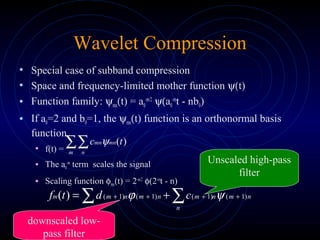
Wavelet Compression
• Special case of subband compression
• Space and frequency-limited mother function ψ(t)
• Function family: ψmn(t) = a0
-m/2
ψ(a0
-m
t - nb0)
• If a0=2 and b0=1, the ψmn(t) function is an orthonormal basis
function
• f(t) =
• The a0
-m
term scales the signal
• Scaling function φmn(t) = 2-m/2
φ(2-m
t - n)
∑∑m n
mnmn tc )(ψ
nmn
n
mnmn
n
mm cdtf )1()1()1()1()( ++++ ∑∑ += ψϕ
Unscaled high-pass
filter
downscaled low-
pass filter

Mmclass4

  • 1.
    Lossy Compression • Basedon spatial redundancy • Measure of spatial redundancy: 2D covariance • CovX(i,j)= σ2 e-α√(i*i+j*j) • Vertical correlation ρ1= • Horizontal correlation ρ2= • For images we assume equal correlations • Typically e-α = ρ1= ρ2= 0.95 • Measure of loss (or distortion): • MSE between encoded and decoded image E[X(i,j)X(i-1,j)] E[X2 (i,j)] E[X(i,j)X(i,j-1)] E[X2 (i,j)]
  • 2.
    Rate-Distortion Function • Tradeoffbetween bit rate (R) of compressed image and distortion (D) • R measured in its per encoder output symbol • Compression ratio = encoder input bits/R • D normalized by the variance of the encoder input • Possible SNR definition = 10 log10 D-1 • For images that can be modeled as uncorrelated Gaussian • R(D)=0.5log2 D-1 • More realistic images • See graph • How do you make these graphs?
  • 3.
    Sample vs. Block-basedCoding • Sample-based • In spatial or frequency domain • Like the JPEG-LS • Make a predictor function (often weighted sum) • Compute and quantize residual • Encode • Block-based • Spatial: group pixels into blocks, compress blocks • Transform: group into blocks, transform, encode
  • 4.
    Which Transformation? • Considerations •Packing the most energy in the least number of elements • Minimizing the total entropy of the sequence • Decorrelating elements in the input blocks maximally • Coding complexity • DFT, KLT, DCT, DHT? See the effects • DCT-based coding • High compaction efficiency for correlated data • Orthogonal and separable • Fast, approximate DCT algorithms available
  • 5.
    The JPEG standard •Operating modes • Lossless • Sequential DCT-based • Progressive DCT-based • Hierarchical
  • 6.
    JPEG: The Process •Preprocess colors • Divide the image into 8 pixel x 8 pixel non- overlapping blocks – why 8? • Transform each block into 2D DCT • Encode • Stage 1: predictive coder for DC or run-length coder for AC coefficients • Stage 2: Huffman or arithmetic coding
  • 7.
    JPEG: Color Processing •Maximum number of color components = 256 • Each sample may be 8 or 12 bits in precision • Conversion of a decorrelated color space • Y-Cb-Cr, YUV, CIELAB • Subsample chrominance components • Interleave components • Maximum MCU components=4 • Maximum number of data units within MCU = 10
  • 8.
    JPEG: Quantization Tables •8 X 8 quantization table for each image component • Q(i,j): quantization step for corresponding DCT element • 1 ≤ Q(i,j) ≤ 255 • Psycho-visual experiments • Bit-rate control • Total number of block = B • yk[i,j] : (i,j) output of k-th block ∑∑= = = 8 1 8 164 1 i i ij rb target av. bit-rate bits per DCT coeff 64 , ])],[([ ]),[( 2log 2 1 ∏ += ji jiyVar jiyVar ij rb ijb jiQ 2 2046 ],[ = for 8-bit images
  • 9.
    JPEG: Entropy Coding •Baseline processing • Total of 4 code tables allowed • Different code tables for luminance and chrominance • DC coefficients • DC differentials are computed and have the range [-2047, 2047] • The range is divided into 12 size categories • Category i needs i bits to represent the value • DC residuals are represented as [size, amplitude] pairs • Size is Huffman encoded
  • 10.
    JPEG: Entropy Coding •AC coefficients • Take value in the range [-1023, 1023] • 10 size categories • Only non-zero coefficients need to be encoded • Processed in zig-zag order • More efficient run-length encoding of AC coefficients • Represented as (run/size, amplitude) • If run > 15, possibly several (15/0) symbols are used
  • 11.
    JPEG: Progressive Coding •Coding is performed sequentially but in multiple scans • The first scan should produce the full image without all details, and details are provided in successive scans • Spectral selection • Each block divided into frequency bands • Each band transmitted during a different scan • Successive approximation • Given a frequency band, DCT coefficients are divided by 2k • MSBs are transmitted first
  • 12.
    Subband Coding • Passan image through an n-band filter bank • Possibly subsample each filtered output • Encode each subband separately • Compression may be achieved by discarding unimportant bands • Advantages • Fewer artifacts than block-coded compression • More robust under transmission errors • Selective encoding/decoding possible • More expensive
  • 13.
    Wavelet Compression • Specialcase of subband compression • Space and frequency-limited mother function ψ(t) • Function family: ψmn(t) = a0 -m/2 ψ(a0 -m t - nb0) • If a0=2 and b0=1, the ψmn(t) function is an orthonormal basis function • f(t) = • The a0 -m term scales the signal • Scaling function φmn(t) = 2-m/2 φ(2-m t - n) ∑∑m n mnmn tc )(ψ nmn n mnmn n mm cdtf )1()1()1()1()( ++++ ∑∑ += ψϕ Unscaled high-pass filter downscaled low- pass filter