GEOLOGICAL STRUCTURES
Myra Karl Elise Arevalo
Kessey Joy Santerva
Geological structures are structures in the
Earth's crust that have geological causes.
There are many types of geological structures
and these can have several causes. For
example, tectonics caused widespread
deformation of the crust like fractures and
folds.
FOLDSLTS
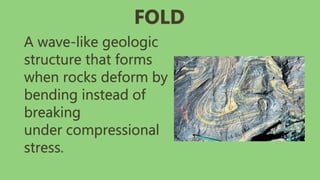
A wave-like geologic
structure that forms
when rocks deform by
bending instead of
breaking
under compressional
stress.
FOLD
TYPES OF FOLDS
ANTICLINE
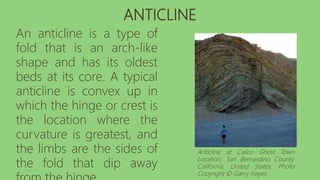
An anticline is a type of
fold that is an arch-like
shape and has its oldest
beds at its core. A typical
anticline is convex up in
which the hinge or crest is
the location where the
curvature is greatest, and
the limbs are the sides of
the fold that dip away
Anticline at Calico Ghost Town
Location: San Bernardino County,
California, United States. Photo
Copyright © Garry Hayes
Anticlines can be recognized and
differentiated from antiforms by a
sequence of rock layers that become
progressively older toward the center of
the fold. Therefore, if age relationships
between various rock strata are
unknown, the term antiform should be
used.
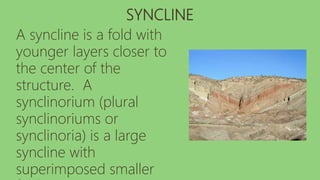
SYNCLINE
A syncline is a fold with
younger layers closer to
the center of the
structure. A
synclinorium (plural
synclinoriums or
synclinoria) is a large
syncline with
superimposed smaller
Synclines are typically a downward
fold, termed a synformal but
synclines that point upwards, or
perched, can be found when strata
have been overturned and folded
(an antiformal syncline).
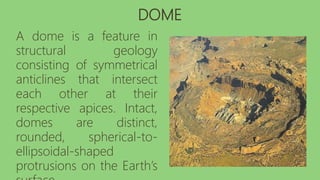
DOME
A dome is a feature in
structural geology
consisting of symmetrical
anticlines that intersect
each other at their
respective apices. Intact,
domes are distinct,
rounded, spherical-to-
ellipsoidal-shaped
protrusions on the Earth’s
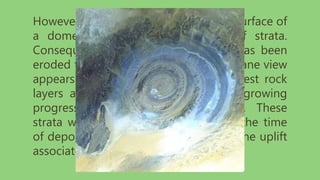
However, a transect parallel to Earth’s surface of
a dome features concentric rings of strata.
Consequently, if the top of a dome has been
eroded flat, the resulting structure in plane view
appears as a bullseye, with the youngest rock
layers at the outside, and each ring growing
progressively older moving inwards. These
strata would have been horizontal at the time
of deposition, then later deformed by the uplift
associated with dome formation.
BASIN
A structural basin is a large-scale structural formation
of rock strata formed by tectonic warping of previously
flat lying strata. Structural basins are geological
depressions, and are the inverse of domes. Some
elongated structural basins are also known as synclines.
Structural basins may also be sedimentary basins,
which are aggregations of sediment that filled up a
depression or accumulated in an area; however, many
structural basins were formed by tectonic events long
after the sedimentary layers were deposited.
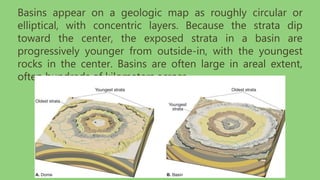
Basins appear on a geologic map as roughly circular or
elliptical, with concentric layers. Because the strata dip
toward the center, the exposed strata in a basin are
progressively younger from outside-in, with the youngest
rocks in the center. Basins are often large in areal extent,
often hundreds of kilometers across.
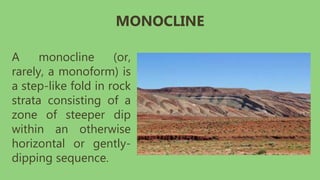
A monocline (or,
rarely, a monoform) is
a step-like fold in rock
strata consisting of a
zone of steeper dip
within an otherwise
horizontal or gently-
dipping sequence.
MONOCLINE
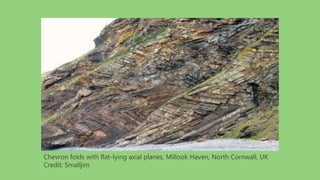
Chevron folds are a structural feature characterized by
repeated well behaved folded beds with straight limbs and
sharp hinges. Well developed, these folds develop
repeated set of v-shaped beds. They develop in response
to regional or local compressive stress. Inter-limb angles
are generally 60 degrees or less. Chevron folding
preferentially occurs when the bedding regularly alternates
between contrasting competences. Turbidites,
characterized by alternating high-competence sandstones
and low-competence shales, provide the typical geological
setting for chevron folds to occurs.
CHEVRON
Chevron folds with flat-lying axial planes, Millook Haven, North Cornwall, UK
Credit: Smalljim
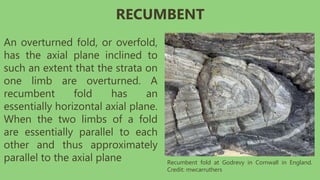
An overturned fold, or overfold,
has the axial plane inclined to
such an extent that the strata on
one limb are overturned. A
recumbent fold has an
essentially horizontal axial plane.
When the two limbs of a fold
are essentially parallel to each
other and thus approximately
parallel to the axial plane Recumbent fold at Godrevy in Cornwall in England.
Credit: mwcarruthers
RECUMBENT
SLUMP
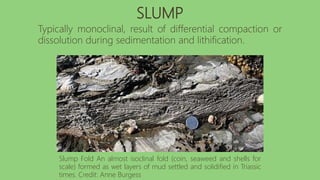
Typically monoclinal, result of differential compaction or
dissolution during sedimentation and lithification.
Slump Fold An almost isoclinal fold (coin, seaweed and shells for
scale) formed as wet layers of mud settled and solidified in Triassic
times. Credit: Anne Burgess
PTYGMATIC
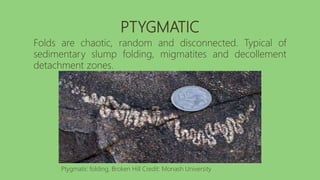
Folds are chaotic, random and disconnected. Typical of
sedimentary slump folding, migmatites and decollement
detachment zones.
Ptygmatic folding, Broken Hill Credit: Monash University
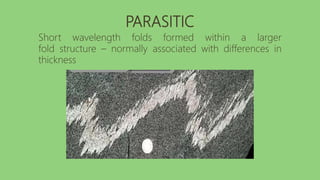
PARASITIC
Short wavelength folds formed within a larger
fold structure – normally associated with differences in
thickness
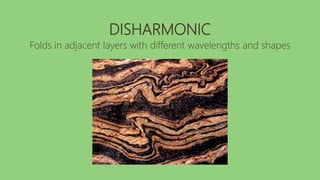
DISHARMONIC
Folds in adjacent layers with different wavelengths and shapes
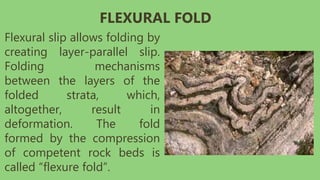
Flexural slip allows folding by
creating layer-parallel slip.
Folding mechanisms
between the layers of the
folded strata, which,
altogether, result in
deformation. The fold
formed by the compression
of competent rock beds is
called “flexure fold”.
FLEXURAL FOLD
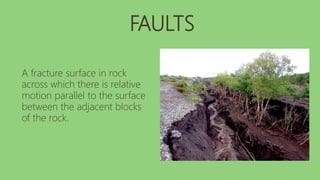
FAULTS
A fracture surface in rock
across which there is relative
motion parallel to the surface
between the adjacent blocks
of the rock.
TYPES OF FAULTS
NORMAL FAULTS - Normal faults form when the hanging
wall drops down
REVERSE FAULTS - Reverse faults form when the hanging
wall moves up
STRIKE SLIP FAULTS - Transcurrent or Strike-slip faults
have walls that move sideways, not up or down.
CLASSIFICATION OF FAULTS ON
THE BASIS OF NET SLIP
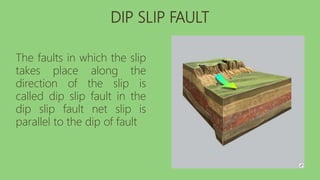
DIP SLIP FAULT
The faults in which the slip
takes place along the
direction of the slip is
called dip slip fault in the
dip slip fault net slip is
parallel to the dip of fault
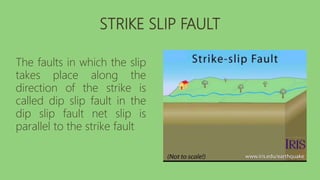
STRIKE SLIP FAULT
The faults in which the slip
takes place along the
direction of the strike is
called dip slip fault in the
dip slip fault net slip is
parallel to the strike fault
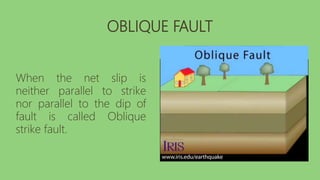
OBLIQUE FAULT
When the net slip is
neither parallel to strike
nor parallel to the dip of
fault is called Oblique
strike fault.
CLASSIFICATION OF FAULTS ON
THE BASIS OF DIP ANGLE
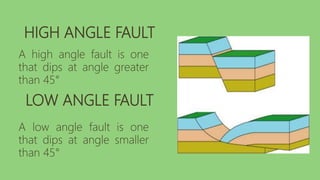
HIGH ANGLE FAULT
A high angle fault is one
that dips at angle greater
than 45°
LOW ANGLE FAULT
A low angle fault is one
that dips at angle smaller
than 45°
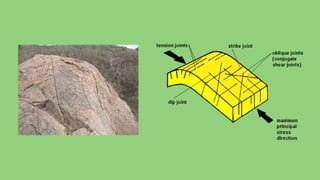
A joint is a fracture dividing rock into two sections that moved away
from each other. A joint does not involve shear displacement, and
forms when tensile stress breaches its threshold. In other kinds of
fracturing, like in a fault, the rock is parted by a visible crack that
forms a gap in the rock.
Joints push out in various directions, usually vertically. They can have
smooth, clean surfaces, or they can be scarred from sliding against
another joint. Joints usually occur as sets, with each set made up of
joints that are parallel to each other.
Joints become more and more obvious when the rock
is weathered (eroded by the elements). When water gets into the
joints, this can lead to the formation of big caves and underground
JOINT
TYPES OF JOINTS WITH RESPECT
TO FORMATION
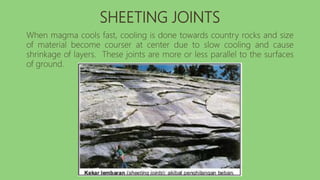
SHEETING JOINTS
When magma cools fast, cooling is done towards country rocks and size
of material become courser at center due to slow cooling and cause
shrinkage of layers. These joints are more or less parallel to the surfaces
of ground.
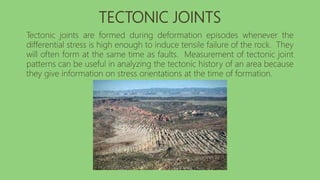
TECTONIC JOINTS
Tectonic joints are formed during deformation episodes whenever the
differential stress is high enough to induce tensile failure of the rock. They
will often form at the same time as faults. Measurement of tectonic joint
patterns can be useful in analyzing the tectonic history of an area because
they give information on stress orientations at the time of formation.
UNLOADING JOINTS
(RELEASE JOINTS)
Joints are most commonly formed when uplift and
erosion removes the overlying rocks thereby reducing the
compressive load and allowing the rock to expand
laterally. Joints related to uplift and erosional unloading
have orientations reflecting the principal stresses during
the uplift. Care needs to be taken when attempting to
understand past tectonic stresses to discriminate, if
possible, between tectonic and unloading joints.
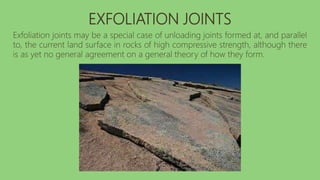
EXFOLIATION JOINTS
Exfoliation joints may be a special case of unloading joints formed at, and parallel
to, the current land surface in rocks of high compressive strength, although there
is as yet no general agreement on a general theory of how they form.
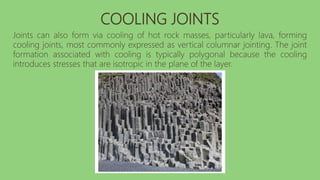
COOLING JOINTS
Joints can also form via cooling of hot rock masses, particularly lava, forming
cooling joints, most commonly expressed as vertical columnar jointing. The joint
formation associated with cooling is typically polygonal because the cooling
introduces stresses that are isotropic in the plane of the layer.
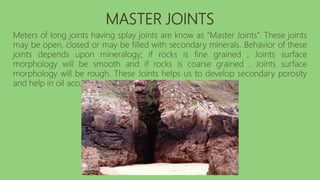
MASTER JOINTS
Meters of long joints having splay joints are know as “Master Joints”. These joints
may be open, closed or may be filled with secondary minerals. Behavior of these
joints depends upon mineralogy; if rocks is fine grained , Joints surface
morphology will be smooth and if rocks is coarse grained , Joints surface
morphology will be rough. These Joints helps us to develop secondary porosity
and help in oil accumulation.
Geological Structures

Geological Structures

  • 1.
    GEOLOGICAL STRUCTURES Myra KarlElise Arevalo Kessey Joy Santerva
  • 2.
    Geological structures arestructures in the Earth's crust that have geological causes. There are many types of geological structures and these can have several causes. For example, tectonics caused widespread deformation of the crust like fractures and folds.
  • 3.
  • 4.
    A wave-like geologic structurethat forms when rocks deform by bending instead of breaking under compressional stress. FOLD
  • 5.
  • 6.
    ANTICLINE An anticline isa type of fold that is an arch-like shape and has its oldest beds at its core. A typical anticline is convex up in which the hinge or crest is the location where the curvature is greatest, and the limbs are the sides of the fold that dip away Anticline at Calico Ghost Town Location: San Bernardino County, California, United States. Photo Copyright © Garry Hayes
  • 7.
    Anticlines can berecognized and differentiated from antiforms by a sequence of rock layers that become progressively older toward the center of the fold. Therefore, if age relationships between various rock strata are unknown, the term antiform should be used.
  • 8.
    SYNCLINE A syncline isa fold with younger layers closer to the center of the structure. A synclinorium (plural synclinoriums or synclinoria) is a large syncline with superimposed smaller
  • 9.
    Synclines are typicallya downward fold, termed a synformal but synclines that point upwards, or perched, can be found when strata have been overturned and folded (an antiformal syncline).
  • 10.
    DOME A dome isa feature in structural geology consisting of symmetrical anticlines that intersect each other at their respective apices. Intact, domes are distinct, rounded, spherical-to- ellipsoidal-shaped protrusions on the Earth’s
  • 11.
    However, a transectparallel to Earth’s surface of a dome features concentric rings of strata. Consequently, if the top of a dome has been eroded flat, the resulting structure in plane view appears as a bullseye, with the youngest rock layers at the outside, and each ring growing progressively older moving inwards. These strata would have been horizontal at the time of deposition, then later deformed by the uplift associated with dome formation.
  • 12.
    BASIN A structural basinis a large-scale structural formation of rock strata formed by tectonic warping of previously flat lying strata. Structural basins are geological depressions, and are the inverse of domes. Some elongated structural basins are also known as synclines. Structural basins may also be sedimentary basins, which are aggregations of sediment that filled up a depression or accumulated in an area; however, many structural basins were formed by tectonic events long after the sedimentary layers were deposited.
  • 13.
    Basins appear ona geologic map as roughly circular or elliptical, with concentric layers. Because the strata dip toward the center, the exposed strata in a basin are progressively younger from outside-in, with the youngest rocks in the center. Basins are often large in areal extent, often hundreds of kilometers across.
  • 14.
    A monocline (or, rarely,a monoform) is a step-like fold in rock strata consisting of a zone of steeper dip within an otherwise horizontal or gently- dipping sequence. MONOCLINE
  • 15.
    Chevron folds area structural feature characterized by repeated well behaved folded beds with straight limbs and sharp hinges. Well developed, these folds develop repeated set of v-shaped beds. They develop in response to regional or local compressive stress. Inter-limb angles are generally 60 degrees or less. Chevron folding preferentially occurs when the bedding regularly alternates between contrasting competences. Turbidites, characterized by alternating high-competence sandstones and low-competence shales, provide the typical geological setting for chevron folds to occurs. CHEVRON
  • 16.
    Chevron folds withflat-lying axial planes, Millook Haven, North Cornwall, UK Credit: Smalljim
  • 17.
    An overturned fold,or overfold, has the axial plane inclined to such an extent that the strata on one limb are overturned. A recumbent fold has an essentially horizontal axial plane. When the two limbs of a fold are essentially parallel to each other and thus approximately parallel to the axial plane Recumbent fold at Godrevy in Cornwall in England. Credit: mwcarruthers RECUMBENT
  • 18.
    SLUMP Typically monoclinal, resultof differential compaction or dissolution during sedimentation and lithification. Slump Fold An almost isoclinal fold (coin, seaweed and shells for scale) formed as wet layers of mud settled and solidified in Triassic times. Credit: Anne Burgess
  • 19.
    PTYGMATIC Folds are chaotic,random and disconnected. Typical of sedimentary slump folding, migmatites and decollement detachment zones. Ptygmatic folding, Broken Hill Credit: Monash University
  • 20.
    PARASITIC Short wavelength foldsformed within a larger fold structure – normally associated with differences in thickness
  • 21.
    DISHARMONIC Folds in adjacentlayers with different wavelengths and shapes
  • 22.
    Flexural slip allowsfolding by creating layer-parallel slip. Folding mechanisms between the layers of the folded strata, which, altogether, result in deformation. The fold formed by the compression of competent rock beds is called “flexure fold”. FLEXURAL FOLD
  • 23.
    FAULTS A fracture surfacein rock across which there is relative motion parallel to the surface between the adjacent blocks of the rock.
  • 24.
  • 25.
    NORMAL FAULTS -Normal faults form when the hanging wall drops down REVERSE FAULTS - Reverse faults form when the hanging wall moves up STRIKE SLIP FAULTS - Transcurrent or Strike-slip faults have walls that move sideways, not up or down.
  • 27.
    CLASSIFICATION OF FAULTSON THE BASIS OF NET SLIP
  • 28.
    DIP SLIP FAULT Thefaults in which the slip takes place along the direction of the slip is called dip slip fault in the dip slip fault net slip is parallel to the dip of fault
  • 29.
    STRIKE SLIP FAULT Thefaults in which the slip takes place along the direction of the strike is called dip slip fault in the dip slip fault net slip is parallel to the strike fault
  • 30.
    OBLIQUE FAULT When thenet slip is neither parallel to strike nor parallel to the dip of fault is called Oblique strike fault.
  • 31.
    CLASSIFICATION OF FAULTSON THE BASIS OF DIP ANGLE
  • 32.
    HIGH ANGLE FAULT Ahigh angle fault is one that dips at angle greater than 45° LOW ANGLE FAULT A low angle fault is one that dips at angle smaller than 45°
  • 33.
    A joint isa fracture dividing rock into two sections that moved away from each other. A joint does not involve shear displacement, and forms when tensile stress breaches its threshold. In other kinds of fracturing, like in a fault, the rock is parted by a visible crack that forms a gap in the rock. Joints push out in various directions, usually vertically. They can have smooth, clean surfaces, or they can be scarred from sliding against another joint. Joints usually occur as sets, with each set made up of joints that are parallel to each other. Joints become more and more obvious when the rock is weathered (eroded by the elements). When water gets into the joints, this can lead to the formation of big caves and underground JOINT
  • 35.
    TYPES OF JOINTSWITH RESPECT TO FORMATION
  • 36.
    SHEETING JOINTS When magmacools fast, cooling is done towards country rocks and size of material become courser at center due to slow cooling and cause shrinkage of layers. These joints are more or less parallel to the surfaces of ground.
  • 37.
    TECTONIC JOINTS Tectonic jointsare formed during deformation episodes whenever the differential stress is high enough to induce tensile failure of the rock. They will often form at the same time as faults. Measurement of tectonic joint patterns can be useful in analyzing the tectonic history of an area because they give information on stress orientations at the time of formation.
  • 38.
    UNLOADING JOINTS (RELEASE JOINTS) Jointsare most commonly formed when uplift and erosion removes the overlying rocks thereby reducing the compressive load and allowing the rock to expand laterally. Joints related to uplift and erosional unloading have orientations reflecting the principal stresses during the uplift. Care needs to be taken when attempting to understand past tectonic stresses to discriminate, if possible, between tectonic and unloading joints.
  • 39.
    EXFOLIATION JOINTS Exfoliation jointsmay be a special case of unloading joints formed at, and parallel to, the current land surface in rocks of high compressive strength, although there is as yet no general agreement on a general theory of how they form.
  • 40.
    COOLING JOINTS Joints canalso form via cooling of hot rock masses, particularly lava, forming cooling joints, most commonly expressed as vertical columnar jointing. The joint formation associated with cooling is typically polygonal because the cooling introduces stresses that are isotropic in the plane of the layer.
  • 41.
    MASTER JOINTS Meters oflong joints having splay joints are know as “Master Joints”. These joints may be open, closed or may be filled with secondary minerals. Behavior of these joints depends upon mineralogy; if rocks is fine grained , Joints surface morphology will be smooth and if rocks is coarse grained , Joints surface morphology will be rough. These Joints helps us to develop secondary porosity and help in oil accumulation.