Presented by-
Ms. Navjot Kaur
Assistant Professor
FIP
 Also known as articulation or arthrosis
 Place of union or junction between 2 or more
bones
 It allows flexibility and movement of skeleton
and attachment between bones
 The study of joints is known as arthrology
 Structural Classification-
1) Fibrous joints
2) Cartilaginous joints
3) Synovial joints
 Functional classification
a) synarthrosis- immovable joint, may be
fibrous or cartilaginous joint
b) Amphiarthrosis- slightly movable, may be
fibrous or cartilaginous joint, acts as shock
absorber
c) Diarthrosis- freely movable joint, always
synovial, ligaments are of elastic connective
tissue
 Bones held together by fibrous connective
tissues and thus has no movement
 Examples-
a) Joints b/w skull bones formed by dense
fibrous connective tissues called sutures
b) Joint b/w tibia and fibula formed by sheet of
fibrous tissue called intraosseous membrane
c) Joint b/w tooth and mandible formed by
dense fibrous connective tissues called
periodontal ligament
 Held together by fibrocartilage or hyaline
cartilage that acts as shock absorber and
permits little movement
 Examples-
a) Pubic symphysis, joint b/w 2 pelvic bones
b) Joint b/w vertebrae
 Characterized by presence of space called
synovial cavity
 Allow movement
 Has following characters-
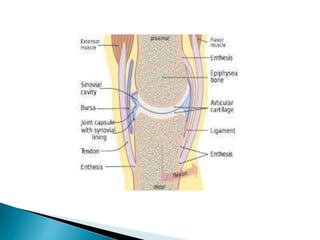
a) Articular cartilage-
 End of bones at the joint are covered by
layer of hyaline cartilage called articular
cartilage
 This layer gives smooth and elastic surface
and reduces friction
b) Articular capsule-
 Joint is surrounded and enclosed by sleeve
like articular capsule that holds bones
together and encloses synovial cavity
 Has further 2 layers-
1) Outer fibrous capsule-
 Consist of dense, fibrous tissue that attaches
to periosteum of articulating bones
 Provides flexibility
 Fibres are arranged in bundle called
ligaments that holds bones together
2) Inner synovial membrane-
 Composed of areolar connective tissues and
elastic fibres
 Contains secretory cells that secrete thick and
sticky synovial fluid
 Secreted by synovial membrane into synovial
cavity
 Lubricates joint to allow frictionless movement of
bones
 Provides nutrition for structures within the cavity
 Serves to hold bones together similar to the
activity of film of water between 2 glass plates
 Bursae , small membrane bound packets present
in some joints ex. Knee, store synovial fluid and
reduce friction between bones
 Called extracapsular ligament and
intracapsular ligaments
 Extracapsular ligaments lie outside the
articular capsule and provide additional
stability
 Intracapsular ligaments lie within the articular
capsule and assist in maintenance of stability
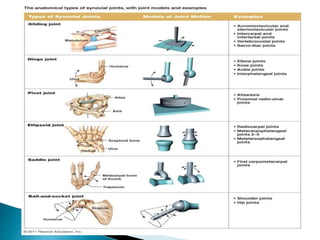
1) Ball and socket joint-
 Ball like head of one bone fitted into socket
or cup like depression of another bone
 Allows movement including flexion,
extension, adduction, abduction, rotation
and circumduction
 Examples- shoulder joint and hip joint
 The convex surface of one bone fits into
concave surface of another bone
 Movement is restricted to flexion and
extension
 Examples- knee joint, elbow joint, ankle joint
and joints b/w phalanges
 Convex oval shaped projection of one bone
fits into cup-shaped depression of another
bone
 Joint permits flexion, extension, adduction,
abduction and circumduction
 Joint permits sliding movement of 2 bones
over each other
 Articular surfaces are usually flat or slightly
curved
 Examples- joint b/w carpals in wrist, tarasals
in foot, b/w sternum and clavicle
 Rounded end of one bone fits into a shallow
pit of another bone
 Joint allows rotatory movement of one bone
on the other
 Examples- joints b/w atlas and axis
 Articular surface one bone is saddle shaped
and articular bone of another bone fits into
saddle
 Examples- carpometacarpal joint of thumb
Joints

Joints

  • 1.
    Presented by- Ms. NavjotKaur Assistant Professor FIP
  • 2.
     Also knownas articulation or arthrosis  Place of union or junction between 2 or more bones  It allows flexibility and movement of skeleton and attachment between bones  The study of joints is known as arthrology
  • 4.
     Structural Classification- 1)Fibrous joints 2) Cartilaginous joints 3) Synovial joints
  • 5.
     Functional classification a)synarthrosis- immovable joint, may be fibrous or cartilaginous joint b) Amphiarthrosis- slightly movable, may be fibrous or cartilaginous joint, acts as shock absorber c) Diarthrosis- freely movable joint, always synovial, ligaments are of elastic connective tissue
  • 6.
     Bones heldtogether by fibrous connective tissues and thus has no movement  Examples- a) Joints b/w skull bones formed by dense fibrous connective tissues called sutures b) Joint b/w tibia and fibula formed by sheet of fibrous tissue called intraosseous membrane c) Joint b/w tooth and mandible formed by dense fibrous connective tissues called periodontal ligament
  • 7.
     Held togetherby fibrocartilage or hyaline cartilage that acts as shock absorber and permits little movement  Examples- a) Pubic symphysis, joint b/w 2 pelvic bones b) Joint b/w vertebrae
  • 8.
     Characterized bypresence of space called synovial cavity  Allow movement
  • 9.
     Has followingcharacters- a) Articular cartilage-  End of bones at the joint are covered by layer of hyaline cartilage called articular cartilage  This layer gives smooth and elastic surface and reduces friction
  • 10.
    b) Articular capsule- Joint is surrounded and enclosed by sleeve like articular capsule that holds bones together and encloses synovial cavity  Has further 2 layers- 1) Outer fibrous capsule-  Consist of dense, fibrous tissue that attaches to periosteum of articulating bones  Provides flexibility  Fibres are arranged in bundle called ligaments that holds bones together
  • 11.
    2) Inner synovialmembrane-  Composed of areolar connective tissues and elastic fibres  Contains secretory cells that secrete thick and sticky synovial fluid
  • 12.
     Secreted bysynovial membrane into synovial cavity  Lubricates joint to allow frictionless movement of bones  Provides nutrition for structures within the cavity  Serves to hold bones together similar to the activity of film of water between 2 glass plates  Bursae , small membrane bound packets present in some joints ex. Knee, store synovial fluid and reduce friction between bones
  • 13.
     Called extracapsularligament and intracapsular ligaments  Extracapsular ligaments lie outside the articular capsule and provide additional stability  Intracapsular ligaments lie within the articular capsule and assist in maintenance of stability
  • 14.
    1) Ball andsocket joint-  Ball like head of one bone fitted into socket or cup like depression of another bone  Allows movement including flexion, extension, adduction, abduction, rotation and circumduction  Examples- shoulder joint and hip joint
  • 15.
     The convexsurface of one bone fits into concave surface of another bone  Movement is restricted to flexion and extension  Examples- knee joint, elbow joint, ankle joint and joints b/w phalanges
  • 16.
     Convex ovalshaped projection of one bone fits into cup-shaped depression of another bone  Joint permits flexion, extension, adduction, abduction and circumduction
  • 17.
     Joint permitssliding movement of 2 bones over each other  Articular surfaces are usually flat or slightly curved  Examples- joint b/w carpals in wrist, tarasals in foot, b/w sternum and clavicle
  • 18.
     Rounded endof one bone fits into a shallow pit of another bone  Joint allows rotatory movement of one bone on the other  Examples- joints b/w atlas and axis
  • 19.
     Articular surfaceone bone is saddle shaped and articular bone of another bone fits into saddle  Examples- carpometacarpal joint of thumb