
©2003 Prentice Hall Business Publishing, Cost Accounting 11/e, Horngren/Datar/Foster 4 - 1
Job Order
Costing
Chapter 4
Manesh Kumar Ahuja
©2003 Prentice Hall Business Publishing, Cost Accounting 11/e, Horngren/Datar/Foster 4 - 2
Learning Objective 1
Describe the building-block
concepts of costing systems.
©2003 Prentice Hall Business Publishing, Cost Accounting 11/e, Horngren/Datar/Foster 4 - 3
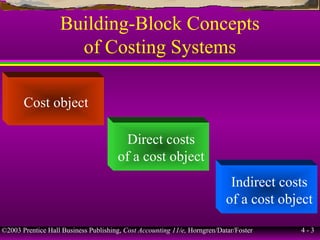
Building-Block Concepts
of Costing Systems
Cost object
Direct costs
of a cost object
Indirect costs
of a cost object
©2003 Prentice Hall Business Publishing, Cost Accounting 11/e, Horngren/Datar/Foster 4 - 4
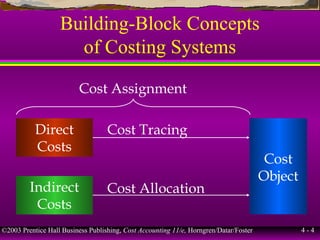
Building-Block Concepts
of Costing Systems
Cost Assignment
Direct
Costs
Indirect
Costs
Cost Tracing
Cost Allocation
Cost
Object
©2003 Prentice Hall Business Publishing, Cost Accounting 11/e, Horngren/Datar/Foster 4 - 5
Building-Block Concepts
of Costing Systems
Cost pool
Cost allocation base
©2003 Prentice Hall Business Publishing, Cost Accounting 11/e, Horngren/Datar/Foster 4 - 6
Learning Objective 2
Distinguish between job
costing and process costing.
©2003 Prentice Hall Business Publishing, Cost Accounting 11/e, Horngren/Datar/Foster 4 - 7
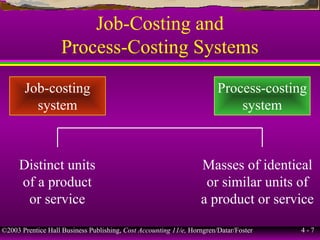
Job-Costing and
Process-Costing Systems
Job-costing
system
Process-costing
system
Distinct units
of a product
or service
Masses of identical
or similar units of
a product or service
©2003 Prentice Hall Business Publishing, Cost Accounting 11/e, Horngren/Datar/Foster 4 - 8
Learning Objective 3
Outline a seven-step
approach to job costing.
©2003 Prentice Hall Business Publishing, Cost Accounting 11/e, Horngren/Datar/Foster 4 - 9
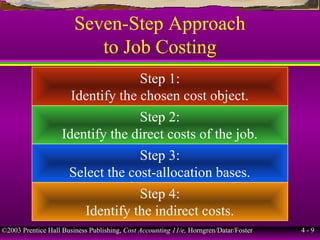
Seven-Step Approach
to Job Costing
Step 1:
Identify the chosen cost object.
Step 2:
Identify the direct costs of the job.
Step 3:
Select the cost-allocation bases.
Step 4:
Identify the indirect costs.
©2003 Prentice Hall Business Publishing, Cost Accounting 11/e, Horngren/Datar/Foster 4 - 10
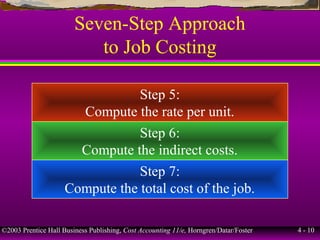
Seven-Step Approach
to Job Costing
Step 5:
Compute the rate per unit.
Step 6:
Compute the indirect costs.
Step 7:
Compute the total cost of the job.
©2003 Prentice Hall Business Publishing, Cost Accounting 11/e, Horngren/Datar/Foster 4 - 11
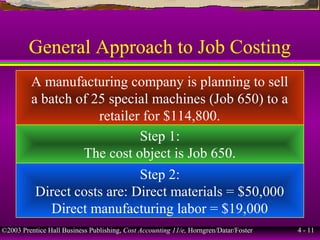
General Approach to Job Costing
A manufacturing company is planning to sell
a batch of 25 special machines (Job 650) to a
retailer for $114,800.
Step 1:
The cost object is Job 650.
Step 2:
Direct costs are: Direct materials = $50,000
Direct manufacturing labor = $19,000
©2003 Prentice Hall Business Publishing, Cost Accounting 11/e, Horngren/Datar/Foster 4 - 12
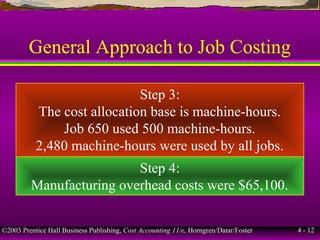
General Approach to Job Costing
Step 3:
The cost allocation base is machine-hours.
Job 650 used 500 machine-hours.
2,480 machine-hours were used by all jobs.
Step 4:
Manufacturing overhead costs were $65,100.
©2003 Prentice Hall Business Publishing, Cost Accounting 11/e, Horngren/Datar/Foster 4 - 13
General Approach to Job Costing
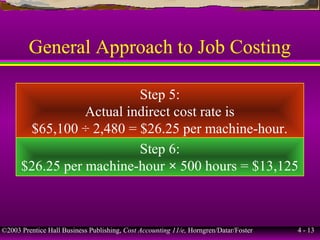
Step 5:
Actual indirect cost rate is
$65,100 ÷ 2,480 = $26.25 per machine-hour.
Step 6:
$26.25 per machine-hour × 500 hours = $13,125
©2003 Prentice Hall Business Publishing, Cost Accounting 11/e, Horngren/Datar/Foster 4 - 14
General Approach to Job Costing
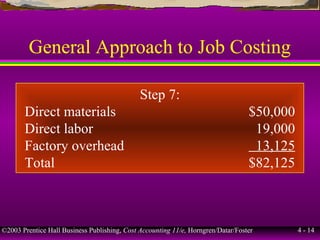
Step 7:
Direct materials $50,000
Direct labor 19,000
Factory overhead 13,125
Total $82,125
©2003 Prentice Hall Business Publishing, Cost Accounting 11/e, Horngren/Datar/Foster 4 - 15
General Approach to Job Costing
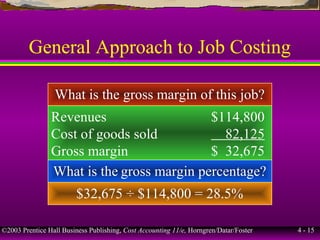
What is the gross margin of this job?
Revenues $114,800
Cost of goods sold 82,125
Gross margin $ 32,675
What is the gross margin percentage?
$32,675 ÷ $114,800 = 28.5%
©2003 Prentice Hall Business Publishing, Cost Accounting 11/e, Horngren/Datar/Foster 4 - 16
Source Documents
Job cost record
Materials requisition record
Labor time record
©2003 Prentice Hall Business Publishing, Cost Accounting 11/e, Horngren/Datar/Foster 4 - 17
Learning Objective 4
Distinguish actual costing
from normal costing.
©2003 Prentice Hall Business Publishing, Cost Accounting 11/e, Horngren/Datar/Foster 4 - 18
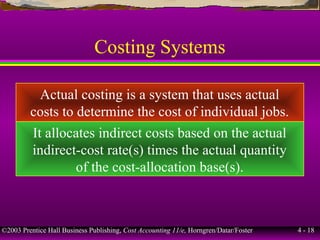
Costing Systems
Actual costing is a system that uses actual
costs to determine the cost of individual jobs.
It allocates indirect costs based on the actual
indirect-cost rate(s) times the actual quantity
of the cost-allocation base(s).
©2003 Prentice Hall Business Publishing, Cost Accounting 11/e, Horngren/Datar/Foster 4 - 19
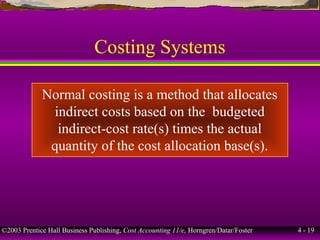
Costing Systems
Normal costing is a method that allocates
indirect costs based on the budgeted
indirect-cost rate(s) times the actual
quantity of the cost allocation base(s).
©2003 Prentice Hall Business Publishing, Cost Accounting 11/e, Horngren/Datar/Foster 4 - 20
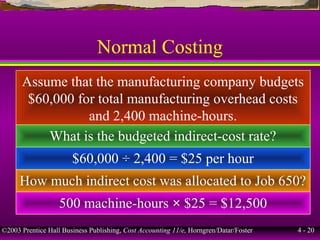
Normal Costing
Assume that the manufacturing company budgets
$60,000 for total manufacturing overhead costs
and 2,400 machine-hours.
What is the budgeted indirect-cost rate?
$60,000 ÷ 2,400 = $25 per hour
How much indirect cost was allocated to Job 650?
500 machine-hours × $25 = $12,500
©2003 Prentice Hall Business Publishing, Cost Accounting 11/e, Horngren/Datar/Foster 4 - 21
Normal Costing
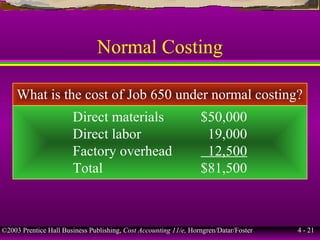
What is the cost of Job 650 under normal costing?
Direct materials $50,000
Direct labor 19,000
Factory overhead 12,500
Total $81,500
©2003 Prentice Hall Business Publishing, Cost Accounting 11/e, Horngren/Datar/Foster 4 - 22
Learning Objective 5
Track the flow of costs
in a job-costing system.
©2003 Prentice Hall Business Publishing, Cost Accounting 11/e, Horngren/Datar/Foster 4 - 23
Transactions
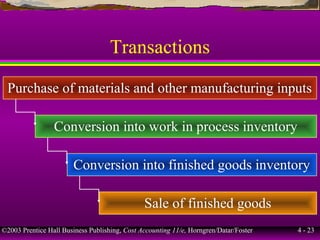
Purchase of materials and other manufacturing inputs
Conversion into work in process inventory
Conversion into finished goods inventory
Sale of finished goods
©2003 Prentice Hall Business Publishing, Cost Accounting 11/e, Horngren/Datar/Foster 4 - 24
Transactions
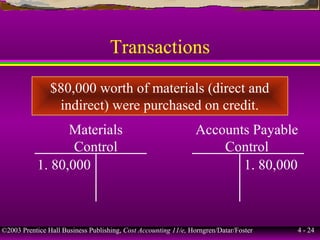
$80,000 worth of materials (direct and
indirect) were purchased on credit.
Materials
Control
1. 80,000 1. 80,000
Accounts Payable
Control
©2003 Prentice Hall Business Publishing, Cost Accounting 11/e, Horngren/Datar/Foster 4 - 25
Transactions
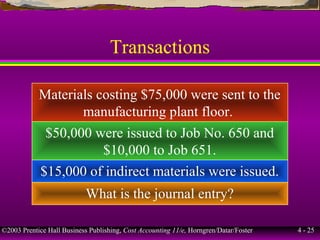
Materials costing $75,000 were sent to the
manufacturing plant floor.
$50,000 were issued to Job No. 650 and
$10,000 to Job 651.
$15,000 of indirect materials were issued.
What is the journal entry?
©2003 Prentice Hall Business Publishing, Cost Accounting 11/e, Horngren/Datar/Foster 4 - 26
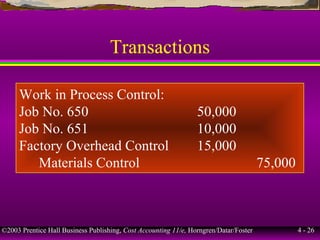
Transactions
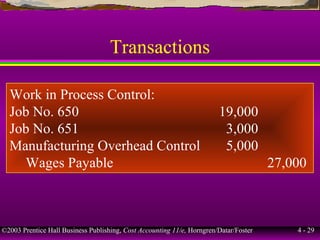
Work in Process Control:
Job No. 650 50,000
Job No. 651 10,000
Factory Overhead Control 15,000
Materials Control 75,000
©2003 Prentice Hall Business Publishing, Cost Accounting 11/e, Horngren/Datar/Foster 4 - 27
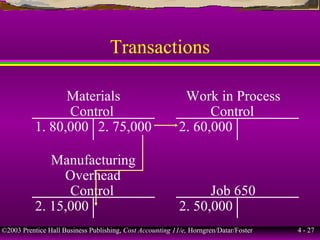
Transactions
Materials
Control
1. 80,000 2. 75,000
Work in Process
Control
2. 60,000
Manufacturing
Overhead
Control
2. 15,000
Job 650
2. 50,000
©2003 Prentice Hall Business Publishing, Cost Accounting 11/e, Horngren/Datar/Foster 4 - 28
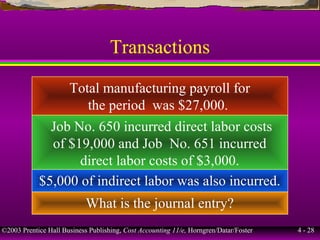
Transactions
Total manufacturing payroll for
the period was $27,000.
Job No. 650 incurred direct labor costs
of $19,000 and Job No. 651 incurred
direct labor costs of $3,000.
$5,000 of indirect labor was also incurred.
What is the journal entry?
©2003 Prentice Hall Business Publishing, Cost Accounting 11/e, Horngren/Datar/Foster 4 - 29
Transactions
Work in Process Control:
Job No. 650 19,000
Job No. 651 3,000
Manufacturing Overhead Control 5,000
Wages Payable 27,000
©2003 Prentice Hall Business Publishing, Cost Accounting 11/e, Horngren/Datar/Foster 4 - 30
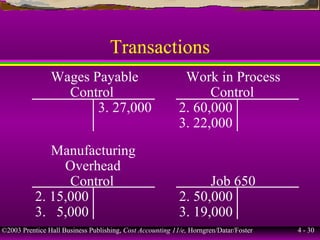
Transactions
Wages Payable
Control
3. 27,000
Work in Process
Control
2. 60,000
3. 22,000
Manufacturing
Overhead
Control
2. 15,000
3. 5,000
Job 650
2. 50,000
3. 19,000
©2003 Prentice Hall Business Publishing, Cost Accounting 11/e, Horngren/Datar/Foster 4 - 31
Transactions
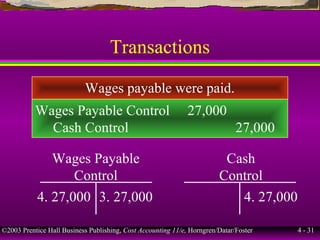
Wages payable were paid.
Wages Payable
Control
4. 27,000 4. 27,000
Cash
Control
Wages Payable Control 27,000
Cash Control 27,000
3. 27,000
©2003 Prentice Hall Business Publishing, Cost Accounting 11/e, Horngren/Datar/Foster 4 - 32
Transactions
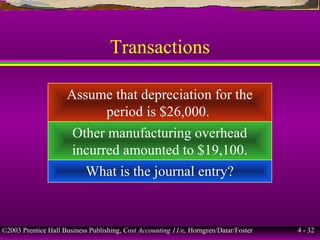
Assume that depreciation for the
period is $26,000.
Other manufacturing overhead
incurred amounted to $19,100.
What is the journal entry?
©2003 Prentice Hall Business Publishing, Cost Accounting 11/e, Horngren/Datar/Foster 4 - 33
Transactions
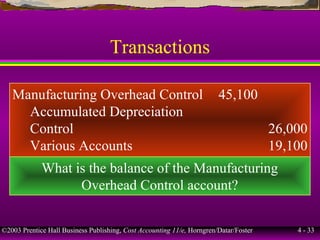
Manufacturing Overhead Control 45,100
Accumulated Depreciation
Control 26,000
Various Accounts 19,100
What is the balance of the Manufacturing
Overhead Control account?
©2003 Prentice Hall Business Publishing, Cost Accounting 11/e, Horngren/Datar/Foster 4 - 34
Transactions
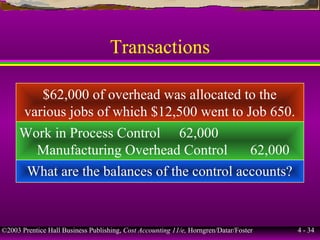
$62,000 of overhead was allocated to the
various jobs of which $12,500 went to Job 650.
Work in Process Control 62,000
Manufacturing Overhead Control 62,000
What are the balances of the control accounts?
©2003 Prentice Hall Business Publishing, Cost Accounting 11/e, Horngren/Datar/Foster 4 - 35
Transactions
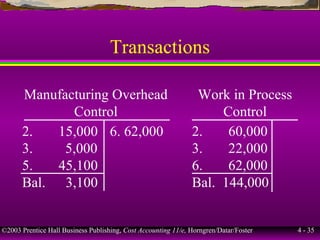
Manufacturing Overhead
Control
Work in Process
Control
2. 15,000
3. 5,000
5. 45,100
Bal. 3,100
2. 60,000
3. 22,000
6. 62,000
Bal. 144,000
6. 62,000
©2003 Prentice Hall Business Publishing, Cost Accounting 11/e, Horngren/Datar/Foster 4 - 36
Transactions
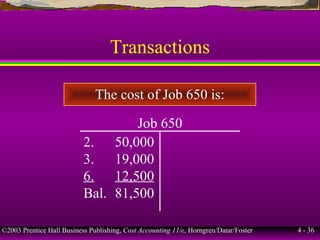
The cost of Job 650 is:
Job 650
2. 50,000
3. 19,000
6. 12,500
Bal. 81,500
©2003 Prentice Hall Business Publishing, Cost Accounting 11/e, Horngren/Datar/Foster 4 - 37
Transactions
Jobs costing $104,000 were completed and
transferred to finished goods, including Job 650.
What effect does this have on the control accounts?
©2003 Prentice Hall Business Publishing, Cost Accounting 11/e, Horngren/Datar/Foster 4 - 38
Transactions
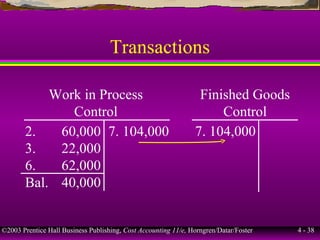
Work in Process
Control
Finished Goods
Control
2. 60,000
3. 22,000
6. 62,000
Bal. 40,000
7. 104,0007. 104,000
©2003 Prentice Hall Business Publishing, Cost Accounting 11/e, Horngren/Datar/Foster 4 - 39
Transactions
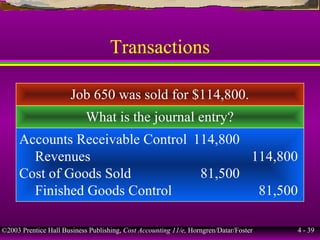
Job 650 was sold for $114,800.
What is the journal entry?
Accounts Receivable Control 114,800
Revenues 114,800
Cost of Goods Sold 81,500
Finished Goods Control 81,500
©2003 Prentice Hall Business Publishing, Cost Accounting 11/e, Horngren/Datar/Foster 4 - 40
Transactions
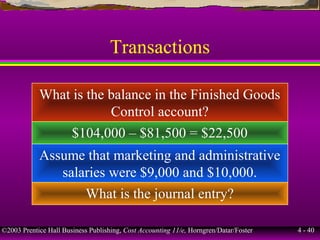
What is the balance in the Finished Goods
Control account?
$104,000 – $81,500 = $22,500
Assume that marketing and administrative
salaries were $9,000 and $10,000.
What is the journal entry?
©2003 Prentice Hall Business Publishing, Cost Accounting 11/e, Horngren/Datar/Foster 4 - 41
Transactions
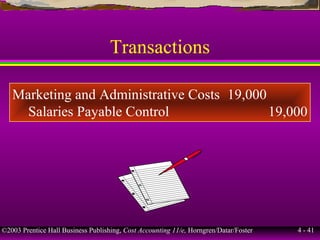
Marketing and Administrative Costs 19,000
Salaries Payable Control 19,000
©2003 Prentice Hall Business Publishing, Cost Accounting 11/e, Horngren/Datar/Foster 4 - 42
Transactions
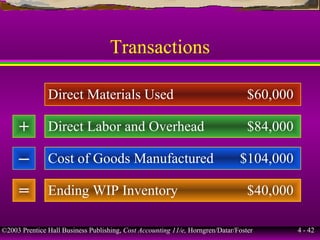
Direct Materials Used $60,000
Direct Labor and Overhead $84,000
Ending WIP Inventory $40,000
Cost of Goods Manufactured $104,000–
=
+
©2003 Prentice Hall Business Publishing, Cost Accounting 11/e, Horngren/Datar/Foster 4 - 43
Transactions
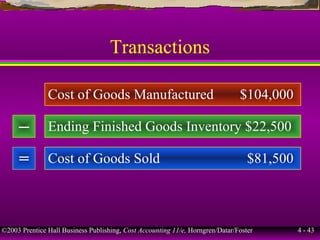
Cost of Goods Manufactured $104,000
Ending Finished Goods Inventory $22,500
Cost of Goods Sold $81,500=
–
©2003 Prentice Hall Business Publishing, Cost Accounting 11/e, Horngren/Datar/Foster 4 - 44
Learning Objective 6
Account for end-of-period
underallocated or overallocated
indirect costs using
alternative methods.
©2003 Prentice Hall Business Publishing, Cost Accounting 11/e, Horngren/Datar/Foster 4 - 45
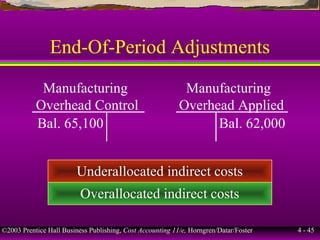
End-Of-Period Adjustments
Underallocated indirect costs
Overallocated indirect costs
Manufacturing
Overhead Control
Bal. 65,100
Manufacturing
Overhead Applied
Bal. 62,000
©2003 Prentice Hall Business Publishing, Cost Accounting 11/e, Horngren/Datar/Foster 4 - 46
End-Of-Period Adjustments
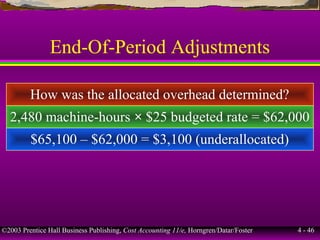
How was the allocated overhead determined?
2,480 machine-hours × $25 budgeted rate = $62,000
$65,100 – $62,000 = $3,100 (underallocated)
©2003 Prentice Hall Business Publishing, Cost Accounting 11/e, Horngren/Datar/Foster 4 - 47
End-Of-Period Adjustments
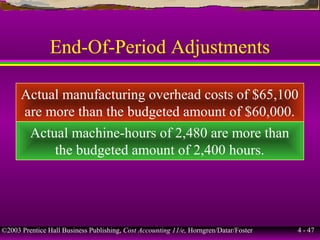
Actual manufacturing overhead costs of $65,100
are more than the budgeted amount of $60,000.
Actual machine-hours of 2,480 are more than
the budgeted amount of 2,400 hours.
©2003 Prentice Hall Business Publishing, Cost Accounting 11/e, Horngren/Datar/Foster 4 - 48
End-Of-Period Adjustments
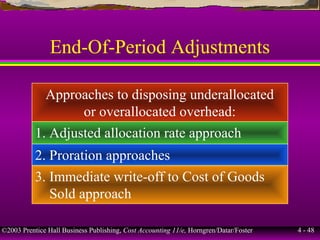
Approaches to disposing underallocated
or overallocated overhead:
1. Adjusted allocation rate approach
2. Proration approaches
3. Immediate write-off to Cost of Goods
Sold approach
©2003 Prentice Hall Business Publishing, Cost Accounting 11/e, Horngren/Datar/Foster 4 - 49
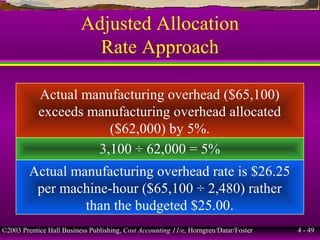
Adjusted Allocation
Rate Approach
Actual manufacturing overhead ($65,100)
exceeds manufacturing overhead allocated
($62,000) by 5%.
3,100 ÷ 62,000 = 5%
Actual manufacturing overhead rate is $26.25
per machine-hour ($65,100 ÷ 2,480) rather
than the budgeted $25.00.
©2003 Prentice Hall Business Publishing, Cost Accounting 11/e, Horngren/Datar/Foster 4 - 50
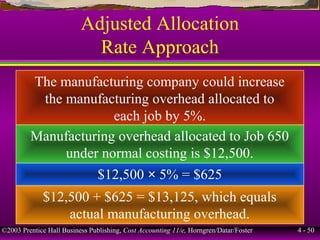
Adjusted Allocation
Rate Approach
The manufacturing company could increase
the manufacturing overhead allocated to
each job by 5%.
Manufacturing overhead allocated to Job 650
under normal costing is $12,500.
$12,500 × 5% = $625
$12,500 + $625 = $13,125, which equals
actual manufacturing overhead.
©2003 Prentice Hall Business Publishing, Cost Accounting 11/e, Horngren/Datar/Foster 4 - 51
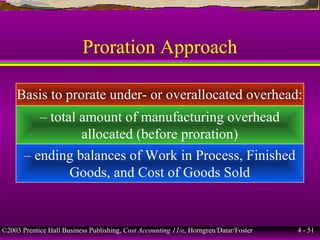
Proration Approach
Basis to prorate under- or overallocated overhead:
– total amount of manufacturing overhead
allocated (before proration)
– ending balances of Work in Process, Finished
Goods, and Cost of Goods Sold
©2003 Prentice Hall Business Publishing, Cost Accounting 11/e, Horngren/Datar/Foster 4 - 52
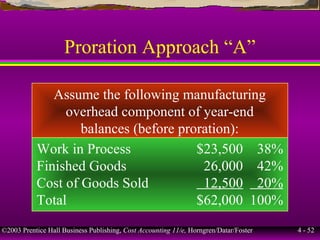
Proration Approach “A”
Assume the following manufacturing
overhead component of year-end
balances (before proration):
Work in Process $23,500 38%
Finished Goods 26,000 42%
Cost of Goods Sold 12,500 20%
Total $62,000 100%
©2003 Prentice Hall Business Publishing, Cost Accounting 11/e, Horngren/Datar/Foster 4 - 53
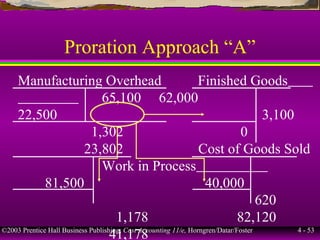
Proration Approach “A”
Manufacturing Overhead Finished Goods
65,100 62,000
22,500 3,100
1,302 0
23,802 Cost of Goods Sold
Work in Process
81,500 40,000
620
1,178 82,120
41,178
©2003 Prentice Hall Business Publishing, Cost Accounting 11/e, Horngren/Datar/Foster 4 - 54
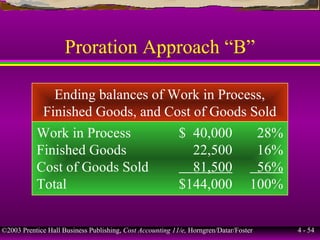
Proration Approach “B”
Ending balances of Work in Process,
Finished Goods, and Cost of Goods Sold
Work in Process $ 40,000 28%
Finished Goods 22,500 16%
Cost of Goods Sold 81,500 56%
Total $144,000 100%
©2003 Prentice Hall Business Publishing, Cost Accounting 11/e, Horngren/Datar/Foster 4 - 55
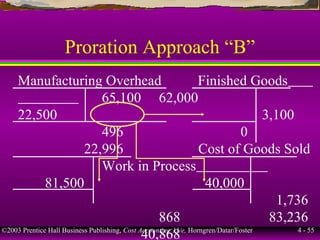
Proration Approach “B”
Manufacturing Overhead Finished Goods
65,100 62,000
22,500 3,100
496 0
22,996 Cost of Goods Sold
Work in Process
81,500 40,000
1,736
868 83,236
40,868
©2003 Prentice Hall Business Publishing, Cost Accounting 11/e, Horngren/Datar/Foster 4 - 56
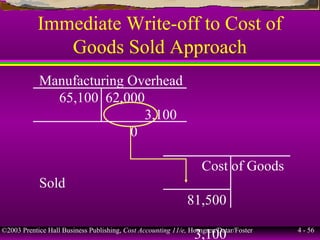
Immediate Write-off to Cost of
Goods Sold Approach
Manufacturing Overhead
65,100 62,000
3,100
0
Cost of Goods
Sold
81,500
3,100
©2003 Prentice Hall Business Publishing, Cost Accounting 11/e, Horngren/Datar/Foster 4 - 57
Learning Objective 7
Apply variations
from
normal costing.
©2003 Prentice Hall Business Publishing, Cost Accounting 11/e, Horngren/Datar/Foster 4 - 58
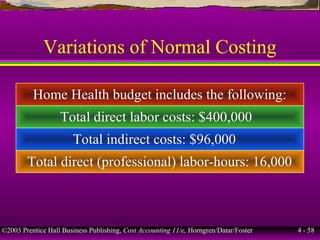
Variations of Normal Costing
Home Health budget includes the following:
Total direct labor costs: $400,000
Total indirect costs: $96,000
Total direct (professional) labor-hours: 16,000
©2003 Prentice Hall Business Publishing, Cost Accounting 11/e, Horngren/Datar/Foster 4 - 59
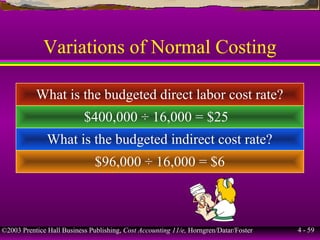
Variations of Normal Costing
What is the budgeted direct labor cost rate?
$400,000 ÷ 16,000 = $25
What is the budgeted indirect cost rate?
$96,000 ÷ 16,000 = $6
©2003 Prentice Hall Business Publishing, Cost Accounting 11/e, Horngren/Datar/Foster 4 - 60
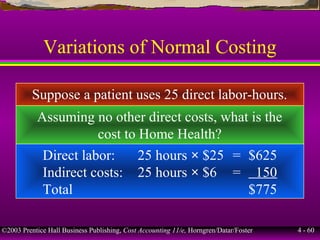
Variations of Normal Costing
Suppose a patient uses 25 direct labor-hours.
Assuming no other direct costs, what is the
cost to Home Health?
Direct labor: 25 hours × $25 = $625
Indirect costs: 25 hours × $6 = 150
Total $775
©2003 Prentice Hall Business Publishing, Cost Accounting 11/e, Horngren/Datar/Foster 4 - 61
End of Chapter 4

Job Order Costing

  • 1.
    ©2003 Prentice HallBusiness Publishing, Cost Accounting 11/e, Horngren/Datar/Foster 4 - 1 Job Order Costing Chapter 4 Manesh Kumar Ahuja
  • 2.
    ©2003 Prentice HallBusiness Publishing, Cost Accounting 11/e, Horngren/Datar/Foster 4 - 2 Learning Objective 1 Describe the building-block concepts of costing systems.
  • 3.
    ©2003 Prentice HallBusiness Publishing, Cost Accounting 11/e, Horngren/Datar/Foster 4 - 3 Building-Block Concepts of Costing Systems Cost object Direct costs of a cost object Indirect costs of a cost object
  • 4.
    ©2003 Prentice HallBusiness Publishing, Cost Accounting 11/e, Horngren/Datar/Foster 4 - 4 Building-Block Concepts of Costing Systems Cost Assignment Direct Costs Indirect Costs Cost Tracing Cost Allocation Cost Object
  • 5.
    ©2003 Prentice HallBusiness Publishing, Cost Accounting 11/e, Horngren/Datar/Foster 4 - 5 Building-Block Concepts of Costing Systems Cost pool Cost allocation base
  • 6.
    ©2003 Prentice HallBusiness Publishing, Cost Accounting 11/e, Horngren/Datar/Foster 4 - 6 Learning Objective 2 Distinguish between job costing and process costing.
  • 7.
    ©2003 Prentice HallBusiness Publishing, Cost Accounting 11/e, Horngren/Datar/Foster 4 - 7 Job-Costing and Process-Costing Systems Job-costing system Process-costing system Distinct units of a product or service Masses of identical or similar units of a product or service
  • 8.
    ©2003 Prentice HallBusiness Publishing, Cost Accounting 11/e, Horngren/Datar/Foster 4 - 8 Learning Objective 3 Outline a seven-step approach to job costing.
  • 9.
    ©2003 Prentice HallBusiness Publishing, Cost Accounting 11/e, Horngren/Datar/Foster 4 - 9 Seven-Step Approach to Job Costing Step 1: Identify the chosen cost object. Step 2: Identify the direct costs of the job. Step 3: Select the cost-allocation bases. Step 4: Identify the indirect costs.
  • 10.
    ©2003 Prentice HallBusiness Publishing, Cost Accounting 11/e, Horngren/Datar/Foster 4 - 10 Seven-Step Approach to Job Costing Step 5: Compute the rate per unit. Step 6: Compute the indirect costs. Step 7: Compute the total cost of the job.
  • 11.
    ©2003 Prentice HallBusiness Publishing, Cost Accounting 11/e, Horngren/Datar/Foster 4 - 11 General Approach to Job Costing A manufacturing company is planning to sell a batch of 25 special machines (Job 650) to a retailer for $114,800. Step 1: The cost object is Job 650. Step 2: Direct costs are: Direct materials = $50,000 Direct manufacturing labor = $19,000
  • 12.
    ©2003 Prentice HallBusiness Publishing, Cost Accounting 11/e, Horngren/Datar/Foster 4 - 12 General Approach to Job Costing Step 3: The cost allocation base is machine-hours. Job 650 used 500 machine-hours. 2,480 machine-hours were used by all jobs. Step 4: Manufacturing overhead costs were $65,100.
  • 13.
    ©2003 Prentice HallBusiness Publishing, Cost Accounting 11/e, Horngren/Datar/Foster 4 - 13 General Approach to Job Costing Step 5: Actual indirect cost rate is $65,100 ÷ 2,480 = $26.25 per machine-hour. Step 6: $26.25 per machine-hour × 500 hours = $13,125
  • 14.
    ©2003 Prentice HallBusiness Publishing, Cost Accounting 11/e, Horngren/Datar/Foster 4 - 14 General Approach to Job Costing Step 7: Direct materials $50,000 Direct labor 19,000 Factory overhead 13,125 Total $82,125
  • 15.
    ©2003 Prentice HallBusiness Publishing, Cost Accounting 11/e, Horngren/Datar/Foster 4 - 15 General Approach to Job Costing What is the gross margin of this job? Revenues $114,800 Cost of goods sold 82,125 Gross margin $ 32,675 What is the gross margin percentage? $32,675 ÷ $114,800 = 28.5%
  • 16.
    ©2003 Prentice HallBusiness Publishing, Cost Accounting 11/e, Horngren/Datar/Foster 4 - 16 Source Documents Job cost record Materials requisition record Labor time record
  • 17.
    ©2003 Prentice HallBusiness Publishing, Cost Accounting 11/e, Horngren/Datar/Foster 4 - 17 Learning Objective 4 Distinguish actual costing from normal costing.
  • 18.
    ©2003 Prentice HallBusiness Publishing, Cost Accounting 11/e, Horngren/Datar/Foster 4 - 18 Costing Systems Actual costing is a system that uses actual costs to determine the cost of individual jobs. It allocates indirect costs based on the actual indirect-cost rate(s) times the actual quantity of the cost-allocation base(s).
  • 19.
    ©2003 Prentice HallBusiness Publishing, Cost Accounting 11/e, Horngren/Datar/Foster 4 - 19 Costing Systems Normal costing is a method that allocates indirect costs based on the budgeted indirect-cost rate(s) times the actual quantity of the cost allocation base(s).
  • 20.
    ©2003 Prentice HallBusiness Publishing, Cost Accounting 11/e, Horngren/Datar/Foster 4 - 20 Normal Costing Assume that the manufacturing company budgets $60,000 for total manufacturing overhead costs and 2,400 machine-hours. What is the budgeted indirect-cost rate? $60,000 ÷ 2,400 = $25 per hour How much indirect cost was allocated to Job 650? 500 machine-hours × $25 = $12,500
  • 21.
    ©2003 Prentice HallBusiness Publishing, Cost Accounting 11/e, Horngren/Datar/Foster 4 - 21 Normal Costing What is the cost of Job 650 under normal costing? Direct materials $50,000 Direct labor 19,000 Factory overhead 12,500 Total $81,500
  • 22.
    ©2003 Prentice HallBusiness Publishing, Cost Accounting 11/e, Horngren/Datar/Foster 4 - 22 Learning Objective 5 Track the flow of costs in a job-costing system.
  • 23.
    ©2003 Prentice HallBusiness Publishing, Cost Accounting 11/e, Horngren/Datar/Foster 4 - 23 Transactions Purchase of materials and other manufacturing inputs Conversion into work in process inventory Conversion into finished goods inventory Sale of finished goods
  • 24.
    ©2003 Prentice HallBusiness Publishing, Cost Accounting 11/e, Horngren/Datar/Foster 4 - 24 Transactions $80,000 worth of materials (direct and indirect) were purchased on credit. Materials Control 1. 80,000 1. 80,000 Accounts Payable Control
  • 25.
    ©2003 Prentice HallBusiness Publishing, Cost Accounting 11/e, Horngren/Datar/Foster 4 - 25 Transactions Materials costing $75,000 were sent to the manufacturing plant floor. $50,000 were issued to Job No. 650 and $10,000 to Job 651. $15,000 of indirect materials were issued. What is the journal entry?
  • 26.
    ©2003 Prentice HallBusiness Publishing, Cost Accounting 11/e, Horngren/Datar/Foster 4 - 26 Transactions Work in Process Control: Job No. 650 50,000 Job No. 651 10,000 Factory Overhead Control 15,000 Materials Control 75,000
  • 27.
    ©2003 Prentice HallBusiness Publishing, Cost Accounting 11/e, Horngren/Datar/Foster 4 - 27 Transactions Materials Control 1. 80,000 2. 75,000 Work in Process Control 2. 60,000 Manufacturing Overhead Control 2. 15,000 Job 650 2. 50,000
  • 28.
    ©2003 Prentice HallBusiness Publishing, Cost Accounting 11/e, Horngren/Datar/Foster 4 - 28 Transactions Total manufacturing payroll for the period was $27,000. Job No. 650 incurred direct labor costs of $19,000 and Job No. 651 incurred direct labor costs of $3,000. $5,000 of indirect labor was also incurred. What is the journal entry?
  • 29.
    ©2003 Prentice HallBusiness Publishing, Cost Accounting 11/e, Horngren/Datar/Foster 4 - 29 Transactions Work in Process Control: Job No. 650 19,000 Job No. 651 3,000 Manufacturing Overhead Control 5,000 Wages Payable 27,000
  • 30.
    ©2003 Prentice HallBusiness Publishing, Cost Accounting 11/e, Horngren/Datar/Foster 4 - 30 Transactions Wages Payable Control 3. 27,000 Work in Process Control 2. 60,000 3. 22,000 Manufacturing Overhead Control 2. 15,000 3. 5,000 Job 650 2. 50,000 3. 19,000
  • 31.
    ©2003 Prentice HallBusiness Publishing, Cost Accounting 11/e, Horngren/Datar/Foster 4 - 31 Transactions Wages payable were paid. Wages Payable Control 4. 27,000 4. 27,000 Cash Control Wages Payable Control 27,000 Cash Control 27,000 3. 27,000
  • 32.
    ©2003 Prentice HallBusiness Publishing, Cost Accounting 11/e, Horngren/Datar/Foster 4 - 32 Transactions Assume that depreciation for the period is $26,000. Other manufacturing overhead incurred amounted to $19,100. What is the journal entry?
  • 33.
    ©2003 Prentice HallBusiness Publishing, Cost Accounting 11/e, Horngren/Datar/Foster 4 - 33 Transactions Manufacturing Overhead Control 45,100 Accumulated Depreciation Control 26,000 Various Accounts 19,100 What is the balance of the Manufacturing Overhead Control account?
  • 34.
    ©2003 Prentice HallBusiness Publishing, Cost Accounting 11/e, Horngren/Datar/Foster 4 - 34 Transactions $62,000 of overhead was allocated to the various jobs of which $12,500 went to Job 650. Work in Process Control 62,000 Manufacturing Overhead Control 62,000 What are the balances of the control accounts?
  • 35.
    ©2003 Prentice HallBusiness Publishing, Cost Accounting 11/e, Horngren/Datar/Foster 4 - 35 Transactions Manufacturing Overhead Control Work in Process Control 2. 15,000 3. 5,000 5. 45,100 Bal. 3,100 2. 60,000 3. 22,000 6. 62,000 Bal. 144,000 6. 62,000
  • 36.
    ©2003 Prentice HallBusiness Publishing, Cost Accounting 11/e, Horngren/Datar/Foster 4 - 36 Transactions The cost of Job 650 is: Job 650 2. 50,000 3. 19,000 6. 12,500 Bal. 81,500
  • 37.
    ©2003 Prentice HallBusiness Publishing, Cost Accounting 11/e, Horngren/Datar/Foster 4 - 37 Transactions Jobs costing $104,000 were completed and transferred to finished goods, including Job 650. What effect does this have on the control accounts?
  • 38.
    ©2003 Prentice HallBusiness Publishing, Cost Accounting 11/e, Horngren/Datar/Foster 4 - 38 Transactions Work in Process Control Finished Goods Control 2. 60,000 3. 22,000 6. 62,000 Bal. 40,000 7. 104,0007. 104,000
  • 39.
    ©2003 Prentice HallBusiness Publishing, Cost Accounting 11/e, Horngren/Datar/Foster 4 - 39 Transactions Job 650 was sold for $114,800. What is the journal entry? Accounts Receivable Control 114,800 Revenues 114,800 Cost of Goods Sold 81,500 Finished Goods Control 81,500
  • 40.
    ©2003 Prentice HallBusiness Publishing, Cost Accounting 11/e, Horngren/Datar/Foster 4 - 40 Transactions What is the balance in the Finished Goods Control account? $104,000 – $81,500 = $22,500 Assume that marketing and administrative salaries were $9,000 and $10,000. What is the journal entry?
  • 41.
    ©2003 Prentice HallBusiness Publishing, Cost Accounting 11/e, Horngren/Datar/Foster 4 - 41 Transactions Marketing and Administrative Costs 19,000 Salaries Payable Control 19,000
  • 42.
    ©2003 Prentice HallBusiness Publishing, Cost Accounting 11/e, Horngren/Datar/Foster 4 - 42 Transactions Direct Materials Used $60,000 Direct Labor and Overhead $84,000 Ending WIP Inventory $40,000 Cost of Goods Manufactured $104,000– = +
  • 43.
    ©2003 Prentice HallBusiness Publishing, Cost Accounting 11/e, Horngren/Datar/Foster 4 - 43 Transactions Cost of Goods Manufactured $104,000 Ending Finished Goods Inventory $22,500 Cost of Goods Sold $81,500= –
  • 44.
    ©2003 Prentice HallBusiness Publishing, Cost Accounting 11/e, Horngren/Datar/Foster 4 - 44 Learning Objective 6 Account for end-of-period underallocated or overallocated indirect costs using alternative methods.
  • 45.
    ©2003 Prentice HallBusiness Publishing, Cost Accounting 11/e, Horngren/Datar/Foster 4 - 45 End-Of-Period Adjustments Underallocated indirect costs Overallocated indirect costs Manufacturing Overhead Control Bal. 65,100 Manufacturing Overhead Applied Bal. 62,000
  • 46.
    ©2003 Prentice HallBusiness Publishing, Cost Accounting 11/e, Horngren/Datar/Foster 4 - 46 End-Of-Period Adjustments How was the allocated overhead determined? 2,480 machine-hours × $25 budgeted rate = $62,000 $65,100 – $62,000 = $3,100 (underallocated)
  • 47.
    ©2003 Prentice HallBusiness Publishing, Cost Accounting 11/e, Horngren/Datar/Foster 4 - 47 End-Of-Period Adjustments Actual manufacturing overhead costs of $65,100 are more than the budgeted amount of $60,000. Actual machine-hours of 2,480 are more than the budgeted amount of 2,400 hours.
  • 48.
    ©2003 Prentice HallBusiness Publishing, Cost Accounting 11/e, Horngren/Datar/Foster 4 - 48 End-Of-Period Adjustments Approaches to disposing underallocated or overallocated overhead: 1. Adjusted allocation rate approach 2. Proration approaches 3. Immediate write-off to Cost of Goods Sold approach
  • 49.
    ©2003 Prentice HallBusiness Publishing, Cost Accounting 11/e, Horngren/Datar/Foster 4 - 49 Adjusted Allocation Rate Approach Actual manufacturing overhead ($65,100) exceeds manufacturing overhead allocated ($62,000) by 5%. 3,100 ÷ 62,000 = 5% Actual manufacturing overhead rate is $26.25 per machine-hour ($65,100 ÷ 2,480) rather than the budgeted $25.00.
  • 50.
    ©2003 Prentice HallBusiness Publishing, Cost Accounting 11/e, Horngren/Datar/Foster 4 - 50 Adjusted Allocation Rate Approach The manufacturing company could increase the manufacturing overhead allocated to each job by 5%. Manufacturing overhead allocated to Job 650 under normal costing is $12,500. $12,500 × 5% = $625 $12,500 + $625 = $13,125, which equals actual manufacturing overhead.
  • 51.
    ©2003 Prentice HallBusiness Publishing, Cost Accounting 11/e, Horngren/Datar/Foster 4 - 51 Proration Approach Basis to prorate under- or overallocated overhead: – total amount of manufacturing overhead allocated (before proration) – ending balances of Work in Process, Finished Goods, and Cost of Goods Sold
  • 52.
    ©2003 Prentice HallBusiness Publishing, Cost Accounting 11/e, Horngren/Datar/Foster 4 - 52 Proration Approach “A” Assume the following manufacturing overhead component of year-end balances (before proration): Work in Process $23,500 38% Finished Goods 26,000 42% Cost of Goods Sold 12,500 20% Total $62,000 100%
  • 53.
    ©2003 Prentice HallBusiness Publishing, Cost Accounting 11/e, Horngren/Datar/Foster 4 - 53 Proration Approach “A” Manufacturing Overhead Finished Goods 65,100 62,000 22,500 3,100 1,302 0 23,802 Cost of Goods Sold Work in Process 81,500 40,000 620 1,178 82,120 41,178
  • 54.
    ©2003 Prentice HallBusiness Publishing, Cost Accounting 11/e, Horngren/Datar/Foster 4 - 54 Proration Approach “B” Ending balances of Work in Process, Finished Goods, and Cost of Goods Sold Work in Process $ 40,000 28% Finished Goods 22,500 16% Cost of Goods Sold 81,500 56% Total $144,000 100%
  • 55.
    ©2003 Prentice HallBusiness Publishing, Cost Accounting 11/e, Horngren/Datar/Foster 4 - 55 Proration Approach “B” Manufacturing Overhead Finished Goods 65,100 62,000 22,500 3,100 496 0 22,996 Cost of Goods Sold Work in Process 81,500 40,000 1,736 868 83,236 40,868
  • 56.
    ©2003 Prentice HallBusiness Publishing, Cost Accounting 11/e, Horngren/Datar/Foster 4 - 56 Immediate Write-off to Cost of Goods Sold Approach Manufacturing Overhead 65,100 62,000 3,100 0 Cost of Goods Sold 81,500 3,100
  • 57.
    ©2003 Prentice HallBusiness Publishing, Cost Accounting 11/e, Horngren/Datar/Foster 4 - 57 Learning Objective 7 Apply variations from normal costing.
  • 58.
    ©2003 Prentice HallBusiness Publishing, Cost Accounting 11/e, Horngren/Datar/Foster 4 - 58 Variations of Normal Costing Home Health budget includes the following: Total direct labor costs: $400,000 Total indirect costs: $96,000 Total direct (professional) labor-hours: 16,000
  • 59.
    ©2003 Prentice HallBusiness Publishing, Cost Accounting 11/e, Horngren/Datar/Foster 4 - 59 Variations of Normal Costing What is the budgeted direct labor cost rate? $400,000 ÷ 16,000 = $25 What is the budgeted indirect cost rate? $96,000 ÷ 16,000 = $6
  • 60.
    ©2003 Prentice HallBusiness Publishing, Cost Accounting 11/e, Horngren/Datar/Foster 4 - 60 Variations of Normal Costing Suppose a patient uses 25 direct labor-hours. Assuming no other direct costs, what is the cost to Home Health? Direct labor: 25 hours × $25 = $625 Indirect costs: 25 hours × $6 = 150 Total $775
  • 61.
    ©2003 Prentice HallBusiness Publishing, Cost Accounting 11/e, Horngren/Datar/Foster 4 - 61 End of Chapter 4