© McGraw-Hill Education (UK) Limited 2013
Costing
Systems
Chapter 4
1
© McGraw-Hill Education (UK) Limited 2013
• LO1 Understand and explain different
approaches to product and service costing
• LO2 Understand how labour and material costs
can be traced to jobs
• LO3 Calculate a manufacturing overhead rate
to assign jobs
• LO4 Calculate a job cost and understand its use
in decision making
Learning Outcomes
2
© McGraw-Hill Education (UK) Limited 2013
• LO5 Deal with under or over allocated
manufacturing overhead
• LO6 Understand how non-manufacturing
overheads are treated
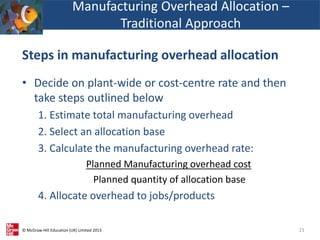
• LO7 Understand how job costing can be used
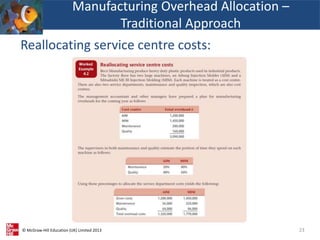
in contracting and service businesses
• LO8 Record job costs and how these relate to
the accounting system
Learning Outcomes
3
© McGraw-Hill Education (UK) Limited 2013
• All business owners and managers need to
know the underlying cost of products or
services
• How costs are assigned to products depends
on the type of business
Introduction
4
© McGraw-Hill Education (UK) Limited 2013
• In this chapter, an absorption costing
approach is used to calculate costs for jobs or
services. The examples used in the chapter
depict a typical manufactured product
• All costs of manufacture are assigned to a
product, that is, materials, labour and a
portion of manufacturing overhead
Introduction
5
© McGraw-Hill Education (UK) Limited 2013
• Costs are assigned to products or services using some
recognized method which reflects the interrelationship
with the cost object and how a business or organization
runs.
• There are three cost system types typically associated
with manufacturing companies and in some service-
sector organizations:
̶ Job costing
̶ Process costing
̶ Contract costing
Cost Systems
6
© McGraw-Hill Education (UK) Limited 2013
• A Job costing system is one where many uniquely
identifiable products/services are the norm
• A Contract costing system is similar to job costing
however it varies in that product or service occurs over a
longer period of time
• A Process costing system is used when a manufacturing
process exists in which a unique product or unit cannot
be identified
Cost Systems
7
© McGraw-Hill Education (UK) Limited 2013
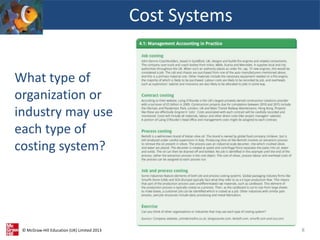
What type of
organization or
industry may use
each type of
costing system?
Cost Systems
8
© McGraw-Hill Education (UK) Limited 2013
• Job costing systems are typically associated
with a manufacturing business, although it is
also used in the service sector
• Manufacturing costs are generally classified as
materials, labour and manufacturing overhead
Overview of a Job Costing System
9
© McGraw-Hill Education (UK) Limited 2013 10
Overview of a Job Costing System
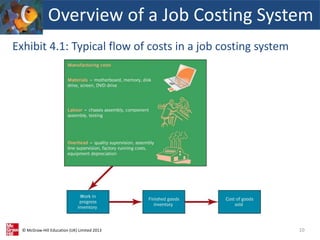
Exhibit 4.1: Typical flow of costs in a job costing system
© McGraw-Hill Education (UK) Limited 2013
• Looking at Exhibit 4.1, you can see how the
cost of a product is accumulated as the
manufacturing process occurs
• At any point in time, it should be possible to
put a reasonably accurate value on any
notebook computer
11
Overview of a Job Costing System
© McGraw-Hill Education (UK) Limited 2013
• You could also think of each cost and stage in
Exhibit 4.1 as a ledger account–a materials
cost account, a labour cost account and an
overhead cost account
• You do not normally see these accounts in
practice, but they are still there in the
background of the information systems used
to capture and accumulate costs
12
Overview of a Job Costing System
© McGraw-Hill Education (UK) Limited 2013
Materials Cost
• The materials necessary to make any products are
usually purchased by a purchasing management
function
• The quantity to be purchased is determined by a
number of factors, as follows:
̶ Inventory level
̶ Price
̶ Stock required for customer orders
13
Overview of a Job Costing System
© McGraw-Hill Education (UK) Limited 2013
Materials Cost
• How is the cost of materials needed for customer
orders calculated?
• The price of materials is actually a key issue to be
addressed in tracing material costs to products
• It may not be possible to determine the actual cost
of all materials to an individual product
14
Overview of a Job Costing System
© McGraw-Hill Education (UK) Limited 2013
Materials Cost
• When it is difficult to trace materials to individual
products then assumptions are made on the
movement of materials under FIFO, LIFO and AVCO
• These assumptions are not related to how materials
physically move or flow in reality
• Of course, actual cost can be used instead of the
above assumptions if a business has adequate
information systems
15
Overview of a Job Costing System
© McGraw-Hill Education (UK) Limited 2013
Labour Cost
• Labour costs in a job costing system typically refer to
the costs of employees directly working on the
manufacture of a product
• The time worked on each job/order needs to be
captured
• Traditionally, the time worked was captured on a job
card, however today more technologically
sophisticated methods are more likely to be used
16
Overview of a Job Costing System
© McGraw-Hill Education (UK) Limited 2013
Labour Cost
• What to do with labour hours that are not or
cannot be traced to a particular job?
• They are usually treated as part of manufacturing
overhead
• Other labour costs, e.g. supervisor/maintenance
crew wages are usually treated as indirect labour
costs and are also included in manufacturing
overhead
17
Overview of a Job Costing System
© McGraw-Hill Education (UK) Limited 2013
• Any manufacturing operations will have costs other
than material and labour which cannot be traced
directly to products
• International accounting standards require a
proportion of manufacturing overhead be included in
the valuation of inventory
• How do you trace/allocate a portion of overhead to a
product?
18
Manufacturing Overhead Allocation –
Traditional Approach
© McGraw-Hill Education (UK) Limited 2013
• The accounting standards do not provide a
solution
• Broadly speaking there are two general
approaches used which are:
̶ Traditional approach
̶ Activity-based approach
19
Manufacturing Overhead Allocation –
Traditional Approach
© McGraw-Hill Education (UK) Limited 2013
• When management accountants refer to ‘allocating
overhead’ or ‘absorbing overhead’, they are referring
to some method used to divide manufacturing
overhead costs between each product produced
• What costs are to be classified as manufacturing
overheads?
• How to divide these overhead costs between
products?
20
Manufacturing Overhead Allocation –
Traditional Approach
© McGraw-Hill Education (UK) Limited 2013
Steps in manufacturing overhead allocation
• Decide on plant-wide or cost-centre rate and then
take steps outlined below
1. Estimate total manufacturing overhead
2. Select an allocation base
3. Calculate the manufacturing overhead rate:
Planned Manufacturing overhead cost
Planned quantity of allocation base
4. Allocate overhead to jobs/products
21
Manufacturing Overhead Allocation –
Traditional Approach
© McGraw-Hill Education (UK) Limited 2013
Manufacturing overhead allocation
• If a company has a detailed cost-centre
structure, then it is likely it has devised
methods to trace as many costs as possible
directly to cost centres
• Cost centres such as maintenance or materials
handling are often called service centres in
that they provide a ‘service’ to other cost
centres
22
Manufacturing Overhead Allocation –
Traditional Approach
© McGraw-Hill Education (UK) Limited 2013
Reallocating service centre costs:
23
Manufacturing Overhead Allocation –
Traditional Approach
© McGraw-Hill Education (UK) Limited 2013
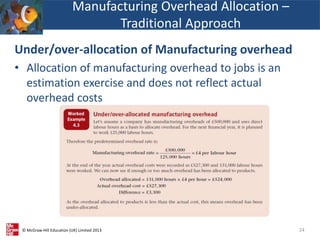
Under/over-allocation of Manufacturing overhead
• Allocation of manufacturing overhead to jobs is an
estimation exercise and does not reflect actual
overhead costs
24
Manufacturing Overhead Allocation –
Traditional Approach
© McGraw-Hill Education (UK) Limited 2013
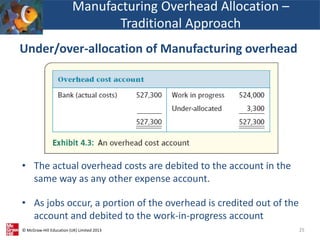
• The actual overhead costs are debited to the account in the
same way as any other expense account.
• As jobs occur, a portion of the overhead is credited out of the
account and debited to the work-in-progress account
25
Manufacturing Overhead Allocation –
Traditional Approach
Under/over-allocation of Manufacturing overhead
© McGraw-Hill Education (UK) Limited 2013
• How are non-manufacturing overheads traced or
allocated to jobs?
• Can use same steps as for manufacturing overhead
• If costs are allocated to cost-centres then the best
base is the one which relates the non-manufacturing
cost to the job
• This is not easy and sometimes results in arbitrary
allocation of costs
26
Non-Manufacturing Overhead
© McGraw-Hill Education (UK) Limited 2013
• A contract-costing system is similar to a job-costing
system in that a uniquely identifiable cost object is
present, that is, a contract
• There are two main differentiating factors in a contract
costing system
̶ Longer time frame causes issues for reporting
revenues and costs
̶ There are more direct costs: for example,
supervisors’ wages, depreciation of equipment and
insurance are much more likely to be direct costs of
a particular contract
Overview of Contract and Process
Costing Systems
27
© McGraw-Hill Education (UK) Limited 2013
Contract costing
• See Worked Example 4.5, p. 86/87
• The portion of any revenues or profits to be
recognized is usually determined using some
method which approximates the degree of
completion of a contract
28
Overview of Contract and Process
Costing Systems
© McGraw-Hill Education (UK) Limited 2013
• The key point is to recognize a loss straight away and some fair
portion of profit when applicable
• A contract is like a job in that it is a unique cost object, but it is
much easier to trace costs directly to a contract
• Indirect costs may be allocated on the basis of contract value
or number of employees on site
• The value of stock is treated as any other inventory
29
Overview of Contract and Process
Costing Systems
Contract costing systems
© McGraw-Hill Education (UK) Limited 2013
• A process environment means that the output of the
manufacturing process does not become a ‘physical’ product
until the end of the process
• The process itself is the cost object
• Unlikely that output is sold in one large lot
• Managers need to find some form of unit as a cost object to
help identify costs and profits
30
Overview of Contract and Process
Costing Systems
Process costing systems
© McGraw-Hill Education (UK) Limited 2013
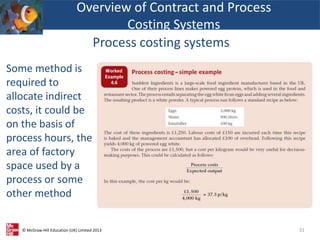
Some method is
required to
allocate indirect
costs, it could be
on the basis of
process hours, the
area of factory
space used by a
process or some
other method
31
Overview of Contract and Process
Costing Systems
Process costing systems
© McGraw-Hill Education (UK) Limited 2013
• Process costs with closing inventory
• See Worked Example 4.7, p. 88-9
32
Overview of Contract and Process
Costing Systems
Process costing systems
© McGraw-Hill Education (UK) Limited 2013
Process costing
• Process costs with opening inventory
• See Worked Example 4.8, p. 89-91
33
Overview of Contract and Process
Costing Systems
Process costing systems
© McGraw-Hill Education (UK) Limited 2013
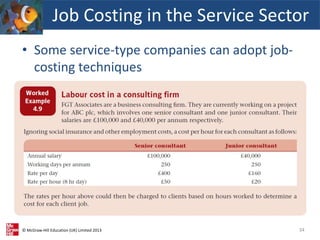
• Some service-type companies can adopt job-
costing techniques
Job Costing in the Service Sector
34
© McGraw-Hill Education (UK) Limited 2013
• As with previous manufacturing examples, an overhead
rate needs to be used
• Budgeted overhead figures are used and allocated using
a suitable base
• Companies like Facebook or Google do not have a
product/service in the traditional sense
• Job costing may not be the most suitable method of
allocation of overheads in relation to service-sector
companies
35
Job Costing in the Service Sector
© McGraw-Hill Education (UK) Limited 2013
• Costing systems depend on the business type
–Job costing is used when unique
jobs/orders/services are identified
–Contract costing – unique contracts, but
longer term
–Process costing – no unique product until
end of process. A cost per unit is
determined based on the process cost
Summary
36
© McGraw-Hill Education (UK) Limited 2013
• Bhimani, A. and M. Bromwich (2010)
Management Accounting: Retrospect and
Prospect, London: CIMA.
• International Accounting Standard 11,
Construction Contracts, www.ifrs.org
References
37

Chapter04.ppt/Management Accounting Costing Systems

  • 1.
    © McGraw-Hill Education(UK) Limited 2013 Costing Systems Chapter 4 1
  • 2.
    © McGraw-Hill Education(UK) Limited 2013 • LO1 Understand and explain different approaches to product and service costing • LO2 Understand how labour and material costs can be traced to jobs • LO3 Calculate a manufacturing overhead rate to assign jobs • LO4 Calculate a job cost and understand its use in decision making Learning Outcomes 2
  • 3.
    © McGraw-Hill Education(UK) Limited 2013 • LO5 Deal with under or over allocated manufacturing overhead • LO6 Understand how non-manufacturing overheads are treated • LO7 Understand how job costing can be used in contracting and service businesses • LO8 Record job costs and how these relate to the accounting system Learning Outcomes 3
  • 4.
    © McGraw-Hill Education(UK) Limited 2013 • All business owners and managers need to know the underlying cost of products or services • How costs are assigned to products depends on the type of business Introduction 4
  • 5.
    © McGraw-Hill Education(UK) Limited 2013 • In this chapter, an absorption costing approach is used to calculate costs for jobs or services. The examples used in the chapter depict a typical manufactured product • All costs of manufacture are assigned to a product, that is, materials, labour and a portion of manufacturing overhead Introduction 5
  • 6.
    © McGraw-Hill Education(UK) Limited 2013 • Costs are assigned to products or services using some recognized method which reflects the interrelationship with the cost object and how a business or organization runs. • There are three cost system types typically associated with manufacturing companies and in some service- sector organizations: ̶ Job costing ̶ Process costing ̶ Contract costing Cost Systems 6
  • 7.
    © McGraw-Hill Education(UK) Limited 2013 • A Job costing system is one where many uniquely identifiable products/services are the norm • A Contract costing system is similar to job costing however it varies in that product or service occurs over a longer period of time • A Process costing system is used when a manufacturing process exists in which a unique product or unit cannot be identified Cost Systems 7
  • 8.
    © McGraw-Hill Education(UK) Limited 2013 What type of organization or industry may use each type of costing system? Cost Systems 8
  • 9.
    © McGraw-Hill Education(UK) Limited 2013 • Job costing systems are typically associated with a manufacturing business, although it is also used in the service sector • Manufacturing costs are generally classified as materials, labour and manufacturing overhead Overview of a Job Costing System 9
  • 10.
    © McGraw-Hill Education(UK) Limited 2013 10 Overview of a Job Costing System Exhibit 4.1: Typical flow of costs in a job costing system
  • 11.
    © McGraw-Hill Education(UK) Limited 2013 • Looking at Exhibit 4.1, you can see how the cost of a product is accumulated as the manufacturing process occurs • At any point in time, it should be possible to put a reasonably accurate value on any notebook computer 11 Overview of a Job Costing System
  • 12.
    © McGraw-Hill Education(UK) Limited 2013 • You could also think of each cost and stage in Exhibit 4.1 as a ledger account–a materials cost account, a labour cost account and an overhead cost account • You do not normally see these accounts in practice, but they are still there in the background of the information systems used to capture and accumulate costs 12 Overview of a Job Costing System
  • 13.
    © McGraw-Hill Education(UK) Limited 2013 Materials Cost • The materials necessary to make any products are usually purchased by a purchasing management function • The quantity to be purchased is determined by a number of factors, as follows: ̶ Inventory level ̶ Price ̶ Stock required for customer orders 13 Overview of a Job Costing System
  • 14.
    © McGraw-Hill Education(UK) Limited 2013 Materials Cost • How is the cost of materials needed for customer orders calculated? • The price of materials is actually a key issue to be addressed in tracing material costs to products • It may not be possible to determine the actual cost of all materials to an individual product 14 Overview of a Job Costing System
  • 15.
    © McGraw-Hill Education(UK) Limited 2013 Materials Cost • When it is difficult to trace materials to individual products then assumptions are made on the movement of materials under FIFO, LIFO and AVCO • These assumptions are not related to how materials physically move or flow in reality • Of course, actual cost can be used instead of the above assumptions if a business has adequate information systems 15 Overview of a Job Costing System
  • 16.
    © McGraw-Hill Education(UK) Limited 2013 Labour Cost • Labour costs in a job costing system typically refer to the costs of employees directly working on the manufacture of a product • The time worked on each job/order needs to be captured • Traditionally, the time worked was captured on a job card, however today more technologically sophisticated methods are more likely to be used 16 Overview of a Job Costing System
  • 17.
    © McGraw-Hill Education(UK) Limited 2013 Labour Cost • What to do with labour hours that are not or cannot be traced to a particular job? • They are usually treated as part of manufacturing overhead • Other labour costs, e.g. supervisor/maintenance crew wages are usually treated as indirect labour costs and are also included in manufacturing overhead 17 Overview of a Job Costing System
  • 18.
    © McGraw-Hill Education(UK) Limited 2013 • Any manufacturing operations will have costs other than material and labour which cannot be traced directly to products • International accounting standards require a proportion of manufacturing overhead be included in the valuation of inventory • How do you trace/allocate a portion of overhead to a product? 18 Manufacturing Overhead Allocation – Traditional Approach
  • 19.
    © McGraw-Hill Education(UK) Limited 2013 • The accounting standards do not provide a solution • Broadly speaking there are two general approaches used which are: ̶ Traditional approach ̶ Activity-based approach 19 Manufacturing Overhead Allocation – Traditional Approach
  • 20.
    © McGraw-Hill Education(UK) Limited 2013 • When management accountants refer to ‘allocating overhead’ or ‘absorbing overhead’, they are referring to some method used to divide manufacturing overhead costs between each product produced • What costs are to be classified as manufacturing overheads? • How to divide these overhead costs between products? 20 Manufacturing Overhead Allocation – Traditional Approach
  • 21.
    © McGraw-Hill Education(UK) Limited 2013 Steps in manufacturing overhead allocation • Decide on plant-wide or cost-centre rate and then take steps outlined below 1. Estimate total manufacturing overhead 2. Select an allocation base 3. Calculate the manufacturing overhead rate: Planned Manufacturing overhead cost Planned quantity of allocation base 4. Allocate overhead to jobs/products 21 Manufacturing Overhead Allocation – Traditional Approach
  • 22.
    © McGraw-Hill Education(UK) Limited 2013 Manufacturing overhead allocation • If a company has a detailed cost-centre structure, then it is likely it has devised methods to trace as many costs as possible directly to cost centres • Cost centres such as maintenance or materials handling are often called service centres in that they provide a ‘service’ to other cost centres 22 Manufacturing Overhead Allocation – Traditional Approach
  • 23.
    © McGraw-Hill Education(UK) Limited 2013 Reallocating service centre costs: 23 Manufacturing Overhead Allocation – Traditional Approach
  • 24.
    © McGraw-Hill Education(UK) Limited 2013 Under/over-allocation of Manufacturing overhead • Allocation of manufacturing overhead to jobs is an estimation exercise and does not reflect actual overhead costs 24 Manufacturing Overhead Allocation – Traditional Approach
  • 25.
    © McGraw-Hill Education(UK) Limited 2013 • The actual overhead costs are debited to the account in the same way as any other expense account. • As jobs occur, a portion of the overhead is credited out of the account and debited to the work-in-progress account 25 Manufacturing Overhead Allocation – Traditional Approach Under/over-allocation of Manufacturing overhead
  • 26.
    © McGraw-Hill Education(UK) Limited 2013 • How are non-manufacturing overheads traced or allocated to jobs? • Can use same steps as for manufacturing overhead • If costs are allocated to cost-centres then the best base is the one which relates the non-manufacturing cost to the job • This is not easy and sometimes results in arbitrary allocation of costs 26 Non-Manufacturing Overhead
  • 27.
    © McGraw-Hill Education(UK) Limited 2013 • A contract-costing system is similar to a job-costing system in that a uniquely identifiable cost object is present, that is, a contract • There are two main differentiating factors in a contract costing system ̶ Longer time frame causes issues for reporting revenues and costs ̶ There are more direct costs: for example, supervisors’ wages, depreciation of equipment and insurance are much more likely to be direct costs of a particular contract Overview of Contract and Process Costing Systems 27
  • 28.
    © McGraw-Hill Education(UK) Limited 2013 Contract costing • See Worked Example 4.5, p. 86/87 • The portion of any revenues or profits to be recognized is usually determined using some method which approximates the degree of completion of a contract 28 Overview of Contract and Process Costing Systems
  • 29.
    © McGraw-Hill Education(UK) Limited 2013 • The key point is to recognize a loss straight away and some fair portion of profit when applicable • A contract is like a job in that it is a unique cost object, but it is much easier to trace costs directly to a contract • Indirect costs may be allocated on the basis of contract value or number of employees on site • The value of stock is treated as any other inventory 29 Overview of Contract and Process Costing Systems Contract costing systems
  • 30.
    © McGraw-Hill Education(UK) Limited 2013 • A process environment means that the output of the manufacturing process does not become a ‘physical’ product until the end of the process • The process itself is the cost object • Unlikely that output is sold in one large lot • Managers need to find some form of unit as a cost object to help identify costs and profits 30 Overview of Contract and Process Costing Systems Process costing systems
  • 31.
    © McGraw-Hill Education(UK) Limited 2013 Some method is required to allocate indirect costs, it could be on the basis of process hours, the area of factory space used by a process or some other method 31 Overview of Contract and Process Costing Systems Process costing systems
  • 32.
    © McGraw-Hill Education(UK) Limited 2013 • Process costs with closing inventory • See Worked Example 4.7, p. 88-9 32 Overview of Contract and Process Costing Systems Process costing systems
  • 33.
    © McGraw-Hill Education(UK) Limited 2013 Process costing • Process costs with opening inventory • See Worked Example 4.8, p. 89-91 33 Overview of Contract and Process Costing Systems Process costing systems
  • 34.
    © McGraw-Hill Education(UK) Limited 2013 • Some service-type companies can adopt job- costing techniques Job Costing in the Service Sector 34
  • 35.
    © McGraw-Hill Education(UK) Limited 2013 • As with previous manufacturing examples, an overhead rate needs to be used • Budgeted overhead figures are used and allocated using a suitable base • Companies like Facebook or Google do not have a product/service in the traditional sense • Job costing may not be the most suitable method of allocation of overheads in relation to service-sector companies 35 Job Costing in the Service Sector
  • 36.
    © McGraw-Hill Education(UK) Limited 2013 • Costing systems depend on the business type –Job costing is used when unique jobs/orders/services are identified –Contract costing – unique contracts, but longer term –Process costing – no unique product until end of process. A cost per unit is determined based on the process cost Summary 36
  • 37.
    © McGraw-Hill Education(UK) Limited 2013 • Bhimani, A. and M. Bromwich (2010) Management Accounting: Retrospect and Prospect, London: CIMA. • International Accounting Standard 11, Construction Contracts, www.ifrs.org References 37