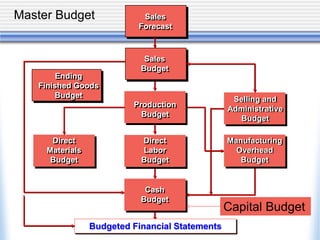
Production
Budget
Selling and
Administrative
Budget
Direct
Materials
Budget
Manufacturing
Overhead
Budget
Direct
Labor
Budget
Cash
Budget
Sales
Budget
Budgeted Financial Statements
Ending
Finished Goods
Budget
Sales
Forecast
Capital Budget
Master Budget
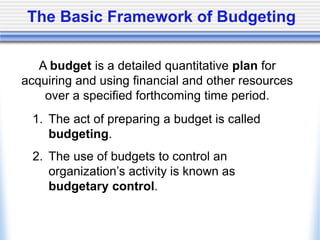
The Basic Framework of Budgeting
A budget is a detailed quantitative plan for
acquiring and using financial and other resources
over a specified forthcoming time period.
1. The act of preparing a budget is called
budgeting.
2. The use of budgets to control an
organization’s activity is known as
budgetary control.
Planning and Control
Planning –
involves developing
objectives and
preparing various
budgets to achieve
these objectives.
Control –
involves the steps
taken by
management that
attempt to ensure
the objectives are
attained.
Advantages of Budgeting
Advantages
Define goal
and objectives
Uncover potential
bottlenecks
Coordinate
activities
Communicate
plans
Think about and
plan for the future
Means of allocating
resources
Responsibility Accounting
Managers should be held responsible for those
items — and only those items — that
the manager can actually control
to a significant extent.
Choosing the Budget Period
Operating Budget
2013 2014 2015 2016
The annual operating budget
may be divided into quarterly
or monthly budgets.
A continuous budget is a 12-
month budget that rolls forward
one month (or quarter) as the
current month (or quarter) is
completed.
Human Factors in Budgeting
The success of budgeting depends upon three
important factors:
1. Top management must be enthusiastic and
committed to the budget process.
2. Top management must not use the budget to
pressure employees or blame them when
something goes wrong.
3. Highly achievable budget targets are usually
preferred when managers are rewarded based
on meeting budget targets.
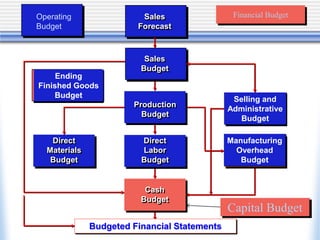
Production
Budget
Selling and
Administrative
Budget
Direct
Materials
Budget
Manufacturing
Overhead
Budget
Direct
Labor
Budget
Cash
Budget
Sales
Budget
Budgeted Financial Statements
Ending
Finished Goods
Budget
Sales
Forecast
Capital Budget
Master Budget
Production
Budget
Selling and
Administrative
Budget
Direct
Materials
Budget
Manufacturing
Overhead
Budget
Direct
Labor
Budget
Cash
Budget
Sales
Budget
Budgeted Financial Statements
Ending
Finished Goods
Budget
Sales
Forecast
Capitol Budget
Sales
Forecast
Operating
Budget
Capital Budget
Financial Budget
Budgeting Example
Royal Company is preparing budgets for the
quarter ending June 30.
Budgeted sales for the next five months are:
April 20,000 units
May 50,000 units
June 30,000 units
July 25,000 units
August 15,000 units.
The selling price is $10 per unit.
The Sales Budget
The individual months of April, May, and June are
summed to obtain the total projected sales in units
and dollars for the quarter ended June 30th
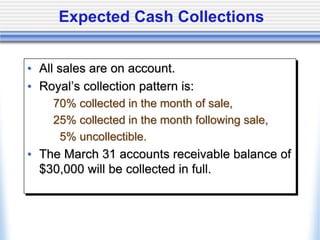
Expected Cash Collections
• All sales are on account.
• Royal’s collection pattern is:
70% collected in the month of sale,
25% collected in the month following sale,
5% uncollectible.
• The March 31 accounts receivable balance of
$30,000 will be collected in full.
Expected Cash Collections
From the Sales Budget for April.
Expected Cash Collections
From the Sales Budget for May.
Expected Cash Collections
The Production Budget
Production
Budget
Sales
Budget
and
Expected
Cash
Collections
Production must be adequate to meet budgeted
sales and provide for sufficient ending inventory.
The Production Budget
• The management at Royal Company wants
ending inventory to be equal to 20% of the
following month’s budgeted sales in units.
• On March 31, 4,000 units were on hand.
The Production Budget
March 31
ending inventory
Budgeted May sales 50,000
Desired ending inventory % 20%
Desired ending inventory 10,000
The Production Budget
Assumed ending inventory.
The Direct Materials Budget
• At Royal Company, five pounds of material
are required per unit of product.
• Management wants materials on hand at
the end of each month equal to 10% of the
following month’s production.
• On March 31, 13,000 pounds of material
are on hand. Material cost is $0.40 per
pound.
Let’s prepare the direct materials budget.
The Direct Materials Budget
From production budget
The Direct Materials Budget
Calculate the materials to
by purchased in May.
March 31 inventory
10% of following months
production needs.
The Direct Materials Budget
Assumed ending inventory
Expected Cash Disbursement for Materials
• Royal pays $0.40 per pound for its materials.
• One-half of a month’s purchases is paid for in
the month of purchase; the other half is paid
in the following month.
• The March 31 accounts payable balance is
$12,000.
Expected Cash Disbursement for Materials
140,000 lbs. × $.40/lb. = $56,000
Expected Cash Disbursement for Materials
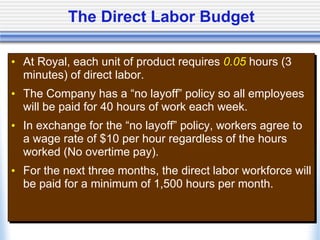
The Direct Labor Budget
• At Royal, each unit of product requires 0.05 hours (3
minutes) of direct labor.
• The Company has a “no layoff” policy so all employees
will be paid for 40 hours of work each week.
• In exchange for the “no layoff” policy, workers agree to
a wage rate of $10 per hour regardless of the hours
worked (No overtime pay).
• For the next three months, the direct labor workforce will
be paid for a minimum of 1,500 hours per month.
The Direct Labor Budget
From production budget
The Direct Labor Budget
Greater of labor hours required
or labor hours guaranteed.
The Direct Labor Budget
Manufacturing Overhead Budget
• At Royal manufacturing overhead is applied to
units of product on the basis of direct labor
hours.
• The variable manufacturing overhead rate is
$20 per direct labor hour.
• Fixed manufacturing overhead is $50,000 per
month and includes $20,000 of noncash costs
(primarily depreciation of plant assets).
Manufacturing Overhead Budget
Direct Labor Budget
Manufacturing Overhead Budget
Total mfg. OH for quarter $251,000
Total labor hours required 5,050
= $49.70 per hour*
*rounded
Manufacturing Overhead Budget
Depreciation is a noncash charge.
Production costs per unit Quantity Cost Total
Direct materials 5.00 lbs. 0.40
$ 2.00
$
Direct labor
Manufacturing overhead
Budgeted finished goods inventory
Ending inventory in units
Unit product cost
Ending finished goods inventory
Ending Finished Goods Inventory Budget
Direct materials
budget and information
Production costs per unit Quantity Cost Total
Direct materials 5.00 lbs. 0.40
$ 2.00
$
Direct labor 0.05 hrs. 10.00
$ 0.50
Manufacturing overhead
Budgeted finished goods inventory
Ending inventory in units
Unit product cost
Ending finished goods inventory
Ending Finished Goods Inventory Budget
Direct labor budget
Production costs per unit Quantity Cost Total
Direct materials 5.00 lbs. 0.40
$ 2.00
$
Direct labor 0.05 hrs. 10.00
$ 0.50
Manufacturing overhead 0.05 hrs. 49.70
$ 2.49
4.99
$
Budgeted finished goods inventory
Ending inventory in units
Unit product cost 4.99
$
Ending finished goods inventory ?
Ending Finished Goods Inventory Budget
Total mfg. OH for quarter $251,000
Total labor hours required 5,050
= $49.70 per hour*
Production costs per unit Quantity Cost Total
Direct materials 5.00 lbs. 0.40
$ 2.00
$
Direct labor 0.05 hrs. 10.00
$ 0.50
Manufacturing overhead 0.05 hrs. 49.70
$ 2.49
4.99
$
Budgeted finished goods inventory
Ending inventory in units 5,000
Unit product cost 4.99
$
Ending finished goods inventory 24,950
$
Ending Finished Goods Inventory Budget
Production Budget
Selling and Administrative Expense Budget
• At Royal, the selling and administrative expenses
budget is divided into variable and fixed
components.
• The variable selling and administrative expenses
are $0.50 per unit sold.
• Fixed selling and administrative expenses are
$70,000 per month.
• The fixed selling and administrative expenses
include $10,000 in costs – primarily depreciation –
that are not cash outflows of the current month.
Selling and Administrative Expense Budget
Format of the Cash Budget
The cash budget is divided into four sections:
1. Cash receipts listing all cash inflows excluding
borrowing
2. Cash disbursements listing all payments
excluding repayments of principal and interest
3. Cash excess or deficiency
4. The financing section listing all borrowings,
repayments and interest
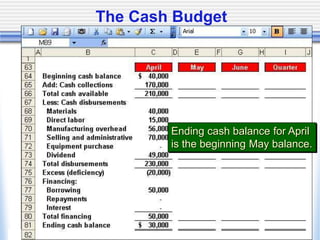
The Cash Budget
Royal:
Maintains a 16% open line of credit for $75,000
Maintains a minimum cash balance of $30,000
Borrows on the first day of the month and repays
loans on the last day of the month
Pays a cash dividend of $49,000 in April
Purchases $143,700 of equipment in May and
$48,300 in June paid in cash
Has an April 1 cash balance of $40,000
The Cash Budget
Schedule of Expected
Cash Collections
The Cash Budget
Direct Labor
Budget
Manufacturing
Overhead Budget
Selling and Administrative
Expense Budget
Schedule of Expected
Cash Disbursements
The Cash Budget
Because Royal maintains
a cash balance of $30,000,
the company must borrow
$50,000 on it line-of-credit.
The Cash Budget
Ending cash balance for April
is the beginning May balance.
The Cash Budget
The Cash Budget
$50,000 × 16% × 3/12 = $2,000
Borrowings on April 1 and
repayment on June 30.
The Budgeted Income Statement
Cash
Budget
Budgeted
Income
Statement
After we complete the cash budget,
we can prepare the budgeted income
statement for Royal.
The Budgeted Income Statement
Royal Company
Budgeted Income Statement
For the Three Months Ended June 30
Sales (100,000 units @ $10) 1,000,000
$
Cost of goods sold (100,000 @ $4.99) 499,000
Gross margin 501,000
Selling and administrative expenses 260,000
Operating income 241,000
Interest expense 2,000
Net income 239,000
$
Sales Budget
Ending Finished
Goods Inventory
Selling and
Administrative
Expense Budget
Cash Budget
The Budgeted Balance Sheet
Royal reported the following account
balances prior to preparing its budgeted
financial statements:
 Land - $50,000
 Common stock - $200,000
 Retained earnings - $146,150
 Equipment - $175,000
Royal Company
Budgeted Balance Sheet
June 30
Current assets
Cash 43,000
$
Accounts receivable 75,000
Raw materials inventory 4,600
Finished goods inventory 24,950
Total current assets 147,550
Property and equipment
Land 50,000
Equipment 367,000
Total property and equipment 417,000
Total assets 564,550
$
Accounts payable 28,400
$
Common stock 200,000
Retained earnings 336,150
Total liabilities and equities 564,550
$
11,500 lbs.
at $0.40/lb.
5,000 units
at $4.99 each
50% of June
purchases
of $56,800
25% of June
sales of
$300,000
Royal Company
Budgeted Balance Sheet
June 30
Current assets
Cash 43,000
$
Accounts receivable 75,000
Raw materials inventory 4,600
Finished goods inventory 24,950
Total current assets 147,550
Property and equipment
Land 50,000
Equipment 367,000
Total property and equipment 417,000
Total assets 564,550
$
Accounts payable 28,400
$
Common stock 200,000
Retained earnings 336,150
Total liabilities and equities 564,550
$
Beginning balance 146,150
$
Add: net income 239,000
Deduct: dividends (49,000)
Ending balance 336,150
$

Master Budget.pptx

  • 1.
  • 2.
    The Basic Frameworkof Budgeting A budget is a detailed quantitative plan for acquiring and using financial and other resources over a specified forthcoming time period. 1. The act of preparing a budget is called budgeting. 2. The use of budgets to control an organization’s activity is known as budgetary control.
  • 3.
    Planning and Control Planning– involves developing objectives and preparing various budgets to achieve these objectives. Control – involves the steps taken by management that attempt to ensure the objectives are attained.
  • 4.
    Advantages of Budgeting Advantages Definegoal and objectives Uncover potential bottlenecks Coordinate activities Communicate plans Think about and plan for the future Means of allocating resources
  • 5.
    Responsibility Accounting Managers shouldbe held responsible for those items — and only those items — that the manager can actually control to a significant extent.
  • 6.
    Choosing the BudgetPeriod Operating Budget 2013 2014 2015 2016 The annual operating budget may be divided into quarterly or monthly budgets. A continuous budget is a 12- month budget that rolls forward one month (or quarter) as the current month (or quarter) is completed.
  • 7.
    Human Factors inBudgeting The success of budgeting depends upon three important factors: 1. Top management must be enthusiastic and committed to the budget process. 2. Top management must not use the budget to pressure employees or blame them when something goes wrong. 3. Highly achievable budget targets are usually preferred when managers are rewarded based on meeting budget targets.
  • 8.
  • 9.
    Production Budget Selling and Administrative Budget Direct Materials Budget Manufacturing Overhead Budget Direct Labor Budget Cash Budget Sales Budget Budgeted FinancialStatements Ending Finished Goods Budget Sales Forecast Capitol Budget Sales Forecast Operating Budget Capital Budget Financial Budget
  • 10.
    Budgeting Example Royal Companyis preparing budgets for the quarter ending June 30. Budgeted sales for the next five months are: April 20,000 units May 50,000 units June 30,000 units July 25,000 units August 15,000 units. The selling price is $10 per unit.
  • 11.
    The Sales Budget Theindividual months of April, May, and June are summed to obtain the total projected sales in units and dollars for the quarter ended June 30th
  • 12.
    Expected Cash Collections •All sales are on account. • Royal’s collection pattern is: 70% collected in the month of sale, 25% collected in the month following sale, 5% uncollectible. • The March 31 accounts receivable balance of $30,000 will be collected in full.
  • 13.
  • 14.
    Expected Cash Collections Fromthe Sales Budget for April.
  • 15.
    Expected Cash Collections Fromthe Sales Budget for May.
  • 16.
  • 17.
    The Production Budget Production Budget Sales Budget and Expected Cash Collections Productionmust be adequate to meet budgeted sales and provide for sufficient ending inventory.
  • 18.
    The Production Budget •The management at Royal Company wants ending inventory to be equal to 20% of the following month’s budgeted sales in units. • On March 31, 4,000 units were on hand.
  • 19.
  • 20.
    The Production Budget March31 ending inventory Budgeted May sales 50,000 Desired ending inventory % 20% Desired ending inventory 10,000
  • 21.
  • 22.
  • 23.
    The Direct MaterialsBudget • At Royal Company, five pounds of material are required per unit of product. • Management wants materials on hand at the end of each month equal to 10% of the following month’s production. • On March 31, 13,000 pounds of material are on hand. Material cost is $0.40 per pound. Let’s prepare the direct materials budget.
  • 24.
    The Direct MaterialsBudget From production budget
  • 25.
  • 26.
    The Direct MaterialsBudget Calculate the materials to by purchased in May. March 31 inventory 10% of following months production needs.
  • 27.
  • 28.
    The Direct MaterialsBudget Assumed ending inventory
  • 29.
    Expected Cash Disbursementfor Materials • Royal pays $0.40 per pound for its materials. • One-half of a month’s purchases is paid for in the month of purchase; the other half is paid in the following month. • The March 31 accounts payable balance is $12,000.
  • 30.
  • 31.
    Expected Cash Disbursementfor Materials 140,000 lbs. × $.40/lb. = $56,000
  • 32.
  • 33.
    The Direct LaborBudget • At Royal, each unit of product requires 0.05 hours (3 minutes) of direct labor. • The Company has a “no layoff” policy so all employees will be paid for 40 hours of work each week. • In exchange for the “no layoff” policy, workers agree to a wage rate of $10 per hour regardless of the hours worked (No overtime pay). • For the next three months, the direct labor workforce will be paid for a minimum of 1,500 hours per month.
  • 34.
    The Direct LaborBudget From production budget
  • 35.
  • 36.
    The Direct LaborBudget Greater of labor hours required or labor hours guaranteed.
  • 37.
  • 38.
    Manufacturing Overhead Budget •At Royal manufacturing overhead is applied to units of product on the basis of direct labor hours. • The variable manufacturing overhead rate is $20 per direct labor hour. • Fixed manufacturing overhead is $50,000 per month and includes $20,000 of noncash costs (primarily depreciation of plant assets).
  • 39.
  • 40.
    Manufacturing Overhead Budget Totalmfg. OH for quarter $251,000 Total labor hours required 5,050 = $49.70 per hour* *rounded
  • 41.
  • 42.
    Production costs perunit Quantity Cost Total Direct materials 5.00 lbs. 0.40 $ 2.00 $ Direct labor Manufacturing overhead Budgeted finished goods inventory Ending inventory in units Unit product cost Ending finished goods inventory Ending Finished Goods Inventory Budget Direct materials budget and information
  • 43.
    Production costs perunit Quantity Cost Total Direct materials 5.00 lbs. 0.40 $ 2.00 $ Direct labor 0.05 hrs. 10.00 $ 0.50 Manufacturing overhead Budgeted finished goods inventory Ending inventory in units Unit product cost Ending finished goods inventory Ending Finished Goods Inventory Budget Direct labor budget
  • 44.
    Production costs perunit Quantity Cost Total Direct materials 5.00 lbs. 0.40 $ 2.00 $ Direct labor 0.05 hrs. 10.00 $ 0.50 Manufacturing overhead 0.05 hrs. 49.70 $ 2.49 4.99 $ Budgeted finished goods inventory Ending inventory in units Unit product cost 4.99 $ Ending finished goods inventory ? Ending Finished Goods Inventory Budget Total mfg. OH for quarter $251,000 Total labor hours required 5,050 = $49.70 per hour*
  • 45.
    Production costs perunit Quantity Cost Total Direct materials 5.00 lbs. 0.40 $ 2.00 $ Direct labor 0.05 hrs. 10.00 $ 0.50 Manufacturing overhead 0.05 hrs. 49.70 $ 2.49 4.99 $ Budgeted finished goods inventory Ending inventory in units 5,000 Unit product cost 4.99 $ Ending finished goods inventory 24,950 $ Ending Finished Goods Inventory Budget Production Budget
  • 46.
    Selling and AdministrativeExpense Budget • At Royal, the selling and administrative expenses budget is divided into variable and fixed components. • The variable selling and administrative expenses are $0.50 per unit sold. • Fixed selling and administrative expenses are $70,000 per month. • The fixed selling and administrative expenses include $10,000 in costs – primarily depreciation – that are not cash outflows of the current month.
  • 47.
  • 48.
  • 49.
    Format of theCash Budget The cash budget is divided into four sections: 1. Cash receipts listing all cash inflows excluding borrowing 2. Cash disbursements listing all payments excluding repayments of principal and interest 3. Cash excess or deficiency 4. The financing section listing all borrowings, repayments and interest
  • 50.
    The Cash Budget Royal: Maintainsa 16% open line of credit for $75,000 Maintains a minimum cash balance of $30,000 Borrows on the first day of the month and repays loans on the last day of the month Pays a cash dividend of $49,000 in April Purchases $143,700 of equipment in May and $48,300 in June paid in cash Has an April 1 cash balance of $40,000
  • 51.
    The Cash Budget Scheduleof Expected Cash Collections
  • 52.
    The Cash Budget DirectLabor Budget Manufacturing Overhead Budget Selling and Administrative Expense Budget Schedule of Expected Cash Disbursements
  • 53.
    The Cash Budget BecauseRoyal maintains a cash balance of $30,000, the company must borrow $50,000 on it line-of-credit.
  • 54.
    The Cash Budget Endingcash balance for April is the beginning May balance.
  • 55.
  • 56.
    The Cash Budget $50,000× 16% × 3/12 = $2,000 Borrowings on April 1 and repayment on June 30.
  • 57.
    The Budgeted IncomeStatement Cash Budget Budgeted Income Statement After we complete the cash budget, we can prepare the budgeted income statement for Royal.
  • 58.
    The Budgeted IncomeStatement Royal Company Budgeted Income Statement For the Three Months Ended June 30 Sales (100,000 units @ $10) 1,000,000 $ Cost of goods sold (100,000 @ $4.99) 499,000 Gross margin 501,000 Selling and administrative expenses 260,000 Operating income 241,000 Interest expense 2,000 Net income 239,000 $ Sales Budget Ending Finished Goods Inventory Selling and Administrative Expense Budget Cash Budget
  • 59.
    The Budgeted BalanceSheet Royal reported the following account balances prior to preparing its budgeted financial statements:  Land - $50,000  Common stock - $200,000  Retained earnings - $146,150  Equipment - $175,000
  • 60.
    Royal Company Budgeted BalanceSheet June 30 Current assets Cash 43,000 $ Accounts receivable 75,000 Raw materials inventory 4,600 Finished goods inventory 24,950 Total current assets 147,550 Property and equipment Land 50,000 Equipment 367,000 Total property and equipment 417,000 Total assets 564,550 $ Accounts payable 28,400 $ Common stock 200,000 Retained earnings 336,150 Total liabilities and equities 564,550 $ 11,500 lbs. at $0.40/lb. 5,000 units at $4.99 each 50% of June purchases of $56,800 25% of June sales of $300,000
  • 61.
    Royal Company Budgeted BalanceSheet June 30 Current assets Cash 43,000 $ Accounts receivable 75,000 Raw materials inventory 4,600 Finished goods inventory 24,950 Total current assets 147,550 Property and equipment Land 50,000 Equipment 367,000 Total property and equipment 417,000 Total assets 564,550 $ Accounts payable 28,400 $ Common stock 200,000 Retained earnings 336,150 Total liabilities and equities 564,550 $ Beginning balance 146,150 $ Add: net income 239,000 Deduct: dividends (49,000) Ending balance 336,150 $