MANAGERIAL
ACCOUNTING
Charles E. Davis
Elizabeth Davis
Accounting As ATool For Management
1. What Is Managerial
Accounting?
2. Different Strategies, Different
Information
3. Ethical Considerations in
Managerial Accounting
What Is Managerial Accounting?
1. Define managerial accounting.
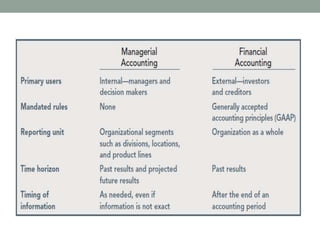
2. Describe the differences between managerial and
financial accounting.
I. Who are the primary users of financial accounting information?
II. Who are the primary users of managerial accounting information?
III. Compare and contrast managerial and financial accounting
information.
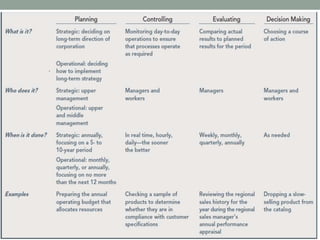
3. List and describe the four functions of managers.
I. What are the four functions of management? How does
management carry out each function?
Different Strategies, Different
Information
• Explain how the selection of a particular business strategy
determines the information that managers need to run an
organization effectively.
I. How does information assist in achieving corporate strategy?
II. How does corporate strategy influence the selection of
information used in decision-making activities?
1. Matching Accounting Information to an Organization’s
Strategy
I. Product Differentiation versus Low-Cost Production
II. Market Share: Build, Hold, Harvest, or Divest
2. Monitoring Strategic Performance
I. The Balanced Scorecard
II. Supply Chain Management
III. Just-In-Time (JIT) Inventory
IV. Enterprise Resource Planning (ERP) Systems
Ethical Considerations in Managerial
Accounting
• Discuss the importance of ethical behaviour in managerial
accounting.
I. Why is it important for an organization to have a code
of conduct?
II. How can an employee’s unethical behavior affect an
organization?
Ethical Considerations in Managerial
Accounting
• (1) “Do I mind others knowing what I have
• done?” (2) “Who does my decision affect or hurt?” and (3)
“Would my decision be considered fair by those affected?”

Managerial accounting

  • 1.
  • 2.
    Accounting As AToolFor Management 1. What Is Managerial Accounting? 2. Different Strategies, Different Information 3. Ethical Considerations in Managerial Accounting
  • 3.
    What Is ManagerialAccounting? 1. Define managerial accounting. 2. Describe the differences between managerial and financial accounting. I. Who are the primary users of financial accounting information? II. Who are the primary users of managerial accounting information? III. Compare and contrast managerial and financial accounting information. 3. List and describe the four functions of managers. I. What are the four functions of management? How does management carry out each function?
  • 6.
    Different Strategies, Different Information •Explain how the selection of a particular business strategy determines the information that managers need to run an organization effectively. I. How does information assist in achieving corporate strategy? II. How does corporate strategy influence the selection of information used in decision-making activities?
  • 7.
    1. Matching AccountingInformation to an Organization’s Strategy I. Product Differentiation versus Low-Cost Production II. Market Share: Build, Hold, Harvest, or Divest 2. Monitoring Strategic Performance I. The Balanced Scorecard II. Supply Chain Management III. Just-In-Time (JIT) Inventory IV. Enterprise Resource Planning (ERP) Systems
  • 8.
    Ethical Considerations inManagerial Accounting • Discuss the importance of ethical behaviour in managerial accounting. I. Why is it important for an organization to have a code of conduct? II. How can an employee’s unethical behavior affect an organization?
  • 9.
    Ethical Considerations inManagerial Accounting • (1) “Do I mind others knowing what I have • done?” (2) “Who does my decision affect or hurt?” and (3) “Would my decision be considered fair by those affected?”