MOHAMAD SHUKRI BIN MUDA
COMMERCE DEPARTMENT
POLITEKNIK METrO BETONG SARAWAK
Definition of job analysis
The procedure of determining the duties and skill
requirements of a job and the kind of person who should
be hired for it.
Using job analysis, HR specialists collect the information
on human requirements, job context, performance
standards, machines, skills as well as work activities.
Job Analysis plays an important role in following
aspects:
• Recruitment and selection,
• Performance analysis,
• Training and development,
• Compensation management, and
• Job designing and redesigning.
Recruitment and Selection: Job Analysis helps in determining what kind of person is
required to perform a particular job. It points out the educational qualifications, level of
experience and technical, physical, emotional and personal skills required to carry out a job
in desired fashion. The objective is to fit a right person at a right place.
Performance Analysis: Job analysis is done to check if goals and objectives of a particular
job are met or not. It helps in deciding the performance standards, evaluation criteria and
individual’s output. On this basis, the overall performance of an employee is measured and
he or she is appraised accordingly.
Training and Development: Job Analysis can be used to assess the training and
development needs of employees. The difference between the expected and actual output
determines the level of training that need to be imparted to employees. It also helps in
deciding the training content, tools and equipments to be used to conduct training and
methods of training.
Compensation Management: Job analysis plays a vital role in deciding the
pay packages and extra perks and benefits and fixed and variable incentives
of employees. After all, the pay package depends on the position, job title and
duties and responsibilities involved in a job. The process guides HR
managers in deciding the worth of an employee for a particular job opening.
Job Designing and Redesigning: The main purpose of job analysis is to
streamline the human efforts and get the best possible output. It helps in
designing, redesigning, enriching, evaluating and also cutting back and
adding the extra responsibilities in a particular job. This is done to enhance
the employee satisfaction while increasing the human output.
There are four (4) methods used in collecting data from
job analysis:
• Interviews
• Surveys
• Observation
• Journals and records
Interviews
Most widely used
method – simple
and quick way to
collect information
(includes that
never appear on a
written form)
Popular methods
for obtaining job-
related information
(may arrange from
completely
unstructured
interviews
It is important to
be sure the
interviewees
understands the
reason for the
interview
Interviews have
weakness due to
distortion of
information
caused by
falsification or
misunderstanding.
Employees tend to
exaggerate certain
responsibilities
while minimizing
others – efficiency
evaluation.
Surveys
Purposely to
describe duties
and
responsibilities
Typical job
analysis survey
may have open-
ended questions
and structured
questions
Surveys – a
quick way to
obtain
information from
a large number
of employees
Cheaper than
interviewing
hundreds of
workers
Time consuming
and expensive
for developing
the survey and
testing it.
Observation
Direct observation is useful
when jobs consist mainly
of observable activities –
assembly-line worker and
accounting clerk
Observation is not
appropriate when the job
involves a lot of mental
activities – lawyer, design
engineer
Journals and records
Journals/Diaries – daily
listings made by workers
of every activity in which
they engage along with the
time each activity takes.
Produce a complete
picture of the job,
especially when
supplemented with
subsequent interviews with
the worker and supervisor
Employees may
exaggerate, but detailed
and chronological nature
of the diary will show the
true picture.
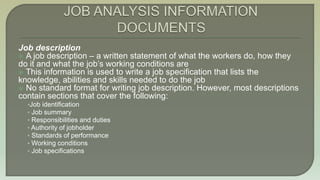
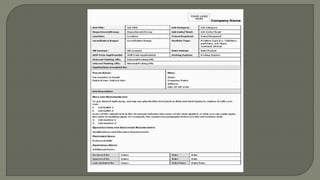
Job description
 A job description – a written statement of what the workers do, how they
do it and what the job’s working conditions are
 This information is used to write a job specification that lists the
knowledge, abilities and skills needed to do the job
 No standard format for writing job description. However, most descriptions
contain sections that cover the following:
•Job identification
• Job summary
• Responsibilities and duties
• Authority of jobholder
• Standards of performance
• Working conditions
• Job specifications
Job specification
 Answer the questions “what human traits and experience
are required to do this job?”
 It shows what kind of person to recruit and for what
qualities that person should be tested.
 Job specification divided into two (2) categories namely:
• Specifications based on judgment
• Specifications based on statistical analysis
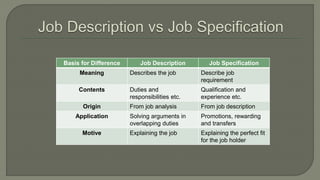
Basis for Difference Job Description Job Specification
Meaning Describes the job Describe job
requirement
Contents Duties and
responsibilities etc.
Qualification and
experience etc.
Origin From job analysis From job description
Application Solving arguments in
overlapping duties
Promotions, rewarding
and transfers
Motive Explaining the job Explaining the perfect fit
for the job holder
Specifications based on judgment
 Most job specification come from the educated guesses of people like
supervisors or HR managers
 The basic procedure is to ask “What does it take in terms of education,
intelligence and training to do this job well?”
Specifications based on statistical analysis
 The more defensible approach, but it is also more difficult.
 Its aim to determine statistically the relationship between:
(a) Some predictor or human trait – height, intelligence, finger dexterity
(b) Some indicator or criterion of job effectiveness, such as performance as
rated by the supervisor
Specifications based on statistical analysis
 The procedure of determining job specification through
statistical analysis.
Analyze the job and decide how to measure job performance
Select personal traits like finger dexterity that the organization believes should
predict successful performance
Test candidates for these traits
Measure these candidates’ subsequent job performance
Statistically analyze relationship between the human trait (finger dexterity) and
job performance
Essential element of effective human resource planning in determining quality of
human resources required in an organisation and facilitates division of work.
Useful in classification of jobs and interrelationship among them. Responsibility
commensurate with authority and accountability for various jobs can be specified so
as to minimise duplication or overlapping.
Provides valuable information required to identify training needs, to design training
programmes and to evaluate training effectiveness.
Provides understanding of what an employee is expected to do on the job. Such
understanding serves as the basis for meaningful forecast of job performance.
Selection methods are based upon such forecasts.
Reveals unhealthy and hazardous environmental and operational conditions in various jobs. Heat,
noise, dust, fumes, etc. are examples of such condition. On the basis of such information,
management can develop measures to ensure the health and safety of employees.
Job evaluation – Job analysis serves as the basis for determining the relative worth of different jobs.
Therefore, it helps in developing appropriate wage and salary structure, with internal pay equity
between jobs.
Career path planning – Job analysis provides a clear idea of career paths and jobs available in the
organisation with the help of job analysis, both employees and the organisation make efforts for
career planning and career development.
Labour Relation – Information obtained through job analysis is helpful to both management and
trade unions for collective bargaining. It is also helpful to resolve disputes and grievances originated
in the workplace.
Definition
A company’s plan that shows how it will match its internal
strengths and weaknesses with external opportunities and
threats to maintain a competitive advantage
Efficient Utilization
• Handling HR
efficiently has
become an important
function in the
industry.
• Large organizations
need huge HR to
execute their job
effectively.
• Staffing function has
emerged as a critical
organization
process.
Key to Managerial
Functions
• Planning, organizing,
leading, directing,
and controlling
(POLDC) are the five
managerial functions
that need HR for
their execution.
• Human resources
help in the
accomplishment of
all these managerial
activities effectively
and efficiently.
• Staffing becomes a
key to all managerial
functions.
Motivation
• The staffing function
in putting the right
men on the right job,
also comprises
various motivational
programmes.
• It is essential to
launch financial and
non-financial
motivational
schemes, including
incentive plans.
• Incentive plans
become an integral
part of staffing
function to satisfy
both intrinsic and
extrinsic motivation.
Better Industrial
Relations
• Focuses on the
relation between the
management and
unions.
• Members from the
unions and asso-
ciations form a
collective bargaining
forum.
• A strong relation
between them helps
taking decisions
collectively.
Higher Productivity
• Productivity levels
increase with the
efficient utilization of
resources in the best
possible manner.
• Minimizing wastage
of time, money,
efforts, and energies.
• Cost reduction, value
engineering, method
study and work
measurement, and
other techniques
help to enhance
productivity.
Forecasting human
resource requirements
It is important to assess both
company’s demand for
qualified employees and the
supply of those employees
either within the organization
or outside of it.
Estimate of numbers and
kinds of employees the
organization will need at
future dates
Demand for firm’s goods or
services must be forecast.
Forecast is then converted
into people requirements
Forecasting human resource
availability
Determining whether the firm will be able
to secure employees with the necessary
skills, and from what sources these
individuals may be obtained
Show whether the needed employees
may be obtained from within the
company, from outside the organization,
or from a combination of the two
sources.
•Demand forecasting
•the detailed process of determining future human
resources needs in terms of quantity — the
number of employees needed — and quality — the
calibre of talent required to meet the company's
current and future needs.
•Supply forecasting
•determines the current resources available to
meet the demands. With previous skills inventory,
HR specialists know which employees in the
organization are available to meet current
demand.
•HR specialists also want to look outside of the
organization for potential hires that can meet the
needs not fulfilled by employees already present
in the organization.
Comparing human
resource requirements
and availability
HR specialist will match
the demand and supply
where the rest of the
human resources
management planning
process comes into place.
HR specialists develop a
plan to link the
organization’s demand for
quality staff with the
supply available in the
market.
This can be achieved by
training current
employees, hiring new
employees, or combining
the two approaches.
Develop and
implement the
strategies
After assessing HR
capacity and forecasting
supply and demand, HR
specialists begin the
process of developing
and adding talent.
Talent development is a
crucial part of the
strategic human
resources management
process.
Evaluation and
implementation of
strategies
Evaluate whether the plan
has helped the company to
achieve its goals in factors
like production, profit,
employee retention, and
employee satisfaction.
If everything is running
smoothly, continue with the
plan.
HR specialist can always
change up different aspects
to better suit company’s
needs.
HRM CHAPTER 2.pptx

HRM CHAPTER 2.pptx

  • 1.
    MOHAMAD SHUKRI BINMUDA COMMERCE DEPARTMENT POLITEKNIK METrO BETONG SARAWAK
  • 2.
    Definition of jobanalysis The procedure of determining the duties and skill requirements of a job and the kind of person who should be hired for it. Using job analysis, HR specialists collect the information on human requirements, job context, performance standards, machines, skills as well as work activities.
  • 3.
    Job Analysis playsan important role in following aspects: • Recruitment and selection, • Performance analysis, • Training and development, • Compensation management, and • Job designing and redesigning.
  • 4.
    Recruitment and Selection:Job Analysis helps in determining what kind of person is required to perform a particular job. It points out the educational qualifications, level of experience and technical, physical, emotional and personal skills required to carry out a job in desired fashion. The objective is to fit a right person at a right place. Performance Analysis: Job analysis is done to check if goals and objectives of a particular job are met or not. It helps in deciding the performance standards, evaluation criteria and individual’s output. On this basis, the overall performance of an employee is measured and he or she is appraised accordingly. Training and Development: Job Analysis can be used to assess the training and development needs of employees. The difference between the expected and actual output determines the level of training that need to be imparted to employees. It also helps in deciding the training content, tools and equipments to be used to conduct training and methods of training.
  • 5.
    Compensation Management: Jobanalysis plays a vital role in deciding the pay packages and extra perks and benefits and fixed and variable incentives of employees. After all, the pay package depends on the position, job title and duties and responsibilities involved in a job. The process guides HR managers in deciding the worth of an employee for a particular job opening. Job Designing and Redesigning: The main purpose of job analysis is to streamline the human efforts and get the best possible output. It helps in designing, redesigning, enriching, evaluating and also cutting back and adding the extra responsibilities in a particular job. This is done to enhance the employee satisfaction while increasing the human output.
  • 6.
    There are four(4) methods used in collecting data from job analysis: • Interviews • Surveys • Observation • Journals and records
  • 7.
    Interviews Most widely used method– simple and quick way to collect information (includes that never appear on a written form) Popular methods for obtaining job- related information (may arrange from completely unstructured interviews It is important to be sure the interviewees understands the reason for the interview Interviews have weakness due to distortion of information caused by falsification or misunderstanding. Employees tend to exaggerate certain responsibilities while minimizing others – efficiency evaluation.
  • 8.
    Surveys Purposely to describe duties and responsibilities Typicaljob analysis survey may have open- ended questions and structured questions Surveys – a quick way to obtain information from a large number of employees Cheaper than interviewing hundreds of workers Time consuming and expensive for developing the survey and testing it.
  • 9.
    Observation Direct observation isuseful when jobs consist mainly of observable activities – assembly-line worker and accounting clerk Observation is not appropriate when the job involves a lot of mental activities – lawyer, design engineer
  • 10.
    Journals and records Journals/Diaries– daily listings made by workers of every activity in which they engage along with the time each activity takes. Produce a complete picture of the job, especially when supplemented with subsequent interviews with the worker and supervisor Employees may exaggerate, but detailed and chronological nature of the diary will show the true picture.
  • 11.
    Job description  Ajob description – a written statement of what the workers do, how they do it and what the job’s working conditions are  This information is used to write a job specification that lists the knowledge, abilities and skills needed to do the job  No standard format for writing job description. However, most descriptions contain sections that cover the following: •Job identification • Job summary • Responsibilities and duties • Authority of jobholder • Standards of performance • Working conditions • Job specifications
  • 13.
    Job specification  Answerthe questions “what human traits and experience are required to do this job?”  It shows what kind of person to recruit and for what qualities that person should be tested.  Job specification divided into two (2) categories namely: • Specifications based on judgment • Specifications based on statistical analysis
  • 14.
    Basis for DifferenceJob Description Job Specification Meaning Describes the job Describe job requirement Contents Duties and responsibilities etc. Qualification and experience etc. Origin From job analysis From job description Application Solving arguments in overlapping duties Promotions, rewarding and transfers Motive Explaining the job Explaining the perfect fit for the job holder
  • 15.
    Specifications based onjudgment  Most job specification come from the educated guesses of people like supervisors or HR managers  The basic procedure is to ask “What does it take in terms of education, intelligence and training to do this job well?” Specifications based on statistical analysis  The more defensible approach, but it is also more difficult.  Its aim to determine statistically the relationship between: (a) Some predictor or human trait – height, intelligence, finger dexterity (b) Some indicator or criterion of job effectiveness, such as performance as rated by the supervisor
  • 16.
    Specifications based onstatistical analysis  The procedure of determining job specification through statistical analysis. Analyze the job and decide how to measure job performance Select personal traits like finger dexterity that the organization believes should predict successful performance Test candidates for these traits Measure these candidates’ subsequent job performance Statistically analyze relationship between the human trait (finger dexterity) and job performance
  • 17.
    Essential element ofeffective human resource planning in determining quality of human resources required in an organisation and facilitates division of work. Useful in classification of jobs and interrelationship among them. Responsibility commensurate with authority and accountability for various jobs can be specified so as to minimise duplication or overlapping. Provides valuable information required to identify training needs, to design training programmes and to evaluate training effectiveness. Provides understanding of what an employee is expected to do on the job. Such understanding serves as the basis for meaningful forecast of job performance. Selection methods are based upon such forecasts.
  • 18.
    Reveals unhealthy andhazardous environmental and operational conditions in various jobs. Heat, noise, dust, fumes, etc. are examples of such condition. On the basis of such information, management can develop measures to ensure the health and safety of employees. Job evaluation – Job analysis serves as the basis for determining the relative worth of different jobs. Therefore, it helps in developing appropriate wage and salary structure, with internal pay equity between jobs. Career path planning – Job analysis provides a clear idea of career paths and jobs available in the organisation with the help of job analysis, both employees and the organisation make efforts for career planning and career development. Labour Relation – Information obtained through job analysis is helpful to both management and trade unions for collective bargaining. It is also helpful to resolve disputes and grievances originated in the workplace.
  • 19.
    Definition A company’s planthat shows how it will match its internal strengths and weaknesses with external opportunities and threats to maintain a competitive advantage
  • 20.
    Efficient Utilization • HandlingHR efficiently has become an important function in the industry. • Large organizations need huge HR to execute their job effectively. • Staffing function has emerged as a critical organization process. Key to Managerial Functions • Planning, organizing, leading, directing, and controlling (POLDC) are the five managerial functions that need HR for their execution. • Human resources help in the accomplishment of all these managerial activities effectively and efficiently. • Staffing becomes a key to all managerial functions. Motivation • The staffing function in putting the right men on the right job, also comprises various motivational programmes. • It is essential to launch financial and non-financial motivational schemes, including incentive plans. • Incentive plans become an integral part of staffing function to satisfy both intrinsic and extrinsic motivation. Better Industrial Relations • Focuses on the relation between the management and unions. • Members from the unions and asso- ciations form a collective bargaining forum. • A strong relation between them helps taking decisions collectively. Higher Productivity • Productivity levels increase with the efficient utilization of resources in the best possible manner. • Minimizing wastage of time, money, efforts, and energies. • Cost reduction, value engineering, method study and work measurement, and other techniques help to enhance productivity.
  • 21.
    Forecasting human resource requirements Itis important to assess both company’s demand for qualified employees and the supply of those employees either within the organization or outside of it. Estimate of numbers and kinds of employees the organization will need at future dates Demand for firm’s goods or services must be forecast. Forecast is then converted into people requirements
  • 22.
    Forecasting human resource availability Determiningwhether the firm will be able to secure employees with the necessary skills, and from what sources these individuals may be obtained Show whether the needed employees may be obtained from within the company, from outside the organization, or from a combination of the two sources. •Demand forecasting •the detailed process of determining future human resources needs in terms of quantity — the number of employees needed — and quality — the calibre of talent required to meet the company's current and future needs. •Supply forecasting •determines the current resources available to meet the demands. With previous skills inventory, HR specialists know which employees in the organization are available to meet current demand. •HR specialists also want to look outside of the organization for potential hires that can meet the needs not fulfilled by employees already present in the organization.
  • 23.
    Comparing human resource requirements andavailability HR specialist will match the demand and supply where the rest of the human resources management planning process comes into place. HR specialists develop a plan to link the organization’s demand for quality staff with the supply available in the market. This can be achieved by training current employees, hiring new employees, or combining the two approaches.
  • 24.
    Develop and implement the strategies Afterassessing HR capacity and forecasting supply and demand, HR specialists begin the process of developing and adding talent. Talent development is a crucial part of the strategic human resources management process.
  • 26.
    Evaluation and implementation of strategies Evaluatewhether the plan has helped the company to achieve its goals in factors like production, profit, employee retention, and employee satisfaction. If everything is running smoothly, continue with the plan. HR specialist can always change up different aspects to better suit company’s needs.