Job Analysis
WHAT IS A JOB?
Job
- Group of related activities and duties.
- Made up of tasks.
Tasks
- Basic element of Job.
- “what gets done”
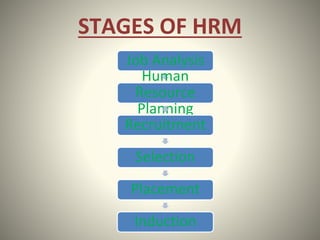
STAGES OF HRM
Job Analysis
Human
Resource
Planning
Recruitment
Selection
Placement
Induction
Job Analysis
- A job analysis is the process used to collect
information about the duties , responsibilities,
necessary skills, outcome and work environment
of a particular job.
- Process of defining a job in terms of its
component tasks or duties and the knowledge
or skills required to perform them.
Decision is made to check that whether already
existing post is valuable or not to create a post.
Definition
“Job analysis is a systematic exploration
of the activities within a job”
“It defines and documents the duties,
responsibilities and accountabilities of a
job and the conditions under which a job is
performed”
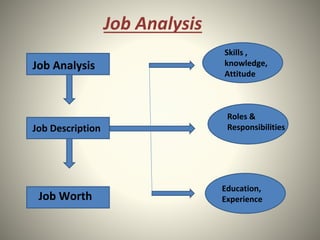
Job Analysis
Job Analysis
Job Description
Job Worth
Skills ,
knowledge,
Attitude
Roles &
Responsibilities
Education,
Experience
Job Analysis Process
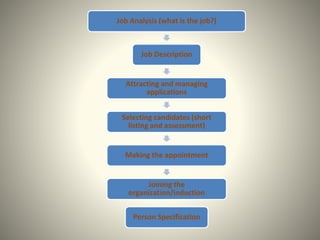
Job Analysis (what is the job?)
Job Description
Attracting and managing
applications
Selecting candidates (short
listing and assessment)
Making the appointment
Joining the
organization/induction
Person Specification
Steps in Job Analysis
Process
1. Job Description-Task Requirements
- Statement that explains duties working
conditions etc. of a job.
2. Job Specification
- Statement of what a job demands of
the incumbent.
- e.g. knowledge ,skill, abilities and other
characteristics required to perform job.
3.Performance Standards
- What is expected from workers.
- JA may provide performance standards for job
where
performance is readily quantified, measureable.
- May need to be augmented – e.g. participative goal–
setting.
ALL OF THESE USES AS FOUNDATION FOR VARIOUS
HRM SYSTEMS
Important Application of
Job analysis
The Job analysis provides the foundation for almost
every thing HR is involve in:
- Job Description
- Employees Selection
- Training
- Performance Appraisals
- Job Classification
- Job Evaluation
- Job Design and Redesign
Reasons For Conducting
Job Analysis
- Training & Development
- Staffing
- Compensation & Benefits
- Safety & Health
- Employee and Labor Relation ship
Methods of Job Analysis
- Direct Observation
- Interview of existing post holder
- Interview of immediate supervisor
- Questionnaires
- Previous Studies
- Work Dairies
Methods of Job Analysis
Observation
➢Information Source
- Observation and noting the physical activities
of
employees as they go about their jobs.
➢ Advantages
- Provide first hand information
- Reduce distortion of information
Methods of Job Analysis
Observation
Disadvantages
- Time Consuming
-Difficulty in capturing entire job cycle
- Of little use if job involves a high level of mental
activity
- Observer’s difference of mental disposition.
- Analyst’s caliber should match employee’s caliber
Methods of Job Analysis
The Interview
❖ Information Source
- Individual Employees(existing job holder)
- Immediate boss(Supervisor) with knowledge
of the job.
❖ Interview Format
- Structured
- Unstructured
The Interview
❑ Advantages
- Quick direct way to find overlooked information required.
❑ Disadvantages
- Depreciation of importance of job
❑ In case of supervisor, he may not be interested in the JD
of the subordinates.
❑ Attitude may not be supportive
❑ Difference in perception, attitude and aptitude of the
interview.
❑ Lack of communication
❑ Analyst’s caliber should match the employee’s caliber.
Methods of Job Analysis
Questionnaires
✓ Information Source
- Have employees fill out questionnaires to their job
describe related duties and responsibilities.
✓ Questionnaires format:
- Structured checklist ( to identify the task performed)
- open ended questions
Questionnaires
o Advantages
oQuick and efficient way to gather information from large
number of employees.
o Quick and economical to use
o Disadvantages
oExpensive and time consuming to prepare and test the
questionnaire.
o Become less useful where the employees lack verbal
skills
Methods of Job Analysis
Previous Studies
•Information source
Past record of any employee.
The analyst keeps the past record of any
employees and keeps the previous experiences
and issues related to the job analysis process of the
organization
Previous Studies
Advantages
- Easy to use this method
- Help to find out that whether it is beneficial or not.
Disadvantages
- Wrong assessment of previous post
- Bad performance of previous employees
Methods of Job Analysis
Work Diaries
•Information source
record of any employee which he keeps in diary or
register.
The employee keeps the past record of any work
done by him, and keeps the previous experiences
and issues related to the job analysis process of the
organization
Work Diaries
Advantages
- Easy to use this method
- Help to find out that whether it is beneficial or
not.
Disadvantages
- Wrong assessment of previous work
- chances of errors and frauds
Job Design
✓The purpose of defining how work will be
performed and what tasks will be required in a
given job.
✓ Factor affecting job designing
- Organizational factors
- Environmental Factors
- Behavioral Factors
Conclusion
Employees Satisfaction is
organization’s Success

Job analysis and design

  • 2.
  • 3.
    WHAT IS AJOB? Job - Group of related activities and duties. - Made up of tasks. Tasks - Basic element of Job. - “what gets done”
  • 4.
    STAGES OF HRM JobAnalysis Human Resource Planning Recruitment Selection Placement Induction
  • 5.
    Job Analysis - Ajob analysis is the process used to collect information about the duties , responsibilities, necessary skills, outcome and work environment of a particular job. - Process of defining a job in terms of its component tasks or duties and the knowledge or skills required to perform them. Decision is made to check that whether already existing post is valuable or not to create a post.
  • 6.
    Definition “Job analysis isa systematic exploration of the activities within a job” “It defines and documents the duties, responsibilities and accountabilities of a job and the conditions under which a job is performed”
  • 7.
    Job Analysis Job Analysis JobDescription Job Worth Skills , knowledge, Attitude Roles & Responsibilities Education, Experience
  • 8.
  • 9.
    Job Analysis (whatis the job?) Job Description Attracting and managing applications Selecting candidates (short listing and assessment) Making the appointment Joining the organization/induction Person Specification
  • 10.
    Steps in JobAnalysis Process 1. Job Description-Task Requirements - Statement that explains duties working conditions etc. of a job. 2. Job Specification - Statement of what a job demands of the incumbent. - e.g. knowledge ,skill, abilities and other characteristics required to perform job.
  • 11.
    3.Performance Standards - Whatis expected from workers. - JA may provide performance standards for job where performance is readily quantified, measureable. - May need to be augmented – e.g. participative goal– setting. ALL OF THESE USES AS FOUNDATION FOR VARIOUS HRM SYSTEMS
  • 12.
    Important Application of Jobanalysis The Job analysis provides the foundation for almost every thing HR is involve in: - Job Description - Employees Selection - Training - Performance Appraisals - Job Classification - Job Evaluation - Job Design and Redesign
  • 13.
    Reasons For Conducting JobAnalysis - Training & Development - Staffing - Compensation & Benefits - Safety & Health - Employee and Labor Relation ship
  • 14.
    Methods of JobAnalysis - Direct Observation - Interview of existing post holder - Interview of immediate supervisor - Questionnaires - Previous Studies - Work Dairies
  • 15.
    Methods of JobAnalysis Observation ➢Information Source - Observation and noting the physical activities of employees as they go about their jobs. ➢ Advantages - Provide first hand information - Reduce distortion of information
  • 16.
    Methods of JobAnalysis Observation Disadvantages - Time Consuming -Difficulty in capturing entire job cycle - Of little use if job involves a high level of mental activity - Observer’s difference of mental disposition. - Analyst’s caliber should match employee’s caliber
  • 17.
    Methods of JobAnalysis The Interview ❖ Information Source - Individual Employees(existing job holder) - Immediate boss(Supervisor) with knowledge of the job. ❖ Interview Format - Structured - Unstructured
  • 18.
    The Interview ❑ Advantages -Quick direct way to find overlooked information required. ❑ Disadvantages - Depreciation of importance of job ❑ In case of supervisor, he may not be interested in the JD of the subordinates. ❑ Attitude may not be supportive ❑ Difference in perception, attitude and aptitude of the interview. ❑ Lack of communication ❑ Analyst’s caliber should match the employee’s caliber.
  • 19.
    Methods of JobAnalysis Questionnaires ✓ Information Source - Have employees fill out questionnaires to their job describe related duties and responsibilities. ✓ Questionnaires format: - Structured checklist ( to identify the task performed) - open ended questions
  • 20.
    Questionnaires o Advantages oQuick andefficient way to gather information from large number of employees. o Quick and economical to use o Disadvantages oExpensive and time consuming to prepare and test the questionnaire. o Become less useful where the employees lack verbal skills
  • 21.
    Methods of JobAnalysis Previous Studies •Information source Past record of any employee. The analyst keeps the past record of any employees and keeps the previous experiences and issues related to the job analysis process of the organization
  • 22.
    Previous Studies Advantages - Easyto use this method - Help to find out that whether it is beneficial or not. Disadvantages - Wrong assessment of previous post - Bad performance of previous employees
  • 23.
    Methods of JobAnalysis Work Diaries •Information source record of any employee which he keeps in diary or register. The employee keeps the past record of any work done by him, and keeps the previous experiences and issues related to the job analysis process of the organization
  • 24.
    Work Diaries Advantages - Easyto use this method - Help to find out that whether it is beneficial or not. Disadvantages - Wrong assessment of previous work - chances of errors and frauds
  • 25.
    Job Design ✓The purposeof defining how work will be performed and what tasks will be required in a given job. ✓ Factor affecting job designing - Organizational factors - Environmental Factors - Behavioral Factors
  • 26.