Understanding factors controlling depolymerization
and polymerization in catalytic degradation of ß-ether
linked model lignin compounds by versatile peroxidase
Outcomes
• In phenolic lignin dimers the VP first produces a neutral
radical via oxidation of the 4-OH position, followed by
polymerization and depolymerization reactions.
• Selection between polymerization and depolymerization
reaction pathways was found to be dependent on the
functional group at the 5 position of the guaiacyl group
(G5).
• The degradation pathway of phenolic β-O-4 was identified
as Cα-aryl cleavage rather than Cα-Cβ.
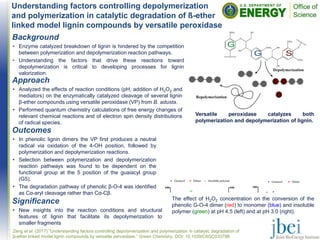
The effect of H2O2 concentration on the conversion of the
phenolic G-O-4 dimer (red) to monomer (blue) and insoluble
polymer (green) at pH 4.5 (left) and at pH 3.0 (right).
Zeng et al. (2017) ”Understanding factors controlling depolymerization and polymerization in catalytic degradation of
β-ether linked model lignin compounds by versatile peroxidase.” Green Chemistry, DOI: 10.1039/C6GC03379B
Background
• Enzyme catalyzed breakdown of lignin is hindered by the competition
between polymerization and depolymerization reaction pathways.
• Understanding the factors that drive these reactions toward
depolymerization is critical to developing processes for lignin
valorization.
Significance
• New insights into the reaction conditions and structural
features of lignin that facilitate its depolymerization to
smaller fragments
Versatile peroxidase catalyzes both
polymerization and depolymerization of lignin.
Approach
• Analyzed the effects of reaction conditions (pH, addition of H2O2 and
mediators) on the enzymatically catalyzed cleavage of several lignin
β-ether compounds using versatile peroxidase (VP) from B. adusta.
• Performed quantum chemistry calculations of free energy changes of
relevant chemical reactions and of electron spin density distributions
of radical species.
Depolymerization
Repolymerization
G
G S
OCH3
O
HO
OH
O
OCH3
OH
OH
OCH3
O
OCH3
Strategy for extending the stability of bio-oil
derived phenolic oligomer via mild hydrotreatment
with ionic liquid stabilized nanoparticles
Kim et al. (2017) “Strategy for extending the stability of bio-oil derived phenolic oligomer via mild
hydrotreatment with ionic liquid stabilized nanoparticles.” Chemsuschem, DOI: 10.1002/cssc.201601515
Background
• Development of catalytic transformations and
processes is essential to utilize bio-oil and lignin
derivatives
• Metal nanoparticles (NPs) stabilized in ionic liquid (IL)
are promising for catalytic hydrotreating of bio-oil and
phenolics
Approach
• Ruthenium NPs were synthesized with copolymers in
1-ethyl-3-methylimidazolium acetate
• Mild hydrotreating of phenolic oligomer was performed
in the presence of synthesized NP catalyst at 100 °C
for 6 hrs with the goal of producing a stable phenolics
Outcomes
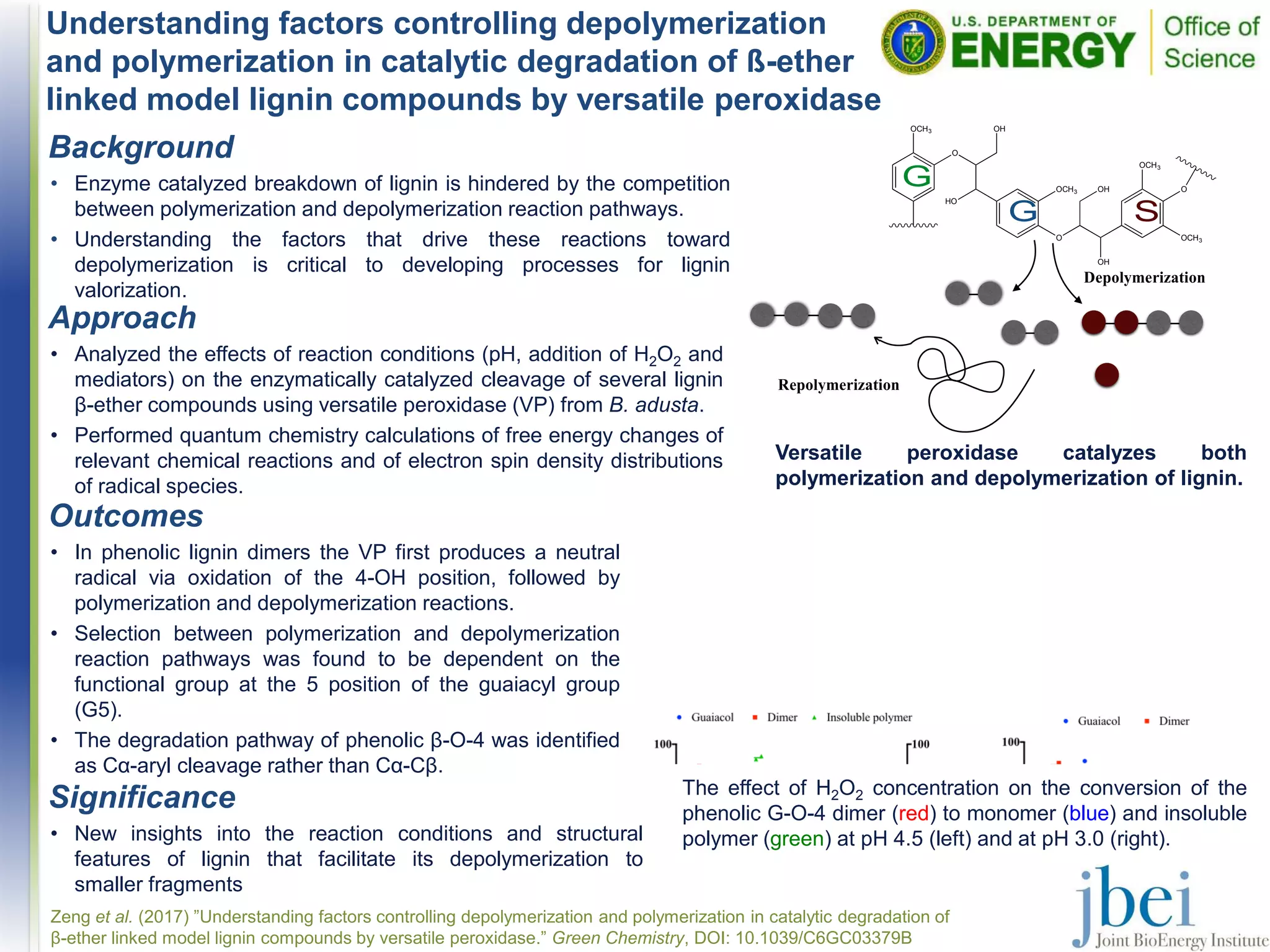
• Hydrotreating of phenolic oligomer over NPs in IL
significantly increased aliphatic carbons, resulting in
alkylphenol units with improved thermal stability
• The catalyst system employed in this work was highly
effective in stabilizing reactive phenolic oligomer
Significance
• The findings of this work provide insight into
hydrotreating mechanisms of phenolic oligomer and
whole bio-oil, which will be useful for development of
sustainable processes in the future
OH
H3CO
OH
O
OCH3
O
OH
OCH3
O
N N
N
O
x y
OH
H3CO
OH
O
OCH3
OH
OH
OCH3
O
Mild hydrotrea ng
The formation of aliphatic carbon compounds during the hydrotreating of
phenolic oligomers in the presence of ILs and NPs
Expression of Aspergillus niger CAZymes is
determined by compositional changes in wheat
straw generated by hydrothermal or ionic liquid
pretreatments
Daly et al. (2017) “Expression of Aspergillus niger CAZymes is determined by compositional changes in wheat straw
generated by hydrothermal or ionic liquid pretreatments.” Biotechnology for Biofuels, DOI: 10.1186/s13068-017-0700-9
Background
• Fungi are major degraders of lignocellulose in nature and are
the main source of the costly enzymes used to saccharify pre-
treated lignocellulose in the production of second-generation
biofuels.
• There is limited understanding of the responses of fungi to
substrates that are pretreated as well as the temporal aspects
of the response.
Approach
• We investigate the response of Aspergillus niger to untreated
and pretreated substrates in a temporally extensive manner,
and are the first to report the fungal response to ionic liquid
pretreated substrates and the response of Aspergilli to
Miscanthus.
Outcomes
• The datasets demonstrate that pretreatment, substrate and
time each have major influence on the fungal responses to
lignocellulose.
• the transcript levels in A. niger correlated with the changes in
substrate composition brought about by the pretreatments
Significance
• Understanding these complex responses of fungi to
pretreated substrates facilitates identification of better
saccharifying enzymes and reduced enzyme production
costs.
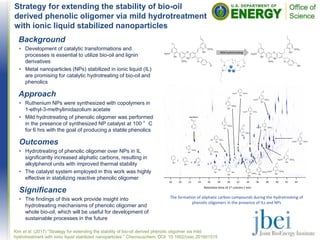
a) The number of CAZy genes that encode plant-polysaccharide active CAZymes
and is significantly induced in cultures with untreated and pretreated straw
compared to the Glu 48 h b) The proportion of transcripts from CAZy genes that
encode plant-polysaccharide active CAZymes is expressed as FPKM value. c)
Subset of the MFuzz clusters from the clustering of all genes from the KMS
time-course with number of genes belonging to the indicated categories.

JBEI Research Highlights - February 2017

  • 1.
    Understanding factors controllingdepolymerization and polymerization in catalytic degradation of ß-ether linked model lignin compounds by versatile peroxidase Outcomes • In phenolic lignin dimers the VP first produces a neutral radical via oxidation of the 4-OH position, followed by polymerization and depolymerization reactions. • Selection between polymerization and depolymerization reaction pathways was found to be dependent on the functional group at the 5 position of the guaiacyl group (G5). • The degradation pathway of phenolic β-O-4 was identified as Cα-aryl cleavage rather than Cα-Cβ. The effect of H2O2 concentration on the conversion of the phenolic G-O-4 dimer (red) to monomer (blue) and insoluble polymer (green) at pH 4.5 (left) and at pH 3.0 (right). Zeng et al. (2017) ”Understanding factors controlling depolymerization and polymerization in catalytic degradation of β-ether linked model lignin compounds by versatile peroxidase.” Green Chemistry, DOI: 10.1039/C6GC03379B Background • Enzyme catalyzed breakdown of lignin is hindered by the competition between polymerization and depolymerization reaction pathways. • Understanding the factors that drive these reactions toward depolymerization is critical to developing processes for lignin valorization. Significance • New insights into the reaction conditions and structural features of lignin that facilitate its depolymerization to smaller fragments Versatile peroxidase catalyzes both polymerization and depolymerization of lignin. Approach • Analyzed the effects of reaction conditions (pH, addition of H2O2 and mediators) on the enzymatically catalyzed cleavage of several lignin β-ether compounds using versatile peroxidase (VP) from B. adusta. • Performed quantum chemistry calculations of free energy changes of relevant chemical reactions and of electron spin density distributions of radical species. Depolymerization Repolymerization G G S OCH3 O HO OH O OCH3 OH OH OCH3 O OCH3
  • 2.
    Strategy for extendingthe stability of bio-oil derived phenolic oligomer via mild hydrotreatment with ionic liquid stabilized nanoparticles Kim et al. (2017) “Strategy for extending the stability of bio-oil derived phenolic oligomer via mild hydrotreatment with ionic liquid stabilized nanoparticles.” Chemsuschem, DOI: 10.1002/cssc.201601515 Background • Development of catalytic transformations and processes is essential to utilize bio-oil and lignin derivatives • Metal nanoparticles (NPs) stabilized in ionic liquid (IL) are promising for catalytic hydrotreating of bio-oil and phenolics Approach • Ruthenium NPs were synthesized with copolymers in 1-ethyl-3-methylimidazolium acetate • Mild hydrotreating of phenolic oligomer was performed in the presence of synthesized NP catalyst at 100 °C for 6 hrs with the goal of producing a stable phenolics Outcomes • Hydrotreating of phenolic oligomer over NPs in IL significantly increased aliphatic carbons, resulting in alkylphenol units with improved thermal stability • The catalyst system employed in this work was highly effective in stabilizing reactive phenolic oligomer Significance • The findings of this work provide insight into hydrotreating mechanisms of phenolic oligomer and whole bio-oil, which will be useful for development of sustainable processes in the future OH H3CO OH O OCH3 O OH OCH3 O N N N O x y OH H3CO OH O OCH3 OH OH OCH3 O Mild hydrotrea ng The formation of aliphatic carbon compounds during the hydrotreating of phenolic oligomers in the presence of ILs and NPs
  • 3.
    Expression of Aspergillusniger CAZymes is determined by compositional changes in wheat straw generated by hydrothermal or ionic liquid pretreatments Daly et al. (2017) “Expression of Aspergillus niger CAZymes is determined by compositional changes in wheat straw generated by hydrothermal or ionic liquid pretreatments.” Biotechnology for Biofuels, DOI: 10.1186/s13068-017-0700-9 Background • Fungi are major degraders of lignocellulose in nature and are the main source of the costly enzymes used to saccharify pre- treated lignocellulose in the production of second-generation biofuels. • There is limited understanding of the responses of fungi to substrates that are pretreated as well as the temporal aspects of the response. Approach • We investigate the response of Aspergillus niger to untreated and pretreated substrates in a temporally extensive manner, and are the first to report the fungal response to ionic liquid pretreated substrates and the response of Aspergilli to Miscanthus. Outcomes • The datasets demonstrate that pretreatment, substrate and time each have major influence on the fungal responses to lignocellulose. • the transcript levels in A. niger correlated with the changes in substrate composition brought about by the pretreatments Significance • Understanding these complex responses of fungi to pretreated substrates facilitates identification of better saccharifying enzymes and reduced enzyme production costs. a) The number of CAZy genes that encode plant-polysaccharide active CAZymes and is significantly induced in cultures with untreated and pretreated straw compared to the Glu 48 h b) The proportion of transcripts from CAZy genes that encode plant-polysaccharide active CAZymes is expressed as FPKM value. c) Subset of the MFuzz clusters from the clustering of all genes from the KMS time-course with number of genes belonging to the indicated categories.