Biochemical characterization of
Arabidopsis APYRASE family reveals their
roles in regulating endomembrane
NDP/NMP homeostasis
Background
• Plant apyrases are nucleoside triphosphate diphosphohydolases
implicated in an array of functions, including the regulation of
extracellular ATP.
• Arabidopsis encodes a family of seven membrane bound
apyrases, with only 2/7 functions known.
Approach
• Systematic study of all seven apyrases to determine their
subcellular localizations and substrate specificities.
• Combined phylogenetic and biochemical screening to elucidate
roles and functions, and compared activities to known yeast and
human apyrases and endo-apyrases, respectively.
Outcomes
• All Arabidopsis members localize internally within the cell and have
an NDPase preferences. Their roles are thus likely to be involved
in ensuring lumenal UDP / GDP from GT reactions is efficiently
converted to UMP / GMP.
Chiu et al., (2015). "Biochemical characterization of Arabidopsis APYRASE family
reveals their roles in regulating endomembrane NDP/NMP homeostasis”, Biochem J.,
doi:10.1042/bj20150235
Significance
• No real evidence in Arabidopsis of an apoplastic apyrase
(NTPase) either subcellular localization or biochemically. This is
contrary to research for the past 20 years implicating 2 members
as having an involvement in external ATP signaling.
cytosol
extracellular matrix
Golgi
NH2 COOHNH2
COOH
Ca2+ , Mg 2+
ER
Ca2+ ,Mg 2+
AtAPY6
NH2 COOH
endosome
AtAPY3
NH2
COOH
AtAPY7
NH2
COOH
NH2
COOH
NH2
COOH
AtAPY1 AtAPY2 AtAPY4
plasma membrane
NDP→NMPUDP→UMP
NTP→NDP
?
AtAPY5
NTP → NDP
NDP/NTP → NMP/NDP
Schematic diagram summarizing the subcellular
localization, putative topology and major specific
activity of the Arabidopsis apyrase family.
Development of a high throughput
platform for screening glycoside
hydrolases based on oxime-NIMS
Background
• Biomass composition varies significantly both in terms of
chemistry and bond moieties.
• Enzyme costs remain significant and there is a need for
simpler, high-performing enzyme mixtures for bioamass
deconstruction.
• desirable to have a reliable high throughput enzyme assay
methods and standardized panels of substrates and
conditions.
Approach
• Leverage oxime-NIMS capability and screen three cellulases
against 12 substrates of interest to GLBRC and JBEI.
Outcomes
• CelEcc_CBM3a is a multifunctional enzyme that has
cellulase, mannanase and hemicellulase activities.
• CelEcc_CBM3a produced 8x more of hexose products with
IL-SG than AFEX-SG.
• CelRcc-CBM3a has only cellulase activity.
Deng, K. et al. (2015). "Development of a High Throughput Platform for Screening Glycoside Hydrolases
based on Oxime-NIMS”, Frontiers in Bioengineering and Biotechnology, doi:10.3389/fbioe.2015.00153
Significance
• This platform automates the handling of both solid biomass and
soluble substrates, the introduction of enzymes as individuals or
a combinations, and the recovery of products for high sensitivity
and high resolution mass spectral analysis
Workflow of oxime-NIMS automation developed to study GHs.
1) Solid biomass was dispersed by Labman. 2) Liquid handling
was performed by Biomek Automation Workstation, including
setup of enzyme and oxime bioconjugation reactions. 3) Sample
array on the NIMS chip was generated by an acoustic printer
(ATS Acoustic Liquid Dispenser) 4) Mass spectrometry imaging
(MSI) provided the readout of experimental assay results.
Labman biomass
dispensing robot
Biomek fluid
handling robot
Acoustic printer + NIMS
Plate A
Plate B
Surface acoustic
printer
Characterization of protein N-glycosylation
by tandem mass spectrometry using
complementary fragmentation techniques
Background
• The identification, characterization and quantification of
post-translational modifications (PTMs) in proteins are a
major challenge in the field of proteomics.
• The development of different fragmentation techniques
available in the current generation of MS instruments may
provide an alternative approach to study PTMs.
Approach
• Used three common fragmentation techniques, namely
CID, HCD,and ETD, to analyze a glycopeptide.
• Develop an integrated fragmentation approach to identify
the modified residue and characterize N-glycan on a
peptide.
Outcomes
• This complementary approach identified the peptide
HLTYKENFTDAKAEADHQR with a complex N-linked
glycan.
Ford, K. L., Zeng, W., Heazlewood, J. L., & Bacic, A. (2015). "Characterization of protein N-glycosylation by
tandem mass spectrometry using complementary fragmentation techniques". Front Plant Sci, 6, 674.
doi:10.3389/fpls.2015.00674
Significance
• Helps build a vision for a future instrument that simultaneously
perform a variety of fragmentation processes during a standard
proteomics workflow.
• Would enable a global analysis of PTMs in conjunction with
protein identification and label free quantification.
Fragmentation spectra of a plant glycopeptide
using (a) CID, (B) HCD, and (C) ETD.
A method to constrain genome-scale
models with 13C labeling data
Background
• While metabolic fluxes constitute the most direct
window into a cell’s metabolism, their accurate
measurement is non trivial.
• JBEI has developed a rigorous, self-consistent
method that uses the full amount of information
contained in 13C labeling data to constrain fluxes for a
genome scale model.
Approach
• The simultaneous use of 13C labeling data and
genome-scale models combines the advantages of
both FBA and 13C MFA: two-scale 13C Metabolic Flux
Analysis (MFA).
Outcomes
• Fluxes calculated through 2S-13C MFA are robust with
respect to their experimental accuracy of the 13C
labeling data.
• Confidence intervals obtained through 2S-13C MFA
immediately identify two types of fluxes, constrained
and loosely constrained, and show that the use of
13C labeling experimental data produce much
narrower confidence intervals than those produced by
FBA.
Garcia Martin, H., Kumar, V. S., Weaver, D., Ghosh, A., Chubukov, V., Mukhopadhyay, A., Arkin, A., &
Keasling, J. D. (2015). "A Method to Constrain Genome-Scale Models with 13C Labeling Data". PLoS Comput
Biol, 11(9), e1004363, doi:10.1371/journal.pcbi.1004363
Significance
• This approach will be a tool of extreme utility in bioengineering,
at a time when a variety of different frameworks for flux
prediction for genome-scale models are becoming available
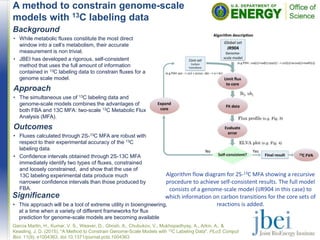
Algorithm flow diagram for 2S-13C MFA showing a recursive
procedure to achieve self-consistent results. The full model
consists of a genome-scale model (iJR904 in this case) to
which information on carbon transitions for the core sets of
reactions is added.
Calorimetric evaluation indicates that
lignin conversion to advanced biofuels is
vital to improving energy yields
Background
• Biomass conversion studies have typically focused on
mass yields rather than calculating energy yields
• Typically do not capture the overall efficiencies and areas
for improving biomass conversion.
Approach
• Energy density measurements using bomb calorimetry
were applied along with mass yields to calculate energy
yields from combinations of individual processes and
lignocellulosic feedstocks using ionic liquid pretreatment.
Outcomes
• Mass yield from switchgrass (68.0% theoretical) after IL
pretreatment was lower than energy yield (61.6%
theoretical).
• In contrast, energy yield (68.0% theoretical) after IL
pretreatment of eucalyptus, was lower than MY (74.3%
theoretical)
• Due to differences in initial lignin present in the feedstock.
Gardner, J. L., He, W., Li, C. L., Wong, J., Sale, K. L., Simmons, B. A., Singh, S., & Tanjore, D.
(2015). "Calorimetric evaluation indicates that lignin conversion to advanced biofuels is vital to
improving energy yields". RSC Advances, 5(63), 51092-51101, doi:10.1039/c5ra01503k
Significance
• Strong correlation between lignin concentrations in pretreated
solids and energy densities.
• New analytical method to establish energy yield as a function of
mass yield of fermentable sugars from biomass conversion
Mass balance and energy yields from mixed feedstocks
after [C2C1Im][OAc] pretreatment and subsequent
enzymatic hydrolysis; *calculated values. Note: all energy
values are reported after adjusting energy density for ash
and moisture content in the sample.
Local and global structural drivers for the
photoactivation of the orange carotenoid
protein
Background
• Photosynthetic organisms have evolved a protective
mechanism known as nonphotochemical quenching (NPQ)
to dissipate excess energy,
• Cyanobacteria, in contrast, use a relatively simple NPQ
mechanism governed by the water soluble orange
carotenoid protein (OCP), and this protein is not well
understood.
Approach
• Used multiple analytical techniques to generate new
insights into the mechanism of the OCP.
Outcomes
• Light activation causes a global conformation change that
results in the complete separation of the two domains of the
OCP.
• Identified local structural changes in residue solvent
accessibility and roles for structural water molecules in
activation of the OCP.
Gupta, S., Guttman, M., Leverenz, R. L., Zhumadilova, K., Pawlowski, E. G., Petzold, C. J.,
Lee, K. K., Ralston, C. Y., & Kerfeld, C. A. (2015). "Local and global structural drivers for the
photoactivation of the orange carotenoid protein”, Proc Natl Acad Sci,,
doi:10.1073/pnas.1512240112
Significance
• By combining small-angle scattering, hydrogen-deuterium
exchange, and X-ray hydroxyl radical footprinting studies, we
were able to construct a model of the structural changes during
the activation of the OCP with an unprecedented level of detail.
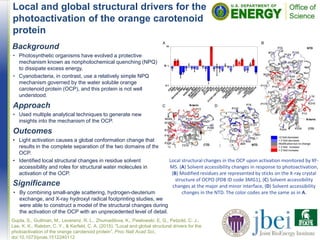
Local structural changes in the OCP upon activation monitored by XF-
MS. (A) Solvent accessibility changes in response to photoactivation,
(B) Modified residues are represented by sticks on the X-ray crystal
structure of OCPO (PDB ID code 3MG1), (C) Solvent accessibility
changes at the major and minor interface, (D) Solvent accessibility
changes in the NTD. The color codes are the same as in A.
Refining the phylum Chlorobi by
resolving the phylogeny and metabolic
potential of the representative of a deeply
branching, uncultivated lineage
Background
• Chlorobi have been found in microbial communities
associated with high rates of biomass deconstruction
and ionic liquid tolerance, but role and function remains
elusive.
Approach
• Phylogenetic trees of the Chlorobi strain NICIL-2 were
built using 16S ribosomal RNA genes and a comparison
was carried out using bioinformatics resources at JBEI.
Outcomes
• Despite its abundance as part of a biomass-
deconstructing consortium, NICIL-2 has limited
metabolic potential for the deconstruction of complex
biomass.
• NICIL-2 is likely a secondary consumer of simple sugars
or amino acids produced during biomass deconstruction
by community members.
Hiras, J., Wu, Y.-W., Eichorst, S. A., Simmons, B. A., & Singer, S. W. (2015). "Refining the phylum
Chlorobi by resolving the phylogeny and metabolic potential of the representative of a deeply
branching, uncultivated lineage”, ISME J., doi:10.1038/ismej.2015.158
Significance
• The targeted recovery of genomes from uncultivated organisms
related to the NICIL-2 provides a promising route to build a more
detailed evolutionary model linking the Bacteroidetes and the
Chlorobi.
Reconstructed metabolism of NICIL-2 inferred from the
reassembled genome. Red text represents enzymes or
biosynthetic pathways that are missing from the
genome. Blue, green and purple arrows indicate ATP,
NADH and NADPH flow, respectively.
Assay for lignin breakdown based on
lignin films: insights into the Fenton
reaction with insoluble lignin
Background
• The valorization of lignin is currently one of the greatest
challenges in developing economically viable industries based
on lignocellulosic biomass.
• One challenge is a rapid and robust diagnostic assay for
insoluble lignin breakdown by enzymes, catalysts, or microbes.
Approach
• Developed a robust technique based on the amount of mass
released from the film as soluble fragments that is quantified
through the decrease in film thickness measured by
ellipsometry.
Outcomes
• The method is quantitative and highly sensitive, as film
thickness can be determined to within ±20 Å.
• While the film format precludes interrogation by NMR, chemical
bonding within the film can be studied by surface analytical
techniques such as FTIR-ATR or XPS, and the chemical nature
of the fragments released can be identified by mass
spectrometry, FTIR, and UV-vis
Kent, M. S., Avina, I. C., Rader, N., Busse, M. L., George, A., Sathitsuksanoh, N., Baidoo, E., Timlin, J., Giron,
N. H., Celina, M. C., Martin, L. E., Polsky, R., Chavez, V. H., Huber, D. L., Keasling, J. D., Singh, S., Simmons,
B. A., & Sale, K. L. (2015). "Assay for lignin breakdown based on lignin films: insights into the Fenton reaction
with insoluble lignin”, Green Chem., doi:10.1039/c5gc01083g
Significance
• With a high sensitivity and multiplexed format, this new assay
should be useful for rapid assessment of catalytic, enzymatic,
and microbial degradation of insoluble lignin
(a) Photo of a lignin film-coated silicon wafer after use in
multiplexed format. The reaction mixtures were incubated against
the lignin film for 18 h at RT. (b) Decrease in lignin film thickness as
a function of FeCl2 concentration corresponding to the image in (a).
Theoretical insights into the role of water
in the dissolution of cellulose using
IL/water mixed solvent systems
Background
• Ionic liquid (IL) pretreatment is promising, but there
remain unanswered questions into the exact
mechanisms between molecules that give rise to desired
performance during pretreatment.
Approach
• Use computational modeling (all atom MD) to
understand the fundamental interactions between water-
IL-cellulose to determine dominant forces that govern
cellulose dissolution. The IL studied is 1-ethyl-3-
methylimidazolium acetate ([C2C1Im][OAc]).
Outcomes
• Interaction of the IL [C2C1Im][OAc] and water at certain
concentrations plays as physicochemical driving forces
assisting the cellulose dissolution process.
• Preferred solvation of [OAc]- energetically favors their
accumulation around the cellulose hydroxyl groups of
the glucan chains and disrupts inter-chain H-bonds
• Increases in water concentration leads to spontaneous
solvation of both [C2C1Im][OAc] and cellulose, which in
turn disrupts the overall pretreatment process efficacy.
Parthasarathi, R., Balamurugan, K., Shi, J., Subramanian, V., Simmons, B. A., & Singh, S.
(2015). "Theoretical Insights into the Role of Water in the Dissolution of Cellulose using
IL/Water Mixed Solvent Systems". J Phys Chem B., doi:10.1021/acs.jpcb.5b02680.
Significance
• Knowledge gained from this study provides a better
understanding of the dual role played by the water (as a co-
solvent/antisolvent) in dissolving cellulose.
The final structural snapshots of the simulated system for 100 ns at 433K.
Analytics for metabolic engineering
Background
• There have been significant advances in the fields of
systems biology and metabolic engineering over the past
decade.
• Multiple applications in energy, environment, and health
if true potential is realized
• Current approaches, although sometimes very
successful, are energy, resource, and bandwidth
intensive, with very little translation of knowledge
between institutions and projects.
Outcomes
• This review article highlights the need for an advanced
Design-Build-Test-Learn (DBTL) cycle, with the following
analytical attributes:
 Advanced gene and pathway design
 Pathway selection and analysis
 Multiple robust hosts
 Metabolomics
 Proteomics
 High-throughput screening
 Automation
 Machine learning
Petzold, C. J., Chan, L. J., Nhan, M., & Adams, P. D. (2015). "Analytics for Metabolic
Engineering”, Front Bioeng Biotechnol, doi:10.3389/fbioe.2015.00135
Significance
• Informs the broader scientific community on the gaps,
challenges, and opportunities for advances in metabolic
engineering and advanced biomanufacturing.
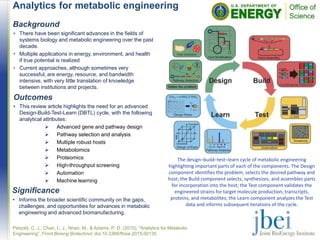
The design–build–test–learn cycle of metabolic engineering
highlighting important parts of each of the components. The Design
component identifies the problem, selects the desired pathway and
host; the Build component selects, synthesizes, and assembles parts
for incorporation into the host; the Test component validates the
engineered strains for target molecule production, transcripts,
proteins, and metabolites; the Learn component analyzes the Test
data and informs subsequent iterations of the cycle.
Structural features affecting the
enzymatic digestibility of pine wood
pretreated with ionic liquids
Background
• Pinus radiata (pine) is a promising feedstock worldwode
for the production of advanced biofuels and renewable
chemicals, but is notoriously difficult to process due to
terpene content and lignin.
• Certain ionic liquids (ILs) are promising but relatively
unproven for processing pine, and the important factors
in determining sugar yields are not well known.
Approach
• Evaluate two different ionic liquids over a range of
temperatures to determine impact on structure,
chemistry, and enzyme accessibility.
Outcomes
• Detailed analysis of the substrates revealed that the
most important change brought about by the IL
pretreatments was an increase in accessible surface
area.
• Loss of cellulose crystallinity only occurred for the more
severe [C2C1Im][OAc] pretreatments.
• Maximum glucose yields of 84% were obtained.
Torr, K. M., Love, K. T., Simmons, B. A., & Hill, S. J. (2015). "Structural features affecting the enzymatic
digestibility of pine wood pretreated with ionic liquids”, Biotechnol Bioeng., doi:10.1002/bit.25831
Significance
• Provides new insights into the mechanism of IL
pretreatment and the most significant factors that
generate high yields of fermentable sugars.
Field emission scanning electron microscopy images of Pinus
radiata wood untreated (A), pretreated with [C2C1Im]Cl at 80
oC (B) and 120 oC (C), and pretreated with [C2C1Im][OAc] at
80 oC (D), 100 oC (E), and 120 oC (F). Scale bar =10 um.

JBEI Highlights September 2015

  • 1.
    Biochemical characterization of ArabidopsisAPYRASE family reveals their roles in regulating endomembrane NDP/NMP homeostasis Background • Plant apyrases are nucleoside triphosphate diphosphohydolases implicated in an array of functions, including the regulation of extracellular ATP. • Arabidopsis encodes a family of seven membrane bound apyrases, with only 2/7 functions known. Approach • Systematic study of all seven apyrases to determine their subcellular localizations and substrate specificities. • Combined phylogenetic and biochemical screening to elucidate roles and functions, and compared activities to known yeast and human apyrases and endo-apyrases, respectively. Outcomes • All Arabidopsis members localize internally within the cell and have an NDPase preferences. Their roles are thus likely to be involved in ensuring lumenal UDP / GDP from GT reactions is efficiently converted to UMP / GMP. Chiu et al., (2015). "Biochemical characterization of Arabidopsis APYRASE family reveals their roles in regulating endomembrane NDP/NMP homeostasis”, Biochem J., doi:10.1042/bj20150235 Significance • No real evidence in Arabidopsis of an apoplastic apyrase (NTPase) either subcellular localization or biochemically. This is contrary to research for the past 20 years implicating 2 members as having an involvement in external ATP signaling. cytosol extracellular matrix Golgi NH2 COOHNH2 COOH Ca2+ , Mg 2+ ER Ca2+ ,Mg 2+ AtAPY6 NH2 COOH endosome AtAPY3 NH2 COOH AtAPY7 NH2 COOH NH2 COOH NH2 COOH AtAPY1 AtAPY2 AtAPY4 plasma membrane NDP→NMPUDP→UMP NTP→NDP ? AtAPY5 NTP → NDP NDP/NTP → NMP/NDP Schematic diagram summarizing the subcellular localization, putative topology and major specific activity of the Arabidopsis apyrase family.
  • 2.
    Development of ahigh throughput platform for screening glycoside hydrolases based on oxime-NIMS Background • Biomass composition varies significantly both in terms of chemistry and bond moieties. • Enzyme costs remain significant and there is a need for simpler, high-performing enzyme mixtures for bioamass deconstruction. • desirable to have a reliable high throughput enzyme assay methods and standardized panels of substrates and conditions. Approach • Leverage oxime-NIMS capability and screen three cellulases against 12 substrates of interest to GLBRC and JBEI. Outcomes • CelEcc_CBM3a is a multifunctional enzyme that has cellulase, mannanase and hemicellulase activities. • CelEcc_CBM3a produced 8x more of hexose products with IL-SG than AFEX-SG. • CelRcc-CBM3a has only cellulase activity. Deng, K. et al. (2015). "Development of a High Throughput Platform for Screening Glycoside Hydrolases based on Oxime-NIMS”, Frontiers in Bioengineering and Biotechnology, doi:10.3389/fbioe.2015.00153 Significance • This platform automates the handling of both solid biomass and soluble substrates, the introduction of enzymes as individuals or a combinations, and the recovery of products for high sensitivity and high resolution mass spectral analysis Workflow of oxime-NIMS automation developed to study GHs. 1) Solid biomass was dispersed by Labman. 2) Liquid handling was performed by Biomek Automation Workstation, including setup of enzyme and oxime bioconjugation reactions. 3) Sample array on the NIMS chip was generated by an acoustic printer (ATS Acoustic Liquid Dispenser) 4) Mass spectrometry imaging (MSI) provided the readout of experimental assay results. Labman biomass dispensing robot Biomek fluid handling robot Acoustic printer + NIMS Plate A Plate B Surface acoustic printer
  • 3.
    Characterization of proteinN-glycosylation by tandem mass spectrometry using complementary fragmentation techniques Background • The identification, characterization and quantification of post-translational modifications (PTMs) in proteins are a major challenge in the field of proteomics. • The development of different fragmentation techniques available in the current generation of MS instruments may provide an alternative approach to study PTMs. Approach • Used three common fragmentation techniques, namely CID, HCD,and ETD, to analyze a glycopeptide. • Develop an integrated fragmentation approach to identify the modified residue and characterize N-glycan on a peptide. Outcomes • This complementary approach identified the peptide HLTYKENFTDAKAEADHQR with a complex N-linked glycan. Ford, K. L., Zeng, W., Heazlewood, J. L., & Bacic, A. (2015). "Characterization of protein N-glycosylation by tandem mass spectrometry using complementary fragmentation techniques". Front Plant Sci, 6, 674. doi:10.3389/fpls.2015.00674 Significance • Helps build a vision for a future instrument that simultaneously perform a variety of fragmentation processes during a standard proteomics workflow. • Would enable a global analysis of PTMs in conjunction with protein identification and label free quantification. Fragmentation spectra of a plant glycopeptide using (a) CID, (B) HCD, and (C) ETD.
  • 4.
    A method toconstrain genome-scale models with 13C labeling data Background • While metabolic fluxes constitute the most direct window into a cell’s metabolism, their accurate measurement is non trivial. • JBEI has developed a rigorous, self-consistent method that uses the full amount of information contained in 13C labeling data to constrain fluxes for a genome scale model. Approach • The simultaneous use of 13C labeling data and genome-scale models combines the advantages of both FBA and 13C MFA: two-scale 13C Metabolic Flux Analysis (MFA). Outcomes • Fluxes calculated through 2S-13C MFA are robust with respect to their experimental accuracy of the 13C labeling data. • Confidence intervals obtained through 2S-13C MFA immediately identify two types of fluxes, constrained and loosely constrained, and show that the use of 13C labeling experimental data produce much narrower confidence intervals than those produced by FBA. Garcia Martin, H., Kumar, V. S., Weaver, D., Ghosh, A., Chubukov, V., Mukhopadhyay, A., Arkin, A., & Keasling, J. D. (2015). "A Method to Constrain Genome-Scale Models with 13C Labeling Data". PLoS Comput Biol, 11(9), e1004363, doi:10.1371/journal.pcbi.1004363 Significance • This approach will be a tool of extreme utility in bioengineering, at a time when a variety of different frameworks for flux prediction for genome-scale models are becoming available Algorithm flow diagram for 2S-13C MFA showing a recursive procedure to achieve self-consistent results. The full model consists of a genome-scale model (iJR904 in this case) to which information on carbon transitions for the core sets of reactions is added.
  • 5.
    Calorimetric evaluation indicatesthat lignin conversion to advanced biofuels is vital to improving energy yields Background • Biomass conversion studies have typically focused on mass yields rather than calculating energy yields • Typically do not capture the overall efficiencies and areas for improving biomass conversion. Approach • Energy density measurements using bomb calorimetry were applied along with mass yields to calculate energy yields from combinations of individual processes and lignocellulosic feedstocks using ionic liquid pretreatment. Outcomes • Mass yield from switchgrass (68.0% theoretical) after IL pretreatment was lower than energy yield (61.6% theoretical). • In contrast, energy yield (68.0% theoretical) after IL pretreatment of eucalyptus, was lower than MY (74.3% theoretical) • Due to differences in initial lignin present in the feedstock. Gardner, J. L., He, W., Li, C. L., Wong, J., Sale, K. L., Simmons, B. A., Singh, S., & Tanjore, D. (2015). "Calorimetric evaluation indicates that lignin conversion to advanced biofuels is vital to improving energy yields". RSC Advances, 5(63), 51092-51101, doi:10.1039/c5ra01503k Significance • Strong correlation between lignin concentrations in pretreated solids and energy densities. • New analytical method to establish energy yield as a function of mass yield of fermentable sugars from biomass conversion Mass balance and energy yields from mixed feedstocks after [C2C1Im][OAc] pretreatment and subsequent enzymatic hydrolysis; *calculated values. Note: all energy values are reported after adjusting energy density for ash and moisture content in the sample.
  • 6.
    Local and globalstructural drivers for the photoactivation of the orange carotenoid protein Background • Photosynthetic organisms have evolved a protective mechanism known as nonphotochemical quenching (NPQ) to dissipate excess energy, • Cyanobacteria, in contrast, use a relatively simple NPQ mechanism governed by the water soluble orange carotenoid protein (OCP), and this protein is not well understood. Approach • Used multiple analytical techniques to generate new insights into the mechanism of the OCP. Outcomes • Light activation causes a global conformation change that results in the complete separation of the two domains of the OCP. • Identified local structural changes in residue solvent accessibility and roles for structural water molecules in activation of the OCP. Gupta, S., Guttman, M., Leverenz, R. L., Zhumadilova, K., Pawlowski, E. G., Petzold, C. J., Lee, K. K., Ralston, C. Y., & Kerfeld, C. A. (2015). "Local and global structural drivers for the photoactivation of the orange carotenoid protein”, Proc Natl Acad Sci,, doi:10.1073/pnas.1512240112 Significance • By combining small-angle scattering, hydrogen-deuterium exchange, and X-ray hydroxyl radical footprinting studies, we were able to construct a model of the structural changes during the activation of the OCP with an unprecedented level of detail. Local structural changes in the OCP upon activation monitored by XF- MS. (A) Solvent accessibility changes in response to photoactivation, (B) Modified residues are represented by sticks on the X-ray crystal structure of OCPO (PDB ID code 3MG1), (C) Solvent accessibility changes at the major and minor interface, (D) Solvent accessibility changes in the NTD. The color codes are the same as in A.
  • 7.
    Refining the phylumChlorobi by resolving the phylogeny and metabolic potential of the representative of a deeply branching, uncultivated lineage Background • Chlorobi have been found in microbial communities associated with high rates of biomass deconstruction and ionic liquid tolerance, but role and function remains elusive. Approach • Phylogenetic trees of the Chlorobi strain NICIL-2 were built using 16S ribosomal RNA genes and a comparison was carried out using bioinformatics resources at JBEI. Outcomes • Despite its abundance as part of a biomass- deconstructing consortium, NICIL-2 has limited metabolic potential for the deconstruction of complex biomass. • NICIL-2 is likely a secondary consumer of simple sugars or amino acids produced during biomass deconstruction by community members. Hiras, J., Wu, Y.-W., Eichorst, S. A., Simmons, B. A., & Singer, S. W. (2015). "Refining the phylum Chlorobi by resolving the phylogeny and metabolic potential of the representative of a deeply branching, uncultivated lineage”, ISME J., doi:10.1038/ismej.2015.158 Significance • The targeted recovery of genomes from uncultivated organisms related to the NICIL-2 provides a promising route to build a more detailed evolutionary model linking the Bacteroidetes and the Chlorobi. Reconstructed metabolism of NICIL-2 inferred from the reassembled genome. Red text represents enzymes or biosynthetic pathways that are missing from the genome. Blue, green and purple arrows indicate ATP, NADH and NADPH flow, respectively.
  • 8.
    Assay for ligninbreakdown based on lignin films: insights into the Fenton reaction with insoluble lignin Background • The valorization of lignin is currently one of the greatest challenges in developing economically viable industries based on lignocellulosic biomass. • One challenge is a rapid and robust diagnostic assay for insoluble lignin breakdown by enzymes, catalysts, or microbes. Approach • Developed a robust technique based on the amount of mass released from the film as soluble fragments that is quantified through the decrease in film thickness measured by ellipsometry. Outcomes • The method is quantitative and highly sensitive, as film thickness can be determined to within ±20 Å. • While the film format precludes interrogation by NMR, chemical bonding within the film can be studied by surface analytical techniques such as FTIR-ATR or XPS, and the chemical nature of the fragments released can be identified by mass spectrometry, FTIR, and UV-vis Kent, M. S., Avina, I. C., Rader, N., Busse, M. L., George, A., Sathitsuksanoh, N., Baidoo, E., Timlin, J., Giron, N. H., Celina, M. C., Martin, L. E., Polsky, R., Chavez, V. H., Huber, D. L., Keasling, J. D., Singh, S., Simmons, B. A., & Sale, K. L. (2015). "Assay for lignin breakdown based on lignin films: insights into the Fenton reaction with insoluble lignin”, Green Chem., doi:10.1039/c5gc01083g Significance • With a high sensitivity and multiplexed format, this new assay should be useful for rapid assessment of catalytic, enzymatic, and microbial degradation of insoluble lignin (a) Photo of a lignin film-coated silicon wafer after use in multiplexed format. The reaction mixtures were incubated against the lignin film for 18 h at RT. (b) Decrease in lignin film thickness as a function of FeCl2 concentration corresponding to the image in (a).
  • 9.
    Theoretical insights intothe role of water in the dissolution of cellulose using IL/water mixed solvent systems Background • Ionic liquid (IL) pretreatment is promising, but there remain unanswered questions into the exact mechanisms between molecules that give rise to desired performance during pretreatment. Approach • Use computational modeling (all atom MD) to understand the fundamental interactions between water- IL-cellulose to determine dominant forces that govern cellulose dissolution. The IL studied is 1-ethyl-3- methylimidazolium acetate ([C2C1Im][OAc]). Outcomes • Interaction of the IL [C2C1Im][OAc] and water at certain concentrations plays as physicochemical driving forces assisting the cellulose dissolution process. • Preferred solvation of [OAc]- energetically favors their accumulation around the cellulose hydroxyl groups of the glucan chains and disrupts inter-chain H-bonds • Increases in water concentration leads to spontaneous solvation of both [C2C1Im][OAc] and cellulose, which in turn disrupts the overall pretreatment process efficacy. Parthasarathi, R., Balamurugan, K., Shi, J., Subramanian, V., Simmons, B. A., & Singh, S. (2015). "Theoretical Insights into the Role of Water in the Dissolution of Cellulose using IL/Water Mixed Solvent Systems". J Phys Chem B., doi:10.1021/acs.jpcb.5b02680. Significance • Knowledge gained from this study provides a better understanding of the dual role played by the water (as a co- solvent/antisolvent) in dissolving cellulose. The final structural snapshots of the simulated system for 100 ns at 433K.
  • 10.
    Analytics for metabolicengineering Background • There have been significant advances in the fields of systems biology and metabolic engineering over the past decade. • Multiple applications in energy, environment, and health if true potential is realized • Current approaches, although sometimes very successful, are energy, resource, and bandwidth intensive, with very little translation of knowledge between institutions and projects. Outcomes • This review article highlights the need for an advanced Design-Build-Test-Learn (DBTL) cycle, with the following analytical attributes:  Advanced gene and pathway design  Pathway selection and analysis  Multiple robust hosts  Metabolomics  Proteomics  High-throughput screening  Automation  Machine learning Petzold, C. J., Chan, L. J., Nhan, M., & Adams, P. D. (2015). "Analytics for Metabolic Engineering”, Front Bioeng Biotechnol, doi:10.3389/fbioe.2015.00135 Significance • Informs the broader scientific community on the gaps, challenges, and opportunities for advances in metabolic engineering and advanced biomanufacturing. The design–build–test–learn cycle of metabolic engineering highlighting important parts of each of the components. The Design component identifies the problem, selects the desired pathway and host; the Build component selects, synthesizes, and assembles parts for incorporation into the host; the Test component validates the engineered strains for target molecule production, transcripts, proteins, and metabolites; the Learn component analyzes the Test data and informs subsequent iterations of the cycle.
  • 11.
    Structural features affectingthe enzymatic digestibility of pine wood pretreated with ionic liquids Background • Pinus radiata (pine) is a promising feedstock worldwode for the production of advanced biofuels and renewable chemicals, but is notoriously difficult to process due to terpene content and lignin. • Certain ionic liquids (ILs) are promising but relatively unproven for processing pine, and the important factors in determining sugar yields are not well known. Approach • Evaluate two different ionic liquids over a range of temperatures to determine impact on structure, chemistry, and enzyme accessibility. Outcomes • Detailed analysis of the substrates revealed that the most important change brought about by the IL pretreatments was an increase in accessible surface area. • Loss of cellulose crystallinity only occurred for the more severe [C2C1Im][OAc] pretreatments. • Maximum glucose yields of 84% were obtained. Torr, K. M., Love, K. T., Simmons, B. A., & Hill, S. J. (2015). "Structural features affecting the enzymatic digestibility of pine wood pretreated with ionic liquids”, Biotechnol Bioeng., doi:10.1002/bit.25831 Significance • Provides new insights into the mechanism of IL pretreatment and the most significant factors that generate high yields of fermentable sugars. Field emission scanning electron microscopy images of Pinus radiata wood untreated (A), pretreated with [C2C1Im]Cl at 80 oC (B) and 120 oC (C), and pretreated with [C2C1Im][OAc] at 80 oC (D), 100 oC (E), and 120 oC (F). Scale bar =10 um.