Background
• Protein kinases are involved in diverse cellular and biological
processes, including cell wall biosynthesis and modification.
• A major obstacle that hinders progress towards kinase
characterization is functional redundancy.
Approach
• The rice kinase database (RKD), which integrated
omics-scale data within a phylogenetics context, is
used to predict the function of protein kinases.
• Transcriptomic data of kinase-encoding genes in diverse rice
tissues and in response to biotic and abiotic stresses and
hormone treatments were integrated into RKD2.0.
Outcomes
• An improved rice kinase database that integrates the most
recent publicly available omics-scale datasets.
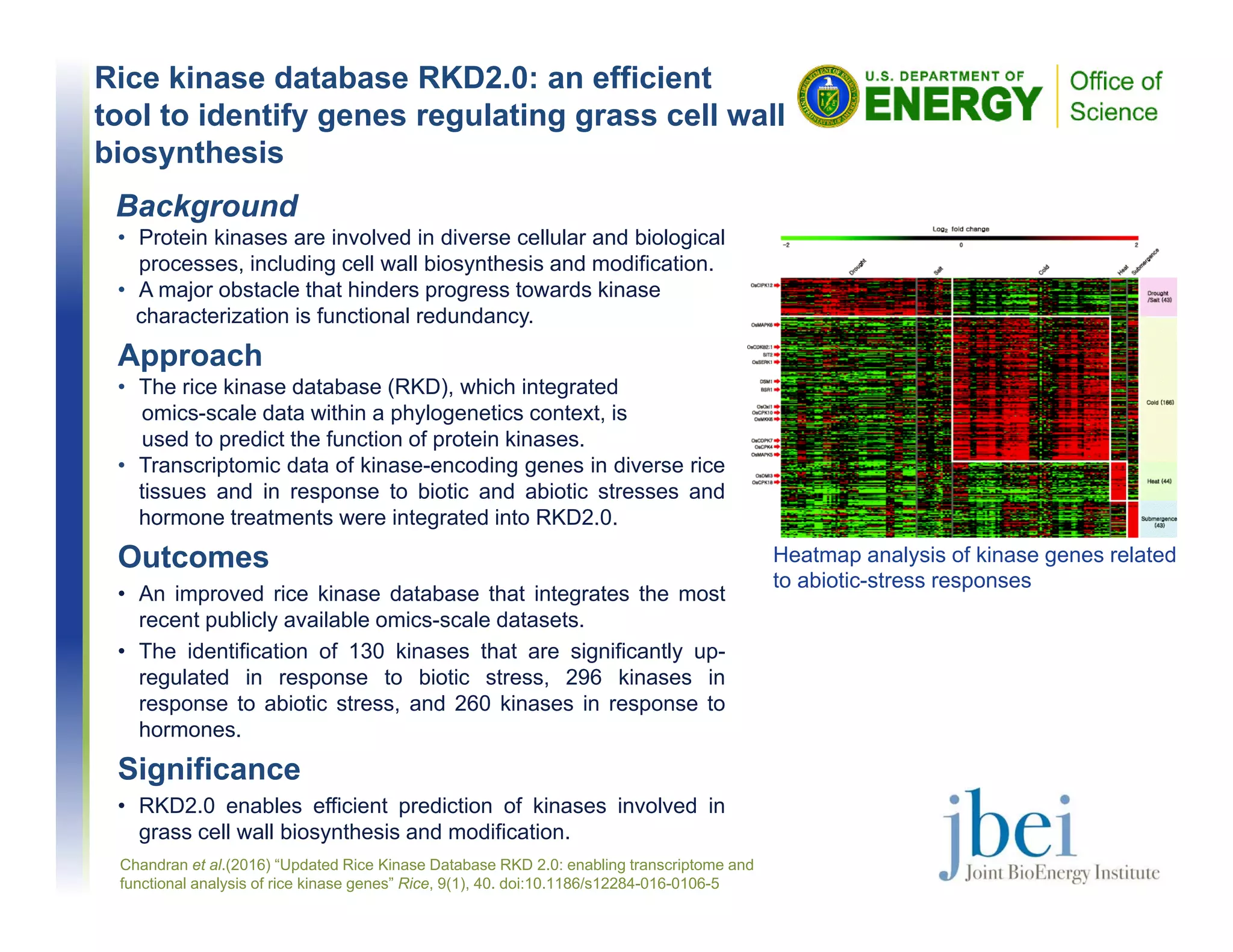
• The identification of 130 kinases that are significantly up-
regulated in response to biotic stress, 296 kinases in
response to abiotic stress, and 260 kinases in response to
hormones.
Significance
• RKD2.0 enables efficient prediction of kinases involved in
grass cell wall biosynthesis and modification.
Rice kinase database RKD2.0: an efficient
tool to identify genes regulating grass cell wall
biosynthesis
Chandran et al.(2016) “Updated Rice Kinase Database RKD 2.0: enabling transcriptome and
functional analysis of rice kinase genes” Rice, 9(1), 40. doi:10.1186/s12284-016-0106-5
Heatmap analysis of kinase genes related
to abiotic-stress responses
A new role for glycoside hydrolase Family 12
proteins discovered using microbial consortia
Outcomes
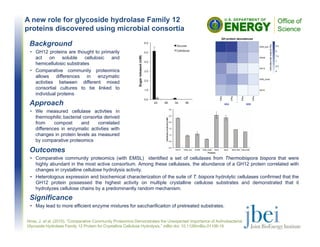
• Comparative community proteomics (with EMSL) identified a set of cellulases from Thermobispora bispora that were
highly abundant in the most active consortium. Among these cellulases, the abundance of a GH12 protein correlated with
changes in crystalline cellulose hydrolysis activity.
• Heterologous expression and biochemical characterization of the suite of T. bispora hydrolytic cellulases confirmed that the
GH12 protein possessed the highest activity on multiple crystalline cellulose substrates and demonstrated that it
hydrolyzes cellulose chains by a predominantly random mechanism.
Significance
• May lead to more efficient enzyme mixtures for saccharificaiton of pretreated substrates.
Hiras, J. et al. (2015). “Comparative Community Proteomics Demonstrates the Unexpected Importance of Actinobacterial
Glycoside Hydrolase Family 12 Protein for Crystalline Cellulose Hydrolysis.” mBio doi: 10.1128/mBio.01106-16
Background
• GH12 proteins are thought to primarily
act on soluble cellulosic and
hemicellulosic substrates
• Comparative community proteomics
allows differences in enzymatic
activties between different mixed
consortial cultures to be linked to
individual proteins
Approach
• We measured cellulase activties in
thermophilic bacterial consortia derived
from compost and correlated
differences in enzymatic activties with
changes in protein levels as measured
by comparative proteomics
0.0
1.0
2.0
3.0
4.0
5.0
6.0
2A 2B 3A 3B
Sugarreleased(mM)
Glucose
Cellobiose
GH protein abundances
GH6_exo
GH48
GH12
GH6_endo
AA10
6
6.5
7
7.5
8
8.5
log(proteinabundances)
Pas2
Pas3
Pas2
Pas3
60A 60B
0.0
0.5
1.0
1.5
2.0
2.5
3.0
GH12 GH6_exo GH48 GH6_endo Mix3 Mix4 Mix3 Add Mix4 Add
Cellobioseproduced(mM)
Proteins
The need for integrated approaches
in metabolic engineering
Lechner et al. (2016) “The Need for Integrated Approaches in Metabolic Engineering” Cold
Spring Harbor Perspectives in Biology doi:10.1101/cshperspect.a023903
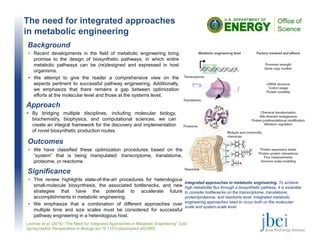
Integrated approaches in metabolic engineering. To achieve
high metabolite flux through a biosynthetic pathway, it is essential
to consider bottlenecks on the transcriptome, translatome,
protein/proteome, and reactome level. Integrated metabolic
engineering approaches need to occur both on the molecular-
scale and system-scale level.
Approach
• By bridging multiple disciplines, including molecular biology,
biochemistry, biophysics, and computational sciences, we can
create an integral framework for the discovery and implementation
of novel biosynthetic production routes.
Background
• Recent developments in the field of metabolic engineering bring
promise to the design of biosynthetic pathways, in which entire
metabolic pathways can be (re)designed and expressed in host
organisms.
• We attempt to give the reader a comprehensive view on the
aspects pertinent to successful pathway engineering. Additionally,
we emphasize that there remains a gap between optimization
efforts at the molecular level and those at the systems level.
Significance
• This review highlights state-of-the-art procedures for heterologous
small-molecule biosynthesis, the associated bottlenecks, and new
strategies that have the potential to accelerate future
accomplishments in metabolic engineering.
• We emphasize that a combination of different approaches over
multiple time and size scales must be considered for successful
pathway engineering in a heterologous host.
Outcomes
• We have classified these optimization procedures based on the
“system” that is being manipulated: transcriptome, translatome,
proteome, or reactome.
Effect of light and nitrogen on the
photosynthetic efficiency of Miscanthus
Outcomes
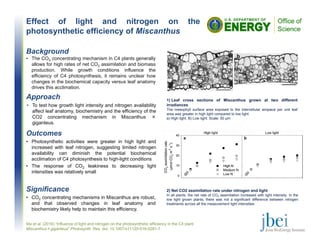
• Photosynthetic activities were greater in high light and
increased with leaf nitrogen, suggesting limited nitrogen
availability can diminish the potential biochemical
acclimation of C4 photosynthesis to high-light conditions
• The response of CO2 leakiness to decreasing light
intensities was relatively small
1) Leaf cross sections of Miscanthus grown at two different
irradiances
The mesophyll surface area exposed to the intercellular airspace per unit leaf
area was greater in high light compared to low light.
a) High light. B) Low light. Scale: 50 µm
Ma et al. (2016) “Influence of light and nitrogen on the photosynthetic efficiency in the C4 plant
Miscanthus×giganteus” Photosynth. Res. doi: 10.1007/s11120-016-0281-7
Background
• The CO2 concentrating mechanism in C4 plants generally
allows for high rates of net CO2 assimilation and biomass
production. While growth conditions influence the
efficiency of C4 photosynthesis, it remains unclear how
changes in the biochemical capacity versus leaf anatomy
drives this acclimation.
Significance
• CO2 concentrating mechanisms in Miscanthus are robust,
and that observed changes in leaf anatomy and
biochemistry likely help to maintain this efficiency.
2) Net CO2 assimilation rate under nitrogen and light
In all plants, the net rate of CO2 assimilation increased with light intensity. In the
low light grown plants, there was not a significant difference between nitrogen
treatments across all the measurement light intensities.
Approach
• To test how growth light intensity and nitrogen availability
affect leaf anatomy, biochemistry and the efficiency of the
CO2 concentrating mechanism in Miscanthus ×
giganteus.
Activation of lignocellulosic biomass for
higher sugar yields using aqueous ionic
liquid at low severity process conditions
Outcomes
• Pretreatment with [TBA][OH] generated high glucose
yields (~95 %) after pretreatment at very mild processing
conditions (50 oC)
• Glycome profiling (BESC) experiments and computational
results indicate that removal of the non-cellulosic
polysaccharides occurs due to the ionic mobility of
[TBA][OH] and is the key factor in determining
pretreatment efficiency
Effect of pretreatment severity on glucose and xylose yields
obtained from saccharification of pretreated switchgrass
Parthasarathi et al. (2016) “Activation of lignocellulosic biomass for higher sugar yields using aqueous
ionic liquid at low severity process conditions” Biotechnol Biofuels, 9, 160. doi:10.1186/s13068-016-
0561-7
Background
• Conventional ILs are relatively expensive in terms of
purchase price
• The most effective imidazolium-based ILs also require
energy intensive processing conditions (>140 °C, 3 h) to
release >90 % fermentable sugar yields after
saccharification
Significance
• This approach to biomass pretreatment at lower
temperatures could be transformative in the affordability
and energy efficiency of lignocellulosic biorefineries
Impact of pretreatment temperature on biorefinery
energy requirements at industrial scale (to process 2000
MT/day dry biomass)
Approach
• Explore inexpensive IL comprised tetrabutylammonium
[TBA](+) and hydroxide [OH](-) ions
• Determine impact of temperature and process severity on
sugar yields obtained after pretreatment
Role of organic matter on soil heating, organic
acid accumulation, and bacterial communities
in solarized soil
Outcomes
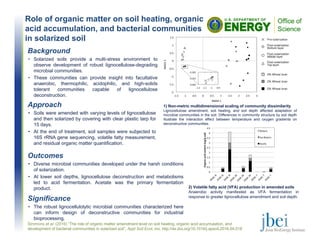
• Diverse microbial communities developed under the harsh conditions
of solarization.
• At lower soil depths, lignocellulose deconstruction and metabolisms
led to acid fermentation. Acetate was the primary fermentation
product.
1) Non-metric multidimensional scaling of community dissimilarity
Lignocellulose amendment, soil heating, and soil depth affected adaptation of
microbial communities in the soil. Differences in community structure by soil depth
illustrate the interaction effect between temperature and oxygen gradients on
deconstructive communities.
Simmons et al. (2016) “The role of organic matter amendment level on soil heating, organic acid accumulation, and
development of bacterial communities in solarized soil”, Appl Soil Ecol, doi, http://dx.doi.org/10.1016/j.apsoil.2016.04.018
Background
• Solarized soils provide a multi-stress environment to
observe development of robust lignocellulose-degrading
microbial communities.
• These communities can provide insight into facultative
anaerobic, thermophilic, acidophilic, and high-solids
tolerant communities capable of lignocellulose
deconstruction.
Significance
• The robust lignocellulolytic microbial communities characterized here
can inform design of deconstructive communities for industrial
bioprocessing.
2) Volatile fatty acid (VFA) production in amended soils
Anaerobic activity manifested as VFA fermentation in
response to greater lignocellulose amendment and soil depth.
Approach
• Soils were amended with varying levels of lignocellulose
and then solarized by covering with clear plastic tarp for
15 days.
• At the end of treatment, soil samples were subjected to
16S rRNA gene sequencing, volatile fatty measurement,
and residual organic matter quantification.
Enhanced fatty acid production in engineered
chemolithoautotrophic bacteria using reduced
sulfur compounds as energy sources
Outcomes
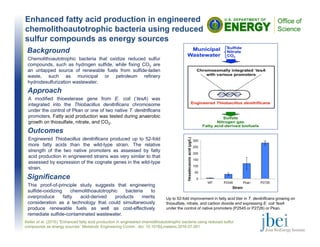
Engineered Thiobacillus denitrificans produced up to 52-fold
more fatty acids than the wild-type strain. The relative
strength of the two native promoters as assessed by fatty
acid production in engineered strains was very similar to that
assessed by expression of the cognate genes in the wild-type
strain.
Beller et al. (2016) “Enhanced fatty acid production in engineered chemolithoautotrophic bacteria using reduced sulfur
compounds as energy sources” Metabolic Engineering Comm., doi: 10.1016/j.meteno.2016.07.001
Background
Chemolithoautotrophic bacteria that oxidize reduced sulfur
compounds, such as hydrogen sulfide, while fixing CO2 are
an untapped source of renewable fuels from sulfide-laden
waste, such as municipal or petroleum refinery
hydrodesulfurization wastewater.
Significance
This proof-of-principle study suggests that engineering
sulfide-oxidizing chemolithoautotrophic bacteria to
overproduce fatty acid-derived products merits
consideration as a technology that could simultaneously
produce renewable fuels as well as cost-effectively
remediate sulfide-contaminated wastewater.
Approach
A modified thioesterase gene from E. coli (‘tesA) was
integrated into the Thiobacillus denitrificans chromosome
under the control of Pkan or one of two native T. denitrificans
promoters. Fatty acid production was tested during anaerobic
growth on thiosulfate, nitrate, and CO2.
Up to 52-fold improvement in fatty acid titer in T. denitrificans growing on
thiosulfate, nitrate, and carbon dioxide and expressing E. coli ‘tesA
under the control of native promoters (P2545 or P2726) or Pkan.

JBEI Highlights August 2016

  • 1.
    Background • Protein kinasesare involved in diverse cellular and biological processes, including cell wall biosynthesis and modification. • A major obstacle that hinders progress towards kinase characterization is functional redundancy. Approach • The rice kinase database (RKD), which integrated omics-scale data within a phylogenetics context, is used to predict the function of protein kinases. • Transcriptomic data of kinase-encoding genes in diverse rice tissues and in response to biotic and abiotic stresses and hormone treatments were integrated into RKD2.0. Outcomes • An improved rice kinase database that integrates the most recent publicly available omics-scale datasets. • The identification of 130 kinases that are significantly up- regulated in response to biotic stress, 296 kinases in response to abiotic stress, and 260 kinases in response to hormones. Significance • RKD2.0 enables efficient prediction of kinases involved in grass cell wall biosynthesis and modification. Rice kinase database RKD2.0: an efficient tool to identify genes regulating grass cell wall biosynthesis Chandran et al.(2016) “Updated Rice Kinase Database RKD 2.0: enabling transcriptome and functional analysis of rice kinase genes” Rice, 9(1), 40. doi:10.1186/s12284-016-0106-5 Heatmap analysis of kinase genes related to abiotic-stress responses
  • 2.
    A new rolefor glycoside hydrolase Family 12 proteins discovered using microbial consortia Outcomes • Comparative community proteomics (with EMSL) identified a set of cellulases from Thermobispora bispora that were highly abundant in the most active consortium. Among these cellulases, the abundance of a GH12 protein correlated with changes in crystalline cellulose hydrolysis activity. • Heterologous expression and biochemical characterization of the suite of T. bispora hydrolytic cellulases confirmed that the GH12 protein possessed the highest activity on multiple crystalline cellulose substrates and demonstrated that it hydrolyzes cellulose chains by a predominantly random mechanism. Significance • May lead to more efficient enzyme mixtures for saccharificaiton of pretreated substrates. Hiras, J. et al. (2015). “Comparative Community Proteomics Demonstrates the Unexpected Importance of Actinobacterial Glycoside Hydrolase Family 12 Protein for Crystalline Cellulose Hydrolysis.” mBio doi: 10.1128/mBio.01106-16 Background • GH12 proteins are thought to primarily act on soluble cellulosic and hemicellulosic substrates • Comparative community proteomics allows differences in enzymatic activties between different mixed consortial cultures to be linked to individual proteins Approach • We measured cellulase activties in thermophilic bacterial consortia derived from compost and correlated differences in enzymatic activties with changes in protein levels as measured by comparative proteomics 0.0 1.0 2.0 3.0 4.0 5.0 6.0 2A 2B 3A 3B Sugarreleased(mM) Glucose Cellobiose GH protein abundances GH6_exo GH48 GH12 GH6_endo AA10 6 6.5 7 7.5 8 8.5 log(proteinabundances) Pas2 Pas3 Pas2 Pas3 60A 60B 0.0 0.5 1.0 1.5 2.0 2.5 3.0 GH12 GH6_exo GH48 GH6_endo Mix3 Mix4 Mix3 Add Mix4 Add Cellobioseproduced(mM) Proteins
  • 3.
    The need forintegrated approaches in metabolic engineering Lechner et al. (2016) “The Need for Integrated Approaches in Metabolic Engineering” Cold Spring Harbor Perspectives in Biology doi:10.1101/cshperspect.a023903 Integrated approaches in metabolic engineering. To achieve high metabolite flux through a biosynthetic pathway, it is essential to consider bottlenecks on the transcriptome, translatome, protein/proteome, and reactome level. Integrated metabolic engineering approaches need to occur both on the molecular- scale and system-scale level. Approach • By bridging multiple disciplines, including molecular biology, biochemistry, biophysics, and computational sciences, we can create an integral framework for the discovery and implementation of novel biosynthetic production routes. Background • Recent developments in the field of metabolic engineering bring promise to the design of biosynthetic pathways, in which entire metabolic pathways can be (re)designed and expressed in host organisms. • We attempt to give the reader a comprehensive view on the aspects pertinent to successful pathway engineering. Additionally, we emphasize that there remains a gap between optimization efforts at the molecular level and those at the systems level. Significance • This review highlights state-of-the-art procedures for heterologous small-molecule biosynthesis, the associated bottlenecks, and new strategies that have the potential to accelerate future accomplishments in metabolic engineering. • We emphasize that a combination of different approaches over multiple time and size scales must be considered for successful pathway engineering in a heterologous host. Outcomes • We have classified these optimization procedures based on the “system” that is being manipulated: transcriptome, translatome, proteome, or reactome.
  • 4.
    Effect of lightand nitrogen on the photosynthetic efficiency of Miscanthus Outcomes • Photosynthetic activities were greater in high light and increased with leaf nitrogen, suggesting limited nitrogen availability can diminish the potential biochemical acclimation of C4 photosynthesis to high-light conditions • The response of CO2 leakiness to decreasing light intensities was relatively small 1) Leaf cross sections of Miscanthus grown at two different irradiances The mesophyll surface area exposed to the intercellular airspace per unit leaf area was greater in high light compared to low light. a) High light. B) Low light. Scale: 50 µm Ma et al. (2016) “Influence of light and nitrogen on the photosynthetic efficiency in the C4 plant Miscanthus×giganteus” Photosynth. Res. doi: 10.1007/s11120-016-0281-7 Background • The CO2 concentrating mechanism in C4 plants generally allows for high rates of net CO2 assimilation and biomass production. While growth conditions influence the efficiency of C4 photosynthesis, it remains unclear how changes in the biochemical capacity versus leaf anatomy drives this acclimation. Significance • CO2 concentrating mechanisms in Miscanthus are robust, and that observed changes in leaf anatomy and biochemistry likely help to maintain this efficiency. 2) Net CO2 assimilation rate under nitrogen and light In all plants, the net rate of CO2 assimilation increased with light intensity. In the low light grown plants, there was not a significant difference between nitrogen treatments across all the measurement light intensities. Approach • To test how growth light intensity and nitrogen availability affect leaf anatomy, biochemistry and the efficiency of the CO2 concentrating mechanism in Miscanthus × giganteus.
  • 5.
    Activation of lignocellulosicbiomass for higher sugar yields using aqueous ionic liquid at low severity process conditions Outcomes • Pretreatment with [TBA][OH] generated high glucose yields (~95 %) after pretreatment at very mild processing conditions (50 oC) • Glycome profiling (BESC) experiments and computational results indicate that removal of the non-cellulosic polysaccharides occurs due to the ionic mobility of [TBA][OH] and is the key factor in determining pretreatment efficiency Effect of pretreatment severity on glucose and xylose yields obtained from saccharification of pretreated switchgrass Parthasarathi et al. (2016) “Activation of lignocellulosic biomass for higher sugar yields using aqueous ionic liquid at low severity process conditions” Biotechnol Biofuels, 9, 160. doi:10.1186/s13068-016- 0561-7 Background • Conventional ILs are relatively expensive in terms of purchase price • The most effective imidazolium-based ILs also require energy intensive processing conditions (>140 °C, 3 h) to release >90 % fermentable sugar yields after saccharification Significance • This approach to biomass pretreatment at lower temperatures could be transformative in the affordability and energy efficiency of lignocellulosic biorefineries Impact of pretreatment temperature on biorefinery energy requirements at industrial scale (to process 2000 MT/day dry biomass) Approach • Explore inexpensive IL comprised tetrabutylammonium [TBA](+) and hydroxide [OH](-) ions • Determine impact of temperature and process severity on sugar yields obtained after pretreatment
  • 6.
    Role of organicmatter on soil heating, organic acid accumulation, and bacterial communities in solarized soil Outcomes • Diverse microbial communities developed under the harsh conditions of solarization. • At lower soil depths, lignocellulose deconstruction and metabolisms led to acid fermentation. Acetate was the primary fermentation product. 1) Non-metric multidimensional scaling of community dissimilarity Lignocellulose amendment, soil heating, and soil depth affected adaptation of microbial communities in the soil. Differences in community structure by soil depth illustrate the interaction effect between temperature and oxygen gradients on deconstructive communities. Simmons et al. (2016) “The role of organic matter amendment level on soil heating, organic acid accumulation, and development of bacterial communities in solarized soil”, Appl Soil Ecol, doi, http://dx.doi.org/10.1016/j.apsoil.2016.04.018 Background • Solarized soils provide a multi-stress environment to observe development of robust lignocellulose-degrading microbial communities. • These communities can provide insight into facultative anaerobic, thermophilic, acidophilic, and high-solids tolerant communities capable of lignocellulose deconstruction. Significance • The robust lignocellulolytic microbial communities characterized here can inform design of deconstructive communities for industrial bioprocessing. 2) Volatile fatty acid (VFA) production in amended soils Anaerobic activity manifested as VFA fermentation in response to greater lignocellulose amendment and soil depth. Approach • Soils were amended with varying levels of lignocellulose and then solarized by covering with clear plastic tarp for 15 days. • At the end of treatment, soil samples were subjected to 16S rRNA gene sequencing, volatile fatty measurement, and residual organic matter quantification.
  • 7.
    Enhanced fatty acidproduction in engineered chemolithoautotrophic bacteria using reduced sulfur compounds as energy sources Outcomes Engineered Thiobacillus denitrificans produced up to 52-fold more fatty acids than the wild-type strain. The relative strength of the two native promoters as assessed by fatty acid production in engineered strains was very similar to that assessed by expression of the cognate genes in the wild-type strain. Beller et al. (2016) “Enhanced fatty acid production in engineered chemolithoautotrophic bacteria using reduced sulfur compounds as energy sources” Metabolic Engineering Comm., doi: 10.1016/j.meteno.2016.07.001 Background Chemolithoautotrophic bacteria that oxidize reduced sulfur compounds, such as hydrogen sulfide, while fixing CO2 are an untapped source of renewable fuels from sulfide-laden waste, such as municipal or petroleum refinery hydrodesulfurization wastewater. Significance This proof-of-principle study suggests that engineering sulfide-oxidizing chemolithoautotrophic bacteria to overproduce fatty acid-derived products merits consideration as a technology that could simultaneously produce renewable fuels as well as cost-effectively remediate sulfide-contaminated wastewater. Approach A modified thioesterase gene from E. coli (‘tesA) was integrated into the Thiobacillus denitrificans chromosome under the control of Pkan or one of two native T. denitrificans promoters. Fatty acid production was tested during anaerobic growth on thiosulfate, nitrate, and CO2. Up to 52-fold improvement in fatty acid titer in T. denitrificans growing on thiosulfate, nitrate, and carbon dioxide and expressing E. coli ‘tesA under the control of native promoters (P2545 or P2726) or Pkan.