Identification and characterization of a highly
sensitive lactam biosensor from Pseudomonas putida
Background
• Caprolactam is an important chemical precursor to the
polymer nylon-6, with a global demand of approximately 5
million tons per year
• Current biological pathways for the production of
caprolactam are inefficient with titers not exceeding 2
mg/L, necessitating novel pathways for its production
• Genetically encoded biosensors can accelerate metabolic
engineering efforts in many ways
Approach
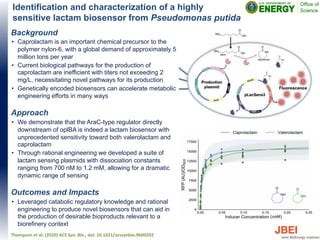
• We demonstrate that the AraC-type regulator directly
downstream of oplBA is indeed a lactam biosensor with
unprecedented sensitivity toward both valerolactam and
caprolactam
• Through rational engineering we developed a suite of
lactam sensing plasmids with dissociation constants
ranging from 700 nM to 1.2 mM, allowing for a dramatic
dynamic range of sensing
Outcomes and Impacts
• Leveraged catabolic regulatory knowledge and rational
engineering to produce novel biosensors that can aid in
the production of desirable bioproducts relevant to a
biorefinery context
Thompson et al. (2020) ACS Syn. Bio., doi: 10.1021/acssynbio.9b00292
Theoretical study on the microscopic mechanism of
lignin solubilization in Keggin-type polyoxometalate
ionic liquids
Background
• Polyoxometalate (POMs) are transition metal oxide anionic
clusters composed of d0
metal cations in different combinations,
with or without a guest atom located in the center of the metal–
oxygen cage
• Keggin-type polyoxometalate derived ionic liquids (POM-ILs)
have recently been presented as effective solvent systems for
biomass delignification
Approach
• Quantum chemical calculations and molecular dynamics
simulations of the lignin model compound, which contains a β-O-
4 bond and POM-IL ([C4C1Im]3[PW12O40]) were performed to
understand the microscopic dissolution mechanism of lignin in
the POM-IL systems
Outcomes and Impacts
• The studies show that more stable POM-IL structures are formed
when [C4C1Im]+
is anchored in the connecting four terminal
oxygen region of the [PW12O40]-3 surface.
• Calculations of POM-IL interacting with GGE show the POM
anion interacts strongly with GGE through many H-bonds and π-
π interactions
• These simulations provide fundamental models of the dissolution
mechanism of lignin by POM-IL, a key aspect in developing
efficient biomass deconstruction technologies
Ju et al. (2020) Physical Chemistry Chemical Physics, doi: 10.1039/C9CP05339E
Enhanced softwood cellulose accessibility by
H3PO4 pretreatment: high sugar yield without
compromising lignin integrity
Background
• Softwoods are one of the more challenging feedstocks to deconstruct,
and typically require high temperatures and/or high enzyme loadings
are required to unlock sugars
• The G-type lignin monomer has a C4 atom available to form a bond
with other G-type lignin monomer units, creating highly cross-linked
lignin that is more difficult to valorize
• This study examined the use of H3PO4 as a pretreatment solvent for
softwoods at mild conditions to evaluate its potential as an
economically viable and efficient solvent
Approach
• We evaluated Douglas fir and pinewood under very mild reaction
conditions (50 °C) and low enzyme loadings (5 FPU g/glucan)
• H3PO4-pretreated streams were examined by by crosspolarization/
magic angle spin (CP/MAS), 13C- NMR, HSQC –NMR and Fourier-
transform infrared spectroscopy (FTIR)
Outcomes and Impacts
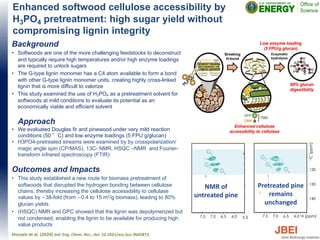
• This study established a new route for biomass pretreatment of
softwoods that disrupted the hydrogen bonding between cellulose
chains, thereby increasing the cellulose accessibility to cellulase
values by ∼38-fold (from ∼0.4 to 15 m2/g biomass), leading to 80%
glucan yields
• (HSQC) NMR and GPC showed that the lignin was depolymerized but
not condensed, enabling the lignin to be available for producing high
value products
Hossain et al. (2020) Ind. Eng. Chem. Res., doi: 10.1021/acs.iecr.9b05873
NMR of
untreated pine
Pretreated pine
remains
unchanged
Systems and synthetic biology tools for
advanced bioproduction hosts
Background
• Advances in synthetic biology tools in recent years contributed to
significant progress in metabolic engineering efforts to produce
both biofuels and bioproducts
• The current ‘trial-and- error’ approach is rarely generalizable
across products or microbial platforms
Approach
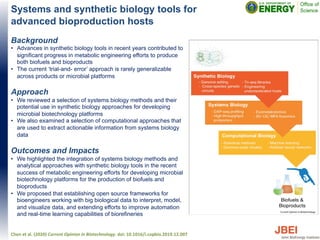
• We reviewed a selection of systems biology methods and their
potential use in synthetic biology approaches for developing
microbial biotechnology platforms
• We also examined a selection of computational approaches that
are used to extract actionable information from systems biology
data
Outcomes and Impacts
• We highlighted the integration of systems biology methods and
analytical approaches with synthetic biology tools in the recent
success of metabolic engineering efforts for developing microbial
biotechnology platforms for the production of biofuels and
bioproducts
• We proposed that establishing open source frameworks for
bioengineers working with big biological data to interpret, model,
and visualize data, and extending efforts to improve automation
and real-time learning capabilities of biorefineries
Chen et al. (2020) Current Opinion in Biotechnology. doi: 10.1016/i.copbio.2019.12.007
Enhancing terminal deoxynucleotidyl transferase
activity for enzymatic de novo DNA synthesis
Background
• Oligonucleotide synthesis is essential for modern biological
research and promises to enable new “digital biology”
approaches to produce biofuels and bioproducts
• A new class of oligonucleotide synthesis methods based
on terminal deoxynucleotidyl transferase (TdT) have been
described
• 3’ terminal secondary structures that arise during synthesis
could lead to poor coupling yields and, thus, deletions in
the synthesized oligonucleotide
Approach
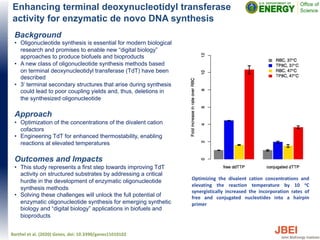
• Optimization of the concentrations of the divalent cation
cofactors
• Engineering TdT for enhanced thermostability, enabling
reactions at elevated temperatures
Outcomes and Impacts
• This study represents a first step towards improving TdT
activity on structured substrates by addressing a critical
hurdle in the development of enzymatic oligonucleotide
synthesis methods
• Solving these challenges will unlock the full potential of
enzymatic oligonucleotide synthesis for emerging synthetic
biology and “digital biology” applications in biofuels and
bioproducts
Barthel et al. (2020) Genes, doi: 10.3390/genes11010102
Optimizing the divalent cation concentrations and
elevating the reaction temperature by 10 oC
synergistically increased the incorporation rates of
free and conjugated nucleotides into a hairpin
primer
Influence of hydrocracking and ionic liquid
pretreatments on composition and properties of
Arabidopsis thaliana wild type and CAD mutant lignins
Background
• Lignin is a primary contributor to the high cost of biofuel-
production from lignocellulosic biomass
• One approach to address lignin is to engineer the lignin
biosynthetic pathway to reduce recalcitrance
• We have previously shown that CAD mutants of
Arabidopsis thaliana have decreased lignin content
Approach
• Applied hydrocracking and ionic liquid pretreatments on
Arabidopsis thaliana biomass from both wild type (WT) and
a mutant (CAD cxd) defective in two cinnamyl alcohol
dehydrogenase genes involved in the lignin biosynthetic
pathway
Outcomes and Impacts
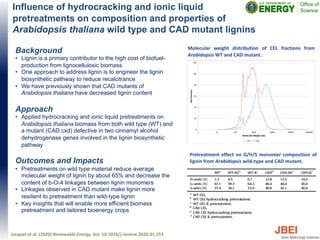
• Pretreatments on wild type material reduce average
molecular weight of lignin by about 65% and decrease the
content of b-O-4 linkages between lignin monomers
• Linkages observed in CAD mutant make lignin more
resilient to pretreatment than wild-type lignin
• Key insights that will enable more efficient biomass
pretreatment and tailored bioenergy crops
Jacquet et al. (2020) Renewable Energy, doi: 10.1016/j.renene.2020.01.153
Pretreatment effect on G/H/S monomer composition of
lignin from Arabidopsis wild-type and CAD mutant.
Molecular weight distribution of CEL fractions from
Arabidopsis WT and CAD mutant.
Phenolic cross-links: building and de-constructing
the plant cell wall
Background
• Understanding the complex polysaccharide-lignin network that
constitutes plant cell wall is crucial for developing biomass
engineering strategies
• Cross-links between the different components of plant cell walls
contribute to the recalcitrance of plant biomass to enzymatic
degradation into simple sugars and conversion into biofuels and
bioproducts
Approach
• Review of how cross-links in the plant cell wall occur during the
assembly of lignin from simple monomers (or monolignols), in the
course of lignin acylation with various aromatic groups, and during
the formation of covalent linkages between lignin and
polysaccharides (e.g., ferulate bridges onto hemicelluloses)
• An exhaustive list of genes and enzymes known to be involved in the
formation of various types of cell wall cross-links is provided for
several plants including bioenergy crops
Outcomes and Impacts
• Potential engineering strategies aiming at modifying specific cross-
links in plant cell wall biomass has been established
• These genes encode for laccases, peroxidases, and BAHD
acyltransferases, and represent targets for future engineering efforts
in bioenergy crops
• Lignin acylating enzymes represent promising targets for
manipulating lignin composition towards valorization
Mnich et al. (2020) Nat. Prod. Rep., doi: 10.1039/c9np00028c
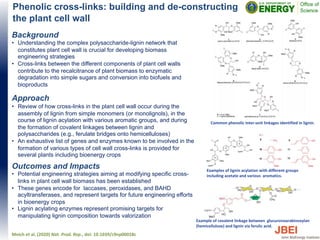
Example of covalent linkage between glucuronoarabinoxylan
(hemicellulose) and lignin via ferulic acid.
Common phenolic inter-unit linkages identified in lignin.
Examples of lignin acylation with different groups
including acetate and various aromatics.
Deep eutectic solvent pretreatment of transgenic
biomass with increased C6C1 lignin monomers
Background
• The complex and heterogeneous polyphenolic structure of lignin
confers recalcitrance to plant cell walls and challenges biomass
processing for bioenergy applications
• This study considers opportunities for leveraging engineered
plant feedstocks in combination with novel deep eutectic
solvents (DES) used for biomass pretreatment
Approach
• We have transformed Arabidopsis with a bacterial
hydroxycinnamoyl-CoA hydratase-lyase (HCHL) for
accumulation of C6C1 aromatics (i.e., 4-hydroxybenzaldehyde
and vanillin) in biomass
• A bio-derived DES (ChCl-VAN) was prepared using choline
chloride (ChCl) and vanillin (VAN)
• ChCl-VAN was used as solvent for pretreatment of engineered
biomass
Outcomes and Impacts
• C6C1 aromatics incorporate lignin in HCHL transgenics, thereby
altering its structure and molecular weight
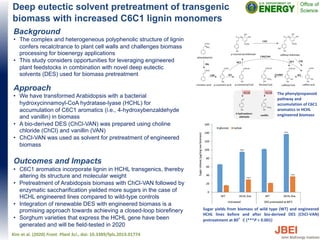
• Pretreatment of Arabidopsis biomass with ChCl-VAN followed by
enzymatic saccharification yielded more sugars in the case of
HCHL engineered lines compared to wild-type controls
• Integration of renewable DES with engineered biomass is a
promising approach towards achieving a closed-loop biorefinery
• Sorghum varieties that express the HCHL gene have been
generated and will be field-tested in 2020
Kim et al. (2020) Front. Plant Sci., doi: 10.3389/fpls.2019.01774
Sugar yields from biomass of wild type (WT) and engineered
HCHL lines before and after bio-derived DES (ChCl-VAN)
pretreatment at 80°C (***P < 0.001)
The phenylpropanoid
pathway and
accumulation of C6C1
aromatics in HCHL
engineered biomass
Fertilizer timing affects nitrous oxide, carbon
dioxide, and ammonia emissions from soil
Background
• The impact of interactions between management and climate
on nitrous oxide (N2O), carbon dioxide (CO2), and ammonia
(NH3) emissions are not well understood
• This study quantified the effect of urea fertilizer application
timing on inorganic N movement, immobilization, and the
gaseous emissions of N2O-N, CO2-C, and NH3-N from
croplands
Approach
• Nitrogen was applied once at two rates on six dates throughout
the crop growing season
• Gaseous emissions, soil temperature, and soil moisture were
measured every 4 hours for 21 consecutive days following
Nitrogen application
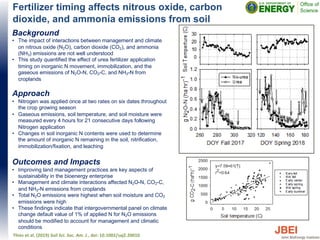
• Changes in soil inorganic N contents were used to determine
the amount of inorganic N remaining in the soil, nitrification,
immobilization/fixation, and leaching
Outcomes and Impacts
• Improving land management practices are key aspects of
sustainability in the bioenergy enterprise
• Management and climate interactions affected N2O-N, CO2-C,
and NH3-N emissions from croplands
• Total N2O emissions were highest when soil moisture and CO2
emissions were high
• These findings indicate that intergovernmental panel on climate
change default value of 1% of applied N for N2O emissions
should be modified to account for management and climatic
conditions
Thies et al. (2019) Soil Sci. Soc. Am. J., doi: 10.1002/saj2.20010
Background
• Terminal alkenes are easily derivatized, making them desirable
functional group target for polyketide synthase (PKS) engineering
• One mechanism for terminal alkene formation in PKS is through of the
activity of an acyl-CoA dehydrogenase (ACAD)
• While TcsD is homologous to canonical α,β-ACADs, it acts
regioselectively at the γ,δ-position and only on α,β-unsaturated
substrates
Approach
• We use biochemical and structural analysis to understand the
mechanism of terminal alkene formation catalyzed by an γ,δ-ACAD
from the biosynthesis of the polyketide natural product FK506,TcsD
Outcomes and Impacts
• Dehyrogenases are an important class of enzymes for the production
of biofuels and bioproducts that are fit for purpose
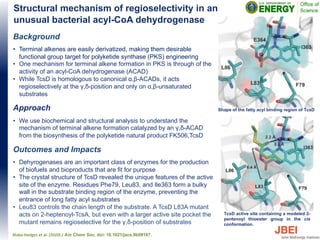
• The crystal structure of TcsD revealed the unique features of the active
site of the enzyme. Residues Phe79, Leu83, and Ile363 form a bulky
wall in the substrate binding region of the enzyme, preventing the
entrance of long fatty acyl substrates
• Leu83 controls the chain length of the substrate. A TcsD L83A mutant
acts on 2-heptenoyl-TcsA, but even with a larger active site pocket the
mutant remains regioselective for the γ,δ-position of substrates
Structural mechanism of regioselectivity in an
unusual bacterial acyl-CoA dehydrogenase
Shape of the fatty acyl binding region of TcsD
Blake-Hedges et al. (2020) J Am Chem Soc, doi: 10.1021/jacs.9b09187.
TcsD active site containing a modeled 2-
pentenoyl thioester group in the cis
conformation.

JBEI highlights January 2020

  • 1.
    Identification and characterizationof a highly sensitive lactam biosensor from Pseudomonas putida Background • Caprolactam is an important chemical precursor to the polymer nylon-6, with a global demand of approximately 5 million tons per year • Current biological pathways for the production of caprolactam are inefficient with titers not exceeding 2 mg/L, necessitating novel pathways for its production • Genetically encoded biosensors can accelerate metabolic engineering efforts in many ways Approach • We demonstrate that the AraC-type regulator directly downstream of oplBA is indeed a lactam biosensor with unprecedented sensitivity toward both valerolactam and caprolactam • Through rational engineering we developed a suite of lactam sensing plasmids with dissociation constants ranging from 700 nM to 1.2 mM, allowing for a dramatic dynamic range of sensing Outcomes and Impacts • Leveraged catabolic regulatory knowledge and rational engineering to produce novel biosensors that can aid in the production of desirable bioproducts relevant to a biorefinery context Thompson et al. (2020) ACS Syn. Bio., doi: 10.1021/acssynbio.9b00292
  • 2.
    Theoretical study onthe microscopic mechanism of lignin solubilization in Keggin-type polyoxometalate ionic liquids Background • Polyoxometalate (POMs) are transition metal oxide anionic clusters composed of d0 metal cations in different combinations, with or without a guest atom located in the center of the metal– oxygen cage • Keggin-type polyoxometalate derived ionic liquids (POM-ILs) have recently been presented as effective solvent systems for biomass delignification Approach • Quantum chemical calculations and molecular dynamics simulations of the lignin model compound, which contains a β-O- 4 bond and POM-IL ([C4C1Im]3[PW12O40]) were performed to understand the microscopic dissolution mechanism of lignin in the POM-IL systems Outcomes and Impacts • The studies show that more stable POM-IL structures are formed when [C4C1Im]+ is anchored in the connecting four terminal oxygen region of the [PW12O40]-3 surface. • Calculations of POM-IL interacting with GGE show the POM anion interacts strongly with GGE through many H-bonds and π- π interactions • These simulations provide fundamental models of the dissolution mechanism of lignin by POM-IL, a key aspect in developing efficient biomass deconstruction technologies Ju et al. (2020) Physical Chemistry Chemical Physics, doi: 10.1039/C9CP05339E
  • 3.
    Enhanced softwood celluloseaccessibility by H3PO4 pretreatment: high sugar yield without compromising lignin integrity Background • Softwoods are one of the more challenging feedstocks to deconstruct, and typically require high temperatures and/or high enzyme loadings are required to unlock sugars • The G-type lignin monomer has a C4 atom available to form a bond with other G-type lignin monomer units, creating highly cross-linked lignin that is more difficult to valorize • This study examined the use of H3PO4 as a pretreatment solvent for softwoods at mild conditions to evaluate its potential as an economically viable and efficient solvent Approach • We evaluated Douglas fir and pinewood under very mild reaction conditions (50 °C) and low enzyme loadings (5 FPU g/glucan) • H3PO4-pretreated streams were examined by by crosspolarization/ magic angle spin (CP/MAS), 13C- NMR, HSQC –NMR and Fourier- transform infrared spectroscopy (FTIR) Outcomes and Impacts • This study established a new route for biomass pretreatment of softwoods that disrupted the hydrogen bonding between cellulose chains, thereby increasing the cellulose accessibility to cellulase values by ∼38-fold (from ∼0.4 to 15 m2/g biomass), leading to 80% glucan yields • (HSQC) NMR and GPC showed that the lignin was depolymerized but not condensed, enabling the lignin to be available for producing high value products Hossain et al. (2020) Ind. Eng. Chem. Res., doi: 10.1021/acs.iecr.9b05873 NMR of untreated pine Pretreated pine remains unchanged
  • 4.
    Systems and syntheticbiology tools for advanced bioproduction hosts Background • Advances in synthetic biology tools in recent years contributed to significant progress in metabolic engineering efforts to produce both biofuels and bioproducts • The current ‘trial-and- error’ approach is rarely generalizable across products or microbial platforms Approach • We reviewed a selection of systems biology methods and their potential use in synthetic biology approaches for developing microbial biotechnology platforms • We also examined a selection of computational approaches that are used to extract actionable information from systems biology data Outcomes and Impacts • We highlighted the integration of systems biology methods and analytical approaches with synthetic biology tools in the recent success of metabolic engineering efforts for developing microbial biotechnology platforms for the production of biofuels and bioproducts • We proposed that establishing open source frameworks for bioengineers working with big biological data to interpret, model, and visualize data, and extending efforts to improve automation and real-time learning capabilities of biorefineries Chen et al. (2020) Current Opinion in Biotechnology. doi: 10.1016/i.copbio.2019.12.007
  • 5.
    Enhancing terminal deoxynucleotidyltransferase activity for enzymatic de novo DNA synthesis Background • Oligonucleotide synthesis is essential for modern biological research and promises to enable new “digital biology” approaches to produce biofuels and bioproducts • A new class of oligonucleotide synthesis methods based on terminal deoxynucleotidyl transferase (TdT) have been described • 3’ terminal secondary structures that arise during synthesis could lead to poor coupling yields and, thus, deletions in the synthesized oligonucleotide Approach • Optimization of the concentrations of the divalent cation cofactors • Engineering TdT for enhanced thermostability, enabling reactions at elevated temperatures Outcomes and Impacts • This study represents a first step towards improving TdT activity on structured substrates by addressing a critical hurdle in the development of enzymatic oligonucleotide synthesis methods • Solving these challenges will unlock the full potential of enzymatic oligonucleotide synthesis for emerging synthetic biology and “digital biology” applications in biofuels and bioproducts Barthel et al. (2020) Genes, doi: 10.3390/genes11010102 Optimizing the divalent cation concentrations and elevating the reaction temperature by 10 oC synergistically increased the incorporation rates of free and conjugated nucleotides into a hairpin primer
  • 6.
    Influence of hydrocrackingand ionic liquid pretreatments on composition and properties of Arabidopsis thaliana wild type and CAD mutant lignins Background • Lignin is a primary contributor to the high cost of biofuel- production from lignocellulosic biomass • One approach to address lignin is to engineer the lignin biosynthetic pathway to reduce recalcitrance • We have previously shown that CAD mutants of Arabidopsis thaliana have decreased lignin content Approach • Applied hydrocracking and ionic liquid pretreatments on Arabidopsis thaliana biomass from both wild type (WT) and a mutant (CAD cxd) defective in two cinnamyl alcohol dehydrogenase genes involved in the lignin biosynthetic pathway Outcomes and Impacts • Pretreatments on wild type material reduce average molecular weight of lignin by about 65% and decrease the content of b-O-4 linkages between lignin monomers • Linkages observed in CAD mutant make lignin more resilient to pretreatment than wild-type lignin • Key insights that will enable more efficient biomass pretreatment and tailored bioenergy crops Jacquet et al. (2020) Renewable Energy, doi: 10.1016/j.renene.2020.01.153 Pretreatment effect on G/H/S monomer composition of lignin from Arabidopsis wild-type and CAD mutant. Molecular weight distribution of CEL fractions from Arabidopsis WT and CAD mutant.
  • 7.
    Phenolic cross-links: buildingand de-constructing the plant cell wall Background • Understanding the complex polysaccharide-lignin network that constitutes plant cell wall is crucial for developing biomass engineering strategies • Cross-links between the different components of plant cell walls contribute to the recalcitrance of plant biomass to enzymatic degradation into simple sugars and conversion into biofuels and bioproducts Approach • Review of how cross-links in the plant cell wall occur during the assembly of lignin from simple monomers (or monolignols), in the course of lignin acylation with various aromatic groups, and during the formation of covalent linkages between lignin and polysaccharides (e.g., ferulate bridges onto hemicelluloses) • An exhaustive list of genes and enzymes known to be involved in the formation of various types of cell wall cross-links is provided for several plants including bioenergy crops Outcomes and Impacts • Potential engineering strategies aiming at modifying specific cross- links in plant cell wall biomass has been established • These genes encode for laccases, peroxidases, and BAHD acyltransferases, and represent targets for future engineering efforts in bioenergy crops • Lignin acylating enzymes represent promising targets for manipulating lignin composition towards valorization Mnich et al. (2020) Nat. Prod. Rep., doi: 10.1039/c9np00028c Example of covalent linkage between glucuronoarabinoxylan (hemicellulose) and lignin via ferulic acid. Common phenolic inter-unit linkages identified in lignin. Examples of lignin acylation with different groups including acetate and various aromatics.
  • 8.
    Deep eutectic solventpretreatment of transgenic biomass with increased C6C1 lignin monomers Background • The complex and heterogeneous polyphenolic structure of lignin confers recalcitrance to plant cell walls and challenges biomass processing for bioenergy applications • This study considers opportunities for leveraging engineered plant feedstocks in combination with novel deep eutectic solvents (DES) used for biomass pretreatment Approach • We have transformed Arabidopsis with a bacterial hydroxycinnamoyl-CoA hydratase-lyase (HCHL) for accumulation of C6C1 aromatics (i.e., 4-hydroxybenzaldehyde and vanillin) in biomass • A bio-derived DES (ChCl-VAN) was prepared using choline chloride (ChCl) and vanillin (VAN) • ChCl-VAN was used as solvent for pretreatment of engineered biomass Outcomes and Impacts • C6C1 aromatics incorporate lignin in HCHL transgenics, thereby altering its structure and molecular weight • Pretreatment of Arabidopsis biomass with ChCl-VAN followed by enzymatic saccharification yielded more sugars in the case of HCHL engineered lines compared to wild-type controls • Integration of renewable DES with engineered biomass is a promising approach towards achieving a closed-loop biorefinery • Sorghum varieties that express the HCHL gene have been generated and will be field-tested in 2020 Kim et al. (2020) Front. Plant Sci., doi: 10.3389/fpls.2019.01774 Sugar yields from biomass of wild type (WT) and engineered HCHL lines before and after bio-derived DES (ChCl-VAN) pretreatment at 80°C (***P < 0.001) The phenylpropanoid pathway and accumulation of C6C1 aromatics in HCHL engineered biomass
  • 9.
    Fertilizer timing affectsnitrous oxide, carbon dioxide, and ammonia emissions from soil Background • The impact of interactions between management and climate on nitrous oxide (N2O), carbon dioxide (CO2), and ammonia (NH3) emissions are not well understood • This study quantified the effect of urea fertilizer application timing on inorganic N movement, immobilization, and the gaseous emissions of N2O-N, CO2-C, and NH3-N from croplands Approach • Nitrogen was applied once at two rates on six dates throughout the crop growing season • Gaseous emissions, soil temperature, and soil moisture were measured every 4 hours for 21 consecutive days following Nitrogen application • Changes in soil inorganic N contents were used to determine the amount of inorganic N remaining in the soil, nitrification, immobilization/fixation, and leaching Outcomes and Impacts • Improving land management practices are key aspects of sustainability in the bioenergy enterprise • Management and climate interactions affected N2O-N, CO2-C, and NH3-N emissions from croplands • Total N2O emissions were highest when soil moisture and CO2 emissions were high • These findings indicate that intergovernmental panel on climate change default value of 1% of applied N for N2O emissions should be modified to account for management and climatic conditions Thies et al. (2019) Soil Sci. Soc. Am. J., doi: 10.1002/saj2.20010
  • 10.
    Background • Terminal alkenesare easily derivatized, making them desirable functional group target for polyketide synthase (PKS) engineering • One mechanism for terminal alkene formation in PKS is through of the activity of an acyl-CoA dehydrogenase (ACAD) • While TcsD is homologous to canonical α,β-ACADs, it acts regioselectively at the γ,δ-position and only on α,β-unsaturated substrates Approach • We use biochemical and structural analysis to understand the mechanism of terminal alkene formation catalyzed by an γ,δ-ACAD from the biosynthesis of the polyketide natural product FK506,TcsD Outcomes and Impacts • Dehyrogenases are an important class of enzymes for the production of biofuels and bioproducts that are fit for purpose • The crystal structure of TcsD revealed the unique features of the active site of the enzyme. Residues Phe79, Leu83, and Ile363 form a bulky wall in the substrate binding region of the enzyme, preventing the entrance of long fatty acyl substrates • Leu83 controls the chain length of the substrate. A TcsD L83A mutant acts on 2-heptenoyl-TcsA, but even with a larger active site pocket the mutant remains regioselective for the γ,δ-position of substrates Structural mechanism of regioselectivity in an unusual bacterial acyl-CoA dehydrogenase Shape of the fatty acyl binding region of TcsD Blake-Hedges et al. (2020) J Am Chem Soc, doi: 10.1021/jacs.9b09187. TcsD active site containing a modeled 2- pentenoyl thioester group in the cis conformation.