A 12 Å carotenoid translocation in a
photoswitch associated with cyanobacterial photoprotection
Outcomes
• Structural studies reveal that an unprecedented
12 Å translocation of pigment accompanies the
activation of the OCP for photoprotection.
• XF identifies amino acid residues that drive the dramatic reconfiguration
of protein-pigment interactions for the photoprotective response.
• Such functionally relevant plasticity in protein-chromophore interactions
has not previously been described for any pigment-protein system.
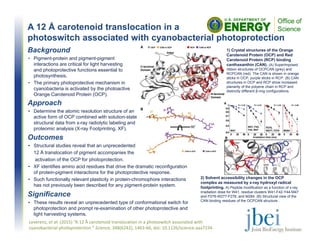
1) Crystal structures of the Orange
Carotenoid Protein (OCP) and Red
Carotenoid Protein (RCP) binding
canthaxanthin (CAN). (A) Superimposed
ribbon structures of OCPCAN (grey) and
RCPCAN (red). The CAN is shown in orange
sticks in OCP, purple sticks in RCP. (B) CAN
structures in OCP and RCP show increased
planarity of the polyene chain in RCP and
distinctly different β-ring configurations.
Leverenz, et al. (2015) “A 12 Å carotenoid translocation in a photoswitch associated with 
cyanobacterial photoprotection ” Science, 348(6242), 1463‐66, doi: 10.1126/science.aaa7234 
Background
• Pigment-protein and pigment-pigment
interactions are critical for light harvesting
and photoprotective functions essential to
photosynthesis.
• The primary photoprotective mechanism in
cyanobacteria is activated by the photoactive
Orange Carotenoid Protein (OCP).
Significance
• These results reveal an unprecedented type of conformational switch for
photoprotection and prompt re-examination of other photoprotective and
light harvesting systems.
2) Solvent accessibility changes in the OCP
complex as measured by x-ray hydroxyl radical
footprinting. A) Peptide modification as a function of x-ray
irradiation dose for W41, residue clusters W41-F42-Y44-M47
and P276-W277-F278, and M284. (B) Structural view of the
CAN binding residues of the OCPCAN structure .
Approach
• Determine the atomic resolution structure of an
active form of OCP combined with solution-state
structural data from x-ray radiolytic labeling and
proteomic analysis (X-ray Footprinting, XF).
Automating Synthetic Biology using a
Droplet Microfluidic Platform
Outcomes
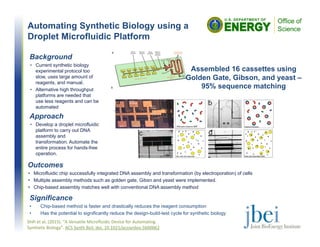
• Microfluidic chip successfully integrated DNA assembly and transformation (by electroporation) of cells
• Multiple assembly methods such as golden gate, Gibsn and yeast were implemented.
• Chip-based assembly matches well with conventional DNA assembly method
Shih et al. (2015). "A Versatile Microfluidic Device for Automating 
Synthetic Biology". ACS Synth Biol. doi, 10.1021/acssynbio.5b00062
Background
• Current synthetic biology
experimental protocol too
slow, uses large amount of
reagents, and manual.
• Alternative high throughput
platforms are needed that
use less reagents and can be
automated
Approach
• Develop a droplet microfluidic
platform to carry out DNA
assembly and
transformation. Automate the
entire process for hands-free
operation.
Significance
• Chip-based method is faster and drastically reduces the reagent consumption
• Has the potential to significantly reduce the design-build-test cycle for synthetic biology
Assembled 16 cassettes using
Golden Gate, Gibson, and yeast –
95% sequence matching
1Linshiz, et al., “PaR-PaR: Laboratory Automation System.” ACS Synth. Biol. 2:216-222 (2013).
2Linshiz, et al., “PR-PR: Cross-Platform Laboratory System.” ACS Synth. Biol. Article ASAP (2014).
Background
• Raoultella terrigena is a nitrogen fixing bacterium that can be found as endophyte in
plants.
• Endophytes are important for plants and may be beneficial for nutrient acquisition
and stress tolerance.
Approach and Outcomes
• Raoultella terrigena was isolated from sterile tobacco roots. It ability to fix nitrogen
has been confirmed
• The draft genome sequence revealed a 5.7-Mb genome with 57.84 mol% G+C
content
• R1Gly also contains all necessary genes for the tryptophan-dependent production of
the plant hormone IAA and of 2,3-butanediol and acetoin volatiles previously shown
to promote growth in Arabidopsis
Significance
• Endophytes are important for plant growth and development
• Understanding the genomics and physiology of nitrogen-fixing endophytes such
as Raoultella terrigena may help in the development of bioenergy crops that can
grow on marginal land with limited inputs.
Schicklberger et al. (2015). "Draft Genome Sequence of Raoultella terrigena R1Gly, a Diazotrophic
Endophyte". Genome Announc, 3(3). doi, 10.1128/genomeA.00607
Draft Genome Sequence of Raoultella
terrigena R1Gly, a Diazotrophic
Endophyte
1Linshiz, et al., “PaR-PaR: Laboratory Automation System.” ACS Synth. Biol. 2:216-222 (2013).
2Linshiz, et al., “PR-PR: Cross-Platform Laboratory System.” ACS Synth. Biol. Article ASAP (2014).
Background
• Arbuscular mycorrhizal fungi (AMF) colonize most plants and
contribute to uptake of nutrients and soli contaminants.
• The diversity of AMF under different environmental conditions
has not been well investigated
Approach and Outcomes
• Metagenomic analyses were used to profile the AMF
community in soil with different level of heavy metal
contamination (Pb, Zn, Cd).
• Chemical and physical parameters in the soil were
determined.
• All soils had abundant AMF and efficient root colonization.
• AMF diversity was much lower in have metal contaminated
soils, which were dominated by a single genotype of Glomus
• AMF communities were also affected by other soil
parameters, especially pH
Significance
• AMF can potentially be employed to improve
bioremediation by black locust or other tolerant plants.
• Heavy metal contaminated soils can be used for growing
non-food crops, for production of biofuels and/or wood
Yang et al. (2015). "Community structure of arbuscular mycorrhizal fungi associated with Robinia
pseudoacacia in uncontaminated and heavy metal contaminated soils". Soil Biol Biochem 86, 146‐158
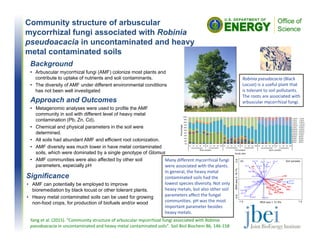
Robinia pseudacacia (Black 
Locust) is a useful plant that 
is tolerant to soil pollutants. 
The roots are associated with 
arbuscular mycorrhizal fungi.
Community structure of arbuscular
mycorrhizal fungi associated with Robinia
pseudoacacia in uncontaminated and heavy
metal contaminated soils
Many different mycorrhizal fungi 
were associated with the plants. 
In general, the heavy metal 
contaminated soils had the 
lowest species diversity. Not only 
heavy metals, but also other soil 
parameters affect the fungal 
communities. pH was the most 
important parameter besides 
heavy metals. 

JBEI Highlights June 2015

  • 1.
    A 12 Åcarotenoid translocation in a photoswitch associated with cyanobacterial photoprotection Outcomes • Structural studies reveal that an unprecedented 12 Å translocation of pigment accompanies the activation of the OCP for photoprotection. • XF identifies amino acid residues that drive the dramatic reconfiguration of protein-pigment interactions for the photoprotective response. • Such functionally relevant plasticity in protein-chromophore interactions has not previously been described for any pigment-protein system. 1) Crystal structures of the Orange Carotenoid Protein (OCP) and Red Carotenoid Protein (RCP) binding canthaxanthin (CAN). (A) Superimposed ribbon structures of OCPCAN (grey) and RCPCAN (red). The CAN is shown in orange sticks in OCP, purple sticks in RCP. (B) CAN structures in OCP and RCP show increased planarity of the polyene chain in RCP and distinctly different β-ring configurations. Leverenz, et al. (2015) “A 12 Å carotenoid translocation in a photoswitch associated with  cyanobacterial photoprotection ” Science, 348(6242), 1463‐66, doi: 10.1126/science.aaa7234  Background • Pigment-protein and pigment-pigment interactions are critical for light harvesting and photoprotective functions essential to photosynthesis. • The primary photoprotective mechanism in cyanobacteria is activated by the photoactive Orange Carotenoid Protein (OCP). Significance • These results reveal an unprecedented type of conformational switch for photoprotection and prompt re-examination of other photoprotective and light harvesting systems. 2) Solvent accessibility changes in the OCP complex as measured by x-ray hydroxyl radical footprinting. A) Peptide modification as a function of x-ray irradiation dose for W41, residue clusters W41-F42-Y44-M47 and P276-W277-F278, and M284. (B) Structural view of the CAN binding residues of the OCPCAN structure . Approach • Determine the atomic resolution structure of an active form of OCP combined with solution-state structural data from x-ray radiolytic labeling and proteomic analysis (X-ray Footprinting, XF).
  • 2.
    Automating Synthetic Biologyusing a Droplet Microfluidic Platform Outcomes • Microfluidic chip successfully integrated DNA assembly and transformation (by electroporation) of cells • Multiple assembly methods such as golden gate, Gibsn and yeast were implemented. • Chip-based assembly matches well with conventional DNA assembly method Shih et al. (2015). "A Versatile Microfluidic Device for Automating  Synthetic Biology". ACS Synth Biol. doi, 10.1021/acssynbio.5b00062 Background • Current synthetic biology experimental protocol too slow, uses large amount of reagents, and manual. • Alternative high throughput platforms are needed that use less reagents and can be automated Approach • Develop a droplet microfluidic platform to carry out DNA assembly and transformation. Automate the entire process for hands-free operation. Significance • Chip-based method is faster and drastically reduces the reagent consumption • Has the potential to significantly reduce the design-build-test cycle for synthetic biology Assembled 16 cassettes using Golden Gate, Gibson, and yeast – 95% sequence matching
  • 3.
    1Linshiz, et al.,“PaR-PaR: Laboratory Automation System.” ACS Synth. Biol. 2:216-222 (2013). 2Linshiz, et al., “PR-PR: Cross-Platform Laboratory System.” ACS Synth. Biol. Article ASAP (2014). Background • Raoultella terrigena is a nitrogen fixing bacterium that can be found as endophyte in plants. • Endophytes are important for plants and may be beneficial for nutrient acquisition and stress tolerance. Approach and Outcomes • Raoultella terrigena was isolated from sterile tobacco roots. It ability to fix nitrogen has been confirmed • The draft genome sequence revealed a 5.7-Mb genome with 57.84 mol% G+C content • R1Gly also contains all necessary genes for the tryptophan-dependent production of the plant hormone IAA and of 2,3-butanediol and acetoin volatiles previously shown to promote growth in Arabidopsis Significance • Endophytes are important for plant growth and development • Understanding the genomics and physiology of nitrogen-fixing endophytes such as Raoultella terrigena may help in the development of bioenergy crops that can grow on marginal land with limited inputs. Schicklberger et al. (2015). "Draft Genome Sequence of Raoultella terrigena R1Gly, a Diazotrophic Endophyte". Genome Announc, 3(3). doi, 10.1128/genomeA.00607 Draft Genome Sequence of Raoultella terrigena R1Gly, a Diazotrophic Endophyte
  • 4.
    1Linshiz, et al.,“PaR-PaR: Laboratory Automation System.” ACS Synth. Biol. 2:216-222 (2013). 2Linshiz, et al., “PR-PR: Cross-Platform Laboratory System.” ACS Synth. Biol. Article ASAP (2014). Background • Arbuscular mycorrhizal fungi (AMF) colonize most plants and contribute to uptake of nutrients and soli contaminants. • The diversity of AMF under different environmental conditions has not been well investigated Approach and Outcomes • Metagenomic analyses were used to profile the AMF community in soil with different level of heavy metal contamination (Pb, Zn, Cd). • Chemical and physical parameters in the soil were determined. • All soils had abundant AMF and efficient root colonization. • AMF diversity was much lower in have metal contaminated soils, which were dominated by a single genotype of Glomus • AMF communities were also affected by other soil parameters, especially pH Significance • AMF can potentially be employed to improve bioremediation by black locust or other tolerant plants. • Heavy metal contaminated soils can be used for growing non-food crops, for production of biofuels and/or wood Yang et al. (2015). "Community structure of arbuscular mycorrhizal fungi associated with Robinia pseudoacacia in uncontaminated and heavy metal contaminated soils". Soil Biol Biochem 86, 146‐158 Robinia pseudacacia (Black  Locust) is a useful plant that  is tolerant to soil pollutants.  The roots are associated with  arbuscular mycorrhizal fungi. Community structure of arbuscular mycorrhizal fungi associated with Robinia pseudoacacia in uncontaminated and heavy metal contaminated soils Many different mycorrhizal fungi  were associated with the plants.  In general, the heavy metal  contaminated soils had the  lowest species diversity. Not only  heavy metals, but also other soil  parameters affect the fungal  communities. pH was the most  important parameter besides  heavy metals.