Fabrication of Suspended Nanowire Structures Jason Mast & Xuan Gao Summer 2009 REU Program at Case Western Reserve University
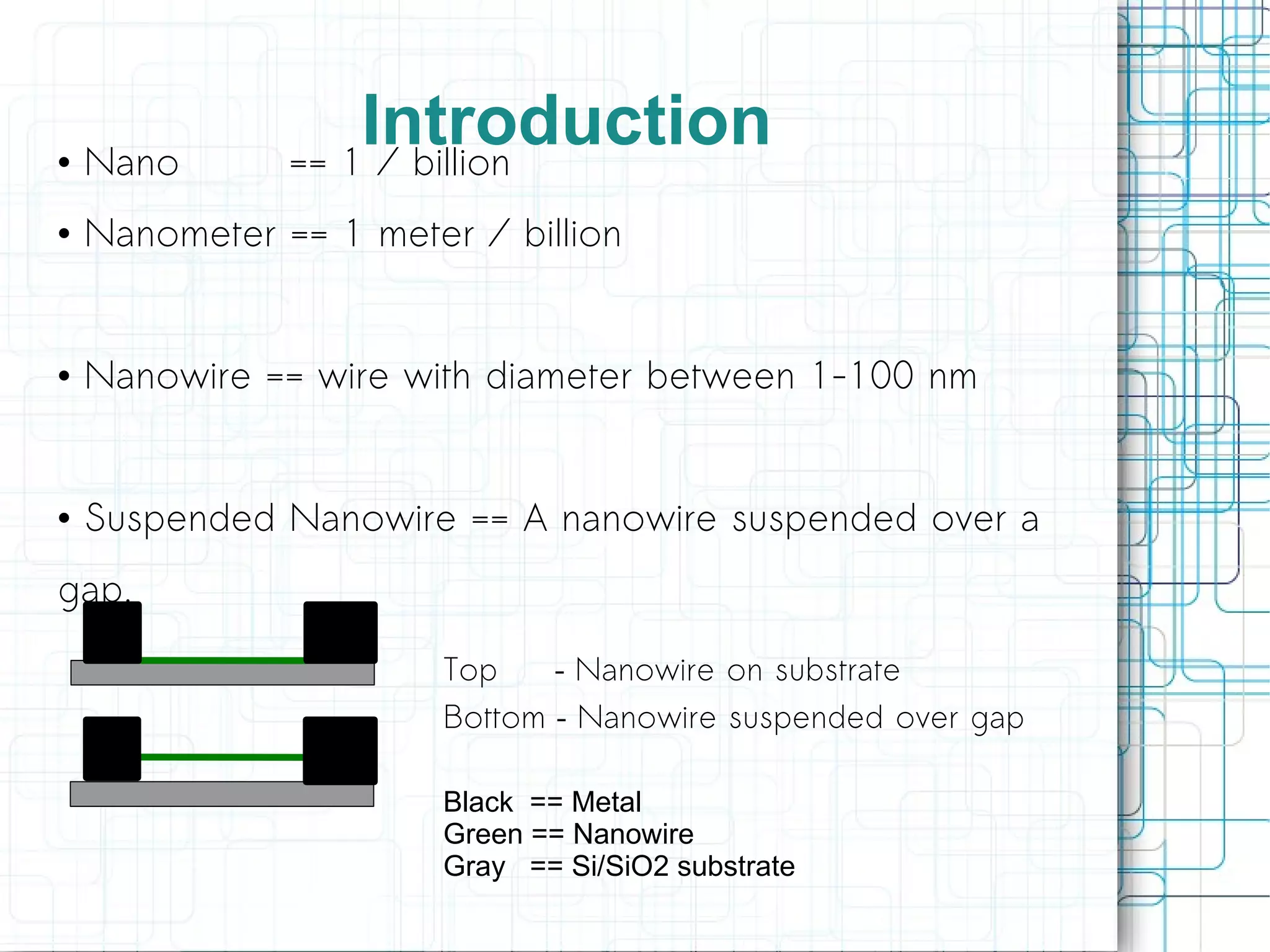
Introduction Nano  == 1 / billion Nanometer == 1 meter / billion Nanowire == wire with diameter between 1-100 nm Suspended Nanowire == A nanowire suspended over a gap. Top  – Nanowire on substrate Bottom – Nanowire suspended over gap Black  == Metal Green == Nanowire Gray  == Si/SiO2 substrate
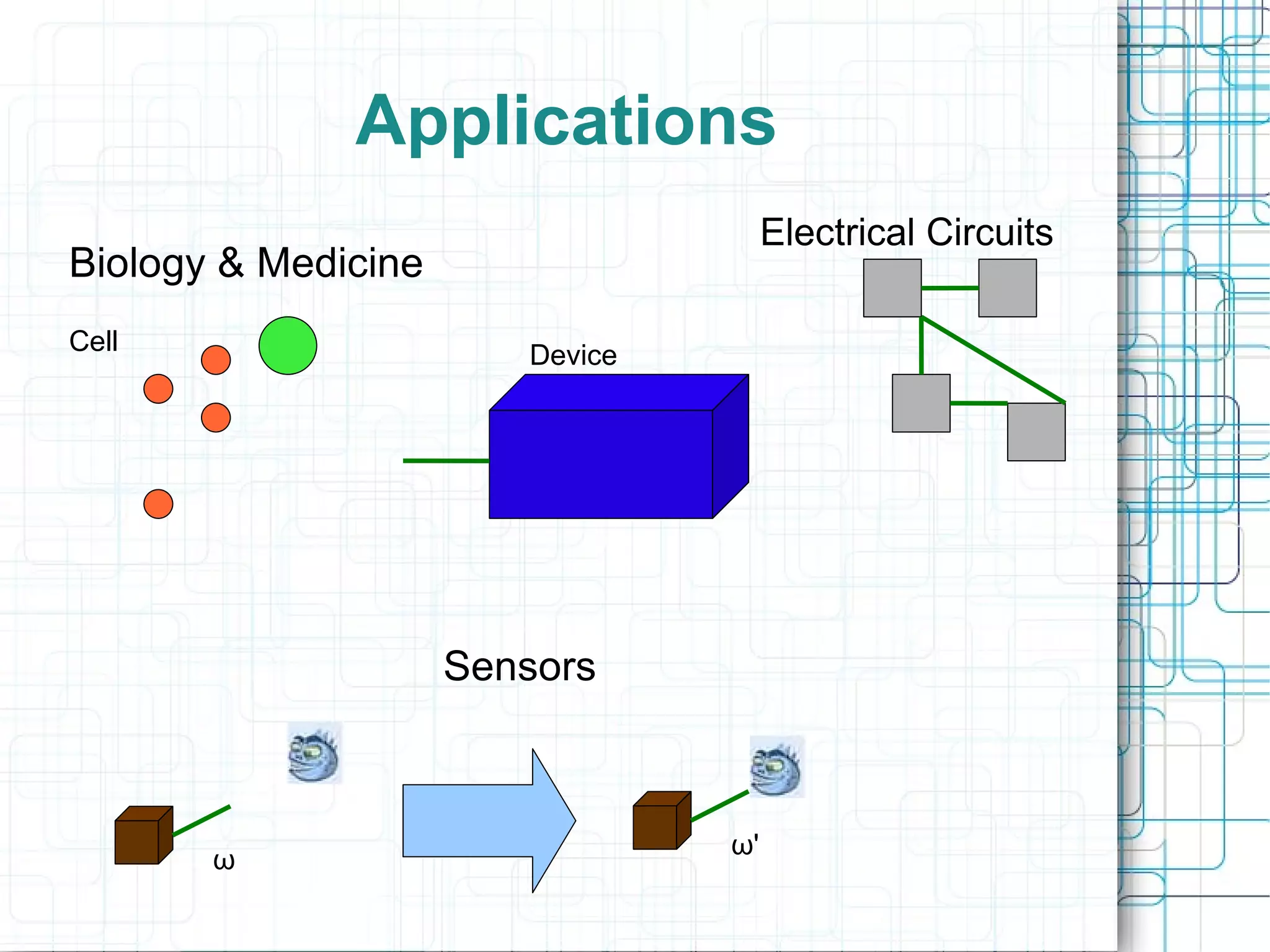
Applications Cell Cell Cell Device Biology & Medicine Electrical Circuits ω ω' Sensors
Goals 1. Fabricate suspended nanowire devices - Simple but not easy. 2. Test the devices and look at the I-V curves. - Should be different because the substrate (read heat sink) is not in contact with the wire.
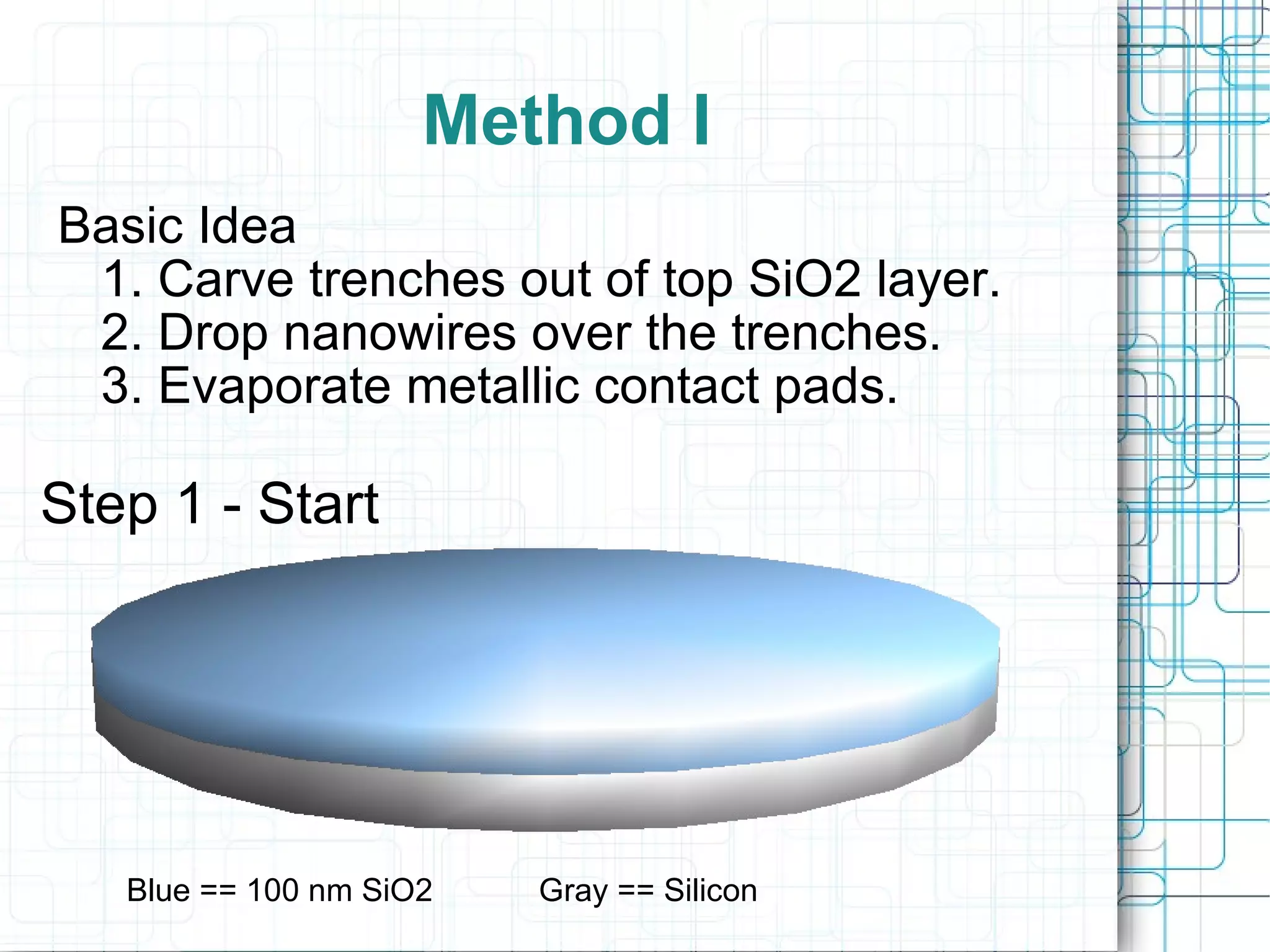
Method I Basic Idea 1. Carve trenches out of top SiO2 layer. 2. Drop nanowires over the trenches. 3. Evaporate metallic contact pads. Step 1 - Start Blue == 100 nm SiO2  Gray == Silicon
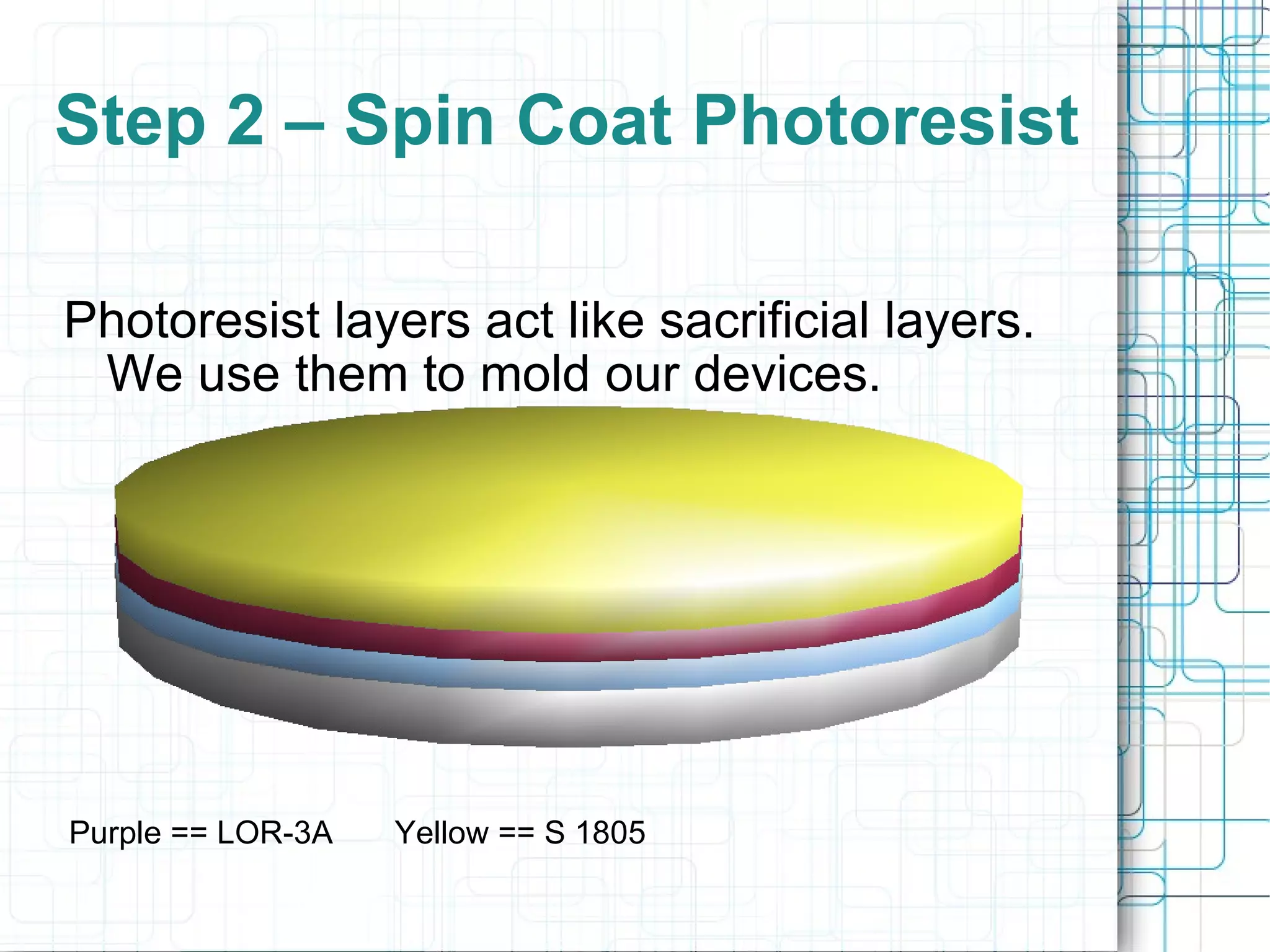
Step 2 – Spin Coat Photoresist Photoresist layers act like sacrificial layers.  We use them to mold our devices. Purple == LOR-3A  Yellow == S 1805
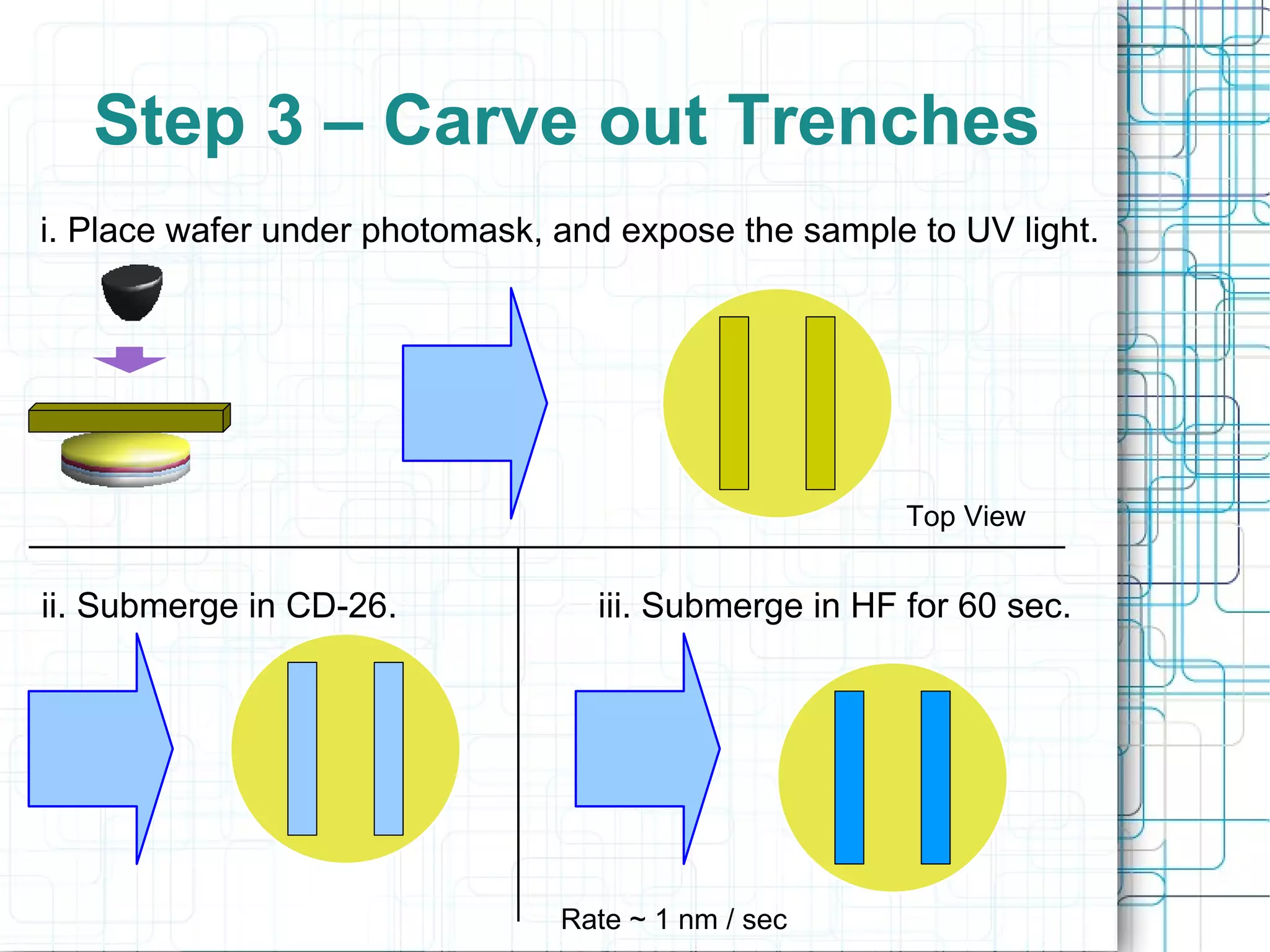
Step 3 – Carve out Trenches i. Place wafer under photomask, and expose the sample to UV light. ii. Submerge in CD-26. I iii. Submerge in HF for 60 sec. Top View Rate ~ 1 nm / sec
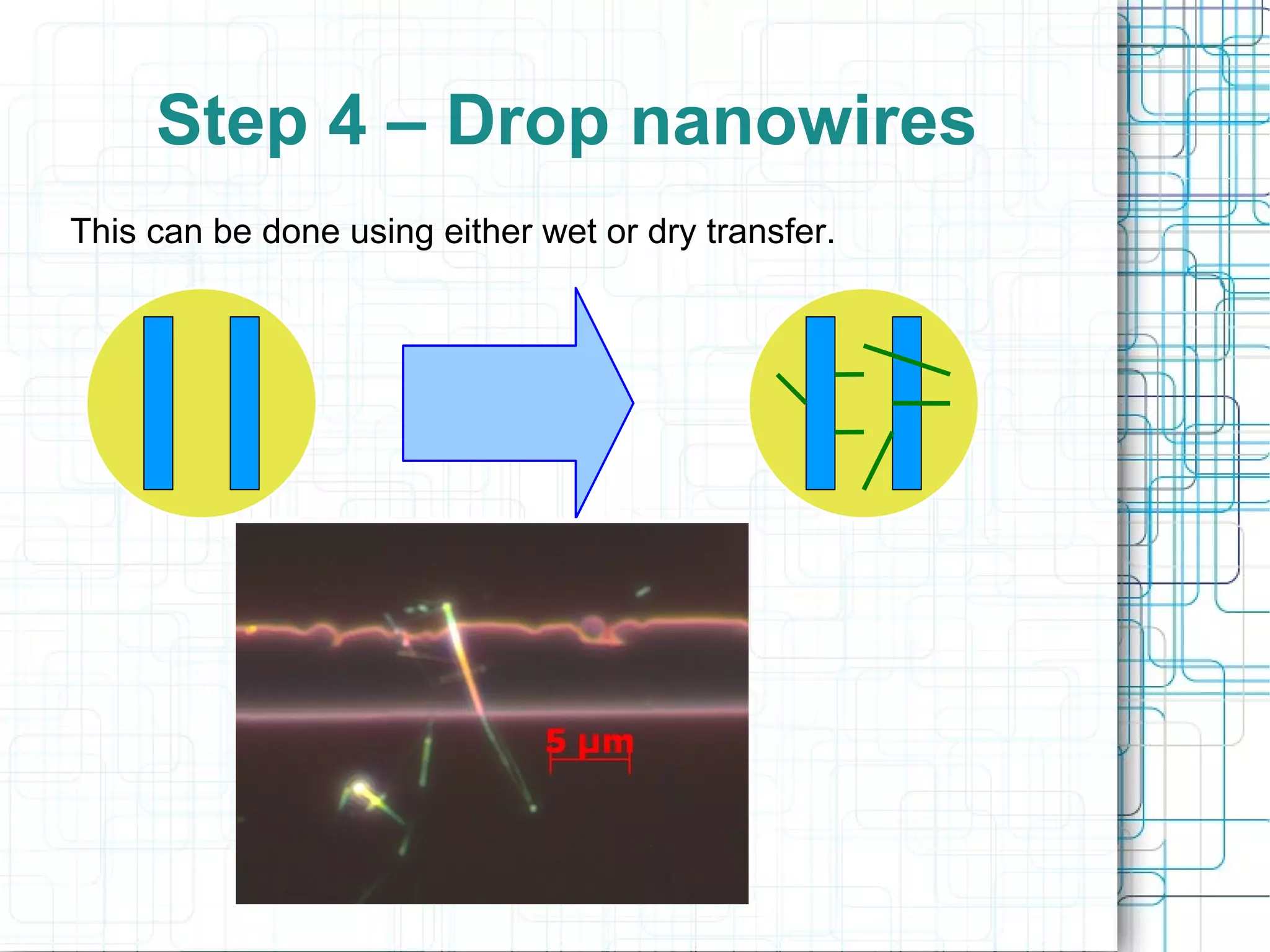
Step 4 – Drop nanowires This can be done using either wet or dry transfer.
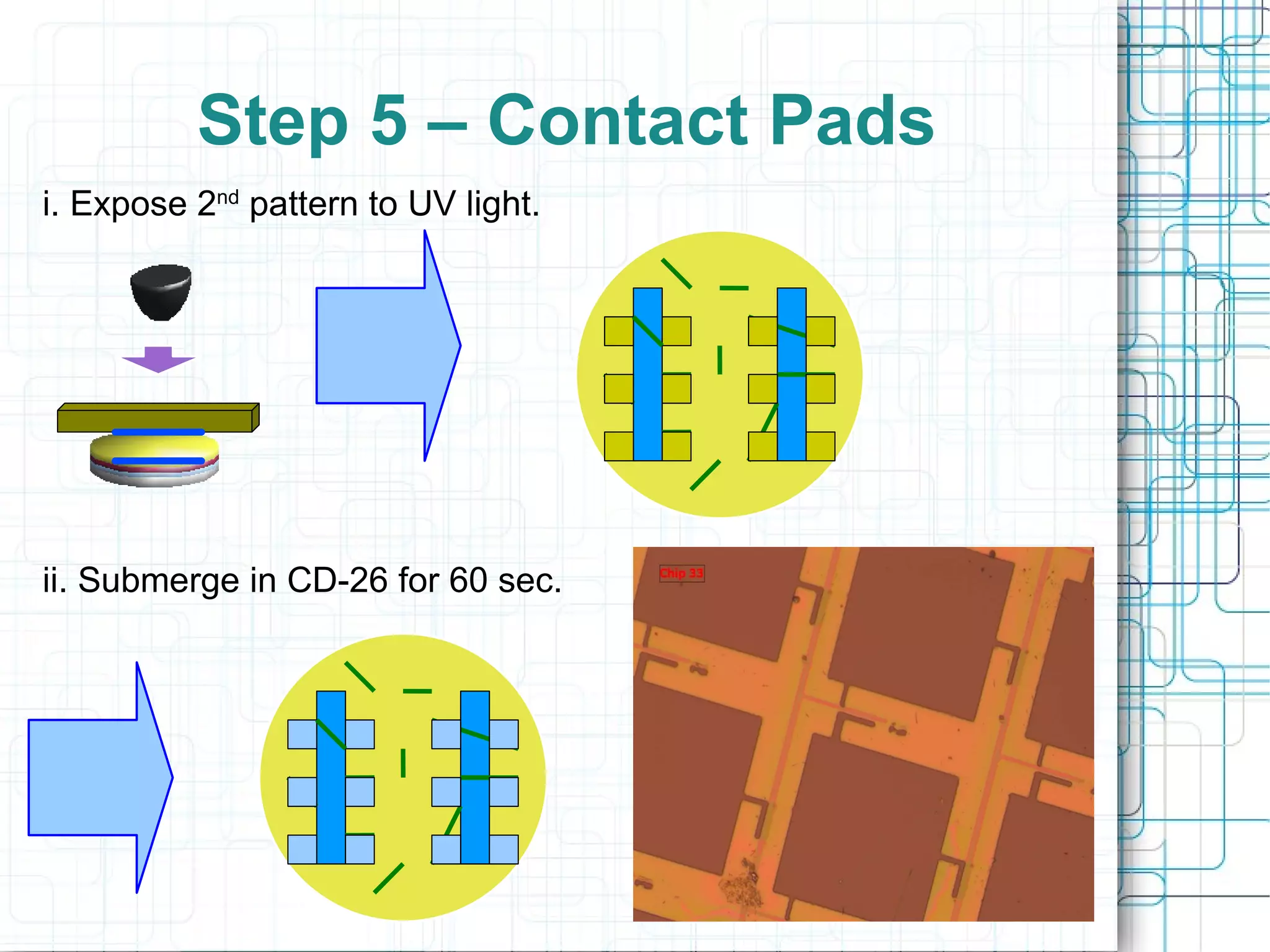
Step 5 – Contact Pads i. Expose 2 nd  pattern to UV light. ii. Submerge in CD-26 for 60 sec.
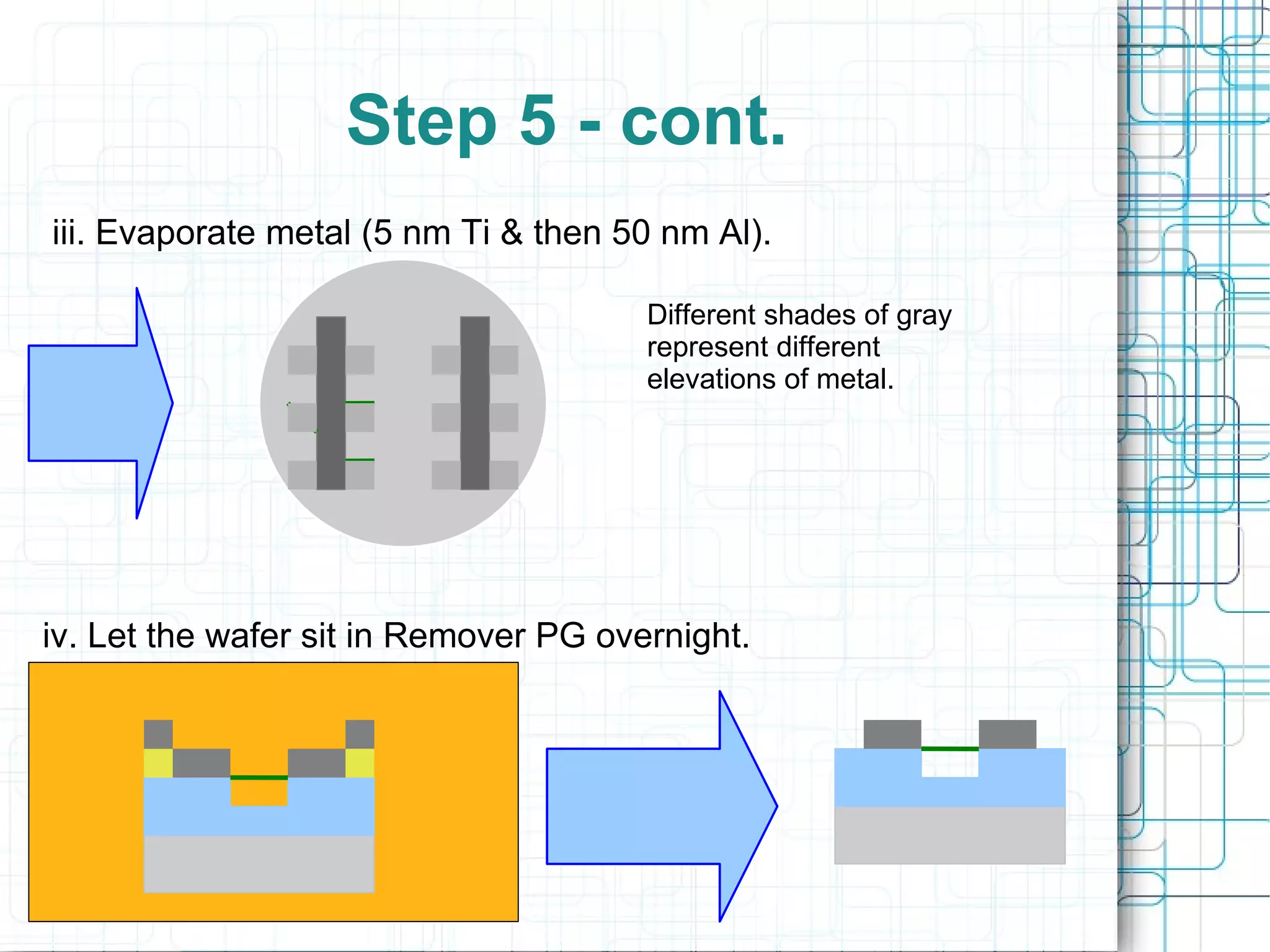
Step 5 - cont. I iii. Evaporate metal (5 nm Ti & then 50 nm Al). Different shades of gray represent different elevations of metal. iv. Let the wafer sit in Remover PG overnight.
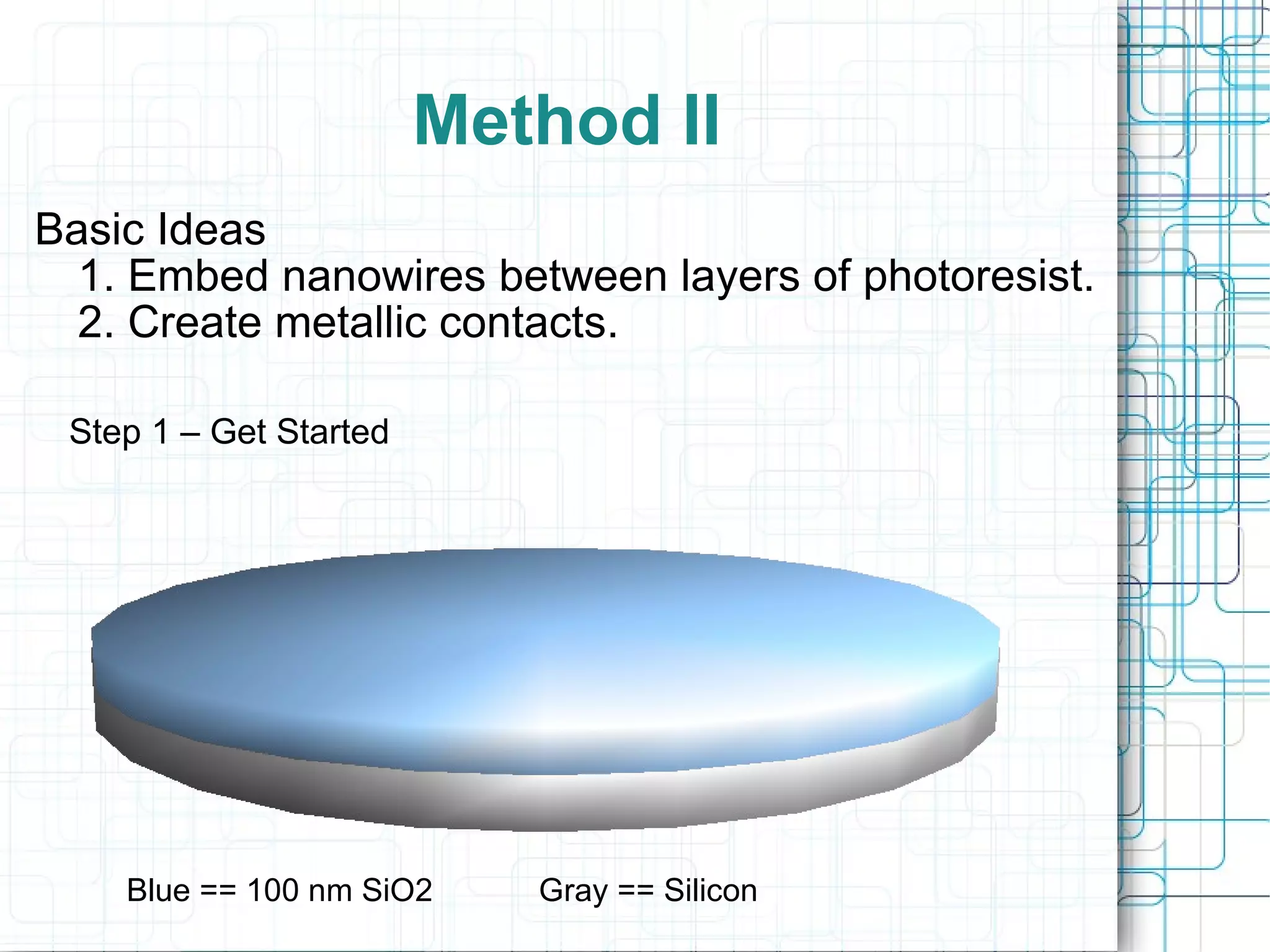
Method II Basic Ideas 1. Embed nanowires between layers of photoresist. 2. Create metallic contacts. Step 1 – Get Started Blue == 100 nm SiO2  Gray == Silicon
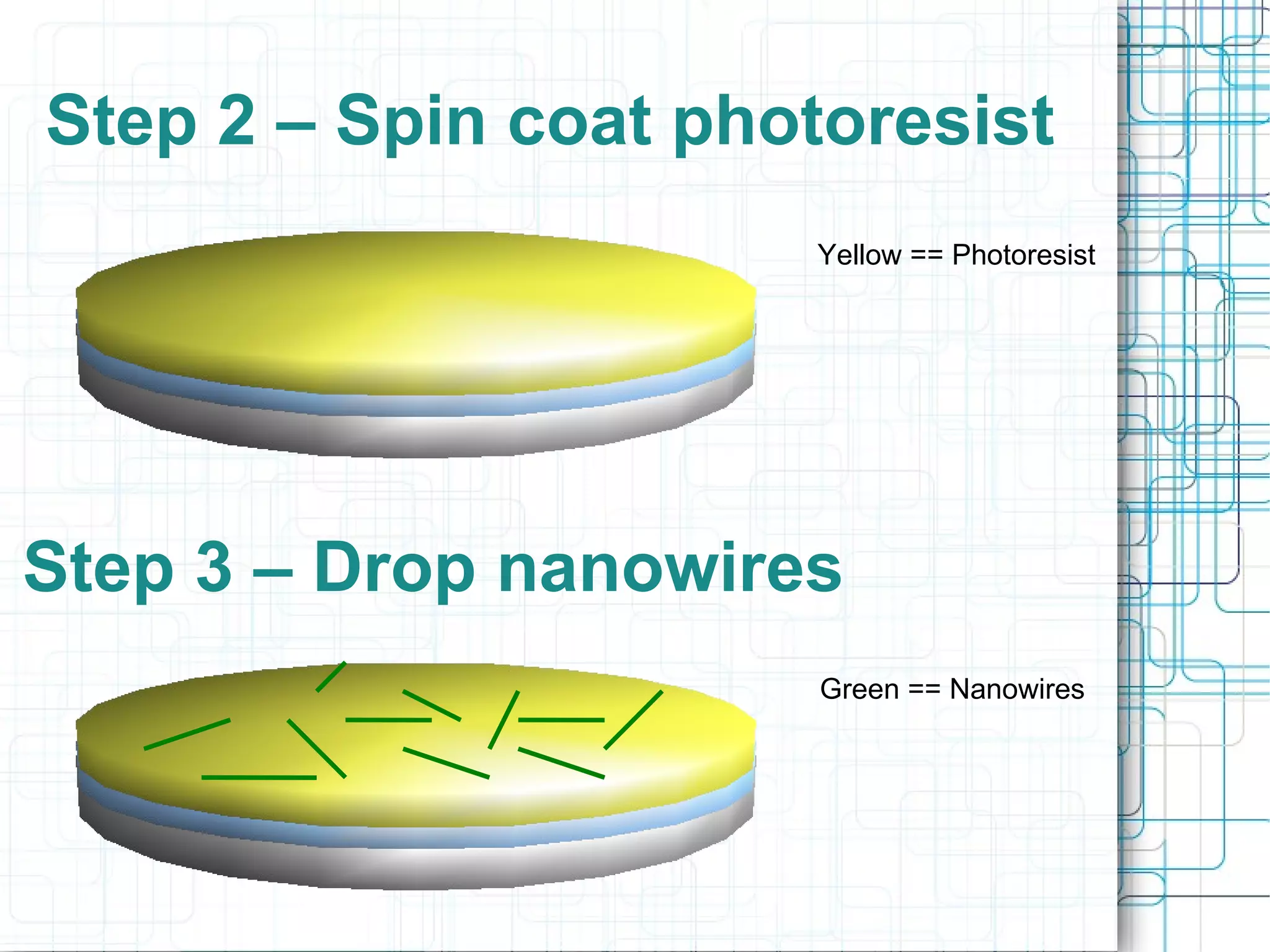
Step 2 – Spin coat photoresist Yellow == Photoresist Step 3 – Drop nanowires Green == Nanowires
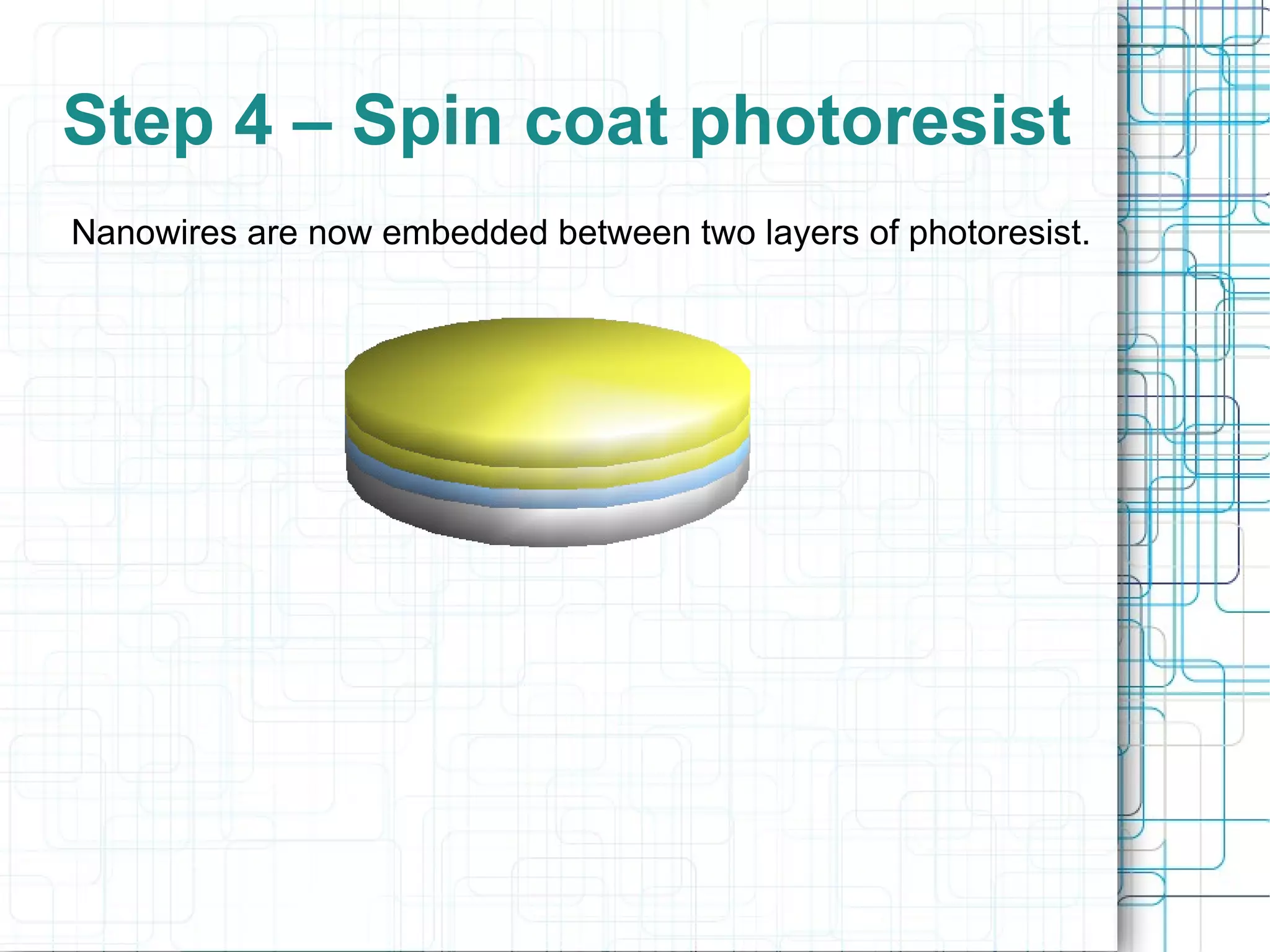
Step 4 – Spin coat photoresist Nanowires are now embedded between two layers of photoresist.
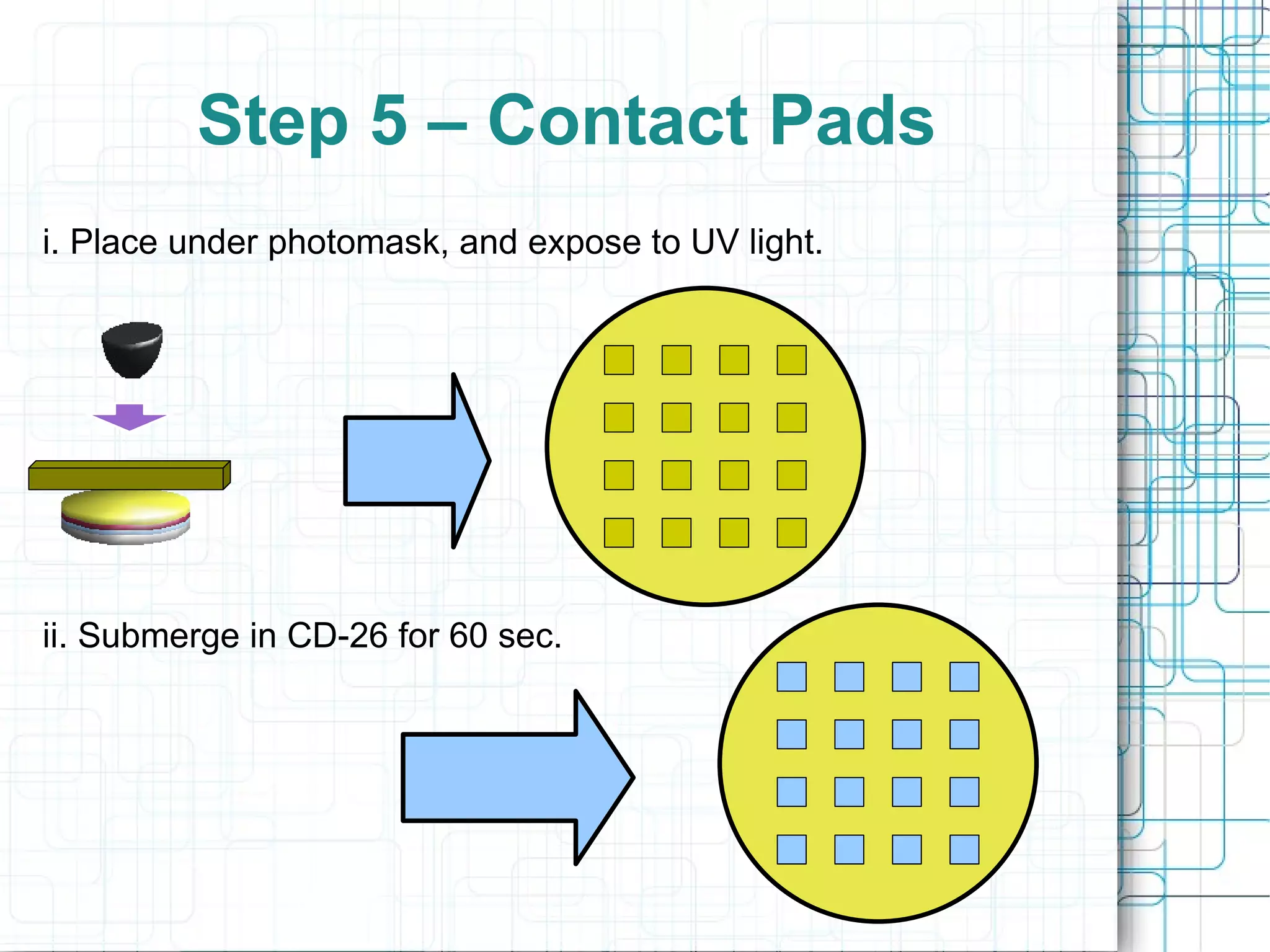
Step 5 – Contact Pads i. Place under photomask, and expose to UV light. ii. Submerge in CD-26 for 60 sec.
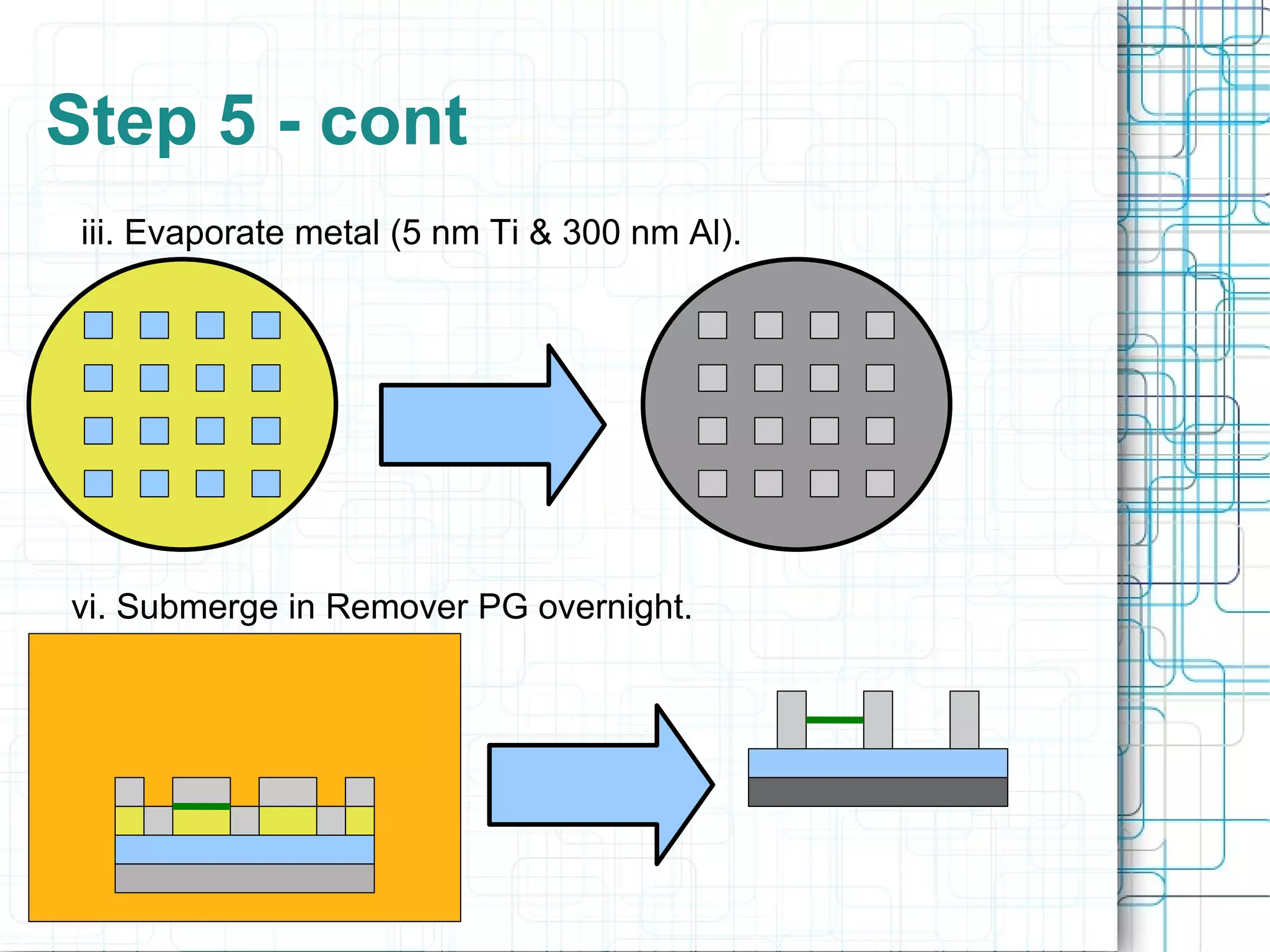
Step 5 - cont I iii. Evaporate metal (5 nm Ti & 300 nm Al). vi. Submerge in Remover PG overnight.
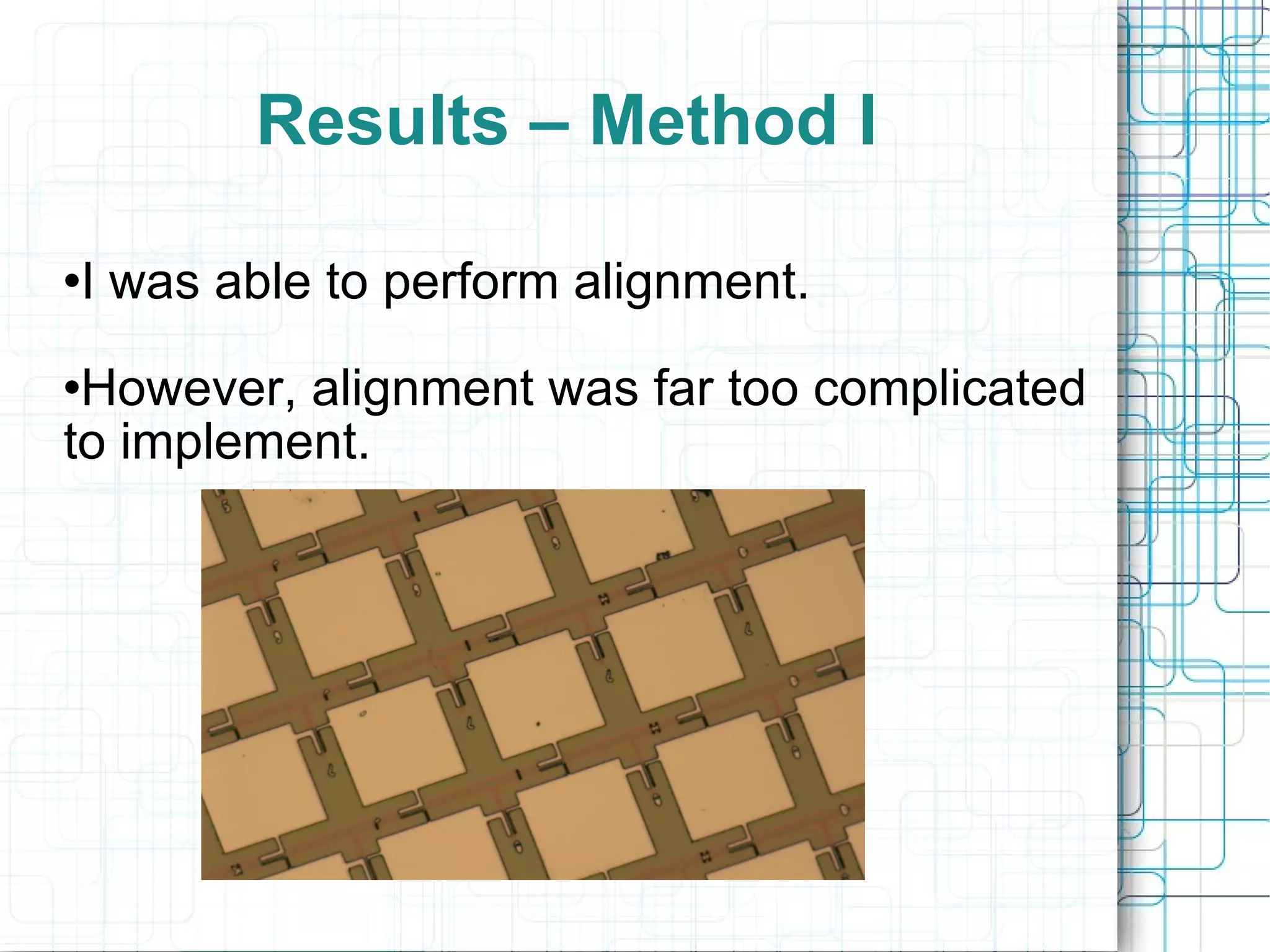
Results – Method I I was able to perform alignment. However, alignment was far too complicated to implement.
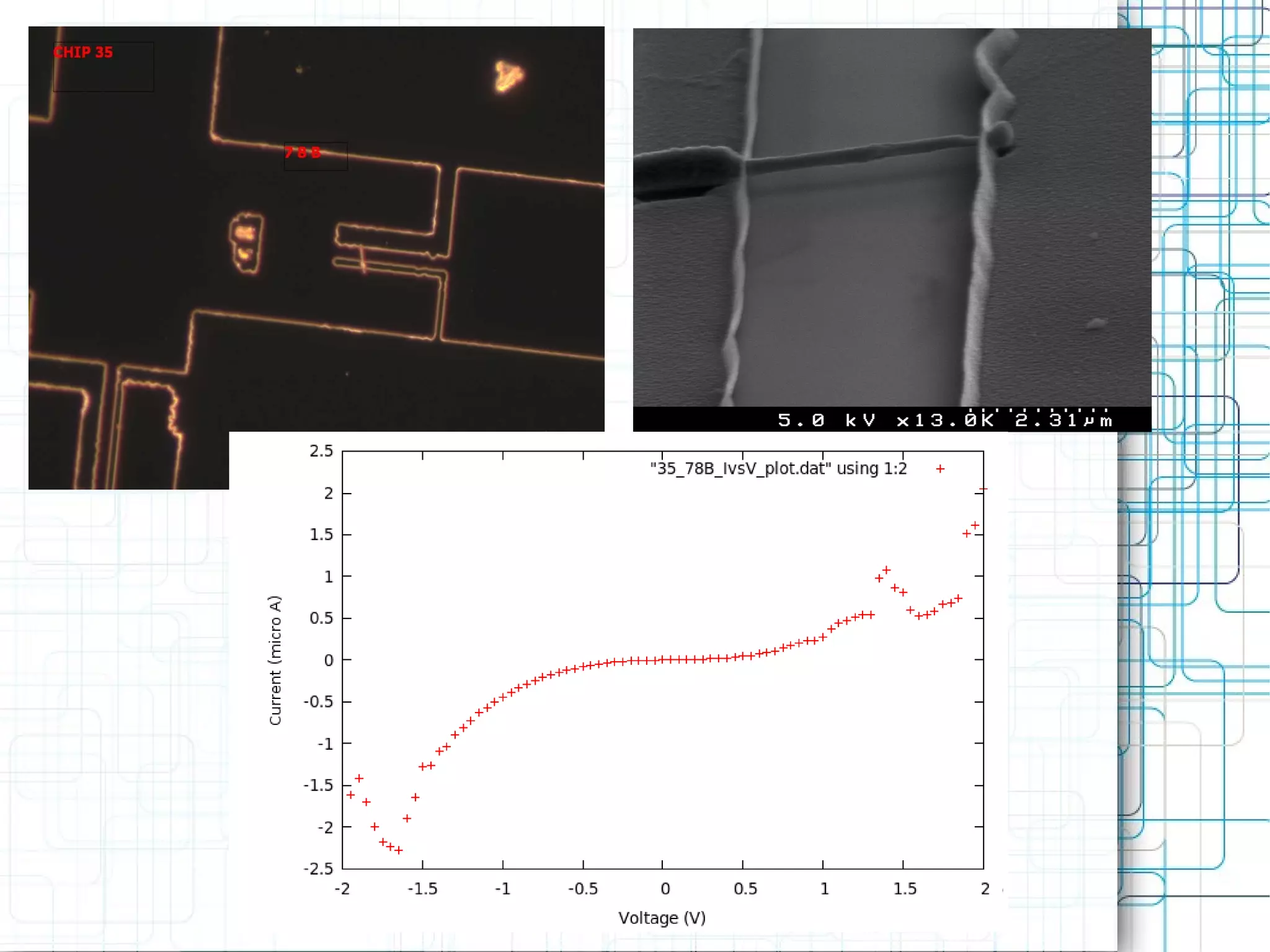
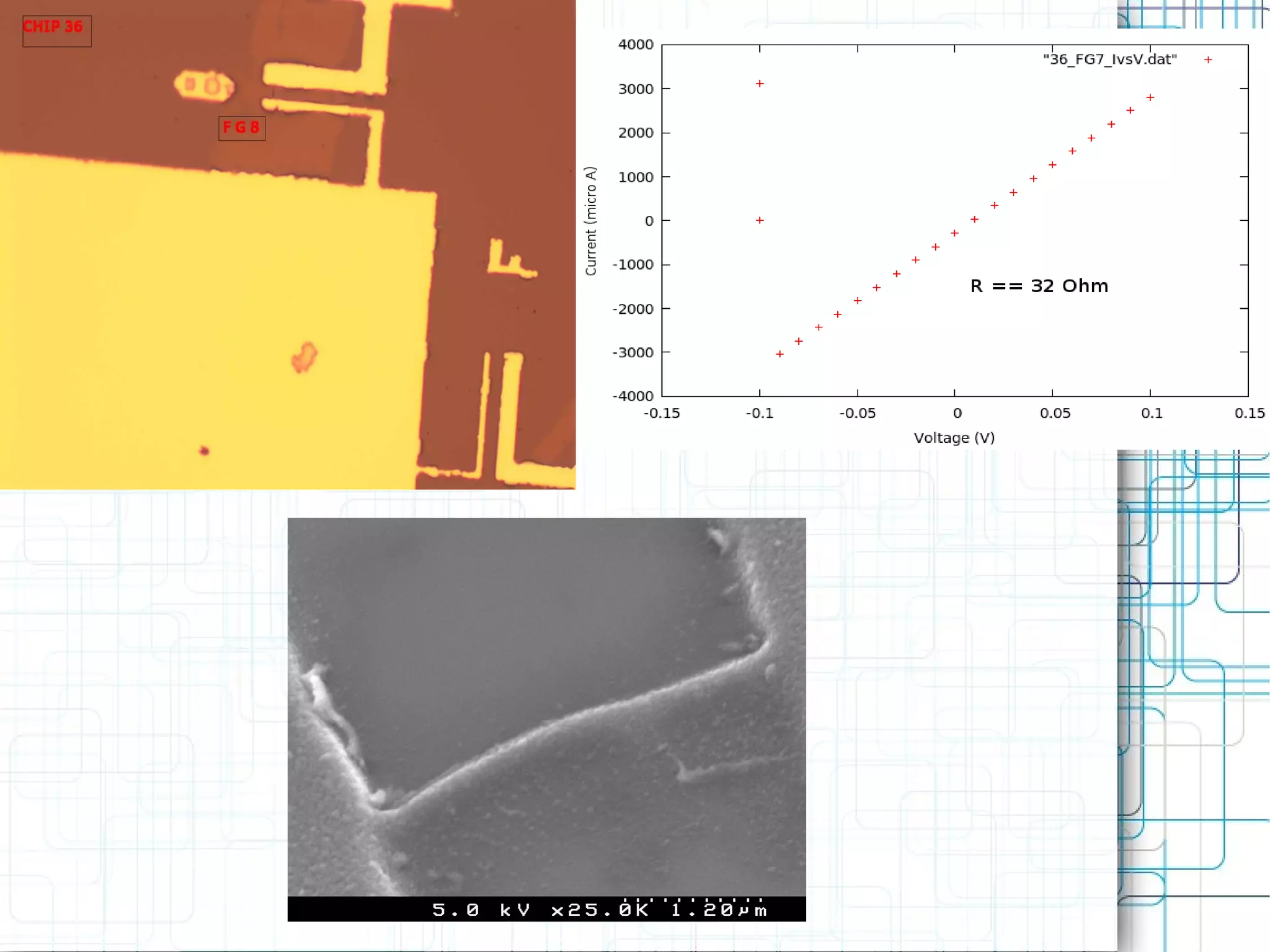
Results – Method II I was able to get suspended nanowire structures. I was able to get a few I-V curves, and a resistance measurement.
 
 
Acknowledgments Special Thanks To: Case Western Reserve University Physics Department National Science Foundation Bob Mike McDonald Professor Kash Reza Sharghi-Moshtaghin NSF REU grant DMR-0850037

Jason Mast Presentation

  • 1.
    Fabrication of SuspendedNanowire Structures Jason Mast & Xuan Gao Summer 2009 REU Program at Case Western Reserve University
  • 2.
    Introduction Nano == 1 / billion Nanometer == 1 meter / billion Nanowire == wire with diameter between 1-100 nm Suspended Nanowire == A nanowire suspended over a gap. Top – Nanowire on substrate Bottom – Nanowire suspended over gap Black == Metal Green == Nanowire Gray == Si/SiO2 substrate
  • 3.
    Applications Cell CellCell Device Biology & Medicine Electrical Circuits ω ω' Sensors
  • 4.
    Goals 1. Fabricatesuspended nanowire devices - Simple but not easy. 2. Test the devices and look at the I-V curves. - Should be different because the substrate (read heat sink) is not in contact with the wire.
  • 5.
    Method I BasicIdea 1. Carve trenches out of top SiO2 layer. 2. Drop nanowires over the trenches. 3. Evaporate metallic contact pads. Step 1 - Start Blue == 100 nm SiO2 Gray == Silicon
  • 6.
    Step 2 –Spin Coat Photoresist Photoresist layers act like sacrificial layers. We use them to mold our devices. Purple == LOR-3A Yellow == S 1805
  • 7.
    Step 3 –Carve out Trenches i. Place wafer under photomask, and expose the sample to UV light. ii. Submerge in CD-26. I iii. Submerge in HF for 60 sec. Top View Rate ~ 1 nm / sec
  • 8.
    Step 4 –Drop nanowires This can be done using either wet or dry transfer.
  • 9.
    Step 5 –Contact Pads i. Expose 2 nd pattern to UV light. ii. Submerge in CD-26 for 60 sec.
  • 10.
    Step 5 -cont. I iii. Evaporate metal (5 nm Ti & then 50 nm Al). Different shades of gray represent different elevations of metal. iv. Let the wafer sit in Remover PG overnight.
  • 11.
    Method II BasicIdeas 1. Embed nanowires between layers of photoresist. 2. Create metallic contacts. Step 1 – Get Started Blue == 100 nm SiO2 Gray == Silicon
  • 12.
    Step 2 –Spin coat photoresist Yellow == Photoresist Step 3 – Drop nanowires Green == Nanowires
  • 13.
    Step 4 –Spin coat photoresist Nanowires are now embedded between two layers of photoresist.
  • 14.
    Step 5 –Contact Pads i. Place under photomask, and expose to UV light. ii. Submerge in CD-26 for 60 sec.
  • 15.
    Step 5 -cont I iii. Evaporate metal (5 nm Ti & 300 nm Al). vi. Submerge in Remover PG overnight.
  • 16.
    Results – MethodI I was able to perform alignment. However, alignment was far too complicated to implement.
  • 17.
    Results – MethodII I was able to get suspended nanowire structures. I was able to get a few I-V curves, and a resistance measurement.
  • 18.
  • 19.
  • 20.
    Acknowledgments Special ThanksTo: Case Western Reserve University Physics Department National Science Foundation Bob Mike McDonald Professor Kash Reza Sharghi-Moshtaghin NSF REU grant DMR-0850037