SCHOOL OF ENGINEERING SCIENCE

SIMON FRASER UNIVERSITY
CANADA

Paintable CUPROUS OXIDE/ZINC
OXIDE Photovoltaic Device

M.Prasad and Ash M. Parameswaran
mpa56@sfu.ca
paramesw@sfu.ca
1
Contents
•
•
•
•
•

2

Background
Introduction
Device preparation
Experimental Results
Conclusion

SIMON FRASER UNIVERSITY
CANADA
Background
•
•
•
•

1920s: Cu2O rectifier
1930s: Cu2O photosensitive device
1970s: Research on Cu2O photovoltaic cells
Reported efficiency 2%. At present: 20% [1,2]

• 1980s: Three main issues of Cu2O solar cells:
1. A sound method of preparation of Cu2O
2. Increasing the photoconductivity of Cu2O
3. Making a good P-N junction [3]

3

SIMON FRASER UNIVERSITY
CANADA
Introduction
• Solar cells research - popular topic now
worldwide need for clean and renewable energy.
• Cu2O Benefits (p-type):
Availability & low cost to develop
Efficiency 20%
Band gap 2 eV[4]
• ZnO (n-type): easy to manufacture and low cost.[4]

The combination of Cu2O and ZnO
inexpensive photoconductive device.

4

SIMON FRASER UNIVERSITY
CANADA
Device Preparation
Three steps:
1. Cu2O painting
2. Deposition of ZnO
3. Electrode connection

5

SIMON FRASER UNIVERSITY
CANADA
Device Preparation
Cu2O painting

1. Copper sheet : Clean and dry thoroughly
2. Prepare a colloidal suspension
3. Paint that suspension on Cu sheet.
4. Dry (5 min), wash with acetone and deionised water

5. Heat (50°C, 5min) to remove any moisture content

Now the material is ready for next step

6

SIMON FRASER UNIVERSITY
CANADA
Device Preparation
Electrochemical deposition of ZnO:
• Using zinc Nitrate aq-solution (pH 12):
(Painted Cu2O sample and carbon
electrode)
• Bias current 3mA at 72°C for 5 hours
• Wash with deionised water and dry.

7

SIMON FRASER UNIVERSITY
CANADA
Device Preparation
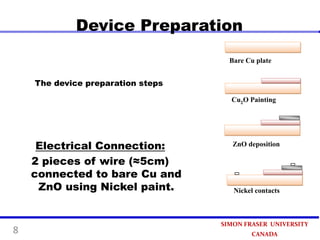
Bare Cu plate

The device preparation steps
Cu2O Painting

Electrical Connection:
2 pieces of wire (≈5cm)
connected to bare Cu and
ZnO using Nickel paint.

8

ZnO deposition

Nickel contacts

SIMON FRASER UNIVERSITY
CANADA
Device Preparation

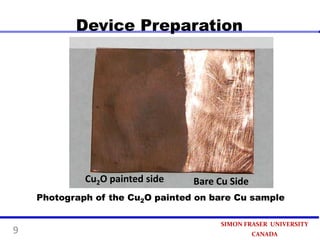
Cu2O painted side

Bare Cu Side

Photograph of the Cu2O painted on bare Cu sample

9

SIMON FRASER UNIVERSITY
CANADA
Device Preparation

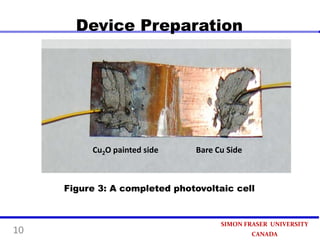
Cu2O painted side

Bare Cu Side

Figure 3: A completed photovoltaic cell

10

SIMON FRASER UNIVERSITY
CANADA
Experimental Results
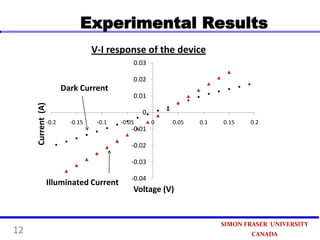
• Tested using “Agilent 4155C SPA”
under the Diode Characterization setting
• voltage sweep: -200mV to 200mV
• Dark vs illuminated

40% increase in current upon illumination

11

SIMON FRASER UNIVERSITY
CANADA
Experimental Results
V-I response of the device
0.03
0.02

Current (A)

Dark Current

-0.2

0.01
0

-0.15

-0.1

-0.05

-0.01

0

0.05

0.1

0.15

0.2

-0.02
-0.03

Illuminated Current

12

-0.04

Voltage (V)

SIMON FRASER UNIVERSITY
CANADA
Conclusion
• A simple approach to Cu/Cu2O-ZnO photovoltaic
device
• simple painting technique to create the interface

A proof concept: Paves an avenue for an
ultra-economical way to produce
photovoltaic devices in the future.

13

SIMON FRASER UNIVERSITY
CANADA
References
1. Rakhshani, A.E., Solid-State
Electronics., 29, 7(1986)
2. Georgieva, V., Tanusevski, A., Georgieva, M., Sola
r Cells- Thin-Film
Technologies., L.A.Kosyachenko., Editor, p.55
INTECH (2011)
3. Olsen L.C., Addis, F.W., Miller.W., Solar Cells., 7
, 247 (1982-83)
4. Motoyoshi, R., Oku, T., Suzuki,A., Kikuchi, K., Ki
kuchi,S., Synthetic Metals., 160, 1219, (2010)

14

SIMON FRASER UNIVERSITY
CANADA
Thank you

15

SIMON FRASER UNIVERSITY
CANADA

347 cu2 o solar cell (9)

  • 1.
    SCHOOL OF ENGINEERINGSCIENCE SIMON FRASER UNIVERSITY CANADA Paintable CUPROUS OXIDE/ZINC OXIDE Photovoltaic Device M.Prasad and Ash M. Parameswaran mpa56@sfu.ca paramesw@sfu.ca 1
  • 2.
  • 3.
    Background • • • • 1920s: Cu2O rectifier 1930s:Cu2O photosensitive device 1970s: Research on Cu2O photovoltaic cells Reported efficiency 2%. At present: 20% [1,2] • 1980s: Three main issues of Cu2O solar cells: 1. A sound method of preparation of Cu2O 2. Increasing the photoconductivity of Cu2O 3. Making a good P-N junction [3] 3 SIMON FRASER UNIVERSITY CANADA
  • 4.
    Introduction • Solar cellsresearch - popular topic now worldwide need for clean and renewable energy. • Cu2O Benefits (p-type): Availability & low cost to develop Efficiency 20% Band gap 2 eV[4] • ZnO (n-type): easy to manufacture and low cost.[4] The combination of Cu2O and ZnO inexpensive photoconductive device. 4 SIMON FRASER UNIVERSITY CANADA
  • 5.
    Device Preparation Three steps: 1.Cu2O painting 2. Deposition of ZnO 3. Electrode connection 5 SIMON FRASER UNIVERSITY CANADA
  • 6.
    Device Preparation Cu2O painting 1.Copper sheet : Clean and dry thoroughly 2. Prepare a colloidal suspension 3. Paint that suspension on Cu sheet. 4. Dry (5 min), wash with acetone and deionised water 5. Heat (50°C, 5min) to remove any moisture content Now the material is ready for next step 6 SIMON FRASER UNIVERSITY CANADA
  • 7.
    Device Preparation Electrochemical depositionof ZnO: • Using zinc Nitrate aq-solution (pH 12): (Painted Cu2O sample and carbon electrode) • Bias current 3mA at 72°C for 5 hours • Wash with deionised water and dry. 7 SIMON FRASER UNIVERSITY CANADA
  • 8.
    Device Preparation Bare Cuplate The device preparation steps Cu2O Painting Electrical Connection: 2 pieces of wire (≈5cm) connected to bare Cu and ZnO using Nickel paint. 8 ZnO deposition Nickel contacts SIMON FRASER UNIVERSITY CANADA
  • 9.
    Device Preparation Cu2O paintedside Bare Cu Side Photograph of the Cu2O painted on bare Cu sample 9 SIMON FRASER UNIVERSITY CANADA
  • 10.
    Device Preparation Cu2O paintedside Bare Cu Side Figure 3: A completed photovoltaic cell 10 SIMON FRASER UNIVERSITY CANADA
  • 11.
    Experimental Results • Testedusing “Agilent 4155C SPA” under the Diode Characterization setting • voltage sweep: -200mV to 200mV • Dark vs illuminated 40% increase in current upon illumination 11 SIMON FRASER UNIVERSITY CANADA
  • 12.
    Experimental Results V-I responseof the device 0.03 0.02 Current (A) Dark Current -0.2 0.01 0 -0.15 -0.1 -0.05 -0.01 0 0.05 0.1 0.15 0.2 -0.02 -0.03 Illuminated Current 12 -0.04 Voltage (V) SIMON FRASER UNIVERSITY CANADA
  • 13.
    Conclusion • A simpleapproach to Cu/Cu2O-ZnO photovoltaic device • simple painting technique to create the interface A proof concept: Paves an avenue for an ultra-economical way to produce photovoltaic devices in the future. 13 SIMON FRASER UNIVERSITY CANADA
  • 14.
    References 1. Rakhshani, A.E.,Solid-State Electronics., 29, 7(1986) 2. Georgieva, V., Tanusevski, A., Georgieva, M., Sola r Cells- Thin-Film Technologies., L.A.Kosyachenko., Editor, p.55 INTECH (2011) 3. Olsen L.C., Addis, F.W., Miller.W., Solar Cells., 7 , 247 (1982-83) 4. Motoyoshi, R., Oku, T., Suzuki,A., Kikuchi, K., Ki kuchi,S., Synthetic Metals., 160, 1219, (2010) 14 SIMON FRASER UNIVERSITY CANADA
  • 15.
    Thank you 15 SIMON FRASERUNIVERSITY CANADA

Editor's Notes

  • #4 1940s the interest shifted to other materials such as selenium, germanium and silicon.20% efficiency is theoretically calculated
  • #7 1. Clean with