Incidence Angle Dependence of Organic Solar CellsVincent DeGeorge1,  Brent Valle2,  Kenneth Singer PhD. 21)Dept. of Physics, John Carroll University, University Heights OH  2) Dept. of Physics, Case Western Reserve University, Cleveland OH
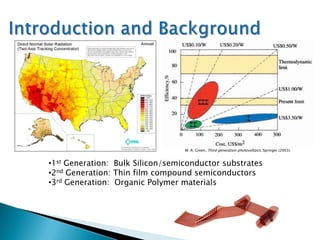
Introduction and BackgroundM. A. Green, Third generation photovoltaics. Springer (2003).1st Generation:  Bulk Silicon/semiconductor substrates
2nd Generation: Thin film compound semiconductors
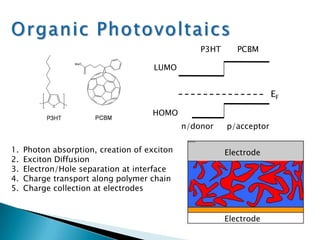
3rd Generation:  Organic Polymer materialsOrganic PhotovoltaicsElectrodePCBMP3HTLUMOElectrodePhoton absorption, creation of excitonExciton DiffusionElectron/Hole separation at interfaceCharge transport along polymer chainCharge collection at electrodesEFHOMOn/donorp/acceptor
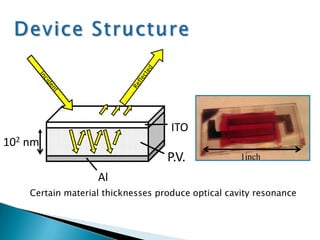
ITOP.V.AlDevice Structure1inchCertain material thicknesses produce optical cavity resonanceReflectedIncident102 nm
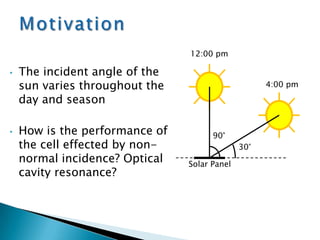
MotivationThe incident angle of the sun varies throughout the day and season
How is the performance of the cell effected by non-normal incidence? Optical cavity resonance?12:00 pm4:00 pm90°30°Solar Panel
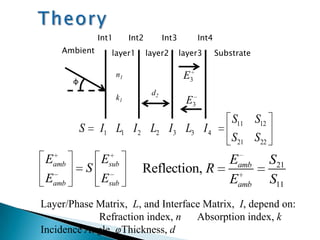
TheoryLayer/Phase Matrix,  L, and Interface Matrix,  I, depend on:                      Refraction index, n      Absorption index, kIncidence Angle, φThickness, dInt1Int2Int3Int4Ambientlayer1layer2Substratelayer3n1φd2k1
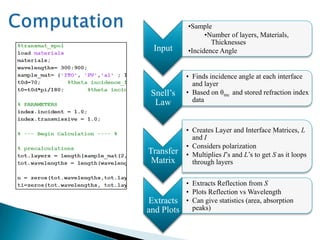
Computation
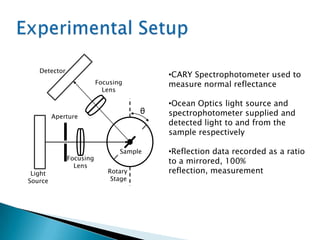
Experimental SetupCARY Spectrophotometer used to measure normal reflectance
Ocean Optics light source and spectrophotometer supplied and detected light to and from the sample respectively

Vincent DeGeorge

  • 1.
    Incidence Angle Dependenceof Organic Solar CellsVincent DeGeorge1, Brent Valle2, Kenneth Singer PhD. 21)Dept. of Physics, John Carroll University, University Heights OH 2) Dept. of Physics, Case Western Reserve University, Cleveland OH
  • 2.
    Introduction and BackgroundM.A. Green, Third generation photovoltaics. Springer (2003).1st Generation: Bulk Silicon/semiconductor substrates
  • 3.
    2nd Generation: Thinfilm compound semiconductors
  • 4.
    3rd Generation: Organic Polymer materialsOrganic PhotovoltaicsElectrodePCBMP3HTLUMOElectrodePhoton absorption, creation of excitonExciton DiffusionElectron/Hole separation at interfaceCharge transport along polymer chainCharge collection at electrodesEFHOMOn/donorp/acceptor
  • 5.
    ITOP.V.AlDevice Structure1inchCertain materialthicknesses produce optical cavity resonanceReflectedIncident102 nm
  • 6.
    MotivationThe incident angleof the sun varies throughout the day and season
  • 7.
    How is theperformance of the cell effected by non-normal incidence? Optical cavity resonance?12:00 pm4:00 pm90°30°Solar Panel
  • 8.
    TheoryLayer/Phase Matrix, L, and Interface Matrix, I, depend on: Refraction index, n Absorption index, kIncidence Angle, φThickness, dInt1Int2Int3Int4Ambientlayer1layer2Substratelayer3n1φd2k1
  • 9.
  • 10.
    Experimental SetupCARY Spectrophotometerused to measure normal reflectance
  • 11.
    Ocean Optics lightsource and spectrophotometer supplied and detected light to and from the sample respectively

Editor's Notes

  • #3 Unlike very concentrated/dense energy sources such as oil or nuclear, solar energy is not very dense as it is fairly uniformly spread out over the surface of the earth.
  • #4 When P3Ht(donor) and PCBM(acceptor) come together some chemistry happens, the system becomes conjugated, meaning that the p-orbitals of the two molecules overlap, and two new “delocalized” orbitals are formed, one bonding one anti-bonding. There is a energy difference between these orbitals, which is the P.V. material’s band gap, and determines which wavelength photons will be absorbed. Once absorbed the photon creates an exciton, electron/hole pair, which drifts randomly until it happens upon a P3HT/PCBM interface. Here they are separated and the (electron/hole/both) travel along the polymer chain until collected by the electrode as photocurrent.Average distance to interface on the same order as diffusion length of exciton
  • #5 Optical cavity resonance, increased absorption, due to thicknesses of P.V. and ITO. Approx 100nm prefered. 80nm showed lagest resonanceTransparent ITO top contact
  • #7 Superposition of left and right moving waveAppropriate boundary condition for Electric field and derivativeAbsorption related to transmission and reflection by, 1-Reflectionabsorption
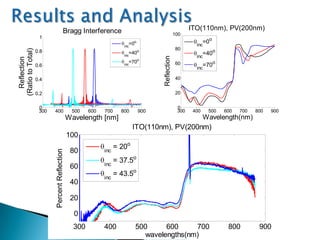
  • #8 Used Matlab to solve Transfer Matrix problemConsidered polarization, as reflectance differs for different polarized light for non-normal incidenceSuccessfully exhibits Blue shift in Bragg Interference
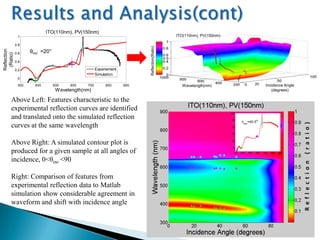
  • #10 32 layers 300nm thick PMMA/?150nm peak shift over 90 degreesLarger waveform shirftawary from 700 nm (look at max absorption)Difficult to compare waveforms of difference incident anglesAnd how to compare to SimulationSpike at ̴650nm is an artifact of the Ocean Optics deuterium light source.