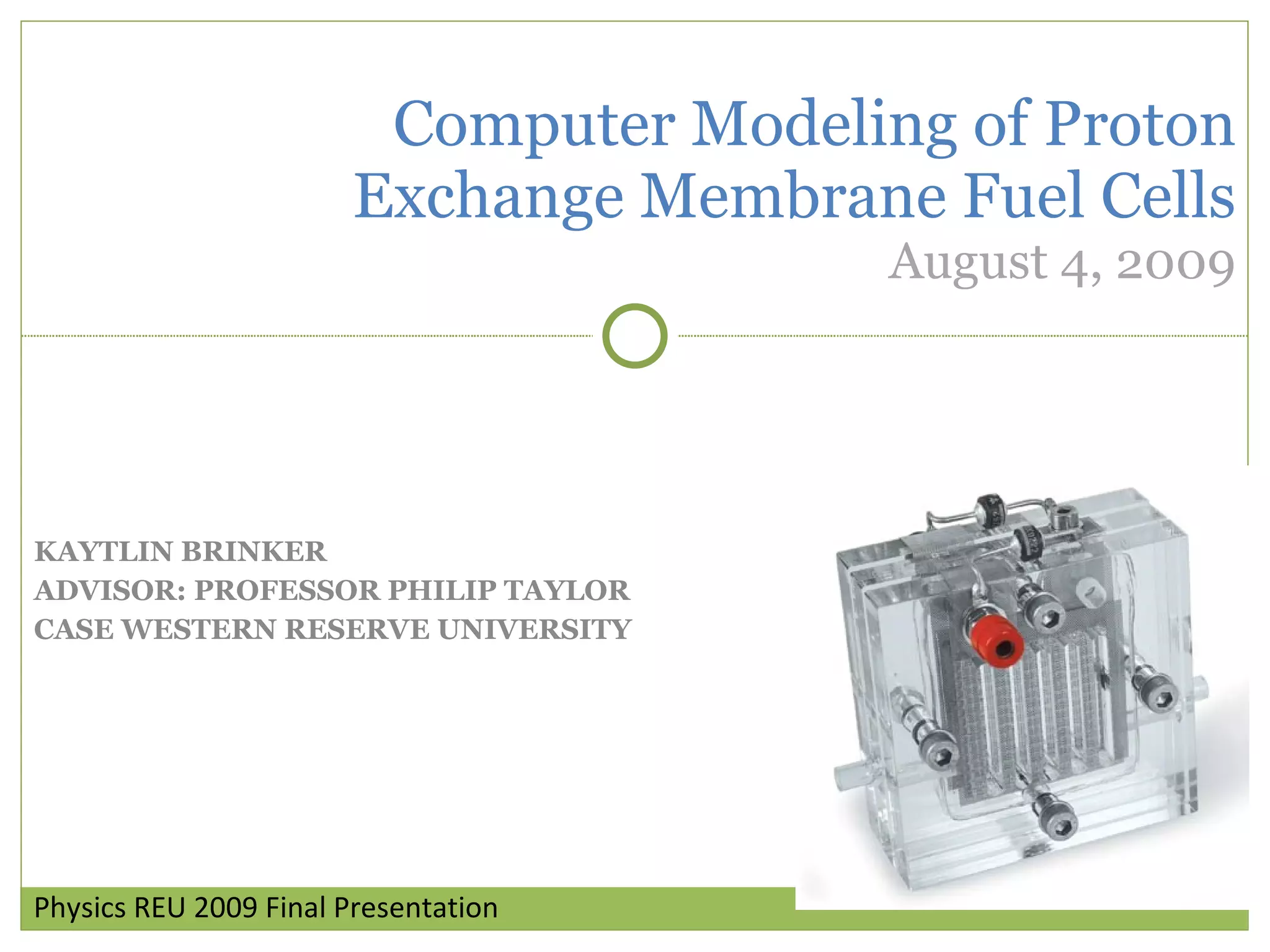
KAYTLIN BRINKER ADVISOR: PROFESSOR PHILIP TAYLOR CASE WESTERN RESERVE UNIVERSITY Computer Modeling of Proton Exchange Membrane Fuel Cells August 4, 2009 Physics REU 2009 Final Presentation
contents fuel cells existing theory problem model results conclusion future work references
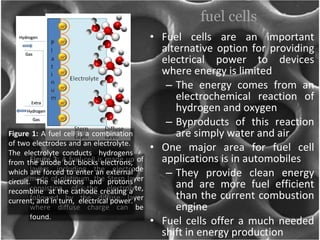
fuel cells Fuel cells are an important alternative option for providing electrical power to devices where energy is limited  The energy comes from an electrochemical reaction of hydrogen and oxygen Byproducts of this reaction are simply water and air One major area for fuel cell applications is in automobiles  They provide clean energy and are more fuel efficient than the current combustion engine Fuel cells offer a much needed shift in energy production Figure 2:  A fuel cell is made up of layers including the electrode made of platinum, the Stern layer consisting of the electrolyte, followed by the diffuse layer where diffuse charge can be found. Figure 1:  A fuel cell is a combination of two electrodes and an electrolyte.  The electrolyte conducts  hydrogens from the anode but blocks electrons, which are forced to enter an external circuit. The electrons and protons recombine  at the cathode creating a current, and in turn,  electrical power.
contents fuel cells existing theory problem model results conclusion future work references
Bazant et al. described the effects of diffuse charge on the electron-transfer rate  for thicker diffuse layers The Butler-Volmer (BV) equation with the Frumkin correction give the kinetics of the electrochemical reaction This equation describes the charge transfer across the Stern layer for a membrane  Figure 3:  A model of the electrostatic potential profile in the fuel cell membrane is given by Bazant et al.  In Fig. 1a, excess protons exist in the anodic polarization layer and a deficit on the cathodic side.  Fig. 1b I is the same case; II has an excess of protons on both sides; while III displays a deficit of protons on both sides. The dashed lines show the electrical voltage increase through the external circuit [1].  existing theory Biesheuvel, P.M., Franco, A.A., Bazant, M.Z. (2009). Diffuse Charge Effects in Fuel Cell Membranes. Journal of The Electrochemical Society.  156, B225-B233.
contents fuel cells existing theory problem model results conclusion future work references
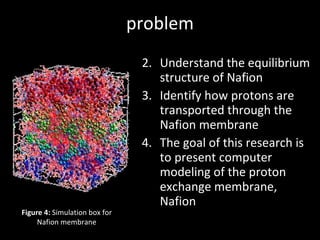
problem Understand the equilibrium structure of Nafion  Identify how protons are transported through the Nafion membrane The goal of this research is to present computer modeling of the proton exchange membrane, Nafion Figure 4:  Simulation box for Nafion membrane
contents fuel cells existing theory problem model results conclusion future work references
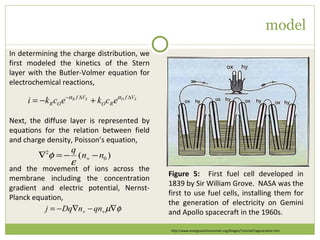
model In determining the charge distribution, we first modeled the kinetics of the Stern layer with the Butler-Volmer equation for electrochemical reactions, Next, the diffuse layer is represented by equations for the relation between field and charge density, Poisson’s equation,  and the movement of ions across the membrane including the concentration gradient and electric potential, Nernst-Planck equation,  Figure 5:  First fuel cell developed in 1839 by Sir William Grove.  NASA was the first to use fuel cells, installing them for the generation of electricity on Gemini and Apollo spacecraft in the 1960s.  http://www.energysolutionscenter.org/distgen/Tutorial/Cogeneration.htm
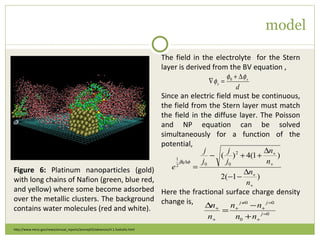
model The field in the electrolyte  for the Stern layer is derived from the BV equation , Since an electric field must be continuous, the field from the Stern layer must match the field in the diffuse layer. The Poisson and NP equation can be solved simultaneously for a function of the potential,  Here the fractional surface charge density change is, Figure 6:  Platinum nanoparticles (gold) with long chains of Nafion (green, blue red, and yellow) where some become adsorbed over the metallic clusters. The background contains water molecules (red and white).  http://www.nersc.gov/news/annual_reports/annrep03/advances/4.1.fuelcells.html
contents fuel cells existing theory problem model results conclusion future work references
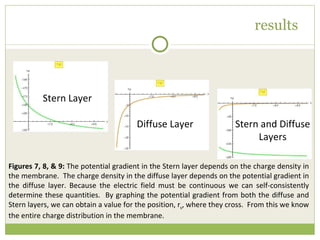
results Figures 7, 8, & 9:  The potential gradient in the Stern layer depends on the charge density in the membrane.  The charge density in the diffuse layer depends on the potential gradient in the diffuse layer. Because the electric field must be continuous we can self-consistently determine these quantities.  By graphing the potential gradient from both the diffuse and Stern layers, we can obtain a value for the position, r s , where they cross.  From this we know the entire charge distribution in the membrane. Stern Layer Diffuse Layer Stern and Diffuse Layers
contents fuel cells existing theory problem model results conclusion future work references
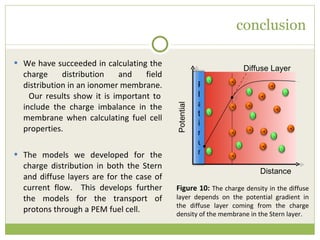
conclusion We have succeeded in calculating the charge distribution and field distribution in an ionomer membrane.  Our results show it is important to include the charge imbalance in the membrane when calculating fuel cell properties.  The models we developed for the charge distribution in both the Stern and diffuse layers are for the case of current flow.  This develops further the models for the transport of protons through a PEM fuel cell.  Figure 10:  The charge density in the diffuse layer depends on the potential gradient in the diffuse layer coming from the charge density of the membrane in the Stern layer. Diffuse Layer + Distance Platinum - - - - + + + - - - - - + + + + + + + +
contents fuel cells existing theory problem model results conclusion future work references
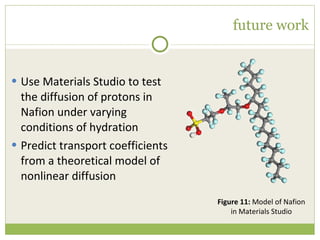
future work Use Materials Studio to test the diffusion of protons in Nafion under varying conditions of hydration Predict transport coefficients from a theoretical model of nonlinear diffusion Figure 11:  Model of Nafion in Materials Studio
contents fuel cells existing theory problem model results conclusion future work references
references Biesheuvel, P.M., Franco, A.A., Bazant, M.Z. (2009). Diffuse Charge Effects in Fuel Cell  Membranes. Journal of The Electrochemical Society.  156, B225-B233. Allahyarov, E. and P. Taylor (2009). Simulation Study of the Correlation between Structure and Conductivity in Stretched Nafion. Journal of Physical Chemistry. 113, 610-617. Yuan, X. and H. Wang. PEM Fuel Cell Electrocatalysts and Catalyst Layers. New York: Springer, 2008. http://www.nersc.gov/news/annual_reports/annrep03/advances/4.1.fuelcells.html http://www.energysolutionscenter.org/distgen/Tutorial/Cogeneration.htm
special thanks A special thanks to professor Philip Taylor for his patience in teaching me the fundamentals of fuel cells, along with professor Kash and Betty Gaffney for their help organizing the Physics REU program. This research was supported by the Physics REU program at Case Western Reserve University, a Research Experience for Undergraduates (REU) funded by the  NSF grant DMR-0850037.
questions?

Kaytlin Brinker Presentation

  • 1.
    KAYTLIN BRINKER ADVISOR:PROFESSOR PHILIP TAYLOR CASE WESTERN RESERVE UNIVERSITY Computer Modeling of Proton Exchange Membrane Fuel Cells August 4, 2009 Physics REU 2009 Final Presentation
  • 2.
    contents fuel cellsexisting theory problem model results conclusion future work references
  • 3.
    contents fuel cellsexisting theory problem model results conclusion future work references
  • 4.
    fuel cells Fuelcells are an important alternative option for providing electrical power to devices where energy is limited The energy comes from an electrochemical reaction of hydrogen and oxygen Byproducts of this reaction are simply water and air One major area for fuel cell applications is in automobiles They provide clean energy and are more fuel efficient than the current combustion engine Fuel cells offer a much needed shift in energy production Figure 2: A fuel cell is made up of layers including the electrode made of platinum, the Stern layer consisting of the electrolyte, followed by the diffuse layer where diffuse charge can be found. Figure 1: A fuel cell is a combination of two electrodes and an electrolyte. The electrolyte conducts hydrogens from the anode but blocks electrons, which are forced to enter an external circuit. The electrons and protons recombine at the cathode creating a current, and in turn, electrical power.
  • 5.
    contents fuel cellsexisting theory problem model results conclusion future work references
  • 6.
    contents fuel cellsexisting theory problem model results conclusion future work references
  • 7.
    Bazant et al.described the effects of diffuse charge on the electron-transfer rate for thicker diffuse layers The Butler-Volmer (BV) equation with the Frumkin correction give the kinetics of the electrochemical reaction This equation describes the charge transfer across the Stern layer for a membrane Figure 3: A model of the electrostatic potential profile in the fuel cell membrane is given by Bazant et al. In Fig. 1a, excess protons exist in the anodic polarization layer and a deficit on the cathodic side. Fig. 1b I is the same case; II has an excess of protons on both sides; while III displays a deficit of protons on both sides. The dashed lines show the electrical voltage increase through the external circuit [1]. existing theory Biesheuvel, P.M., Franco, A.A., Bazant, M.Z. (2009). Diffuse Charge Effects in Fuel Cell Membranes. Journal of The Electrochemical Society. 156, B225-B233.
  • 8.
    contents fuel cellsexisting theory problem model results conclusion future work references
  • 9.
    contents fuel cellsexisting theory problem model results conclusion future work references
  • 10.
    problem Understand theequilibrium structure of Nafion Identify how protons are transported through the Nafion membrane The goal of this research is to present computer modeling of the proton exchange membrane, Nafion Figure 4: Simulation box for Nafion membrane
  • 11.
    contents fuel cellsexisting theory problem model results conclusion future work references
  • 12.
    contents fuel cellsexisting theory problem model results conclusion future work references
  • 13.
    model In determiningthe charge distribution, we first modeled the kinetics of the Stern layer with the Butler-Volmer equation for electrochemical reactions, Next, the diffuse layer is represented by equations for the relation between field and charge density, Poisson’s equation, and the movement of ions across the membrane including the concentration gradient and electric potential, Nernst-Planck equation, Figure 5: First fuel cell developed in 1839 by Sir William Grove. NASA was the first to use fuel cells, installing them for the generation of electricity on Gemini and Apollo spacecraft in the 1960s. http://www.energysolutionscenter.org/distgen/Tutorial/Cogeneration.htm
  • 14.
    model The fieldin the electrolyte for the Stern layer is derived from the BV equation , Since an electric field must be continuous, the field from the Stern layer must match the field in the diffuse layer. The Poisson and NP equation can be solved simultaneously for a function of the potential, Here the fractional surface charge density change is, Figure 6: Platinum nanoparticles (gold) with long chains of Nafion (green, blue red, and yellow) where some become adsorbed over the metallic clusters. The background contains water molecules (red and white). http://www.nersc.gov/news/annual_reports/annrep03/advances/4.1.fuelcells.html
  • 15.
    contents fuel cellsexisting theory problem model results conclusion future work references
  • 16.
    contents fuel cellsexisting theory problem model results conclusion future work references
  • 17.
    results Figures 7,8, & 9: The potential gradient in the Stern layer depends on the charge density in the membrane. The charge density in the diffuse layer depends on the potential gradient in the diffuse layer. Because the electric field must be continuous we can self-consistently determine these quantities. By graphing the potential gradient from both the diffuse and Stern layers, we can obtain a value for the position, r s , where they cross. From this we know the entire charge distribution in the membrane. Stern Layer Diffuse Layer Stern and Diffuse Layers
  • 18.
    contents fuel cellsexisting theory problem model results conclusion future work references
  • 19.
    contents fuel cellsexisting theory problem model results conclusion future work references
  • 20.
    conclusion We havesucceeded in calculating the charge distribution and field distribution in an ionomer membrane. Our results show it is important to include the charge imbalance in the membrane when calculating fuel cell properties. The models we developed for the charge distribution in both the Stern and diffuse layers are for the case of current flow. This develops further the models for the transport of protons through a PEM fuel cell. Figure 10: The charge density in the diffuse layer depends on the potential gradient in the diffuse layer coming from the charge density of the membrane in the Stern layer. Diffuse Layer + Distance Platinum - - - - + + + - - - - - + + + + + + + +
  • 21.
    contents fuel cellsexisting theory problem model results conclusion future work references
  • 22.
    contents fuel cellsexisting theory problem model results conclusion future work references
  • 23.
    future work UseMaterials Studio to test the diffusion of protons in Nafion under varying conditions of hydration Predict transport coefficients from a theoretical model of nonlinear diffusion Figure 11: Model of Nafion in Materials Studio
  • 24.
    contents fuel cellsexisting theory problem model results conclusion future work references
  • 25.
    contents fuel cellsexisting theory problem model results conclusion future work references
  • 26.
    references Biesheuvel, P.M.,Franco, A.A., Bazant, M.Z. (2009). Diffuse Charge Effects in Fuel Cell Membranes. Journal of The Electrochemical Society. 156, B225-B233. Allahyarov, E. and P. Taylor (2009). Simulation Study of the Correlation between Structure and Conductivity in Stretched Nafion. Journal of Physical Chemistry. 113, 610-617. Yuan, X. and H. Wang. PEM Fuel Cell Electrocatalysts and Catalyst Layers. New York: Springer, 2008. http://www.nersc.gov/news/annual_reports/annrep03/advances/4.1.fuelcells.html http://www.energysolutionscenter.org/distgen/Tutorial/Cogeneration.htm
  • 27.
    special thanks Aspecial thanks to professor Philip Taylor for his patience in teaching me the fundamentals of fuel cells, along with professor Kash and Betty Gaffney for their help organizing the Physics REU program. This research was supported by the Physics REU program at Case Western Reserve University, a Research Experience for Undergraduates (REU) funded by the NSF grant DMR-0850037.
  • 28.