Synthesis and Characterization of Zinc Tin Nitride Ian Curtin
Group III Nitrides GaN, InN, AlN Widely studied group of materials Applications in optoelectric devices: LED Lights Lasers
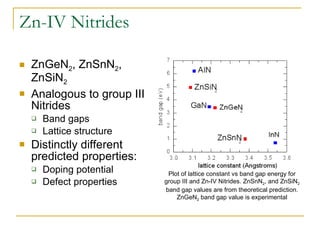
Zn-IV Nitrides ZnGeN 2 , ZnSnN 2 , ZnSiN 2 Analogous to group III Nitrides  Band gaps Lattice structure Distinctly different predicted properties: Doping potential Defect properties Plot of lattice constant vs band gap energy for group III and Zn-IV Nitrides. ZnSnN 2 , and ZnSiN 2  band gap values are from theoretical prediction. ZnGeN 2  band gap value is experimental
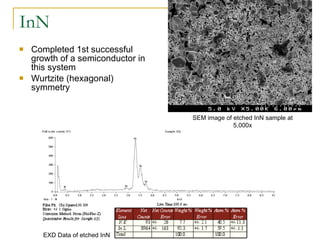
InN Completed 1st successful growth of a semiconductor in this system Wurtzite (hexagonal) symmetry SEM image of etched InN sample at 5,000x EXD Data of etched InN
ZnSnN 2 Zn-IV nitride analog to InN Theory predicts a band gap energy of 1 eV  (± 1 eV ?) To date has not yet be synthesized Orthorhombic (not perfectly wurtzite) lattice structure Due to Zn and Sn different bond lengths Stucture more closely matched with GaN
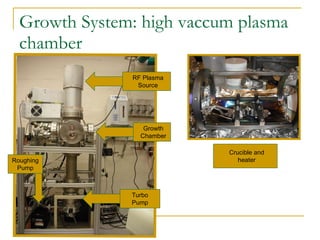
Growth System: high vaccum plasma chamber RF Plasma Source Growth Chamber Turbo Pump Roughing Pump Crucible and heater
System Changes Installed new turbo pump Lowered crucible and heater Allows observation of sample during growth Soon we’ll install a longer quartz tube Allowing increased amount of activated Nitrogen reaching the melt Before After
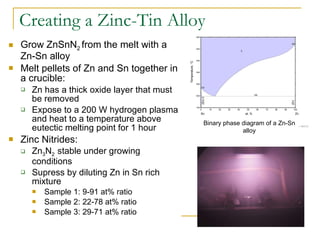
Creating a Zinc-Tin Alloy Grow ZnSnN 2  from the melt with a Zn-Sn alloy Melt pellets of Zn and Sn together in a crucible: Zn has a thick oxide layer that must be removed Expose to a 200 W hydrogen plasma and heat to a temperature above eutectic melting point for 1 hour Zinc Nitrides: Zn 3 N 2  stable under growing conditions Supress by diluting Zn in Sn rich mixture Sample 1: 9-91 at% ratio Sample 2: 22-78 at% ratio Sample 3: 29-71 at% ratio Binary phase diagram of a Zn-Sn alloy
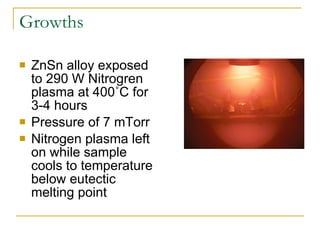
Growths ZnSn alloy exposed to 290 W Nitrogren plasma at 400˚C for 3-4 hours  Pressure of 7 mTorr Nitrogen plasma left on while sample cools to temperature below eutectic melting point
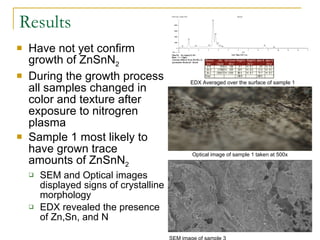
Results Have not yet confirm growth of ZnSnN 2 During the growth process all samples changed in color and texture after exposure to nitrogren plasma Sample 1 most likely to have grown trace amounts of ZnSnN 2 SEM and Optical images displayed signs of crystalline morphology EDX revealed the presence of Zn,Sn, and N EDX Averaged over the surface of sample 1 Optical image of sample 1 taken at 500x SEM image of sample 3
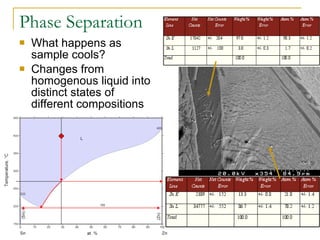
Phase Separation What happens as sample cools? Changes from homogenous liquid into distinct states of different compositions
Conclusions Haven’t yet confirmed growth of ZnSnN 2 Initial results showed small amounts of ZnSnN 2  could’ve formed More indepth analysis needed on certain features Saw strong evidence of phase separation Made positive changes to the experimental package

Ian Curtin

  • 1.
    Synthesis and Characterizationof Zinc Tin Nitride Ian Curtin
  • 2.
    Group III NitridesGaN, InN, AlN Widely studied group of materials Applications in optoelectric devices: LED Lights Lasers
  • 3.
    Zn-IV Nitrides ZnGeN2 , ZnSnN 2 , ZnSiN 2 Analogous to group III Nitrides Band gaps Lattice structure Distinctly different predicted properties: Doping potential Defect properties Plot of lattice constant vs band gap energy for group III and Zn-IV Nitrides. ZnSnN 2 , and ZnSiN 2 band gap values are from theoretical prediction. ZnGeN 2 band gap value is experimental
  • 4.
    InN Completed 1stsuccessful growth of a semiconductor in this system Wurtzite (hexagonal) symmetry SEM image of etched InN sample at 5,000x EXD Data of etched InN
  • 5.
    ZnSnN 2 Zn-IVnitride analog to InN Theory predicts a band gap energy of 1 eV (± 1 eV ?) To date has not yet be synthesized Orthorhombic (not perfectly wurtzite) lattice structure Due to Zn and Sn different bond lengths Stucture more closely matched with GaN
  • 6.
    Growth System: highvaccum plasma chamber RF Plasma Source Growth Chamber Turbo Pump Roughing Pump Crucible and heater
  • 7.
    System Changes Installednew turbo pump Lowered crucible and heater Allows observation of sample during growth Soon we’ll install a longer quartz tube Allowing increased amount of activated Nitrogen reaching the melt Before After
  • 8.
    Creating a Zinc-TinAlloy Grow ZnSnN 2 from the melt with a Zn-Sn alloy Melt pellets of Zn and Sn together in a crucible: Zn has a thick oxide layer that must be removed Expose to a 200 W hydrogen plasma and heat to a temperature above eutectic melting point for 1 hour Zinc Nitrides: Zn 3 N 2 stable under growing conditions Supress by diluting Zn in Sn rich mixture Sample 1: 9-91 at% ratio Sample 2: 22-78 at% ratio Sample 3: 29-71 at% ratio Binary phase diagram of a Zn-Sn alloy
  • 9.
    Growths ZnSn alloyexposed to 290 W Nitrogren plasma at 400˚C for 3-4 hours Pressure of 7 mTorr Nitrogen plasma left on while sample cools to temperature below eutectic melting point
  • 10.
    Results Have notyet confirm growth of ZnSnN 2 During the growth process all samples changed in color and texture after exposure to nitrogren plasma Sample 1 most likely to have grown trace amounts of ZnSnN 2 SEM and Optical images displayed signs of crystalline morphology EDX revealed the presence of Zn,Sn, and N EDX Averaged over the surface of sample 1 Optical image of sample 1 taken at 500x SEM image of sample 3
  • 11.
    Phase Separation Whathappens as sample cools? Changes from homogenous liquid into distinct states of different compositions
  • 12.
    Conclusions Haven’t yetconfirmed growth of ZnSnN 2 Initial results showed small amounts of ZnSnN 2 could’ve formed More indepth analysis needed on certain features Saw strong evidence of phase separation Made positive changes to the experimental package