J M R O A D
Supported by MCCIA, Pune
KNOWING THE PLACE
1CONTEXT
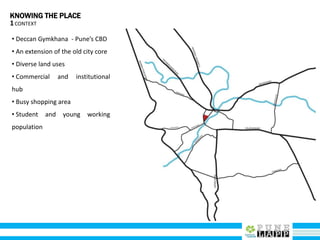
• Deccan Gymkhana - Pune’s CBD
• An extension of the old city core
• Diverse land uses
• Commercial and institutional
hub
• Busy shopping area
• Student and young working
population
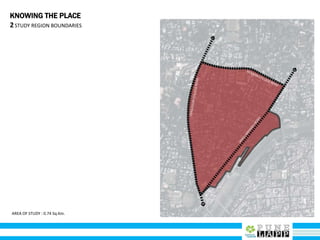
AREA OF STUDY : 0.74 Sq.Km.
2STUDY REGION BOUNDARIES
KNOWING THE PLACE
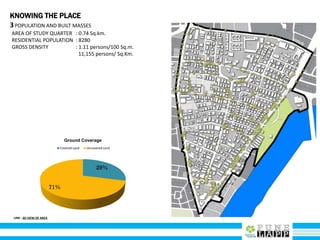
AREA OF STUDY QUARTER : 0.74 Sq.km.
RESIDENTIAL POPULATION : 8280
GROSS DENSITY : 1.11 persons/100 Sq.m.
11,155 persons/ Sq.Km.
3POPULATION AND BUILT MASSES
KNOWING THE PLACE
29%
71%
Ground Coverage
Covered Land Uncovered Land
LINK : 3D VIEW OF AREA
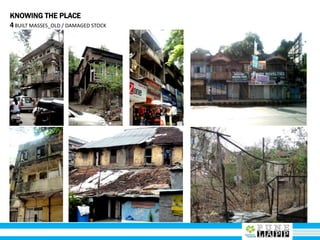
4BUILT MASSES_OLD / DAMAGED STOCK
KNOWING THE PLACE
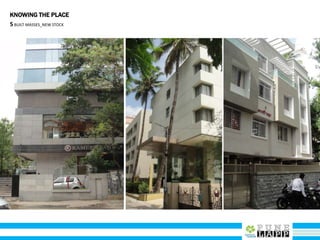
5BUILT MASSES_NEW STOCK
KNOWING THE PLACE
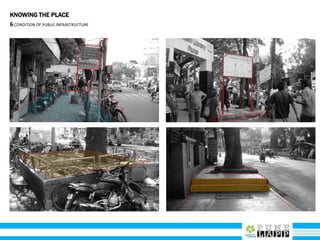
6CONDITION OF PUBLIC INFRASTRUCTURE
KNOWING THE PLACE
KNOWING THE PLACE
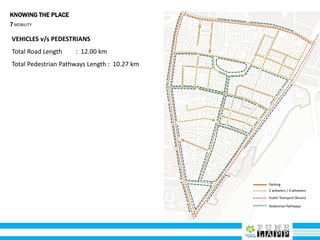
7MOBILITY
Public Transport (Buses)
2 wheelers / 4 wheelers
Parking
VEHICLES v/s PEDESTRIANS
Total Road Length : 12.00 km
Total Pedestrian Pathways Length : 10.27 km
Pedestrian Pathways
KNOWING THE PLACE
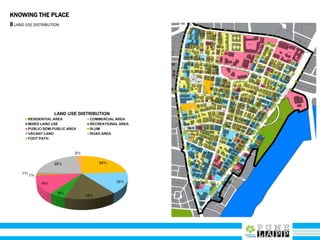
8LAND USE DISTRIBUTION
24%
16%
15%
5%
14%
1%
1%
22%
2%
LAND USE DISTRIBUTION
RESIDENTIAL AREA COMMERCIAL AREA
MIXED LAND USE RECREATIONAL AREA
PUBLIC-SEMI PUBLIC AREA SLUM
VACANT LAND ROAD AREA
FOOT PATH
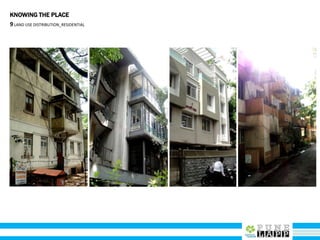
9LAND USE DISTRIBUTION_RESIDENTIAL
KNOWING THE PLACE
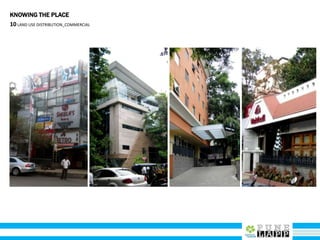
10LAND USE DISTRIBUTION_COMMERCIAL
KNOWING THE PLACE
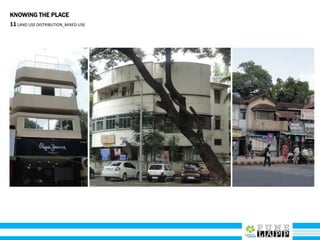
11LAND USE DISTRIBUTION_MIXED-USE
KNOWING THE PLACE
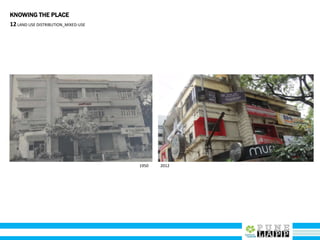
12LAND USE DISTRIBUTION_MIXED-USE
KNOWING THE PLACE
1950 2012
KNOWING THE PLACE
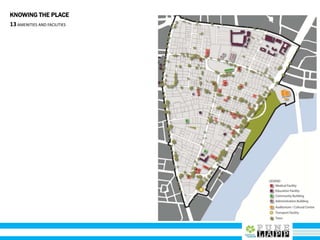
13AMENITIES AND FACILITIES
UNDERSTANDING THE POTENTIAL
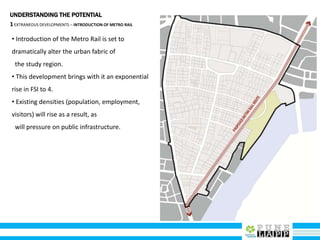
1EXTRANEOUS DEVELOPMENTS – INTRODUCTION OF METRO RAIL
• Introduction of the Metro Rail is set to
dramatically alter the urban fabric of
the study region.
• This development brings with it an exponential
rise in FSI to 4.
• Existing densities (population, employment,
visitors) will rise as a result, as
will pressure on public infrastructure.
ANALYSIS
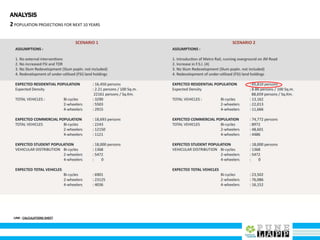
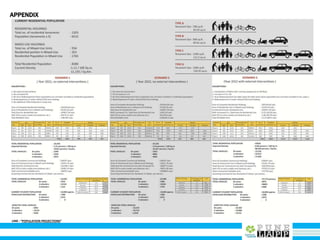
2POPULATION PROJECTIONS FOR NEXT 10 YEARS
LINK : CALCULATIONS SHEET
ANALYSIS
3ASSESSMENT OF EXISTING AMENITIES
MOBILITY
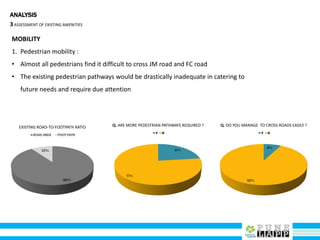
1. Pedestrian mobility :
• Almost all pedestrians find it difficult to cross JM road and FC road
• The existing pedestrian pathways would be drastically inadequate in catering to
future needs and require due attention
8%
92%
Q. DO YOU MANAGE TO CROSS ROADS EASILY ?
Y N
90%
10%
EXISTING ROAD-TO-FOOTPATH RATIO
ROAD AREA FOOT PATH
23%
77%
Q. ARE MORE PEDESTRIAN PATHWAYS REQUIRED ?
Y N
ANALYSIS
3ASSESSMENT OF EXISTING AMENITIES
MOBILITY
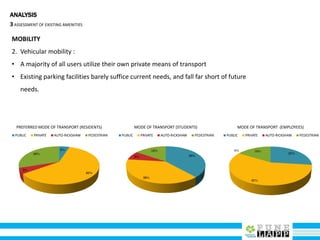
2. Vehicular mobility :
• A majority of all users utilize their own private means of transport
• Existing parking facilities barely suffice current needs, and fall far short of future
needs.
39%
38%
8%
15%
MODE OF TRANSPORT (STUDENTS)
PUBLIC PRIVATE AUTO-RICKSHAW PEDESTRIAN
5%
60%
5%
30%
PREFERRED MODE OF TRANSPORT (RESIDENTS)
PUBLIC PRIVATE AUTO-RICKSHAW PEDESTRIAN
27%
57%
0% 16%
MODE OF TRANSPORT (EMPLOYEES)
PUBLIC PRIVATE AUTO-RICKSHAW PEDESTRIAN
ANALYSIS
3ASSESSMENT OF EXISTING AMENITIES
AMENITIES
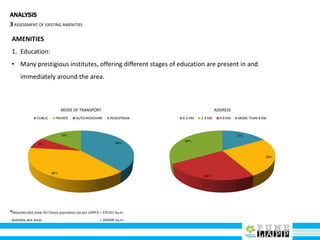
1. Education:
• Many prestigious institutes, offering different stages of education are present in and
immediately around the area.
39%
38%
8%
15%
MODE OF TRANSPORT
PUBLIC PRIVATE AUTO-RICKSHAW PEDESTRIAN
17%
25%
25%
33%
ADDRESS
0-2 KM 2-4 KM 4-8 KM MORE THAN 8 KM
*Required plot areas for future population (as per UDPFI) = 235161 Sq.m.
Available plot areas = 266600 Sq.m.
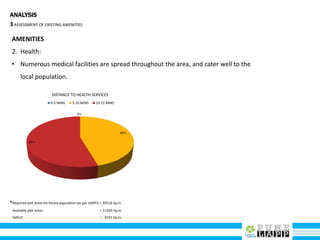
0%
45%
55%
DISTANCE TO HEALTH SERVICES
0-5 MINS 5-10 MINS 10-15 MINS
ANALYSIS
3ASSESSMENT OF EXISTING AMENITIES
AMENITIES
2. Health:
• Numerous medical facilities are spread throughout the area, and cater well to the
local population.
*Required plot areas for future population (as per UDPFI) = 20510 Sq.m.
Available plot areas = 11269 Sq.m.
Deficit = 9241 Sq.m.
ANALYSIS
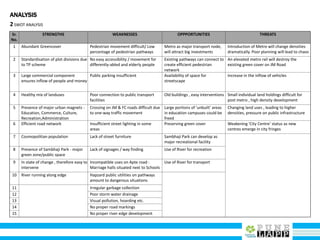
2SWOT ANALYSIS
Sr.
No.
STRENGTHS WEAKNESSES OPPPORTUNITIES THREATS
1 Abundant Greencover Pedestrian movement difficult/ Low
percentage of pedestrian pathways
Metro as major transport node,
will attract big investments
Introduction of Metro will change densities
dramatically. Poor planning will lead to chaos
2 Standardisation of plot divisions due
to TP scheme
No easy accessibility / movement for
differently-abled and elderly people
Existing pathways can connect to
create efficient pedestrian
network
An elevated metro rail will destroy the
existing green cover on JM Road
3 Large commercial component
ensures inflow of people and money
Public parking insufficient Availability of space for
streetscape
Increase in the inflow of vehicles
4 Healthy mix of landuses Poor connection to public transport
facilities
Old buildings , easy interventions Small individual land holdings difficult for
post metro , high density development
5 Presence of major urban magnets -
Education, Commerce, Culture,
Recreation,Administration
Crossing on JM & FC roads difficult due
to one-way traffic movement
Large portions of 'unbuilt' areas
in education campuses could be
freed
Changing land uses , leading to higher
densities, pressure on public infrastructure
6 Efficient road network Insufficient street lighting in some
areas
Preserving green cover Weakening 'City Centre' status as new
centres emerge in city fringes
7 Cosmopolitian population Lack of street furniture Sambhaji Park can develop as
major recreational facility
8 Presence of Sambhaji Park - major
green zone/public space
Lack of signages / way finding Use of River for recreation
9 In state of change , therefore easy to
intervene
Incompatible uses on Apte road :
Marriage halls situated next to Schools
Use of River for transport
10 River running along edge Hapzard public utilities on pathways
amount to dangerous situations
11 Irregular garbage collection
12 Poor storm water drainage
13 Visual pollution, hoarding etc.
14 No proper road markings
15 No proper river edge development
FORMING ISSUES AND TARGETS
1MAIN ISSUES
MOBILITY
• Facilitation of smooth pedestrian movement
• Accessibility for differently-abled and elderly citizens
• Re-configuration of JM Road and FC Road, to enable easy crossing
• Easy access to public transport facilities
VEHICULAR MOVEMENT
• Providing sufficient parking for incoming vehicles
• Clearly defined road edges and signages for road safety, and facilitate smooth flow of
vehicular traffic
PUBLIC SPACES AND NATURAL ELEMENTS
• Creation of more neighborhood and public spaces, scales ranging from small street furniture
to large public plazas
• Preservation of existing trees on JM and FC roads
SHORT TERM INTERVENTIONS
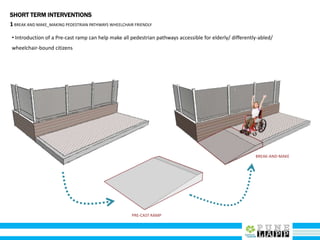
1BREAK AND MAKE_MAKING PEDESTRIAN PATHWAYS WHEELCHAIR FRIENDLY
PRE-CAST RAMP
BREAK-AND-MAKE
• Introduction of a Pre-cast ramp can help make all pedestrian pathways accessible for elderly/ differently-abled/
wheelchair-bound citizens
SHORT TERM INTERVENTIONS
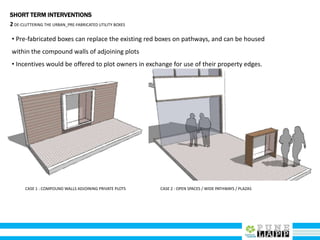
2DE-CLUTTERING THE URBAN_PRE-FABRICATED UTILITY BOXES
• Pre-fabricated boxes can replace the existing red boxes on pathways, and can be housed
within the compound walls of adjoining plots
• Incentives would be offered to plot owners in exchange for use of their property edges.
CASE 1 : COMPOUND WALLS ADJOINING PRIVATE PLOTS CASE 2 : OPEN SPACES / WIDE PATHWAYS / PLAZAS
SHORT TERM INTERVENTIONS
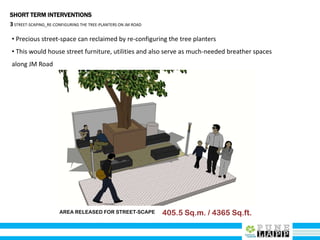
3STREET-SCAPING_RE-CONFIGURING THE TREE-PLANTERS ON JM ROAD
• Precious street-space can reclaimed by re-configuring the tree planters
• This would house street furniture, utilities and also serve as much-needed breather spaces
along JM Road
AREA RELEASED FOR STREET-SCAPE 405.5 Sq.m. / 4365 Sq.ft.
MEDIUM TERM INTERVENTIONS
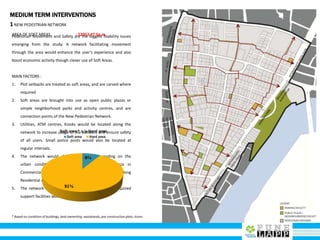
1NEW PEDESTRIAN NETWORK
Pedestrian Movement and Safety are the biggest livability issues
emerging from the study. A network facilitating movement
through the area would enhance the user’s experience and also
boost economic activity though clever use of Soft Areas.
MAIN FACTORS :
1. Plot setbacks are treated as soft areas, and are carved where
required
2. Soft areas are brought into use as open public plazas or
simple neighborhood parks and activity centres, and are
connection points of the New Pedestrian Network.
3. Utilities, ATM centres, Kiosks would be located along the
network to increase usage of the network and ensure safety
of all users. Small police posts would also be located at
regular intervals.
4. The network would change character depending on the
urban conditions surrounding it, ex., Public Plaza in
Commercial Areas, and quiet, landscaped pathways along
Residential Areas.
5. The network would also cater to cyclists, and the required
support facilities would be provided.
AREA OF SOFT AREAS : 52053.47 Sq.m.
* Based on condition of buildings, land ownership, wastelands, pre-construction plots, slums
9%
91%
Soft area* v/s Hard area
Soft area Hard area
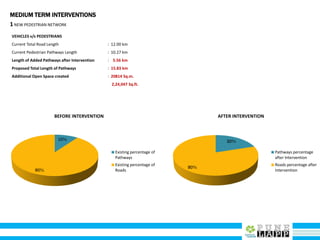
20%
80%
AFTER INTERVENTION
Pathways percentage
after Intervention
Roads percentage after
Intervention
10%
90%
BEFORE INTERVENTION
Existing percentage of
Pathways
Existing percentage of
Roads
MEDIUM TERM INTERVENTIONS
1NEW PEDESTRIAN NETWORK
VEHICLES v/s PEDESTRIANS
Current Total Road Length : 12.00 km
Current Pedestrian Pathways Length : 10.27 km
Length of Added Pathways after Intervention : 5.56 km
Proposed Total Length of Pathways : 15.83 km
Additional Open Space created : 20814 Sq.m.
2,24,047 Sq.ft.
MEDIUM TERM INTERVENTIONS
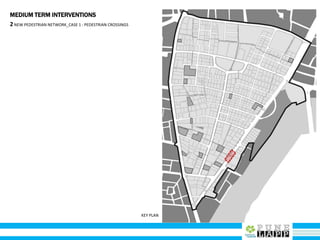
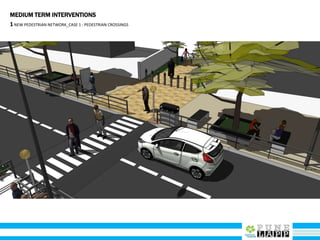
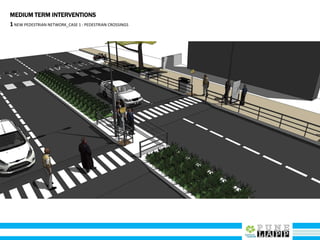
2NEW PEDESTRIAN NETWORK_CASE 1 : PEDESTRIAN CROSSINGS
KEY PLAN
MEDIUM TERM INTERVENTIONS
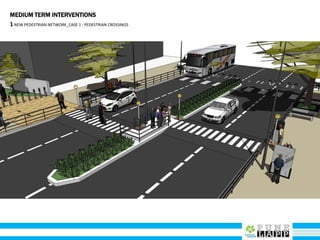
1NEW PEDESTRIAN NETWORK_CASE 1 : PEDESTRIAN CROSSINGS
MEDIUM TERM INTERVENTIONS
1NEW PEDESTRIAN NETWORK_CASE 1 : PEDESTRIAN CROSSINGS
MEDIUM TERM INTERVENTIONS
1NEW PEDESTRIAN NETWORK_CASE 1 : PEDESTRIAN CROSSINGS
MEDIUM TERM INTERVENTIONS
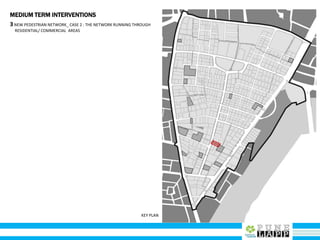
KEY PLAN
3NEW PEDESTRIAN NETWORK_ CASE 2 : THE NETWORK RUNNING THROUGH
RESIDENTIAL/ COMMERCIAL AREAS
MEDIUM TERM INTERVENTIONS
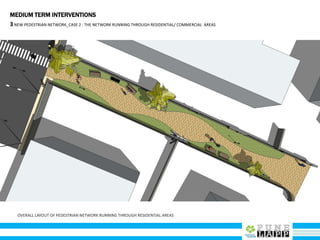
3NEW PEDESTRIAN NETWORK_CASE 2 : THE NETWORK RUNNING THROUGH RESIDENTIAL/ COMMERCIAL AREAS
OVERALL LAYOUT OF PEDESTRIAN NETWORK RUNNING THROUGH RESIDENTIAL AREAS
MEDIUM TERM INTERVENTIONS
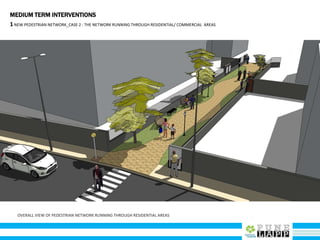
1NEW PEDESTRIAN NETWORK_CASE 2 : THE NETWORK RUNNING THROUGH RESIDENTIAL/ COMMERCIAL AREAS
OVERALL VIEW OF PEDESTRIAN NETWORK RUNNING THROUGH RESIDENTIAL AREAS
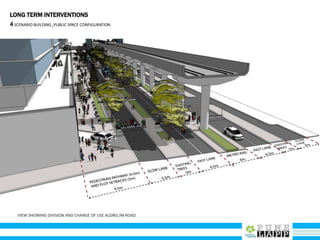
VIEW SHOWING DIVISION AND CHANGE OF USE ALONG JM ROAD
LONG TERM INTERVENTIONS
4SCENARIO BUILDING_PUBLIC SPACE CONFIGURATION
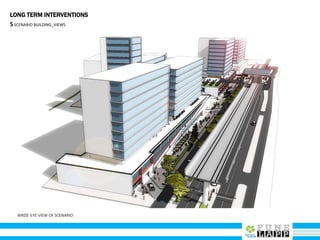
BIRDS’ EYE VIEW OF SCENARIO
LONG TERM INTERVENTIONS
5SCENARIO BUILDING_VIEWS
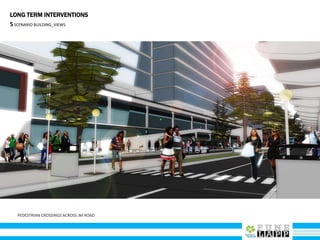
PEDESTRIAN CROSSINGS ACROSS JM ROAD
LONG TERM INTERVENTIONS
5SCENARIO BUILDING_VIEWS
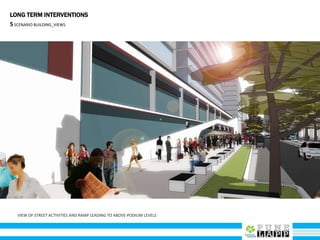
VIEW OF STREET ACTIVITIES AND RAMP LEADING TO ABOVE-PODIUM LEVELS
LONG TERM INTERVENTIONS
5SCENARIO BUILDING_VIEWS
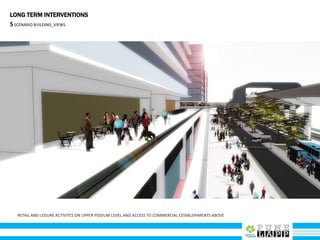
RETAIL AND LEISURE ACTIVITES ON UPPER PODIUM LEVEL AND ACCESS TO COMMERCIAL ESTABLISHMENTS ABOVE
LONG TERM INTERVENTIONS
5SCENARIO BUILDING_VIEWS
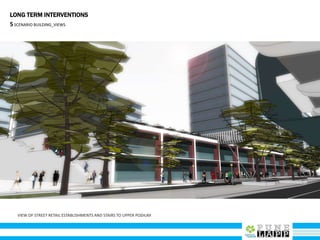
VIEW OF STREET RETAIL ESTABLISHMENTS AND STAIRS TO UPPER PODIUM
LONG TERM INTERVENTIONS
5SCENARIO BUILDING_VIEWS
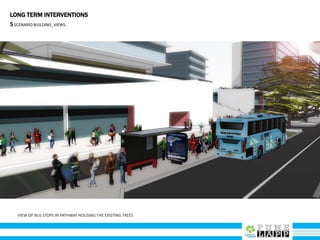
VIEW OF BUS STOPS IN PATHWAY HOUSING THE EXISTING TREES
LONG TERM INTERVENTIONS
5SCENARIO BUILDING_VIEWS
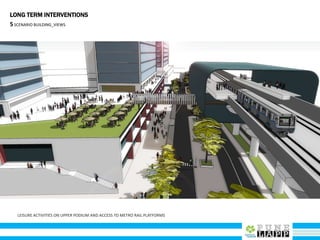
LEISURE ACTIVITIES ON UPPER PODIUM AND ACCESS TO METRO RAIL PLATFORMS
LONG TERM INTERVENTIONS
5SCENARIO BUILDING_VIEWS
LONG TERM INTERVENTIONS
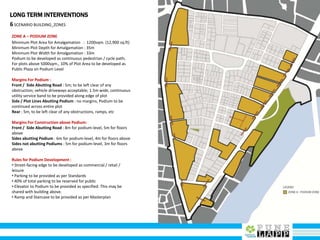
6SCENARIO BUILDING_ZONES
ZONE A – PODIUM ZONE
Minimum Plot Area for Amalgamation : 1200sqm. (12,900 sq.ft)
Minimum Plot Depth for Amalgamation : 35m
Minimum Plot Width for Amalgamation : 33m
Podium to be developed as continuous pedestrian / cycle path;
For plots above 5000sqm., 10% of Plot Area to be developed as
Public Plaza on Podium Level
Margins For Podium :
Front / Side Abutting Road : 5m; to be left clear of any
obstruction; vehicle driveways acceptable; 1.5m wide, continuous
utility service band to be provided along edge of plot
Side / Plot Lines Abutting Podium : no margins, Podium to be
continued across entire plot
Rear : 5m, to be left clear of any obstructions, ramps, etc
Margins For Construction above Podium:
Front / Side Abutting Road : 8m for podium-level, 5m for floors
above
Sides abutting Podium : 6m for podium-level, 4m for floors above
Sides not abutting Podiums : 5m for podium-level, 3m for floors
above
Rules for Podium Development :
• Street-facing edge to be developed as commercial / retail /
leisure
• Parking to be provided as per Standards
• 40% of total parking to be reserved for public
• Elevator to Podium to be provided as specified. This may be
shared with building above.
• Ramp and Staircase to be provided as per Masterplan
LONG TERM INTERVENTIONS
6SCENARIO BUILDING_ZONES
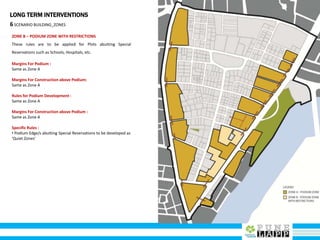
ZONE B – PODIUM ZONE WITH RESTRICTIONS
These rules are to be applied for Plots abutting Special
Reservations such as Schools, Hospitals, etc.
Margins For Podium :
Same as Zone A
Margins For Construction above Podium:
Same as Zone A
Rules for Podium Development :
Same as Zone A
Margins For Construction above Podium :
Same as Zone A
Specific Rules :
• Podium Edge/s abutting Special Reservations to be developed as
‘Quiet Zones’
LONG TERM INTERVENTIONS
6SCENARIO BUILDING_ZONES
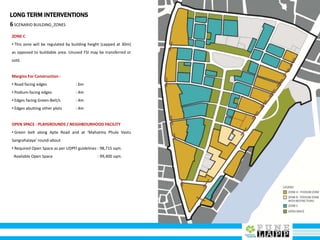
ZONE C
• This zone will be regulated by building height (capped at 30m)
as opposed to buildable area. Unused FSI may be transferred or
sold.
Margins For Construction :
• Road facing edges : 6m
• Podium-facing edges : 4m
• Edges facing Green-Belt/s : 4m
• Edges abutting other plots : 4m
OPEN SPACE : PLAYGROUNDS / NEIGHBOURHOOD FACILITY
• Green belt along Apte Road and at ‘Mahatma Phule Vastu
Sangrahalaya’ round-about
• Required Open Space as per UDPFI guidelines : 98,715 sqm.
Available Open Space : 99,400 sqm.
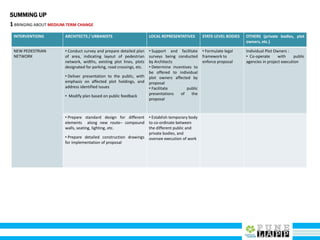
SUMMING UP
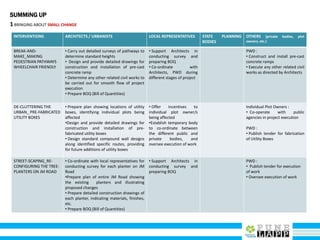
1BRINGING ABOUT SMALL CHANGE
INTERVENTIONS ARCHITECTS / URBANISTS LOCAL REPRESENTATIVES STATE PLANNING
BODIES
OTHERS (private bodies, plot
owners, etc.)
BREAK-AND-
MAKE_MAKING
PEDESTRIAN PATHWAYS
WHEELCHAIR FRIENDLY
• Carry out detailed surveys of pathways to
determine standard heights
• Design and provide detailed drawings for
construction and installation of pre-cast
concrete ramp
• Determine any other related civil works to
be carried out for smooth flow of project
execution
• Prepare BOQ (Bill of Quantities)
• Support Architects in
conducting survey and
preparing BOQ
• Co-ordinate with
Architects, PWD during
different stages of project
PWD :
• Construct and install pre-cast
concrete ramps
• Execute any other related civil
works as directed by Architects
DE-CLUTTERING THE
URBAN_ PRE-FABRICATED
UTILITY BOXES
• Prepare plan showing locations of utility
boxes, identifying individual plots being
affected
•Design and provide detailed drawings for
construction and installation of pre-
fabricated utility boxes
• Design standard compound wall designs
along identified specific routes, providing
for future additions of utility boxes
• Offer incentives to
individual plot owner/s
being affected
•Establish temporary body
to co-ordinate between
the different public and
private bodies, and
oversee execution of work
Individual Plot Owners :
• Co-operate with public
agencies in project execution
PWD :
• Publish tender for fabrication
of Utility Boxes
STREET-SCAPING_RE-
CONFIGURING THE TREE-
PLANTERS ON JM ROAD
• Co-ordinate with local representatives for
conducting survey for each planter on JM
Road
•Prepare plan of entire JM Road showing
the existing planters and illustrating
proposed changes
• Prepare detailed construction drawings of
each planter, indicating materials, finishes,
etc.
• Prepare BOQ (Bill of Quantities)
• Support Architects in
conducting survey and
preparing BOQ
PWD :
• Publish tender for execution
of work
• Oversee execution of work
SUMMING UP
1BRINGING ABOUT MEDIUM-TERM CHANGE
INTERVENTIONS ARCHITECTS / URBANISTS LOCAL REPRESENTATIVES STATE-LEVEL BODIES OTHERS (private bodies, plot
owners, etc.)
NEW PEDESTRIAN
NETWORK
• Conduct survey and prepare detailed plan
of area, indicating layout of pedestrian
network, widths, existing plot lines, plots
designated for parking, road crossings, etc.
• Deliver presentation to the public, with
emphasis on affected plot holdings, and
address identified issues
• Modify plan based on public feedback
• Support and facilitate
surveys being conducted
by Architects
• Determine incentives to
be offered to individual
plot owners affected by
proposal
• Facilitate public
presentations of the
proposal
• Formulate legal
framework to
enforce proposal
Individual Plot Owners :
• Co-operate with public
agencies in project execution
• Prepare standard design for different
elements along new route– compound
walls, seating, lighting, etc.
• Prepare detailed construction drawings
for implementation of proposal
• Establish temporary body
to co-ordinate between
the different public and
private bodies, and
oversee execution of work
….thank you
APPENDIX
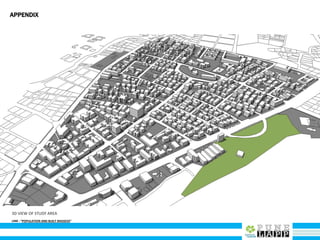
LINK : “POPULATION AND BUILT MASSESS”
3D VIEW OF STUDY AREA
APPENDIX
LINK : “POPULATION PROJECTIONS”

Janwani - LAPP JM Rd

  • 1.
    J M RO A D Supported by MCCIA, Pune
  • 2.
    KNOWING THE PLACE 1CONTEXT •Deccan Gymkhana - Pune’s CBD • An extension of the old city core • Diverse land uses • Commercial and institutional hub • Busy shopping area • Student and young working population
  • 3.
    AREA OF STUDY: 0.74 Sq.Km. 2STUDY REGION BOUNDARIES KNOWING THE PLACE
  • 4.
    AREA OF STUDYQUARTER : 0.74 Sq.km. RESIDENTIAL POPULATION : 8280 GROSS DENSITY : 1.11 persons/100 Sq.m. 11,155 persons/ Sq.Km. 3POPULATION AND BUILT MASSES KNOWING THE PLACE 29% 71% Ground Coverage Covered Land Uncovered Land LINK : 3D VIEW OF AREA
  • 5.
    4BUILT MASSES_OLD /DAMAGED STOCK KNOWING THE PLACE
  • 6.
  • 7.
    6CONDITION OF PUBLICINFRASTRUCTURE KNOWING THE PLACE
  • 8.
    KNOWING THE PLACE 7MOBILITY PublicTransport (Buses) 2 wheelers / 4 wheelers Parking VEHICLES v/s PEDESTRIANS Total Road Length : 12.00 km Total Pedestrian Pathways Length : 10.27 km Pedestrian Pathways
  • 9.
    KNOWING THE PLACE 8LANDUSE DISTRIBUTION 24% 16% 15% 5% 14% 1% 1% 22% 2% LAND USE DISTRIBUTION RESIDENTIAL AREA COMMERCIAL AREA MIXED LAND USE RECREATIONAL AREA PUBLIC-SEMI PUBLIC AREA SLUM VACANT LAND ROAD AREA FOOT PATH
  • 10.
  • 11.
  • 12.
  • 13.
  • 14.
  • 15.
    UNDERSTANDING THE POTENTIAL 1EXTRANEOUSDEVELOPMENTS – INTRODUCTION OF METRO RAIL • Introduction of the Metro Rail is set to dramatically alter the urban fabric of the study region. • This development brings with it an exponential rise in FSI to 4. • Existing densities (population, employment, visitors) will rise as a result, as will pressure on public infrastructure.
  • 16.
    ANALYSIS 2POPULATION PROJECTIONS FORNEXT 10 YEARS LINK : CALCULATIONS SHEET
  • 17.
    ANALYSIS 3ASSESSMENT OF EXISTINGAMENITIES MOBILITY 1. Pedestrian mobility : • Almost all pedestrians find it difficult to cross JM road and FC road • The existing pedestrian pathways would be drastically inadequate in catering to future needs and require due attention 8% 92% Q. DO YOU MANAGE TO CROSS ROADS EASILY ? Y N 90% 10% EXISTING ROAD-TO-FOOTPATH RATIO ROAD AREA FOOT PATH 23% 77% Q. ARE MORE PEDESTRIAN PATHWAYS REQUIRED ? Y N
  • 18.
    ANALYSIS 3ASSESSMENT OF EXISTINGAMENITIES MOBILITY 2. Vehicular mobility : • A majority of all users utilize their own private means of transport • Existing parking facilities barely suffice current needs, and fall far short of future needs. 39% 38% 8% 15% MODE OF TRANSPORT (STUDENTS) PUBLIC PRIVATE AUTO-RICKSHAW PEDESTRIAN 5% 60% 5% 30% PREFERRED MODE OF TRANSPORT (RESIDENTS) PUBLIC PRIVATE AUTO-RICKSHAW PEDESTRIAN 27% 57% 0% 16% MODE OF TRANSPORT (EMPLOYEES) PUBLIC PRIVATE AUTO-RICKSHAW PEDESTRIAN
  • 19.
    ANALYSIS 3ASSESSMENT OF EXISTINGAMENITIES AMENITIES 1. Education: • Many prestigious institutes, offering different stages of education are present in and immediately around the area. 39% 38% 8% 15% MODE OF TRANSPORT PUBLIC PRIVATE AUTO-RICKSHAW PEDESTRIAN 17% 25% 25% 33% ADDRESS 0-2 KM 2-4 KM 4-8 KM MORE THAN 8 KM *Required plot areas for future population (as per UDPFI) = 235161 Sq.m. Available plot areas = 266600 Sq.m.
  • 20.
    0% 45% 55% DISTANCE TO HEALTHSERVICES 0-5 MINS 5-10 MINS 10-15 MINS ANALYSIS 3ASSESSMENT OF EXISTING AMENITIES AMENITIES 2. Health: • Numerous medical facilities are spread throughout the area, and cater well to the local population. *Required plot areas for future population (as per UDPFI) = 20510 Sq.m. Available plot areas = 11269 Sq.m. Deficit = 9241 Sq.m.
  • 21.
    ANALYSIS 2SWOT ANALYSIS Sr. No. STRENGTHS WEAKNESSESOPPPORTUNITIES THREATS 1 Abundant Greencover Pedestrian movement difficult/ Low percentage of pedestrian pathways Metro as major transport node, will attract big investments Introduction of Metro will change densities dramatically. Poor planning will lead to chaos 2 Standardisation of plot divisions due to TP scheme No easy accessibility / movement for differently-abled and elderly people Existing pathways can connect to create efficient pedestrian network An elevated metro rail will destroy the existing green cover on JM Road 3 Large commercial component ensures inflow of people and money Public parking insufficient Availability of space for streetscape Increase in the inflow of vehicles 4 Healthy mix of landuses Poor connection to public transport facilities Old buildings , easy interventions Small individual land holdings difficult for post metro , high density development 5 Presence of major urban magnets - Education, Commerce, Culture, Recreation,Administration Crossing on JM & FC roads difficult due to one-way traffic movement Large portions of 'unbuilt' areas in education campuses could be freed Changing land uses , leading to higher densities, pressure on public infrastructure 6 Efficient road network Insufficient street lighting in some areas Preserving green cover Weakening 'City Centre' status as new centres emerge in city fringes 7 Cosmopolitian population Lack of street furniture Sambhaji Park can develop as major recreational facility 8 Presence of Sambhaji Park - major green zone/public space Lack of signages / way finding Use of River for recreation 9 In state of change , therefore easy to intervene Incompatible uses on Apte road : Marriage halls situated next to Schools Use of River for transport 10 River running along edge Hapzard public utilities on pathways amount to dangerous situations 11 Irregular garbage collection 12 Poor storm water drainage 13 Visual pollution, hoarding etc. 14 No proper road markings 15 No proper river edge development
  • 22.
    FORMING ISSUES ANDTARGETS 1MAIN ISSUES MOBILITY • Facilitation of smooth pedestrian movement • Accessibility for differently-abled and elderly citizens • Re-configuration of JM Road and FC Road, to enable easy crossing • Easy access to public transport facilities VEHICULAR MOVEMENT • Providing sufficient parking for incoming vehicles • Clearly defined road edges and signages for road safety, and facilitate smooth flow of vehicular traffic PUBLIC SPACES AND NATURAL ELEMENTS • Creation of more neighborhood and public spaces, scales ranging from small street furniture to large public plazas • Preservation of existing trees on JM and FC roads
  • 23.
    SHORT TERM INTERVENTIONS 1BREAKAND MAKE_MAKING PEDESTRIAN PATHWAYS WHEELCHAIR FRIENDLY PRE-CAST RAMP BREAK-AND-MAKE • Introduction of a Pre-cast ramp can help make all pedestrian pathways accessible for elderly/ differently-abled/ wheelchair-bound citizens
  • 24.
    SHORT TERM INTERVENTIONS 2DE-CLUTTERINGTHE URBAN_PRE-FABRICATED UTILITY BOXES • Pre-fabricated boxes can replace the existing red boxes on pathways, and can be housed within the compound walls of adjoining plots • Incentives would be offered to plot owners in exchange for use of their property edges. CASE 1 : COMPOUND WALLS ADJOINING PRIVATE PLOTS CASE 2 : OPEN SPACES / WIDE PATHWAYS / PLAZAS
  • 25.
    SHORT TERM INTERVENTIONS 3STREET-SCAPING_RE-CONFIGURINGTHE TREE-PLANTERS ON JM ROAD • Precious street-space can reclaimed by re-configuring the tree planters • This would house street furniture, utilities and also serve as much-needed breather spaces along JM Road AREA RELEASED FOR STREET-SCAPE 405.5 Sq.m. / 4365 Sq.ft.
  • 26.
    MEDIUM TERM INTERVENTIONS 1NEWPEDESTRIAN NETWORK Pedestrian Movement and Safety are the biggest livability issues emerging from the study. A network facilitating movement through the area would enhance the user’s experience and also boost economic activity though clever use of Soft Areas. MAIN FACTORS : 1. Plot setbacks are treated as soft areas, and are carved where required 2. Soft areas are brought into use as open public plazas or simple neighborhood parks and activity centres, and are connection points of the New Pedestrian Network. 3. Utilities, ATM centres, Kiosks would be located along the network to increase usage of the network and ensure safety of all users. Small police posts would also be located at regular intervals. 4. The network would change character depending on the urban conditions surrounding it, ex., Public Plaza in Commercial Areas, and quiet, landscaped pathways along Residential Areas. 5. The network would also cater to cyclists, and the required support facilities would be provided. AREA OF SOFT AREAS : 52053.47 Sq.m. * Based on condition of buildings, land ownership, wastelands, pre-construction plots, slums 9% 91% Soft area* v/s Hard area Soft area Hard area
  • 27.
    20% 80% AFTER INTERVENTION Pathways percentage afterIntervention Roads percentage after Intervention 10% 90% BEFORE INTERVENTION Existing percentage of Pathways Existing percentage of Roads MEDIUM TERM INTERVENTIONS 1NEW PEDESTRIAN NETWORK VEHICLES v/s PEDESTRIANS Current Total Road Length : 12.00 km Current Pedestrian Pathways Length : 10.27 km Length of Added Pathways after Intervention : 5.56 km Proposed Total Length of Pathways : 15.83 km Additional Open Space created : 20814 Sq.m. 2,24,047 Sq.ft.
  • 28.
    MEDIUM TERM INTERVENTIONS 2NEWPEDESTRIAN NETWORK_CASE 1 : PEDESTRIAN CROSSINGS KEY PLAN
  • 29.
    MEDIUM TERM INTERVENTIONS 1NEWPEDESTRIAN NETWORK_CASE 1 : PEDESTRIAN CROSSINGS
  • 30.
    MEDIUM TERM INTERVENTIONS 1NEWPEDESTRIAN NETWORK_CASE 1 : PEDESTRIAN CROSSINGS
  • 31.
    MEDIUM TERM INTERVENTIONS 1NEWPEDESTRIAN NETWORK_CASE 1 : PEDESTRIAN CROSSINGS
  • 32.
    MEDIUM TERM INTERVENTIONS KEYPLAN 3NEW PEDESTRIAN NETWORK_ CASE 2 : THE NETWORK RUNNING THROUGH RESIDENTIAL/ COMMERCIAL AREAS
  • 33.
    MEDIUM TERM INTERVENTIONS 3NEWPEDESTRIAN NETWORK_CASE 2 : THE NETWORK RUNNING THROUGH RESIDENTIAL/ COMMERCIAL AREAS OVERALL LAYOUT OF PEDESTRIAN NETWORK RUNNING THROUGH RESIDENTIAL AREAS
  • 34.
    MEDIUM TERM INTERVENTIONS 1NEWPEDESTRIAN NETWORK_CASE 2 : THE NETWORK RUNNING THROUGH RESIDENTIAL/ COMMERCIAL AREAS OVERALL VIEW OF PEDESTRIAN NETWORK RUNNING THROUGH RESIDENTIAL AREAS
  • 35.
    VIEW SHOWING DIVISIONAND CHANGE OF USE ALONG JM ROAD LONG TERM INTERVENTIONS 4SCENARIO BUILDING_PUBLIC SPACE CONFIGURATION
  • 36.
    BIRDS’ EYE VIEWOF SCENARIO LONG TERM INTERVENTIONS 5SCENARIO BUILDING_VIEWS
  • 37.
    PEDESTRIAN CROSSINGS ACROSSJM ROAD LONG TERM INTERVENTIONS 5SCENARIO BUILDING_VIEWS
  • 38.
    VIEW OF STREETACTIVITIES AND RAMP LEADING TO ABOVE-PODIUM LEVELS LONG TERM INTERVENTIONS 5SCENARIO BUILDING_VIEWS
  • 39.
    RETAIL AND LEISUREACTIVITES ON UPPER PODIUM LEVEL AND ACCESS TO COMMERCIAL ESTABLISHMENTS ABOVE LONG TERM INTERVENTIONS 5SCENARIO BUILDING_VIEWS
  • 40.
    VIEW OF STREETRETAIL ESTABLISHMENTS AND STAIRS TO UPPER PODIUM LONG TERM INTERVENTIONS 5SCENARIO BUILDING_VIEWS
  • 41.
    VIEW OF BUSSTOPS IN PATHWAY HOUSING THE EXISTING TREES LONG TERM INTERVENTIONS 5SCENARIO BUILDING_VIEWS
  • 42.
    LEISURE ACTIVITIES ONUPPER PODIUM AND ACCESS TO METRO RAIL PLATFORMS LONG TERM INTERVENTIONS 5SCENARIO BUILDING_VIEWS
  • 43.
    LONG TERM INTERVENTIONS 6SCENARIOBUILDING_ZONES ZONE A – PODIUM ZONE Minimum Plot Area for Amalgamation : 1200sqm. (12,900 sq.ft) Minimum Plot Depth for Amalgamation : 35m Minimum Plot Width for Amalgamation : 33m Podium to be developed as continuous pedestrian / cycle path; For plots above 5000sqm., 10% of Plot Area to be developed as Public Plaza on Podium Level Margins For Podium : Front / Side Abutting Road : 5m; to be left clear of any obstruction; vehicle driveways acceptable; 1.5m wide, continuous utility service band to be provided along edge of plot Side / Plot Lines Abutting Podium : no margins, Podium to be continued across entire plot Rear : 5m, to be left clear of any obstructions, ramps, etc Margins For Construction above Podium: Front / Side Abutting Road : 8m for podium-level, 5m for floors above Sides abutting Podium : 6m for podium-level, 4m for floors above Sides not abutting Podiums : 5m for podium-level, 3m for floors above Rules for Podium Development : • Street-facing edge to be developed as commercial / retail / leisure • Parking to be provided as per Standards • 40% of total parking to be reserved for public • Elevator to Podium to be provided as specified. This may be shared with building above. • Ramp and Staircase to be provided as per Masterplan
  • 44.
    LONG TERM INTERVENTIONS 6SCENARIOBUILDING_ZONES ZONE B – PODIUM ZONE WITH RESTRICTIONS These rules are to be applied for Plots abutting Special Reservations such as Schools, Hospitals, etc. Margins For Podium : Same as Zone A Margins For Construction above Podium: Same as Zone A Rules for Podium Development : Same as Zone A Margins For Construction above Podium : Same as Zone A Specific Rules : • Podium Edge/s abutting Special Reservations to be developed as ‘Quiet Zones’
  • 45.
    LONG TERM INTERVENTIONS 6SCENARIOBUILDING_ZONES ZONE C • This zone will be regulated by building height (capped at 30m) as opposed to buildable area. Unused FSI may be transferred or sold. Margins For Construction : • Road facing edges : 6m • Podium-facing edges : 4m • Edges facing Green-Belt/s : 4m • Edges abutting other plots : 4m OPEN SPACE : PLAYGROUNDS / NEIGHBOURHOOD FACILITY • Green belt along Apte Road and at ‘Mahatma Phule Vastu Sangrahalaya’ round-about • Required Open Space as per UDPFI guidelines : 98,715 sqm. Available Open Space : 99,400 sqm.
  • 46.
    SUMMING UP 1BRINGING ABOUTSMALL CHANGE INTERVENTIONS ARCHITECTS / URBANISTS LOCAL REPRESENTATIVES STATE PLANNING BODIES OTHERS (private bodies, plot owners, etc.) BREAK-AND- MAKE_MAKING PEDESTRIAN PATHWAYS WHEELCHAIR FRIENDLY • Carry out detailed surveys of pathways to determine standard heights • Design and provide detailed drawings for construction and installation of pre-cast concrete ramp • Determine any other related civil works to be carried out for smooth flow of project execution • Prepare BOQ (Bill of Quantities) • Support Architects in conducting survey and preparing BOQ • Co-ordinate with Architects, PWD during different stages of project PWD : • Construct and install pre-cast concrete ramps • Execute any other related civil works as directed by Architects DE-CLUTTERING THE URBAN_ PRE-FABRICATED UTILITY BOXES • Prepare plan showing locations of utility boxes, identifying individual plots being affected •Design and provide detailed drawings for construction and installation of pre- fabricated utility boxes • Design standard compound wall designs along identified specific routes, providing for future additions of utility boxes • Offer incentives to individual plot owner/s being affected •Establish temporary body to co-ordinate between the different public and private bodies, and oversee execution of work Individual Plot Owners : • Co-operate with public agencies in project execution PWD : • Publish tender for fabrication of Utility Boxes STREET-SCAPING_RE- CONFIGURING THE TREE- PLANTERS ON JM ROAD • Co-ordinate with local representatives for conducting survey for each planter on JM Road •Prepare plan of entire JM Road showing the existing planters and illustrating proposed changes • Prepare detailed construction drawings of each planter, indicating materials, finishes, etc. • Prepare BOQ (Bill of Quantities) • Support Architects in conducting survey and preparing BOQ PWD : • Publish tender for execution of work • Oversee execution of work
  • 47.
    SUMMING UP 1BRINGING ABOUTMEDIUM-TERM CHANGE INTERVENTIONS ARCHITECTS / URBANISTS LOCAL REPRESENTATIVES STATE-LEVEL BODIES OTHERS (private bodies, plot owners, etc.) NEW PEDESTRIAN NETWORK • Conduct survey and prepare detailed plan of area, indicating layout of pedestrian network, widths, existing plot lines, plots designated for parking, road crossings, etc. • Deliver presentation to the public, with emphasis on affected plot holdings, and address identified issues • Modify plan based on public feedback • Support and facilitate surveys being conducted by Architects • Determine incentives to be offered to individual plot owners affected by proposal • Facilitate public presentations of the proposal • Formulate legal framework to enforce proposal Individual Plot Owners : • Co-operate with public agencies in project execution • Prepare standard design for different elements along new route– compound walls, seating, lighting, etc. • Prepare detailed construction drawings for implementation of proposal • Establish temporary body to co-ordinate between the different public and private bodies, and oversee execution of work
  • 48.
  • 49.
    APPENDIX LINK : “POPULATIONAND BUILT MASSESS” 3D VIEW OF STUDY AREA
  • 50.