Structural Engineering
Laboratory
Non-destructive Testing
Laboratory
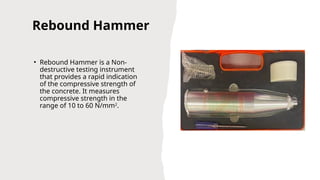
Rebound Hammer
• Rebound Hammer is a Non-
destructive testing instrument
that provides a rapid indication
of the compressive strength of
the concrete. It measures
compressive strength in the
range of 10 to 60 N/mm2
.
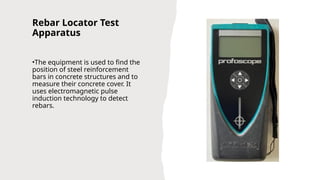
Rebar Locator Test
Apparatus
•The equipment is used to find the
position of steel reinforcement
bars in concrete structures and to
measure their concrete cover. It
uses electromagnetic pulse
induction technology to detect
rebars.
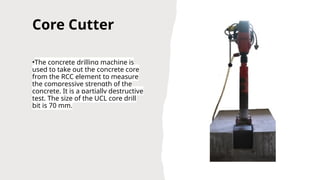
Core Cutter
•The concrete drilling machine is
used to take out the concrete core
from the RCC element to measure
the compressive strength of the
concrete. It is a partially destructive
test. The size of the UCL core drill
bit is 70 mm.
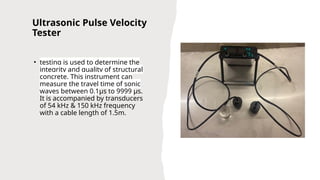
Ultrasonic Pulse Velocity
Tester
• testing is used to determine the
integrity and quality of structural
concrete. This instrument can
measure the travel time of sonic
waves between 0.1µs to 9999 µs.
It is accompanied by transducers
of 54 kHz & 150 kHz frequency
with a cable length of 1.5m.
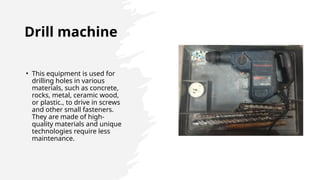
Drill machine
• This equipment is used for
drilling holes in various
materials, such as concrete,
rocks, metal, ceramic wood,
or plastic., to drive in screws
and other small fasteners.
They are made of high-
quality materials and unique
technologies require less
maintenance.
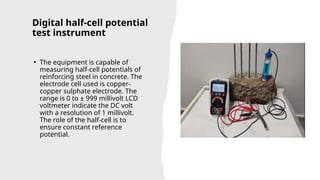
Digital half-cell potential
test instrument
• The equipment is capable of
measuring half-cell potentials of
reinforcing steel in concrete. The
electrode cell used is copper-
copper sulphate electrode. The
range is 0 to ± 999 millivolt LCD
voltmeter indicate the DC volt
with a resolution of 1 millivolt.
The role of the half-cell is to
ensure constant reference
potential.
Earthquake Engineering
Laboratory
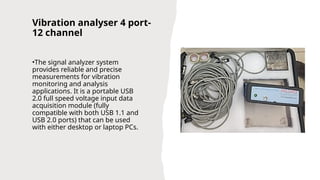
Vibration analyser 4 port-
12 channel
•The signal analyzer system
provides reliable and precise
measurements for vibration
monitoring and analysis
applications. It is a portable USB
2.0 full speed voltage input data
acquisition module (fully
compatible with both USB 1.1 and
USB 2.0 ports) that can be used
with either desktop or laptop PCs.
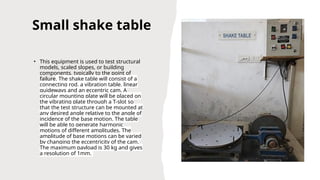
Small shake table
• This equipment is used to test structural
models, scaled slopes, or building
components, typically to the point of
failure. The shake table will consist of a
connecting rod, a vibration table, linear
guideways and an eccentric cam. A
circular mounting plate will be placed on
the vibrating plate through a T-slot so
that the test structure can be mounted at
any desired angle relative to the angle of
incidence of the base motion. The table
will be able to generate harmonic
motions of different amplitudes. The
amplitude of base motions can be varied
by changing the eccentricity of the cam.
The maximum payload is 30 kg and gives
a resolution of 1mm.
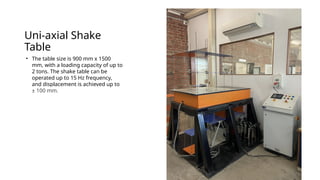
Uni-axial Shake
Table
• The table size is 900 mm x 1500
mm, with a loading capacity of up to
2 tons. The shake table can be
operated up to 15 Hz frequency,
and displacement is achieved up to
± 100 mm.
Structural Analysis
Models
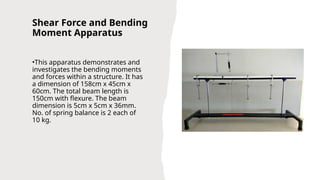
Shear Force and Bending
Moment Apparatus
•This apparatus demonstrates and
investigates the bending moments
and forces within a structure. It has
a dimension of 158cm x 45cm x
60cm. The total beam length is
150cm with flexure. The beam
dimension is 5cm x 5cm x 36mm.
No. of spring balance is 2 each of
10 kg.
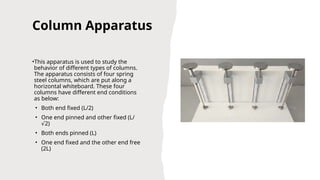
Column Apparatus
•This apparatus is used to study the
behavior of different types of columns.
The apparatus consists of four spring
steel columns, which are put along a
horizontal whiteboard. These four
columns have different end conditions
as below:
• Both end fixed (L/2)
• One end pinned and other fixed (L/
2)
√
• Both ends pinned (L)
• One end fixed and the other end free
(2L)
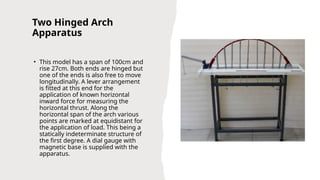
Two Hinged Arch
Apparatus
• This model has a span of 100cm and
rise 27cm. Both ends are hinged but
one of the ends is also free to move
longitudinally. A lever arrangement
is fitted at this end for the
application of known horizontal
inward force for measuring the
horizontal thrust. Along the
horizontal span of the arch various
points are marked at equidistant for
the application of load. This being a
statically indeterminate structure of
the first degree. A dial gauge with
magnetic base is supplied with the
apparatus.
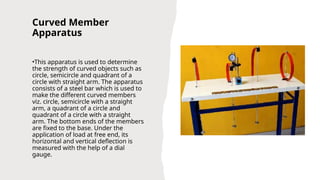
Curved Member
Apparatus
•This apparatus is used to determine
the strength of curved objects such as
circle, semicircle and quadrant of a
circle with straight arm. The apparatus
consists of a steel bar which is used to
make the different curved members
viz. circle, semicircle with a straight
arm, a quadrant of a circle and
quadrant of a circle with a straight
arm. The bottom ends of the members
are fixed to the base. Under the
application of load at free end, its
horizontal and vertical deflection is
measured with the help of a dial
gauge.
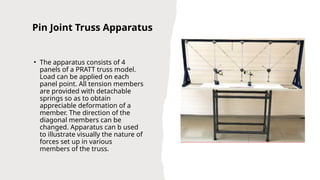
Pin Joint Truss Apparatus
• The apparatus consists of 4
panels of a PRATT truss model.
Load can be applied on each
panel point. All tension members
are provided with detachable
springs so as to obtain
appreciable deformation of a
member. The direction of the
diagonal members can be
changed. Apparatus can b used
to illustrate visually the nature of
forces set up in various
members of the truss.
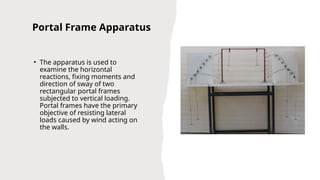
Portal Frame Apparatus
• The apparatus is used to
examine the horizontal
reactions, fixing moments and
direction of sway of two
rectangular portal frames
subjected to vertical loading.
Portal frames have the primary
objective of resisting lateral
loads caused by wind acting on
the walls.

CEPT University | Structural Engineering Laboratory

  • 1.
  • 2.
  • 3.
    Rebound Hammer • ReboundHammer is a Non- destructive testing instrument that provides a rapid indication of the compressive strength of the concrete. It measures compressive strength in the range of 10 to 60 N/mm2 .
  • 4.
    Rebar Locator Test Apparatus •Theequipment is used to find the position of steel reinforcement bars in concrete structures and to measure their concrete cover. It uses electromagnetic pulse induction technology to detect rebars.
  • 5.
    Core Cutter •The concretedrilling machine is used to take out the concrete core from the RCC element to measure the compressive strength of the concrete. It is a partially destructive test. The size of the UCL core drill bit is 70 mm.
  • 6.
    Ultrasonic Pulse Velocity Tester •testing is used to determine the integrity and quality of structural concrete. This instrument can measure the travel time of sonic waves between 0.1µs to 9999 µs. It is accompanied by transducers of 54 kHz & 150 kHz frequency with a cable length of 1.5m.
  • 7.
    Drill machine • Thisequipment is used for drilling holes in various materials, such as concrete, rocks, metal, ceramic wood, or plastic., to drive in screws and other small fasteners. They are made of high- quality materials and unique technologies require less maintenance.
  • 8.
    Digital half-cell potential testinstrument • The equipment is capable of measuring half-cell potentials of reinforcing steel in concrete. The electrode cell used is copper- copper sulphate electrode. The range is 0 to ± 999 millivolt LCD voltmeter indicate the DC volt with a resolution of 1 millivolt. The role of the half-cell is to ensure constant reference potential.
  • 9.
  • 10.
    Vibration analyser 4port- 12 channel •The signal analyzer system provides reliable and precise measurements for vibration monitoring and analysis applications. It is a portable USB 2.0 full speed voltage input data acquisition module (fully compatible with both USB 1.1 and USB 2.0 ports) that can be used with either desktop or laptop PCs.
  • 11.
    Small shake table •This equipment is used to test structural models, scaled slopes, or building components, typically to the point of failure. The shake table will consist of a connecting rod, a vibration table, linear guideways and an eccentric cam. A circular mounting plate will be placed on the vibrating plate through a T-slot so that the test structure can be mounted at any desired angle relative to the angle of incidence of the base motion. The table will be able to generate harmonic motions of different amplitudes. The amplitude of base motions can be varied by changing the eccentricity of the cam. The maximum payload is 30 kg and gives a resolution of 1mm.
  • 12.
    Uni-axial Shake Table • Thetable size is 900 mm x 1500 mm, with a loading capacity of up to 2 tons. The shake table can be operated up to 15 Hz frequency, and displacement is achieved up to ± 100 mm.
  • 13.
  • 14.
    Shear Force andBending Moment Apparatus •This apparatus demonstrates and investigates the bending moments and forces within a structure. It has a dimension of 158cm x 45cm x 60cm. The total beam length is 150cm with flexure. The beam dimension is 5cm x 5cm x 36mm. No. of spring balance is 2 each of 10 kg.
  • 15.
    Column Apparatus •This apparatusis used to study the behavior of different types of columns. The apparatus consists of four spring steel columns, which are put along a horizontal whiteboard. These four columns have different end conditions as below: • Both end fixed (L/2) • One end pinned and other fixed (L/ 2) √ • Both ends pinned (L) • One end fixed and the other end free (2L)
  • 16.
    Two Hinged Arch Apparatus •This model has a span of 100cm and rise 27cm. Both ends are hinged but one of the ends is also free to move longitudinally. A lever arrangement is fitted at this end for the application of known horizontal inward force for measuring the horizontal thrust. Along the horizontal span of the arch various points are marked at equidistant for the application of load. This being a statically indeterminate structure of the first degree. A dial gauge with magnetic base is supplied with the apparatus.
  • 17.
    Curved Member Apparatus •This apparatusis used to determine the strength of curved objects such as circle, semicircle and quadrant of a circle with straight arm. The apparatus consists of a steel bar which is used to make the different curved members viz. circle, semicircle with a straight arm, a quadrant of a circle and quadrant of a circle with a straight arm. The bottom ends of the members are fixed to the base. Under the application of load at free end, its horizontal and vertical deflection is measured with the help of a dial gauge.
  • 18.
    Pin Joint TrussApparatus • The apparatus consists of 4 panels of a PRATT truss model. Load can be applied on each panel point. All tension members are provided with detachable springs so as to obtain appreciable deformation of a member. The direction of the diagonal members can be changed. Apparatus can b used to illustrate visually the nature of forces set up in various members of the truss.
  • 19.
    Portal Frame Apparatus •The apparatus is used to examine the horizontal reactions, fixing moments and direction of sway of two rectangular portal frames subjected to vertical loading. Portal frames have the primary objective of resisting lateral loads caused by wind acting on the walls.