Teaching and Learning in Studio Units at CEPT University
Teaching and Learning Center, CEPT University
Program Structure
1
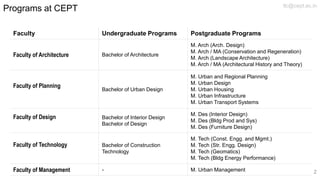
Faculty Undergraduate Programs Postgraduate Programs
Faculty of Architecture Bachelor of Architecture
M. Arch (Arch. Design)
M. Arch / MA (Conservation and Regeneration)
M. Arch (Landscape Architecture)
M. Arch / MA (Architectural History and Theory)
Faculty of Planning
Bachelor of Urban Design
M. Urban and Regional Planning
M. Urban Design
M. Urban Housing
M. Urban Infrastructure
M. Urban Transport Systems
Faculty of Design Bachelor of Interior Design
Bachelor of Design
M. Des (Interior Design)
M. Des (Bldg Prod and Sys)
M. Des (Furniture Design)
Faculty of Technology Bachelor of Construction
Technology
M. Tech (Const. Engg. and Mgmt.)
M. Tech (Str. Engg. Design)
M. Tech (Geomatics)
M. Tech (Bldg Energy Performance)
Faculty of Management - M. Urban Management
Programs at CEPT tlc@cept.ac.in
2
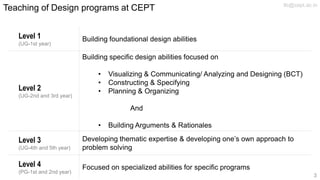
Level 1
(UG-1st year)
Building foundational design abilities
Level 2
(UG-2nd and 3rd year)
Building specific design abilities focused on
• Visualizing & Communicating/ Analyzing and Designing (BCT)
• Constructing & Specifying
• Planning & Organizing
And
• Building Arguments & Rationales
Level 3
(UG-4th and 5th year)
Developing thematic expertise & developing one’s own approach to
problem solving
Level 4
(PG-1st and 2nd year)
Focused on specialized abilities for specific programs
Teaching of Design programs at CEPT tlc@cept.ac.in
3
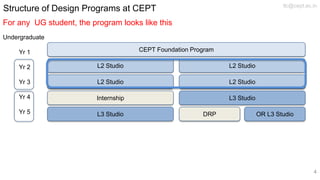
Structure of Design Programs at CEPT
For any UG student, the program looks like this
Undergraduate
Yr 1
Yr 2
Yr 3
Yr 4
Yr 5
Postgraduate
Yr 1
Yr 2
CEPT Foundation Program
L2 Studio
L3 Studio
L2 Studio
L2 Studio L2 Studio
DRP
L3 Studio
Internship
PG L3 Studio
PG Thesis
PG L3 Studio
PG Foundation
OR L3 Studio
tlc@cept.ac.in
4
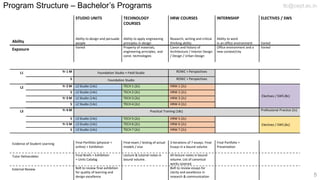
STUDIO UNITS TECHNOLOGY
COURSES
HRW COURSES INTERNSHIP ELECTIVES / SWS
Ability
Ability to design and persuade
people
Ability to apply engineering
principles in design
Research, writing and critical
thinking ability
Ability to work
in an office environment Varied
Exposure Varied Property of materials,
engineering principles, and
const. technologies
Canon and history of
Architecture / Interior Design
/ Design / Urban Design
Office environment and a
new context/city
Varied
L1 Yr 1 M Foundation Studio + Field Studio ROWC + Perspectives
S Foundation Studio ROWC + Perspectives
L2 Yr 2 M L2 Studio (14c) TECH 1 (2c) HRW 1 (2c)
Electives / SWS (8c)
S L2 Studio (14c) TECH 2 (2c) HRW 2 (2c)
Yr 3 M L2 Studio (14c) TECH 3 (2c) HRW 3 (2c)
S L2 Studio (14c) TECH 4 (2c) HRW 4 (2c)
L3 Yr 4 M Practical Training (18c) Professional Practice (2c)
S L3 Studio (14c) TECH 5 (2c) HRW 5 (2c)
Electives / SWS (6c)
Yr 5 M L3 Studio (14c) TECH 6 (2c) HRW 6 (2c)
S L3 Studio (14c) TECH 7 (2c) HRW 7 (2c)
Evidence of Student Learning Final Portfolio (physical +
online) + Exhibition
Final exam / testing of actual
models / viva
3 iterations of 7 essays. Final
Essays in a bound volume.
Final Portfolio +
Presentation
Tutor Deliverables Final Briefs + Exhibition
+ Units Catalog
Lecture & tutorial notes in
bound volume.
All lecture notes in bound
volume. List of canonical
works covered.
External Review BoR to review final exhibition
for quality of learning and
design excellence
BoR to review essays for
clarity and excellence in
research & communication
Program Structure – Bachelor’s Programs tlc@cept.ac.in
5
PG programs in Faculty of Architecture
Architectural
Design
Landscape
Architecture
Arch. History &
Theory
Conservation &
Regeneration
S 1
S 2
S 3
S 4
Foundation Studio
Foundation Studio
Foundation Studio
L4 Studio
L4 Studio
L4 Studio
L4 Studio / DRP
L4 Studio
L4 Studio
L4 Studio / DRP
L4 Studio
L4 Studio
Independent
Research
L4 Studio
L4 Studio
Directed
Research
Type of
Program
Deepening /
Specializing
New Field New Field New Field
tlc@cept.ac.in
6
Program Structure – Master’s Programs
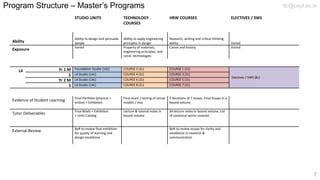
STUDIO UNITS TECHNOLOGY
COURSES
HRW COURSES ELECTIVES / SWS
Ability
Ability to design and persuade
people
Ability to apply engineering
principles in design
Research, writing and critical thinking
ability Varied
Exposure Varied Property of materials,
engineering principles, and
const. technologies
Canon and history Varied
L4 Yr 1 M Foundation Studio (14c) COURSE 2 (2c) COURSE 1 (2c)
Electives / SWS (8c)
S L4 Studio (14c) COURSE 4 (2c) COURSE 3 (2c)
Yr 2 M L4 Studio (14c) COURSE 6 (2c) COURSE 5 (2c)
S L4 Studio (14c) COURSE 8 (2c) COURSE 7 (2c)
Evidence of Student Learning Final Portfolio (physical +
online) + Exhibition
Final exam / testing of actual
models / viva
3 iterations of 7 essays. Final Essays in a
bound volume.
Tutor Deliverables Final Briefs + Exhibition
+ Units Catalog
Lecture & tutorial notes in
bound volume.
All lecture notes in bound volume. List
of canonical works covered.
External Review BoR to review final exhibition
for quality of learning and
design excellence
BoR to review essays for clarity and
excellence in research &
communication
tlc@cept.ac.in
7
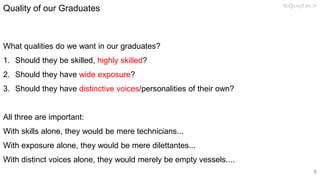
Quality of our Graduates
What qualities do we want in our graduates?
1. Should they be skilled, highly skilled?
2. Should they have wide exposure?
3. Should they have distinctive voices/personalities of their own?
All three are important:
With skills alone, they would be mere technicians...
With exposure alone, they would be mere dilettantes...
With distinct voices alone, they would merely be empty vessels....
tlc@cept.ac.in
8
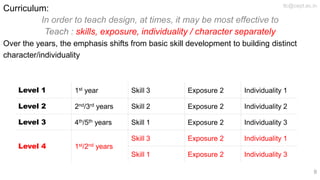
Curriculum:
Over the years, the emphasis shifts from basic skill development to building distinct
character/individuality. 6th/7th years Skill 1 Exposure 2 Individuality 3
Level 1 1st year Skill 3 Exposure 2 Individuality 1
Level 2 2nd/3rd years Skill 2 Exposure 2 Individuality 2
Level 3 4th/5th years Skill 1 Exposure 2 Individuality 3
Level 4 1st/2nd years
Skill 3 Exposure 2 Individuality 1
Skill 1 Exposure 2 Individuality 3
In order to teach design, at times, it may be most effective to
Teach : skills, exposure, individuality / character separately
tlc@cept.ac.in
9
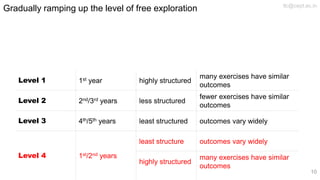
Gradually ramping up the level of free exploration
Level 1 1st year highly structured
many exercises have similar
outcomes
Level 2 2nd/3rd years less structured
fewer exercises have similar
outcomes
Level 3 4th/5th years least structured outcomes vary widely
Level 4 1st/2nd years
least structure outcomes vary widely
highly structured
many exercises have similar
outcomes
tlc@cept.ac.in
10
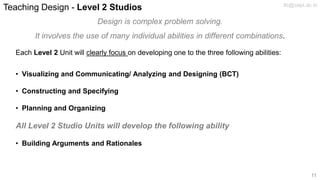
Teaching Design - Level 2 Studios
Each Level 2 Unit will clearly focus on developing one to the three following abilities:
• Visualizing and Communicating/ Analyzing and Designing (BCT)
• Constructing and Specifying
• Planning and Organizing
All Level 2 Studio Units will develop the following ability
• Building Arguments and Rationales
Design is complex problem solving.
It involves the use of many individual abilities in different combinations.
tlc@cept.ac.in
11
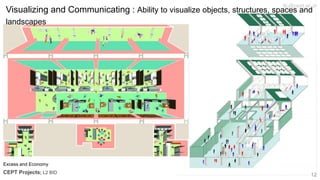
Excess and Economy
CEPT Projects; L2 BID
Visualizing and Communicating : Ability to visualize objects, structures, spaces and
landscapes
tlc@cept.ac.in
12
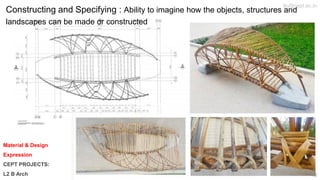
Material & Design
Expression
CEPT PROJECTS:
L2 B Arch
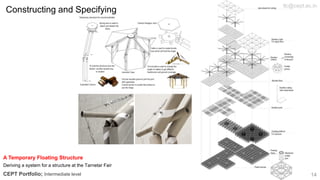
Constructing and Specifying : Ability to imagine how the objects, structures and
landscapes can be made or constructed
tlc@cept.ac.in
13
Constructing and Specifying
A Temporary Floating Structure
Deriving a system for a structure at the Tarnetar Fair
CEPT Portfolio; Intermediate level
tlc@cept.ac.in
14
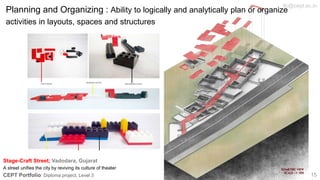
Stage-Craft Street; Vadodara, Gujarat
A street unifies the city by reviving its culture of theater
CEPT Portfolio; Diploma project, Level 3
Planning and Organizing : Ability to logically and analytically plan or organize
activities in layouts, spaces and structures
tlc@cept.ac.in
15
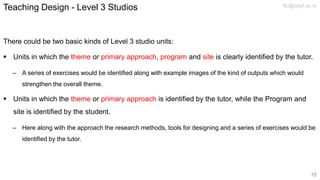
There could be two basic kinds of Level 3 studio units:
 Units in which the theme or primary approach, program and site is clearly identified by the tutor.
– A series of exercises would be identified along with example images of the kind of outputs which would
strengthen the overall theme.
 Units in which the theme or primary approach is identified by the tutor, while the Program and
site is identified by the student.
– Here along with the approach the research methods, tools for designing and a series of exercises would be
identified by the tutor.
Teaching Design - Level 3 Studios tlc@cept.ac.in
16
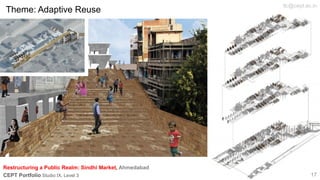
Restructuring a Public Realm: Sindhi Market, Ahmedabad
CEPT Portfolio Studio IX, Level 3
Theme: Adaptive Reuse
tlc@cept.ac.in
17
Two types of PG programs
1. Moving into a new field.
E.g. architects desiring a career in urban planning
2. Deepening skills / specializing within the same field.
E.g. architects desiring to specialize in housing design
Teaching Design - Level 4 Studios tlc@cept.ac.in
18

Program Structure

  • 1.
    Teaching and Learningin Studio Units at CEPT University Teaching and Learning Center, CEPT University Program Structure 1
  • 2.
    Faculty Undergraduate ProgramsPostgraduate Programs Faculty of Architecture Bachelor of Architecture M. Arch (Arch. Design) M. Arch / MA (Conservation and Regeneration) M. Arch (Landscape Architecture) M. Arch / MA (Architectural History and Theory) Faculty of Planning Bachelor of Urban Design M. Urban and Regional Planning M. Urban Design M. Urban Housing M. Urban Infrastructure M. Urban Transport Systems Faculty of Design Bachelor of Interior Design Bachelor of Design M. Des (Interior Design) M. Des (Bldg Prod and Sys) M. Des (Furniture Design) Faculty of Technology Bachelor of Construction Technology M. Tech (Const. Engg. and Mgmt.) M. Tech (Str. Engg. Design) M. Tech (Geomatics) M. Tech (Bldg Energy Performance) Faculty of Management - M. Urban Management Programs at CEPT tlc@cept.ac.in 2
  • 3.
    Level 1 (UG-1st year) Buildingfoundational design abilities Level 2 (UG-2nd and 3rd year) Building specific design abilities focused on • Visualizing & Communicating/ Analyzing and Designing (BCT) • Constructing & Specifying • Planning & Organizing And • Building Arguments & Rationales Level 3 (UG-4th and 5th year) Developing thematic expertise & developing one’s own approach to problem solving Level 4 (PG-1st and 2nd year) Focused on specialized abilities for specific programs Teaching of Design programs at CEPT tlc@cept.ac.in 3
  • 4.
    Structure of DesignPrograms at CEPT For any UG student, the program looks like this Undergraduate Yr 1 Yr 2 Yr 3 Yr 4 Yr 5 Postgraduate Yr 1 Yr 2 CEPT Foundation Program L2 Studio L3 Studio L2 Studio L2 Studio L2 Studio DRP L3 Studio Internship PG L3 Studio PG Thesis PG L3 Studio PG Foundation OR L3 Studio tlc@cept.ac.in 4
  • 5.
    STUDIO UNITS TECHNOLOGY COURSES HRWCOURSES INTERNSHIP ELECTIVES / SWS Ability Ability to design and persuade people Ability to apply engineering principles in design Research, writing and critical thinking ability Ability to work in an office environment Varied Exposure Varied Property of materials, engineering principles, and const. technologies Canon and history of Architecture / Interior Design / Design / Urban Design Office environment and a new context/city Varied L1 Yr 1 M Foundation Studio + Field Studio ROWC + Perspectives S Foundation Studio ROWC + Perspectives L2 Yr 2 M L2 Studio (14c) TECH 1 (2c) HRW 1 (2c) Electives / SWS (8c) S L2 Studio (14c) TECH 2 (2c) HRW 2 (2c) Yr 3 M L2 Studio (14c) TECH 3 (2c) HRW 3 (2c) S L2 Studio (14c) TECH 4 (2c) HRW 4 (2c) L3 Yr 4 M Practical Training (18c) Professional Practice (2c) S L3 Studio (14c) TECH 5 (2c) HRW 5 (2c) Electives / SWS (6c) Yr 5 M L3 Studio (14c) TECH 6 (2c) HRW 6 (2c) S L3 Studio (14c) TECH 7 (2c) HRW 7 (2c) Evidence of Student Learning Final Portfolio (physical + online) + Exhibition Final exam / testing of actual models / viva 3 iterations of 7 essays. Final Essays in a bound volume. Final Portfolio + Presentation Tutor Deliverables Final Briefs + Exhibition + Units Catalog Lecture & tutorial notes in bound volume. All lecture notes in bound volume. List of canonical works covered. External Review BoR to review final exhibition for quality of learning and design excellence BoR to review essays for clarity and excellence in research & communication Program Structure – Bachelor’s Programs tlc@cept.ac.in 5
  • 6.
    PG programs inFaculty of Architecture Architectural Design Landscape Architecture Arch. History & Theory Conservation & Regeneration S 1 S 2 S 3 S 4 Foundation Studio Foundation Studio Foundation Studio L4 Studio L4 Studio L4 Studio L4 Studio / DRP L4 Studio L4 Studio L4 Studio / DRP L4 Studio L4 Studio Independent Research L4 Studio L4 Studio Directed Research Type of Program Deepening / Specializing New Field New Field New Field tlc@cept.ac.in 6
  • 7.
    Program Structure –Master’s Programs STUDIO UNITS TECHNOLOGY COURSES HRW COURSES ELECTIVES / SWS Ability Ability to design and persuade people Ability to apply engineering principles in design Research, writing and critical thinking ability Varied Exposure Varied Property of materials, engineering principles, and const. technologies Canon and history Varied L4 Yr 1 M Foundation Studio (14c) COURSE 2 (2c) COURSE 1 (2c) Electives / SWS (8c) S L4 Studio (14c) COURSE 4 (2c) COURSE 3 (2c) Yr 2 M L4 Studio (14c) COURSE 6 (2c) COURSE 5 (2c) S L4 Studio (14c) COURSE 8 (2c) COURSE 7 (2c) Evidence of Student Learning Final Portfolio (physical + online) + Exhibition Final exam / testing of actual models / viva 3 iterations of 7 essays. Final Essays in a bound volume. Tutor Deliverables Final Briefs + Exhibition + Units Catalog Lecture & tutorial notes in bound volume. All lecture notes in bound volume. List of canonical works covered. External Review BoR to review final exhibition for quality of learning and design excellence BoR to review essays for clarity and excellence in research & communication tlc@cept.ac.in 7
  • 8.
    Quality of ourGraduates What qualities do we want in our graduates? 1. Should they be skilled, highly skilled? 2. Should they have wide exposure? 3. Should they have distinctive voices/personalities of their own? All three are important: With skills alone, they would be mere technicians... With exposure alone, they would be mere dilettantes... With distinct voices alone, they would merely be empty vessels.... tlc@cept.ac.in 8
  • 9.
    Curriculum: Over the years,the emphasis shifts from basic skill development to building distinct character/individuality. 6th/7th years Skill 1 Exposure 2 Individuality 3 Level 1 1st year Skill 3 Exposure 2 Individuality 1 Level 2 2nd/3rd years Skill 2 Exposure 2 Individuality 2 Level 3 4th/5th years Skill 1 Exposure 2 Individuality 3 Level 4 1st/2nd years Skill 3 Exposure 2 Individuality 1 Skill 1 Exposure 2 Individuality 3 In order to teach design, at times, it may be most effective to Teach : skills, exposure, individuality / character separately tlc@cept.ac.in 9
  • 10.
    Gradually ramping upthe level of free exploration Level 1 1st year highly structured many exercises have similar outcomes Level 2 2nd/3rd years less structured fewer exercises have similar outcomes Level 3 4th/5th years least structured outcomes vary widely Level 4 1st/2nd years least structure outcomes vary widely highly structured many exercises have similar outcomes tlc@cept.ac.in 10
  • 11.
    Teaching Design -Level 2 Studios Each Level 2 Unit will clearly focus on developing one to the three following abilities: • Visualizing and Communicating/ Analyzing and Designing (BCT) • Constructing and Specifying • Planning and Organizing All Level 2 Studio Units will develop the following ability • Building Arguments and Rationales Design is complex problem solving. It involves the use of many individual abilities in different combinations. tlc@cept.ac.in 11
  • 12.
    Excess and Economy CEPTProjects; L2 BID Visualizing and Communicating : Ability to visualize objects, structures, spaces and landscapes tlc@cept.ac.in 12
  • 13.
    Material & Design Expression CEPTPROJECTS: L2 B Arch Constructing and Specifying : Ability to imagine how the objects, structures and landscapes can be made or constructed tlc@cept.ac.in 13
  • 14.
    Constructing and Specifying ATemporary Floating Structure Deriving a system for a structure at the Tarnetar Fair CEPT Portfolio; Intermediate level tlc@cept.ac.in 14
  • 15.
    Stage-Craft Street; Vadodara,Gujarat A street unifies the city by reviving its culture of theater CEPT Portfolio; Diploma project, Level 3 Planning and Organizing : Ability to logically and analytically plan or organize activities in layouts, spaces and structures tlc@cept.ac.in 15
  • 16.
    There could betwo basic kinds of Level 3 studio units:  Units in which the theme or primary approach, program and site is clearly identified by the tutor. – A series of exercises would be identified along with example images of the kind of outputs which would strengthen the overall theme.  Units in which the theme or primary approach is identified by the tutor, while the Program and site is identified by the student. – Here along with the approach the research methods, tools for designing and a series of exercises would be identified by the tutor. Teaching Design - Level 3 Studios tlc@cept.ac.in 16
  • 17.
    Restructuring a PublicRealm: Sindhi Market, Ahmedabad CEPT Portfolio Studio IX, Level 3 Theme: Adaptive Reuse tlc@cept.ac.in 17
  • 18.
    Two types ofPG programs 1. Moving into a new field. E.g. architects desiring a career in urban planning 2. Deepening skills / specializing within the same field. E.g. architects desiring to specialize in housing design Teaching Design - Level 4 Studios tlc@cept.ac.in 18