IXYS Corporation; 3540 Bassett Street; Santa Clara, CA 95054; Tel: 408-982-0700; Fax: 408-496-0670
IXYS Semiconductor GmbH; Edisonstr. 15; D-68623; Lampertheim, Germany; Tel: +49-6206-503-0; Fax: +49-6206-503627
1
MOSFET/IGBT DRIVERS
THEORY AND APPLICATIONS
By Abhijit D. Pathak
© 2001 IXYS Corporation
IXAN0010
1. Introduction
1.1. MOSFET and IGBT Technology.
1.2. MOSFET Models and critical parameters
1.3. Turn-on and Turn-off phenomenon and their explanations
1.4. Power losses in Drivers
2. Types of Drivers
2.1. IC Gate Drivers
2.2. Techniques available to boost current outputs
2.3. Techniques available to generate negative bias during turn-off
2.4. Need for under-voltage protections
2.5. Overload and Short Circuit Protection
3. Isolation Techniques
3.1. Employing Charge-pump and Bootstrap Techniques
3.2. Examples of use of Opto-couplers in practical Driver Circuits
3.3. Examples using transformers in practical Driver Circuits
4. IXYS Line of MOSFET/IGBT Drivers
4.1. Technical details of all IXYS Drivers
4.2. Features and Advantages of IXYS Drivers
4.3. Applying IXYS Drivers in various topologies
5. Practical Considerations
6. Conclusion
IXYS Corporation; 3540 Bassett Street; Santa Clara, CA 95054; Tel: 408-982-0700; Fax: 408-496-0670
IXYS Semiconductor GmbH; Edisonstr. 15; D-68623; Lampertheim, Germany; Tel: +49-6206-503-0; Fax: +49-6206-503627
2
1. INTRODUCTION
Modern Power Electronics makes generous use of MOS-
FETs and IGBTs in most applications and, if the present
trend is any indication, the future will see more and more
applications making use of MOSFETs and IGBTs.
Although sufficient literature is available on characteris-
tics of MOSFETs and IGBTs, practical aspects of driving
them in specific circuit configurations at different power
levels and at different frequencies require that design en-
gineers pay attention to a number of aspects.
An attempt is made here to review this subject with some
illustrative examples with a view to assist both experienced
design engineers and those who are just initiated into this
discipline .
1.1 MOSFET AND IGBT TECHNOLOGY
Due to the absence of minority carrier transport, MOS-
FETs can be switched at much higher frequencies. The
limit on this is imposed by two factors: transit time of elec-
trons across the drift region and the time required to charge
and discharge the input Gate and ‘Miller’ capacitances.
IGBT derives its advantages from MOSFET and BJT. It
operates as a MOSFET with an injecting region on its
Drain side to provide for conductivity modulation of the
Drain drift region so that on-state losses are reduced,
especially when compared to an equally rated high volt-
age MOSFET.
As far as driving IGBT is concerned, it resembles a MOS-
FET and hence all turn-on and turn-off phenomena com-
ments, diagrams and Driver circuits designed for driving
MOSFET apply equally well to an IGBT. Therefore, what
follows deals only with MOSFET models.
N+
Co
Cp
C CGD
N+
GATE Electrode
SOURCE
METALIZATION
P-BASE
RB
DB
C
N-DRIFT
Depletion boundaries
Fig. (1A) MOSFET cell internal structure
Fig. (1B) Cross sectional view of N-Channel MOSFET
showing various inter-junction capacitances
C
C
CGS
DS
GD
N+
P
N-
N+
N+
P
SOURCE GATE
PARASITIC BJT
DRAIN
DRAIN BODY
DEPLETION LAYER
INTERNAL
BODY DIODE
O VGS
Actual
Linearized
gm =
ID
D
R
A
IN
C
U
R
R
E
N
T
GS(th)
V
GS
V
ID
ID
VGS
Fig. (2) Transfer characteristics of a power MOSFET
1.2 MOSFET MODELS AND CRITICAL PARAMETERS
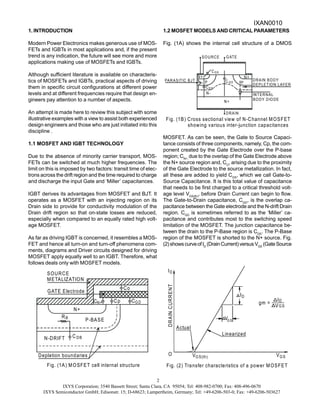
Fig. (1A) shows the internal cell structure of a DMOS
MOSFET. As can be seen, the Gate to Source Capaci-
tance consists of three components, namely, Cp, the com-
ponent created by the Gate Electrode over the P-base
region; CN+,
due to the overlap of the Gate Electrode above
the N+ source region and, CO
, arising due to the proximity
of the Gate Electrode to the source metallization. In fact,
all these are added to yield CGS
, which we call Gate-to-
Source Capacitance. It is this total value of capacitance
that needs to be first charged to a critical threshold volt-
age level VGS(th)
, before Drain Current can begin to flow.
The Gate-to-Drain capacitance, CGD
, is the overlap ca-
pacitance between the Gate electrode and the N-drift Drain
region. CGD
is sometimes referred to as the ‘Miller’ ca-
pacitance and contributes most to the switching speed
limitation of the MOSFET. The junction capacitance be-
tween the drain to the P-Base region is CDS
. The P-Base
region of the MOSFET is shorted to the N+ source. Fig.
(2)showscurveofID
(DrainCurrent)versusVGS
(GateSource
IXAN0010
IXYS Corporation; 3540 Bassett Street; Santa Clara, CA 95054; Tel: 408-982-0700; Fax: 408-496-0670
IXYS Semiconductor GmbH; Edisonstr. 15; D-68623; Lampertheim, Germany; Tel: +49-6206-503-0; Fax: +49-6206-503627
3
Voltage). The graph has a slope ( ID
/ VGS
) equal to gm
,
which is called transconductance. Please note that the
actual relationship between VGS
and ID
is shown by dotted
line and it can be observed that in the vicinity of VGS(th)
, the
relationship between VGS
and ID
is parabolic in nature:
ID
= K [VGS
-VGS(th)
]2
Eq.1.1
However, for Power MOSFETs, it is appropriate to con-
sider the relationship to be linear for values of VGS
above
VGS(th).
The manufacturer’s data sheet value of VGS(th)
is speci-
fied at 25
o
C.
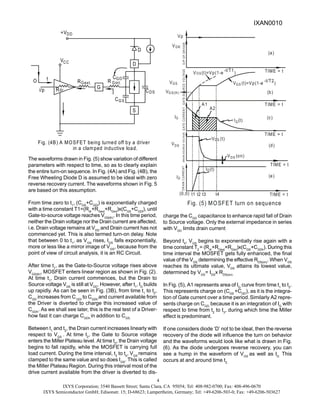
Fig. (3A) shows a symbol of N-Channel MOSFET and an
equivalent model of the same with three inter-junction para-
sitic capacitances, namely: CGS
, CGD
and CDS
. I have shown
all these as variable as they indeed are. For example the
CGD
, decreases rapidly as the Drain to Source voltage rises,
as shown in Fig. (3B). In Fig. (3B), the high value of CGD
is
called CGDh
, while the low value of CGD
is termed CGDl.
Fig.
(1B) shows another cross-sectional view of a MOSFET
with all these capacitances. In addition, It also shows the
internal body diode and the parasitic BJT.
1.3 Turn-on and Turn-off Phenomena
1.3.1 Turn-on Phenomenon
TounderstandTurn-onandTurn-offphenomenaofthePower
MOSFET, we will assume clamped inductive switching as
it is the most widely used mode of operation. This is shown
in Fig. (4A) and Fig. (4B). A model of MOSFET is shown
with all relevant components, which play a role in turn-on
and turn-off events. As stated above, MOSFET’s Gate to
Source Capacitance CGS
needs to be charged to a critical
voltage level to initiate conduction from Drain to Source. A
few words of explanation will help understand Fig. (4A)
and Fig. (4B). The clamped inductive load is being shown
by a current source with a diode D connected antiparallel
across the inductor. The MOSFET has its intrinsic internal
Gate resistance, called RGint
. As described above, the in-
ter-junction parametric capacitances (CGS
, CGD
and CDS
)
are shown and connected at their proper points. VDD
repre-
sents the DC Bus voltage to the Drain of the MOSFET
through the clamped inductive load. The Driver is supplied
by Vcc of value Vp and its ground is connected to the
common ground of VDD
and is returned to the Source of
the MOSFET. The output from the Driver is connected to
the Gate of the MOSFET through a resistor RGext
.
Now when a positive going pulse appears at the input ter-
minal of the Driver, an amplified pulse appears at the out-
put terminal of the Driver with an amplitude Vp. This is fed
to the Gate of the MOSFET through RGext
. As one can see
the rate of rise of voltage, VGS
, over Gate and Source termi-
nals of the MOSFET is governed by value of the total resis-
tance in series (Rdr
+RGext
+RGint
) and total effective value of
capacitance (CGS
+CGD
). Rdr
stands for the output source
impedance of the Driver. Rgext
is the resistance one gener-
ally puts in series with the Gate of a MOSFET to control
the turn-on and turn-off speed of the MOSFET.
Fig. (3A) Symbol and equivalent circuit of a MOSFET
Symbol of
N-Channel MOSFET
D
G
S
G
CGD
GS
C
G
R
D
S
CDS
RDS(on)
int
V DS
GS
V
Fig. (3B) C variation V
with respect to DS
DS
V =
GD
C
GD
C
CGD
h
l
GD
Fig (4A) A MOSFET being turned on by a driver
in a clamped inductive load.
Gext.
O
t
i/p R
o/p
DRIVER
dr
G
I
R
V
+V
CC
DD
GD
GS
G
C
Gs
Gint.
I
R
S
C
C
IGD
D
D
DS
IXAN0010
IXYS Corporation; 3540 Bassett Street; Santa Clara, CA 95054; Tel: 408-982-0700; Fax: 408-496-0670
IXYS Semiconductor GmbH; Edisonstr. 15; D-68623; Lampertheim, Germany; Tel: +49-6206-503-0; Fax: +49-6206-503627
4
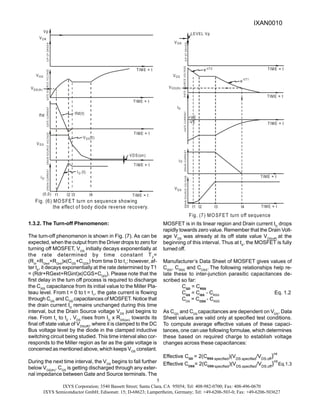
The waveforms drawn in Fig. (5) show variation of different
parameters with respect to time, so as to clearly explain
the entire turn-on sequence. In Fig. (4A) and Fig. (4B), the
Free Wheeling Diode D is assumed to be ideal with zero
reverse recovery current. The waveforms shown in Fig. 5
are based on this assumption.
From time zero to t1
, (CGS
+CGDl
) is exponentially charged
with a time constant T1=(Rdr
+RGext
+RGint
)x(CGS
+CGDl
), until
Gate-to-source voltage reaches VGS(th)
. In this time period,
neither the Drain voltage nor the Drain current are affected,
i.e. Drain voltage remains at VDD
and Drain current has not
commenced yet. This is also termed turn-on delay. Note
that between 0 to t1
, as VGS
rises, IGS
falls exponentially,
more or less like a mirror image of VGS
, because from the
point of view of circuit analysis, it is an RC Circuit.
After time t1
, as the Gate-to-Source voltage rises above
VGS(th)
, MOSFET enters linear region as shown in Fig. (2).
At time t1
, Drain current commences, but the Drain to
Source voltage VDS
is still at VDD
. However, after t1
, ID
builds
up rapidly. As can be seen in Fig. (3B), from time t1
to t2
,
CGD
increases from CGDl
to CGDh
and current available from
the Driver is diverted to charge this increased value of
CGDh
. As we shall see later, this is the real test of a Driver-
how fast it can charge CGDh
in addition to CGS.
Between t1
and t2
, the Drain current increases linearly with
respect to VGS
. At time t2
, the Gate to Source voltage
enters the Miller Plateau level. At time t2
, the Drain voltage
begins to fall rapidly, while the MOSFET is carrying full
load current. During the time interval, t2
to t4
, VGS
remains
clamped to the same value and so does IGS
. This is called
the Miller Plateau Region. During this interval most of the
drive current available from the driver is diverted to dis-
charge the CGD
capacitance to enhance rapid fall of Drain
to Source voltage. Only the external impedance in series
with VDD
limits drain current.
Beyond t4
, VGS
begins to exponentially rise again with a
time constant T2
= (Rdr
+RGext
+RGint
)x(CGS
+CGDh
). During this
time interval the MOSFET gets fully enhanced, the final
value of the VGS
determining the effective RDS(on)
. When VGS
reaches its ultimate value, VDS
attains its lowest value,
determined by VDS
= IDS
x RDS(on) .
In Fig. (5), A1 represents area of IG
curve from time t1
to t2
.
This represents charge on (CGS
+CGD
), as it is the integra-
tion of Gate current over a time period.Similarly A2 repre-
sents charge on CGD,
because it is an integration of IG
with
respect to time from t2
to t3
, during which time the Miller
effect is predominant.
If one considers diode ‘D’ not to be ideal, then the reverse
recovery of the diode will influence the turn on behavior
and the waveforms would look like what is drawn in Fig.
(6). As the diode undergoes reverse recovery, you can
see a hump in the waveform of VGS
as well as ID.
This
occurs at and around time t2 .
Fig. (4B) A MOSFET being turned off by a driver
in a clamped inductive load.
+V
V
dr
t
i/p
O
R
Gext.
R
CC
DD
G
CGS
C
Gint.
R
GD
S
C
D
D
DS
TIME = t
D
R
AIN
C
U
R
R
E
N
T
(0,0) t1 t2 t3 t4
I
I (t)
DRAIN
SOURCE
VOLTAGE
V
TIME = t
G
AT
E
C
U
R
R
E
N
T
I
TIME = t
G
AT
E
-S
O
U
R
C
E
V
O
LTA
G
E
TIME = t
O
/P
O
F
D
R
IV
ER
VDR
GS
GS(th)
DS
D
D
DS
DS
TIME = t
V (t)
V (on)
A1
A2
I (t)
V
V
V (t)=Vp(1-e )
-t/T1
-t/T2
V (t)=Vp(1-e )
Vp
(a)
(b)
(c)
(d)
(e)
Fig. (5) MOSFET turn on sequence
GS
GS
G
G
IXAN0010
IXYS Corporation; 3540 Bassett Street; Santa Clara, CA 95054; Tel: 408-982-0700; Fax: 408-496-0670
IXYS Semiconductor GmbH; Edisonstr. 15; D-68623; Lampertheim, Germany; Tel: +49-6206-503-0; Fax: +49-6206-503627
5
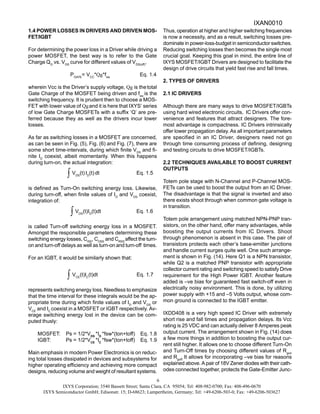
1.3.2. The Turn-off Phenomenon:
The turn-off phenomenon is shown in Fig. (7). As can be
expected, when the output from the Driver drops to zero for
turning off MOSFET, VGS
initially decays exponentially at
the rate determined by time constant T2
=
(Rdr
+RGext
+RGint
)x(CGS
+CGDh
) from time 0 to t1
; however, af-
ter t4
, it decays exponentially at the rate determined by T1
= (Rdr+RGext+RGint)x(CGS+CGDl
). Please note that the
first delay in the turn off process is required to discharge
the CISS
capacitance from its initial value to the Miller Pla-
teau level. From t = 0 to t = t1
, the gate current is flowing
through CGS
and CGD
capacitances of MOSFET. Notice that
the drain current ID
remains unchanged during this time
interval, but the Drain Source voltage VDS
just begins to
rise. From t1
to t2
, VDS
rises from ID
x RDS(on)
towards its
final off state value of VDS(off)
, where it is clamped to the DC
Bus voltage level by the diode in the clamped inductive
switching circuit being studied. This time interval also cor-
responds to the Miller region as far as the gate voltage is
concerned as mentioned above, which keeps VGS
constant.
During the next time interval, the VGS
begins to fall further
below VGS(th)
. CGS
is getting discharged through any exter-
nal impedance between Gate and Source terminals. The
MOSFET is in its linear region and Drain current ID
drops
rapidly towards zero value. Remember that the Drain Volt-
age VDS
was already at its off state value VDS(off)
at the
beginning of this interval. Thus at t4
, the MOSFET is fully
turned off.
Manufacturer’s Data Sheet of MOSFET gives values of
CISS
, CRSS
and COSS
. The following relationships help re-
late these to inter-junction parasitic capacitances de-
scribed so far:
CGD
= CRSS
CGS
= CISS
- CRSS
Eq. 1.2
CDS
= COSS
- CRSS
As CGD
and CDS
capacitances are dependent on VDS
, Data
Sheet values are valid only at specified test conditions.
To compute average effective values of these capaci-
tances, one can use following formulae, which determines
these based on required charge to establish voltage
changes across these capacitances:
Effective CGD
= 2(CRSS specified
)(VDS.specified
/VDS.off
)
1/2
Effective COSS
= 2(COSS specified
)(VDS.specified
/VDS.off
)
1/2
Eq.1.3
TIME = t
D
R
A
IN
C
U
R
R
E
N
T
(0,0) t1 t2 t3 t4
I
I (t)
D
R
A
IN
S
O
U
R
C
E
V
O
LTA
G
E
V
TIME = t
G
AT
E
C
U
R
R
E
N
T
Ifid
TIME = t
G
AT
E
-S
O
U
R
C
E
V
O
LTA
G
E
TIME = t
O
/P
O
F
D
R
IV
E
R
VDR
GS
TIME = t
V (t)
VDS(on)
Ifid(t)
V
V
Vp
Fig. (6) MOSFET turn on sequence showing
the effect of body diode reverse recovery.
GS(th)
DS
DS
D
D
TIME = t
D
R
A
IN
C
U
R
R
E
N
T
I
G
AT
E
C
U
R
R
E
N
T
I
TIME = t
G
AT
E
-S
O
U
R
C
E
V
O
LTA
G
E
TIME = t
O
/P
O
F
D
R
IV
E
R
VDR
GS
GS(th)
TIME = t
V
V
LEVEL Vp
Fig. (7) MOSFET turn off sequence
-t/T2
e
-t/T1
e
D
R
A
IN
S
O
U
R
C
E
V
O
LTA
G
E
V
TIME = t
0 t1 t2 t3 t4
-VE
+VE
G
D
DS
IXAN0010
IXYS Corporation; 3540 Bassett Street; Santa Clara, CA 95054; Tel: 408-982-0700; Fax: 408-496-0670
IXYS Semiconductor GmbH; Edisonstr. 15; D-68623; Lampertheim, Germany; Tel: +49-6206-503-0; Fax: +49-6206-503627
6
1.4 POWER LOSSES IN DRIVERS AND DRIVEN MOS-
FET/IGBT
For determining the power loss in a Driver while driving a
power MOSFET, the best way is to refer to the Gate
Charge QG
vs. VGS
curve for different values of VDS(off)
.
PGATE
= VCC
*Qg*fsw
Eq. 1.4
wherein Vcc is the Driver’s supply voltage, Qg is thetotal
Gate Charge of the MOSFET being driven and fsw
is the
switching frequency. It is prudent then to choose a MOS-
FET with lower value of Qgand it is here that IXYS’ series
of low Gate Charge MOSFETs with a suffix ‘Q’ are pre-
ferred because they as well as the drivers incur lower
losses.
As far as switching losses in a MOSFET are concerned,
as can be seen in Fig. (5), Fig. (6) and Fig. (7), there are
some short time-intervals, during which finite VDS
and fi-
nite ID
coexist, albeit momentarily. When this happens
during turn-on, the actual integration:
VDS
(t) ID
(t) dt Eq. 1.5
is defined as Turn-On switching energy loss. Likewise,
during turn-off, when finite values of ID
and VDS
coexist,
integration of:
VDS
(t)ID
(t)dt Eq. 1.6
is called Turn-off switching energy loss in a MOSFET.
Amongst the responsible parameters determining these
switching energy losses, CISS
, COSS
and CRSS
affect the turn-
on and turn-off delays as well as turn-on and turn-off times.
For an IGBT, it would be similarly shown that:
VCE
(t)IC
(t)dt Eq. 1.7
represents switching energy loss. Needless to emphasize
that the time interval for these integrals would be the ap-
propriate time during which finite values of ID
and VDS
or
VCE
and IC
coexist in a MOSFET or IGBT respectively. Av-
erage switching energy lost in the device can be com-
puted thusly:
MOSFET: Ps = 1/2*VDS
*ID
*fsw*(ton+toff) Eq. 1.8
IGBT: Ps = 1/2*VCE
*IC
*fsw*(ton+toff) Eq. 1.9
Main emphasis in modern Power Electronics is on reduc-
ing total losses dissipated in devices and subsystems for
higher operating efficiency and achieving more compact
designs, reducing volume and weight of resultant systems.
Thus, operation at higher and higher switching frequencies
is now a necessity, and as a result, switching losses pre-
dominate in power-loss-budget in semiconductor switches.
Reducing switching losses then becomes the single most
crucial goal. Keeping this goal in mind, the entire line of
IXYS MOSFET/IGBT Drivers are designed to facilitate the
design of drive circuits that yield fast rise and fall times.
2. TYPES OF DRIVERS
2.1 IC DRIVERS
Although there are many ways to drive MOSFET/IGBTs
using hard wired electronic circuits, IC Drivers offer con-
venience and features that attract designers. The fore-
most advantage is compactness. IC Drivers intrinsically
offer lower propagation delay. As all important parameters
are specified in an IC Driver, designers need not go
through time consuming process of defining, designing
and testing circuits to drive MOSFET/IGBTs.
2.2 TECHNIQUES AVAILABLE TO BOOST CURRENT
OUTPUTS
Totem pole stage with N-Channel and P-Channel MOS-
FETs can be used to boost the output from an IC Driver.
The disadvantage is that the signal is inverted and also
there exists shoot through when common gate voltage is
in transition.
Totem pole arrangement using matched NPN-PNP tran-
sistors, on the other hand, offer many advantages, while
boosting the output currents from IC Drivers. Shoot
through phenomenon is absent in this case. The pair of
transistors protects each other’s base-emitter junctions
and handle current surges quite well. One such arrange-
ment is shown in Fig. (14). Here Q1 is a NPN transistor,
while Q2 is a matched PNP transistor with appropriate
collector current rating and switching speed to satisfy Drive
requirement for the High Power IGBT. Another feature
added is –ve bias for guaranteed fast switch-off even in
electrically noisy environment. This is done, by utilizing
power supply with +15 and –5 Volts output, whose com-
mon ground is connected to the IGBT emitter.
IXDD408 is a very high speed IC Driver with extremely
short rise and fall times and propagation delays. Its Vcc
rating is 25 VDC and can actually deliver 8 Amperes peak
output current. The arrangement shown in Fig. (14) does
a few more things in addition to boosting the output cur-
rent still higher. It allows one to choose different Turn-On
and Turn-Off times by choosing different values of Rgon
and Rgoff.
It allows for incorporating –ve bias for reasons
explained above. A pair of 18V Zener diodes with their cath-
odes connected together, protects the Gate-Emitter Junc-
IXAN0010
IXYS Corporation; 3540 Bassett Street; Santa Clara, CA 95054; Tel: 408-982-0700; Fax: 408-496-0670
IXYS Semiconductor GmbH; Edisonstr. 15; D-68623; Lampertheim, Germany; Tel: +49-6206-503-0; Fax: +49-6206-503627
7
tion of IGBT from voltage spikes.
2.3 TECHNIQUES TO GENERATE –Ve BIAS DURING
TURN-OFF
Importance of –ve bias during turn-off for practically all
semiconductor switches cannot be overemphasized, as
one may recall from the days of Bipolar transistors. This
helps to quickly remove any charge on the CGS
and CGD
in
the case of MOSFETs and IGBTs, thus considerably ac-
celerating turn-off.
It is important to understand that turn-on speed of a MOS-
FET or IGBT can be increased only up to a level matched
by the reverse recovery of rectifiers or diodes in a power
supply, because in an inductive clamped load (most com-
mon), turn-on of a MOSFET or IGBT coincides with turn-
off (or reverse recovery completion) of the rectifier diode.
Any turn-on faster than this does not help. Too fast a turn-
on could also cause oscillation in the Drain or Collector
current. However, it is always beneficial to have a Driver
with intrinsic low turn-on time and then be able to tailor
this with a series gate resistor.
Turn-off phenomenon, on the other hand, does not have
to wait for any other component in the subsystem. It is
here that any enhancement technique can be utilized. Al-
though IXYS drivers themselves feature extremely low
turn-on and turn-off times, arrangement to provide –ve
bias during turn-off helps still faster turn-off and prevents
false turn on even in electrically noisy environment.
Fig. (12C) demonstrates one way of generating –ve bias
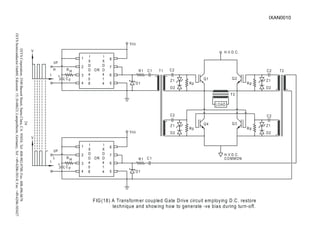
during turn-off. Fig. (18) shows how to generate –ve bias
in a transformer coupled Drive circuit arrangement. Here
Zener diode can be chosen of appropriate voltage for giv-
ing that much –ve bias (plus one diode drop) during turn-
off. Another unique feature of circuit in Fig.(18) is its abil-
ity to maintain exact pulse wave shape across Gate and
source. In Fig. (16) a method of using isolated DC to DC
converter with outputs of +15 and –5 V is used to power
IXDD414, while by connecting isolated ground of this DC
to DC Converter to the emitter of the IGBT being driven,
–5 V of –ve bias during turn-off is ensured.
2.4 NEED FOR UNDER-VOLTAGE PROTECTION
Fig. (2) shows a transfer characteristics (ID
vs. VGS
) of a
MOSFET. As can be seen for values of VGS
below VGS(th)
the drain current is negligible, but in this vicinity, the de-
vice is in its linear (Ohmic) region and concurrent appli-
cation of large values of VDS
could cause considerable
amount of localized heating of the junction. In short, when
a MOSFET is being used as a switch, any operation in its
linear region could cause overheating or device failure.
Bringing the MOSFET quickly into its saturation from its
off-state is the Driver’s job. And, if Vcc is below the mini-
mum required value, linear operation can ensue to the
detriment of MOSFET. I hasten to add, however, that most
PWM ICs, controller ICs and microcomputer ICs have
this protection feature built-in and, if sharing the same
Vcc bus, the Driver IC gets the benefit of this function
being implemented elsewhere in the subsystem.
2.5 OVERLOAD/SHORT CIRCUIT PROTECTION
Any operation of MOSFET/IGBT outside the Safe Oper-
ating Area (SOA) could cause overheating and eventual
device failure and should be prevented by an electronic
active monitoring and corrective arrangement.
Load or current sensing could be done by either a Hall
Effect Sensor or by a Shunt resistor in series with source/
emitter terminal. The voltage picked up, which is propor-
tional to current, is low pass filtered and then compared
to a preset limit. The comparator output could initiate turn-
off of MOSFET/IGBT. A circuit to detect overload/short
circuit is shown in Fig. (16), where the output FAULT will
go low when it occurs.
All IXDD series of Drivers have an ENABLE pin, which,
when driven low, say, by the FAULT output from this com-
parator, puts the final N-Channel and P-channel MOS-
FETs of the IXDD Driver in its TRISTATE mode. This not
only stops any output from the Driver, but also provides
an environment for implementing soft turn-off. There are
two ways of doing this. Just by connecting a resistor of
appropriate value from Gate to source/emitter, the CGS
gets discharged through this resistor and, depending on
the value of the connected resistor, soft turn-off of any
duration can be achieved. Another way, as shown in the
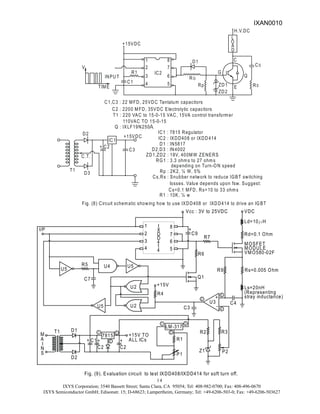
Fig. (9), is to use a signal MOSFET Q1 to pull down the
Gate, when short circuit is detected. The resistor in se-
ries with this signal MOSFET determines the time dura-
tion of this soft turn-off. Soft turn-off helps protect IGBT/
MOSFET from any voltage transients generated due to
LdIC
/dt (or LdID
/dt) that could otherwise bring about ava-
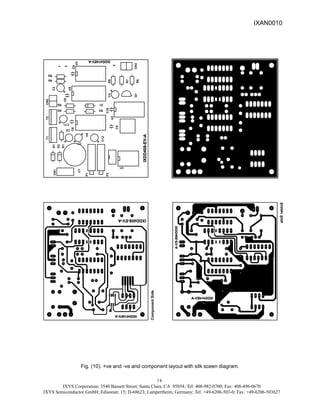
lanche breakdown. The PC board layout for this circuit is
shown in Fig. (10).
For an IGBT, Desat detection (Desat = Desaturation of
forward voltage drop) is a method used for short circuit/
overload protection. When short circuit/overload occurs,
the forward voltage drop of the IGBT (VCE
) rises to dispro-
portionately high values. One must ignore the initial turn-
on rise in VCE
, when output from Driver has still not risen
to high enough value. Nevertheless, when VCE
rises to a
level of, say, 7 Volts, in presence of sufficient Gate Drive
voltage, it means the collector current IC
has risen to a
IXAN0010
IXYS Corporation; 3540 Bassett Street; Santa Clara, CA 95054; Tel: 408-982-0700; Fax: 408-496-0670
IXYS Semiconductor GmbH; Edisonstr. 15; D-68623; Lampertheim, Germany; Tel: +49-6206-503-0; Fax: +49-6206-503627
8
disproportionately high value, signaling overload. When a
voltage level higher than 6.5 Volts is detected, Gate signal
can be softly turned off, resulting into soft turn-off of the
IGBT. Fig. (16) shows how Desat feature can be wired into
a total Driver Circuit, using also other features, such as
Opto-isolation and –ve turn-off bias.
3. HIGH SIDE DRIVING TECHNIQUES
3.1 EMPLOYING CHARGE-PUMP AND BOOTSTRAP
METHODS
For driving the upper MOSFET/IGBT in a phase leg em-
ployed in a bridge topology, a buck converter or a 2-
transitor forward converter, low side drivers cannot be used
directly. This is because the source/emitter of upper MOS-
FET/IGBT is not sitting at ground potential.
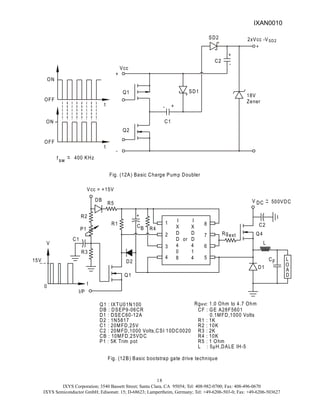
Fig. (12A) shows how a charge pump creates a higher
Vcc to be used for the driver IC for the Upper MOSFET/
IGBT. Here the pair of N-Channel and P-Channel MOS-
FETs acts as switches, alternately connecting incoming
supply voltage to output through capacitors and Schottky
diodes, isolating it and almost doubling it. Switching fre-
quency in several hundred Kilohertz is used and, there-
fore, low ripple isolated output voltage is available as DC
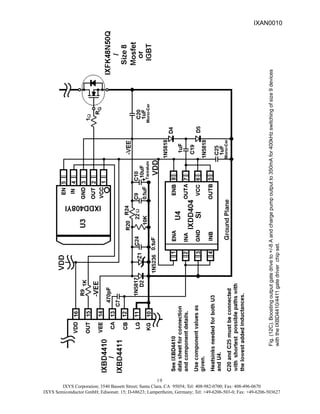
Supply for the Driver of Upper MOSFET/IGBT. Fig. (12C)
illustrates how one IXDD404 can be used as charge pump,
delivering 350 mA, and one IXDD408 as a Driver giving +/-
8 Amps, in conjunction with IXBD4410 and IXBD4411, for
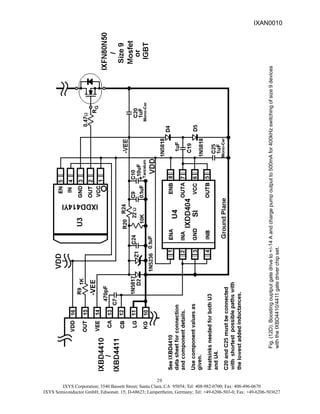
driving a phase leg of two IXFX50N50 MOSFETs. Fig. (12D)
shows how a charge pump delivering as much as 500 mA
can be constructed using one IXDD404; and by utilizing
one IXDD414, one can boost the output from IXBD4410
and IXBD4411 to +/- 14Amps for driving Size 9 high power
MOSFETs and IGBTs or even MOSFET/IGBT modules in
phase leg configuration.
Another method is the Bootstrap Technique as shown in
Fig. (12B). The basic bootstrap building elements are the
level shift circuit, bootstrap diode DB, level shift transistor
Q1, bootstrap capacitor CB and IXDD408 or IXDD414.
The bootstrap capacitor, IXDD408/IXDD414 driver and
the gate resistor are the floating, source-referenced parts
of the bootstrap arrangement. The disadvantages of this
technique are longer turn-on and turn-off delays and 100%
duty cycle is not possible. Additionally the driver has to
overcome the load impedance and negative voltage
present at the source of the device during turn-off.
3.2 ACHIEVING GALVANIC ISOLATION BY USING
OPTO-COUPLERS TO DRIVE UPPER MOSFET/IGBT
For driving high side MOSFET/IGBT in any topology, opto-
couplers can be used with following advantages:
1. They can be used to give a very high isolation voltage;
2500 to 5000 Volts of isolation is achievable by use of
properly certified opto-couplers.
2. Signals from DC to several MHz can be handled by
opto-couplers.
3. They can be easily interfaced to Microcomputers or
other controller ICs or any PWM IC.
One disadvantage is that the opto-coupler adds its own
propagation delay. Another disadvantage of using an opto-
coupler is that separate isolated power supply is required
to feed the output side of the opto-coupler and the driver
connected to it. However, isolated DC to DC Converters
with few thousand Volts of isolation are readily available.
These can be used to supply isolated and regulated +ve
15 V and –ve 5V to the output side of the opto-coupler
and the Driver IC for driving Upper MOSFET/IGBT as is
shown in Fig. (16) and Fig. (17). As can be seen, identical
chain of opto-coupler, Driver and DC to DC Converters
are used for even lower IGBTs. This is to guarantee iden-
tical propagation delays for all signals so that their time of
arrival at the Gate of IGBT bear the same phase relation-
ships with one another as when they originated in the mi-
crocomputer.
3.3 USE OF TRANSFORMERS TO OBTAIN GALVANIC
ISOLATION IN DRIVING UPPER MOSFET/IGBT
Using transformers to achieve galvanic isolation is a very
old technique. Depending on the range of frequencies be-
ing handled and power rating (voltage and current ratings
and ratios), transformers can be designed to be quite ef-
ficient. The gate drive transformer carries very small av-
erage power but delivers high peak currents at turn-on
and turn-off of MOSFET/IGBT.
While designing or choosing a Gate Drive transformer, the
following points should be kept in mind:
1. Average power being handled by the transformer
should be used as a design guideline. Margin of safety
should be taken into account, keeping in mind maxi-
mum volt-second product and allowing for worst case
transients with maximum duty ratio and maximum in-
put voltage possible.
2. Employing bifilar winding techniques to eliminate any
net DC current in any winding. This is to avoid core
saturation.
3. If operation in any one quadrant of B-H loop is cho-
sen, care should be taken for resetting the core.
Advantages of employing transformers for Gate Drive are:
1. There is no need for any isolated DC to DC Converter
IXAN0010
IXYS Corporation; 3540 Bassett Street; Santa Clara, CA 95054; Tel: 408-982-0700; Fax: 408-496-0670
IXYS Semiconductor GmbH; Edisonstr. 15; D-68623; Lampertheim, Germany; Tel: +49-6206-503-0; Fax: +49-6206-503627
9
for driving an upper MOSFET/IGBT .
2. There is practically no propagation delay time in a trans-
former to carry signals from primary side to the sec-
ondary side.
3. Several thousand volts of isolation can be built-in be-
tween windings by proper design and layouts.
The disadvantages of using transformers for Gate Drive
are:
1. They can be used only for AC signals.
2. Large duty ratios cannot be handled by the trans-
former without being saturated by net DC, unless AC
coupling capacitors are employed in series.
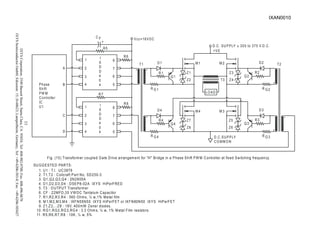
Two examples of gate Drive circuits, using transformers
follow. In Fig. (15), a phase shift controller outputs its sig-
nals to the IXDD404 Dual Drivers, which in-turn, feed the
transformers. The secondary windings of these transform-
ers are coupled to the Gates of upper and lower MOS-
FETs in a “H” Bridge topology. Fig. (18) shows another
transformer coupled Gate Drive circuit employing DC re-
store technique to maintain same waveshape of original
signal with added feature of -ve bias offered using a Zener
in series with a fast diode across secondary.
4.0 IXYS LINE OF MOSFET/IGBT DRIVERS
IXYS Corporation offers the following MOSFET/IGBT Driv-
ers:
1. IXBD4410 and IXBD4411 Half Bridge Driver Chipset
2. IXDD404 Dual 4 Amp Ultrafast Driver
3. IXDD408 Single 8 Amp Ultrafast Driver
4. IXDD414 Single 14 Amp Ultrafast Driver
5. IXDD415 Dual 15 Amp Ultrafast Driver
4.1 IXBD4410 and IXBD4411 Half Bridge MOSFET/
IGBT Driver Chipset
This chipset is best suited to applications in Half Bridge,
Full Bridge and 3 Phase Bridge topologies. Here the
IXBD4410 is wired as a full-featured Low-Side Driver, while
IXBD4411 is wired as a full-featured High-Side Driver. To-
gether, they make up a stand alone Driver System for
Phase leg of any of the above mentioned Bridge Configu-
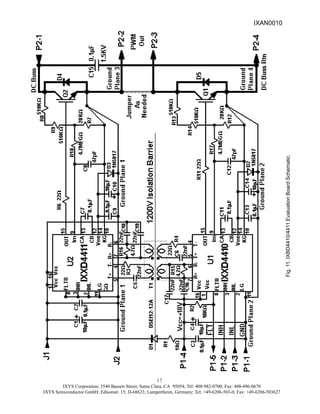
rations. The suggested wiring diagram is shown in Fig.
(11). Likewise, the wiring diagram is to be repeated for
each phase leg and hence one needs two such cards for
“H” Bridge and three such cards for 3-Phase Bridge.
As can be seen in this schematic, to obtain galvanic iso-
lation, it uses one ferrite core transformer for sending drive
signals to IXBD4411 and another ferrite core transformer
for receiving fault and status signals from IXBD4411. T1
represents both these transformers housed in one IC type
package. To avoid saturation, capacitors are placed in se-
ries with each primary winding to which AC (time-varying
signals) are transmitted. 1200 Volts of isolation barrier is
built in.
BothIXBD4410andIXBD4411arefeature-richDrivers.These
include:
1. Undervoltage and overvoltage lockout protection for Vcc;
2. dV/dt immunity of greater than ± 50 V/ns;
3. Galvanic isolation of 1200 Volts (or greater) between
low side and high side;
4. On-chip negative gate-drive supply to ensure
MOSFET/IGBT turn-off even in electrically noisy envi-
ronment;
5. 5 volt logic compatible HCMOS inputs with hysteresis;
6. 20ns rise and fall times with 1000 pF load and 100 ns
rise and fall times with 10000 pF load;
7. 100 ns of propagation delay;
8. 2 Ampere peak output Drive Capability;
9. Automatic shutdown of output in response to overcurrent
and/or short-circuit;
10.Protection against cross conduction between upper
and lower MOSFET/IGBT;
11.Logic compatible fault indication from both low and
high-side drivers.
Higher current MOSFET/IGBTs require higher drive cur-
rents, especially for operating them at high switching fre-
quencies. For these applications, one can use IXDD408
or IXDD414, either in stand-alone mode or in conjunction
with IXBD4410 and IXBD4411. It is easy to realize now
that one can easily get all the facilities of feature-rich
IXBD4410 and IXBD4411 and when higher drive current
capability is called for, use them in conjunction with
IXDD408 or IXDD414. In case of a low-side MOSFET/
IGBT, it is simple to use IXDD408 or IXDD414 alone. One
such example is given in Fig. (11).
For driving upper MOSFET/IGBT of a phase leg, one of
the approaches is to employ a charge pump. Two such
application circuit schematics are shown in Fig. (12C) and
Fig. (12D). In Fig. (12C) output from IXBD4410/4411 is
boosted up to ± 8 Amps using IXDD408 and the charge
pump output is boosted to 350 mA, using one driver of
IXDD404 for driving IXFK48N50 (rated at Id=48 Amps and
Vd = 500 Volts). In Fig. (12D), the output from IXBD4410/
4411 is boosted up to ±14 Amps by IXDD414 to drive a
Size 9 MOSFET IXFN80N50 (rated at Id = 80 Amps and
Vd = 500 Volts). IXDD404 can still adequately provide
500 mA for the charge pump circuit.
IXAN0010
IXYS Corporation; 3540 Bassett Street; Santa Clara, CA 95054; Tel: 408-982-0700; Fax: 408-496-0670
IXYS Semiconductor GmbH; Edisonstr. 15; D-68623; Lampertheim, Germany; Tel: +49-6206-503-0; Fax: +49-6206-503627
10
4.2 GENERAL REMARKS ABOUT IXDD SERIES OF
DRIVERS
The most important strength of these Drivers is their ability
to provide high currents needed to adequately drive today’s
and tomorrow’s large size MOSFETs and IGBTs. This is
made possible by devoting a large portion of the silicon die
area to creating high current (NMOS and PMOS) output
stage. Another important feature of these Drivers is that
there is no cross conduction, thus giving almost 33% lower
transition power dissipation.
In addition, all these Drivers incorporate a unique facility
to disable output by using the ENABLE pin. With the ex-
ception of the IXDD408, the ENABLE pin is tied high in-
ternally. When this pin is driven LOW in response to de-
tecting an abnormal load current, the Driver output enters
its Tristate (High Impedance State) mode and a soft turn-
off of MOSFET/IGBT can be achieved. This helps pre-
vent damage that could occur to the MOSFET/IGBT due
to LdI/dt overvoltage transient, if it were to be switched off
abruptly, “L” representing total inductance in series with
Drain or Collector. A suggested circuit to accomplish this
soft turn off upon detecting overload or short circuit is
shown in Fig. (9 ). It is also possible to do this by an inde-
pendent short circuit/overload detect circuit, which could
be a part of the PWM or other controller IC. All one needs
to do is to take output signal (FAULT) from such a circuit
and feed it into the ENABLE pin of Driver. A resistor RP
connected across Gate and Source or Gate and Emitter
(as the case may be) would ensure soft turn-off of the
MOSFET/IGBT, turn-off time being equal to RP
(CGS
+CGD
)
Detailed specifications of these IXDD series of Drivers
are available on web site www.ixys.com under heading:
“ICs”. All IXDD series of IXYS MOSFET/IGBT Drivers are
Low-Side Drivers, but with techniques covered in this Ap-
plication Note, one can use them as High-Side Drivers as
well. Evaluation Printed Circuit Boards are also available.
4.2.1 IXDD404
IXDD404 is a dual 4 Ampere Driver, which comes in handy
in many circuits employing two MOSFETs or IGBTs. It
could also be used for two MOSFETs/IGBTs connected
in phase leg, provided the voltage level is below 25 VDC.
While using High Voltage DC Supplies for driving Phase
leg, H-Bridge or 3 Phase Bridge Circuits, some technique
for achieving galvanic isolation of upper MOSFET/IGBT
Drivers is required, in addition to making provision for iso-
lated power supplies.
Fig. (15) shows an interesting application for IXDD404 in
a Phase Shift PWM Controller application, in which gal-
vanic isolation is obtained by using ferrite core Gate Drive
Transformers. Note that this Controller operates at a fixed
frequency. Turn-off enhancement is achieved by using
local PNP transistors.
For a vast number of low and medium current MOSFETs
and IGBTs, IXDD404 provides a simple answer for driv-
ing them.
4.2.2 IXDD408 AND IXDD414
IXDD408 is eminently suitable for driving higher current
MOSFETs and IGBTs and IXDD414 can drive larger size
MOSFET/IGBT Modules. Many circuit schematics apply-
ing these in various topologies are possible and some of
these are shown in different figures in this application note.
The 5 pin TO-263 surface mount version can be soldered
directly on to a copper pad on the printed circuit board for
better heat dissipation. It is possible then to use these
high current drivers for very high frequency switching ap-
plication, driving high current MOSFET modules for a high
power converter/inverter.
Fig. (8) shows a basic low side driver configuration using
IXDD408 or IXDD414. C1 is used as a bypass capacitor
placed very close to pin No. 1 and 8 of the Driver IC. Fig.
.(13) shows a method to separately control the turn on
and turn off times of MOSFET/IGBT. Turn-on time can be
adjusted by Rgon
, while the turn-off time can be varied by
Rgoff
. The diodes in series are fast diodes with low forward
voltage drop. The 18V, 400mW Zener diodes protect the
Gate-Emitter junction of the IGBT. A careful layout of the
PCB, making shortest possible length between pin Nos.6
and 7 and IGBT Gate and providing generous copper
surface for a ground plane, helps achieve fast turn-on
and turn-off times without creating oscillation in the Drain/
Collector current.
Fig. (13) shows another arrangement and includes a
method for faster turn-off using a PNP transistor placed
very close to the MOSFET Gate and Source. It is a good
practice to tie the ENABLE pin of drivers to Vcc through a
10K resistor. This ensures that the driver always remains
in its ENABLED mode except when driven low due to a
FAULT signal. Again this FAULT signal puts these two
drivers into their TRISTATE output mode.
Fig. (14) shows a method to boost output from IXDD408
to a much higher level for driving very high power IGBT
module. Here the turn-on and turn-off times can be var-
ied by choosing different values of resistors, Rgon
and Rgoff
.
To provide –ve bias of 5 Volts, the IGBT emitter is grounded
to the common of +15V and –5V power supply, which
feeds +15V and –5 v to the IXDD408. Notice that the in-
coming signals must also be level shifted.
IXAN0010
IXYS Corporation; 3540 Bassett Street; Santa Clara, CA 95054; Tel: 408-982-0700; Fax: 408-496-0670
IXYS Semiconductor GmbH; Edisonstr. 15; D-68623; Lampertheim, Germany; Tel: +49-6206-503-0; Fax: +49-6206-503627
11
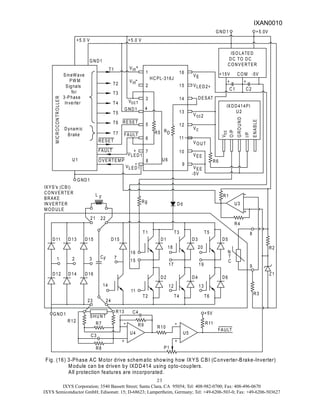
Fig. (16) shows an IXDD414 driving one IGBT of a Con-
verter Brake Inverter (CBI) module. Here all protection fea-
tures are incorporated. For High Temperature cutoff, a
bridge circuit is used with the CBI module’s thermistor.
Comparator U3 compares voltage drop across the ther-
mistor to the stable voltage from the Zener diode. P1 can
be used to preset the cutoff point at which the comparator’s
output goes low. This is fed into the Microcomputer as
OVERTEMP signal.
Short circuit protection is provided by continuously moni-
toring the voltage drop across a SHUNT. Note that one
end of SHUNT is connected to the power supply ground
GND1. The voltage picked up from this SHUNT is ampli-
fied by a low noise Op Amp and is then compared to the
stable voltage from the same Zener. When short circuit
occurs, the comparator output (FAULT) goes low. 1%
metal film resistors are used throughout in both these cir-
cuits to ensure precision and stability. C3 and C4 help in
offering low pass filtering to avoid nuisance tripping.
Principle of DESAT sensing for detecting overload on an
IGBT has been explained before in section 2.5 above. In
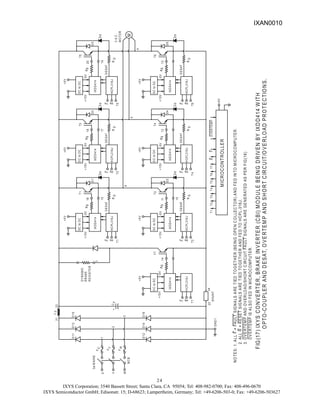
the case of AC Motor Drive, each IGBT has to be pro-
tected from overload using separate DESAT sensing. Fig.
(16) and Fig. (17) show the connection for each IGBT.
DESAT sensing is done on the isolated side of each opto-
coupler, while the resultant FAULT signal is generated on
the common input side with respect to GND1. Each FAULT
signal is open collector type and hence can be tied to-
gether with other FAULT signals from other opto-coupler or
from other comparators. The Microcomputer will stop out-
put drive signals when either FAULT or OVERTEMP signal
goes low. When this happens, notice that IXDD414 offers
a -ve bias of -5V to guarantee turn-off conditions, even in
presence of electrical noise. -5V is applied to gate of each
IGBT during turn-off even under normal operating condi-
tions. After fault is cleared, the Microcomputer can issue
a RESET signal for resuming normal operation.
5.0 PRACTICAL CONSIDERATIONS
When designing and building driver circuits for MOSFET/
IGBT, several practical aspects have to be taken care of
to avoid unpleasant voltage spikes, oscillation or ringing
and false turn-on. More often than not, these are a result
of improper or inadequate power supply by-passing, lay-
out and mismatch of driver to the driven MOSFET/IGBT.
As we understand now, turning MOSFET/IGBT on and
off amounts to charging and discharging large capacitive
loads. Suppose we are trying to charge a capacitive load
of 10,000 pF from 0 to 15 VDC (assuming we are turning
on a MOSFET) in 25 ns, using IXDD414, which is a 14
amp ultra high speed driver.
I = VxC / t Eq. 5.1
I = (15-0)x10000x10
-12
/ 25x10-9
= 6 A
What this equation tells us is that current output from driver
is directly proportional to voltage swing and/or load ca-
pacitance and inversely proportional to rise time. Actually
the charging current would not be steady, but would peak
around 9.6 Amps, well within the capability of IXDD414.
However, IXDD414 will have to draw this current from its
power supply in just 25 ns. The best way to guarantee
this is by putting a pair of by-pass capacitors (of at least
10 times the load capacitance) of complementary imped-
ance curves in parallel, very close to the VCC pin of
IXDD414. These capacitors should have the lowest pos-
sible ESR (Equivalent Series Resistance) and ESL
(Equivalent Series Inductance). One must keep the ca-
pacitor lead lengths to the bare minimum.
Another very crucial point is proper grounding. Drivers
need a very low impedance path for current return to
ground avoiding loops. The three paths for returning cur-
rent to ground are: 1. Between IXDD414 and the logic
driving it; 2. Between IXDD414 and its own power supply;
3. Between IXDD414 and the source/emitter of MOSFET/
IGBT being driven. All these paths should be extremely
short in length to reduce inductance and be as wide as
possible to reduce resistance. Also these ground paths
should be kept distinctly separate to avoid returning ground
current from the load to affect the logic line driving the
IXDD414. A good method is to dedicate one copper plane
in a multilayered PCB to provide a ground surface. All
ground points in the circuit should return to the same physi-
cal point to avoid generating differential ground poten-
tials.
With desired rise and fall times in the range of 25 to 50
ns, extreme care is required to keep lengths of current
carrying conductors to the bare minimum. Since every
inch of length adds approximately 20 nH of inductance, a
di/dt of 240 Amps/microsecond (used in the example cal-
culation for Eq. 5.1) generates a transient LdI/dt voltage of
4.8 volts per inch of wire length, which subtracts from the
driver’s output. The real effect will be a significant increase
in rise time for every tiny increase in conductor length from
output pin of driver to the Gate lead of MOSFET/IGBT. For
example, one extra inch of conductor length could increase
rise time from 20 ns to 70 ns, in a ultra high speed gate
drive circuit. Another detrimental effect of longer conductor
length is transmission line effect and resultant RFI/EMI.
It is prudent to also keep in mind the fact that every MOS-
FET/IGBT has some inductance depending on the pack-
age style and design. The lower this value, the better is
IXAN0010
IXYS Corporation; 3540 Bassett Street; Santa Clara, CA 95054; Tel: 408-982-0700; Fax: 408-496-0670
IXYS Semiconductor GmbH; Edisonstr. 15; D-68623; Lampertheim, Germany; Tel: +49-6206-503-0; Fax: +49-6206-503627
12
the switching performance, as this inductance is, in effect,
in series with the source/emitter and the resulting negative
feedback increases switching times. IXYS MOSFET/IGBTs
are housed in packages, which have extremely low intrin-
sic inductance.
While applying driver IC for any application, it is also nec-
essary to compute power dissipated in the driver for a worst
case scenario. The total power dissipated in the driver IC
is a sum of the following:
1. Capacitive load power dissipation;
2. Transition power dissipation;
3. Quiescent power dissipation.
For all IXDD series of drivers, transition power dissipa-
tion is absent due to a unique method (Patent pending) to
drivetheoutputN-ChannelandP-ChannelMOSFETs, prac-
tically eliminating cross conduction.
As described under section 1.4, a MOSFET/IGBT driver
incurs losses. Let us derive formulae to compute this
power loss in a driver:
PD(on) = D x ROH x Vcc x Qg x fsw Eq. 5.2
ROH + RGext + RGint
PD(off) = (1-D) x ROL x Vcc x Qg x fsw Eq. 5.3
ROL + RGext+ RGint
where: ROH = Output resistance of driver @ output High
ROL = Output resistance of driver @ output Low
fsw = Switching frequency
RGext = resistance kept externally in series with
Gate of MOSFET/IGBT
RGint = Internal mesh resistance of MOSFET/
IGBT
D = Duty Cycle ( Value between 0.0 to 1.0)
Qg= Gate Charge of MOSFET/IGBT
Total loss PD = PD(on) + PD(off)
Note also that in general, RGint
is small and can be ne-
glected and that ROH = ROL for all IXDD drivers. Conse-
quently, if the external turn-on and turn-off gate resistors
are identical, the total driver power dissipation formula sim-
plifies to:
PD = PD(on) + PD(off) = ROH x Vcc x Qg x fsw Eq. 5.4
ROL + RGext
Let us review some examples.
1. Assuming that, we are driving an IXFN200N07 for a
Telecom power supply application or for a UPS/Inverter
application at a switching frequency of 20 kHz
2. RGext = 4.7 Ohms and gate supply voltage is 15V.
On page No. 2 of the IXDD408 Data sheet, we read the
value of ROH = 1.5 Ohms ( Maximum). For Qg, refer to
Data Sheet of the IXFN200N07 from www.ixys.com and go
to Gate Charge vs. VGS
curve and look for value of Qg at
Vcc = 15 V. You can read it as 640 nC. Substituting these
values into Eq. 5.4 yields:
PD = 1.5 x 15 x 640 x 20,000 x 10-9
1.5 + 4.7
PD = 46.45 mW
Assuming an ambient of 50 o
C in the vicinity of IXDD408PI,
the power dissipation capability of IXDD408PI must be
derated by 7.6mW/o
C, which works out to be 190 mW.
The maximum allowable power dissipation at this tem-
perature becomes 975-190=785 mW. However, as cal-
culated above, we will be dissipating only 46.45 mW so
we are well within the dissipation limit of 785 mW.
If one increases fsw to 500 kHz for a DC to DC Converter
application, keeping other parameters the same as above,
now the dissipation would be 1.16 W, which exceeds the
specification for IXDD408PI. So in this case, it is recom-
mended to use either the IXDD408YI (TO-263 package)
or IXDD408CI (TO-220) package. Both these packages
can dissipate about 17 W with proper heat sinking ar-
rangement. The TO-263 is a surface mount package and
can be soldered onto a large pad on a copper surface of
a PCB for achieving good heat transfer. For TO-220 pack-
age, a heat sink can be employed.
Let us take another example of a boost converter, using
IXFK55N50 at VDS
= 250 VDC and at ID
= 27.5 Amps. As-
suming fsw = 500 kHz, Vcc = 12 V. From the curve of
Gate Charge for IXFK55N50 in the Data Sheet one can
determine that Qg = 370 nC. Let us set RGext = 1.0 Ohm.
We use IXDD414YI or IXDD414CI here, which can dissi-
pate 12W. Here typical value of ROH = ROL = 0.6 Ohm.
Substituting the above values in our equation, we com-
pute the power dissipation to be:
PD = 0.6 x 12 x 370 x 500 kHz x 10-9
0.6 + 1.0 + 0.0
PD = 0.83 W.
With adequate air circulation, one may be able to use the
PDIP Package.
For the third example, considering driving the large size
MOSFET module VMO 580-02F at fsw = 250 kHz. Let
Vcc = 10 V, ROH = ROL = 0.6 Ohm, RGext= 0.0 Ohm. We
read that Qg =2750 nC at Vcc = 10 V off the VMO 580-
02F data sheet. Now:
IXAN0010
IXYS Corporation; 3540 Bassett Street; Santa Clara, CA 95054; Tel: 408-982-0700; Fax: 408-496-0670
IXYS Semiconductor GmbH; Edisonstr. 15; D-68623; Lampertheim, Germany; Tel: +49-6206-503-0; Fax: +49-6206-503627
13
PD = 0.6 x 10 x 2750 x 250kHz x 10-9
0.6+ 0.0 + 0.0
PD = 6.86 W
IXDD414YI(TO-263)orIXDD414CI(TO-220)caneasilydrive
this load provided adequate heatsinking and proper air flow
is maintained. Comments above for mounting TO-263 and/
or TO-220 packages apply here as well. For derating use
0.1 W/o
C. So for an ambient temperature of 50 o
C, it works
out to be 2.5 W. As the limit of IXDD414YI or IXDD414CI is
12 W, subtracting 2.5 W from this yields 9.5 W. So 6.86
W is still possible. Thermal Impedance (Junction to Case)
is 0.55o
C/W for TO-263 and TO-220, hence a rise in case
temperature should be within limit. If we increase Vcc to
15V, conduction losses in MOSFET could reduce due to
lower RDS(on), but obtaining the same rise and fall times
will incur more power loss in driver due to increased Vcc
and Qg. If that happens, approach described in Fig. (14)
can be employed.
6. CONCLUSION
With proliferating applications of modern power electron-
ics worldwide, faster, more efficient and more compact
MOSFETs and IGBTs are replacing older solid state and
mechanical devices. The design of newer and more effi-
cient techniques to turn these solid state devices on and
off is a subject that requires thorough study and under-
standing of the internal structure and dynamic processes
involved in the working of MOSFET/IGBTs.
Main emphasis in modern Power Electronics is to reduce
total losses dissipated in devices and subsystems for higher
operating efficiency and achieving more compact designs,
reducing volume and weight of resultant systems. Thus,
operation at higher and higher switching frequencies is now
a necessity, and as a result, switching losses predomi-
nate in the power-loss-budget in semiconductor switches.
Reducing switching losses then becomes the single most
crucial goal. Keeping this goal in mind, the entire line of
IXYS MOSFET/IGBT Drivers are designed to facilitate the
design of drive circuits that yield fast rise and fall times,
matching or often exceeding the speeds of the driven
MOSFET/IGBTs. Extremely low propagation delay time
facilitates implementation of fast overload/short circuit pro-
tection.
With the advent of IC Drivers for these fast MOSFET/
IGBTs, the designer is relieved of the tedious task of de-
signing elaborate driver circuits. Nevertheless, under-
standing these newer ICs, their strengths and limitations,
is of paramount importance. Different configurations for
particular topologies call for specific application knowl-
edge. Illustrations are the best way to explain theory and
applications of these IC drivers. Practical use of these IC
drivers call for great care for achieving near theoretical
results.
References:
1. B. Jayant Baliga, “Power Semiconductor Devices”,
PWS Publishing Company, Boston, MA (1996)
2. Ned Mohan, Tore M. Undeland, William P. Robbins:
“POWER ELECTRONICS: Converters, Applications
and Design”, John Wiley & Sons, New York (1994)
3. Power Supply Design Seminar - 2001 series, Unitrode
Products from Texas Instruments.
Recommended for further reading:
1. George J. Krausse, “Gate Driver Design for Switch-
Mode Applications and the DE-SERIES MOSFET Tran-
sistor”, Directed Energy, Inc. Application Note available
from<www.directedenergy.com>.
Mr. Abhijit D. Pathak received his B. E. (Electrical Engi-
neering) from M. S. University, Baroda, India in 1966. He
obtained his MS (EE) degree from University of Rhode Is-
land, Kingston, R. I., U.S.A. in 1971. From 1968 to 1973
he worked in USA in the areas of development of D.C.
Drives, high frequency high Voltage Inverters, precision in-
strumentation and measurement systems and their ap-
plications in industry. In 1973, he returned to India and
joined Indian Space Research Organization (Govt.of India)
as a Senior Scientist/Engineer. At I.S.R.O. he project en-
gineered development of a number of large electronic sys-
tems for the first time in the country under sponsorship of
Dept. of Electronics, Govt. of India. He wrote a number of
technical papers, while at I.S.R.O. Subsequently, in 1981,
he started working in private sector and developed a num-
ber of industrial systems, including AC Variable Frequency
Drives, UPS Systems, Inverters, Temperature Controllers,
I/P (Current to Pressure) Converters and Float-cum-boost
chargers. He also taught Final Year Degree program at the
University level for four years as a Visiting Professor in the
Department of Instrumentation & Controls in India. Since
May 2000 he has been with IXYS Corporation as a Senior
Applications Engineer. He has written a number of Appli-
cation Reports on the subject of Power Electronics.
DISCLAIMER:
Although information furnished herein is believed to be
accurate and reliable, IXYS Corporation assumes no re-
sponsibility for its use; nor for any infringement of patents
or other rights of third parties which may result from its
use.
IXAN0010
IXYS Corporation; 3540 Bassett Street; Santa Clara, CA 95054; Tel: 408-982-0700; Fax: 408-496-0670
IXYS Semiconductor GmbH; Edisonstr. 15; D-68623; Lampertheim, Germany; Tel: +49-6206-503-0; Fax: +49-6206-503627
14
X
2
3
4 4 5
1
4 6
D
D
7
1 I 8
I/P +
C9
R7
Vcc : 3V to 25VDC
U5
VDC
Ld=10 H
m
Rd=0.1 Ohm
U4 U5
R5
C7
U2
U2
U5
M
A
I
N
S
T1 D1
D2
C1
C2
+ +
7815
1
2 +
C2
3
+15V TO
LM-317
R1
P1
1 3
2
P2
R3
R2
Z1
R6
R9 Rs=0.005 Ohm
Ls=20nH
MOSFET
C4
MODULE
VMO580-02F
U3
2
4
5
+
-
C3
+15V
R4
Fig. (9). Evaluation circuit to test IXDD408/IXDD414 for soft turn off.
Q1
ALL ICs
(Representing
stray inductance)
C1,C3 : 22 MFD, 25VDC Tantalum capacitors
D1
RG
Rp ZD1
ZD2
RS
CS
C
E
G
Q
+15VDC
H.V.DC
C1
R1
1
2
3
4 5
6
7
8
V
TIME
INPUT
IC2
D2
D3
C2
IC1
C3
T1
+15VDC
+
C.T.
C2 : 2200 MFD, 35VDC Electrolytic capacitors
T1 : 220 VAC to 15-0-15 VAC, 15VA control transformer
110VAC TO 15-0-15
D2,D3 : IN4002
IC2 : IXDD408 or IXDD414
D1 : IN5817
IC1 : 7815 Regulator
Cs,Rs : Snubber network to reduce IGBT switching
Rp : 2K2, ¼ W, 5%
RG1 : 3.3 ohms to 27 ohms
ZD1,ZD2 : 18V, 400MW ZENERS
Cs=0.1 MFD, Rs=10 to 33 ohms
Fig. (8) Circuit schematic showing how to use IXDD408 or IXDD414 to drive an IGBT
losses. Value depends upon fsw. Suggest:
depending on Turn-ON speed
L
O
A
D
Q : IXLF19N250
R1 : 10K, ¼ w
A
IXAN0010
IXYS Corporation; 3540 Bassett Street; Santa Clara, CA 95054; Tel: 408-982-0700; Fax: 408-496-0670
IXYS Semiconductor GmbH; Edisonstr. 15; D-68623; Lampertheim, Germany; Tel: +49-6206-503-0; Fax: +49-6206-503627
15
Bill of Materials for Fig.(9)
Resistors:
R1: 240
R2: 560
R3: 10K
R4: 5K
R5: 1Meg
R6: 1K5
R7: Rg-T.B.D.
R8: 1Meg
Capacitors:
C1: 1000mF;35VWDC
C2: 22mF, 63 VWDC
C3: 1pF, silver dipped mica
C4: 100pF silver dipped mica
C5: 0.1mF, 35WDC Tantalum
C6: 0.1mF, 35VWDC Tantalum
C7: 1pF silver dipped mica
C8: 0.1mF, 35VWDC Tantalum
C9: 0.1mF, 35VWDC Tantalum
C10: 0.1mF, 35VWDC Tantalum
Diodes:
D1: 1N4002 or BA 159
D2: 1N4002 or BA 159
Zener Diodes:
1. Z1: 1N821
Voltage Regulators:
1. 7815
2. LM317T
Transistors:
1. Q1: 2N7000
ICs:
U1: IXDD408PI or IXDD414PI
U2: CD4001
U3: LM339
U4: CD4011
U5: CD4049
U6: IXDD408YI or IXDD414YI
Note: Either use either U1 or U6 but not both.
Trimmers:
P1: 5K, 3006P Bourns or Spectrol
P2: 1K, 3006P Bpurns or Spectrol
IXAN0010
IXYS Corporation; 3540 Bassett Street; Santa Clara, CA 95054; Tel: 408-982-0700; Fax: 408-496-0670
IXYS Semiconductor GmbH; Edisonstr. 15; D-68623; Lampertheim, Germany; Tel: +49-6206-503-0; Fax: +49-6206-503627
16
Component
Side
IXDD408-EV-A
IXDD408-EV-A
IXDD414EV-A
IXDD414EV-A
S
o
l
d
e
r
S
i
d
e
I
X
D
D
4
1
4
E
V
-
A I
X
D
D
4
1
4
E
V
-
A
I
X
D
D
4
0
8
-
E
V
-
A
I
X
D
D
4
0
8
-
E
V
-
A
CN1
P2
P1
U1
C1
D2
D1
R1
C12
C2
T1
C7
C5
U4
C6
T2
C11
U2
C10
R3
R2
Z1
R5
CN2
U5
C8
Q1
C4
C3
R6
R7
R9
R4
U3
C9
R8
3
1
2
CN3
IXDD414EV-A
IXDD414EV-A
IXDD408-EV-A
IXDD408-EV-A
Fig. (10). +ve and -ve and component layout with silk sceen diagram.
IXAN0010
IXYS Corporation; 3540 Bassett Street; Santa Clara, CA 95054; Tel: 408-982-0700; Fax: 408-496-0670
IXYS Semiconductor GmbH; Edisonstr. 15; D-68623; Lampertheim, Germany; Tel: +49-6206-503-0; Fax: +49-6206-503627
17
Fig.
11.
IXBD4410/4411
Evaluation
Board
Schematic.
IXAN0010
IXYS Corporation; 3540 Bassett Street; Santa Clara, CA 95054; Tel: 408-982-0700; Fax: 408-496-0670
IXYS Semiconductor GmbH; Edisonstr. 15; D-68623; Lampertheim, Germany; Tel: +49-6206-503-0; Fax: +49-6206-503627
18
Fig. (12A) Basic Charge Pump Doubler
Vcc
+
-
Q1
Q2
+
-
C1
SD1
C2
-
+
SD2
18V
Zener
+
2xVcc -VSD2
ON
OFF
t
f sw
~
~ 400 KHz
ON
OFF
t
Fig. (12B) Basic bootstrap gate drive technique
1
4
3
2
8
5
7
4
4
8
0
4
1
D
D or
X
D
D
X
6
I I
Q1
R1
Q4
DB
Rgext
L
O
A
D
D1
V DC
CB
I/P
t
V
CF
Vcc = +15V
L
P1 R4
+
D2
~
~ 500VDC
C2
Q1 : IXTU01N100
DB : DSEP9-06CR
D1 : DSEC60-12A
D2 : 1N5817
C1 : 20MFD,25V
C2 : 20MFD,1000 Volts,CSI 10DC0020
CB : 10MFD,25VDC
P1 : 5K Trim pot
R3
C1
0
15V
R2
R5
Rg 1.0 Ohm to 4.7 Ohm
ext:
CF : GE A28F5601
0.1MFD,1000 Volts
R1 : 1K
R2 : 10K
R3 : 2K
R4 : 10K
R5 : 1 Ohm
L : 5µH,DALE IH-5
IXAN0010
IXYS Corporation; 3540 Bassett Street; Santa Clara, CA 95054; Tel: 408-982-0700; Fax: 408-496-0670
IXYS Semiconductor GmbH; Edisonstr. 15; D-68623; Lampertheim, Germany; Tel: +49-6206-503-0; Fax: +49-6206-503627
19
Fig.
(12C).
Boosting
output
gate
drive
to
+/-8
A
and
charge
pump
output
to
350mA
for
400kHz
switching
of
size
9
devices
with
the
IXBD4410/4411
gate
driver
chip
set.
IXAN0010
IXYS Corporation; 3540 Bassett Street; Santa Clara, CA 95054; Tel: 408-982-0700; Fax: 408-496-0670
IXYS Semiconductor GmbH; Edisonstr. 15; D-68623; Lampertheim, Germany; Tel: +49-6206-503-0; Fax: +49-6206-503627
20
Fig.
(12D).
Boosting
ouptput
gate
drive
to
+/-14
A
and
charge
pump
output
to
500mA
for
400kHz
switching
of
size
9
devices
with
the
IXBD4410/4411
gate
driver
chip
set.
IXAN0010
IXYS
Corporation;
3540
Bassett
Street;
Santa
Clara,
CA
95054;
Tel:
408-982-0700;
Fax:
408-496-0670
IXYS
Semiconductor
GmbH;
Edisonstr.
15;
D-68623;
Lampertheim,
Germany;
Tel:
+49-6206-503-0;
Fax:
+49-6206-503627
2
1
1
2
3
4
8
7
6
5
I
X
D
D
4
0
8
or
4
4
1
D
D
X
I
Fig (13) Turn-off enhancement methods.
Vcc
I/P
D
C F Rg
+
L
O
A
D
H.V.DC
I/P 2 7
D D
F
or
4 8
3 4
0
D
5
4
4
1
D
6
Rg
Q2
1
X
I
X
I
8
C
+
Vcc
O
D
A
H.V.DC
L
D
V
t
on
Z1
Z2
Z1
Z2
D on
off
Rg
Fig. (14). Technique to boost current output and provide -ve bias to achieve faster turn off for high power MOSFET and IGBT Modules
D
0
4 8
3
2
4
D
5
6
7 Rb
1 I
X
8
+
F
C
+Vcc=+15V
Q2
LOAD H.V.DC
V = -5V
EE
V
+15V
t
-5V
Q1
Rg on
Rg off
IGBT
0.0V
I/P
Z2
Z1 1. Z1,Z2 : 18V,400mW
Zener diodes
2. D : 1N5821
3. Q1 : D44VH10
4. Q2 : D45VH10
5. Rb : 10 Ohms,1/4w,1%
IXAN0010
IXYS
Corporation;
3540
Bassett
Street;
Santa
Clara,
CA
95054;
Tel:
408-982-0700;
Fax:
408-496-0670
IXYS
Semiconductor
GmbH;
Edisonstr.
15;
D-68623;
Lampertheim,
Germany;
Tel:
+49-6206-503-0;
Fax:
+49-6206-503627
2
2
Fig. (15) Transformer coupled Gate Drive arrangement for "H" Bridge in a Phase Shift PW M Controller at fixed Switching frequency.
D
0
4 4
3
2
4
D
5
6
7
1 I
X
8
7
2
4
3
4 5
4
0
D
6
1
X
D
I
8
Phase
Shift
PW M
Controller
IC
U1
A
B
C
D
Vcc=16VDC
D1
R6
R5
R8
R7
Q 1
T1
R1
R G 1
G 4
R
R4
D4
Q 4
Z1
Z2
Z8
Z7
F
C
+
LO AD
T3
T2
Z5
Z6
Z4
Z3
D.C. SUPPLY ~ 300 to 375 V.D.C.
~
+V E
Q 2
D2
R2
G 2
R
M 1 M 2
M 4 M 3
Q 3
R3
R G 3
D3
D.C.SUPPLY
CO MM O N
SUGGESTED PARTS:
1. U1 : T.I. UC3879
2. T1,T2 : Coilcraft Part No. SD250-3
3. Q1,Q2,Q3,Q4 : 2N2905A
4. D1,D2,D3,D4 : DSEP8-02A IXYS HiPerFRED
5. T3 : OUTPUT Transformer
6. CF : 22MFD,35 VW DC Tantalum Capacitor
7. R1,R2,R3,R4 : 560 Ohms, ¼ w,1% Metal film
8. M1,M2,M3,M4 : IXFN55N50 IXYS HiPerFET or IXFN80N50 IXYS HiPerFET
9. Z1,Z2,...Z8 : 18V, 400mW Zener diodes.
10. RG1,RG2,RG3,RG4 : 3.3 Ohms, ¼ w, 1% Metal Film resistors.
11. R5,R6,R7,R8 : 10K, ¼ w, 5%
IXAN0010
IXYS Corporation; 3540 Bassett Street; Santa Clara, CA 95054; Tel: 408-982-0700; Fax: 408-496-0670
IXYS Semiconductor GmbH; Edisonstr. 15; D-68623; Lampertheim, Germany; Tel: +49-6206-503-0; Fax: +49-6206-503627
23
SineWave
PW M
Signals
for
3-Phase
Inverter
Dynamic
Brake
M
IC
R
O
C
O
N
T
R
O
L
LE
R
U1
Fig. (16) 3-Phase AC Motor drive schem atic showing how IXYS CBI (Converter-Brake-Inverter)
Module can be driven by IXDD414 using opto-couplers.
All protection features are incorporated.
FAULT
T1
T2
T3
T4
T5
T6
T7
RESET
O VERTEM P
G ND1
+5.0 V
G ND1
1
2
3
4
5
6
7
8
16
15
14
13
12
11
10
9
U6
HC PL-316J
RESET
FAULT R5
Vin
Vin
+
-
Vcc1
G ND1
VLED1
LED1
V
+
-
VE
LED2+
V
DESAT
cc2
V
c
V
O UT
V
EE
V
EE
V
R6
-5V
IXDD414PI
U2
cc
V
O
/P
G
R
O
U
N
D
I/P
E
N
A
B
LE
ISO LATED
DC TO DC
CO NVERTER
+15V CO M -5V
+ +
C1 C2
G ND1 +5.0V
+5.0 V
1 2 3
D16
D14
D12
D11 D13 D15
14
7
F
L
CF
11
16
D15
22
21
15
D1
D2
12
17
18
D4
D3
Rg
D5
D6
13
19
20
T1 T3 T5
T6
T4
T2
IXYS's (CBI)
CO NVERTER
BRAKE
IN VERTER
M OD ULE
U3
-
+
N
T
C
R4
R3
8
9
R2
Z1
U4
-
+ +
-
U5
SHU NT
R7
C3
R8
G ND1 C4
R9
23 24
P1
+5V
R11
FAULT
R1
R12
R13
R10
R
Dd
D
IXAN0010
IXYS Corporation; 3540 Bassett Street; Santa Clara, CA 95054; Tel: 408-982-0700; Fax: 408-496-0670
IXYS Semiconductor GmbH; Edisonstr. 15; D-68623; Lampertheim, Germany; Tel: +49-6206-503-0; Fax: +49-6206-503627
24
D
12
D
14
D
16
D
11
D
13
D
15
U
V
W
3
ø
M
AINS
M
CB
1
2
3
DC
to
DC
IX
DD
414
+
15
V
-5
V
HC
PL
316
J
16
1
5
T
1
F
R
T1
N
O
TE
S
:
1.
A
LL
F
=
FAU
LT
S
IG
N
A
LS
A
RE
T
IED
TO
G
ET
H
E
R
(B
EIN
G
O
P
E
N
C
O
LLE
C
TO
R)
A
N
D
F
E
D
IN
TO
M
IC
R
O
C
O
M
P
U
TE
R
.
2
.
ALL
R
=
R
E
SE
T
SIG
N
ALS
A
RE
T
IED
TO
G
E
T
H
ER
A
ND
F
E
D
TO
H
C
P
L-316J.
3
.
O
V
E
RT
EM
P
AN
D
O
V
E
R
LO
A
D/S
H
O
R
T
C
IR
C
U
IT
FA
U
LT
S
IG
N
ALS
AR
E
G
E
N
E
RAT
E
D
AS
P
ER
F
IG
(16)
O
V
ERT
E
M
P
IS
AL
S
O
FE
D
IN
M
IC
R
O
C
O
M
P
UT
E
R
.
F
IG
(17
)
IX
Y
S
C
O
N
V
E
R
T
E
R
,
B
R
A
K
E
IN
V
E
R
TE
R
(C
B
I)
M
O
D
U
L
E
B
E
IN
G
D
R
IV
E
N
B
Y
IX
D
D
4
1
4
W
ITH
O
P
TO
-C
O
U
P
L
E
R
A
N
D
D
E
S
AT,
O
V
E
R
T
E
M
P
A
N
D
S
H
O
R
T
C
IR
C
U
IT
/O
V
E
R
LO
A
D
P
R
O
T
E
C
T
IO
N
S
.
+
5
V
D
1
21
22
L
F
23
24
C
F
H
CP
L316J
IXD
D4
14
1
4
D
C
to
D
C
+5V
T7
7
T
3
1
8
17
IXD
D
414
H
CP
L316J
+15V
-5V
D3
+5V
D
C
to
D
C
T3
DC
to
DC
HC
PL
316
J
IXD
D
414
T5
+
15
V
-5
V
1
9
20
D
5
+
5
V
T
5
T2
-5
V
IXD
D
414
H
CP
L316J
D
C
to
D
C
HC
PL
316
J
T
4
1
0
11
DC
to
DC
IX
DD
414
+
15
V
+15
V
-5
V
-5
V
+
5
V
D
2
T
2
+15V
T6
HC
PL
316
J
-5V
T4
1
2
+5V
+
15
V
D4
IXD
D
414
DC
to
DC
+
5
V
13
T
6
D
6
+
M
4
5
6
M
ICR
OC
ONT
ROLLE
R
T1
T2
T3
T
4
T5
T6
T
7
R
F
O
VER
TE
M
P
U
V
W
F
F
F
G
ND
1
S
HU
NT
T
7
R
F
R
F
R
F
R
F
R
F
R
F
R
g
R
g
R
g
R
g
R
g
R
g
R
g
R
EG
IS
TO
R
B
R
AK
E
D
YN
A
M
IC
DE
S
AT
DE
S
AT
D
E
SAT
D
E
SAT
D
E
SAT
D
E
SAT
3
A.C
.
M
O
TO
R
+5
V
D
d
D
R
D
d
D
D
d
D
D
d
D
D
d
D
D
d
D
R
R
R
R
R
IXAN0010
IXYS Corporation; 3540 Bassett Street; Santa Clara, CA 95054; Tel: 408-982-0700; Fax: 408-496-0670
IXYS Semiconductor GmbH; Edisonstr. 15; D-68623; Lampertheim, Germany; Tel: +49-6206-503-0; Fax: +49-6206-503627
25
Bill of Materials for Fig. (16) and Fig. (17)
R1, R3, R5, R10, R11: 10K, 1/4W, 1% MFR
R2: 560 Ohms, 1/4W, 1% MFR
R4: 2.2 MegOhms, 1/4W, 5%
R6: 100 Ohms, 1/4 W, 1% MFR
R7: 20K, 1/4W, 1% MFR
R8, R9: 61.9K, 1/4W, 1% MFR
R12, R13: 1.24K, 1/4W, 1% MFR
Rg: T.B.D. based on Ton and Toff & size of IGBT
RD:100 Ohms,1/4 w, 5%
P1: 10K, multi turn trimpot, Bourns 3006P or
Spectrol
C3, C4: 33 pF, silver dipped mica
Dd: General Semiconductor make,
Type: RGP02-20E, 0.5 A, 2000 V, trr: 300 ns
Z1: Zener LM336, 2.5 Volt
U3, U5 : LM339 Comparator
U4 : LM-101 Op Amp
SHUNT : 75 mV @ full load current
LF: Gapped D C Choke for filtering rectified
power
CF: Electrolytic Filter Capacitor with very low
ESR & ESL and screw type terminals to
handle high ripple current. Voltage rating
is based on DC Bus plus AC ripple Voltage
CBI Module: IXYS Corporation Type Nos:
MUBW 50-12A8 or any MUBW module from
CBI 1, CBI 2 or CBI 3 series.
Microcontroller: T.I. TMS320F240 with embedded
software for AC Drive, using brake feature.
IXDD414 Driver chip: 7 are required to imple-
ment the A.C.Drive, using Brake feature.
HCPL316J( Opto-coupler) : 7 are required to
implement the A.C.Drive With Brake feature.
Isolated DC to DC Converter: 7 are required
with specified isolation.
IXAN0010
IXYS
Corporation;
3540
Bassett
Street;
Santa
Clara,
CA
95054;
Tel:
408-982-0700;
Fax:
408-496-0670
IXYS
Semiconductor
GmbH;
Edisonstr.
15;
D-68623;
Lampertheim,
Germany;
Tel:
+49-6206-503-0;
Fax:
+49-6206-503627
2
6
FIG(18) A Transformer coupled Gate Drive circuit employing D.C. restore
technique and showing how to generate -ve bias during turn-off.
H
7
2
4
3
5
OR
6
1 8
Vcc
T1
H.V.D.C.
H.V.D.C.
LOAD
D2
Z1
T3
T2
I/P
8
D
0
4
D
I
X
4
D
1
4
D
I
X
R1 C1
D1
C2
Rp
D2
Z1
Rp
C2
D2
Z1
Rp
C2
D2
Rp
Z1
C2
COMMON
Q4
Q1 Q2
Q3
1 8
L
I/P
4 4
4 8
3
0
4 5
1
6
2 D
D
X
D
D
OR
7
X
D1
R1 C1
I I
Vcc
+
+
C F
t
V
t
V
R H
C F
R H
IXAN0010

Ixan0010 drivers igbt

  • 1.
    IXYS Corporation; 3540Bassett Street; Santa Clara, CA 95054; Tel: 408-982-0700; Fax: 408-496-0670 IXYS Semiconductor GmbH; Edisonstr. 15; D-68623; Lampertheim, Germany; Tel: +49-6206-503-0; Fax: +49-6206-503627 1 MOSFET/IGBT DRIVERS THEORY AND APPLICATIONS By Abhijit D. Pathak © 2001 IXYS Corporation IXAN0010 1. Introduction 1.1. MOSFET and IGBT Technology. 1.2. MOSFET Models and critical parameters 1.3. Turn-on and Turn-off phenomenon and their explanations 1.4. Power losses in Drivers 2. Types of Drivers 2.1. IC Gate Drivers 2.2. Techniques available to boost current outputs 2.3. Techniques available to generate negative bias during turn-off 2.4. Need for under-voltage protections 2.5. Overload and Short Circuit Protection 3. Isolation Techniques 3.1. Employing Charge-pump and Bootstrap Techniques 3.2. Examples of use of Opto-couplers in practical Driver Circuits 3.3. Examples using transformers in practical Driver Circuits 4. IXYS Line of MOSFET/IGBT Drivers 4.1. Technical details of all IXYS Drivers 4.2. Features and Advantages of IXYS Drivers 4.3. Applying IXYS Drivers in various topologies 5. Practical Considerations 6. Conclusion
  • 2.
    IXYS Corporation; 3540Bassett Street; Santa Clara, CA 95054; Tel: 408-982-0700; Fax: 408-496-0670 IXYS Semiconductor GmbH; Edisonstr. 15; D-68623; Lampertheim, Germany; Tel: +49-6206-503-0; Fax: +49-6206-503627 2 1. INTRODUCTION Modern Power Electronics makes generous use of MOS- FETs and IGBTs in most applications and, if the present trend is any indication, the future will see more and more applications making use of MOSFETs and IGBTs. Although sufficient literature is available on characteris- tics of MOSFETs and IGBTs, practical aspects of driving them in specific circuit configurations at different power levels and at different frequencies require that design en- gineers pay attention to a number of aspects. An attempt is made here to review this subject with some illustrative examples with a view to assist both experienced design engineers and those who are just initiated into this discipline . 1.1 MOSFET AND IGBT TECHNOLOGY Due to the absence of minority carrier transport, MOS- FETs can be switched at much higher frequencies. The limit on this is imposed by two factors: transit time of elec- trons across the drift region and the time required to charge and discharge the input Gate and ‘Miller’ capacitances. IGBT derives its advantages from MOSFET and BJT. It operates as a MOSFET with an injecting region on its Drain side to provide for conductivity modulation of the Drain drift region so that on-state losses are reduced, especially when compared to an equally rated high volt- age MOSFET. As far as driving IGBT is concerned, it resembles a MOS- FET and hence all turn-on and turn-off phenomena com- ments, diagrams and Driver circuits designed for driving MOSFET apply equally well to an IGBT. Therefore, what follows deals only with MOSFET models. N+ Co Cp C CGD N+ GATE Electrode SOURCE METALIZATION P-BASE RB DB C N-DRIFT Depletion boundaries Fig. (1A) MOSFET cell internal structure Fig. (1B) Cross sectional view of N-Channel MOSFET showing various inter-junction capacitances C C CGS DS GD N+ P N- N+ N+ P SOURCE GATE PARASITIC BJT DRAIN DRAIN BODY DEPLETION LAYER INTERNAL BODY DIODE O VGS Actual Linearized gm = ID D R A IN C U R R E N T GS(th) V GS V ID ID VGS Fig. (2) Transfer characteristics of a power MOSFET 1.2 MOSFET MODELS AND CRITICAL PARAMETERS Fig. (1A) shows the internal cell structure of a DMOS MOSFET. As can be seen, the Gate to Source Capaci- tance consists of three components, namely, Cp, the com- ponent created by the Gate Electrode over the P-base region; CN+, due to the overlap of the Gate Electrode above the N+ source region and, CO , arising due to the proximity of the Gate Electrode to the source metallization. In fact, all these are added to yield CGS , which we call Gate-to- Source Capacitance. It is this total value of capacitance that needs to be first charged to a critical threshold volt- age level VGS(th) , before Drain Current can begin to flow. The Gate-to-Drain capacitance, CGD , is the overlap ca- pacitance between the Gate electrode and the N-drift Drain region. CGD is sometimes referred to as the ‘Miller’ ca- pacitance and contributes most to the switching speed limitation of the MOSFET. The junction capacitance be- tween the drain to the P-Base region is CDS . The P-Base region of the MOSFET is shorted to the N+ source. Fig. (2)showscurveofID (DrainCurrent)versusVGS (GateSource IXAN0010
  • 3.
    IXYS Corporation; 3540Bassett Street; Santa Clara, CA 95054; Tel: 408-982-0700; Fax: 408-496-0670 IXYS Semiconductor GmbH; Edisonstr. 15; D-68623; Lampertheim, Germany; Tel: +49-6206-503-0; Fax: +49-6206-503627 3 Voltage). The graph has a slope ( ID / VGS ) equal to gm , which is called transconductance. Please note that the actual relationship between VGS and ID is shown by dotted line and it can be observed that in the vicinity of VGS(th) , the relationship between VGS and ID is parabolic in nature: ID = K [VGS -VGS(th) ]2 Eq.1.1 However, for Power MOSFETs, it is appropriate to con- sider the relationship to be linear for values of VGS above VGS(th). The manufacturer’s data sheet value of VGS(th) is speci- fied at 25 o C. Fig. (3A) shows a symbol of N-Channel MOSFET and an equivalent model of the same with three inter-junction para- sitic capacitances, namely: CGS , CGD and CDS . I have shown all these as variable as they indeed are. For example the CGD , decreases rapidly as the Drain to Source voltage rises, as shown in Fig. (3B). In Fig. (3B), the high value of CGD is called CGDh , while the low value of CGD is termed CGDl. Fig. (1B) shows another cross-sectional view of a MOSFET with all these capacitances. In addition, It also shows the internal body diode and the parasitic BJT. 1.3 Turn-on and Turn-off Phenomena 1.3.1 Turn-on Phenomenon TounderstandTurn-onandTurn-offphenomenaofthePower MOSFET, we will assume clamped inductive switching as it is the most widely used mode of operation. This is shown in Fig. (4A) and Fig. (4B). A model of MOSFET is shown with all relevant components, which play a role in turn-on and turn-off events. As stated above, MOSFET’s Gate to Source Capacitance CGS needs to be charged to a critical voltage level to initiate conduction from Drain to Source. A few words of explanation will help understand Fig. (4A) and Fig. (4B). The clamped inductive load is being shown by a current source with a diode D connected antiparallel across the inductor. The MOSFET has its intrinsic internal Gate resistance, called RGint . As described above, the in- ter-junction parametric capacitances (CGS , CGD and CDS ) are shown and connected at their proper points. VDD repre- sents the DC Bus voltage to the Drain of the MOSFET through the clamped inductive load. The Driver is supplied by Vcc of value Vp and its ground is connected to the common ground of VDD and is returned to the Source of the MOSFET. The output from the Driver is connected to the Gate of the MOSFET through a resistor RGext . Now when a positive going pulse appears at the input ter- minal of the Driver, an amplified pulse appears at the out- put terminal of the Driver with an amplitude Vp. This is fed to the Gate of the MOSFET through RGext . As one can see the rate of rise of voltage, VGS , over Gate and Source termi- nals of the MOSFET is governed by value of the total resis- tance in series (Rdr +RGext +RGint ) and total effective value of capacitance (CGS +CGD ). Rdr stands for the output source impedance of the Driver. Rgext is the resistance one gener- ally puts in series with the Gate of a MOSFET to control the turn-on and turn-off speed of the MOSFET. Fig. (3A) Symbol and equivalent circuit of a MOSFET Symbol of N-Channel MOSFET D G S G CGD GS C G R D S CDS RDS(on) int V DS GS V Fig. (3B) C variation V with respect to DS DS V = GD C GD C CGD h l GD Fig (4A) A MOSFET being turned on by a driver in a clamped inductive load. Gext. O t i/p R o/p DRIVER dr G I R V +V CC DD GD GS G C Gs Gint. I R S C C IGD D D DS IXAN0010
  • 4.
    IXYS Corporation; 3540Bassett Street; Santa Clara, CA 95054; Tel: 408-982-0700; Fax: 408-496-0670 IXYS Semiconductor GmbH; Edisonstr. 15; D-68623; Lampertheim, Germany; Tel: +49-6206-503-0; Fax: +49-6206-503627 4 The waveforms drawn in Fig. (5) show variation of different parameters with respect to time, so as to clearly explain the entire turn-on sequence. In Fig. (4A) and Fig. (4B), the Free Wheeling Diode D is assumed to be ideal with zero reverse recovery current. The waveforms shown in Fig. 5 are based on this assumption. From time zero to t1 , (CGS +CGDl ) is exponentially charged with a time constant T1=(Rdr +RGext +RGint )x(CGS +CGDl ), until Gate-to-source voltage reaches VGS(th) . In this time period, neither the Drain voltage nor the Drain current are affected, i.e. Drain voltage remains at VDD and Drain current has not commenced yet. This is also termed turn-on delay. Note that between 0 to t1 , as VGS rises, IGS falls exponentially, more or less like a mirror image of VGS , because from the point of view of circuit analysis, it is an RC Circuit. After time t1 , as the Gate-to-Source voltage rises above VGS(th) , MOSFET enters linear region as shown in Fig. (2). At time t1 , Drain current commences, but the Drain to Source voltage VDS is still at VDD . However, after t1 , ID builds up rapidly. As can be seen in Fig. (3B), from time t1 to t2 , CGD increases from CGDl to CGDh and current available from the Driver is diverted to charge this increased value of CGDh . As we shall see later, this is the real test of a Driver- how fast it can charge CGDh in addition to CGS. Between t1 and t2 , the Drain current increases linearly with respect to VGS . At time t2 , the Gate to Source voltage enters the Miller Plateau level. At time t2 , the Drain voltage begins to fall rapidly, while the MOSFET is carrying full load current. During the time interval, t2 to t4 , VGS remains clamped to the same value and so does IGS . This is called the Miller Plateau Region. During this interval most of the drive current available from the driver is diverted to dis- charge the CGD capacitance to enhance rapid fall of Drain to Source voltage. Only the external impedance in series with VDD limits drain current. Beyond t4 , VGS begins to exponentially rise again with a time constant T2 = (Rdr +RGext +RGint )x(CGS +CGDh ). During this time interval the MOSFET gets fully enhanced, the final value of the VGS determining the effective RDS(on) . When VGS reaches its ultimate value, VDS attains its lowest value, determined by VDS = IDS x RDS(on) . In Fig. (5), A1 represents area of IG curve from time t1 to t2 . This represents charge on (CGS +CGD ), as it is the integra- tion of Gate current over a time period.Similarly A2 repre- sents charge on CGD, because it is an integration of IG with respect to time from t2 to t3 , during which time the Miller effect is predominant. If one considers diode ‘D’ not to be ideal, then the reverse recovery of the diode will influence the turn on behavior and the waveforms would look like what is drawn in Fig. (6). As the diode undergoes reverse recovery, you can see a hump in the waveform of VGS as well as ID. This occurs at and around time t2 . Fig. (4B) A MOSFET being turned off by a driver in a clamped inductive load. +V V dr t i/p O R Gext. R CC DD G CGS C Gint. R GD S C D D DS TIME = t D R AIN C U R R E N T (0,0) t1 t2 t3 t4 I I (t) DRAIN SOURCE VOLTAGE V TIME = t G AT E C U R R E N T I TIME = t G AT E -S O U R C E V O LTA G E TIME = t O /P O F D R IV ER VDR GS GS(th) DS D D DS DS TIME = t V (t) V (on) A1 A2 I (t) V V V (t)=Vp(1-e ) -t/T1 -t/T2 V (t)=Vp(1-e ) Vp (a) (b) (c) (d) (e) Fig. (5) MOSFET turn on sequence GS GS G G IXAN0010
  • 5.
    IXYS Corporation; 3540Bassett Street; Santa Clara, CA 95054; Tel: 408-982-0700; Fax: 408-496-0670 IXYS Semiconductor GmbH; Edisonstr. 15; D-68623; Lampertheim, Germany; Tel: +49-6206-503-0; Fax: +49-6206-503627 5 1.3.2. The Turn-off Phenomenon: The turn-off phenomenon is shown in Fig. (7). As can be expected, when the output from the Driver drops to zero for turning off MOSFET, VGS initially decays exponentially at the rate determined by time constant T2 = (Rdr +RGext +RGint )x(CGS +CGDh ) from time 0 to t1 ; however, af- ter t4 , it decays exponentially at the rate determined by T1 = (Rdr+RGext+RGint)x(CGS+CGDl ). Please note that the first delay in the turn off process is required to discharge the CISS capacitance from its initial value to the Miller Pla- teau level. From t = 0 to t = t1 , the gate current is flowing through CGS and CGD capacitances of MOSFET. Notice that the drain current ID remains unchanged during this time interval, but the Drain Source voltage VDS just begins to rise. From t1 to t2 , VDS rises from ID x RDS(on) towards its final off state value of VDS(off) , where it is clamped to the DC Bus voltage level by the diode in the clamped inductive switching circuit being studied. This time interval also cor- responds to the Miller region as far as the gate voltage is concerned as mentioned above, which keeps VGS constant. During the next time interval, the VGS begins to fall further below VGS(th) . CGS is getting discharged through any exter- nal impedance between Gate and Source terminals. The MOSFET is in its linear region and Drain current ID drops rapidly towards zero value. Remember that the Drain Volt- age VDS was already at its off state value VDS(off) at the beginning of this interval. Thus at t4 , the MOSFET is fully turned off. Manufacturer’s Data Sheet of MOSFET gives values of CISS , CRSS and COSS . The following relationships help re- late these to inter-junction parasitic capacitances de- scribed so far: CGD = CRSS CGS = CISS - CRSS Eq. 1.2 CDS = COSS - CRSS As CGD and CDS capacitances are dependent on VDS , Data Sheet values are valid only at specified test conditions. To compute average effective values of these capaci- tances, one can use following formulae, which determines these based on required charge to establish voltage changes across these capacitances: Effective CGD = 2(CRSS specified )(VDS.specified /VDS.off ) 1/2 Effective COSS = 2(COSS specified )(VDS.specified /VDS.off ) 1/2 Eq.1.3 TIME = t D R A IN C U R R E N T (0,0) t1 t2 t3 t4 I I (t) D R A IN S O U R C E V O LTA G E V TIME = t G AT E C U R R E N T Ifid TIME = t G AT E -S O U R C E V O LTA G E TIME = t O /P O F D R IV E R VDR GS TIME = t V (t) VDS(on) Ifid(t) V V Vp Fig. (6) MOSFET turn on sequence showing the effect of body diode reverse recovery. GS(th) DS DS D D TIME = t D R A IN C U R R E N T I G AT E C U R R E N T I TIME = t G AT E -S O U R C E V O LTA G E TIME = t O /P O F D R IV E R VDR GS GS(th) TIME = t V V LEVEL Vp Fig. (7) MOSFET turn off sequence -t/T2 e -t/T1 e D R A IN S O U R C E V O LTA G E V TIME = t 0 t1 t2 t3 t4 -VE +VE G D DS IXAN0010
  • 6.
    IXYS Corporation; 3540Bassett Street; Santa Clara, CA 95054; Tel: 408-982-0700; Fax: 408-496-0670 IXYS Semiconductor GmbH; Edisonstr. 15; D-68623; Lampertheim, Germany; Tel: +49-6206-503-0; Fax: +49-6206-503627 6 1.4 POWER LOSSES IN DRIVERS AND DRIVEN MOS- FET/IGBT For determining the power loss in a Driver while driving a power MOSFET, the best way is to refer to the Gate Charge QG vs. VGS curve for different values of VDS(off) . PGATE = VCC *Qg*fsw Eq. 1.4 wherein Vcc is the Driver’s supply voltage, Qg is thetotal Gate Charge of the MOSFET being driven and fsw is the switching frequency. It is prudent then to choose a MOS- FET with lower value of Qgand it is here that IXYS’ series of low Gate Charge MOSFETs with a suffix ‘Q’ are pre- ferred because they as well as the drivers incur lower losses. As far as switching losses in a MOSFET are concerned, as can be seen in Fig. (5), Fig. (6) and Fig. (7), there are some short time-intervals, during which finite VDS and fi- nite ID coexist, albeit momentarily. When this happens during turn-on, the actual integration: VDS (t) ID (t) dt Eq. 1.5 is defined as Turn-On switching energy loss. Likewise, during turn-off, when finite values of ID and VDS coexist, integration of: VDS (t)ID (t)dt Eq. 1.6 is called Turn-off switching energy loss in a MOSFET. Amongst the responsible parameters determining these switching energy losses, CISS , COSS and CRSS affect the turn- on and turn-off delays as well as turn-on and turn-off times. For an IGBT, it would be similarly shown that: VCE (t)IC (t)dt Eq. 1.7 represents switching energy loss. Needless to emphasize that the time interval for these integrals would be the ap- propriate time during which finite values of ID and VDS or VCE and IC coexist in a MOSFET or IGBT respectively. Av- erage switching energy lost in the device can be com- puted thusly: MOSFET: Ps = 1/2*VDS *ID *fsw*(ton+toff) Eq. 1.8 IGBT: Ps = 1/2*VCE *IC *fsw*(ton+toff) Eq. 1.9 Main emphasis in modern Power Electronics is on reduc- ing total losses dissipated in devices and subsystems for higher operating efficiency and achieving more compact designs, reducing volume and weight of resultant systems. Thus, operation at higher and higher switching frequencies is now a necessity, and as a result, switching losses pre- dominate in power-loss-budget in semiconductor switches. Reducing switching losses then becomes the single most crucial goal. Keeping this goal in mind, the entire line of IXYS MOSFET/IGBT Drivers are designed to facilitate the design of drive circuits that yield fast rise and fall times. 2. TYPES OF DRIVERS 2.1 IC DRIVERS Although there are many ways to drive MOSFET/IGBTs using hard wired electronic circuits, IC Drivers offer con- venience and features that attract designers. The fore- most advantage is compactness. IC Drivers intrinsically offer lower propagation delay. As all important parameters are specified in an IC Driver, designers need not go through time consuming process of defining, designing and testing circuits to drive MOSFET/IGBTs. 2.2 TECHNIQUES AVAILABLE TO BOOST CURRENT OUTPUTS Totem pole stage with N-Channel and P-Channel MOS- FETs can be used to boost the output from an IC Driver. The disadvantage is that the signal is inverted and also there exists shoot through when common gate voltage is in transition. Totem pole arrangement using matched NPN-PNP tran- sistors, on the other hand, offer many advantages, while boosting the output currents from IC Drivers. Shoot through phenomenon is absent in this case. The pair of transistors protects each other’s base-emitter junctions and handle current surges quite well. One such arrange- ment is shown in Fig. (14). Here Q1 is a NPN transistor, while Q2 is a matched PNP transistor with appropriate collector current rating and switching speed to satisfy Drive requirement for the High Power IGBT. Another feature added is –ve bias for guaranteed fast switch-off even in electrically noisy environment. This is done, by utilizing power supply with +15 and –5 Volts output, whose com- mon ground is connected to the IGBT emitter. IXDD408 is a very high speed IC Driver with extremely short rise and fall times and propagation delays. Its Vcc rating is 25 VDC and can actually deliver 8 Amperes peak output current. The arrangement shown in Fig. (14) does a few more things in addition to boosting the output cur- rent still higher. It allows one to choose different Turn-On and Turn-Off times by choosing different values of Rgon and Rgoff. It allows for incorporating –ve bias for reasons explained above. A pair of 18V Zener diodes with their cath- odes connected together, protects the Gate-Emitter Junc- IXAN0010
  • 7.
    IXYS Corporation; 3540Bassett Street; Santa Clara, CA 95054; Tel: 408-982-0700; Fax: 408-496-0670 IXYS Semiconductor GmbH; Edisonstr. 15; D-68623; Lampertheim, Germany; Tel: +49-6206-503-0; Fax: +49-6206-503627 7 tion of IGBT from voltage spikes. 2.3 TECHNIQUES TO GENERATE –Ve BIAS DURING TURN-OFF Importance of –ve bias during turn-off for practically all semiconductor switches cannot be overemphasized, as one may recall from the days of Bipolar transistors. This helps to quickly remove any charge on the CGS and CGD in the case of MOSFETs and IGBTs, thus considerably ac- celerating turn-off. It is important to understand that turn-on speed of a MOS- FET or IGBT can be increased only up to a level matched by the reverse recovery of rectifiers or diodes in a power supply, because in an inductive clamped load (most com- mon), turn-on of a MOSFET or IGBT coincides with turn- off (or reverse recovery completion) of the rectifier diode. Any turn-on faster than this does not help. Too fast a turn- on could also cause oscillation in the Drain or Collector current. However, it is always beneficial to have a Driver with intrinsic low turn-on time and then be able to tailor this with a series gate resistor. Turn-off phenomenon, on the other hand, does not have to wait for any other component in the subsystem. It is here that any enhancement technique can be utilized. Al- though IXYS drivers themselves feature extremely low turn-on and turn-off times, arrangement to provide –ve bias during turn-off helps still faster turn-off and prevents false turn on even in electrically noisy environment. Fig. (12C) demonstrates one way of generating –ve bias during turn-off. Fig. (18) shows how to generate –ve bias in a transformer coupled Drive circuit arrangement. Here Zener diode can be chosen of appropriate voltage for giv- ing that much –ve bias (plus one diode drop) during turn- off. Another unique feature of circuit in Fig.(18) is its abil- ity to maintain exact pulse wave shape across Gate and source. In Fig. (16) a method of using isolated DC to DC converter with outputs of +15 and –5 V is used to power IXDD414, while by connecting isolated ground of this DC to DC Converter to the emitter of the IGBT being driven, –5 V of –ve bias during turn-off is ensured. 2.4 NEED FOR UNDER-VOLTAGE PROTECTION Fig. (2) shows a transfer characteristics (ID vs. VGS ) of a MOSFET. As can be seen for values of VGS below VGS(th) the drain current is negligible, but in this vicinity, the de- vice is in its linear (Ohmic) region and concurrent appli- cation of large values of VDS could cause considerable amount of localized heating of the junction. In short, when a MOSFET is being used as a switch, any operation in its linear region could cause overheating or device failure. Bringing the MOSFET quickly into its saturation from its off-state is the Driver’s job. And, if Vcc is below the mini- mum required value, linear operation can ensue to the detriment of MOSFET. I hasten to add, however, that most PWM ICs, controller ICs and microcomputer ICs have this protection feature built-in and, if sharing the same Vcc bus, the Driver IC gets the benefit of this function being implemented elsewhere in the subsystem. 2.5 OVERLOAD/SHORT CIRCUIT PROTECTION Any operation of MOSFET/IGBT outside the Safe Oper- ating Area (SOA) could cause overheating and eventual device failure and should be prevented by an electronic active monitoring and corrective arrangement. Load or current sensing could be done by either a Hall Effect Sensor or by a Shunt resistor in series with source/ emitter terminal. The voltage picked up, which is propor- tional to current, is low pass filtered and then compared to a preset limit. The comparator output could initiate turn- off of MOSFET/IGBT. A circuit to detect overload/short circuit is shown in Fig. (16), where the output FAULT will go low when it occurs. All IXDD series of Drivers have an ENABLE pin, which, when driven low, say, by the FAULT output from this com- parator, puts the final N-Channel and P-channel MOS- FETs of the IXDD Driver in its TRISTATE mode. This not only stops any output from the Driver, but also provides an environment for implementing soft turn-off. There are two ways of doing this. Just by connecting a resistor of appropriate value from Gate to source/emitter, the CGS gets discharged through this resistor and, depending on the value of the connected resistor, soft turn-off of any duration can be achieved. Another way, as shown in the Fig. (9), is to use a signal MOSFET Q1 to pull down the Gate, when short circuit is detected. The resistor in se- ries with this signal MOSFET determines the time dura- tion of this soft turn-off. Soft turn-off helps protect IGBT/ MOSFET from any voltage transients generated due to LdIC /dt (or LdID /dt) that could otherwise bring about ava- lanche breakdown. The PC board layout for this circuit is shown in Fig. (10). For an IGBT, Desat detection (Desat = Desaturation of forward voltage drop) is a method used for short circuit/ overload protection. When short circuit/overload occurs, the forward voltage drop of the IGBT (VCE ) rises to dispro- portionately high values. One must ignore the initial turn- on rise in VCE , when output from Driver has still not risen to high enough value. Nevertheless, when VCE rises to a level of, say, 7 Volts, in presence of sufficient Gate Drive voltage, it means the collector current IC has risen to a IXAN0010
  • 8.
    IXYS Corporation; 3540Bassett Street; Santa Clara, CA 95054; Tel: 408-982-0700; Fax: 408-496-0670 IXYS Semiconductor GmbH; Edisonstr. 15; D-68623; Lampertheim, Germany; Tel: +49-6206-503-0; Fax: +49-6206-503627 8 disproportionately high value, signaling overload. When a voltage level higher than 6.5 Volts is detected, Gate signal can be softly turned off, resulting into soft turn-off of the IGBT. Fig. (16) shows how Desat feature can be wired into a total Driver Circuit, using also other features, such as Opto-isolation and –ve turn-off bias. 3. HIGH SIDE DRIVING TECHNIQUES 3.1 EMPLOYING CHARGE-PUMP AND BOOTSTRAP METHODS For driving the upper MOSFET/IGBT in a phase leg em- ployed in a bridge topology, a buck converter or a 2- transitor forward converter, low side drivers cannot be used directly. This is because the source/emitter of upper MOS- FET/IGBT is not sitting at ground potential. Fig. (12A) shows how a charge pump creates a higher Vcc to be used for the driver IC for the Upper MOSFET/ IGBT. Here the pair of N-Channel and P-Channel MOS- FETs acts as switches, alternately connecting incoming supply voltage to output through capacitors and Schottky diodes, isolating it and almost doubling it. Switching fre- quency in several hundred Kilohertz is used and, there- fore, low ripple isolated output voltage is available as DC Supply for the Driver of Upper MOSFET/IGBT. Fig. (12C) illustrates how one IXDD404 can be used as charge pump, delivering 350 mA, and one IXDD408 as a Driver giving +/- 8 Amps, in conjunction with IXBD4410 and IXBD4411, for driving a phase leg of two IXFX50N50 MOSFETs. Fig. (12D) shows how a charge pump delivering as much as 500 mA can be constructed using one IXDD404; and by utilizing one IXDD414, one can boost the output from IXBD4410 and IXBD4411 to +/- 14Amps for driving Size 9 high power MOSFETs and IGBTs or even MOSFET/IGBT modules in phase leg configuration. Another method is the Bootstrap Technique as shown in Fig. (12B). The basic bootstrap building elements are the level shift circuit, bootstrap diode DB, level shift transistor Q1, bootstrap capacitor CB and IXDD408 or IXDD414. The bootstrap capacitor, IXDD408/IXDD414 driver and the gate resistor are the floating, source-referenced parts of the bootstrap arrangement. The disadvantages of this technique are longer turn-on and turn-off delays and 100% duty cycle is not possible. Additionally the driver has to overcome the load impedance and negative voltage present at the source of the device during turn-off. 3.2 ACHIEVING GALVANIC ISOLATION BY USING OPTO-COUPLERS TO DRIVE UPPER MOSFET/IGBT For driving high side MOSFET/IGBT in any topology, opto- couplers can be used with following advantages: 1. They can be used to give a very high isolation voltage; 2500 to 5000 Volts of isolation is achievable by use of properly certified opto-couplers. 2. Signals from DC to several MHz can be handled by opto-couplers. 3. They can be easily interfaced to Microcomputers or other controller ICs or any PWM IC. One disadvantage is that the opto-coupler adds its own propagation delay. Another disadvantage of using an opto- coupler is that separate isolated power supply is required to feed the output side of the opto-coupler and the driver connected to it. However, isolated DC to DC Converters with few thousand Volts of isolation are readily available. These can be used to supply isolated and regulated +ve 15 V and –ve 5V to the output side of the opto-coupler and the Driver IC for driving Upper MOSFET/IGBT as is shown in Fig. (16) and Fig. (17). As can be seen, identical chain of opto-coupler, Driver and DC to DC Converters are used for even lower IGBTs. This is to guarantee iden- tical propagation delays for all signals so that their time of arrival at the Gate of IGBT bear the same phase relation- ships with one another as when they originated in the mi- crocomputer. 3.3 USE OF TRANSFORMERS TO OBTAIN GALVANIC ISOLATION IN DRIVING UPPER MOSFET/IGBT Using transformers to achieve galvanic isolation is a very old technique. Depending on the range of frequencies be- ing handled and power rating (voltage and current ratings and ratios), transformers can be designed to be quite ef- ficient. The gate drive transformer carries very small av- erage power but delivers high peak currents at turn-on and turn-off of MOSFET/IGBT. While designing or choosing a Gate Drive transformer, the following points should be kept in mind: 1. Average power being handled by the transformer should be used as a design guideline. Margin of safety should be taken into account, keeping in mind maxi- mum volt-second product and allowing for worst case transients with maximum duty ratio and maximum in- put voltage possible. 2. Employing bifilar winding techniques to eliminate any net DC current in any winding. This is to avoid core saturation. 3. If operation in any one quadrant of B-H loop is cho- sen, care should be taken for resetting the core. Advantages of employing transformers for Gate Drive are: 1. There is no need for any isolated DC to DC Converter IXAN0010
  • 9.
    IXYS Corporation; 3540Bassett Street; Santa Clara, CA 95054; Tel: 408-982-0700; Fax: 408-496-0670 IXYS Semiconductor GmbH; Edisonstr. 15; D-68623; Lampertheim, Germany; Tel: +49-6206-503-0; Fax: +49-6206-503627 9 for driving an upper MOSFET/IGBT . 2. There is practically no propagation delay time in a trans- former to carry signals from primary side to the sec- ondary side. 3. Several thousand volts of isolation can be built-in be- tween windings by proper design and layouts. The disadvantages of using transformers for Gate Drive are: 1. They can be used only for AC signals. 2. Large duty ratios cannot be handled by the trans- former without being saturated by net DC, unless AC coupling capacitors are employed in series. Two examples of gate Drive circuits, using transformers follow. In Fig. (15), a phase shift controller outputs its sig- nals to the IXDD404 Dual Drivers, which in-turn, feed the transformers. The secondary windings of these transform- ers are coupled to the Gates of upper and lower MOS- FETs in a “H” Bridge topology. Fig. (18) shows another transformer coupled Gate Drive circuit employing DC re- store technique to maintain same waveshape of original signal with added feature of -ve bias offered using a Zener in series with a fast diode across secondary. 4.0 IXYS LINE OF MOSFET/IGBT DRIVERS IXYS Corporation offers the following MOSFET/IGBT Driv- ers: 1. IXBD4410 and IXBD4411 Half Bridge Driver Chipset 2. IXDD404 Dual 4 Amp Ultrafast Driver 3. IXDD408 Single 8 Amp Ultrafast Driver 4. IXDD414 Single 14 Amp Ultrafast Driver 5. IXDD415 Dual 15 Amp Ultrafast Driver 4.1 IXBD4410 and IXBD4411 Half Bridge MOSFET/ IGBT Driver Chipset This chipset is best suited to applications in Half Bridge, Full Bridge and 3 Phase Bridge topologies. Here the IXBD4410 is wired as a full-featured Low-Side Driver, while IXBD4411 is wired as a full-featured High-Side Driver. To- gether, they make up a stand alone Driver System for Phase leg of any of the above mentioned Bridge Configu- rations. The suggested wiring diagram is shown in Fig. (11). Likewise, the wiring diagram is to be repeated for each phase leg and hence one needs two such cards for “H” Bridge and three such cards for 3-Phase Bridge. As can be seen in this schematic, to obtain galvanic iso- lation, it uses one ferrite core transformer for sending drive signals to IXBD4411 and another ferrite core transformer for receiving fault and status signals from IXBD4411. T1 represents both these transformers housed in one IC type package. To avoid saturation, capacitors are placed in se- ries with each primary winding to which AC (time-varying signals) are transmitted. 1200 Volts of isolation barrier is built in. BothIXBD4410andIXBD4411arefeature-richDrivers.These include: 1. Undervoltage and overvoltage lockout protection for Vcc; 2. dV/dt immunity of greater than ± 50 V/ns; 3. Galvanic isolation of 1200 Volts (or greater) between low side and high side; 4. On-chip negative gate-drive supply to ensure MOSFET/IGBT turn-off even in electrically noisy envi- ronment; 5. 5 volt logic compatible HCMOS inputs with hysteresis; 6. 20ns rise and fall times with 1000 pF load and 100 ns rise and fall times with 10000 pF load; 7. 100 ns of propagation delay; 8. 2 Ampere peak output Drive Capability; 9. Automatic shutdown of output in response to overcurrent and/or short-circuit; 10.Protection against cross conduction between upper and lower MOSFET/IGBT; 11.Logic compatible fault indication from both low and high-side drivers. Higher current MOSFET/IGBTs require higher drive cur- rents, especially for operating them at high switching fre- quencies. For these applications, one can use IXDD408 or IXDD414, either in stand-alone mode or in conjunction with IXBD4410 and IXBD4411. It is easy to realize now that one can easily get all the facilities of feature-rich IXBD4410 and IXBD4411 and when higher drive current capability is called for, use them in conjunction with IXDD408 or IXDD414. In case of a low-side MOSFET/ IGBT, it is simple to use IXDD408 or IXDD414 alone. One such example is given in Fig. (11). For driving upper MOSFET/IGBT of a phase leg, one of the approaches is to employ a charge pump. Two such application circuit schematics are shown in Fig. (12C) and Fig. (12D). In Fig. (12C) output from IXBD4410/4411 is boosted up to ± 8 Amps using IXDD408 and the charge pump output is boosted to 350 mA, using one driver of IXDD404 for driving IXFK48N50 (rated at Id=48 Amps and Vd = 500 Volts). In Fig. (12D), the output from IXBD4410/ 4411 is boosted up to ±14 Amps by IXDD414 to drive a Size 9 MOSFET IXFN80N50 (rated at Id = 80 Amps and Vd = 500 Volts). IXDD404 can still adequately provide 500 mA for the charge pump circuit. IXAN0010
  • 10.
    IXYS Corporation; 3540Bassett Street; Santa Clara, CA 95054; Tel: 408-982-0700; Fax: 408-496-0670 IXYS Semiconductor GmbH; Edisonstr. 15; D-68623; Lampertheim, Germany; Tel: +49-6206-503-0; Fax: +49-6206-503627 10 4.2 GENERAL REMARKS ABOUT IXDD SERIES OF DRIVERS The most important strength of these Drivers is their ability to provide high currents needed to adequately drive today’s and tomorrow’s large size MOSFETs and IGBTs. This is made possible by devoting a large portion of the silicon die area to creating high current (NMOS and PMOS) output stage. Another important feature of these Drivers is that there is no cross conduction, thus giving almost 33% lower transition power dissipation. In addition, all these Drivers incorporate a unique facility to disable output by using the ENABLE pin. With the ex- ception of the IXDD408, the ENABLE pin is tied high in- ternally. When this pin is driven LOW in response to de- tecting an abnormal load current, the Driver output enters its Tristate (High Impedance State) mode and a soft turn- off of MOSFET/IGBT can be achieved. This helps pre- vent damage that could occur to the MOSFET/IGBT due to LdI/dt overvoltage transient, if it were to be switched off abruptly, “L” representing total inductance in series with Drain or Collector. A suggested circuit to accomplish this soft turn off upon detecting overload or short circuit is shown in Fig. (9 ). It is also possible to do this by an inde- pendent short circuit/overload detect circuit, which could be a part of the PWM or other controller IC. All one needs to do is to take output signal (FAULT) from such a circuit and feed it into the ENABLE pin of Driver. A resistor RP connected across Gate and Source or Gate and Emitter (as the case may be) would ensure soft turn-off of the MOSFET/IGBT, turn-off time being equal to RP (CGS +CGD ) Detailed specifications of these IXDD series of Drivers are available on web site www.ixys.com under heading: “ICs”. All IXDD series of IXYS MOSFET/IGBT Drivers are Low-Side Drivers, but with techniques covered in this Ap- plication Note, one can use them as High-Side Drivers as well. Evaluation Printed Circuit Boards are also available. 4.2.1 IXDD404 IXDD404 is a dual 4 Ampere Driver, which comes in handy in many circuits employing two MOSFETs or IGBTs. It could also be used for two MOSFETs/IGBTs connected in phase leg, provided the voltage level is below 25 VDC. While using High Voltage DC Supplies for driving Phase leg, H-Bridge or 3 Phase Bridge Circuits, some technique for achieving galvanic isolation of upper MOSFET/IGBT Drivers is required, in addition to making provision for iso- lated power supplies. Fig. (15) shows an interesting application for IXDD404 in a Phase Shift PWM Controller application, in which gal- vanic isolation is obtained by using ferrite core Gate Drive Transformers. Note that this Controller operates at a fixed frequency. Turn-off enhancement is achieved by using local PNP transistors. For a vast number of low and medium current MOSFETs and IGBTs, IXDD404 provides a simple answer for driv- ing them. 4.2.2 IXDD408 AND IXDD414 IXDD408 is eminently suitable for driving higher current MOSFETs and IGBTs and IXDD414 can drive larger size MOSFET/IGBT Modules. Many circuit schematics apply- ing these in various topologies are possible and some of these are shown in different figures in this application note. The 5 pin TO-263 surface mount version can be soldered directly on to a copper pad on the printed circuit board for better heat dissipation. It is possible then to use these high current drivers for very high frequency switching ap- plication, driving high current MOSFET modules for a high power converter/inverter. Fig. (8) shows a basic low side driver configuration using IXDD408 or IXDD414. C1 is used as a bypass capacitor placed very close to pin No. 1 and 8 of the Driver IC. Fig. .(13) shows a method to separately control the turn on and turn off times of MOSFET/IGBT. Turn-on time can be adjusted by Rgon , while the turn-off time can be varied by Rgoff . The diodes in series are fast diodes with low forward voltage drop. The 18V, 400mW Zener diodes protect the Gate-Emitter junction of the IGBT. A careful layout of the PCB, making shortest possible length between pin Nos.6 and 7 and IGBT Gate and providing generous copper surface for a ground plane, helps achieve fast turn-on and turn-off times without creating oscillation in the Drain/ Collector current. Fig. (13) shows another arrangement and includes a method for faster turn-off using a PNP transistor placed very close to the MOSFET Gate and Source. It is a good practice to tie the ENABLE pin of drivers to Vcc through a 10K resistor. This ensures that the driver always remains in its ENABLED mode except when driven low due to a FAULT signal. Again this FAULT signal puts these two drivers into their TRISTATE output mode. Fig. (14) shows a method to boost output from IXDD408 to a much higher level for driving very high power IGBT module. Here the turn-on and turn-off times can be var- ied by choosing different values of resistors, Rgon and Rgoff . To provide –ve bias of 5 Volts, the IGBT emitter is grounded to the common of +15V and –5V power supply, which feeds +15V and –5 v to the IXDD408. Notice that the in- coming signals must also be level shifted. IXAN0010
  • 11.
    IXYS Corporation; 3540Bassett Street; Santa Clara, CA 95054; Tel: 408-982-0700; Fax: 408-496-0670 IXYS Semiconductor GmbH; Edisonstr. 15; D-68623; Lampertheim, Germany; Tel: +49-6206-503-0; Fax: +49-6206-503627 11 Fig. (16) shows an IXDD414 driving one IGBT of a Con- verter Brake Inverter (CBI) module. Here all protection fea- tures are incorporated. For High Temperature cutoff, a bridge circuit is used with the CBI module’s thermistor. Comparator U3 compares voltage drop across the ther- mistor to the stable voltage from the Zener diode. P1 can be used to preset the cutoff point at which the comparator’s output goes low. This is fed into the Microcomputer as OVERTEMP signal. Short circuit protection is provided by continuously moni- toring the voltage drop across a SHUNT. Note that one end of SHUNT is connected to the power supply ground GND1. The voltage picked up from this SHUNT is ampli- fied by a low noise Op Amp and is then compared to the stable voltage from the same Zener. When short circuit occurs, the comparator output (FAULT) goes low. 1% metal film resistors are used throughout in both these cir- cuits to ensure precision and stability. C3 and C4 help in offering low pass filtering to avoid nuisance tripping. Principle of DESAT sensing for detecting overload on an IGBT has been explained before in section 2.5 above. In the case of AC Motor Drive, each IGBT has to be pro- tected from overload using separate DESAT sensing. Fig. (16) and Fig. (17) show the connection for each IGBT. DESAT sensing is done on the isolated side of each opto- coupler, while the resultant FAULT signal is generated on the common input side with respect to GND1. Each FAULT signal is open collector type and hence can be tied to- gether with other FAULT signals from other opto-coupler or from other comparators. The Microcomputer will stop out- put drive signals when either FAULT or OVERTEMP signal goes low. When this happens, notice that IXDD414 offers a -ve bias of -5V to guarantee turn-off conditions, even in presence of electrical noise. -5V is applied to gate of each IGBT during turn-off even under normal operating condi- tions. After fault is cleared, the Microcomputer can issue a RESET signal for resuming normal operation. 5.0 PRACTICAL CONSIDERATIONS When designing and building driver circuits for MOSFET/ IGBT, several practical aspects have to be taken care of to avoid unpleasant voltage spikes, oscillation or ringing and false turn-on. More often than not, these are a result of improper or inadequate power supply by-passing, lay- out and mismatch of driver to the driven MOSFET/IGBT. As we understand now, turning MOSFET/IGBT on and off amounts to charging and discharging large capacitive loads. Suppose we are trying to charge a capacitive load of 10,000 pF from 0 to 15 VDC (assuming we are turning on a MOSFET) in 25 ns, using IXDD414, which is a 14 amp ultra high speed driver. I = VxC / t Eq. 5.1 I = (15-0)x10000x10 -12 / 25x10-9 = 6 A What this equation tells us is that current output from driver is directly proportional to voltage swing and/or load ca- pacitance and inversely proportional to rise time. Actually the charging current would not be steady, but would peak around 9.6 Amps, well within the capability of IXDD414. However, IXDD414 will have to draw this current from its power supply in just 25 ns. The best way to guarantee this is by putting a pair of by-pass capacitors (of at least 10 times the load capacitance) of complementary imped- ance curves in parallel, very close to the VCC pin of IXDD414. These capacitors should have the lowest pos- sible ESR (Equivalent Series Resistance) and ESL (Equivalent Series Inductance). One must keep the ca- pacitor lead lengths to the bare minimum. Another very crucial point is proper grounding. Drivers need a very low impedance path for current return to ground avoiding loops. The three paths for returning cur- rent to ground are: 1. Between IXDD414 and the logic driving it; 2. Between IXDD414 and its own power supply; 3. Between IXDD414 and the source/emitter of MOSFET/ IGBT being driven. All these paths should be extremely short in length to reduce inductance and be as wide as possible to reduce resistance. Also these ground paths should be kept distinctly separate to avoid returning ground current from the load to affect the logic line driving the IXDD414. A good method is to dedicate one copper plane in a multilayered PCB to provide a ground surface. All ground points in the circuit should return to the same physi- cal point to avoid generating differential ground poten- tials. With desired rise and fall times in the range of 25 to 50 ns, extreme care is required to keep lengths of current carrying conductors to the bare minimum. Since every inch of length adds approximately 20 nH of inductance, a di/dt of 240 Amps/microsecond (used in the example cal- culation for Eq. 5.1) generates a transient LdI/dt voltage of 4.8 volts per inch of wire length, which subtracts from the driver’s output. The real effect will be a significant increase in rise time for every tiny increase in conductor length from output pin of driver to the Gate lead of MOSFET/IGBT. For example, one extra inch of conductor length could increase rise time from 20 ns to 70 ns, in a ultra high speed gate drive circuit. Another detrimental effect of longer conductor length is transmission line effect and resultant RFI/EMI. It is prudent to also keep in mind the fact that every MOS- FET/IGBT has some inductance depending on the pack- age style and design. The lower this value, the better is IXAN0010
  • 12.
    IXYS Corporation; 3540Bassett Street; Santa Clara, CA 95054; Tel: 408-982-0700; Fax: 408-496-0670 IXYS Semiconductor GmbH; Edisonstr. 15; D-68623; Lampertheim, Germany; Tel: +49-6206-503-0; Fax: +49-6206-503627 12 the switching performance, as this inductance is, in effect, in series with the source/emitter and the resulting negative feedback increases switching times. IXYS MOSFET/IGBTs are housed in packages, which have extremely low intrin- sic inductance. While applying driver IC for any application, it is also nec- essary to compute power dissipated in the driver for a worst case scenario. The total power dissipated in the driver IC is a sum of the following: 1. Capacitive load power dissipation; 2. Transition power dissipation; 3. Quiescent power dissipation. For all IXDD series of drivers, transition power dissipa- tion is absent due to a unique method (Patent pending) to drivetheoutputN-ChannelandP-ChannelMOSFETs, prac- tically eliminating cross conduction. As described under section 1.4, a MOSFET/IGBT driver incurs losses. Let us derive formulae to compute this power loss in a driver: PD(on) = D x ROH x Vcc x Qg x fsw Eq. 5.2 ROH + RGext + RGint PD(off) = (1-D) x ROL x Vcc x Qg x fsw Eq. 5.3 ROL + RGext+ RGint where: ROH = Output resistance of driver @ output High ROL = Output resistance of driver @ output Low fsw = Switching frequency RGext = resistance kept externally in series with Gate of MOSFET/IGBT RGint = Internal mesh resistance of MOSFET/ IGBT D = Duty Cycle ( Value between 0.0 to 1.0) Qg= Gate Charge of MOSFET/IGBT Total loss PD = PD(on) + PD(off) Note also that in general, RGint is small and can be ne- glected and that ROH = ROL for all IXDD drivers. Conse- quently, if the external turn-on and turn-off gate resistors are identical, the total driver power dissipation formula sim- plifies to: PD = PD(on) + PD(off) = ROH x Vcc x Qg x fsw Eq. 5.4 ROL + RGext Let us review some examples. 1. Assuming that, we are driving an IXFN200N07 for a Telecom power supply application or for a UPS/Inverter application at a switching frequency of 20 kHz 2. RGext = 4.7 Ohms and gate supply voltage is 15V. On page No. 2 of the IXDD408 Data sheet, we read the value of ROH = 1.5 Ohms ( Maximum). For Qg, refer to Data Sheet of the IXFN200N07 from www.ixys.com and go to Gate Charge vs. VGS curve and look for value of Qg at Vcc = 15 V. You can read it as 640 nC. Substituting these values into Eq. 5.4 yields: PD = 1.5 x 15 x 640 x 20,000 x 10-9 1.5 + 4.7 PD = 46.45 mW Assuming an ambient of 50 o C in the vicinity of IXDD408PI, the power dissipation capability of IXDD408PI must be derated by 7.6mW/o C, which works out to be 190 mW. The maximum allowable power dissipation at this tem- perature becomes 975-190=785 mW. However, as cal- culated above, we will be dissipating only 46.45 mW so we are well within the dissipation limit of 785 mW. If one increases fsw to 500 kHz for a DC to DC Converter application, keeping other parameters the same as above, now the dissipation would be 1.16 W, which exceeds the specification for IXDD408PI. So in this case, it is recom- mended to use either the IXDD408YI (TO-263 package) or IXDD408CI (TO-220) package. Both these packages can dissipate about 17 W with proper heat sinking ar- rangement. The TO-263 is a surface mount package and can be soldered onto a large pad on a copper surface of a PCB for achieving good heat transfer. For TO-220 pack- age, a heat sink can be employed. Let us take another example of a boost converter, using IXFK55N50 at VDS = 250 VDC and at ID = 27.5 Amps. As- suming fsw = 500 kHz, Vcc = 12 V. From the curve of Gate Charge for IXFK55N50 in the Data Sheet one can determine that Qg = 370 nC. Let us set RGext = 1.0 Ohm. We use IXDD414YI or IXDD414CI here, which can dissi- pate 12W. Here typical value of ROH = ROL = 0.6 Ohm. Substituting the above values in our equation, we com- pute the power dissipation to be: PD = 0.6 x 12 x 370 x 500 kHz x 10-9 0.6 + 1.0 + 0.0 PD = 0.83 W. With adequate air circulation, one may be able to use the PDIP Package. For the third example, considering driving the large size MOSFET module VMO 580-02F at fsw = 250 kHz. Let Vcc = 10 V, ROH = ROL = 0.6 Ohm, RGext= 0.0 Ohm. We read that Qg =2750 nC at Vcc = 10 V off the VMO 580- 02F data sheet. Now: IXAN0010
  • 13.
    IXYS Corporation; 3540Bassett Street; Santa Clara, CA 95054; Tel: 408-982-0700; Fax: 408-496-0670 IXYS Semiconductor GmbH; Edisonstr. 15; D-68623; Lampertheim, Germany; Tel: +49-6206-503-0; Fax: +49-6206-503627 13 PD = 0.6 x 10 x 2750 x 250kHz x 10-9 0.6+ 0.0 + 0.0 PD = 6.86 W IXDD414YI(TO-263)orIXDD414CI(TO-220)caneasilydrive this load provided adequate heatsinking and proper air flow is maintained. Comments above for mounting TO-263 and/ or TO-220 packages apply here as well. For derating use 0.1 W/o C. So for an ambient temperature of 50 o C, it works out to be 2.5 W. As the limit of IXDD414YI or IXDD414CI is 12 W, subtracting 2.5 W from this yields 9.5 W. So 6.86 W is still possible. Thermal Impedance (Junction to Case) is 0.55o C/W for TO-263 and TO-220, hence a rise in case temperature should be within limit. If we increase Vcc to 15V, conduction losses in MOSFET could reduce due to lower RDS(on), but obtaining the same rise and fall times will incur more power loss in driver due to increased Vcc and Qg. If that happens, approach described in Fig. (14) can be employed. 6. CONCLUSION With proliferating applications of modern power electron- ics worldwide, faster, more efficient and more compact MOSFETs and IGBTs are replacing older solid state and mechanical devices. The design of newer and more effi- cient techniques to turn these solid state devices on and off is a subject that requires thorough study and under- standing of the internal structure and dynamic processes involved in the working of MOSFET/IGBTs. Main emphasis in modern Power Electronics is to reduce total losses dissipated in devices and subsystems for higher operating efficiency and achieving more compact designs, reducing volume and weight of resultant systems. Thus, operation at higher and higher switching frequencies is now a necessity, and as a result, switching losses predomi- nate in the power-loss-budget in semiconductor switches. Reducing switching losses then becomes the single most crucial goal. Keeping this goal in mind, the entire line of IXYS MOSFET/IGBT Drivers are designed to facilitate the design of drive circuits that yield fast rise and fall times, matching or often exceeding the speeds of the driven MOSFET/IGBTs. Extremely low propagation delay time facilitates implementation of fast overload/short circuit pro- tection. With the advent of IC Drivers for these fast MOSFET/ IGBTs, the designer is relieved of the tedious task of de- signing elaborate driver circuits. Nevertheless, under- standing these newer ICs, their strengths and limitations, is of paramount importance. Different configurations for particular topologies call for specific application knowl- edge. Illustrations are the best way to explain theory and applications of these IC drivers. Practical use of these IC drivers call for great care for achieving near theoretical results. References: 1. B. Jayant Baliga, “Power Semiconductor Devices”, PWS Publishing Company, Boston, MA (1996) 2. Ned Mohan, Tore M. Undeland, William P. Robbins: “POWER ELECTRONICS: Converters, Applications and Design”, John Wiley & Sons, New York (1994) 3. Power Supply Design Seminar - 2001 series, Unitrode Products from Texas Instruments. Recommended for further reading: 1. George J. Krausse, “Gate Driver Design for Switch- Mode Applications and the DE-SERIES MOSFET Tran- sistor”, Directed Energy, Inc. Application Note available from<www.directedenergy.com>. Mr. Abhijit D. Pathak received his B. E. (Electrical Engi- neering) from M. S. University, Baroda, India in 1966. He obtained his MS (EE) degree from University of Rhode Is- land, Kingston, R. I., U.S.A. in 1971. From 1968 to 1973 he worked in USA in the areas of development of D.C. Drives, high frequency high Voltage Inverters, precision in- strumentation and measurement systems and their ap- plications in industry. In 1973, he returned to India and joined Indian Space Research Organization (Govt.of India) as a Senior Scientist/Engineer. At I.S.R.O. he project en- gineered development of a number of large electronic sys- tems for the first time in the country under sponsorship of Dept. of Electronics, Govt. of India. He wrote a number of technical papers, while at I.S.R.O. Subsequently, in 1981, he started working in private sector and developed a num- ber of industrial systems, including AC Variable Frequency Drives, UPS Systems, Inverters, Temperature Controllers, I/P (Current to Pressure) Converters and Float-cum-boost chargers. He also taught Final Year Degree program at the University level for four years as a Visiting Professor in the Department of Instrumentation & Controls in India. Since May 2000 he has been with IXYS Corporation as a Senior Applications Engineer. He has written a number of Appli- cation Reports on the subject of Power Electronics. DISCLAIMER: Although information furnished herein is believed to be accurate and reliable, IXYS Corporation assumes no re- sponsibility for its use; nor for any infringement of patents or other rights of third parties which may result from its use. IXAN0010
  • 14.
    IXYS Corporation; 3540Bassett Street; Santa Clara, CA 95054; Tel: 408-982-0700; Fax: 408-496-0670 IXYS Semiconductor GmbH; Edisonstr. 15; D-68623; Lampertheim, Germany; Tel: +49-6206-503-0; Fax: +49-6206-503627 14 X 2 3 4 4 5 1 4 6 D D 7 1 I 8 I/P + C9 R7 Vcc : 3V to 25VDC U5 VDC Ld=10 H m Rd=0.1 Ohm U4 U5 R5 C7 U2 U2 U5 M A I N S T1 D1 D2 C1 C2 + + 7815 1 2 + C2 3 +15V TO LM-317 R1 P1 1 3 2 P2 R3 R2 Z1 R6 R9 Rs=0.005 Ohm Ls=20nH MOSFET C4 MODULE VMO580-02F U3 2 4 5 + - C3 +15V R4 Fig. (9). Evaluation circuit to test IXDD408/IXDD414 for soft turn off. Q1 ALL ICs (Representing stray inductance) C1,C3 : 22 MFD, 25VDC Tantalum capacitors D1 RG Rp ZD1 ZD2 RS CS C E G Q +15VDC H.V.DC C1 R1 1 2 3 4 5 6 7 8 V TIME INPUT IC2 D2 D3 C2 IC1 C3 T1 +15VDC + C.T. C2 : 2200 MFD, 35VDC Electrolytic capacitors T1 : 220 VAC to 15-0-15 VAC, 15VA control transformer 110VAC TO 15-0-15 D2,D3 : IN4002 IC2 : IXDD408 or IXDD414 D1 : IN5817 IC1 : 7815 Regulator Cs,Rs : Snubber network to reduce IGBT switching Rp : 2K2, ¼ W, 5% RG1 : 3.3 ohms to 27 ohms ZD1,ZD2 : 18V, 400MW ZENERS Cs=0.1 MFD, Rs=10 to 33 ohms Fig. (8) Circuit schematic showing how to use IXDD408 or IXDD414 to drive an IGBT losses. Value depends upon fsw. Suggest: depending on Turn-ON speed L O A D Q : IXLF19N250 R1 : 10K, ¼ w A IXAN0010
  • 15.
    IXYS Corporation; 3540Bassett Street; Santa Clara, CA 95054; Tel: 408-982-0700; Fax: 408-496-0670 IXYS Semiconductor GmbH; Edisonstr. 15; D-68623; Lampertheim, Germany; Tel: +49-6206-503-0; Fax: +49-6206-503627 15 Bill of Materials for Fig.(9) Resistors: R1: 240 R2: 560 R3: 10K R4: 5K R5: 1Meg R6: 1K5 R7: Rg-T.B.D. R8: 1Meg Capacitors: C1: 1000mF;35VWDC C2: 22mF, 63 VWDC C3: 1pF, silver dipped mica C4: 100pF silver dipped mica C5: 0.1mF, 35WDC Tantalum C6: 0.1mF, 35VWDC Tantalum C7: 1pF silver dipped mica C8: 0.1mF, 35VWDC Tantalum C9: 0.1mF, 35VWDC Tantalum C10: 0.1mF, 35VWDC Tantalum Diodes: D1: 1N4002 or BA 159 D2: 1N4002 or BA 159 Zener Diodes: 1. Z1: 1N821 Voltage Regulators: 1. 7815 2. LM317T Transistors: 1. Q1: 2N7000 ICs: U1: IXDD408PI or IXDD414PI U2: CD4001 U3: LM339 U4: CD4011 U5: CD4049 U6: IXDD408YI or IXDD414YI Note: Either use either U1 or U6 but not both. Trimmers: P1: 5K, 3006P Bourns or Spectrol P2: 1K, 3006P Bpurns or Spectrol IXAN0010
  • 16.
    IXYS Corporation; 3540Bassett Street; Santa Clara, CA 95054; Tel: 408-982-0700; Fax: 408-496-0670 IXYS Semiconductor GmbH; Edisonstr. 15; D-68623; Lampertheim, Germany; Tel: +49-6206-503-0; Fax: +49-6206-503627 16 Component Side IXDD408-EV-A IXDD408-EV-A IXDD414EV-A IXDD414EV-A S o l d e r S i d e I X D D 4 1 4 E V - A I X D D 4 1 4 E V - A I X D D 4 0 8 - E V - A I X D D 4 0 8 - E V - A CN1 P2 P1 U1 C1 D2 D1 R1 C12 C2 T1 C7 C5 U4 C6 T2 C11 U2 C10 R3 R2 Z1 R5 CN2 U5 C8 Q1 C4 C3 R6 R7 R9 R4 U3 C9 R8 3 1 2 CN3 IXDD414EV-A IXDD414EV-A IXDD408-EV-A IXDD408-EV-A Fig. (10). +ve and -ve and component layout with silk sceen diagram. IXAN0010
  • 17.
    IXYS Corporation; 3540Bassett Street; Santa Clara, CA 95054; Tel: 408-982-0700; Fax: 408-496-0670 IXYS Semiconductor GmbH; Edisonstr. 15; D-68623; Lampertheim, Germany; Tel: +49-6206-503-0; Fax: +49-6206-503627 17 Fig. 11. IXBD4410/4411 Evaluation Board Schematic. IXAN0010
  • 18.
    IXYS Corporation; 3540Bassett Street; Santa Clara, CA 95054; Tel: 408-982-0700; Fax: 408-496-0670 IXYS Semiconductor GmbH; Edisonstr. 15; D-68623; Lampertheim, Germany; Tel: +49-6206-503-0; Fax: +49-6206-503627 18 Fig. (12A) Basic Charge Pump Doubler Vcc + - Q1 Q2 + - C1 SD1 C2 - + SD2 18V Zener + 2xVcc -VSD2 ON OFF t f sw ~ ~ 400 KHz ON OFF t Fig. (12B) Basic bootstrap gate drive technique 1 4 3 2 8 5 7 4 4 8 0 4 1 D D or X D D X 6 I I Q1 R1 Q4 DB Rgext L O A D D1 V DC CB I/P t V CF Vcc = +15V L P1 R4 + D2 ~ ~ 500VDC C2 Q1 : IXTU01N100 DB : DSEP9-06CR D1 : DSEC60-12A D2 : 1N5817 C1 : 20MFD,25V C2 : 20MFD,1000 Volts,CSI 10DC0020 CB : 10MFD,25VDC P1 : 5K Trim pot R3 C1 0 15V R2 R5 Rg 1.0 Ohm to 4.7 Ohm ext: CF : GE A28F5601 0.1MFD,1000 Volts R1 : 1K R2 : 10K R3 : 2K R4 : 10K R5 : 1 Ohm L : 5µH,DALE IH-5 IXAN0010
  • 19.
    IXYS Corporation; 3540Bassett Street; Santa Clara, CA 95054; Tel: 408-982-0700; Fax: 408-496-0670 IXYS Semiconductor GmbH; Edisonstr. 15; D-68623; Lampertheim, Germany; Tel: +49-6206-503-0; Fax: +49-6206-503627 19 Fig. (12C). Boosting output gate drive to +/-8 A and charge pump output to 350mA for 400kHz switching of size 9 devices with the IXBD4410/4411 gate driver chip set. IXAN0010
  • 20.
    IXYS Corporation; 3540Bassett Street; Santa Clara, CA 95054; Tel: 408-982-0700; Fax: 408-496-0670 IXYS Semiconductor GmbH; Edisonstr. 15; D-68623; Lampertheim, Germany; Tel: +49-6206-503-0; Fax: +49-6206-503627 20 Fig. (12D). Boosting ouptput gate drive to +/-14 A and charge pump output to 500mA for 400kHz switching of size 9 devices with the IXBD4410/4411 gate driver chip set. IXAN0010
  • 21.
    IXYS Corporation; 3540 Bassett Street; Santa Clara, CA 95054; Tel: 408-982-0700; Fax: 408-496-0670 IXYS Semiconductor GmbH; Edisonstr. 15; D-68623; Lampertheim, Germany; Tel: +49-6206-503-0; Fax: +49-6206-503627 2 1 1 2 3 4 8 7 6 5 I X D D 4 0 8 or 4 4 1 D D X I Fig (13) Turn-offenhancement methods. Vcc I/P D C F Rg + L O A D H.V.DC I/P 2 7 D D F or 4 8 3 4 0 D 5 4 4 1 D 6 Rg Q2 1 X I X I 8 C + Vcc O D A H.V.DC L D V t on Z1 Z2 Z1 Z2 D on off Rg Fig. (14). Technique to boost current output and provide -ve bias to achieve faster turn off for high power MOSFET and IGBT Modules D 0 4 8 3 2 4 D 5 6 7 Rb 1 I X 8 + F C +Vcc=+15V Q2 LOAD H.V.DC V = -5V EE V +15V t -5V Q1 Rg on Rg off IGBT 0.0V I/P Z2 Z1 1. Z1,Z2 : 18V,400mW Zener diodes 2. D : 1N5821 3. Q1 : D44VH10 4. Q2 : D45VH10 5. Rb : 10 Ohms,1/4w,1% IXAN0010
  • 22.
    IXYS Corporation; 3540 Bassett Street; Santa Clara, CA 95054; Tel: 408-982-0700; Fax: 408-496-0670 IXYS Semiconductor GmbH; Edisonstr. 15; D-68623; Lampertheim, Germany; Tel: +49-6206-503-0; Fax: +49-6206-503627 2 2 Fig. (15) Transformercoupled Gate Drive arrangement for "H" Bridge in a Phase Shift PW M Controller at fixed Switching frequency. D 0 4 4 3 2 4 D 5 6 7 1 I X 8 7 2 4 3 4 5 4 0 D 6 1 X D I 8 Phase Shift PW M Controller IC U1 A B C D Vcc=16VDC D1 R6 R5 R8 R7 Q 1 T1 R1 R G 1 G 4 R R4 D4 Q 4 Z1 Z2 Z8 Z7 F C + LO AD T3 T2 Z5 Z6 Z4 Z3 D.C. SUPPLY ~ 300 to 375 V.D.C. ~ +V E Q 2 D2 R2 G 2 R M 1 M 2 M 4 M 3 Q 3 R3 R G 3 D3 D.C.SUPPLY CO MM O N SUGGESTED PARTS: 1. U1 : T.I. UC3879 2. T1,T2 : Coilcraft Part No. SD250-3 3. Q1,Q2,Q3,Q4 : 2N2905A 4. D1,D2,D3,D4 : DSEP8-02A IXYS HiPerFRED 5. T3 : OUTPUT Transformer 6. CF : 22MFD,35 VW DC Tantalum Capacitor 7. R1,R2,R3,R4 : 560 Ohms, ¼ w,1% Metal film 8. M1,M2,M3,M4 : IXFN55N50 IXYS HiPerFET or IXFN80N50 IXYS HiPerFET 9. Z1,Z2,...Z8 : 18V, 400mW Zener diodes. 10. RG1,RG2,RG3,RG4 : 3.3 Ohms, ¼ w, 1% Metal Film resistors. 11. R5,R6,R7,R8 : 10K, ¼ w, 5% IXAN0010
  • 23.
    IXYS Corporation; 3540Bassett Street; Santa Clara, CA 95054; Tel: 408-982-0700; Fax: 408-496-0670 IXYS Semiconductor GmbH; Edisonstr. 15; D-68623; Lampertheim, Germany; Tel: +49-6206-503-0; Fax: +49-6206-503627 23 SineWave PW M Signals for 3-Phase Inverter Dynamic Brake M IC R O C O N T R O L LE R U1 Fig. (16) 3-Phase AC Motor drive schem atic showing how IXYS CBI (Converter-Brake-Inverter) Module can be driven by IXDD414 using opto-couplers. All protection features are incorporated. FAULT T1 T2 T3 T4 T5 T6 T7 RESET O VERTEM P G ND1 +5.0 V G ND1 1 2 3 4 5 6 7 8 16 15 14 13 12 11 10 9 U6 HC PL-316J RESET FAULT R5 Vin Vin + - Vcc1 G ND1 VLED1 LED1 V + - VE LED2+ V DESAT cc2 V c V O UT V EE V EE V R6 -5V IXDD414PI U2 cc V O /P G R O U N D I/P E N A B LE ISO LATED DC TO DC CO NVERTER +15V CO M -5V + + C1 C2 G ND1 +5.0V +5.0 V 1 2 3 D16 D14 D12 D11 D13 D15 14 7 F L CF 11 16 D15 22 21 15 D1 D2 12 17 18 D4 D3 Rg D5 D6 13 19 20 T1 T3 T5 T6 T4 T2 IXYS's (CBI) CO NVERTER BRAKE IN VERTER M OD ULE U3 - + N T C R4 R3 8 9 R2 Z1 U4 - + + - U5 SHU NT R7 C3 R8 G ND1 C4 R9 23 24 P1 +5V R11 FAULT R1 R12 R13 R10 R Dd D IXAN0010
  • 24.
    IXYS Corporation; 3540Bassett Street; Santa Clara, CA 95054; Tel: 408-982-0700; Fax: 408-496-0670 IXYS Semiconductor GmbH; Edisonstr. 15; D-68623; Lampertheim, Germany; Tel: +49-6206-503-0; Fax: +49-6206-503627 24 D 12 D 14 D 16 D 11 D 13 D 15 U V W 3 ø M AINS M CB 1 2 3 DC to DC IX DD 414 + 15 V -5 V HC PL 316 J 16 1 5 T 1 F R T1 N O TE S : 1. A LL F = FAU LT S IG N A LS A RE T IED TO G ET H E R (B EIN G O P E N C O LLE C TO R) A N D F E D IN TO M IC R O C O M P U TE R . 2 . ALL R = R E SE T SIG N ALS A RE T IED TO G E T H ER A ND F E D TO H C P L-316J. 3 . O V E RT EM P AN D O V E R LO A D/S H O R T C IR C U IT FA U LT S IG N ALS AR E G E N E RAT E D AS P ER F IG (16) O V ERT E M P IS AL S O FE D IN M IC R O C O M P UT E R . F IG (17 ) IX Y S C O N V E R T E R , B R A K E IN V E R TE R (C B I) M O D U L E B E IN G D R IV E N B Y IX D D 4 1 4 W ITH O P TO -C O U P L E R A N D D E S AT, O V E R T E M P A N D S H O R T C IR C U IT /O V E R LO A D P R O T E C T IO N S . + 5 V D 1 21 22 L F 23 24 C F H CP L316J IXD D4 14 1 4 D C to D C +5V T7 7 T 3 1 8 17 IXD D 414 H CP L316J +15V -5V D3 +5V D C to D C T3 DC to DC HC PL 316 J IXD D 414 T5 + 15 V -5 V 1 9 20 D 5 + 5 V T 5 T2 -5 V IXD D 414 H CP L316J D C to D C HC PL 316 J T 4 1 0 11 DC to DC IX DD 414 + 15 V +15 V -5 V -5 V + 5 V D 2 T 2 +15V T6 HC PL 316 J -5V T4 1 2 +5V + 15 V D4 IXD D 414 DC to DC + 5 V 13 T 6 D 6 + M 4 5 6 M ICR OC ONT ROLLE R T1 T2 T3 T 4 T5 T6 T 7 R F O VER TE M P U V W F F F G ND 1 S HU NT T 7 R F R F R F R F R F R F R g R g R g R g R g R g R g R EG IS TO R B R AK E D YN A M IC DE S AT DE S AT D E SAT D E SAT D E SAT D E SAT 3 A.C . M O TO R +5 V D d D R D d D D d D D d D D d D D d D R R R R R IXAN0010
  • 25.
    IXYS Corporation; 3540Bassett Street; Santa Clara, CA 95054; Tel: 408-982-0700; Fax: 408-496-0670 IXYS Semiconductor GmbH; Edisonstr. 15; D-68623; Lampertheim, Germany; Tel: +49-6206-503-0; Fax: +49-6206-503627 25 Bill of Materials for Fig. (16) and Fig. (17) R1, R3, R5, R10, R11: 10K, 1/4W, 1% MFR R2: 560 Ohms, 1/4W, 1% MFR R4: 2.2 MegOhms, 1/4W, 5% R6: 100 Ohms, 1/4 W, 1% MFR R7: 20K, 1/4W, 1% MFR R8, R9: 61.9K, 1/4W, 1% MFR R12, R13: 1.24K, 1/4W, 1% MFR Rg: T.B.D. based on Ton and Toff & size of IGBT RD:100 Ohms,1/4 w, 5% P1: 10K, multi turn trimpot, Bourns 3006P or Spectrol C3, C4: 33 pF, silver dipped mica Dd: General Semiconductor make, Type: RGP02-20E, 0.5 A, 2000 V, trr: 300 ns Z1: Zener LM336, 2.5 Volt U3, U5 : LM339 Comparator U4 : LM-101 Op Amp SHUNT : 75 mV @ full load current LF: Gapped D C Choke for filtering rectified power CF: Electrolytic Filter Capacitor with very low ESR & ESL and screw type terminals to handle high ripple current. Voltage rating is based on DC Bus plus AC ripple Voltage CBI Module: IXYS Corporation Type Nos: MUBW 50-12A8 or any MUBW module from CBI 1, CBI 2 or CBI 3 series. Microcontroller: T.I. TMS320F240 with embedded software for AC Drive, using brake feature. IXDD414 Driver chip: 7 are required to imple- ment the A.C.Drive, using Brake feature. HCPL316J( Opto-coupler) : 7 are required to implement the A.C.Drive With Brake feature. Isolated DC to DC Converter: 7 are required with specified isolation. IXAN0010
  • 26.
    IXYS Corporation; 3540 Bassett Street; Santa Clara, CA 95054; Tel: 408-982-0700; Fax: 408-496-0670 IXYS Semiconductor GmbH; Edisonstr. 15; D-68623; Lampertheim, Germany; Tel: +49-6206-503-0; Fax: +49-6206-503627 2 6 FIG(18) A Transformercoupled Gate Drive circuit employing D.C. restore technique and showing how to generate -ve bias during turn-off. H 7 2 4 3 5 OR 6 1 8 Vcc T1 H.V.D.C. H.V.D.C. LOAD D2 Z1 T3 T2 I/P 8 D 0 4 D I X 4 D 1 4 D I X R1 C1 D1 C2 Rp D2 Z1 Rp C2 D2 Z1 Rp C2 D2 Rp Z1 C2 COMMON Q4 Q1 Q2 Q3 1 8 L I/P 4 4 4 8 3 0 4 5 1 6 2 D D X D D OR 7 X D1 R1 C1 I I Vcc + + C F t V t V R H C F R H IXAN0010